
Kimi K2.6 – The AI agent swarm from China: When 300 agents think together
Xpert Pre-Release

Available in 27 languages 📢
Prefer Xpert.Digital on GoogleⓘPublished on: April 27, 2026 / Updated on: April 27, 2026 – Author: Konrad Wolfenstein
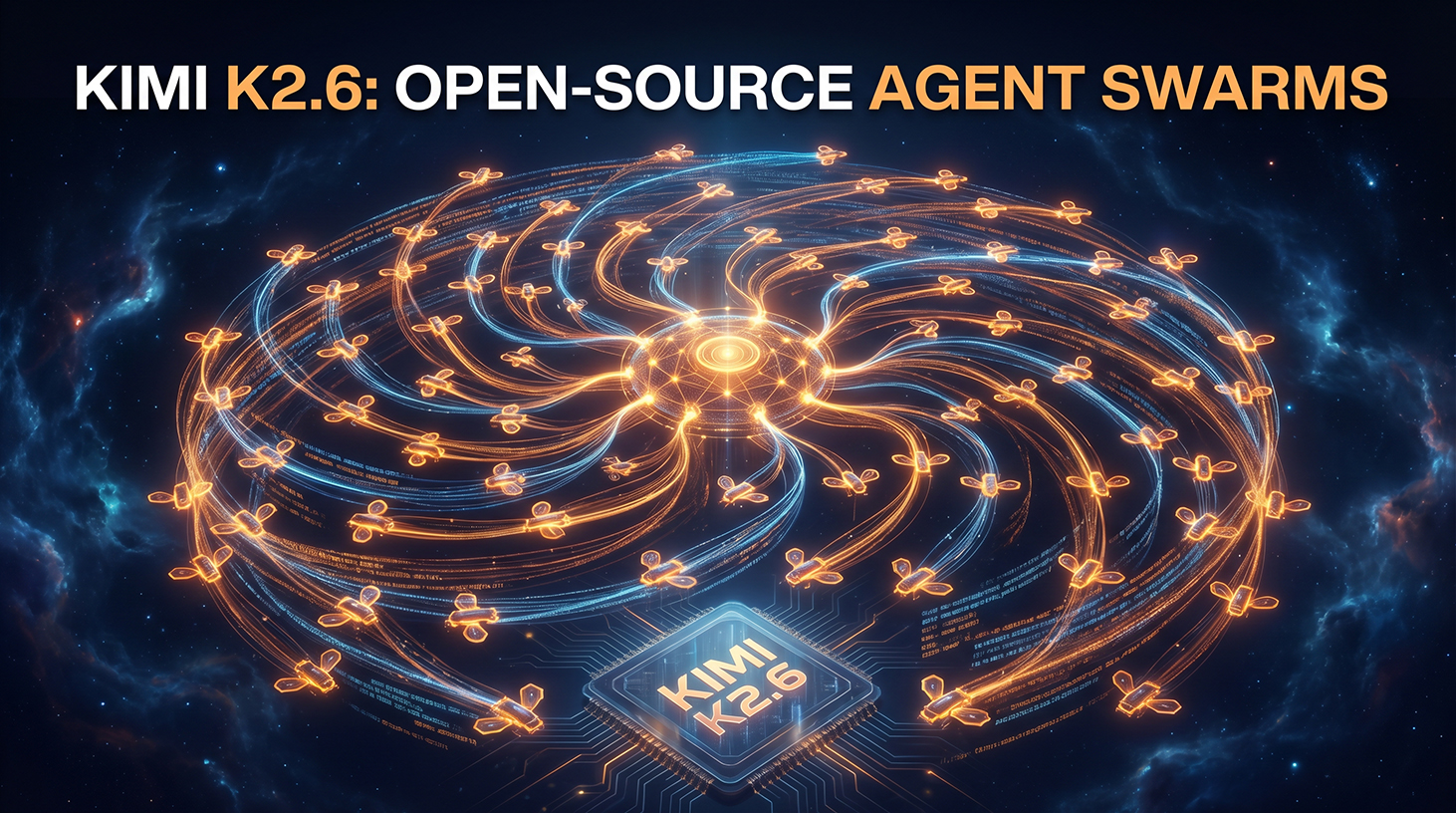
Kimi K2.6 – The AI agent swarm from China: When 300 agents think together – Image: Xpert.Digital
The end of the single prompt? Kimi K2.6 brings the ultimate AI agent swarm
1 trillion parameters, open source: How Kimi K2.6 is turning the AI world upside down
With the release of Kimi K2.6 by the Chinese AI startup Moonshot AI, the global AI industry is experiencing its next major paradigm shift. Just three months after its predecessor, the company presents an open-source flagship with a trillion parameters, which not only puts massive pressure on Western industry giants like OpenAI and Anthropic in benchmark tests but also undercuts them in terms of price. However, Kimi K2.6's true unique selling point is its revolutionary agent swarm architecture: Instead of processing requests linearly, the model delegates complex tasks to up to 300 specialized and concurrently operating sub-agents. This unprecedented orchestration capability, coupled with innovations such as cross-network "claw groups" and a learning "skills" system, marks the end of traditional prompt input. Kimi K2.6 impressively demonstrates that the future of artificial intelligence lies in autonomous, efficient, and globally accessible swarms – and China is increasingly setting the pace.
Open source, a trillion parameters, and an attack that GPT-5.5 cannot ignore
On April 20, 2026, the Chinese AI company Moonshot AI released its latest flagship model, Kimi K2.6, in a manner that is increasingly becoming the hallmark of Chinese open-source labs in the AI industry: completely open, under a commercially usable license, and with benchmark results that immediately targeted the top spots in relevant performance rankings. Within hours of the release, Moonshot AI's official social media channels recorded over four million views—an indication of the immense interest that agent-based AI architectures are now generating, even outside of academia.
Kimi K2.6 is the direct successor to K2.5, which was released in January 2026—just three months earlier. This speed of development is remarkable in itself. But the pace is explained: K2.6 is not a complete reboot. The model's architecture is identical to K2.5—Moonshot itself states in the deployment guide on Hugging Face that the K2.5 infrastructure can be reused directly. The crucial difference lies in the post-training: more training computing power for long-term stability, instruction compliance, and swarm coordination.
The technical basis: One trillion parameters, efficiently used
Kimi K2.6 is based on a native multimodal Mixture-of-Experts (MoE) architecture with a total of one trillion parameters. Only 32 billion of these are activated per token – a ratio that massively increases computational efficiency without sacrificing the knowledge depth of a large model. The model supports a context window of 256,000 tokens and processes text, images, and structured data natively – not through appended modules, but through an integrated MoonViT vision encoder that embeds visual information directly into the inference process.
The release is under a modified MIT license that largely permits commercial use and adaptation. Restrictions apply only to very large players: companies with more than 100 million monthly active users or monthly revenue exceeding $20 million must negotiate a separate license. For the vast majority of users—developers, startups, medium-sized businesses, and research institutions—this means free, commercial use of a cutting-edge model without license fees.
The agent swarm architecture as a paradigm shift
What fundamentally distinguishes Kimi K2.6 from other Frontier models of this generation is not a parameter record or a single benchmark value, but an architectural design principle: the agent swarm. K2.6 can break down a complex task into subproblems and delegate these to up to 300 specialized sub-agents acting in parallel, which can coordinate and execute up to 4,000 consecutive steps.
That's three times as many agents as its predecessor, K2.5, could coordinate. The efficiency gains from this parallelization are enormous: Moonshot states that agent swarm mode reduces end-to-end runtime by up to 80 percent compared to single-agent execution, with a real-world measured acceleration of 4.5 times through parallelization. In concrete terms: A workflow that takes 13 hours to execute with a single agent can be reduced to under three hours in swarm mode – with simultaneously improved quality through specialized subtasks.
The most well-known demonstration of this capability is the autonomous rebuild of an eight-year-old financial matching engine over 13 hours without human intervention, in which K2.6 achieved a throughput gain of 185 percent in average performance and 133 percent in peak throughput. This is not an academic scenario—it is exactly the kind of legacy code modernization that banks, insurance companies, and industrial firms typically outsource to expensive consulting teams.
Benchmark positions: At the top of the world with question marks
The benchmark results published by Moonshot AI for K2.6 position the model at the absolute top of the frontier models worldwide – at least in some relevant dimensions. On HLE-Full with Tools, one of the most demanding agent-based benchmarks in AI research, K2.6 achieves 54.0 points, surpassing GPT-5.4 (52.1), Claude Opus 4.6 (53.0), and Gemini 3.1 Pro (51.4). On SWE-Bench Pro, the standard test for real-world software engineering tasks, K2.6 achieves 58.6 percent, on LiveCodeBench (v6) 89.6 percent, and on GPQA Diamond 90.5 percent.
In the agent swarm mode on BrowseComp, a benchmark for deep web research, K2.6 achieves 86.3 points compared to 78.4 for K2.5. On DeepSearchQA, K2.6 achieves an F1 score of 92.5 compared to 78.6 for GPT-5.4—a lead of almost 14 points on a task central to research and analysis applications. On OSWorld-Verified, the test for the ability to control real-world computer interfaces, K2.6 scores 73.1 percent.
These figures – as is standard practice with all model releases – were initially generated internally. Independent replications by research groups were still pending at the time of publication. However, the values are consistent with the model's structural profile: The swarm architecture does indeed generate qualitative advantages over single models for tasks requiring parallel research, multi-stage planning, and long-term consistency – a finding also supported by independent research on multi-agent coordination.
🎯🎯🎯 Data-driven B2B industry hub as a quasi-in-house solution

The quasi-in-house solution: How Xpert.Digital closes operational gaps in B2B marketing and sales – Smart Content-Driven Business - Image: Xpert.Digital
Xpert.Digital is a data-driven B2B industry hub led by Konrad Wolfenstein . The company acts as an external, quasi-in-house solution for industrial partners, closing operational gaps in marketing, content, and sales – without requiring additional resources on the client side.
More information here:
Skills instead of prompts: How reusable modules ensure consistency in companies – What K2.6 means for cost reduction, data protection, self-hosting and Europe
Claw Groups: The Principle of the Heterogeneous Swarm
Building on the agent swarm architecture, Kimi K2.6 introduces a research preview feature called Claw Groups, which takes the concept a step further. Claw Groups allow not only the coordination of K2.6's own sub-agents, but also the assembly of an open, heterogeneous ecosystem of agents – on different devices, with different models, each with its own toolkits, memory contexts, and capabilities.
Specifically, this means that a user can bring agents from their laptop, a mobile device, and a cloud instance simultaneously into the same operational space, with K2.6 handling the coordination, routing tasks according to skills, and automatically detecting and reassigning faulty subtasks. Humans can join these swarms as full participants for review steps, corrections, or decisions requiring human judgment.
This represents a fundamental conceptual break with the classic model of AI use, where a human gives a model tasks and consumes its output. Claw Groups enable a bidirectional, collaborative interface between humans, K2.6 agents, and external third-party agents—a step toward what researchers describe as a "human-in-the-loop" agent architecture. The practical benefits for complex enterprise applications—such as in product development, research, or data analysis—are immediately apparent.
Skills: Reusable Intelligence
Another innovation that distinguishes K2.6 from pure language models is its skills system. The swarm can analyze PDF documents, spreadsheets, or presentations and create reusable skill modules that preserve the structural and stylistic properties of the source document. These skills can then be used in future workflow executions to produce consistent output—for example, automatically generating reports that conform to a company's specific format or generating code that respects the conventions of a particular project.
This capability addresses one of the central problems in the productive use of large language models: the lack of consistency between executions. If a model has to be retrained every time, which is a company's preferred format, significant prompt engineering costs and quality variation arise. A persistent skill system that captures and reuses this information significantly reduces this overhead.
Economic Implications: The Open Source Disruption Cycle
The economic significance of Kimi K2.6 extends far beyond the model itself. It is part of an accelerating pattern that has characterized the AI industry since the DeepSeek R1 moment in January 2025: cutting-edge models are being released as open source ever faster, drastically shortening the half-life of proprietary competitive advantages.
According to calculations, the Moonshot API for K2.6 is six to ten times cheaper than comparable endpoints from OpenAI and Anthropic. For startups and mid-sized companies that want to use AI productively but don't have the budget for GPT-5.5 or Claude Opus, K2.6 opens up access to frontier AI power that was previously unavailable. For enterprise customers who prefer a self-hosted solution for data privacy reasons, K2.6, with its open-weight model, offers a direct and legally sound option.
At the same time, K2.6 challenges the established pricing strategies of leading Western AI companies. If an open-source model from China achieves leading benchmark positions while being available at a fraction of the cost, OpenAI and Anthropic must sharpen their value proposition. Service-level agreements, data privacy compliance, integration ecosystems, and support quality become crucial differentiators – no longer solely raw model performance.
The orchestration question: The actual differentiating feature
From a nuanced AI industry perspective, the most interesting observation regarding Kimi K2.6 is not a benchmark score, but the conceptual shift the model represents. The era in which a single LLM call could solve complex tasks is over. The next dimension of competition is orchestration: the ability to efficiently coordinate many specialized agents, coherently synthesize their outputs, and act consistently over long periods.
K2.6 is the first world-class model to implement this orchestration capability as a native core feature—not as an add-on extension—while also being completely open source. This means that developers worldwide can study, adapt, and further develop not only the model itself, but also the swarm orchestration architecture for their specific applications.
Critical assessment: What K2.6 is not yet
Despite the enthusiasm surrounding the technical capabilities of K2.6, some critical limitations are warranted. The context window of 256,000 tokens is impressive, but less than the one million tokens supported by both DeepSeek V4 and GPT-5.5 (in certain modes). For applications requiring extremely long contexts—such as analyzing entire code repositories or large document sets—this can be a significant drawback.
The Claw Groups and the Skills system are released as a Research Preview – meaning they are not yet production-ready and may exhibit limitations in stability and performance during commercial use. Furthermore, the question of how reliably a swarm of 300 agents can be coordinated in practice over extended periods is not yet supported by sufficient real-world evidence. The impressive demo with the financial matching engine is a strong argument, but not yet systematic proof.
Geopolitics and structural change in the AI market
Kimi K2.6 is representative of a broader development: China's position in the global AI competition has fundamentally changed within just 18 months. As recently as mid-2024, the Chinese AI industry was considered technologically lagging behind US-based Frontier Labs. Today, models from DeepSeek, Moonshot AI, and other Chinese labs compete on equal footing with—and in some respects ahead of—the offerings from OpenAI, Anthropic, and Google.
This presents European companies and policymakers with a complex balancing act. The technical quality of Chinese open-source models is undeniable. At the same time, legitimate questions arise regarding data protection, intellectual property rights, and strategic dependencies when using models developed by companies under Chinese jurisdiction. Self-hosting under the MIT license significantly reduces these risks, but does not eliminate them entirely.
The speed of development—from K2.5 to K2.6 in three months, from DeepSeek V3.2 to V4 in less than a year—also demonstrates that the AI race is accelerating at a pace that poses significant challenges to traditional corporate strategies and regulatory frameworks. Kimi K2.6 is not the endpoint of this development. It is an intermediate step in a race that is only just beginning.
Consulting - Planning - Implementation

Konrad Wolfenstein
I would be happy to serve as your personal advisor.
me at wolfenstein∂xpert.digital contact
Just call me on +49 7348 4088 965 .
A new dimension of digital transformation with 'Managed AI' (Artificial Intelligence) - Platform & B2B solution | Xpert Consulting

A new dimension of digital transformation with 'Managed AI' (Artificial Intelligence) – Platform & B2B solution | Xpert Consulting - Image: Xpert.Digital
Here you will learn how your company can implement customized AI solutions quickly, securely and without high entry barriers.
A managed AI platform is your all-inclusive, worry-free solution for artificial intelligence. Instead of dealing with complex technology, expensive infrastructure, and lengthy development processes, you receive a ready-made solution tailored to your needs from a specialized partner – often within just a few days.
The key advantages at a glance:
⚡ Rapid implementation: From idea to ready-to-use application in days, not months. We deliver practical solutions that create immediate added value.
🔒 Maximum data security: Your sensitive data stays with you. We guarantee secure and compliant processing without sharing data with third parties.
💸 No financial risk: You only pay for results. High upfront investments in hardware, software, or personnel are completely eliminated.
🎯 Focus on your core business: Concentrate on what you do best. We take care of the entire technical implementation, operation, and maintenance of your AI solution.
📈 Future-proof & scalable: Your AI grows with you. We ensure continuous optimization and scalability, and flexibly adapt the models to new requirements.
More information here:









