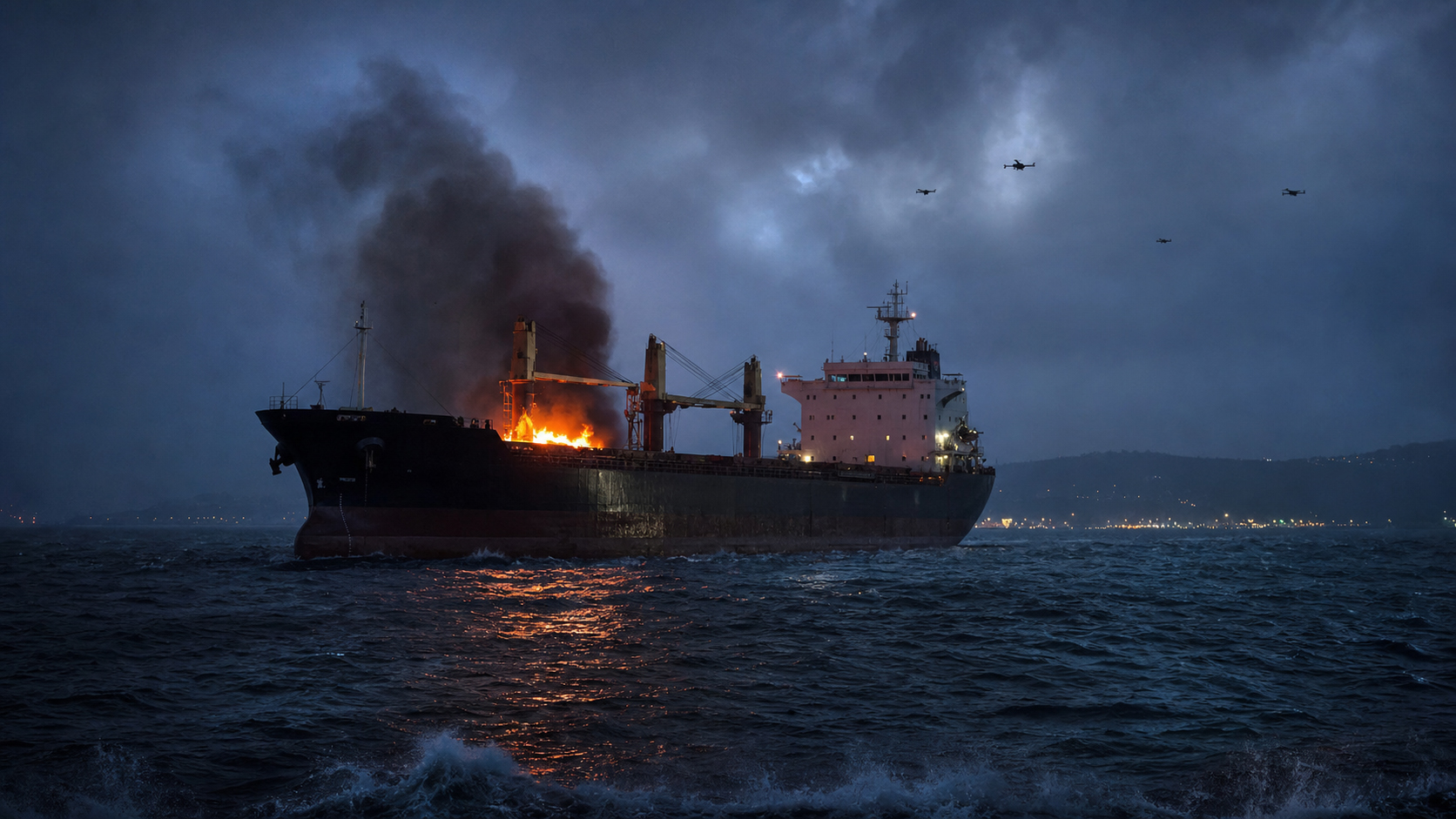
Deadly trap Black Sea? Agricultural exports in the crosshairs: The new normal in the Black Sea is spiraling out of control – Creative image on the topic, created with AI: Xpert.Digital
Why neutral freighters are now caught in the crossfire and insurance companies are on the verge of collapse: How maritime warfare threatens our grain routes
Deadly trap Black Sea: Drones on civilian ships: – The dangerous new escalation off Odessa
The war in the Black Sea has reached a new, highly dangerous dimension: Neutral merchant ships and vital grain freighters are increasingly caught in the crosshairs of both sides in the conflict. Recent attacks on international cargo vessels illustrate a worrying trend in which civilian shipping is being systematically transformed into a military battleground. The consequences are drastic: skyrocketing insurance premiums, collapsing export capacity for Ukraine, and massive shifts in the global agricultural market. With no flag offering reliable protection against drones and missiles, maritime logistics is facing a deep crisis. Read here why the geopolitical escalation in the Black Sea threatens not only regional security but also the global food supply – and why a short-term de-escalation of the situation is a distant prospect.
Black Sea under attack: When merchant shipping becomes a battleground
Between war risk premium and the collapse of neutral shipping – why no one can sail safely across the Black Sea anymore
On August 6, 2026, according to Oleh Kiper, the Ukrainian regional governor of Odessa, two cargo ships were hit south and east of the port city. One of the ships, a merchant freighter sailing under the flag of Guinea-Bissau and loaded with Ukrainian wheat, sustained hull damage; one crew member was killed and three others were injured. The Russian Ministry of Defense confirmed the attacks on the Odessa region shortly afterward, stating that it had hit two ships, but simultaneously accused Ukraine of misusing grain freighters to transport military supplies. These accusations could not be independently verified. The incident is therefore not an isolated event, but rather the latest episode in a spiral of escalation that has been building for months and has systematically transformed civilian merchant shipping in the Black Sea into a battleground.
A series of attacks as the new normal
The August incident is the latest in a long list of similar attacks that have occurred with remarkable frequency since the spring of 2026. As early as May, according to the Ukrainian Navy, three cargo ships were hit in the Odessa Black Sea region, including the "KSL Deyang," a Marshallese-flagged vessel with a Chinese crew, which was en route to load iron ore concentrate. In July, the situation escalated further: the "Golden Leo," a grain freighter sailing under the Guinea-Bissau flag with crew members from India, Syria, and Ukraine, was attacked with three cruise missiles as it was leaving the port of Odessa. Ten people were killed, including a Ukrainian pilot; eight others were rescued, two of whom were injured. Just a few days earlier, another ship, flying the flag of Antigua and Barbuda, had been hit in an attack on Odessa's port infrastructure. One person was killed in that attack.
The attacks are by no means limited to the Ukrainian side of the conflict. In early August 2026, a drone struck the Turkish Ro-Ro cargo ship "Nadezhda," which was transporting fruit and vegetables from Novorossiysk to Samsun, approximately 20 nautical miles off the Russian coast. Three of the 22 crew members were injured, and their condition was initially considered critical; a rescue operation was not possible at first due to the ongoing drone threat. Turkey reacted with marked concern and called on both Russia and Ukraine to take measures to ensure the safety of shipping in the Black Sea. This incident, too, remained officially unresolved regarding the drone's responsibility, reflecting a fundamental pattern of the entire conflict: responsibilities are rarely clearly assigned, and both sides accuse each other of attacks on civilian shipping.
The economic dimension of a maritime war
For Ukraine, agricultural exports via the Black Sea are of vital importance. Grain and vegetable oils remain the country's largest source of foreign currency, with more than 90 percent of exports handled through the three ports of the Greater Odessa region. The Ukrainian Sea Corridor, established in 2023, runs along the coast to Romania and then across the Black Sea, and has moved impressive volumes since its inception: over 200 million tons of cargo have been transported, including 118 million tons of grain, with more than 7,800 ship passages. In 2026 alone, nearly 35 million tons have already been shipped through the ports to 35 countries.
However, the increasing intensity of the attacks is resulting in concrete capacity losses. The main Ukrainian farmers' association reported in July 2026 that the country had lost around a third of its grain export capacity via the Black Sea ports. Instead of the previously possible six million tons per month, only an average of about four million tons could now be shipped – a capacity loss of around 2.5 million tons per month, leading to bottlenecks in storage and onward transport. The Ukrainian railway company registered an 11 percent decrease in grain wagons bound for Odessa in the first week of July 2026, while exports plummeted by 17 percent during the same period. The figures from the beginning of the year painted a similar picture: In January 2026, weekly export volumes were around 50 percent below the previous year's figure, with the strongest week reaching only around 571,000 tons, while comparable weeks in January 2025 recorded over 750,000 tons and sometimes over one million tons. The Ukrainian Agricultural Council put the decline in agricultural exports at the beginning of the year at 47 percent compared to the same period of the previous year.
Insurance markets as an early warning system for escalation
A particularly revealing indicator of the actual risk level in the Black Sea is the war risk insurance premiums, which are adjusted in real time by specialized brokers and insurers. Following a series of drone attacks on two Greek-managed oil tankers in January 2026, the corresponding premiums almost doubled within a single day: from around 0.6 to 0.8 percent of the ship's value at the end of December 2025 to one percent of the ship's value. This marked the highest level since the beginning of 2023, the year of the first major wave of drone attacks against tankers with close ties to Russia. Also indicative of the volatility of the situation is the fact that the review intervals for war risk policies were shortened from 48 hours to 24 hours, because the risk assessment can change so rapidly and without warning that longer commitment periods are no longer viable for insurers.
This dynamic intensified throughout 2026. Russian insurers increasingly began simply refusing to underwrite war risks for shipments in the Black and Azov Seas in the summer of 2026, as confirmed by an industry representative to a Russian business newspaper. Marine insurance premiums increased two- to fourfold in the second quarter of 2026, while the loss ratio in the reinsurance segment for terrorism, sabotage, and drone risks climbed to 2,800 percent within four months – a figure that fundamentally calls into question the economic viability of traditional insurance models for this region. According to this source, 35 tankers, freighters, and specialized vessels were attacked within a period of just 96 hours. This frequency demonstrates that these are no longer isolated incidents, but rather a systematic campaign.
Our global industry and economic expertise in business development, sales and marketing


Our global industry and economic expertise in business development, sales and marketing - Image: Xpert.Digital
Industry focus areas: B2B, digitalization (from AI to XR), mechanical engineering, logistics, renewable energies and industry
More information here:
A thematic hub offering insights and expertise:
- Knowledge platform covering global and regional economies, innovation and industry-specific trends
- A collection of analyses, insights, and background information from our key areas of focus
- A place for expertise and information on current developments in business and technology
- A hub for companies seeking information on markets, digitalization, and industry innovations
War in the Black Sea: How the new escalation threatens global grain trade
The new logic of mutual threat
The legal and strategic situation can be traced back to the summer of 2023, when Russia did not renew the so-called Black Sea Grain Agreement after approximately one year and subsequently announced that it would consider ships approaching Ukrainian ports as potential carriers of military cargo and thus as legitimate military targets. This announcement marked a break with the previously applicable international agreement, which had stipulated a security corridor through mined waters escorted by Ukrainian pilots and joint inspections of ships in Istanbul by Russian, Turkish, and Ukrainian observers. Since then, the threat level has escalated in both directions: Ukraine began systematically attacking ships of the so-called Russian shadow fleet with its own sea drones – those tankers and freighters that transport Russian oil and grain from annexed Ukrainian territories despite Western sanctions. In July 2026 alone, according to Ukrainian figures, almost 200 ships and other vessels were attacked in this manner.
Russia, in turn, increasingly shifted its focus to cargo ships en route to or from Ukrainian ports, regardless of their flag or ownership status. This mutual escalation has resulted in virtually no neutral merchant vessel being considered safe in the Black Sea, whether it is calling at Russian, Ukrainian, or third-country ports. Particularly noteworthy is the increasing blurring of the line between legitimate warfare and attacks on uninvolved third parties: in recent months, ships flying the flags of Guinea-Bissau, Panama, the Marshall Islands, Turkey, and Antigua and Barbuda, with crew members from India, Syria, Turkey, and Ukraine, have been affected. The geographical reach now extends even beyond the Black Sea to the Caspian Sea, where in July 2026, a suspected Ukrainian attack on an Iranian cargo ship left one person dead and one injured, prompting strong diplomatic protests from Tehran.
Structural shifts in global grain trade
Despite the escalating security situation, the resilience of Ukraine's export infrastructure is proving surprisingly robust in some areas. Despite all the logistical challenges, the United States still ranked Ukraine as the world's fourth-largest corn exporter and fifth-largest wheat exporter for 2025. Interestingly, transport costs for Ukrainian grain fell from 2024 to 2025 to levels comparable to those before the Russian invasion. This decline, however, was less attributable to a structural improvement in the security situation than to lower export volumes and consequently reduced utilization of logistics networks. The new sea corridor itself is causing exporters significant additional costs: while transport before the Russian invasion cost around €46 per ton, it now ranges between €64 and €73 per ton via the new corridor, although this is still considerably cheaper than alternative river routes through Europe, which are almost three times as expensive.
The global supply side presents a more nuanced picture. For the 2025/26 marketing year, Russia and Ukraine together exported 62 million tons of wheat, an increase of 5.5 percent compared to the previous year. However, this growth was solely attributable to Russia, whose exports climbed 11.6 percent to 48 million tons, while Ukrainian wheat exports declined by 11.1 percent to 14 million tons. For the current 2026/27 marketing year, the US Department of Agriculture anticipates a lower overall wheat harvest for both countries of 111.5 million tons, with Russian production estimated at 88 million tons and Ukrainian production at 23.5 million tons. This shift in relative market share in favor of Russia within the global grain supply is a direct consequence of the military attacks on Ukrainian export infrastructure and illustrates how geopolitical violence can redistribute real market share in the global food supply.
The Solidarity Lanes as an alternative route
In light of growing uncertainty on the sea route, the European Union, together with Ukraine, has developed alternative land routes, the so-called Solidarity Lanes. Since May 2022, a total of approximately 214 million tons of goods have been transported via these routes, including around 99 million tons of agricultural products and 91 million tons of grain, oilseeds, and related products. The total value of trade handled via these land corridors is estimated at around €270 billion, of which approximately €72 billion is attributable to Ukrainian exports. However, the ratio of transport routes is noteworthy: while around 60 percent of Ukrainian imports and non-agricultural exports are transported via the land corridors, approximately 85 percent of grain and oilseed exports continue to be handled via the significantly riskier sea route through the Black Sea. This dependency is simply explained by capacity and cost: bulk freighters in maritime transport can transport far larger quantities more cost-effectively than rail or road vehicles, so a complete shift to land routes would hardly be economically viable for export-dependent Ukrainian agriculture.
What the latest attack means for the future of Black Sea shipping
The attack of August 6, 2026, fits into a pattern that has been steadily intensifying for approximately three years and now affects all participants in Black Sea shipping, regardless of their flag, ownership, or route. For shipping companies, insurers, and exporters, this means a continuous reassessment of the risk profile of this trade route, reflected in structurally higher freight costs, volatile insurance premiums, and an increasing willingness on the part of some insurers to refuse to cover war risks in this region altogether. For Ukraine, the ongoing threat to its most important export route means a continued erosion of its economic base, while Russia, by simultaneously threatening neutral merchant ships, demonstrates its continued willingness to wage economic warfare at sea with military means. Furthermore, the repeated diplomatic protests from third-party states such as Turkey and Iran underscore that the conflict is no longer limited to the two warring parties but has become a security risk for all international merchant shipping in the Black Sea basin. Given the hardened military fronts and the unwillingness of both sides to refrain from targeted attacks against shipping infrastructure, a short-term easing of tensions is not currently in sight.
Your global marketing and business development partner
☑️ Our business language is English or German
☑️ NEW: Correspondence in your native language!

Konrad Wolfenstein
I and my team are happy to be available to you as your personal advisor.
You can contact me by filling out the contact form here wolfenstein@xpert.digital:or simply call me at +49 7348 4088 965. My email address is
I'm looking forward to our joint project.
☑️ SME support in strategy, consulting, planning and implementation
☑️ Creation or realignment of the digital strategy and digitization
☑️ Expansion and optimization of international sales processes
☑️ Global & Digital B2B trading platforms
☑️ Pioneer Business Development / Marketing / PR / Trade Fairs
📈🚀 From visibility to trust 👀🤝 Your scalable path with Xpert.Digital

From visibility to trust: Your scalable path with Xpert.Digital - Image: Xpert.Digital
In industrial B2B, sustainable business relationships rarely emerge overnight. They develop step by step – through visibility, professional relevance, recurring touchpoints, and growing trust. Xpert.Digital's 4-stage model addresses precisely this: It offers a structured path that begins with a manageable entry point and can evolve into deeper collaboration in business development if needed.
Instead of relying on loud marketing promises, this model puts the relationship at the forefront. Companies start with clearly defined, easily calculable measures and then decide, based on their own experience, how far they want to expand the collaboration. A key factor for this undisturbed trust-building process: The platform completely avoids annoying advertising ads, so the editorial focus remains solely on the companies' expertise.
More information here: