Germany as a pioneer | 5G campus networks instead of Wi-Fi: Why German industry is now building its own mobile communications infrastructure
Xpert pre-release

Language selection 📢
Published on: December 7, 2025 / Updated on: December 7, 2025 – Author: Konrad Wolfenstein

Germany as a pioneer | 5G campus networks instead of Wi-Fi: Why German industry is now building its own mobile communications infrastructure – Image: Xpert.Digital
Why the private 5G network is not just an upgrade, but the new operating system layer of Industry 4.0.
Cost trap or competitive advantage? The nervous system of Industry 4.0: Why private 5G networks will determine the future of production
The introduction of the 5G mobile communications standard is often perceived by the public as simply faster download speeds for smartphones. However, beyond the consumer market, a far more profound transformation is taking place: 5G is evolving into the fundamental operating system layer of modern industry. At the heart of this development are so-called campus networks – exclusive, locally limited mobile networks that offer companies independence from public providers and guaranteed performance parameters.
While conventional technologies like Wi-Fi or wired Ethernet solutions are reaching their physical limits in an increasingly flexible and automated world, private 5G networks promise a new era of connectivity. They enable millisecond latency, massive network density for the Internet of Things (IoT), and the reliability that is essential for critical machine controls. Germany occupies a unique global position in this regard: Through the strategic decision of the Federal Network Agency to reserve dedicated frequency bands for industry, the Federal Republic has become a hotspot for industrial 5G innovations.
This article offers an in-depth look at the world of private 5G infrastructure. We analyze the technological leap from 4G to today's complex standalone architectures, highlight concrete use cases ranging from autonomous logistics robots to augmented reality in maintenance, and take a critical look at the economic hurdles. The path to a private network is far from straightforward: high investment costs, complex security requirements, and the shortage of skilled workers present companies with strategic challenges. Learn why the 5G campus network is much more than a technical upgrade – and how, as a pioneer for future technologies like 6G and artificial intelligence, it secures the competitiveness of industry in the 21st century.
Suitable for:

The Foundation of Connectivity: An Introduction to the 5G Era
The introduction of the fifth generation of mobile communications marks far more than just an iterative step toward faster downloads on consumer devices. At its core, 5G represents a paradigm shift in how industrial and institutional infrastructures are networked. While its predecessor technologies were primarily geared toward the needs of human communication and mobile broadband, 5G was designed from the outset with a clear focus on machine-to-machine communication and critical industrial applications. In this context, campus networks have emerged as one of the most disruptive innovations. A 5G campus network is an exclusive, locally confined mobile network specifically tailored to the individual requirements of a company, government agency, or research institution. Unlike public mobile networks, where thousands of users share the bandwidth of a cell and compete for resources, a campus network offers guaranteed performance parameters, full data sovereignty, and a deterministic communication environment.
The relevance of this topic stems from the increasing digitalization and automation of the global economy. In an era where production facilities must become more flexible, logistics chains more transparent, and medical procedures more precise, conventional connectivity technologies such as Wi-Fi or wired Ethernet solutions are increasingly reaching their physical and economic limits. This white paper from TÜV Rheinland provides a sound basis for analyzing this technological leap. It not only illuminates the technical specifications that make 5G so superior—such as millisecond latency and massive network density—but also the specific regulatory framework in Germany that paved the way for this private infrastructure. This article will bridge the gap between the dry technical data and the strategic importance for decision-makers. We will trace the development from the first 4G trials to the highly complex standalone 5G architectures, deconstruct mechanisms such as network slicing and beamforming, and take a critical look at the economic hurdles that still stand in the way of widespread adoption. The aim is to paint a holistic picture that goes beyond mere hype and reveals the real value creation of this technology.
Suitable for:
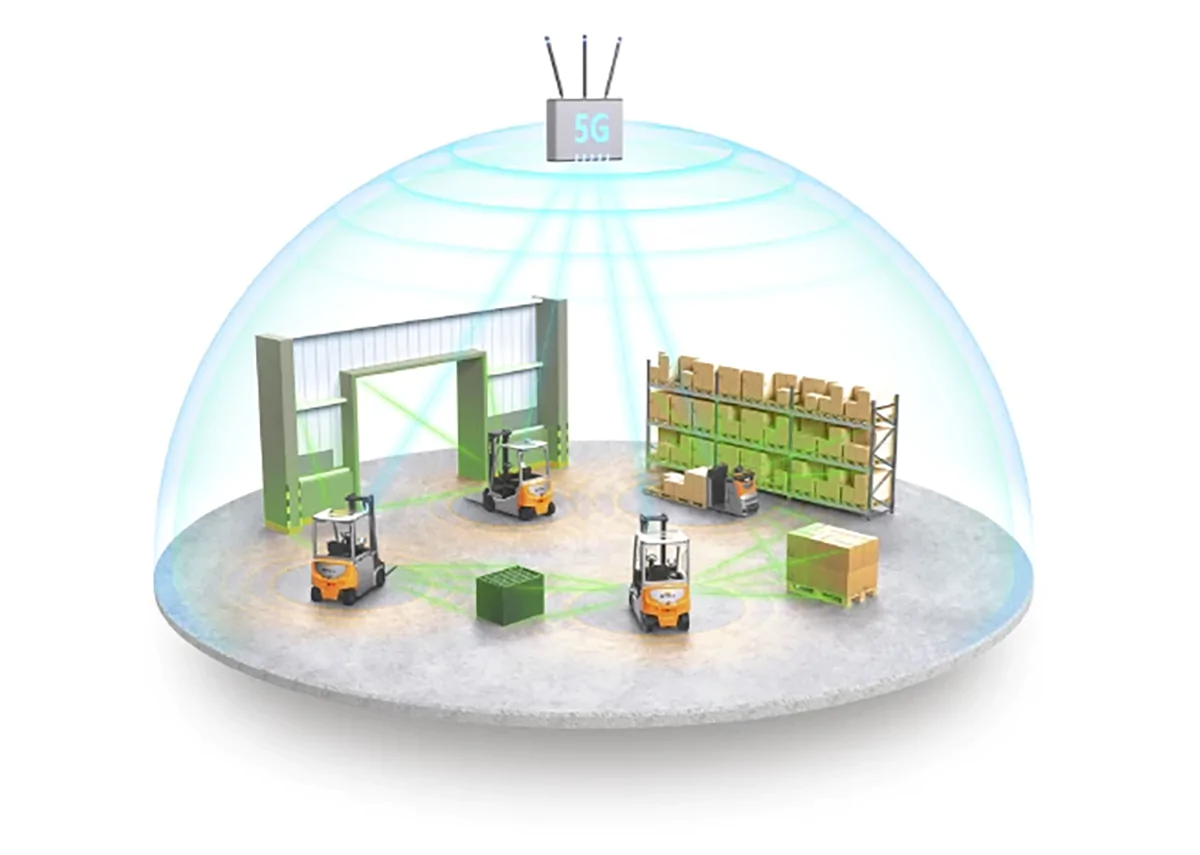
From cable to cloud: The development of private mobile networks
To fully grasp the significance of 5G campus networks today, it's essential to examine the history of wireless communication in an industrial context. For a long time, cables were the only medium capable of guaranteeing the reliability and latency necessary for industrial control processes. Wireless technologies were viewed with skepticism, as they were considered susceptible to interference and insecure. The first significant step away from cables and toward a standardized, cellular technology for private use occurred during the 4G/LTE era. Even before the official definition of 5G, pioneering companies and research institutions began building private LTE networks. However, these early installations were often complex, expensive custom builds running on modified carrier hardware and operating in regulatory gray areas or relying on test frequencies. Nevertheless, they already demonstrated the potential: better coverage than Wi-Fi, especially in challenging environments like reinforced concrete halls or container ports, and seamless vehicle mobility without the connection drops typical of Wi-Fi when switching between access points.
The real turning point came in 2015 when the International Telecommunication Union (ITU) published its vision for IMT-2020. This document defined, for the first time, quantifiable goals that went far beyond what 4G could deliver: sub-millisecond latency, data rates of up to 20 gigabits per second, and a connection density of one million devices per square kilometer. These requirements were no longer focused solely on human users but anticipated a world of the Internet of Things. In parallel, the 3rd Generation Partnership Project (3GPP), the global standards body for mobile communications, was working on the technical specifications. Release 15 saw the adoption of the first official 5G standard, laying the foundation for today's networks. However, it was only with subsequent releases, particularly Releases 16 and 17, that the features essential for industry—such as Ultra-Reliable Low-Latency Communication (uRLLC) and precise positioning—were fully specified.
In Germany, this technological evolution was accompanied by a far-sighted political decision. During preparations for the 5G frequency auction in 2019, the Federal Network Agency decided not to auction off the entire available spectrum to the major mobile network operators. Instead, it strategically reserved 100 megahertz in the 3.7 to 3.8 gigahertz range specifically for local applications. This decision, which catapulted Germany into a pioneering role internationally, enabled companies for the first time to apply for frequencies directly and operate their networks independently of the major telecommunications corporations. It marked the birth of the modern campus network as we understand it today: democratized access to high-frequency technology that reduces dependence on external providers and puts control of critical infrastructure back into the hands of users.
Under the hood: Architecture and functionality of campus networks
The technological superiority of 5G over competing standards such as WLAN (even in its modern WiFi 6 variant) or LoRaWAN is based on a number of complex mechanisms deeply embedded in the standard's architecture. To understand the campus network system, one must first distinguish between the different implementation models. On the one hand, there is the completely isolated, private network, often referred to as a Standalone Non-Public Network (SNPN). Here, the company installs both the radio access network (RAN) and the core network on its own premises. This guarantees that no sensitive data leaves the company grounds – a crucial factor for industries where industrial espionage poses a real risk. The core network acts as the brain of the operation: It manages user authentication, data packet routing, and the enforcement of quality of service (QoS) policies. Because this brain is physically located on-site, the long signal propagation times to distant data centers are eliminated, which is what makes the extremely low latencies physically possible in the first place.
An alternative model is called network slicing. Here, the company uses the physical infrastructure of a public mobile network operator but receives virtually separated resources – a slice of the network. Technologically, this is made possible by virtualization techniques such as Software-Defined Networking (SDN) and Network Function Virtualization (NFV). The operator can guarantee that the company's data traffic runs completely separate from public YouTube or Netflix traffic and is given priority. While this saves on investment costs for proprietary hardware, it means that data potentially travels through third-party infrastructure, and latency can be limited by the distance to the operator's core network.
At the radio technology level, 5G utilizes advanced techniques such as Massive MIMO and beamforming. While conventional antennas often radiate their signal broadly and indiscriminately, 5G antennas can focus the signal beam precisely on a single user or vehicle by superimposing waveforms. This not only increases the range and data rate for the specific device but also reduces interference with other nearby devices. For campus networks in metal-rich environments such as factory floors, where reflections often cause problems, this precise signal control is a tremendous advantage. Another key feature is 5G's flexible frame design. The network can dynamically decide how many resources are used for downloading or uploading. In industrial applications, where, for example, camera systems upload vast amounts of video data for quality control, the ratio can be shifted in favor of uploads—a scenario that often represents a bottleneck in traditional mobile networks, which are optimized for content consumption (downloading).
In addition, the standard differentiates between three main application profiles that can coexist in a campus network. Enhanced Mobile Broadband (eMBB) provides the raw data rate for applications such as augmented reality or 4K video streams. Massive Machine Type Communication (mMTC) enables the networking of thousands of sensors in a very small space without the network collapsing, which is essential for IoT scenarios. Finally, Ultra-Reliable Low-Latency Communication (uRLLC) is the mode for business-critical, real-time applications, such as robot control, where a lost data packet could cause physical damage. The ability to run these profiles in parallel on the same hardware makes 5G the universal toolkit of modern industry.
Our EU and Germany expertise in business development, sales and marketing

Our EU and Germany expertise in business development, sales and marketing - Image: Xpert.Digital
Industry focus: B2B, digitalization (from AI to XR), mechanical engineering, logistics, renewable energies and industry
More about it here:
A topic hub with insights and expertise:
- Knowledge platform on the global and regional economy, innovation and industry-specific trends
- Collection of analyses, impulses and background information from our focus areas
- A place for expertise and information on current developments in business and technology
- Topic hub for companies that want to learn about markets, digitalization and industry innovations
5G campus networks in Germany: Why the global pioneer is still far from the mass market
Measuring the present: Market status and adoption dynamics
The current status of 5G campus networks paints a picture of dynamic growth, but also of unevenly distributed adoption. Germany has established itself as a global hotspot for private 5G networks through the early allocation of the 3.7 to 3.8 GHz spectrum. By April 2025, the Federal Network Agency had recorded a total of 465 frequency allocations in this range. This figure is more than just a statistic; it represents hundreds of companies, universities, and hospitals that have taken the step of becoming their own network operator. The industry-specific distribution is particularly interesting. Research and development, as well as public institutions, lead the list with a share of 31 percent, closely followed by the IT and telecommunications sector with 27 percent and the metal and electrical industries with 23 percent. This suggests that we are still in a phase dominated by innovation and pilot projects, even though productive use in manufacturing is rapidly catching up.
A look beyond national borders reveals different speeds and models. While Germany relies on local licensing, other industrialized nations such as the USA, Japan, and the UK have introduced similar but subtly different models. The USA, for example, uses the CBRS (Citizens Broadband Radio Service) band with a complex system of dynamic frequency sharing, which, while flexible, is technically more demanding in terms of coordination. China, on the other hand, relies heavily on close cooperation between industry and state-owned mobile network operators, with private networks often implemented as dedicated slices of the public networks rather than directly allocating frequencies to companies. Nevertheless, Europe, led by Germany, remains the leading region with a 39 percent share of all private mobile networks worldwide, ahead of North America and the Asia-Pacific region.
Despite these successes, it must be acknowledged that the theoretical market potential is far from exhausted. Forecasts predicting thousands of networks by 2025 have proven overly optimistic. The discrepancy between the 465 licenses and the potentially tens of thousands of industrial companies in Germany demonstrates that 5G campus networks are not yet a mass-market product for small and medium-sized enterprises (SMEs). A key factor in this is the availability of end devices. While the network technology is readily available, the ecosystem of industrial-grade 5G modules, sensors, and actuators often lags behind or is prohibitively expensive for smaller companies. Furthermore, the millimeter wave band (26 GHz), which promises extremely high data rates, has so far been barely explored, with only 24 applications submitted by April 2025. This suggests technical challenges regarding range and penetration in this frequency range.
Suitable for:

Theory meets reality: Lighthouse projects and operational experience
The abstract advantages of 5G become most apparent in concrete application scenarios that demonstrate how the technology overcomes existing limitations. A classic example can be found in modern intralogistics, such as in large seaports or on sprawling factory sites. Here, automated guided vehicles (AGVs) are used to move containers or components autonomously. In the past, such systems often relied on Wi-Fi. The problem with this was the so-called handover: when a vehicle left the range of one Wi-Fi access point and connected to the next, brief connection interruptions or latency spikes often occurred. This is tolerable for a single vehicle, but for a fleet of hundreds of robots operating in a coordinated swarm, it leads to a safety risk. The vehicles have to stop, recalibrate, and the entire flow comes to a standstill. 5G campus networks solve this problem through seamless mobility management. Because the network anticipates the device's movement, the transition between radio cells occurs without interrupting the data connection. This not only enables higher vehicle speeds but also shifts the intelligence: computing power can be offloaded from the vehicle to a central edge server, making the robots lighter, cheaper, and more energy-efficient.
Another striking example comes from the manufacturing industry, often summarized under the buzzword Industry 4.0. In a modern factory, flexibility is the most valuable asset. Production lines must be able to be quickly reconfigured to respond to new product variants or fluctuating demand. Wired networking is a literal constraint in this regard. Every change to the layout requires expensive and time-consuming rewiring. 5G enables the wireless factory approach. Machines, robotic arms, and tools are connected wirelessly. This allows a production line to be completely reconfigured overnight. A specific use case is the use of augmented reality (AR) for maintenance technicians. A technician servicing a complex machine wears AR glasses that overlay construction plans and maintenance steps onto the real-time image of the machine. Since the glasses themselves must be too light to support a heavy computer, the graphics data is processed on a local server and streamed in real time via 5G. The high data rates (eMBB) ensure a sharp image, while the low latency (uRLLC) prevents the technician from experiencing motion sickness caused by head movements. Such scenarios are hardly achievable with industrial-grade quality using conventional Wi-Fi due to fluctuating bandwidth and latency.
The first transformative applications are also emerging in the healthcare sector. University hospitals are testing campus networks to enable the flexible deployment of large medical devices such as mobile MRI scanners or X-ray machines and to transmit vast amounts of image data instantly to the treating physician without overloading the hospital's Wi-Fi network. The isolation of the campus network also offers a crucial advantage in terms of data security: patient data never leaves the protected area of the hospital infrastructure, which facilitates compliance with strict data protection regulations.
Beyond the hype: Hurdles, risks and the cost trap
Despite its undeniable technical advantages, implementing a 5G campus network is not a sure thing. The downsides of this technology lie less in its performance than in its complexity and the economic barriers. For a manufacturing company, operating its own mobile network effectively means becoming a small telecommunications provider. This requires expertise that is often lacking in the traditional IT department of a medium-sized enterprise. Managing SIM cards, radio network planning, and core network configuration is fundamentally different from managing a Wi-Fi router. This leads to a new dependency on specialized integrators or managed service providers, which somewhat negates the promised independence. The shortage of skilled workers here coincides with an extremely niche market: experts with a deep understanding of both industrial automation technology (operational technology, OT) and mobile core architectures are rare and expensive.
Another critical point is cost. The initial investment (CapEx) for a private 5G network is significantly higher than for comparable Wi-Fi installations. While the license fees payable to the Federal Network Agency are often manageable—the formulas favor industrial areas over urban locations—the hardware costs for base stations and core servers are substantial. Added to this are the ongoing operating costs (OpEx) for maintenance, software updates, and security monitoring. Many companies struggle to calculate a clear return on investment (ROI) because the advantages of 5G—such as increased flexibility or reliability—are often difficult to quantify directly in euros before the damage of a failure actually occurs.
Security is also a double-edged sword. While 5G offers a higher level of security than Wi-Fi through SIM-based authentication and strong encryption, the complexity of its configuration poses risks. A misconfigured core network or insufficiently secured interfaces to external networks can provide entry points for cyberattacks. Since 5G networks often directly control the physical operation of machinery, security incidents here can result not only in data loss but also potentially in physical damage or production downtime. Furthermore, there is the risk of vendor lock-in. While initiatives like Open RAN (Radio Access Network) promise to make hardware and software from different manufacturers compatible, the reality is often still dominated by proprietary, end-to-end solutions from major network equipment providers. Once a provider has been chosen, switching is often very expensive.
Tomorrow and the day after: 6G, AI and the sensory network
Looking to the future, 5G is just the beginning of an even more profound transformation. Research is already underway on 6G, which is expected to launch around 2030. However, even the upcoming evolutionary stages of 5G (often referred to as 5G-Advanced) and the transition to 6G will radically expand the concept of the campus network. A key trend is the integration of artificial intelligence directly into the air interface. Future networks will not only transmit data but will also use AI to optimize the radio channel in real time, predict interference, and self-heal. The network will become "native AI," meaning that AI models will no longer be just an application running over the network, but an integral part of the network control itself.
Another revolutionary aspect is the integration of sensors and communication, often referred to as “Integrated Sensing and Communication” (ISAC). Future 6G networks will not only use radio waves for data transmission but will also scan their surroundings, much like radar. A campus network in a factory could then detect the location of a forklift or whether a person is entering a hazardous area, simply by analyzing the reflections of radio signals, without the need for additional sensors. The network thus becomes a sensory organ for the factory.
Technologically, convergence with Time-Sensitive Networking (TSN) is also being further advanced. This enables 5G to seamlessly merge with the wired, real-time Ethernet protocols used in industrial automation, making wireless control of even highly dynamic robot movements possible in sub-millisecond intervals without jitter. Finally, the expansion into the third dimension through Non-Terrestrial Networks (NTN), i.e., the integration of satellites, will enable campus networks even in the most remote locations—such as open-pit mines in the desert or on offshore platforms—that were previously completely cut off from the digital map.
The nervous system of industry: Why 5G campus networks are now crucial
5G campus networks are far more than just an infrastructure measure. They are a strategic enabler for the digital sovereignty and competitiveness of industry in the 21st century. Analysis has shown that the advantages in terms of reliability, latency, and data security significantly outweigh those of technological alternatives. Through the progressive regulation of the Federal Network Agency, Germany has created a favorable environment for this technology, reflected in a high number of license awards. Nevertheless, the hurdles of complexity and cost remain. Campus networks are not an off-the-shelf product but require a deliberate strategic decision and the development of new expertise.
For companies, this means that waiting is no longer a viable strategy. The learning curve for implementing this technology is steep, and organizations that gain experience now in pilot projects will have a decisive advantage in the coming era of AI-driven, fully automated production. The 5G campus network is therefore not the destination, but rather the necessary nervous system for the organism of the future economy. It transforms connectivity from a mere tool into an integral factor of production. Whoever masters this nervous system controls the pulse of their own value creation.
EU/DE Data Security | Integration of an independent and cross-data source AI platform for all business needs

Independent AI platforms as a strategic alternative for European companies - Image: Xpert.Digital
Ki-Gamechanger: The most flexible AI platform-tailor-made solutions that reduce costs, improve their decisions and increase efficiency
Independent AI platform: Integrates all relevant company data sources
- Fast AI integration: tailor-made AI solutions for companies in hours or days instead of months
- Flexible infrastructure: cloud-based or hosting in your own data center (Germany, Europe, free choice of location)
- Highest data security: Use in law firms is the safe evidence
- Use across a wide variety of company data sources
- Choice of your own or various AI models (DE, EU, USA, CN)
More about it here:
Advice - planning - implementation

Konrad Wolfenstein
I would be happy to serve as your personal advisor.
contact me under Wolfenstein ∂ Xpert.digital
call me under +49 89 674 804 (Munich)
🎯🎯🎯 Benefit from Xpert.Digital's extensive, five-fold expertise in a comprehensive service package | BD, R&D, XR, PR & Digital Visibility Optimization

Benefit from Xpert.Digital's extensive, fivefold expertise in a comprehensive service package | R&D, XR, PR & Digital Visibility Optimization - Image: Xpert.Digital
Xpert.Digital has in-depth knowledge of various industries. This allows us to develop tailor-made strategies that are tailored precisely to the requirements and challenges of your specific market segment. By continually analyzing market trends and following industry developments, we can act with foresight and offer innovative solutions. Through the combination of experience and knowledge, we generate added value and give our customers a decisive competitive advantage.
More about it here: