
Stellantis promises a €15,000 electric car – but the plan has a huge catch
Xpert Pre-Release

Available in 27 languages 📢
Prefer Xpert.Digital on GoogleⓘPublished on: May 26, 2026 / Updated on: May 26, 2026 – Author: Konrad Wolfenstein
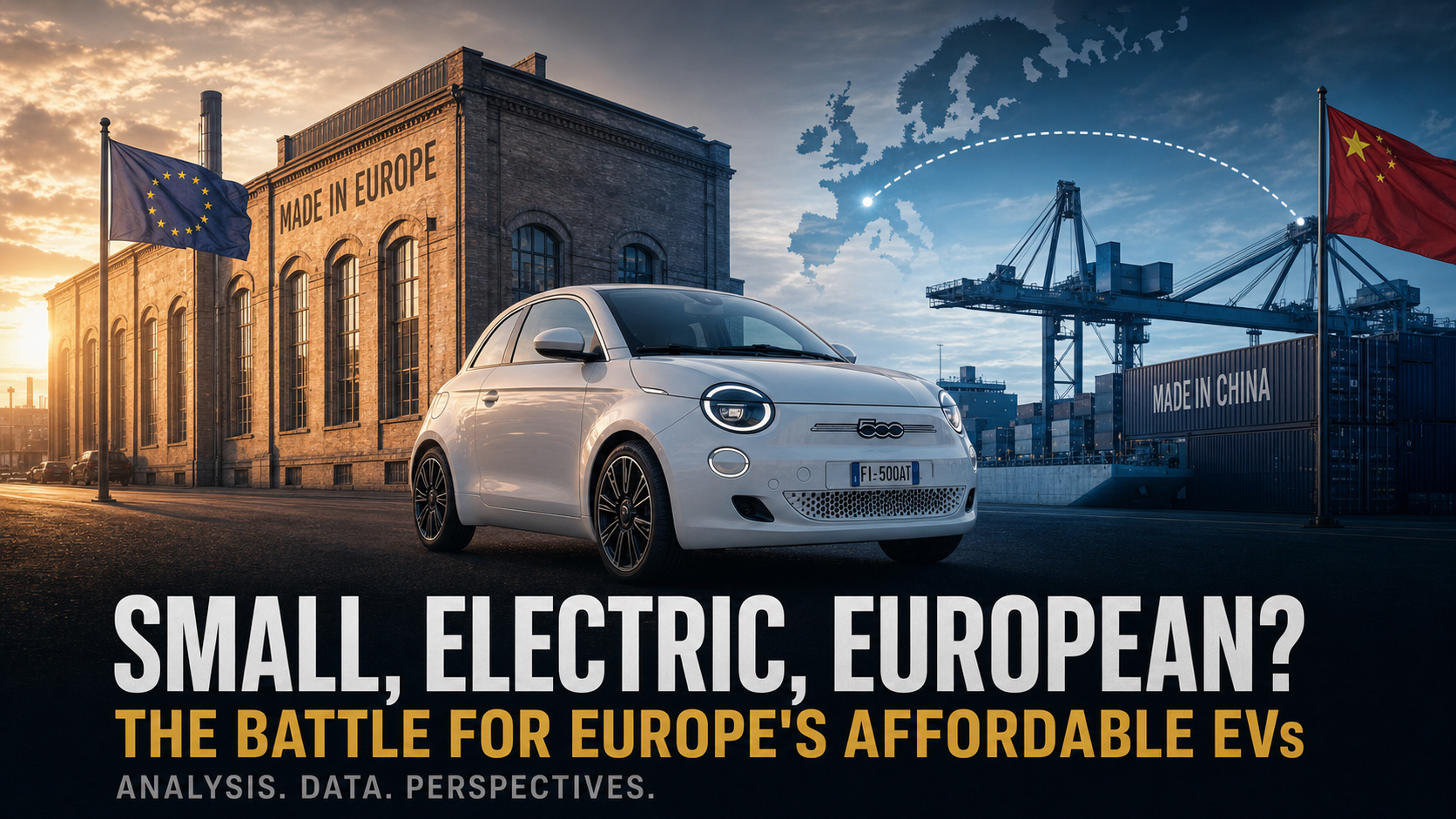
Stellantis promises a €15,000 electric car – but the plan has a huge catch – Creative image: Xpert.Digital
The secret EU trick: How the car industry is suddenly building the €15,000 car after all
The demise of the small car was a lie: Why affordable electric cars are now making a comeback
A fully-fledged European electric car for €15,000? What at first glance sounds like the long-awaited breakthrough for affordable electric mobility turns out, on closer inspection, to be a desperate catch-up attempt by an industry in crisis. For years, the European automotive industry systematically bled the once-popular small car segment dry in order to rake in record profit margins with large SUVs. But now, existential losses in the billions, unprecedented price and innovation pressure from China, and a new regulatory gimmick from the EU are forcing manufacturers to radically rethink their strategies. The Stellantis Group's example ruthlessly illustrates this: the sudden return of the affordable small car is not a visionary innovation offensive, but rather the belated repair of a self-inflicted disaster. A profound look at the true economic and political motives behind Europe's new electric car strategy.
Stellantis is one of the world's largest automotive groups (formed in 2021 from the merger of Fiat Chrysler and the French PSA Group). The group does not manufacture cars under the name "Stellantis," but rather unites 14 well-known automotive brands under its umbrella.
These can be divided regionally as follows:
- Germany & Great Britain: Opel, Vauxhall
- France: Peugeot, Citroën, DS Automobiles
- Italy: Fiat, Alfa Romeo, Lancia, Maserati, Abarth
- USA: Jeep, Chrysler, Dodge, Ram
In addition, the group manufactures light commercial vehicles and vans under the Fiat Professional brand.
How the automotive industry is selling a self-inflicted problem as an innovation offensive – and what that really means economically
A price tag of €15,000 for a European-made electric car sounds like a small revolution. In May 2026, Stellantis announced plans to begin production of a compact electric city car, codenamed "E-Car," at its Pomigliano d'Arco plant in southern Italy starting in 2028 – serving as the basis for models from several of its group brands, including Fiat, Citroën, Opel, and Peugeot. CEO Antonio Filosa described it as the answer to the "unprecedented decline in the small, affordable car segment in Europe in recent years." However, what is presented as a strategic breakthrough is, upon closer economic examination, something else entirely: a belated attempt to repair self-inflicted damage, driven by regulatory pressure and Chinese competition.
The systematic hemorrhaging of the small car segment
The small car segment is not a victim of the market, but rather a victim of deliberate corporate strategies. Between 2019 and 2023, sales of small cars in Germany plummeted from 230,000 to 110,000 vehicles. At the same time, the number of models offered nearly halved – from 19 to just ten. The ADAC (German Automobile Club) calculated that in 2025, buyers would have to pay an average of over €25,000 for a new small car – more than 80 percent more than in 2013. For a segment that historically represented an entry point into individual mobility, this constitutes a structural devaluation.
The reasons are obvious: small cars simply don't generate enough profit margins for manufacturers. The production and development costs for larger vehicles are more profitable relative to the achievable sales price. Almost one in three newly registered cars in Germany is now an SUV, while only one in ten is a small car. The industry drew the logical conclusion rigorously: Ford Ka, Ford Fiesta, Opel Karl, Opel Adam, Citroën C1, Peugeot 108, Smart Fortwo, Škoda Citigo, Seat Mii, Renault Twingo – they are all history. Particularly symbolic: the Fiat Punto, once the epitome of the affordable family car, was discontinued. Not because of a lack of demand, but because the profit demands of corporate headquarters required it.
Manufacturers regularly attributed the demise of small cars to rising development costs for the Euro 6 emissions standard and complex safety technology. This is true – but it's only half the story. Because, in parallel, those very small cars that remained on the market were consistently made more expensive. A Mini cost an average of €12,750 in 2019, but four years later, the price had risen to €18,400. The industry didn't abandon the segment primarily due to unprofitability; it deliberately pushed prices upwards to extract premium margins from a brand niche that is essentially a volume market.
Stellantis: A corporation in an existential crisis
The announcement of the €15,000 electric car comes at a time of deep crisis for the Stellantis Group. The company posted a loss of €22.3 billion for the full year 2025 – the second-largest loss ever reported by a French conglomerate. Despite a slight increase in vehicle sales, revenue fell by two percent to €153.5 billion. Stellantis had already recorded a net loss of €2.3 billion in the first half of 2025, compared to a profit of €5.6 billion in the same period of the previous year. Operating profit, adjusted for special items, collapsed from €8.5 billion to just €540 million in the first half of the year – a decline of 94 percent.
Former CEO Carlos Tavares had focused for years on high-margin, expensive vehicles and systematically neglected the entry-level segment. This strategy backfired: Stellantis could no longer sell its large SUVs and pickup trucks in North America at the usual prices, while cheaper competitors gained market share in Europe. Tavares had to leave in 2024. His successor, Filosa, announced a realignment, stating that the company needed to be "repositioned so that customers can freely choose from the full range of electric, hybrid, and combustion engine technologies." The electric car project, therefore, is not an expression of strategic foresight, but rather a crisis response from a corporation that had backed the wrong horse for too long.
Furthermore, there is another admission: Stellantis had to write off 22 billion euros because, according to the company, it had "significantly overestimated" the demand for electric cars. In this context, the announcement of an affordable small electric car seems doubly contradictory – initially too much electric technology was promised, now too little affordable product was offered.
EU regulation as a driving force: The M1E vehicle category
Behind Stellantis' announcement lies a regulatory mechanism without which the project would hardly be economically viable: the EU's planned M1E vehicle category. This is a new subcategory of the existing M1 passenger car class, encompassing purely electric vehicles up to 4.20 meters in length, which must be produced exclusively in the EU. Formal adoption was expected by mid-2026, with implementation beginning in 2027.
The decisive economic lever: Vehicles in the M1E class are counted 1.3 times, instead of the usual 1.0 factor, when calculating manufacturers' fleet CO2 emissions. This corresponds to a regulatory advantage of 30 percent in achieving CO2 compliance targets. A manufacturer who is currently hitting their fleet limits can effectively offset more CO2 emissions in other segments by selling an M1E vehicle. To ensure planning certainty, the requirements for this class are to be frozen for ten years.
The concept is loosely based on Japanese Kei cars, a vehicle class established in the 1950s for particularly small, lightweight, and affordable city cars with strict government regulations regarding size, engine displacement, and power. The crucial difference is twofold: First, the M1E comprises exclusively electric vehicles, no combustion engine vehicles. Second, its maximum length of 4.20 meters is significantly higher than the Japanese Kei car limit of 3.40 meters. Therefore, the M1E is not a European equivalent to a Kei car, but rather a compact electric car with regulatory privileges.
For consumers, little changes with this category: M1E vehicles are treated like normal passenger cars, require a Class B driving license, are subject to regular EU type approval, and are classified for insurance purposes like any other passenger car. The category does not create new user rights, but primarily new incentives for manufacturers.
Why now in particular: Chinese pressure as the actual catalyst
The decisive driving force behind the return of European manufacturers to the small car segment is not coming from Brussels or from the corporate headquarters in Turin, Amsterdam, or Stuttgart. It is coming from Shanghai, Hangzhou, and Shenzhen. In 2025, Chinese automakers supplied around 60 percent of the world's electric cars. Over 60 percent of vehicles produced in China were already electric, while EU manufacturers only achieved an EV share of around 17 percent. Chinese exports of electric cars doubled in 2025 to a record high of over 2.5 million units.
The cheapest electric car on the European market, the Dacia Spring, is produced in China and was at times available for under €12,000 with the electric vehicle incentive. This is not a European model, but a Renault Group car with Chinese roots. The M1E regulation explicitly excludes vehicles produced outside the EU – meaning the Dacia Spring, the Hyundai Inster, and the Mini Cooper are ineligible for subsidies. This is no coincidence: The EU is building protectionist barriers around the small car segment, just as it previously imposed tariffs on Chinese electric cars.
The irony is considerable: Stellantis itself has entered into extensive collaborations with Chinese partners to implement its more affordable electric vehicle strategy. The Opel brand is developing a new electric SUV together with the Chinese manufacturer Leapmotor, which is scheduled to be built at the Stellantis plant in Zaragoza starting in the summer of 2028. Stellantis holds a 51 percent stake in the joint venture Leapmotor International, which produces European vehicles using Chinese technology. Stellantis has not yet confirmed whether the technology partner for the new electric car project is also of Chinese origin – however, industry observers consider it highly likely.
The price promise: Realistic or wishful thinking?
€15,000 for a fully-fledged European electric car – at first glance, that sounds like an attractive offer. On closer inspection, however, it raises significant questions. The currently cheapest European-produced small electric car, the Fiat 500e, is priced considerably above this threshold. According to industry experts, reaching the €15,000 to €20,000 price range would require significant relaxation of regulatory requirements.
This is precisely the crux of the contradiction: European manufacturers discontinued small cars for years, arguing that increasing safety and emissions regulations made them unprofitable. Now, the same regulatory environment, through targeted exemptions and simplifications within the M1E class, is suddenly supposed to enable a €15,000 electric car. The industry is thus demanding regulatory relief to fulfill a price promise it had previously ruled out, citing precisely this regulatory burden.
The cost structure remains challenging. Batteries – the biggest cost driver for electric vehicles – are still largely dominated by Chinese manufacturers like CATL, which controls over 80 percent of global battery cell production. A European-produced vehicle without access to these cost-effective supply chains must offset these costs through scaling, simplified equipment, and regulatory relief. Whether this will be successful by 2028, and whether the €15,000 price point can actually be maintained, remains to be seen. For context: Even the Dacia Spring, the cheapest mass-produced electric car in Europe, cost from around €11,900 after manufacturer incentives at the end of 2025 – and it is manufactured in China.
Our EU and German expertise in business development, sales and marketing

Our EU and German expertise in business development, sales and marketing - Image: Xpert.Digital
Industry focus areas: B2B, digitalization (from AI to XR), mechanical engineering, logistics, renewable energies and industry
More information here:
A thematic hub offering insights and expertise:
- Knowledge platform covering global and regional economies, innovation and industry-specific trends
- A collection of analyses, insights, and background information from our key areas of focus
- A place for expertise and information on current developments in business and technology
- A hub for companies seeking information on markets, digitalization, and industry innovations
Who will save the €15,000 electric car? Europe's answer to Chinese price pressure
The timing problem: Too late, too slow, too cautious
2028 isn't just around the corner. It's a very long production lead time for a market undergoing historically accelerated change. The VW Group plans to launch several electric city cars as early as 2026 – the Cupra Raval, the VW ID. Polo, the VW ID. Cross, and the Skoda Epiq, all produced in Spain. Renault is planning the new electric Twingo, which should be available from the end of 2026. The competition is moving, while Stellantis is announcing a launch date two full years in the future.
This is structurally typical for a corporation that has relied too heavily on its premium strategy for too long and now has to catch up. As early as 2025, the Stellantis CEO and the Renault CEO jointly sounded the alarm, demanding EU reforms for the small car segment, as otherwise factory closures in Europe would be inevitable. The fact that the industry responded two years later with projects for 2028 demonstrates the extent of this structural inertia.
Furthermore, the branding issue remains complex: Under which group brands the electric car project will be sold is not yet fully defined. Stellantis speaks of "exciting new models for multiple brands," which suggests a shared platform strategy for Fiat, Citroën, Opel, and Peugeot. This platform strategy makes sense for cost reduction but carries the risk of brand dilution: If the same small car is sold as a Fiat, Opel, and Citroën, distinguished only by badges and minimal design variations, the question arises as to the genuine added value of each brand.
The regulatory repair shop: When the state does what the market didn't
The M1E vehicle category and its associated super credits are a prime example of regulatory repair work. The market failed—not because there was a lack of demand for affordable small cars, but because manufacturers prioritized profit margins over customer benefits. Now, regulation is stepping in to act as a corrective, creating artificial incentives to close a gap that the market was unwilling to fill on its own.
From an economic perspective, this is a classic case of market failure followed by government intervention. The problem is that this intervention indirectly burdens taxpayers, as government subsidies, tax breaks, and CO2 compliance benefits cover the actual costs that the manufacturer was unwilling to bear in the free market. Renault and Stellantis are effectively receiving regulatory rewards for finally doing what they could and should have been doing for years.
The EU explicitly justifies the M1E category with the goal of making fleet-wide CO2 targets achievable while simultaneously increasing the affordability of electric vehicles. This is understandable. However, it ignores the fact that the same EU, through strict safety and emissions regulations, has significantly contributed to making small cars structurally uneconomical. The exemptions for M1E vehicles from certain obligations are effectively an admission that the existing regulatory framework has placed an undue burden on the small car segment.
Geopolitical dimension: Europe between protection and dependence
The M1E regulation clearly exhibits protectionist characteristics. The requirement that vehicles must be produced in the EU to receive the supercredits is a direct instrument for shielding European manufacturers from Chinese competition. This is politically understandable, but not without economic risk.
First, protectionism distorts competition. If European manufacturers are not competitive through efficiency and innovation, but rather through regulatory privileges, the underlying problem—a lack of competitiveness—is not solved, but merely postponed. Second, despite the obligation to produce locally, the European automotive industry is deeply dependent on Chinese supply chains: battery cells largely come from China, and technology partnerships like the one between Opel and Leapmotor ultimately rely on Chinese development resources. The car is assembled in Europe, but is often developed in China and equipped with Chinese components.
Thirdly, the tariffs imposed by the EU on Chinese electric cars represent a doubling of protection – combined with the M1E super credits, this constitutes a comprehensive support scheme for the domestic industry. The consequence for consumers: they pay more than necessary during a transitional phase because cheaper Chinese alternatives are made more expensive by the tariffs. Whether this aligns with the actual objective – affordable electric mobility for all – remains questionable.
What's really at stake: Social mobility and climate policy
Behind the economic policy debate about margins, regulation, and competition lies a social issue of considerable consequence. Access to a new car has become increasingly expensive for broad segments of the population in Europe for years. According to the ADAC (German Automobile Club), only four car models are currently available on the German market for under €15,000. Those with limited funds buy a used car – often old, inefficient, and polluting – or forgo a vehicle altogether. Both options are problematic from a socio-political perspective.
The small car segment is crucial from a climate policy perspective. Fleet-wide CO2 regulations work statistically: manufacturers who sell many small, fuel-efficient vehicles can simultaneously offset larger vehicles with higher emissions. If the lower market segment is ignored, this logic reverses, and achieving climate targets becomes more expensive or slower. The M1E-Class is therefore not only a matter of competition policy, but also an instrument of climate policy.
The irony lies in the timing: In the 1990s and 2000s, the small car segment in Europe was thriving – the Fiat Punto, the VW Polo, the Ford Fiesta, the Peugeot 206 were mass-produced and yet profitable. The segment wasn't destroyed by external forces, but by internal manufacturer decisions, coupled with a regulatory framework that favored size and complexity. Now, with Chinese manufacturers proving that affordable, fully-fledged electric vehicles are possible – albeit under different production conditions – Europe is suddenly rediscovering the small car segment.
Pomigliano production site: symbol and reality
The Pomigliano d'Arco plant in Campania is more than just a production site – it's a political symbol. The region is one of the weakest economically in Italy, and the plant is a major employer. Currently, the Fiat Panda and the Alfa Romeo Tonale are produced there. The hybrid version of the Fiat Panda is slated to continue production there until 2030, alongside the planned electric car starting in 2028.
Stellantis has sent a political signal with its location decision – precisely at a time when the Italian government had leveled massive criticism at the company for its withdrawal from the country and the neglect of its Italian plants. The electric car project is thus becoming a tool for industrial policy communication: an affordable electric car for Europe, built in an economically disadvantaged region of Italy, by a company facing heavy losses, as a reaction to Chinese price pressure and EU regulations. This is not a clear strategic vision, but rather the compression of several simultaneous crises into a single announcement.
Whether the announced "significant volumes" at the Pomigliano plant will ever be realized depends on factors that are currently unpredictable: How will the market for small electric cars develop between 2026 and 2028? Will the M1E-Class be approved and implemented as planned? Can the price point of €15,000 actually be maintained? How strongly will VW respond with its own small cars? And how aggressive will the Chinese competition remain?
Market structure 2026: Who is fighting for the segment?
The small electric car segment is set to become one of the most competitive fields in the European automotive industry by 2026. The VW Group is positioning itself with four new models – the Cupra Raval, VW ID. Polo, VW ID. Cross, and Skoda Epiq – all announced for 2026 and all produced in Spain. Renault is launching the new Twingo. Citroën already has the ë-C3 on the market. Fiat sells the 500e. And Dacia offers the Spring as the most affordable option, which, despite being produced in China, is extremely popular with private customers in Europe.
The segment will therefore be more densely populated in 2026 and 2027 than ever before – precisely at the moment when the M1E regulation provides the necessary incentives. This is strategically advantageous for consumers, but structurally risky for each individual supplier, who depend on sufficient volume to recoup development costs. VW has a BEV market share of 28 percent in Europe, by far the strongest starting position. Stellantis is struggling with a tarnished image and a time lag of at least two years compared to its strongest competitors.
The VW Group had already predicted in 2025 that the market for all-electric small cars in Europe would be roughly four times larger after 2030 than it was at that time. This is the real strategic game: whoever dominates the segment by 2030 secures a market position that is crucial for the entire electric transformation. Stellantis needs to catch up, not lead.
Conclusion: Between new beginnings and coming to terms with the past
Stellantis' €15,000 electric car is realistically feasible, supported by sensible regulations, and desirable from an industrial policy perspective. What it is not, however, is proof of the strategic foresight of the European automotive industry. It is the result of years of failure—on the part of the market, regulation, and corporate strategists—now being corrected by the combined pressure of Chinese competition and European regulation.
The economic analysis reveals an industry that, in the past, prioritized short-term profits through margin maintenance over market presence, and is now confronted with the consequences, reacting under the pressure of several crises simultaneously: weak sales, losses in the billions, China's technological lead, and EU climate targets. The political fix of M1E super-credits and tariffs buys time – but it doesn't resolve the structural competitive weakness that arose when the mass-market car was abandoned.
Those who celebrate the 2028 electric car project are right to celebrate the progress. But they shouldn't forget why the journey was so long. And they should ask whether Europe will still be able to produce affordable electric vehicles when the subsidies and super-credits eventually run out.
🎯🎯🎯 Data-driven B2B industry hub as a quasi-in-house solution

The quasi-in-house solution: How Xpert.Digital closes operational gaps in B2B marketing and sales – Smart Content-Driven Business - Image: Xpert.Digital
Xpert.Digital is a data-driven B2B industry hub led by Konrad Wolfenstein . The company acts as an external, quasi-in-house solution for industrial partners, closing operational gaps in marketing, content, and sales – without requiring additional resources on the client side.
More information here:
Your global marketing and business development partner
☑️ Our business language is English or German
☑️ NEW: Correspondence in your native language!

Konrad Wolfenstein
I and my team are happy to be available to you as your personal advisor.
You can contact me by filling out the contact form here simply call me at +49 7348 4088 965. My email address is [email protected]:or
I'm looking forward to our joint project.










