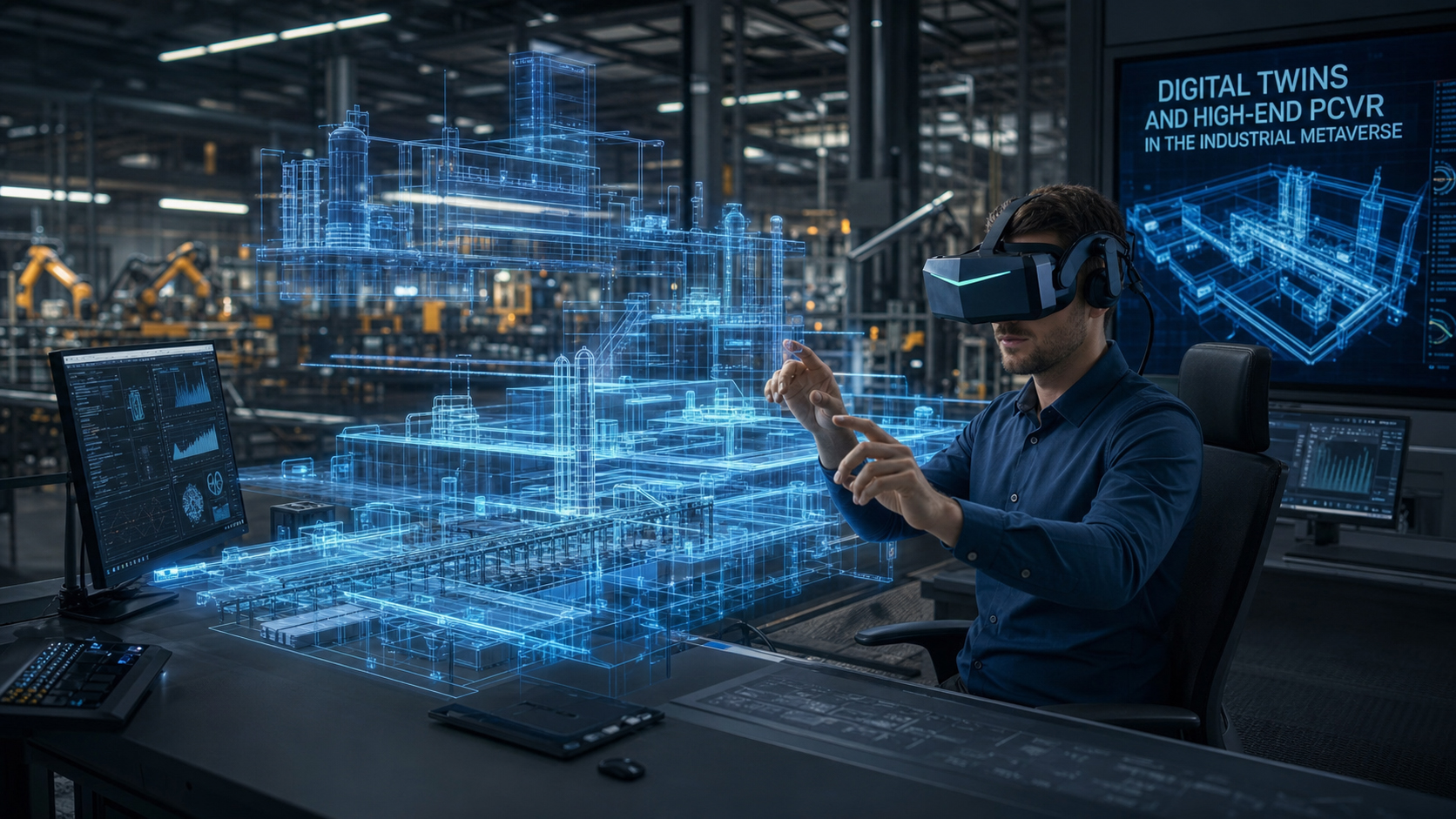
When the factory becomes a virtual stage: Why wired high-performance VR could become the backbone of Industry 4.0 – Image: Xpert.Digital
End of the standalone hype? Billions of polygons: Why self-contained VR headsets are failing in modern industry
The cable's comeback: Why Industry 4.0 relies on high-end VR for true digital twins
The public debate surrounding virtual reality is currently dominated almost exclusively by lightweight, wireless, standalone headsets for the mass market. However, behind the scenes of Industry 4.0, a remarkable counter-trend is emerging: When it comes to simulating entire factories, machines, and manufacturing processes as photorealistic digital twins, mobile processors are overwhelmed by the sheer volume of data. Billions of polygons, coupled with live, real-time production data, demand uncompromising computing power. Led by industry giants like Siemens and NVIDIA, industrial companies are therefore increasingly turning to high-performance, wired VR systems. New tools like the "Digital Twin Composer" and impressive cost savings achieved by pioneers like PepsiCo demonstrate that virtual pre-validation of factories is becoming the new gold standard – because virtual failure ultimately translates into millions saved on real-world construction.
Related to this:

Millions of dollars' worth of data need a cable, not compromises
The public perception of virtual reality is largely dominated by lightweight, standalone consumer headsets that function wirelessly and without an external computer. However, this image falls short for industrial applications, particularly for visualizing digital twins of entire factories. A complete digital twin of a production plant consists of billions of polygons linked to live data from manufacturing execution systems, quality management systems, programmable logic controllers (PLCs), and industrial IoT sensors. This volume of data simply cannot be processed in real time and with photorealistic quality using the mobile chipsets of today's standalone headsets. Therefore, professional applications are increasingly returning to wired, workstation-based VR systems.
This development is gaining further momentum right now because Siemens, one of Europe's largest industrial groups, unveiled the Digital Twin Composer at CES 2026 in Las Vegas. This tool aims to bridge the gap between technical plant data and immersive, photorealistic visualization. The software combines two- and three-dimensional digital twin data with real-time information from physical plants and transforms it into photorealistic three-dimensional environments based on NVIDIA Omniverse graphics libraries. The tool is slated to be available via the Siemens Xcelerator marketplace from mid-2026, which is of immediate strategic relevance to European industrial companies.
A German automation company conquers the American tech stage
What was remarkable about CES 2026 was its symbolic starting point: This year, the keynote address at the world's largest technology trade show was not given by an American Silicon Valley company, but by Roland Busch, CEO of Siemens Germany. He contextualized the deepened partnership with graphics chip manufacturer NVIDIA across several thematic areas, including faster chip and circuit board design, the new tool for digital twins, and the transition from pure planning to actual operation, illustrated by Siemens' own electronics plant in Erlangen. This plant is intended to serve as a reference example of how fully AI-driven, adaptive manufacturing can be implemented in industrial practice.
Siemens describes the Digital Twin Composer itself as the primary product launch of its trade fair presentation. The software is designed not to remain a static model, but to continuously update during operation, allowing technicians to plan interventions, analyze root causes, or virtually test variants before any employee even physically approaches the system. For chip manufacturer NVIDIA, the partnership is a key component of its so-called Physical AI strategy, with which the company is positioning itself not only as a hardware and AI platform provider, but also increasingly as a physics-based simulation layer for industrial applications in general.
PepsiCo as a blueprint: What the digital twin really saves
Particularly revealing for the economic evaluation of this technology is its ongoing use at PepsiCo, one of the first major users of the new system. The beverage and food company is using the Digital Twin Composer in conjunction with NVIDIA Omniverse to replicate every machine, conveyor belt, pallet route, and operator path with physical accuracy. Based on this, AI agents can simulate, test, and refine system changes before a single physical modification is made.
The key performance indicators (KPIs) published by Siemens and NVIDIA from this field trial are economically remarkable. Around ninety percent of potential problems arising from physical modifications can already be identified in the virtual model. Initial design implementations resulted in a twenty percent increase in throughput, while design validation was performed almost entirely—nearly one hundred percent—in the virtual environment. Furthermore, capital expenditures were reduced by ten to fifteen percent because hidden capacities were uncovered and investments were validated virtually before capital was tied up. These figures provide, for the first time, solid business evidence that immersive digital twin technology makes sense not only technically, but also financially.
The anatomy of a walk-in twin: Why standalone glasses reach their limits
To understand the technological necessity of wired, high-performance systems, it's worth considering the sheer data load generated by an industrial digital twin. While a simple product model for a consumer good manages with a few million polygons, the digital twin of an entire automotive factory or a chip manufacturing plant comprises billions of polygons, enriched with textured surfaces, physically accurate material properties, and dynamic data streams from manufacturing execution systems and programmable logic controllers (PLCs). A mobile chipset, such as those used in standalone consumer and enterprise headsets, like the Snapdragon XR processors in current Pico models, is simply not designed for computational loads of this magnitude.
Enterprise headsets like the Pico 4 Ultra Enterprise series offer solid performance for many business applications with approximately 2160 x 2160 pixels per eye and a field of view of about 105 degrees. However, they reach their processing limits with complex, data-intensive factory simulations. In contrast, headsets like the Finnish Varjo XR-4 are explicitly positioned as PC-based solutions: With a resolution of 3840 x 3744 pixels, an extended field of view of 120 x 105 degrees, and a mandatory DisplayPort connection to a high-performance workstation graphics card, it delivers the uncompressed image quality required for professional engineering applications. This dependence on external computing power is not a technological step backward, but a conscious decision in favor of zero latency and visual fidelity, which is essential for decision-making processes based on digital twins.
Related to this:
Between hype correction and structural maturity: The market for digital twins
Market figures for digital twins and the industrial metaverse paint a picture that oscillates between unabated growth optimism and emerging disillusionment. Different market research institutes arrive at sometimes significantly different figures depending on their definition of the market, reflecting the still nascent and methodologically inconsistent categorization of this technology segment. One estimate projects the global market for digital twins to reach approximately US$39.75 billion in 2026, with a growth rate of 32.4 percent per year until 2030, while another study assumes a starting value of US$30.54 billion in 2026 and growth to US$80.65 billion by 2032, with an annual growth rate of 17.2 percent. The broader market for the industrial metaverse as a whole is even estimated by one analysis to be worth 45.7 billion US dollars in 2026, with a prospect of 543 billion US dollars by the early 2030s.
These discrepancies are not coincidental, but rather reflect a market still in its definition phase. At the same time, critical voices are growing louder within the established product lifecycle management (PLM) software industry. At the CIMdata industry conference 2026, it was reported that while the global PLM market grew by 8.7 percent to US$87.3 billion, it fell short of its own forecast, and that 55 percent of the surveyed companies now believe that traditional PLM has passed its peak, compared to only 22 percent the previous year. This suggests that investment dynamics are shifting from traditional lifecycle management tools to new, AI-powered, and immersive visualization layers, such as those represented by the Digital Twin Composer.
The economic core: Why virtual failure is cheaper than real failure
The key business mechanism justifying investment in photorealistic, walk-through digital twins lies in the drastic shift in costs from physical to virtual troubleshooting. In traditional plant design, design flaws, unfavorable material flows, or ergonomic problems are often only discovered during commissioning or even during operation, when corrections are already associated with significant downtime, retrofitting costs, and production losses.
If, however, an error is identified in the scaled, physically accurate virtual model, only the costs of one simulation iteration are incurred. (Note: Here, the word "Production failures," which was fragmented by the shortcodes in the original, has been meaningfully reassembled to maintain readability and functionality.)
This logic can be compared to the classic cost of defects rule from quality management, according to which the cost of correcting a defect increases by an order of magnitude with each process stage that a defect passes through undetected. Applied to plant design, this means that a design flaw discovered in the digital twin stage may incur only a fraction of the costs that would be incurred if discovered after groundbreaking or even after commissioning. PepsiCo's reported identification of ninety percent of potential problems before any physical change is precisely this leverage effect in measurable form.
🎯🏢🥽 Enterprise XR Solution Hub for B2B projects – from digital twins to customized extended reality solutions

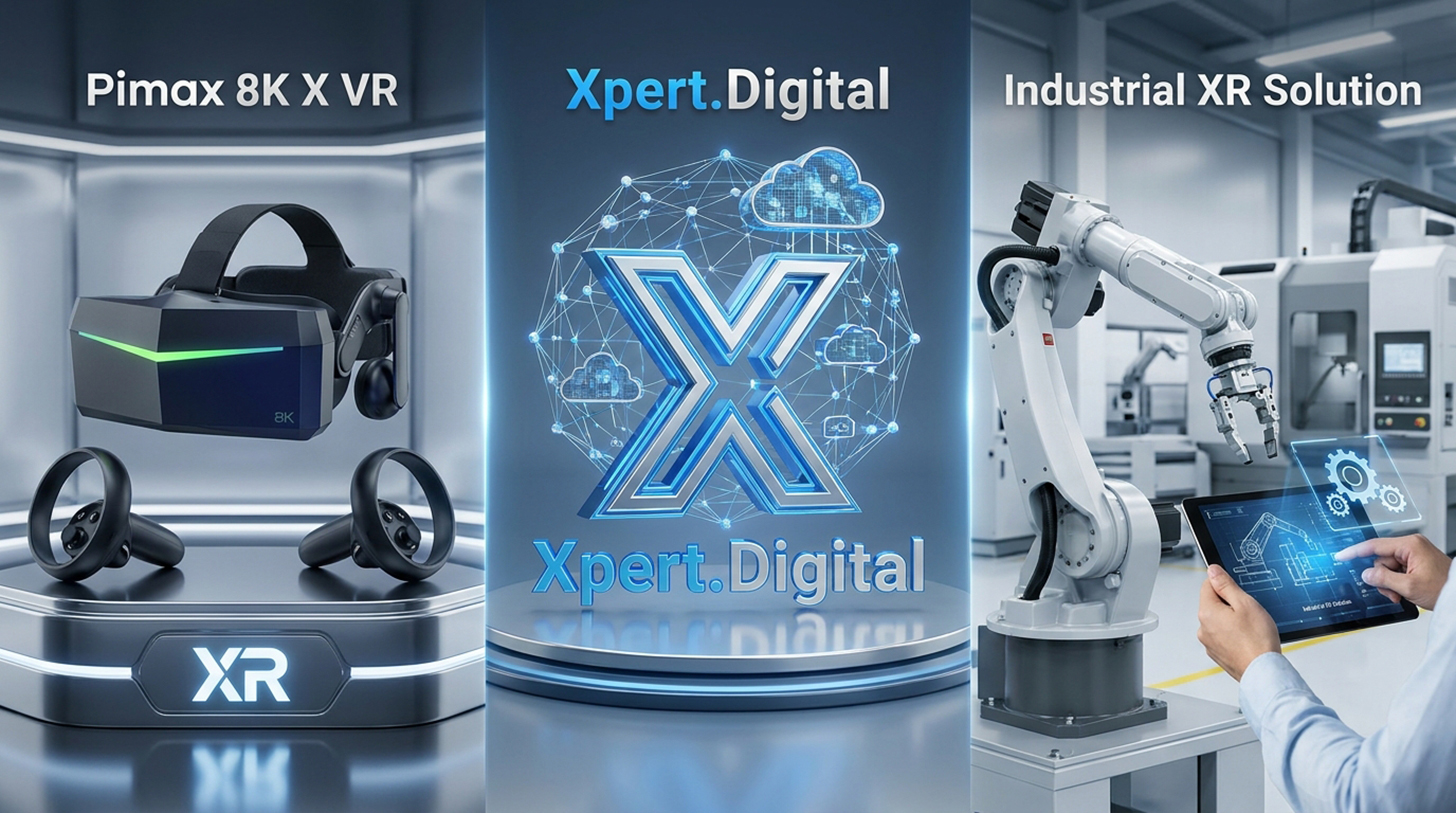
Enterprise XR Solution Hub for B2B projects – from digital twins to customized mixed reality solutions – Image: Xpert.Digital
Xpert.Digital acts as a holistic Enterprise XR Solution Hub, seamlessly integrating high-performance Pimax hardware into industrial B2B workflows. From digital twin analysis in engineering ("top floor") to immersive training on the production floor ("shop floor"), companies receive a customized, comprehensive solution including strategic consulting and support.
More information here:
Why digital twins only become economically valuable through 3D visualization
The visualization layer as a strategic bottleneck
An often overlooked aspect of the digital twin debate is that the mere existence of simulation data alone does not generate economic value. Value only arises when human decision-makers—engineers, plant managers, investors, or board members—can intuitively understand this data and translate it into actionable decisions. A two-dimensional CAD model on a screen or a tabular overview of sensor data does not convey a spatial understanding of traffic flow, collision risks, or ergonomic bottlenecks in a factory hall. This is precisely where immersive visualization comes in, restoring the spatial intuition that is lost in traditional two-dimensional planning.
This insight explains why Siemens positions the Digital Twin Composer not as an isolated simulation tool, but explicitly as a bridge between design, engineering, and operation, creating a continuous digital thread across the entire lifecycle of a product or plant. NVIDIA manager Rev Lebaredian put it this way: companies will be able to validate their entire lifecycle, from product development to factory logistics, in the virtual world before a single physical component is moved. This statement marks a conceptual break with previous practice, where simulation and real-world commissioning were largely separate, sequential process steps.
Related to this:

Competitive landscape: Who else is vying for twin supremacy?
Siemens is far from the only player vying for dominance in digital twin visualization. The PLM software market as a whole, which serves as the methodological foundation for many digital twin applications, is estimated by various surveys to be worth between US$27.88 billion and US$50.17 billion this year, with expected growth rates of approximately 7.6 to 8.1 percent annually. Besides Siemens, key competitors include Dassault Systèmes, PTC, Autodesk, SAP, Hexagon, and Bentley Systems, all of which pursue their own strategies for integrating real-time data, artificial intelligence, and immersive visualization into their respective platforms.
The following overview categorizes key market indicators, illustrating the magnitudes and methodological range.
| Market segment | Market size 2026 | Forecast horizon | Annual growth rate |
|---|---|---|---|
| Digital twins (broadly defined) | approximately USD 39.75 billion | 2030 | approximately 32.4 percent |
| Digital twins (in a narrower sense) | approximately USD 30.54 billion | 2032 | approximately 17.2 percent |
| Industrial metaverse global | approximately USD 45.7 billion | early 2030s | well into double digits |
| PLM software global | USD 36.8 to 50.17 billion | 2031 to 2033 | approximately 7.6 to 8.1 percent |
This range shows that investors and strategic planners must factor in considerable methodological uncertainty when assessing this market, while at the same time a robust structural growth trend is evident across almost all surveys.
The hardware question: Between convenience and image quality
On a technical level, a clear bifurcation can currently be observed in the professional VR hardware market. On the one hand, there are mobile, standalone enterprise headsets that offer high flexibility and low setup complexity due to their wireless design, but whose image quality and data capacity are limited by the processing power of mobile chipsets. On the other hand, there are wired systems connected to powerful workstation graphics processors, which, while less convenient to use, deliver the photorealistic, latency-free rendering required for displaying complex digital twin environments.
Interestingly, voices in specialist forums and industry discussions are increasingly arguing that pure standalone VR has now reached its technical and economic limits because the computing power necessary for true visual immersion is hardly achievable economically on mobile devices anymore. At the same time, techniques such as eye-tracking-based foveated rendering, in which only the area of the image focused by the eye is calculated at full resolution, could enable new efficiency gains without having to forgo the computing power of an external workstation. For companies investing in digital twin visualization, this means in practice that the choice of hardware is not a one-time purchase, but a strategic decision with implications for integration effort, user experience, and long-term scalability.
Target groups and application scenarios in practice
The primary beneficiaries of this technology combination can be clearly identified: factory planners who need to validate complete plant layouts before construction; those responsible for product lifecycle management who require seamless digital connections from design to operation; users of the Siemens Xcelerator ecosystem who have already invested in the corresponding software landscape; and automotive manufacturers, whose production complexity and product variety particularly benefit from virtual pre-validation. Siemens itself cites specific use cases including the execution of comprehensive simulations and virtual commissioning of entire factories, the training of autonomous robots in so-called dark factories without human presence, and the visualization and simulation of systems in buildings and properties.
It is also noteworthy that Siemens explicitly positions the Digital Twin Composer not only for new plants, but also for the modernization of existing plants, so-called brownfield sites. This significantly expands the addressable market, since the vast majority of industrial plants worldwide are not new buildings, but rather historically grown, technologically heterogeneous existing structures whose digitalization presents considerably more complex integration challenges than the "greenfield" construction of a new factory.
Opportunities, risks and a reasoned assessment
The economic logic behind wired, high-performance VR as a visualization layer for industrial digital twins appears convincing based on the available evidence, particularly given the efficiency gains reported by PepsiCo in fault identification, throughput increase, and capital tied up in inventory. At the same time, caution is advised against uncritically generalizing these early success stories, as they are reference cases communicated by the companies involved, and their reproducibility in other industry contexts and company sizes has not yet been independently verified. Furthermore, the concurrent disillusionment in the traditional PLM market, where over half of the surveyed experts consider the current approach to have reached its limits, suggests that the real value driver no longer lies solely in the software architecture, but increasingly in the combination of artificial intelligence, real-time data, and immersive visualization.
This presents a twofold strategic opportunity for European, and especially German, industrial companies. Firstly, Siemens, a domestic corporation, is positioning itself at the technological forefront of this development, which could create integration advantages for suppliers and users already established within the Xcelerator ecosystem. Secondly, the sheer data complexity of modern digital twin applications is forcing a return to high-performance, wired hardware infrastructure, opening up new growth prospects for established workstation and graphics card manufacturers as well as specialized VR hardware providers like the Finnish company Varjo, even as the broader consumer VR market is trending towards lighter, standalone devices. The next two to three years will be crucial in determining whether the Digital Twin Composer and comparable offerings from competitors will evolve from flagship projects of individual large corporations into an industry-wide standard tool for industrial planning.
Your global marketing and business development partner
☑️ Our business language is English or German
☑️ NEW: Correspondence in your native language!

Konrad Wolfenstein
I and my team are happy to be available to you as your personal advisor.
You can contact me by filling out the contact form here wolfenstein@xpert.digital:or simply call me at +49 7348 4088 965. My email address is
I'm looking forward to our joint project.
☑️ SME support in strategy, consulting, planning and implementation
☑️ Creation or realignment of the digital strategy and digitization
☑️ Expansion and optimization of international sales processes
☑️ Global & Digital B2B trading platforms
☑️ Pioneer Business Development / Marketing / PR / Trade Fairs
🎯🎯🎯 Data-driven B2B industry hub as a quasi-in-house solution


The quasi-in-house solution: How Xpert.Digital closes operational gaps in B2B marketing and sales – Smart Content-Driven Business - Image: Xpert.Digital
Xpert.Digital is a data-driven B2B industry hub led by Konrad Wolfenstein . The company acts as an external, quasi-in-house solution for industrial partners, closing operational gaps in marketing, content, and sales – without requiring additional resources on the client side.
More information here: