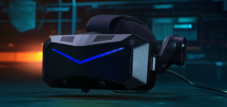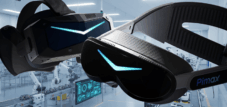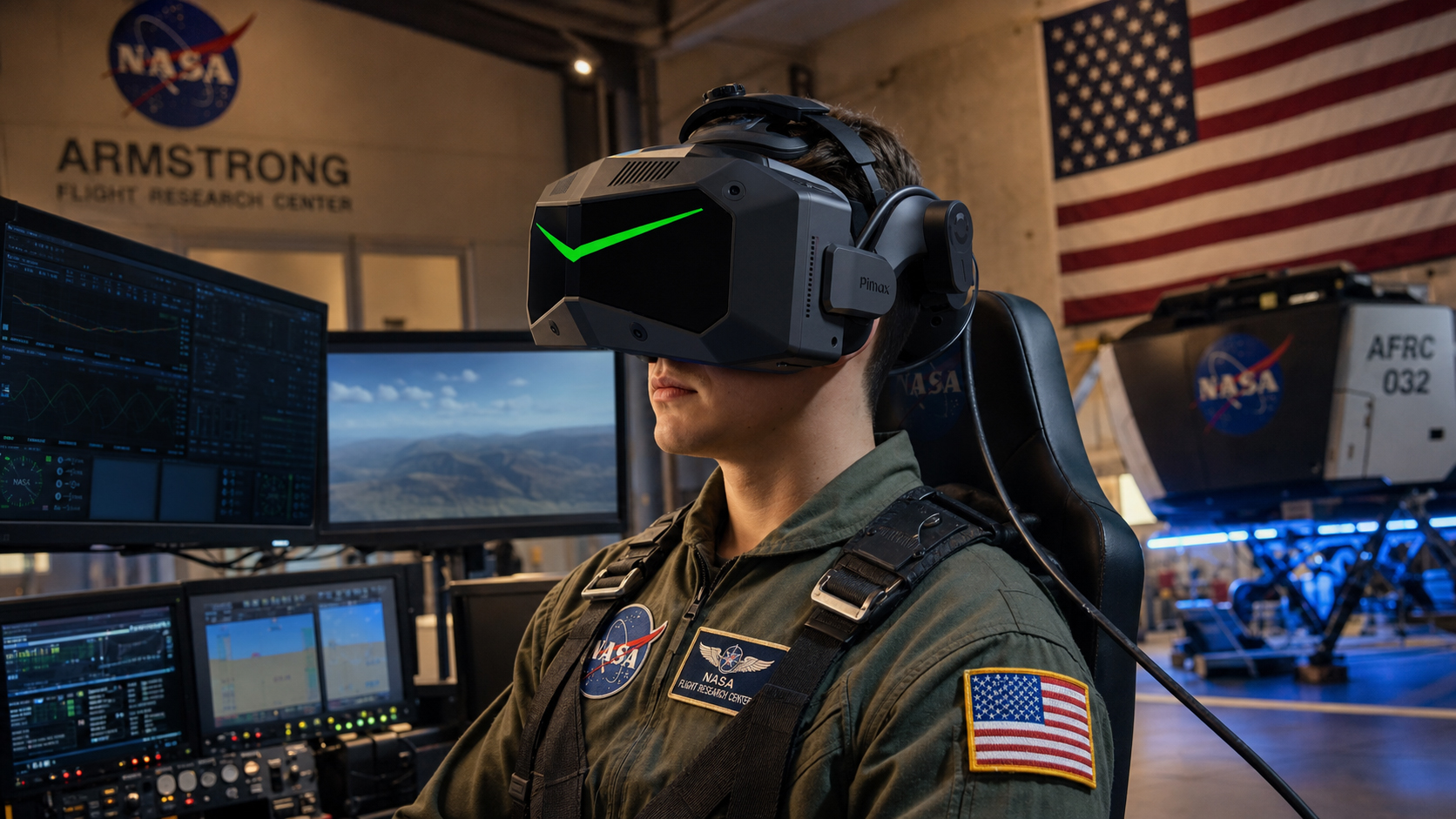
When NASA "secretly" deploys PIMAX: Forget standalone VR – Why industry professionals are swearing by cables again – Creative image: Xpert.Digital
57 PPD for the perfect flight: The headset trusted by NASA and Microsoft
No pixels, just sharpness: The VR system that prevents costly design flaws in the industry
When the glossy brochure isn't enough: How a "niche" headset conquers the Enterprise world
In the world of virtual reality, glossy marketing, high-profile partnerships, and the convenience of wireless standalone devices often dominate the headlines. But when it comes to the highest precision in industry, complex flight simulations, or space exploration, the reality is fundamentally different. When the renowned NASA Armstrong Flight Research Center recently procured VR headsets for a large-scale event, the agency eschewed PR campaigns and sponsorship deals. Instead, it simply purchased the best system on the market: wired PCVR from Pimax.
This seemingly insignificant process reveals a profound shift in the enterprise VR market. It demonstrates that in highly professional applications—from troubleshooting heavy machinery to design review at automotive companies—image quality, extreme pixel density, and zero latency are non-negotiable. While many companies fall into a "deployment paradox" and opt for low-resolution systems out of sheer convenience, practical experience shows a clear trend: Those seeking measurable error prevention and a genuine return on investment (ROI) cannot avoid the performance limits of modern PC-based systems. The following analysis illuminates why, in demanding B2B scenarios, the cable is not an obstacle but rather a guarantee of reliability—and how the darling of simulation enthusiasts has become a serious, industrially validated reference platform.
Related to this:

The silent revolution of industrial virtual reality: Why quality demands a cable
Those who need quality don't wait for the glossy brochure
The procurement logic of institutions with high technical requirements exhibits a peculiar decision-making quality: if a system is good enough, you simply buy it. No briefing, no partnership agreement, no PR campaign with promises of flagship projects. You go to the market, choose the best available tool, and buy it. That is precisely what NASA's Armstrong Flight Research Center did—and in doing so, unintentionally, delivered a verdict on wired PCVR that no marketing budget could have bought.
The NASA Armstrong Flight Research Center in Edwards, California, is the institution named after Neil Armstrong, whose core mission is the research of unique research aircraft and the development of flight testing methods. Every year, the center hosts a "Bring Your Kids to Work Day," during which over 400 young people visit the research center, don flight suits, and experience flight simulations using professional VR equipment. As part of this event, the Pimax Business Portal reported that the VR headsets used for the flight simulation were from Pimax, and this procurement was carried out entirely independently by NASA—without any prior contact with Pimax, without a cooperation agreement, and without any marketing arrangements. NASA simply purchased on the open market and chose Pimax.
This fact is less significant than an official partnership, but as a sign of trust, it's greater than any official press release. It highlights the core argument this text aims to develop: Wired PCVR – and Pimax as its technologically leading provider – is no longer just a niche product for simulation enthusiasts in the professional sector. It's the tool that demanding institutions choose when it matters most.
The space agency's silent verdict: What NASA's procurement means
Independent procurement as the highest form of product validation
In the enterprise VR market, it's common practice for manufacturers to arrange flagship projects with high-profile clients: structured pilot projects with accompanying support, reduced rates, and mutual communication benefits. These collaborations have their value, but they don't constitute independent quality assessments. They are sales events. It's fundamentally different when an institution like NASA's Armstrong Center conducts its own market research, identifies a vendor, and makes a purchase—and the first thing the vendor learns about it is through NASA's public announcement on social media.
NASA shared photos of the event, commenting that these young people might have just witnessed the next generation of aerospace pioneers. This post became the source of information for Pimax itself. Thus, NASA, unintentionally, carried out one of the most effective forms of institutional product validation possible in a B2B context: a quiet, independent choice by an institution with the highest technical standards, without any commercial bias.
The NASA Armstrong acquisition is also symptomatic of a broader quality standard the center sets for visualization technology. The center is actively researching the use of VR and AR for complex flight tests and pilot training and has developed technology programs that combine AR cockpit displays with inward-facing VR cameras. The institution's requirement: if a headset is used for visualization research or training, it must be the best technically available. A simple consumer standalone headset would have sufficed if the focus had been solely on the experience. The decision to use Pimax—a wired PCVR system with significantly higher image quality—demonstrates that the benchmark was different.
The technical reason why Pimax was the right choice in this context
Flight simulation places the highest demands on VR hardware in the consumer market, demands that translate directly into professional requirements. Pilots – both real and simulated – must read instrument displays in the virtual cockpit, judge horizons at a distance, perceive peripheral movements, and maintain spatial orientation under information overload. All of this requires image quality far exceeding that of standard standalone headsets. The Pimax Crystal Super delivers 57 PPD (pixels per degree) at a resolution of 3,840 × 3,840 pixels per eye. This is more than double the pixel density of current top-of-the-line standalone devices, which offer approximately 20 to 25 PPD.
The technical consequence is immediately noticeable: In a cockpit equipped with a Pimax Crystal Super, a pilot can see the altimeter needle sharply without turning their head. They can perceive a horizontal runway at a distance as a sharply defined line, not a blurry edge. The Crystal Super's Micro-OLED display uses Sony Micro-OLED panels, employing Retina-level display technology that delivers image sharpness that remains consistently high across approximately 70 to 80 percent of the field of view, even in the peripheral vision. For a training device in an aerospace research facility, this is the difference between a learning tool and a toy.
From gaming enthusiast market to industrial reference platform
Why the best proof of professionalism comes from the leisure market
Pimax has built its reputation within a community that occupies the most unusual position in the global VR market: simulation enthusiasts – flight simulator pilots in DCS World, Microsoft Flight Simulator, or IL-2, racing simulation drivers in iRacing, Assetto Corsa, or Le Mans Ultimate – are the most demanding hardware testers the market knows. These users spend hours in virtual cockpits, know every technical parameter of their headsets, and formulate quality judgments with a precision that many institutional purchasers cannot replicate.
The Pimax Crystal Super is unanimously considered the benchmark device in this community. Reviews characterize its image quality as the best ever achieved in a consumer VR headset – clear cockpit instruments at any distance, no visible pixel structure, natural color reproduction thanks to QLED technology and local dimming. Anyone flying a DCS World fighter jet cockpit with the Pimax Crystal Super will see the cannon hit indicators on the HUD just as sharply as the mountain contours on the horizon – and that's precisely the quality standard that an aerospace agency demands of a training device.
This cross-qualification from the enthusiast market to professional use is no coincidence. It's structural: Flight simulation is the consumer use case most closely related to professional avionics training. The headset that's good enough for a simulation enthusiast in Germany to spend their hours in DCS at the highest quality level is the same headset that's the right choice for a STEM training context at NASA's Armstrong Center.
Microsoft as an institutional bridge to the enterprise world
The most prominent public recognition of Pimax quality in a professional context came in the fall of 2024, when Microsoft selected Pimax as the official VR hardware partner for Microsoft Flight Simulator 2024. At the simulation's global preview event in September 2024 in Tusayan, Arizona, the Pimax Crystal Light was the headset of choice for all invited journalists and content creators. This decision wasn't sponsored product placement in the sense that Microsoft simply chose the highest bidder—it was a technical recommendation. Microsoft needed a headset that could truly reproduce the visual qualities of its high-resolution flight simulator scenario, and Pimax was the only provider on the market that met this requirement at a reasonable price.
The partnership between Pimax and Microsoft Flight Simulator 2024 is significant from a B2B perspective because it solidifies the technological bridge between consumer gaming and professional aviation applications. Pimax has expanded this bridge with its own pilot proficiency program and emphasizes that the quality of flight simulation with Pimax headsets can make a real contribution to pilot training – from private pilots to professional training scenarios.
The Pimax Enterprise Case Library: Validations from five industrial domains
Automotive, rail and heavy machinery maintenance: When global industry chooses
The Pimax Business Enterprise Case Library documents, in addition to the NASA-Armstrong context, a number of other industrial use cases that confirm the quality argument for wired PCVR from various perspectives. Volkswagen and Mercedes-Benz use Pimax headsets for vehicle design reviews and industrial design processes. Deutsche Bahn employs the technology for training and simulation scenarios in the rail transport sector. These customers are not pilot projects or experimental trials—they represent VR applications deeply integrated into operational processes at companies that are measured against precise quality standards and reliable results.
In the industrial training sector, the case study library demonstrates a complete, high-resolution VR training system for heavy machinery maintenance and repair. Machine operators practice fault diagnosis, disassembly, and inspection of complex hydraulic, mechanical, and electronic systems in precisely simulated 3D environments—tasks where every misperceived detail can lead to errors with significant economic consequences in real-world situations. A training device that displays components blurred or with distorted colors in the simulation trains false perceptual expectations. This is not a theoretical risk, but a documented problem in industrial training research.
In the field of cultural tourism, the Cologne TimeRide project illustrates what wired PCVR quality can achieve beyond the industrial sphere: Visitors experience Cologne's city center of 1926 in an immersive reconstruction that combines spatial sound and wind effects with high-resolution visualization. The qualitative credibility of this experience depends directly on the image quality – cobblestones from 1926 must have a different texture than modern asphalt, and a historicist facade must be able to display its intricate ornamental details. Wired PCVR hardware meets these requirements, not a current-generation standalone system.
STEM education and the next generation of skilled workers
The NASA Armstrong event has a dimension that extends beyond technical product validation: it demonstrates the role high-resolution VR technology can play in training the next generation of aerospace professionals. Over 400 young people experienced flight simulations with Pimax headsets in a single day, wearing flight suits. NASA commented that they may have just encountered the next generation of pioneers. This statement is far more than mere rhetoric—it describes the potential that high-quality VR educational experiences have for early career decisions.
STEM (Science, Technology, Engineering, Mathematics) education in many countries struggles with a motivation problem: abstract concepts are taught abstractly, and students' access to the physical world of research and industry is limited. VR can remove this barrier—but only if the experience is compelling enough to truly stimulate engagement. A blurry, latency-prone VR experience with a low-resolution standalone headset teaches children that VR is inadequate. A sharp, precise, immersive experience with high-resolution PCVR teaches them that the technology can be transformative. This is an educational difference that is well-documented in learning research.
The structural problem: Why wired PCVR is underrepresented in the enterprise market
The deployment paradox of the convenient solution
Despite its compelling quality arguments, wired PCVR is systematically underrepresented in enterprise VR deployments. The reason lies not in the technology itself, but in purchasing logic: Standalone headsets are easier to procure, easier to deploy, and easier to integrate into mobile device management (MDM) systems. A purchasing manager acquiring 50 VR headsets for a training program will choose MetaQuest Business or Pico Business because these systems come with full MDM certifications, fleet management software, and established sales channels. Pimax has historically not built a comparable institutional sales infrastructure.
The paradox is that this convenient deployment strategy produces a systematic undersupply of quality for a significant proportion of industrial VR applications. A maintenance technician learning to assess a weld using a standalone headset with 22 PPD sees something fundamentally different in the simulation than in reality. A design engineer using low-resolution hardware to check the mountability of a housing cover in a design review of an industrial fan simply cannot identify issues in VR that would be immediately apparent in the physical model. The savings from procuring a less expensive standalone headset can quickly turn into additional costs for subsequent error correction.
Five requirement classes in which the cable has no room for negotiation
Wired PCVR isn't the right hardware for all enterprise scenarios. For scalable training, standardized onboarding programs, and mobile training sessions, standalone remains the most economically viable choice. However, there are five clearly definable requirement categories where wired PCVR is categorically superior and standalone hardware structurally fails:
The first category is pixel-density-dependent quality assessment. Whenever the quality of a decision—whether a component is sound, whether a weld meets a standard, whether an architectural material has the right appearance—depends on the visual sharpness of the judgment, low pixel density poses a productivity risk. With 57 PPD in the Pimax Crystal Super, instruments, textures, and structures can be perceived with a sharpness that standalone headsets with 20 to 25 PPD cannot reproduce.
The second class is latency-critical simulation. Flight simulation, surgical simulation, driving simulation, and any application that trains precise timing and motor synchronization requires a latency below the human perception threshold of approximately 20 milliseconds. Wired connections provide this latency consistently. Wireless systems vary depending on network infrastructure and interference.
The third class is continuous, uninterrupted operation. Eight-hour design reviews, multi-day training sessions, all-day trade fair demonstrations – anywhere battery management would pose an operational problem, the cable completely eliminates this issue. In this context, the cable connection is not a limitation, but an operational advantage.
The fourth class is high-precision interaction. Outside-in tracking with SteamVR Lighthouse base stations, optionally available for the Pimax Crystal series, achieves sub-millimeter precision in position tracking and remains robust during rapid movements and extreme angles. This tracking quality is a mandatory technical requirement for surgical training simulators, assembly instructions with precise hand positioning, or quality control simulations.
The fifth class is professional software deep integration. CAD-native VR viewers, Autodesk VRED for automotive design, Siemens NX for mechanical engineering design reviews, NVIDIA Omniverse for digital twins – all these systems are primarily designed for PCVR infrastructure. The native OpenXR pipeline of a wired PCVR system enables graphics card utilization without the compression layers that are unavoidable with wireless streaming. This is the technical reason why professional visualization software is optimized for PCVR and has limited functionality on standalone hardware.
🎯🏢🥽 Enterprise XR Solution Hub for B2B projects – from digital twins to customized extended reality solutions

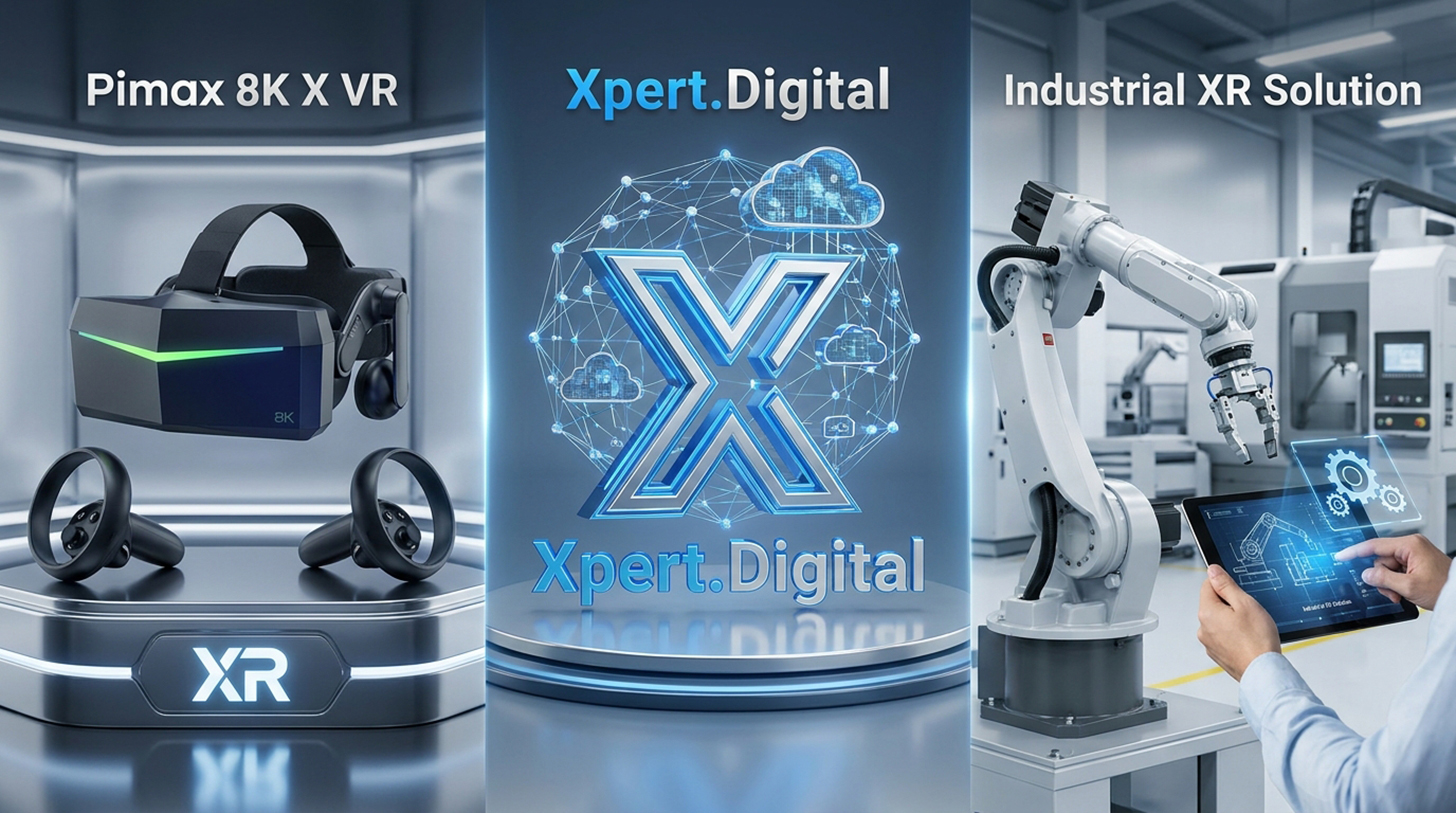
Enterprise XR Solution Hub for B2B projects – from digital twins to customized mixed reality solutions – Image: Xpert.Digital
Xpert.Digital acts as a holistic Enterprise XR Solution Hub, seamlessly integrating high-performance Pimax hardware into industrial B2B workflows. From digital twin analysis in engineering ("top floor") to immersive training on the production floor ("shop floor"), companies receive a customized, comprehensive solution including strategic consulting and support.
More information here:
Why wired PCVR is economically indispensable for industrial applications
Pimax in the economic market perspective
Growth market with increasing quality demands
The global VR market is experiencing accelerated growth, primarily driven by enterprise applications. Market volume was estimated at $41.51 billion in 2026 and is projected to reach $147.78 billion by 2032 – a compound annual growth rate (CAGR) of 23.2 percent. This growth is driven by applications in industrial training, design, and simulation contexts, rather than purely consumer entertainment. This structural shift in the market provides the economic foundation for the argument that positions Pimax as a true enterprise platform.
The immersive VR submarket, encompassing industrial and professional applications, is projected to reach $16.29 billion in 2026 and grow to $55.29 billion by 2031. In this segment, image quality is the key differentiator. Companies scaling VR from pilot phases to enterprise-wide rollouts are finding that while simple onboarding applications work with inexpensive hardware, design reviews, simulation labs, and precision training demand a completely different level of quality.
In January 2025, Pimax completed another funding round of $13.6 million, explicitly intended to accelerate R&D for PCVR headsets in the US and Europe. This capital round, combined with the Microsoft partnership, NASA validation, and enterprise customer references from Volkswagen, Mercedes-Benz, and Deutsche Bahn, paints a picture of a company systematically transforming from a niche provider for enthusiasts into an institutionally validated enterprise platform.
The price point as a strategic disruptor
A crucial aspect of Pimax's positioning in the enterprise market is its pricing architecture. Varjo, its only serious competitor in the professional high-resolution VR segment, charges over €10,000 per headset for its XR-4 series in full configuration, with mandatory software licenses for offline operation costing thousands more. This makes Varjo virtually unaffordable for mid-sized businesses. The Pimax Crystal Super, on the other hand, costs around $1,700, while the new Dream Air—featuring Sony Micro-OLED panels, 8K total resolution, and weighing under 170 grams—starts at $1,999 in its most affordable configuration.
This price point is historically unprecedented in professional VR. It means that, for the first time, a medium-sized mechanical engineering company can build a professional, high-quality PCVR workstation for a total investment of under €10,000 (headset plus powerful workstation) – a level that, just three years ago, was only attainable for DAX-listed companies or research institutions with corresponding budgets. This democratization of quality fundamentally changes the economic equation for enterprise VR investments.
The ROI calculation: When does the investment in PCVR quality pay off?
Concrete figures from industrial practice
The economic core of the argument for wired PCVR in the enterprise sector lies in a simple equation: A single avoided design flaw can many times over offset the investment in a PCVR workstation. General Electric Mexico discovered an assembly error during a VR design review of a turbine, the correction of which would have cost between $100,000 and $1 million in the physical stage – the VR review cost only a fraction of that. Ford achieved a 90 percent reduction in prototype costs through VR in vehicle development. Boeing reduced the design time for complex aircraft components by 30 percent.
A Forrester analysis puts the three-year ROI of mixed reality at 177 percent, with a net added value of $7.6 million and a payback period of 13 months. NVIDIA reports that VR-integrated development projects have 60 to 65 percent fewer design errors. An analysis of mechanical engineering by the SMS Group shows that VR-based design reviews in projects that could not be conducted with physical models due to the pandemic nevertheless identified all major planning errors and significantly reduced on-site costs.
These figures are based on VR usage in general, not specifically on wired PCVR. The crucial point, however, is that these ROI values are only fully realized if the VR quality is high enough to actually reveal the relevant flaws. A design review using a headset that doesn't render fine details sharply will fail to identify flaws that would be obvious in a high-quality PCVR setup. Therefore, the ROI is not dependent on VR technology in general, but on VR quality specifically.
What the Cologne TimeRide project teaches us about immersion depth and economic value
The TimeRide project in Cologne is an unexpected textbook example of the economic logic of immersion depth. Visitors pay for an immersive VR experience that transports them to Cologne in 1926 – complete with trams, church sounds, and historic city architecture. The economic viability of this offering hinges on the experience's persuasiveness. If the texture of the cobblestones blurs, if the window frames of the late 19th-century facades appear as pixelated rectangles, if the church steeple in the background lacks a clear horizon – then the experience is not immersive, but disappointing, and the willingness to repeat the experience or recommend it to others diminishes. The decision to use wired PCVR with high pixel density is not a technical preference here, but a direct investment in the business model.
This principle applies equally in industrial contexts, only with different economic consequences: If an employee perceives VR training as inadequate because the visualization doesn't train a reliable response, the training is wasted. If a design review in VR doesn't provide planners with the information they need to make a sound decision, the result will be questioned, and they'll revert to the physical prototype—with all the associated costs. High-quality visualization isn't a convenience feature. It's a matter of precision in the workplace.
The communication task: Positioning Pimax as a B2B platform
From simulation jargon to decision relevance
Pimax faces a communication challenge familiar to many leading technology companies during the crossover phase: the language of the community that made the product successful is not the language of the target audience it is now trying to reach. PPD values, field-of-view diagrams, optical engine comparisons, and SteamVR compatibility lists are standard metrics for simulation enthusiasts. For a purchasing manager at an automotive supplier, a digital transformation manager at an engineering firm, or a training manager at a machine manufacturer, they are completely foreign concepts.
The necessary translation work is clearly defined: The technical argument "57 PPD" must become "You can unequivocally determine whether two components collide during design review – you cannot reliably assess this with a standalone headset." The technical argument "wired DisplayPort connection" must become "Your simulation runs without connection interruptions, regardless of the session duration." The technical argument "SteamVR Lighthouse tracking" must become "The positional precision is high enough for training scenarios where millimeter accuracy makes a real difference."
The NASA-Armstrong narrative accomplishes this translation effortlessly. It's not a technical specification, but a story of trust: One of the world's most prestigious aerospace research institutions, without any consultation with the manufacturer, chose its product for an application demanding the highest standards. This story is understandable in any language, relevant to any B2B audience, and impervious to any counterargument—because it's not a marketing construct, but a documented fact.
Enterprise Case Library as a living validation tool
The Pimax Business Enterprise Case Library, in its current form, is a start, but not yet a fully developed B2B communication tool. The documented case studies from education, industrial training, cultural tourism, and immersive cinema provide important case studies. What's missing is the systematic translation into the business language of enterprise procurement: What specific cost savings were achieved? What errors were discovered that would not have been visible without VR? What training times were reduced, and what does that mean in hours equivalent?
The involvement of Volkswagen, Mercedes-Benz, and Deutsche Bahn has the potential for precisely this kind of in-depth case study. When Volkswagen conducts design reviews using Pimax hardware, there's a key metric: How many iteration cycles were saved by identifying errors early on? How did this impact the development schedule? What costs were avoided? These figures aren't just marketing material—they're the evidence enterprise buyers need to justify an investment that goes beyond the mass-market standalone headset.
Hybridization without loss of quality
Pimax's technological development is tracing a path that brings PCVR quality to increasingly flexible form factors. The Dream Air – weighing under 170 grams, featuring a Sony Micro-OLED display, 8K total resolution, and wired DisplayPort 1.4 – demonstrates that weight reduction and image quality are no longer mutually exclusive. The optional "Cobb" compute module also allows the Crystal series, based on the Snapdragon XR2 Gen 2, to operate independently when a PC is unavailable – with the corresponding reduction in quality, but with maximum deployment flexibility.
This hybrid architecture is strategically sound: it serves enterprise customers who require mobile operation for specific scenarios without compromising Pimax's commitment to quality-conscious users. The cable is the switch that unlocks maximum performance – and for application classes where that performance matters, it remains the system's most important feature.
The next technological frontier in enterprise VR isn't wireless connectivity – that's largely resolved, provided the network infrastructure is stable. The question is whether AI-powered upscaling and foveated rendering algorithms will allow standalone hardware to achieve PCVR-like quality. The Pimax Crystal Super and Dream Air already integrate eye-tracking with Dynamic Foveated Rendering 2.0, which significantly reduces GPU load by rendering at full resolution only where the eye is actually looking. This pushes the performance limit upwards without lowering the quality limit.
However, NASA's verdict remains valid: Anyone seeking the best available tool for the most demanding visualization tasks should buy wired PCVR. Not because the cable is so elegant – but because it's the unadulterated connection to the computing power that makes the crucial difference.
Your global marketing and business development partner
☑️ Our business language is English or German
☑️ NEW: Correspondence in your native language!

Konrad Wolfenstein
I and my team are happy to be available to you as your personal advisor.
You can contact me by filling out the contact form here wolfenstein@xpert.digital:or simply call me at +49 7348 4088 965. My email address is
I'm looking forward to our joint project.
☑️ SME support in strategy, consulting, planning and implementation
☑️ Creation or realignment of the digital strategy and digitization
☑️ Expansion and optimization of international sales processes
☑️ Global & Digital B2B trading platforms
☑️ Pioneer Business Development / Marketing / PR / Trade Fairs
🎯🎯🎯 Data-driven B2B industry hub as a quasi-in-house solution


The quasi-in-house solution: How Xpert.Digital closes operational gaps in B2B marketing and sales – Smart Content-Driven Business - Image: Xpert.Digital
Xpert.Digital is a data-driven B2B industry hub led by Konrad Wolfenstein . The company acts as an external, quasi-in-house solution for industrial partners, closing operational gaps in marketing, content, and sales – without requiring additional resources on the client side.
More information here: