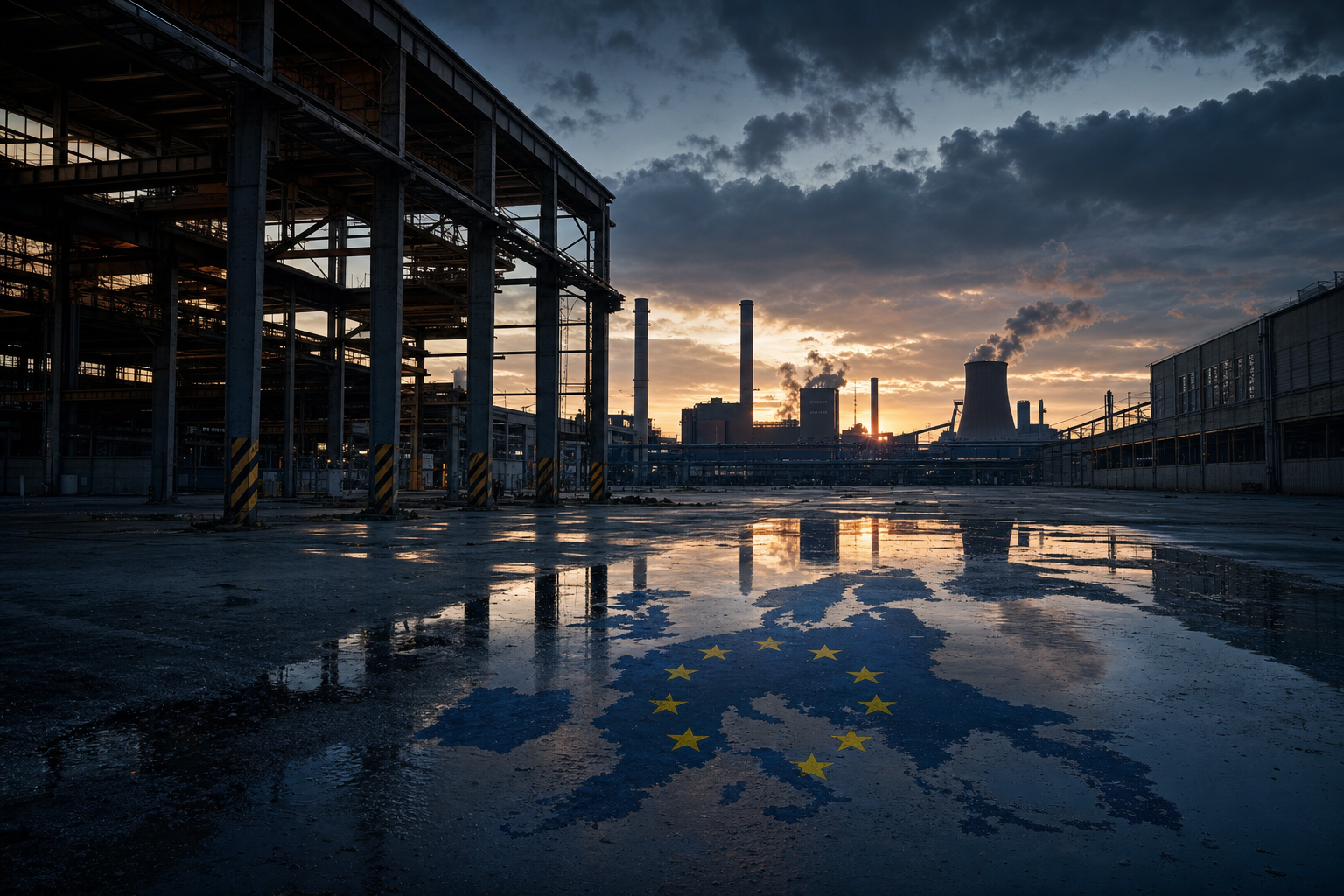
Europe's industrial shock: Why Germany and Italy are faltering – and who is now profiting – Image: Xpert.Digital
While Spain is booming: The eerie deindustrialization of Germany in hard numbers
The Draghi Alarm: Why Europe's economy is facing an unprecedented historical upheaval
European industry is facing a historic upheaval. While economies like Spain and France are weathering the current crisis with remarkable resilience, the former powerhouses of Germany and Italy are experiencing a worrying decline in production. What might initially appear to be a typical economic downturn reveals itself upon closer examination of the data as a profound structural crisis. Exploding energy costs, disrupted global supply chains, growing bureaucratic hurdles, and aggressive competition from Asia and the US are threatening the foundations of European prosperity. In Germany, tens of thousands of jobs are already at risk, particularly in key sectors such as the automotive industry. Can an unprecedented €500 billion program halt the gradual decline, or will Europe definitively lose its place among the world's leading economies? A detailed analysis of this crucial economic question for the continent.
Related to this:


When the foundation crumbles – Germany's and Italy's industrial crisis as a warning signal for the entire continent
A glance at Eurostat's current production indices for the largest European economies reveals a stark picture. Based on 2021 as the reference point (index = 100), Germany recorded a decline of 11.5 index points by the first quarter of 2026, followed by Italy with a drop of 8.8 points. Both figures are significantly below the EU-27 average, which fell by 3.9 points during this period. Spain, on the other hand, saw a decline of only 1.7 points, while France, with a decrease of 0.4 points, remained almost at the level of the initial year. It is these disparities that truly highlight the dramatic nature of the situation. What might initially appear to be a cyclical fluctuation, upon closer analysis, reveals itself to be an expression of profound structural distortions – particularly in Germany.
Since the start of Russia's war of aggression against Ukraine in February 2022, European industrial production as a whole has been under exceptional pressure. Soaring energy prices, disrupted supply chains, weakening domestic and international demand, and increasing competitive pressure from Asia have all combined to place Europe in a difficult position as a production location. However, the consequences of these shocks are not evenly distributed. They have hit, and continue to hit, primarily those economies whose prosperity is traditionally built on a strong, energy-intensive, and export-oriented industrial sector – first and foremost, Germany.
When energy becomes a weapon: The structural cost trap
The collapse of Russian gas supplies to Europe was a watershed moment. For Germany, which had based its energy mix on cheap Russian pipeline gas for decades, the end of this era meant not only a short-term supply crisis, but a fundamental shift in the cost base for the entire industrial sector. In 2024, German industrial electricity prices, at around 14 cents per kilowatt-hour, were slightly above the EU-27 average, a level that creates significant competitive disadvantages in international comparison. Crucially, it is not just the absolute price that matters, but the difference compared to the energy costs of Germany's main global competitors in the USA, China, and the Middle East, where electricity and gas are often available at a fraction of European prices.
Studies have shown that energy prices are empirically the most important determinant of the energy intensity of European industry. Energy-intensive sectors such as chemicals, metallurgy, paper, and glass manufacturing have since faced a cost structure that makes it increasingly difficult for them to offer competitive prices on global markets. The result is a gradual deindustrialization – less through dramatic factory closures than through the quiet relocation of investments abroad and the abandonment of new capacity development in Germany.
As early as 2024, the ifo Institute noted that high energy and production costs were increasingly impairing competitiveness in the manufacturing sector, and that the majority of industrial companies reported a significantly worsened competitive position in their business surveys. The institute concluded that, in the long term, Germany's competitiveness must be strengthened by reducing energy costs, cutting red tape, and modernizing infrastructure. However, it takes years for such measures to take effect – time during which competitors can catch up and shift market shares.
Structural crisis, not a cyclical downturn
It would be convenient to interpret the decline in German industrial production as a temporary reaction to exceptional shocks, from which the country can recover with the next economic upswing. However, the data paints a sobering picture. Industrial production in Germany fell by around one percent in 2025 – the fourth consecutive decline. Compared to the peak at the beginning of 2018, the volume of industrial goods produced is now around 14 to 15 percent lower. Apart from the slump caused by the coronavirus pandemic, production is thus at a level last seen around 15 years ago. This can no longer be considered a cyclical up and down; it must be described as a structural decline.
Claus Michelsen, chief economist of the Association of Research-Based Pharmaceutical Companies (vfa), shares this assessment, stating that Germany's industry is suffering not from a cyclical weakness, but primarily from a structural competitive disadvantage. High bureaucratic costs, insufficient venture capital, and uncertain framework conditions are hindering investment, while other economic regions are successfully attracting capital. Structural change itself is not necessarily negative—it is inevitable. The problem lies in the speed at which old industries are disappearing and the slowness with which new, value-added activities are emerging. The four megatrends of digitalization, decarbonization, demographics, and deglobalization are forcing a transformation of production structures, which must be understood as both an opportunity and a risk.
The special weight of German industry
The decline in industrial production weighs far more heavily on Germany than on most other European economies – and for a simple but crucial reason: nowhere else in the EU is industry so deeply interwoven into the economic fabric. In 2024, the manufacturing sector in Germany generated 19.9 percent of total gross value added. By comparison, the figures were 18.1 percent in Poland, 16.6 percent in Italy, 11.9 percent in Spain, and only 10.7 percent in France. The EU average was around 15.9 percent.
Looking at the industrial share of GDP in its entirety—including mining and energy, as shown in the original infographic at 25.8 percent for Germany—the dependency becomes even clearer. Therefore, if industrial production declines in Germany, the entire economic ecosystem is impacted far more severely than in countries that have already shifted their focus more towards services, tourism, or the digital sector. Suppliers lose orders, logistics companies suffer freight losses, regional labor markets in industrial cities come under pressure, and tax revenues for municipalities that rely on business taxes from traditional industrial companies shrink. No other major EU country is exposed to a similarly far-reaching chain reaction from a decline in industrial production.
The job market: When numbers become people
Industrial policy is not an abstract matter. It determines employment, income, and social conditions in entire regions. In Germany, the manufacturing sector was recently a direct employer for around 5.5 million people. However, this figure is under pressure – and this pressure is becoming increasingly noticeable.
Nowhere is this more evident than in the German automotive industry, which has formed the backbone of German industrial excellence for decades. By the end of the third quarter of 2025, the sector employed 48,700 fewer people than a year earlier. This represents a decline of 6.3 percent – the sharpest job loss among all major industrial sectors with more than 200,000 employees. The sector now employs only around 721,400 people – the lowest number since mid-2011. Manufacturers of parts and accessories were particularly hard hit: 11.1 percent of jobs were lost within a year, amounting to approximately 235,400 remaining employees.
In 2025, German industrial companies cut over 124,000 jobs, according to EY – a record low that more than doubled the previous year's loss of around 56,000 jobs. The automotive industry alone lost almost 50,000 jobs in 2025, and since 2019, the pre-pandemic year, employment in the German automotive sector has fallen by more than 112,000. These figures are more than just economic statistics. They reflect an accelerated industry transformation in which electromobility, while opening up new business models, favors a technological structure that requires less vertical integration and thus fewer jobs in Germany – especially if battery cell production and other key components are not located domestically.
Italy: A History of Missed Reforms
Italy's industrial decline of 8.8 index points since the first quarter of 2023, while less severe than Germany's, is at least as worrying in its nature. The structural weaknesses of Italian industry have been known for decades: a fragmented middle class that, while highly specialized and innovative, is often too small to meet the challenges of global supply chains; a cumbersome public administration system that stifles entrepreneurial initiative; high levels of public debt that limit fiscal leeway for structural policy interventions; and an industrial south that, despite EU funding, has failed to catch up with the highly productive north.
The 7.1 percent year-on-year decline in Italian industrial production in January 2025 was the sharpest among all major EU economies. Italy remained in negative territory in the following months as well. This reflects not only the general challenges facing European industry, but also the particular vulnerability of an economy whose industry relies heavily on intermediate and capital goods – products whose demand is the first to fall when European and global investment slows. Italy's automotive, mechanical engineering, and metalworking industries are suffering from the same demand shocks as their German counterparts, but without the financial strength and technological depth of their German competitors.
Our EU and German expertise in business development, sales and marketing

Our EU and German expertise in business development, sales and marketing - Image: Xpert.Digital
Industry focus areas: B2B, digitalization (from AI to XR), mechanical engineering, logistics, renewable energies and industry
More information here:
A thematic hub offering insights and expertise:
- Knowledge platform covering global and regional economies, innovation and industry-specific trends
- A collection of analyses, insights, and background information from our key areas of focus
- A place for expertise and information on current developments in business and technology
- A hub for companies seeking information on markets, digitalization, and industry innovations
Draghi's wake-up call: The three issues that will determine Europe's competitiveness
The contrast: Spain and France as relative winners
A comparison of production indices reveals not only losers, but also countries that, despite the challenging environment, are showing remarkably stable or even upward-trending industrial development. Spain's index recorded a decline of only 1.7 points over the three-year period, while France remains almost at its starting level with a decrease of just 0.4 points.
Spain's relative strength can be explained by a combination of several favorable factors. The country's economy is far less dependent on energy-intensive heavy industry than Germany or Northern Italy. Tourism, services, and a booming construction sector support growth. The Spanish economy recorded overall growth of 2.8 percent in 2025 – making it one of the fastest-growing major industrialized nations worldwide. Added to this are competitive advantages in the electricity sector: Spain has established itself as a pioneer in renewable energy production, which has significantly reduced energy costs and benefits both local industry and foreign investors. And last but not least, Spain has benefited disproportionately from EU recovery funds, which were specifically targeted at digital transformation, green industries, and modern infrastructure.
France, for its part, has a structurally different starting point, with a lower dependence of its economy on the manufacturing sector – which accounts for only around 10.7 percent of gross value added. At the same time, France's manufacturing sector showed a surprising recovery at the end of 2025: The Purchasing Managers' Index for the manufacturing sector climbed to 50.7 points in December – the strongest reading in three and a half years. Export orders increased from Eastern and Southern Europe, North America, and parts of Africa. Employment in the manufacturing sector grew at its fastest rate since August 2024. For Germany and Italy, these figures are from a different world.
Related to this:

Geopolitics as a multiplier of the structural crisis
The crisis in German and European industry is not merely a domestic political problem. It is deeply embedded in geopolitical shifts that have been gaining momentum since the end of the globalization euphoria of the 1990s and 2000s. Russia's war of aggression against Ukraine has forced Europe to rethink its energy dependencies. China's growing economic and technological power is putting European industry under increasing competitive pressure in more and more sectors – from the steel and chemical industries to electric vehicles, mechanical engineering, and solar energy.
US trade policy under President Trump has created additional uncertainty through tariffs on European products, directly impacting European exporters and leading to the postponement of investment decisions. For Germany, a highly export-dependent economy reliant on free market access to its most important sales markets, such geopolitical risks have immediate business implications. If trade conflicts become entrenched, production locations shift – companies build closer to their target markets and further away from Germany. This trend toward the regionalization of supply chains and production poses a serious threat to Germany's industrial base.
The Draghi Report and Europe's Response
At the European level, the scale of the challenge has long been recognized. The report on European competitiveness presented in autumn 2024 by former ECB President and ex-Italian Prime Minister Mario Draghi identified three key problem areas: closing a growing innovation gap with the US and China, managing the energy transition without sacrificing industrial competitiveness, and reducing critical dependencies in security-relevant supply chains. Draghi estimated the necessary additional investment at 750 to 800 billion euros per year – a sum he placed in historical comparison with the Marshall Plan after the Second World War.
In direct response, the European Commission under Ursula von der Leyen presented the so-called Clean Industrial Deal – an economic policy framework that combines subsidies for strategic industrial sectors with deregulation and introduces targets for 40 percent of future production of green technologies such as wind and solar power plants within the EU. EU state aid rules were relaxed to make it easier for member states to provide state support for strategically important sectors. A new €400 billion Competitiveness Fund is planned for the EU budget for 2028 to 2034 to finance industrial policy. These are important signals – but they are largely long-term measures that offer little immediate relief.
Germany's counter-strategy: The 500 billion program
The federal government also took action at the national level. In March 2025, with cross-party consensus in the Bundestag and Bundesrat, the German government approved a historically unprecedented special fund of €500 billion for infrastructure and climate neutrality – enshrined in an amendment to the Basic Law and established over a period of twelve years. As early as 2025, federal investments increased by approximately 17 percent compared to the previous year, reaching a total of around €87 billion. Record investments of almost €127 billion are planned for 2026.
The focus is on modernizing transport infrastructure – around €21.3 billion is earmarked for rail, road, and waterways alone in 2026, more than double the amount for 2025 – as well as on digitalization, energy infrastructure, and hospital construction. The investment program is complemented by tax measures: accelerated depreciation of up to 30 percent for equipment investments, a phased reduction in corporate tax starting in 2028, simplified business start-up procedures, and a new Germany Fund to close financing gaps for small and medium-sized enterprises (SMEs) and industry. A location promotion law is intended to incentivize private investment and mobilize venture capital for innovative companies.
These are structurally sound steps that address many political demands of recent years. However, the crucial factor will be whether the funds are actually accessed and invested quickly and effectively – Germany has a historically poor track record when it comes to the rapid implementation of large investment programs – and whether structural obstacles to economic development, such as bureaucracy, lengthy approval processes, and a shortage of skilled workers, are simultaneously reduced. The special fund is a necessary, but not sufficient, condition for industrial renewal.
The pattern of divergence: What the numbers mean for Europe's future
The divergence of industrial production indices within the EU is more than a statistical phenomenon. It indicates that Europe is not a homogeneous economic unit and that the challenges and opportunities of industrial transformation are very unevenly distributed. Countries like Spain, which have diversified more, have more favorable energy structures, and have benefited disproportionately from EU recovery funds, are significantly better off. Countries like Germany and Italy, whose prosperity is built on a specific industrial model—export-oriented specialized manufacturing, often energy-intensive and based on established technological pathways—are struggling more.
Should the trend of relative deindustrialization continue in Germany and Italy, it would have far-reaching consequences for the economic geography of Europe. Spain, and to a lesser extent other smaller EU members, could gain relative importance in terms of industrial investment, employment, and value creation. The EU's industrial center of gravity would shift. This would not be a disaster in itself, as long as the affected economies develop high-growth new sectors in return. The real danger lies in a scenario where the dismantling of old industrial strengths proceeds faster than the development of new ones, and where the social and fiscal fabric of regions that have depended on industry for generations is irreparably damaged.
The real question of the system
At its core, the weakness of German and European industry reveals a deeper systemic question: Is the European economic model – with its comparatively high labor and energy costs, its dense regulatory framework, its robust social systems and its focus on high quality standards – still competitive in a world where technological leadership increasingly originates in the USA and China and cost leadership lies in Asia and elsewhere?
Those who answer this question in the affirmative point to the still undisputed strengths: the technological depth and quality reputation of European industrial products, the large human capital, the well-developed research infrastructure, and the innovative capacity of both small and medium-sized enterprises and large corporations. Those who are skeptical point to declining production figures, job losses, the lack of major investments, and the relocation of research and development centers abroad. Both sides have valid arguments. What is lacking is time – and that is precisely what Europe risks losing if it postpones structural reforms for too long.
The Draghi report put it bluntly: Europe faces an existential threat to its economic position. This is not an exaggeration to justify political ambitions. It is the objective description of a reality reflected in the production indices of the Eurostat statistics, in the job-cutting programs of the automotive industry, and in declining investment rates.
The long road back
The situation is serious, but not hopeless. Germany and Italy possess industrial substance, technological know-how, and a well-trained workforce that other economies lack. The German government's special fund, European industrial policy initiatives, and the initial cautious recovery in individual sectors show that a turnaround is possible. However, it will not happen automatically.
What is needed is a coherent interplay of lower and stable energy prices, streamlined permitting processes, targeted innovation support in future technologies, an active European trade and industrial policy, and the will not to postpone difficult structural decisions until the next legislative period. The next three to five years will be crucial. The indices that are currently declining can also rise again. The prerequisite for this is that political insight into the depth of the problem keeps pace with the determination to change – a requirement that European democracies notoriously fail to meet when comfort and a focus on the status quo outweigh the willingness to reform.
Your global marketing and business development partner
☑️ Our business language is English or German
☑️ NEW: Correspondence in your native language!

Konrad Wolfenstein
I and my team are happy to be available to you as your personal advisor.
You can contact me by filling out the contact form here wolfenstein@xpert.digital:or simply call me at +49 7348 4088 965. My email address is
I'm looking forward to our joint project.
☑️ SME support in strategy, consulting, planning and implementation
☑️ Creation or realignment of the digital strategy and digitization
☑️ Expansion and optimization of international sales processes
☑️ Global & Digital B2B trading platforms
☑️ Pioneer Business Development / Marketing / PR / Trade Fairs
🎯🎯🎯 Data-driven B2B industry hub as a quasi-in-house solution


The quasi-in-house solution: How Xpert.Digital closes operational gaps in B2B marketing and sales – Smart Content-Driven Business - Image: Xpert.Digital
Xpert.Digital is a data-driven B2B industry hub led by Konrad Wolfenstein . The company acts as an external, quasi-in-house solution for industrial partners, closing operational gaps in marketing, content, and sales – without requiring additional resources on the client side.
More information here: