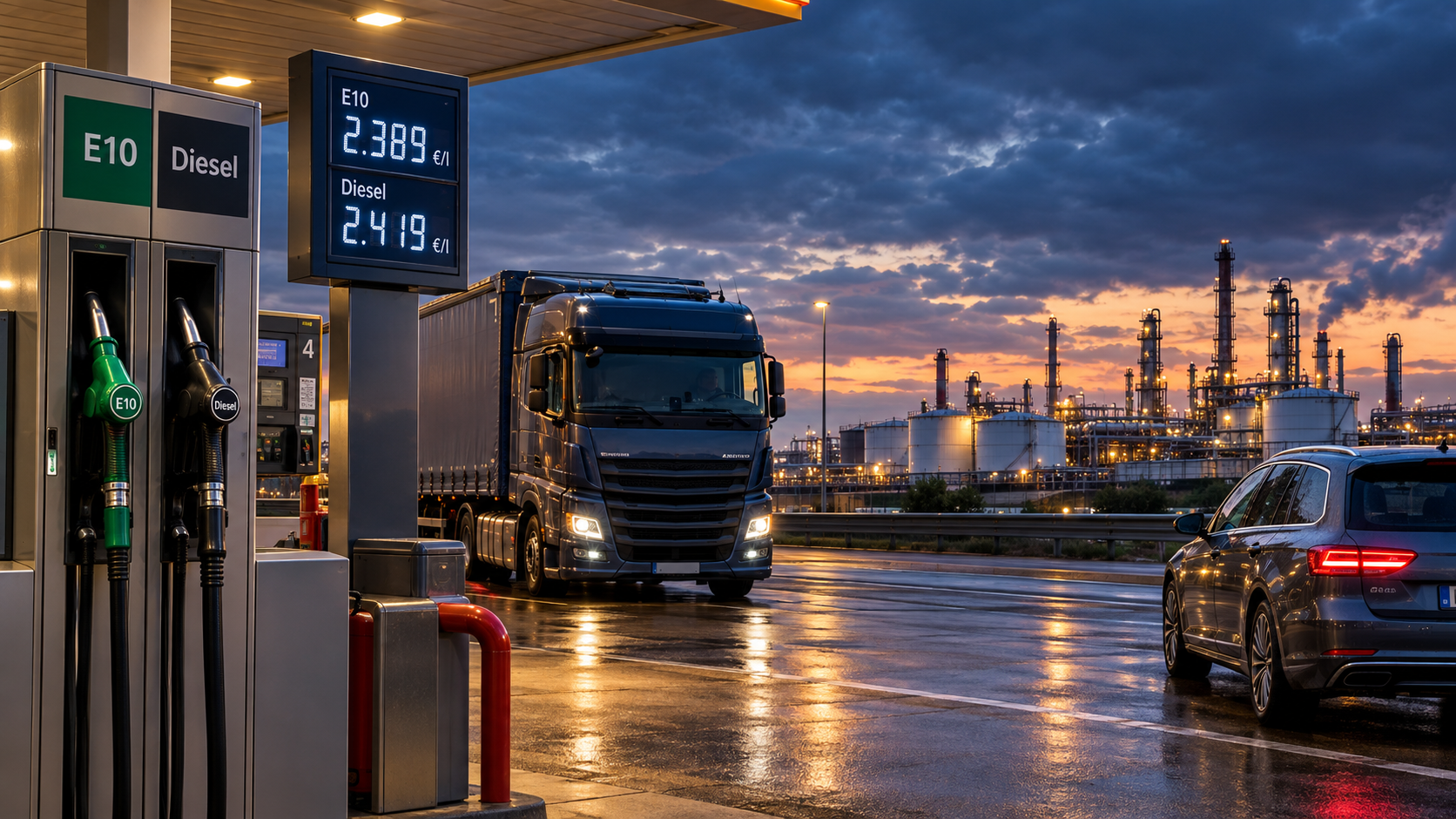
Price shock at the pump: Fuel prices and the energy crisis – Why cheaper refueling alone won't solve the crisis – Creative image on the topic, created with AI: Xpert.Digital
Over €2.40 for diesel! What's really behind the new price explosion?
Energy crisis 2026: Why a new fuel discount won't solve our problems now
The real reason for the price shock: What will really make fuel so extremely expensive in 2026
Refueling in Germany will once again be a strain on the wallet in autumn 2026:
With an average price of €2.30 per liter for Super E10 and a painful €2.42 for diesel, fuel prices are breaking all previous records. But those who blame this price explosion solely on Berlin or greedy oil companies are missing the point. Rather, a toxic mix of global conflicts, blocked supply chains in the Middle East, and limited refinery capacity is colliding with a European economy that remains heavily dependent on oil in the transportation sector. The result is a brutal supply shock that not only burdens private households but also, as a dangerous price driver, affects the entire logistics industry and inflation. Our comprehensive analysis explores which political measures will truly help, why popular concepts like a rigid price cap or a blanket fuel discount are risky, and how Germany must find its way out of this fatal oil trap.
The state can dampen the price – but it can neither conjure up oil nor discount away Europe's vulnerability
Fuel prices in Germany reached a level in mid-September 2026 that once again transformed a daily annoyance into a major economic strain. According to the latest ADAC analysis, a liter of Super E10 cost an average of €2.30 nationwide on September 15th. This was a new all-time high and 4.1 cents more than the previous week. Diesel prices even rose by 10.1 cents within a week to €2.422 per liter, just shy of its record high of €2.447 reached in April. By comparison, in mid-January, average prices were €1.743 for E10 and €1.687 for diesel.
This difference illustrates the magnitude of the shock better than any political rhetoric. Within eight months, the price of E10 increased by around 56 cents per liter, and diesel by about 74 cents. For a 50-liter tank, this equates to an additional cost of approximately €28 for E10 and €37 for diesel. Someone who consumes 150 liters per month will pay roughly €84 or €110 more compared to January. This is noticeable for private households; for commercial fleets, it can completely alter the cost calculations of entire contracts.
The current situation, however, is not simply a repeat of the 2022 energy crisis. Back then, the Russian attack on Ukraine, drastically reduced gas supplies, and an already strained European energy market coincided. In 2026, the focus is more strongly on the global oil market. The war in the Middle East, the temporary and significant disruption of oil shipments through the Strait of Hormuz, high risk premiums, and shortages of refined products are impacting an economy that, while having become more resilient in terms of gas, remains heavily dependent on liquid fossil fuels for transportation.
The term "energy crisis" is therefore justified, but should be used precisely. Germany is not suffering from a general physical energy shortage. Electricity, gas, and petroleum products are available. The central problem is an external supply shock: Imported energy is becoming scarcer, riskier, and more expensive. As a result, more income flows to foreign producers, while purchasing power, corporate margins, and investment opportunities decline domestically. Such a situation is particularly difficult economically because it simultaneously increases inflation and hinders growth.
The origin lies beyond the fuel pump
The immediate trigger for the price surge lies not at German gas stations, but on the international crude oil and product markets. Since the beginning of the Middle East war at the end of February 2026, oil flows through the Strait of Hormuz have been temporarily reduced to less than a tenth of pre-crisis levels. The International Energy Agency responded with the largest coordinated release of emergency reserves in its history: 400 million barrels were to be made available to the market. This scale alone makes it clear that this is not a normal price fluctuation, but an exceptional supply disruption.
For German consumers, the Brent price alone is not the deciding factor. Between the price of a barrel of crude oil and the price of a liter of diesel or gasoline lie refining costs, product availability, freight costs, insurance, storage, biofuel blending, CO₂ pricing, energy tax, distribution margins, and value-added tax. In a crisis, these components can diverge. Therefore, if the price of crude oil falls, fuel prices do not necessarily fall to the same extent. If refinery capacity is limited or certain product flows are disrupted, gasoline and especially diesel can remain expensive.
This refinery effect will play a crucial role in 2026. The European Central Bank points out that the rise in energy inflation is exacerbated not only by higher commodity prices but also by increasing margins on refined petroleum products. Diesel is particularly sensitive because Europe is structurally more dependent on imports of middle distillates, and the fuel is also needed in road freight transport, construction and agricultural machinery, and, to some extent, as a heating oil equivalent. A shortage would therefore affect several demand sectors simultaneously.
Exchange rate effects also play a role. Crude oil and many petroleum products are traded in US dollars. A weaker euro makes energy imports more expensive, even if the dollar price remains unchanged. Conversely, a stronger euro can cushion an increase in oil prices, but rarely neutralize it completely. Therefore, the final price depends not only on the situation in the Middle East, but also on the reaction of international financial markets.
Inland, logistical bottlenecks can further exacerbate the situation. Low water levels on the Rhine increase the cost of transporting petroleum products because tankers can carry less cargo and require more trips. These effects vary regionally and explain why prices don't rise uniformly everywhere. The energy crisis is therefore also a transportation crisis: energy must not only be produced or imported, but also delivered to the right place at the right time.
What's included in the price per liter
The price at the pump is often presented as simply the result of government levies or high corporate margins. In reality, it consists of several components whose weight changes with the market price. The energy tax is a fixed quantity tax and is normally 65.45 cents per liter of gasoline and 47.04 cents per liter of diesel. It does not automatically increase when crude oil becomes more expensive. Added to this are the costs of the national emissions trading system, procurement and refining, transport and storage, the margins of the various stages of the supply chain, and finally, 19 percent value-added tax on the total net price, including energy tax and CO₂ costs.
The national CO₂ price in 2026 will fluctuate between €55 and €65 per ton. The first auction in July ended at the upper end of this range, at €65. Compared to the price of €55 in 2025, a level of €65 increases the final price by approximately 2.8 cents per liter of gasoline and 3.2 cents per liter of diesel. The CO₂ price thus contributes to the price increase, but does not even come close to explaining the rise of several dozen cents since the beginning of the year. The dominant factor is the fossil fuel procurement and processing price resulting from the geopolitical supply disruption.
The claim that the state automatically benefits from high fuel prices is also an oversimplification. While the value-added tax (VAT) per liter sold increases with the gross price, sales volumes may decrease, while the volume-based energy tax remains unchanged or generates less revenue due to lower consumption. Furthermore, expensive energy puts a strain on the economy and thus on other tax sources. Based on the data currently available, the Federal Ministry of Finance does not expect the state to generate any additional revenue overall from the price shock. However, complete consumption and tax data for 2026 are still needed for a final assessment.
This does not mean that government levies are insignificant. At a price of €2.30 per liter, the regular energy tax on gasoline alone accounts for more than a quarter of the final price; CO₂ costs and sales tax are added on top. The government therefore possesses a short-term lever. However, it can only change the domestic share of taxes. It cannot steer away the world market price, refinery bottlenecks, and geopolitical risk premiums.
Why diesel is becoming a crisis indicator
The price of diesel is more important for economic analysis than a focus on private cars alone might suggest. Diesel powers the vast majority of heavy commercial vehicles and is therefore a key input factor for the supply of food, industrial goods, building materials, and parcel services. If its price rises, not only does mobility become more expensive, but so does the physical movement of almost all goods.
According to the German Federal Association of Road Haulage, Logistics and Waste Disposal (BGL), fuel costs account for around one-third of total costs for many transport companies. As a rough rule of thumb, a 10 percent increase in diesel prices therefore leads to approximately 3 percent higher total costs. A price jump of nearly 30 percent can consequently increase a company's cost base by about 9 percent. This is a significant figure in a low-margin sector, especially given the simultaneous burden of wages, insurance, financing, vehicles, and tolls.
In the wholesale market, the diesel price in July 2026 was €171.61 per 100 liters excluding VAT. This was 36.5 percent higher than a year earlier and 24 percent higher than in June. The rapid fluctuations between high and low monthly prices make it difficult to calculate bids. A freight carrier who concludes a contract based on the June price may have to cope with a double-digit price increase just a few weeks later.
Large logistics companies can utilize price adjustment clauses, their own fuel depots, scheduled delivery models, or purchasing alliances. Small and medium-sized transport companies often have less negotiating power and liquidity. They have to pay for fuel immediately but can frequently only pass on surcharges to their clients with a delay. This creates a financing effect: even if the higher costs are passed on later, the company has to bridge the interim period.
If diesel surcharges are consistently passed on, transport costs will rise. This is necessary from a business perspective, but it acts as a second round of inflation for the economy as a whole. The burden per individual item often remains small, but it accumulates through intermediate products, inventory movements, regional distribution, and the last mile. Products with low value and high weight or volume are particularly affected, such as building materials, beverages, agricultural products, and waste transport.
If companies cannot pass on the costs, their margins shrink. Investments in new vehicles, digitalization, or alternative drive systems are then postponed. In extreme cases, suppliers leave the market, which in the medium term reduces capacity and further increases freight rates. The crisis thus has a paradoxical effect: While high fossil fuel prices create a stronger incentive to switch to alternative drive systems, they can simultaneously destroy the financial resources that companies need for this transition.
Private households are affected differently
A blanket view of all car drivers obscures significant distributional differences. Households in large cities can more often resort to public transport, bicycles, or shorter journeys. In rural areas, a car is frequently a prerequisite for employment, education, medical care, and shopping. Shift workers also often lack a suitable alternative, even if their place of residence is formally well-connected.
The absolute savings from a lower price per liter increase with consumption. Frequent drivers, large vehicles, and high-income households with multiple cars benefit particularly strongly. At the same time, the relative burden, measured against disposable income, can be significantly higher for low-income earners. A blanket tax cut is therefore quick and noticeable, but only partially effective in targeting social groups.
Furthermore, households don't just pay at the pump. Higher diesel prices increase the cost of delivery services, tradespeople, food transport, and municipal services. Rising heating oil prices burden owners and tenants of oil-heated buildings. Companies can also try to pass on higher energy costs through pricing or offset them with lower wage increases and investments. The real loss of purchasing power is therefore greater than the additional fuel bill.
The situation becomes particularly problematic for households that simultaneously have low incomes, long commutes, and an inefficient vehicle. They cannot move or buy an electric car in the short term and do not automatically benefit from subsidy programs that require a high initial investment. An economically sound crisis policy must take these liquidity and adjustment limits into account. It is not enough to point to technological alternatives in the long term when the current bill is due today.
The price shock is impacting inflation and interest rates
In August 2026, the German inflation rate was 2.9 percent, compared to 2.8 percent in July and 2.3 percent in June. Energy products were 10.5 percent more expensive than a year earlier, and fuels were even 27.7 percent more expensive. Without energy, the inflation rate would have been only 2.2 percent, and without heating oil and fuels, 2.0 percent. This difference illustrates how strongly the current price increases are driven by energy.
An oil price shock initially has a direct impact on fuels and heating oil. This is followed by indirect effects through production and transportation. If companies anticipate permanently higher costs, they adjust price lists, supply contracts, and investment calculations. Employees, in turn, attempt to compensate for real wage losses in collective bargaining. Thus, a temporary energy price surge can lead to broader inflation, even though the original cause lies outside the German economy.
The European Central Bank (ECB) expects average inflation of 3.0 percent for the eurozone in its baseline scenario for 2026, peaking at 3.6 percent in the fourth quarter. It forecasts 2.5 percent for 2027 and 2.1 percent for 2028. At the same time, the ECB anticipates real growth of only 0.9 percent in 2026. This illustrates the classic dilemma of a negative supply shock: tighter monetary policy can limit the second-round effects, but it does not produce additional oil and tends to weaken demand.
For businesses, this means a double burden. Energy and logistics become more expensive, while financing costs may remain elevated for longer. Construction, mechanical engineering, chemicals, metal processing, and other capital- or energy-intensive industries are particularly affected by this mechanism. Private construction and consumer demand also suffers when households spend more on mobility and heating and loans remain expensive.
The Bundesbank expects the effects of higher energy prices to become apparent in living costs only gradually. This contradicts the assumption that a short-term drop in oil prices will solve the problem immediately. Supply contracts, inventories, and price negotiations create delays. Conversely, this also means that if the shock remains temporary, many indirect effects will be less severe than in the case of a shortage lasting for years.
Our EU and German expertise in business development, sales and marketing


Our EU and German expertise in business development, sales and marketing - Image: Xpert.Digital
Industry focus areas: B2B, digitalization (from AI to XR), mechanical engineering, logistics, renewable energies and industry
More information here:
A thematic hub offering insights and expertise:
- Knowledge platform covering global and regional economies, innovation and industry-specific trends
- A collection of analyses, insights, and background information from our key areas of focus
- A place for expertise and information on current developments in business and technology
- A hub for companies seeking information on markets, digitalization, and industry innovations
The truth about fuel discounts: Why government aid often vanishes into thin air
The fuel discount provides a mixed lesson
Between May 1 and June 30, 2026, Germany reduced the energy tax on gasoline and diesel by 14.04 cents per liter. Because this also lowered the tax base for value-added tax (VAT), the potential relief for consumers amounted to approximately 16.7 cents per liter. The measure cost the government roughly €1.6 billion for two months.
The crucial question was whether the petroleum industry passed on the tax reduction at the pump. The Federal Cartel Office's Market Transparency Unit estimates the average pass-through across the entire value chain at 13.8 cents per liter for diesel and 13 cents for Super E5. This corresponded to 82.6 and 77.8 percent, respectively, of the potential gross tax relief. The fuel discount was therefore largely, but not entirely, effective.
The assessment is complicated by the fact that crude oil and wholesale prices fluctuated sharply at the same time. At the beginning of May, pump prices for gasoline initially fell by almost 12 cents, and for diesel by almost 15 cents. In June, lower crude oil prices further contributed to the easing of the situation. After the end of the tax cut, gasoline prices rose by 9.6 cents and diesel by 10.4 cents between June 30 and July 1. Looking at several days in advance, the increase was even more pronounced.
This case study is therefore neither proof of complete market failure nor of perfect pass-through. A broad tax cut can quickly reach consumers, but some of the relief may remain within the value chain. In tight markets with scarce refinery products and regional supply disparities, achieving 100% pass-through is difficult. Furthermore, the longer a temporary measure lasts, the more difficult it becomes to distinguish between tax, crude oil, exchange rate, and margin effects.
The administrative simplicity of the tax speaks in favor of its reintroduction. It is levied at an early stage of the supply chain; no application from each household is required. Arguments against reintroduction include high fiscal costs, limited social targeting, and a weakening of the scarcity signal. Furthermore, a harsh price effect will occur when the relief ends. A fuel rebate is therefore more suitable as a short-term emergency measure than as a permanent response to structurally higher oil prices.
VAT reduction with significant leverage
As an alternative, a temporary reduction in VAT on fuels from 19 to 7 percent is being discussed. Assuming an unchanged net price, this would theoretically reduce the price of E10 (starting at €2.30) by approximately 23 cents per liter and diesel (starting at €2.422) by approximately 24 cents per liter. The potential impact would therefore be greater than that of the fuel price reduction in May and June.
The difference lies in the structure. The energy tax is a fixed amount in cents per liter. A reduction in value-added tax (VAT) is proportional to the net price and therefore provides greater relief when market prices are particularly high. This is precisely what makes it politically attractive in an acute crisis. However, it also means that the fiscal burden is substantial and the relief increases with consumption.
The risk of pass-through remains economically. With intense competition and transparent price monitoring, a significant portion of the reduction should be passed on. However, there is no guarantee. Furthermore, some of the price reduction could be offset by higher demand or changes in margins. The tighter the market, the more likely a surge in demand will result in higher pre-tax prices.
European law and tax law must also be considered. A change in the VAT rate requires legally sound implementation and must be compatible with the European VAT framework. The politically proposed start date of October 1st is therefore ambitious. While the fact that an energy tax reduction was decided upon very quickly in 2026 demonstrates the legislature's operational capacity, it does not replace the need to examine the specific instrument.
A VAT reduction would be most convincing if it were clearly time-limited, linked to close market monitoring, and supplemented by targeted subsidies. Without a time limit, it would create a permanent budget deficit and weaken the transition to more efficient drive systems. Without social support measures, the largest single euro amount would remain with the biggest consumers.
Price caps promise more than they deliver
A government-imposed fuel price cap sounds immediately plausible: the price per liter must not exceed a set limit. For consumers, the effect would be easily understood and visible. However, the instrument is economically risky if the capped final price falls below the procurement and distribution costs.
In this case, either the state must reimburse the difference or providers must reduce their offerings. Reimbursement shifts the costs from the pump to the household and creates complex auditing problems. Without reimbursement, local shortages, a decline in quality, or the withdrawal of independent gas stations are likely. A cap doesn't solve the physical scarcity; it merely masks it.
Models from Luxembourg or Belgium cannot simply be transferred. Smaller countries, different market structures, cross-border fuel transport, and established margin rules create different conditions. Germany has a large, regionally heterogeneous market with refineries, import terminals, inland waterway transport, wholesalers, and around 15,000 monitored filling stations. A central price regulation would have to reflect this complexity.
More sensible than a rigid final price cap might be time-limited rules for margins or exceptional price increases, provided they are precisely defined and enforceable under competition law. However, such interventions also require reliable reference prices. Otherwise, there is a risk that the state will mistake normal risk and logistics costs for abusive pricing.
The excess profits tax solves a different problem
The excess profit tax proposed by some members of the SPD primarily pursues a distributional and financing goal. It is intended to capture extraordinary profits that companies generate not through additional performance, but as a consequence of the crisis. The revenue could be used to finance relief measures. However, such a tax would not automatically lower fuel prices.
The key difficulty lies in defining excess profit. Comparisons with previous years can be distorted by past losses, investment cycles, refinery outages, corporate structures, and international profit shifting. If the tax base is defined too narrowly, significant profits remain untaxed. If it is defined too broadly, normal earnings or necessary risk premiums may be included.
The investment impact is also ambivalent. A special tax that is retroactive or unpredictable increases regulatory uncertainty and can stifle investment in refineries, storage facilities, import infrastructure, or transformation. On the other hand, a clearly defined, EU-wide coordinated, and time-limited rule can reduce distortions of competition and increase public acceptance of crisis measures.
The crucial point is separating the objectives. Those who want to lower the price per liter in the short term need a tool that addresses either price or demand. Those who want to skim off crisis profits need a tax-based instrument. Those who want to protect low-income households need targeted transfers. A single measure can hardly fulfill all three tasks simultaneously.
Direct aid is more accurate, but slower
Direct payments to low-income households are more convincing from a distributional policy perspective than flat-rate fuel subsidies. The state can scale the support according to income, household size, place of residence, or work-related mobility. This would prevent owners of large vehicles from receiving the largest subsidies simply because of their high fuel consumption.
The problem lies in the implementation. A functioning payment mechanism requires up-to-date income data and bank account details. According to the federal government, the necessary account information is currently only available for a limited number of taxpayers. A nationwide immediate payment on October 1st therefore seems less realistic than a change in existing tax rates.
For employees, existing systems such as income tax, commuter allowance, or mobility bonus could be used. However, the commuter allowance only provides relief through the tax return and offers less benefit to those with a low tax burden. An increased mobility bonus or a monthly advance payment would be more targeted, but administratively more complex. Self-employed individuals, pensioners, trainees, and those who do not file an income tax return would need to be considered separately.
A pragmatic solution could be two-stage. In the short term, limited, transparent price relief would cushion the acute shock. At the same time, particularly affected households and small transport companies would receive targeted liquidity assistance. Once the payment systems are functioning, the broad subsidy could be phased out and replaced by income-based support.
Competition policy remains indispensable
High prices are not automatically proof of collusion or abuse. They can also arise in a functioning competitive market when there is genuine scarcity. Nevertheless, margins and pricing levels must be monitored, especially during a crisis, because supply bottlenecks can increase market power.
The Market Transparency Unit for Fuels receives price reports from approximately 15,000 gas stations and can analyze changes in near real-time. Since April 2026, gas stations have only been permitted to raise their prices once a day at noon; reductions are allowed at any time. This measure aims to reduce the number of price fluctuations that are difficult to understand. In the second quarter, around 2.1 percent of the reported price changes violated this rule, with enforcement being the responsibility of the relevant state authorities.
Transparency helps consumers find better deals and increases competitive pressure. However, it doesn't replace investigation into upstream stages. Refineries, import terminals, pipelines, storage facilities, and wholesalers determine a large part of the price before the fuel even reaches the pump. Regional shortages, in particular, can arise at these points.
The Federal Cartel Office is not a price control authority and cannot intervene simply because prices are high. It must prove market power and abusive practices. This is necessary under the rule of law, but difficult in dynamic crises. A better database on refinery margins, import costs, inventory levels, and regional wholesale prices would accelerate the analysis without automatically intervening in price formation.
Climate policy is coming under political pressure
In every energy crisis, the pressure to suspend CO₂ pricing increases. The national price for 2026 is between 55 and 65 euros per ton; the market surcharge compared to 2025 amounts to only a few cents per liter, depending on the auction results. A complete abolition would therefore only partially compensate for the current price shock, while simultaneously weakening a crucial climate signal.
The political conflict is real. High fossil fuel prices promote efficiency, carpooling, public transport, and alternative propulsion systems. However, if the increase is abrupt due to war and scarcity, it is neither predictable nor socially balanced. Households and businesses need time and capital to adapt. Climate policy becomes unbelievable if it ignores these transition costs; but it also loses credibility if every market signal is immediately neutralized.
The right answer, therefore, lies not in permanently lowering the price of fossil fuels, but in redistribution and investment opportunities. Revenues from CO₂ pricing can be used as climate compensation, for social relief, charging infrastructure, rail transport, or the electrification of commercial fleets. Crucially, those affected must be offered a realistic alternative.
For road freight transport, simply pointing to battery-electric trucks isn't enough in the short term. Vehicles are expensive, charging points at depots and along highways are sometimes lacking, grid connections take time, and long-haul profiles vary. Nevertheless, every sustained increase in diesel prices improves the relative economic viability of electric trucks. Policymakers shouldn't eliminate this investment incentive through permanent diesel subsidies, but rather leverage it through faster permitting processes, reliable grid fees, charging infrastructure, and predictable subsidies.
The crisis exposes strategic weaknesses
The most important lesson concerns Europe's dependence on imported fossil fuels. Every tax cut can redistribute the national burden, but it cannot eliminate the import bill. As long as transport, petrochemicals, agriculture, and parts of the heating sector rely on oil, conflicts along key transport routes will remain a direct economic risk.
Strategic resilience therefore means more than emergency reserves. Reserves can bridge acute shortages and prevent panic, but they cannot close a supply gap lasting for years. What is needed are diversified sources of supply, efficient ports and pipelines, sufficient refining and storage capacities, and a faster decline in oil demand. Synthetic fuels and sustainable biofuels can also play a role in sectors that are difficult to electrify, but they will remain scarce and expensive for the foreseeable future.
For companies, energy and fuel risk is becoming a strategic management challenge. Price adjustment clauses, consumption monitoring, route optimization, joint procurement, alternative modes of transport, and a phased fleet conversion reduce exposure. No single instrument eliminates the risk, but a combination of measures reduces dependence on short-term market peaks.
The state, too, must improve its crisis management strategy. Recurring ad-hoc debates about fuel discounts, price caps, and special taxes waste time and create uncertainty. A predefined, tiered model with clear trigger criteria would be more sensible. Such a mechanism could be based on price levels, the duration of the shock, supply indicators, and social impact, determining when reserves, competition controls, transfers, or temporary tax cuts are activated.
Three paths for the next few months
In a scenario where the situation eases, oil shipments through the Strait of Hormuz normalize, risk premiums decrease, and refinery products become more readily available. Pump prices could then decline relatively quickly. A substantial tax cut would be expensive in this case and potentially already outdated by the time it takes effect. Crucially, the reduction in procurement costs would need to be tracked transparently all the way to the gas station through comprehensive market monitoring.
In the baseline scenario, the conflict remains unresolved, but supplies function to a limited extent. Oil prices and refinery margins remain volatile without continuing to skyrocket. Fuel prices could stabilize at a high level. In that case, a combination of temporary relief, targeted transfers, and investment aid would be more sensible than a rigid price cap.
In an escalation scenario, supply routes will again be severely disrupted or additional production facilities will fail. National tax instruments will then be insufficient. Europe would have to coordinate emergency reserves, joint procurement, consumption reduction, and, if necessary, the prioritized supply of critical sectors. In a genuine physical shortage, the question of who receives fuel becomes more important than the question of which tax rate applies.
The ECB's scenarios underscore the wide range of possibilities. The baseline scenario anticipates a gradual easing of the energy shock, while at the same time, the risks to inflation remain high and to growth low. Economic policy should therefore be reversible. Measures must be able to be implemented quickly but also withdrawn just as quickly once the market calms down.
A viable relief strategy
An economically sound strategy should combine five objectives: mitigating the acute liquidity shock, protecting particularly affected households and businesses, safeguarding competition, stabilizing inflation expectations, and reducing dependence on oil. These objectives are often conflicting. A broad-based subsidy acts quickly but is expensive and weakens the incentive to save. A targeted payment is fairer but requires data and time. A tax on excess profits can generate revenue but does not immediately lower prices.
For the acute phase, a clearly defined, time-limited reduction in energy tax or value-added tax would be justifiable if the geopolitical shock persists. The measure should be short-term and include a fixed end date or an automatic exit clause. At the same time, the Federal Cartel Office would have to closely monitor the pass-through of these savings along the value chain. This would prevent an emergency measure from becoming a permanent fossil fuel subsidy.
For low-income commuters and households in rural areas, direct, flat-rate payments are more sensible than a permanently lower tax per liter. Subsidies should not be tied to maximizing consumption, but rather to demonstrable mobility needs and financial capacity. For small transport companies, low-interest working capital loans, accelerated loss carryforward, or temporary hardship assistance could bridge liquidity gaps without permanently subsidizing every liter of diesel.
Transparent diesel price adjustment clauses should become more standard practice in logistics contracts. These clauses distribute the price risk between clients and carriers and prevent short-term oil price shocks from disproportionately impacting small businesses. Public sector clients can lead the way with well-formulated clauses. At the same time, abuse and double compensation must be avoided.
In the medium term, some of the crisis spending should be redirected towards structural resilience. This includes high-performance electricity grids, truck charging parks, depot charging, rail capacity, digital traffic management, and faster permitting processes. Funding programs must be predictable and not subject to changes every time there is a budget conflict. Companies will only invest if they can calculate the total costs over several years.
The actual decision
The debate about fuel prices is understandably emotional because the price is high, visible, and virtually unavoidable for many people. Economically, however, it's about more than just a few cents at the pump. The current shock demonstrates how geopolitical risks, via oil, refineries, exchange rates, and logistics, permeate almost every sector of the German economy.
A government can and should limit exceptional hardships. However, it should clearly state that any relief must be financed – through taxes, debt, spending cuts, or the skimming of certain profits. The idea that high prices can be permanently eliminated without costing anyone is wrong.
The most convincing approach combines short-term, temporary price relief with targeted social support, strict market monitoring, and accelerated investment in alternatives. A blanket fuel discount alone would be too drastic. A price cap would require too much intervention. A profit tax alone wouldn't reach the pump quickly enough. Direct payments alone couldn't overcome the acute time pressure.
The strategic response must therefore be twofold: today, secure the solvency of vulnerable households and businesses; tomorrow, structurally reduce oil consumption. Only then will the next geopolitical crisis not become yet another national debate about how the state can mask the world market price for a few weeks. Cheaper fuel can buy time. Energy security will only be achieved if Germany actually uses this time.
🎯🎯🎯 Data-driven B2B industry hub as a quasi-in-house solution


The quasi-in-house solution: How Xpert.Digital closes operational gaps in B2B marketing and sales – Smart Content-Driven Business - Image: Xpert.Digital
Xpert.Digital is a data-driven B2B industry hub led by Konrad Wolfenstein . The company acts as an external, quasi-in-house solution for industrial partners, closing operational gaps in marketing, content, and sales – without requiring additional resources on the client side.
More information here:
Your global marketing and business development partner
☑️ Our business language is English or German
☑️ NEW: Correspondence in your native language!

Konrad Wolfenstein
I and my team are happy to be available to you as your personal advisor.
You can contact me by filling out the contact form here wolfenstein@xpert.digital:or simply call me at +49 7348 4088 965. My email address is
I'm looking forward to our joint project.