Who produces the most green electricity? Private individuals or investors?

Language selection 📢
Published on: November 7, 2021 / Updated on: November 7, 2021 – Author: Konrad Wolfenstein

Who produces the most green electricity? – Image: My Life Graphic|Shutterstock.com
According to the Fraunhofer Institute for Solar Energy Systems ISE, half of the electricity generated in Germany comes from renewable sources. Wind energy alone contributed around 27 percent to electricity generation last year. But who produces green electricity? 17.2 percent of the installed capacity belongs to energy suppliers, and another 14.1 percent to banks and funds. However, according to a study by the Agency for Renewable Energies (AEE), owned by private individuals. This now appears to be changing, a development the AEE views critically. “At the beginning of the energy transition, it was primarily citizens in Germany who recognized the economic opportunities of renewable energies. The fact that financially strong investors are now also becoming more involved in climate-friendly energy production is certainly encouraging. However, citizen-owned energy projects must continue to play a role in the ongoing energy transition. Opportunities for participation promote acceptance,” says AEE Managing Director Robert Brandt.
Renewable electricity is a private matter

Green electricity: Renewable electricity is a private matter – Image: Statista
Distribution of installed renewable energy capacity in Germany in 2019
- Private individuals – 30.2%
- Energy suppliers – 17.2%
- Project developers – 14.2%
- Funds/Banks – 14.1%
- Businesses – 13.2%
- Farmers – 10.2%
- Other 0.8%
Survey: What is more important to you: a rapid energy transition or cheap electricity prices?
Willingness to pay a higher electricity price for renewable energies
Willingness to pay a higher electricity price for renewable energies – Image: Xpert.Digital
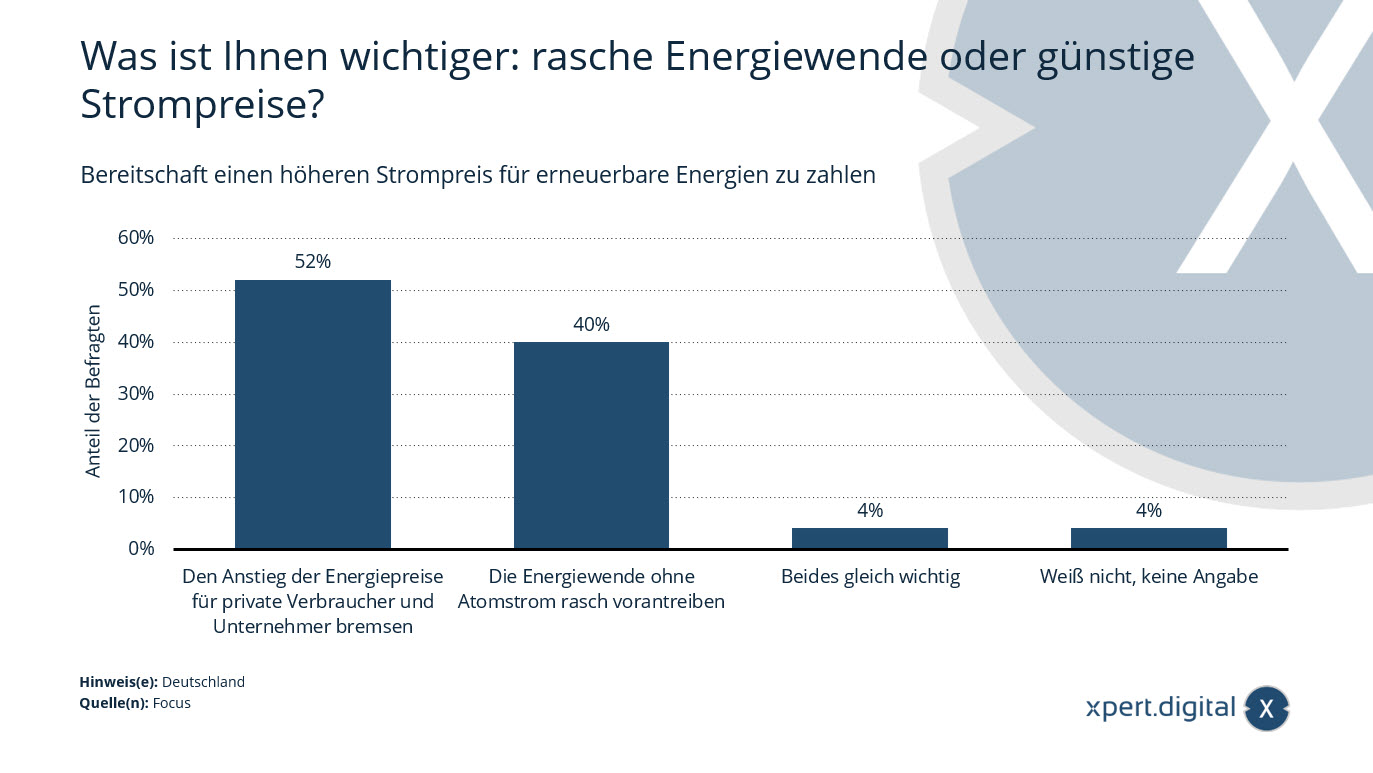
This statistic deals with the results of a survey on the willingness to pay a higher electricity price for the use of renewable energies. At the time of the survey, 52 percent of respondents stated that the increase in energy prices for private consumers and businesses should be slowed.
What is more important to you: a rapid energy transition or cheap electricity prices?
- Slowing the rise in energy prices for private consumers and businesses – 52%
- Rapidly advance the energy transition without nuclear power – 40%
- Both equally important – 4%
- Don't know, no information – 4%
*Computer-assisted telephone interviews (CATI); Focus, No. 5/2014, page 16; The source provides no information on the type of survey, the number of respondents, or the time of the survey.
Amount of the EEG surcharge for household electricity customers until 2022
Amount of the EEG surcharge for household electricity customers until 2022 – Image: Xpert.Digital
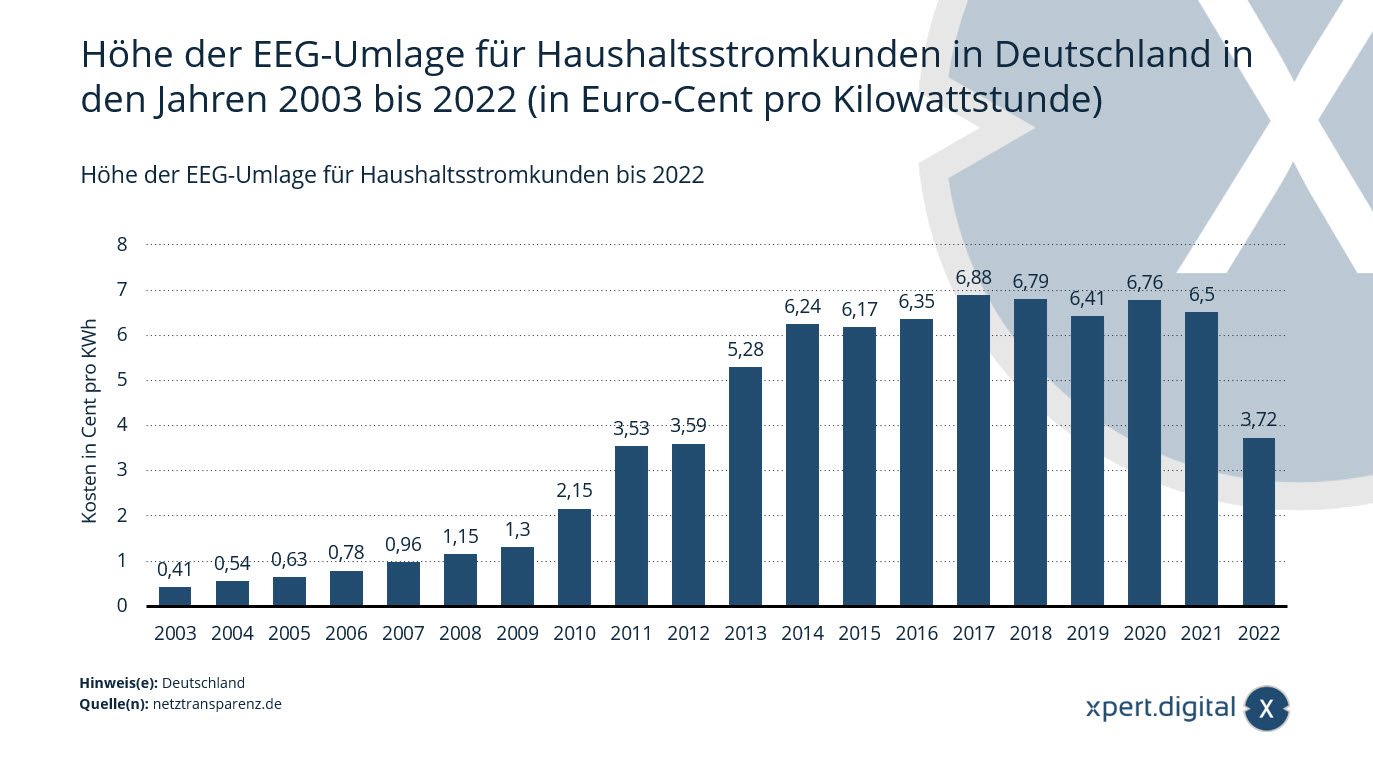
In 2022, private households in Germany paid 3.72 cents per kilowatt-hour of electricity for the EEG surcharge. The EEG surcharge is used to promote renewable energies under the Renewable Energy Sources Act. It is part of the electricity price and represents the difference between the market price for electricity and the feed-in tariff for renewable energy sources.
Composition of the electricity price
In 2020, residential customers in Germany paid an average of 33.8 cents per kilowatt-hour of electricity under the basic supply tariff. The electricity price in Germany is composed of various components. The EEG surcharge, network charges, and the "procurement and distribution" factor have so far accounted for the largest share of the total price.
Industrial electricity prices
Electricity prices for industry in Germany have tended to rise since the turn of the 20th century. However, if prices are considered without taking the levied electricity tax into account, a price decrease can be observed in Germany. As with private households, the electricity price for industry is currently composed primarily of network charges, procurement and distribution costs, and the EEG surcharge. In a European comparison, Malta, Ireland, and Cyprus have the highest industrial electricity prices.
Amount of the EEG surcharge for household electricity customers in Germany in the years 2003 to 2022 (in euro cents per kilowatt hour)
- 2003 – 0.41 euro cents
- 2004 – 0.54 euro cents
- 2005 – 0.63 euro cents
- 2006 – 0.78 euro cents
- 2007 – 0.96 euro cents
- 2008 – 1.15 euro cents
- 2009 – 1.3 euro cents
- 2010 – 2.15 euro cents
- 2011 – 3.53 euro cents
- 2012 – 3.59 euro cents
- 2013 – 5.28 euro cents
- 2014 – 6.24 euro cents
- 2015 – 6.17 euro cents
- 2016 – 6.35 euro cents
- 2017 – 6.88 euro cents
- 2018 – 6.79 euro cents
- 2019 – 6.41 euro cents
- 2020 – 6.76 euro cents
- 2021 – 6.5 euro cents
- 2022 – 3.72 euro cents
*The figures for the years from 2019 onwards were taken from the same publications of the previous year. The figures for the years 2010 to 2018 are taken from the reports of the four transmission system operators. The figures for the years before 2010 are taken from the publication “Exemption of energy-intensive industries in Germany from energy levies”, published in 2012.
Write to me

Xpert.Digital – Konrad Wolfenstein
Xpert.Digital is a hub for industry with a focus on digitalization, mechanical engineering, logistics/intralogistics and photovoltaics.
With our 360° business development solution, we support well-known companies from new business to after sales.
Market intelligence, smarketing, marketing automation, content development, PR, mail campaigns, personalized social media and lead nurturing are part of our digital tools.
You can find out more at: www.xpert.digital – www.xpert.solar – www.xpert.plus
Keep in touch