Physical AI: As machines learn to touch the world, manufacturing faces its biggest transformation since the steam engine.
Xpert pre-release
Language selection 📢
Published on: December 1, 2025 / Updated on: December 1, 2025 – Author: Konrad Wolfenstein

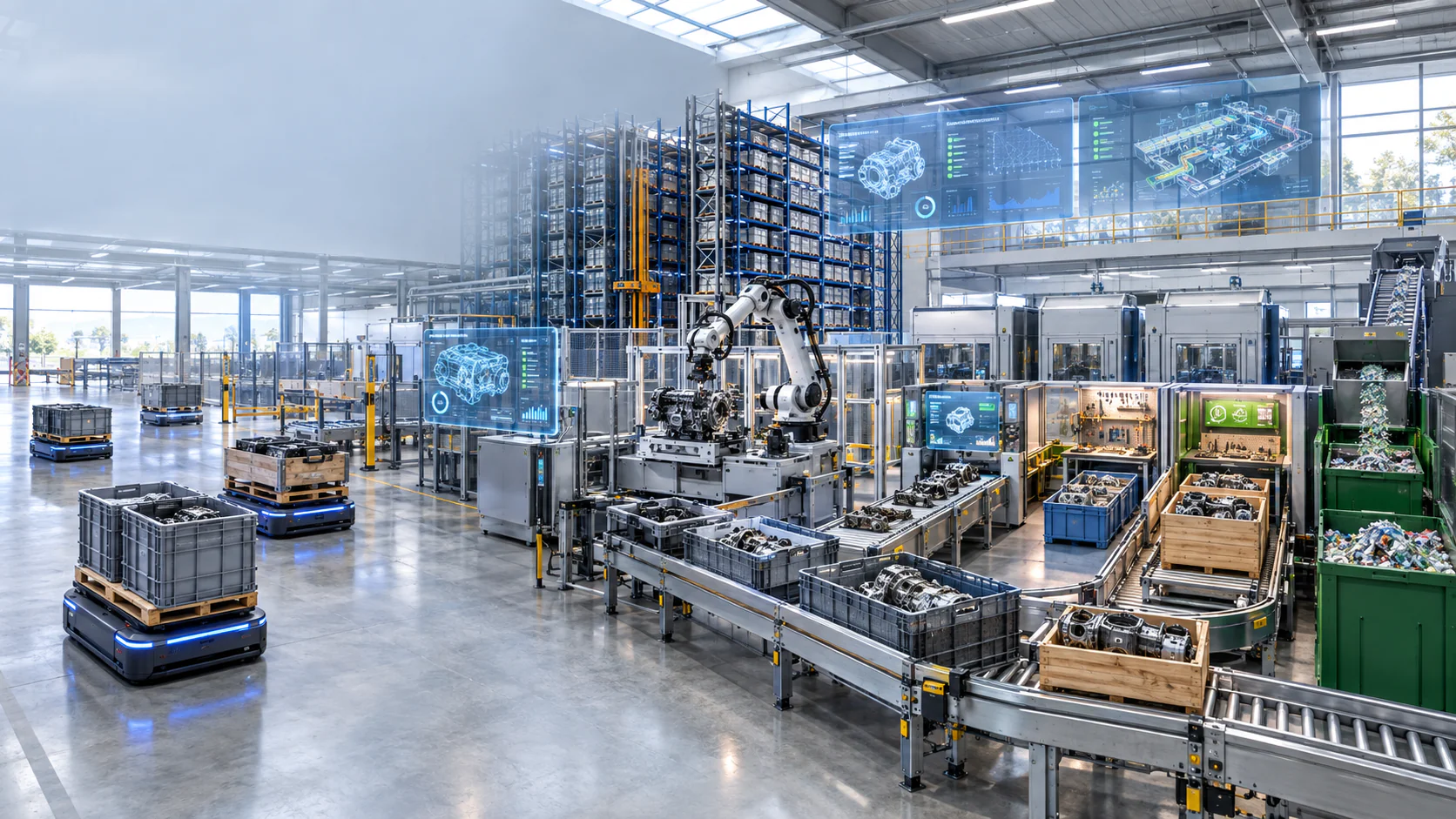
Physical AI: When machines learn to touch the world, manufacturing faces its biggest transformation since the steam engine – Creative image: Xpert.Digital
Robotics & Physical AI - The End of Pure Software AI: When Algorithms Learn to Touch the World
Industry shock or once-in-a-century opportunity? Robot colleagues instead of mass layoffs? The surprising truth about physical AI in the workplace
While the world is still marveling at ChatGPT's texts, the industry is preparing for a far more radical transformation: Physical AI takes artificial intelligence out of the computer case and gives it a physical form. An analysis of the merging of bits and atoms.
In recent years, generative AI models like ChatGPT and Gemini have dominated the headlines, transforming the way we write, generate images, and program. But while these systems operate in the purely digital realm, a silent yet massive revolution is taking place in the background, one whose impact will fundamentally shake the physical reality of our economy more than any purely software-based solution before it. We are at the dawn of the age of "Physical AI"—physical artificial intelligence.
Physical AI marks the historic moment when machine learning leaves the theoretical realm and begins to literally touch the world. It is the symbiosis of advanced robotics, highly sensitive sensors, and new foundation models that allows machines to no longer simply execute instructions blindly, but to see, feel, understand, and act autonomously. From the factory floors at BMW in Spartanburg to Amazon's futuristic logistics centers, the boundary between digital intelligence and mechanical labor is dissolving.
For industrialized nations like Germany, whose prosperity is traditionally based on excellent mechanical engineering and precision manufacturing, this development is far more than just a technological trend. It is the "iPhone moment" of robotics – a phase in which hardware and software merge to create a new level of performance. The World Economic Forum sees this as the key to future industrial competitiveness. But what opportunities lie when humanoid robots like Tesla's Optimus or Figures 02 work side by side with humans? What risks do machines that independently interpret their environment pose?
This article illuminates the anatomy of this technological disruption. We analyze the path from the first rigid industrial robots to NVIDIA's visionary GR00T project, examine the complex infrastructure of sensors and world models, and take a critical look at the challenges—from safety to the energy consumption of these systems. Learn why physical AI is arguably the biggest revolution for manufacturing since the steam engine and why now is the crucial moment to act.
Suitable for:
- The global race for technological supremacy in robotics – a comparison of the USA, Asia, China, Europe, and Germany
The merging of intelligence and matter: Why robotics and physical AI are changing everything
The industrial world is at a turning point, comparable in its significance to the first industrial revolution. While generative AI systems like ChatGPT or Gemini have dominated public attention in recent years, a far more fundamental transformation is taking place in the background: Physical artificial intelligence, known as Physical AI in the English-speaking world, is for the first time directly connecting the digital world of algorithms with the physical reality of factories, warehouses, and supply chains.
Physical AI describes AI systems embedded in physical bodies that can interact with the real world. Unlike traditional software AI, which operates exclusively in the digital realm, these systems combine perception, decision-making, and physical action in a closed control loop. The machines see through cameras and LiDAR sensors, they feel through tactile sensors, they think through foundation models, and they act through actuators and manipulators. This integration opens up entirely new possibilities for production and logistics that go far beyond the capabilities of traditional industrial robots.
The strategic importance of this development can hardly be overstated. The World Economic Forum identifies physical AI as a key enabler for industrial resilience and competitiveness, and predicts that companies that act now and integrate robotics as a strategic asset will lead the next phase of industrial competitiveness. For Germany, as a leading industrial nation with its strong foundation in mechanical engineering, mechatronics, and precision manufacturing, this presents a historic opportunity, but also a significant risk if it misses the boat.
This article comprehensively analyzes what constitutes physical AI, the components and infrastructure required, and how this technology is fundamentally transforming production and logistics. The analysis is structured into historical development, technical foundations, the current state of implementation, concrete practical examples, critical challenges, and a well-founded outlook on future developments.
From Unimate to GR00T: The long road to machine-based body intelligence
The roots of physical AI reach back to the early 1960s, when the first industrial robot, named Unimate, was deployed on an assembly line at General Motors. This simple robotic arm marked the beginning of industrial automation, but its capabilities were strictly limited to predefined, repetitive movements. The vision of equipping machines with true intelligence and adaptability remained an academic research topic for decades.
A significant milestone was the development of Shakey at the Stanford Research Institute in 1969, the first mobile robot capable of reflecting on its own actions. Shakey combined robotics, computer vision, and natural language processing, making it the first project to link logical reasoning with physical action. Nevertheless, practical applications remained limited, and the AI winters of the 1970s and 1990s significantly slowed progress.
The real breakthrough came with the deep learning boom starting in 2012, when AlexNet won the ImageNet Challenge, ushering in a new era of machine learning. These advances in image processing and pattern recognition laid the foundation for today's physical AI by enabling machines to visually understand their environment for the first time. The development of Generative Adversarial Networks (GANs) from 2014 onward, and later of Transformer architectures, further accelerated this development.
The years 2023 and 2024 finally mark the beginning of the true Physical AI era. In March 2024, NVIDIA unveiled Project GR00T at the GTC conference, a foundational model for humanoid robots designed to understand natural language and mimic movements by observing human actions. Jensen Huang, CEO of NVIDIA, stated: “The age of generalist robotics has arrived. With NVIDIA Isaac GR00T N1 and new frameworks for data generation and robot learning, robotics developers worldwide will unlock the next frontier in the AI age.”
Since then, development has accelerated dramatically. In May 2025, Isaac GR00T N1.5 was unveiled, followed by N1.6 in September 2025, which for the first time enabled humanoid robots to move and manipulate objects simultaneously. The Open Physical AI Dataset on Hugging Face has already been downloaded over 4.8 million times and contains thousands of synthetic and real-world motion trajectories. This rapid development underscores how quickly the field is evolving and how rapidly established boundaries of what is technically feasible are being pushed.
The anatomy of physical intelligence: hardware, software, and infrastructure
The technical architecture of physical AI systems can be divided into several interconnected layers that together enable the ability to perceive, process and physically interact with the environment.
The sensory system forms the perceptual level and comprises various sensor types that work together to create a comprehensive picture of the environment. Camera systems, including RGB cameras, depth cameras, and time-of-flight sensors, provide visual data for computer vision tasks such as object detection, tracking, and semantic segmentation. LiDAR and radar generate precise 3D maps of the environment and are essential for navigation and obstacle detection. Inertial measurement units (IMUs) with accelerometers and gyroscopes detect motion, orientation, and acceleration, contributing to the stabilization of physical systems. Tactile and force-torque sensors enable sensitive manipulation and safe human-robot collaboration by registering touch and pressure.
Mechanical hardware represents the physical substrate through which AI systems interact with their environment. Chassis and frame structures provide the structural basis for robotic systems of various forms: humanoid robots, robotic arms, autonomous mobile robots (AMRs), drones, or hybrid systems. Actuators convert electrical signals into mechanical motion and include electric motors, pneumatic and hydraulic systems, as well as novel soft robotics components that mimic biological muscles. Advanced end effectors, such as adaptive grippers with force feedback, enable the manipulation of a wide variety of objects, from rigid metal parts to delicate food products.
The software and AI layer represents the cognitive core of physical AI systems. Foundation models like NVIDIA's GR00T form the core and integrate vision language models (VLMs) for understanding multimodal inputs with action decoders that translate these representations into executable robot movements. These models enable zero-shot learning, where robots can perform new tasks without explicit training, simply by interpreting natural language instructions. Reinforcement learning and imitation learning are used to train robust behavioral strategies in simulated and real-world environments.
Simulation infrastructure plays a central role in the development and validation of physical AI systems. NVIDIA Isaac Sim enables the design, simulation, and testing of AI-controlled robots in physically accurate virtual environments. The PhysX engine simulates realistic physics, including joint friction, rigid-body dynamics, and contact mechanics. Digital twins, or virtual replicas of real-world facilities, allow robots to be trained in thousands of scenarios without compromising the physical infrastructure. The market for sensor fusion technology reached $8 billion in 2023 and is projected to grow to $34.9 billion by 2035, highlighting the increasing importance of these technologies.
The computing infrastructure provides the necessary processing capacity. Edge computing platforms like NVIDIA Jetson Thor with Blackwell GPUs enable the execution of complex AI models directly on the robot with latencies of less than 20 milliseconds. Cloud systems support the training and orchestration of large robot fleets. NVIDIA OSMO coordinates complex robotics workflows across distributed computing resources. 5G networks with sub-millisecond latencies enable real-time processing even for bandwidth-intensive applications.
Finally, physical AI systems require a data infrastructure for training and operation. World Foundation Models like NVIDIA Cosmos simulate real-world dynamics and generate synthetic training data. The GR00T Dreams blueprint can generate large amounts of synthetic motion data for training new behaviors. Open-source datasets like the Physical AI NuRec Dataset on Hugging Face provide robotics training data for researchers and developers.
The silent transformation: Physical AI in factories and warehouses
The current state of physical AI implementation paints a picture of accelerated adoption and increasing industrial maturity. By 2023, over 4 million industrial robots had been installed worldwide. Annual installations are projected to increase by a further 6 percent in 2025 and exceed 700,000 units by 2028. The intralogistics automation market is expected to reach $69 billion in 2025, while the supply chain AI market is projected to grow to over $21 billion by 2028.
In the manufacturing industry, physical AI is manifesting itself in several application domains. Adaptive manufacturing enables robots to react in real time to variations in materials, positions, and orientations of components. Where traditional industrial robots had to be painstakingly reprogrammed for every change, physical AI systems can understand and execute instructions in natural language. This flexibility perfectly aligns with modern manufacturing trends such as high-mix, low-volume production and customized manufacturing.
Predictive maintenance uses AI systems and sensor data to forecast malfunctions, thereby reducing unplanned downtime and costs. Computer vision systems can inspect thousands of products per minute and detect defects invisible to the human eye. Integrating physical AI into quality control leads to significantly reduced error rates and higher product quality.
In logistics, autonomous mobile robots (AMRs) are transforming warehouses and distribution centers. The mobile robot market is projected to reach $29.86 billion by 2025. AMRs differ fundamentally from older automated guided vehicles (AGVs) in their ability to navigate autonomously, optimize routes using AI, and dynamically adapt to changing environments. While AGVs follow fixed routes along floor markings, AMRs utilize SLAM (Simultaneous Localization and Mapping) technology and AI algorithms for flexible navigation.
Warehouse management system (WMS) adoption now exceeds 90 percent, and AI-powered inventory management can optimize stock levels by 35 percent. Pick-and-pack robots with computer vision and advanced grippers are increasingly automating tasks previously considered too complex for machines. Drones are being used for inventory counts and can generate savings of over $250,000 per year.
The workforce transformation shows that physical AI is not just replacing jobs, but also creating new roles. Human-robot teams are demonstrably 85 percent more productive than all-human or all-robot teams. New job profiles are emerging, such as robot supervisor, AI trainer, fleet coordinator, and AI-assisted inspector. Amazon reports a 30 percent increase in skilled roles after introducing advanced robotics in its fulfillment centers.
A new dimension of digital transformation with 'Managed AI' (Artificial Intelligence) - Platform & B2B Solution | Xpert Consulting

A new dimension of digital transformation with 'Managed AI' (Artificial Intelligence) – Platform & B2B Solution | Xpert Consulting - Image: Xpert.Digital
Here you will learn how your company can implement customized AI solutions quickly, securely, and without high entry barriers.
A Managed AI Platform is your all-round, worry-free package for artificial intelligence. Instead of dealing with complex technology, expensive infrastructure, and lengthy development processes, you receive a turnkey solution tailored to your needs from a specialized partner – often within a few days.
The key benefits at a glance:
⚡ Fast implementation: From idea to operational application in days, not months. We deliver practical solutions that create immediate value.
🔒 Maximum data security: Your sensitive data remains with you. We guarantee secure and compliant processing without sharing data with third parties.
💸 No financial risk: You only pay for results. High upfront investments in hardware, software, or personnel are completely eliminated.
🎯 Focus on your core business: Concentrate on what you do best. We handle the entire technical implementation, operation, and maintenance of your AI solution.
📈 Future-proof & Scalable: Your AI grows with you. We ensure ongoing optimization and scalability, and flexibly adapt the models to new requirements.
More about it here:
Efficiency leap with Physical AI: How robot fleets, digital twins and 5G are transforming industry
Pioneers of body intelligence: BMW, Amazon and Tesla show the way
The practical implementation of physical AI can be illustrated by several pioneering companies that have already achieved significant success.
The BMW plant in Spartanburg, South Carolina, represents one of the most advanced use cases for humanoid robots in automotive production. Figure AI tested its Figure 02 robot there for 11 months. The results are remarkable: The robot ran for ten hours a day on every production day, loaded over 90,000 parts, logged more than 1,250 operating hours, and contributed to the production of over 30,000 X3 vehicles. Its task involved loading sheet metal parts, requiring both precision and speed. Parts had to be positioned with a tolerance of 5 millimeters in just 2 seconds.
Compared to its predecessor, the Figure 02 achieved four times the operating speed and seven times improved reliability. These results led to the development of its successor, the Figure 03, whose design incorporated the insights gained. The forearm subsystem, in particular, was completely redesigned, as it had proven to be the most frequent point of hardware failure.
Amazon operates the world's largest robot fleet, with over one million robots in 300 fulfillment centers. The company has introduced a new generative, AI-based foundational model called DeepFleet, which optimizes the coordination of the entire robot fleet and improves driving efficiency by 10 percent. Three core technologies form the backbone of the system: Sequoia, an automated storage and retrieval system; Sparrow, an AI-powered manipulator capable of handling approximately 60 percent of all items in the product range; and Proteus, a collaborative autonomous mobile robot.
The new Blue Jay system coordinates multiple robotic arms to perform various handling tasks simultaneously, reducing repetitive lifting for employees. Remarkably, its development time was accelerated: while previous robotic systems like Robin, Cardinal, and Sparrow required more than three years of development, Blue Jay, thanks to AI support and digital twins, went from concept to production in just over a year. Amazon's most advanced facility in Shreveport, Louisiana, achieves 25 percent faster deliveries and 25 percent greater efficiency while creating 30 percent more skilled jobs.
With its Optimus project, Tesla is pursuing one of the most ambitious visions in the field of humanoid robots. While the original plan was for 5,000 to 10,000 units by 2025, actual production has so far reached only a few hundred. Nevertheless, Elon Musk remains committed to his long-term vision: At the 2025 Tesla annual meeting, he announced the fastest production ramp-up of any complex manufactured product ever, starting with a line capable of producing one million units per year in Fremont. The long-term vision includes 10 million units per year at Giga Texas and, in the long run, up to one billion Optimus robots per year.
The projected price of $25,000 to $30,000 for the Tesla Optimus G2 would make it a relatively affordable option for businesses. For comparison, the Unitree H1 costs under $90,000, while the Figure 01 is estimated at $30,000 to $150,000.
Suitable for:
- “Physical AI” & Industry 5.0 & Robotics – Germany has the best opportunities and prerequisites in physical AI
The dark side of the revolution: risks and unresolved questions
Despite the impressive progress, the physical AI industry faces significant challenges that require critical examination.
The security of physical AI systems requires entirely new frameworks and approaches. Physical AI systems exhibit security vulnerabilities similar to those of industrial automation controllers, with the difference that they often contain millions of lines of code, thus presenting an enormous attack surface. Unlike in traditional automation environments, where a de-energized state often corresponds to a safe state, a simple shutdown function is insufficient for physical AI. Humans interact with these systems unpredictably, which is why multiple shutdown mechanisms are necessary.
The problem of AI hallucinations presents one of the greatest challenges. If AI systems misidentify objects or misjudge situations due to hallucinations, the consequences in physical environments can be dangerous. Viral videos have already shown a robot stepping on a child's foot, apparently because the system failed to correctly detect or appropriately react to a human presence. These incidents underscore the critical importance of sensitive sensor detection and adaptive safety protocols.
The skills shortage and skills gap represent another key challenge. The World Economic Forum's Future of Jobs Report 2025 identifies skills gaps as the biggest barrier to business transformation, with 63 percent of employers citing this as a major obstacle. The EY 2025 Work Reimagined Survey reveals a critical discrepancy: While 37 percent of employees fear that excessive reliance on AI could erode their skills, only 12 percent receive sufficient AI training. Employees who receive over 81 hours of annual AI training report an average productivity increase of 14 hours per week, but are also 55 percent more likely to leave the company due to the high demand for AI talent.
The energy consumption of physical AI systems and their associated infrastructure is growing dramatically. Training GPT-4 consumed an estimated 50 gigawatt-hours of electricity, roughly 40 times more than GPT-3. The International Energy Agency warns that the electricity demand of data centers will more than double by 2030, potentially reaching 1,050 terawatt-hours, exceeding Japan's total current energy consumption. A single AI data center can consume as much energy as 100,000 households.
The labor market impact requires a nuanced perspective. An MIT study found that AI could already replace 11.7 percent of US jobs, with at-risk occupations spread across all 50 states, including rural areas typically excluded from AI discussions. Internal Amazon documents suggest that its robotics strategy could eliminate the need to hire 160,000 workers in just two years. The company's robotics team aims to automate 75 percent of its operations.
Regulation is lagging behind technological development. The EU AI Act represents the world's first comprehensive AI legal framework, but existing occupational health and safety regulations, such as the Occupational Health and Safety Act or the Industrial Safety Ordinance, reach their limits when dealing with dynamically learning AI systems. The Machinery Directive, which will replace the Machinery Directive in 2027, addresses systems with self-evolving behavior, but does not contain conclusive requirements for ongoing conformity assessments in the event of system changes.
The next decade: World Models, Humanoids and the autonomous factory
The future of physical AI is characterized by several converging trends that will shape the next decade.
World Foundation models are becoming a critical enabler for physical AI. These advanced AI systems are designed to simulate and predict real-world environments and their dynamics. They understand fundamental physical principles such as motion, force, causality, and spatial relationships, enabling them to simulate how objects and entities interact within an environment. Meta's V-JEPA 2, with 1.2 billion parameters, was trained on over a million hours of video and sets new benchmarks in physical reasoning and zero-shot robot planning. Google's Genie 3 and World Labs' Marble represent other significant developments in this field.
Synthetic data generation solves the critical training bottleneck for physical AI. The GR00T Dreams blueprint enables the generation of large amounts of synthetic motion data from a single input image. Using this technology, NVIDIA Research was able to develop GR00T N1.5 in just 36 hours, compared to almost three months of manual data collection. This acceleration will drastically shorten development cycles for physical AI systems.
Humanoid robots are on the verge of mass production. Goldman Sachs forecasts 50,000 to 100,000 humanoid units shipped worldwide in 2026, with manufacturing costs falling to $15,000 to $20,000 per unit. By 2035, industry forecasts predict 1.3 billion AI-powered robots could be in use globally. The global market for humanoid robots will reach $6 billion by 2030 and grow to $51 billion by 2035. Investments in robotics and embodied AI are expected to reach a cumulative $400 billion to $700 billion between 2026 and 2030.
The convergence of physical AI with spatial computing and extended reality opens up new dimensions. Yann LeCun, Meta's Chief AI Scientist, emphasizes that LLMs are not a path to human-like AI and shifts the focus to physical AI, which combines perception, reasoning, and control in three-dimensional spaces. Fei-Fei Li's new company, World Labs, identifies itself as a spatial intelligence company focused on models that can perceive, generate, and interact with three-dimensional environments.
Edge computing and 5G integration will dramatically expand the real-time capabilities of physical AI systems. 5G networks reduce response times from 100 milliseconds to less than one millisecond, enabling true real-time control. Private 5G networks give organizations direct control over their edge computing environments with precise latency and bandwidth requirements. Network slicing enables dedicated bandwidth for critical edge applications.
The automation landscape will continue to differentiate. Three robot system types will coexist and form a layered automation strategy: rule-based robotics for structured, repetitive tasks with unsurpassed precision; training-based robotics for variable tasks using reinforcement learning; and context-based robotics with zero-shot learning for unpredictable processes and new environments.
From simulation to smart machine: How Physical AI accelerates Industry 4.0
The analysis of physical AI reveals a technological revolution unfolding at an unprecedented pace, fundamentally transforming production and logistics. The convergence of AI algorithms, advanced sensors, powerful computing infrastructure, and innovative robotics hardware has reached a point where, for the first time, machines can perceive and interact with the physical world with a level of intelligence and adaptability previously reserved for humans.
The technological foundations are in place. Foundation models like GR00T enable zero-shot learning and natural language instruction. Simulation environments like Isaac Sim drastically reduce development time and costs. Synthetic data generation solves the critical training bottleneck. Advanced sensors and actuators give machines perception and dexterity. Edge computing and 5G provide the necessary real-time capability.
Practical validation is already underway on an industrial scale. BMW, Amazon, Foxconn, and numerous other companies are demonstrating the feasibility and benefits of physical AI in real-world production and logistics environments. The results are compelling: accelerated cycle times, improved quality, increased flexibility, reduced costs, and new, more skilled jobs.
At the same time, these challenges demand serious attention. Security, energy consumption, skills gaps, regulatory ambiguities, and potential labor market disruptions must be addressed proactively. Companies implementing physical AI need not only technological expertise but also a clear strategy for workforce transformation and social responsibility.
This presents a historic opportunity for Germany and Europe. Physical AI requires not only digital intelligence, but also excellent mechatronics, precision engineering, and deep domain expertise. These strengths are deeply rooted in German industry. Integrating AI into physical systems can build on an established industrial foundation and transform it for the age of intelligent automation.
The time for strategic action is now. Companies that embed physical AI as a strategic asset today will lead the next phase of industrial competitiveness. The revolution is no longer theoretical; it is already happening, and its pace is accelerating. The question is no longer whether physical AI will transform industry, but who will lead this transformation and who will be overtaken by it.
Your global marketing and business development partner
☑️ Our business language is English or German
☑️ NEW: Correspondence in your national language!
I would be happy to serve you and my team as a personal advisor.
You can contact me by filling out the contact form or simply call me on +49 89 89 674 804 (Munich) . My email address is: wolfenstein ∂ xpert.digital
I'm looking forward to our joint project.
☑️ SME support in strategy, consulting, planning and implementation
☑️ Creation or realignment of the digital strategy and digitalization
☑️ Expansion and optimization of international sales processes
☑️ Global & Digital B2B trading platforms
☑️ Pioneer Business Development / Marketing / PR / Trade Fairs
🎯🎯🎯 Benefit from Xpert.Digital's extensive, five-fold expertise in a comprehensive service package | BD, R&D, XR, PR & Digital Visibility Optimization

Benefit from Xpert.Digital's extensive, fivefold expertise in a comprehensive service package | R&D, XR, PR & Digital Visibility Optimization - Image: Xpert.Digital
Xpert.Digital has in-depth knowledge of various industries. This allows us to develop tailor-made strategies that are tailored precisely to the requirements and challenges of your specific market segment. By continually analyzing market trends and following industry developments, we can act with foresight and offer innovative solutions. Through the combination of experience and knowledge, we generate added value and give our customers a decisive competitive advantage.
More about it here: