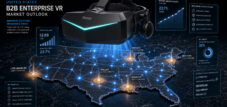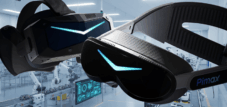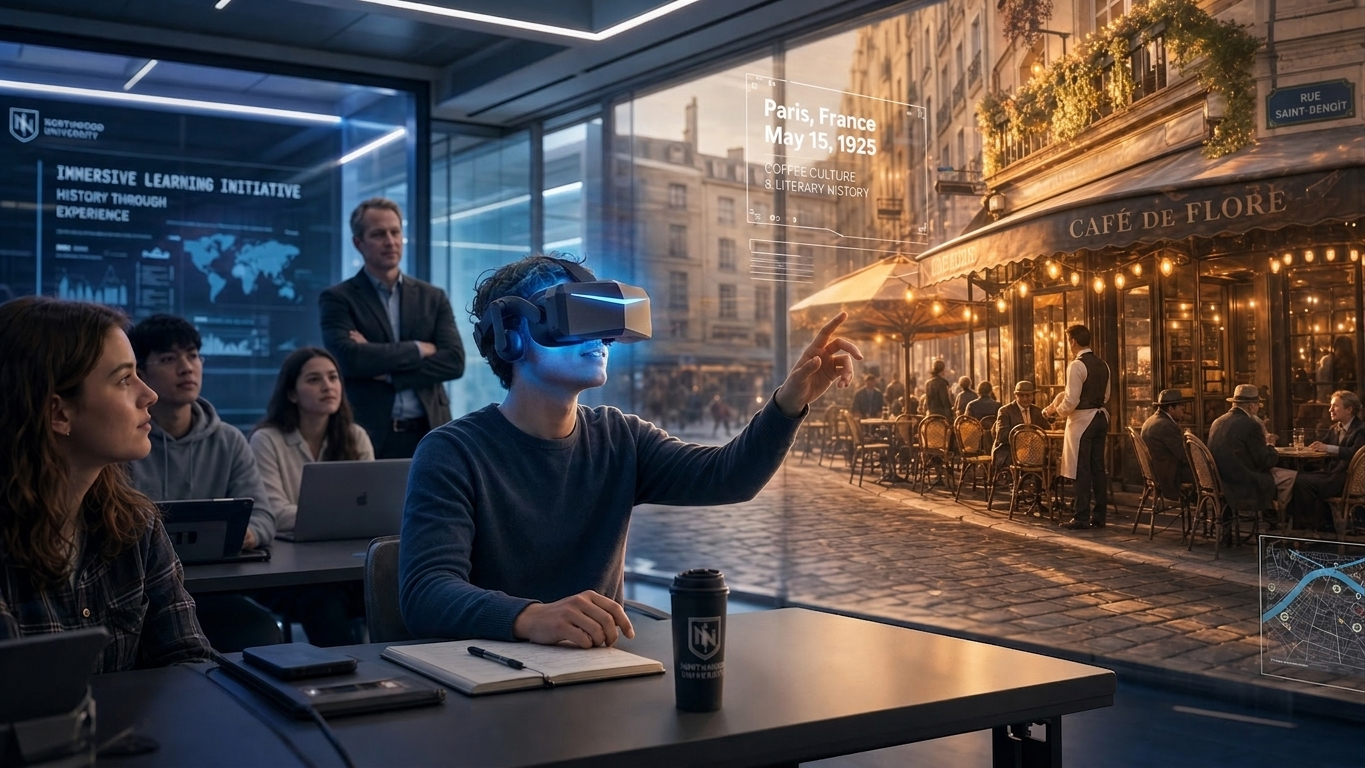
VR-supported language teaching at Chinese universities: The Beihang-Pimax project as a signpost for a global education revolution – Image: Xpert.Digital
Classrooms of the future: Why a Chinese elite university relies on high-end VR instead of textbooks
The multi-billion dollar business of education: What Western universities can learn from China's PR strategy
Anyone learning a foreign language knows the problem: grammar and vocabulary are memorized perfectly, but in real life – be it at the Paris airport or in a French supermarket – the words suddenly fail you. In the Chinese education debate, this widespread phenomenon has long been aptly described as "silent French." To finally close the gap between rote memorization and fluent, intuitive language use, the Sino-French Institute at Beihang University, in cooperation with hardware manufacturer Pimax Technology, is taking an innovative approach: they are bringing everyday French life directly into the lecture hall using high-resolution virtual reality (VR) and artificial intelligence.
But this ambitious project is far more than a fascinating technological gimmick. It sheds entirely new light on learning theory, ruthlessly calculates when immersive education truly becomes economically viable, and incidentally illustrates China's rapid ambitions in the global EdTech market. A deep insight into a flagship project that could serve as a blueprint for a worldwide educational revolution – and a critical examination of the blind spots of digital immersion.
Beihang University is one of China's most prestigious technical universities and was founded in Beijing in 1952 as a university of aeronautics and astronautics. Its official Chinese name remains Beijing Hangkong Hangtian Daxue. For decades, the institution was known internationally by its English name, Beijing University of Aeronautics and Astronautics, abbreviated BUAA. However, in 2002, the university administration decided to adopt the abbreviation Beihang, which had been used in China since its founding and is composed of the first syllables of the Chinese name, for its international presence. Since then, the university has used the name Beihang University in English-language publications, international collaborations, and scientific papers, while within China, the full Chinese name continues to be the official name. This dual approach is not unique but follows a common pattern among top Chinese universities, which deliberately decouple their international brand identity from their domestic name to maintain a memorable and unambiguous name in the global academic arena.
When the classroom wall becomes the border – and VR tears it down
Anyone learning French in China finds themselves in a paradoxical situation: a language that thrives on rhythm, intonation, cultural context, and social awareness is taught in learning environments that systematically exclude all of these elements. The classroom offers grammar rules, vocabulary lists, conjugated verbs—but no Parisian brasserie, no French classmates, no situation where a wrong expression elicits a friendly laugh instead of a failing grade. The result is a phenomenon now openly referred to in Chinese educational discourse as "silent French": students who pass exams but can't hold a functioning conversation at the baggage claim of Charles de Gaulle Airport.
This gap between declarative knowledge and procedural competence is not a problem specific to China. It affects foreign language teaching worldwide. However, it is particularly critical at universities that aim to cultivate international talent—such as the Sino-French Institute at Beihang University. Beihang currently operates three Sino-French cooperative institutions in Beijing and Hangzhou, educates around 500 students annually in dual-degree programs, and collaborates closely with French partner universities like the École Centrale de Lyon. Those who want to enable these students to pursue genuine international careers cannot afford to teach "silent French.".
The answer to this structural failure of traditional language teaching methods is not a better textbook or a more motivating teaching style. It lies in a technological bridge: the targeted use of virtual reality to bring the missing real-life experience into the classroom. This is precisely the approach pursued by the collaboration between Pimax Technology and the Beihang Institute – and it does so with a technical and pedagogical depth that goes far beyond a mere marketing concept.
Related to this:

Situated learning meets kilobytes per pixel
To understand the educational significance of the Beihang project, one must briefly delve into learning theory. The concept of "situated learning," developed by Jean Lave and Etienne Wenger in the late 1980s, posits that knowledge is most effectively acquired in the context in which it is intended to be used. Language is, by definition, situated knowledge: it gains meaning through its social and spatial context, through nonverbal signals, and through the consequences of correct and incorrect formulations. The traditional classroom abstracts this context into meaninglessness. VR, on the other hand, can reconstruct it, at least approximately.
The VR French classroom, developed by Pimax Technology for the Sino-French Institute, comprises over 20 typical everyday scenarios modeled on the course of studying in France: arrival at the airport, university registration, opening a bank account, grocery shopping, doctor's appointments, and social events. Each of these scenarios is not designed as a passive visualization, but as an interactive field of action in which AI-controlled virtual characters – customs officers, professors, landlords, fellow students – react to the students' speech.
What makes this responsiveness technically possible is an integrated natural language processing (NLP) engine combined with highly precise speech recognition. The system not only recognizes the spoken content but also analyzes pronunciation accuracy, fluency, and intonation multidimensionally, generating personalized diagnostic reports. This data-driven feedback loop represents a qualitative leap compared to what even dedicated human teachers can achieve in a classroom setting: Simultaneous observation and evaluation of individual speech production among 30 students is simply impossible.
The hardware powering this experience is the Pimax Crystal – a headset considered the highest-resolution consumer device in its class within the VR industry. With 2,880 x 2,880 pixels per eye, a horizontal field of view of up to 125 degrees, Tobii eye tracking at 120 Hz, and local dimming technology with a 20,000:1 contrast ratio, it delivers visual precision that makes immersive illusions significantly more convincing than comparable devices. This isn't just a technical detail, but pedagogically relevant: the more believable the simulation, the more effective the emotional and cognitive engagement of the learners – a connection well-documented in educational psychology as the "presence effect.".
What research really knows about immersive language learning
The enthusiasm for VR-supported learning is understandable, but it shouldn't lead to uncritically paraphrasing the scientific findings. A recent systematic review of randomized controlled trials on foreign language learning with immersive VR, published in early 2026 in Frontiers in Psychology, arrives at a nuanced conclusion: VR interventions show positive effects compared to non-VR-based control conditions in the majority of the studies examined—particularly for vocabulary acquisition, listening comprehension, and, most notably, for the long-term retention of learned material. At the same time, the immediate learning effect, i.e., the short-term knowledge gain directly after the intervention, is considerably less clearly established.
This nuance is important because it explains why VR in language teaching cannot simply be the counterpart to the traditional method, but rather its complement. The strongest effect appears to lie precisely where the classic classroom is weakest: in the contextually grounded, emotionally charged, situational language practice that creates memories that can still be recalled months later. A pilot study with 10- to 11-year-old Spanish-English learners revealed that while language production in the VR environment was less controlled and precise than in traditional lessons, it also exhibited more spontaneous language use, more mediation between learners, and in some cases even higher levels of language proficiency than expected for this age group.
A critical factor repeatedly highlighted by research is cognitive load. VR environments generate increased intrinsic and extrinsic cognitive load, which can potentially reduce the processing capacity available for actual learning. Recent studies show that higher levels of immersion do not automatically lead to better learning outcomes and, in certain contexts, can even lag behind less immersive conditions. For the design of a VR language learning environment, this means that the scenarios must be pedagogically sound, not merely technically impressive. Interactions with virtual characters must be specifically geared towards learning objectives, not sensory overload. The Beihang project addresses this challenge with a three-tiered systems approach that organically links the VR learning system, classroom integration, and language lab – a pedagogically sound structure that mitigates cognitive overload through structuring and tiered complexity.
A doctoral dissertation from the Technical University of Berlin in 2024 explicitly developed a set of criteria for evaluating the quality of VR language learning applications. It confirmed that the use of VR in foreign language learning has a positive impact on learning success and intrinsic motivation – but at the same time, it also identified significant disadvantages that are too often overlooked in the euphoria: technical hurdles, lack of compatibility with existing curricula, accessibility issues, and the still unresolved challenge of systematic quality control for VR content.
The economics of immersion: What VR really costs and what it saves
Behind the educational promise lies a very real economic question: Is the investment in VR classrooms worthwhile? The answer depends on the time horizon, the scaling perspective, and the benchmark – and, with honest calculations, is surprisingly clear.
A widely cited study by PwC on the company-wide use of VR training provides the most methodologically robust reference data. The results are clear: VR learners completed training four times faster than participants in traditional classroom training, were four times more focused, and demonstrated 275% greater confidence in applying what they had learned. In terms of cost per learner, VR becomes cost-equivalent to classroom training with approximately 375 learners and around 52% cheaper with 3,000 learners. With economies of scale reaching 10,000 learners, costs drop to approximately US$53 per person – a fraction of traditional training costs.
These figures are transferable to the educational context at universities, although not directly. The investment logic differs slightly: universities have a lower sensitivity to hourly wages than companies, but a constant influx of new learners, which makes economies of scale quickly achievable. VR scenarios, once developed, can be reused as often as needed without significant additional costs. The alternative – foreign visiting lecturers, excursions to France, exchange programs with the associated logistics and travel expenses – is considerably more expensive in its overall cost calculation, even if the individual investments are less noticeable.
A Forrester report, commissioned by Meta and published in 2026, quantifies the ROI for enterprise VR training at 219% over three years, with a payback period of less than six months. For a reference organization with 10,000 employees and 3,300 VR training participants, total benefits of $6.1 million were identified against costs of $1.9 million. While such figures should be attributed to the client, they reflect a general trend confirmed by independent studies: VR training becomes increasingly economically attractive as the number of users grows.
For the Beihang Institute, this means that the investment in the VR French classroom will not pay for itself over a single cohort, but over the entire lifespan of the university. If 500 students are trained annually in dual degree programs, and even if only a portion of them regularly use the VR French classroom, the saved teaching resources, the reduced use of foreign native speakers, and the improved preparation of students for studying abroad will significantly outweigh the acquisition and development costs – even before factoring in the less quantifiable reputational gains resulting from excellent teaching quality.
🎯🏢🥽 Enterprise XR Solution Hub for B2B projects – from digital twins to customized extended reality solutions

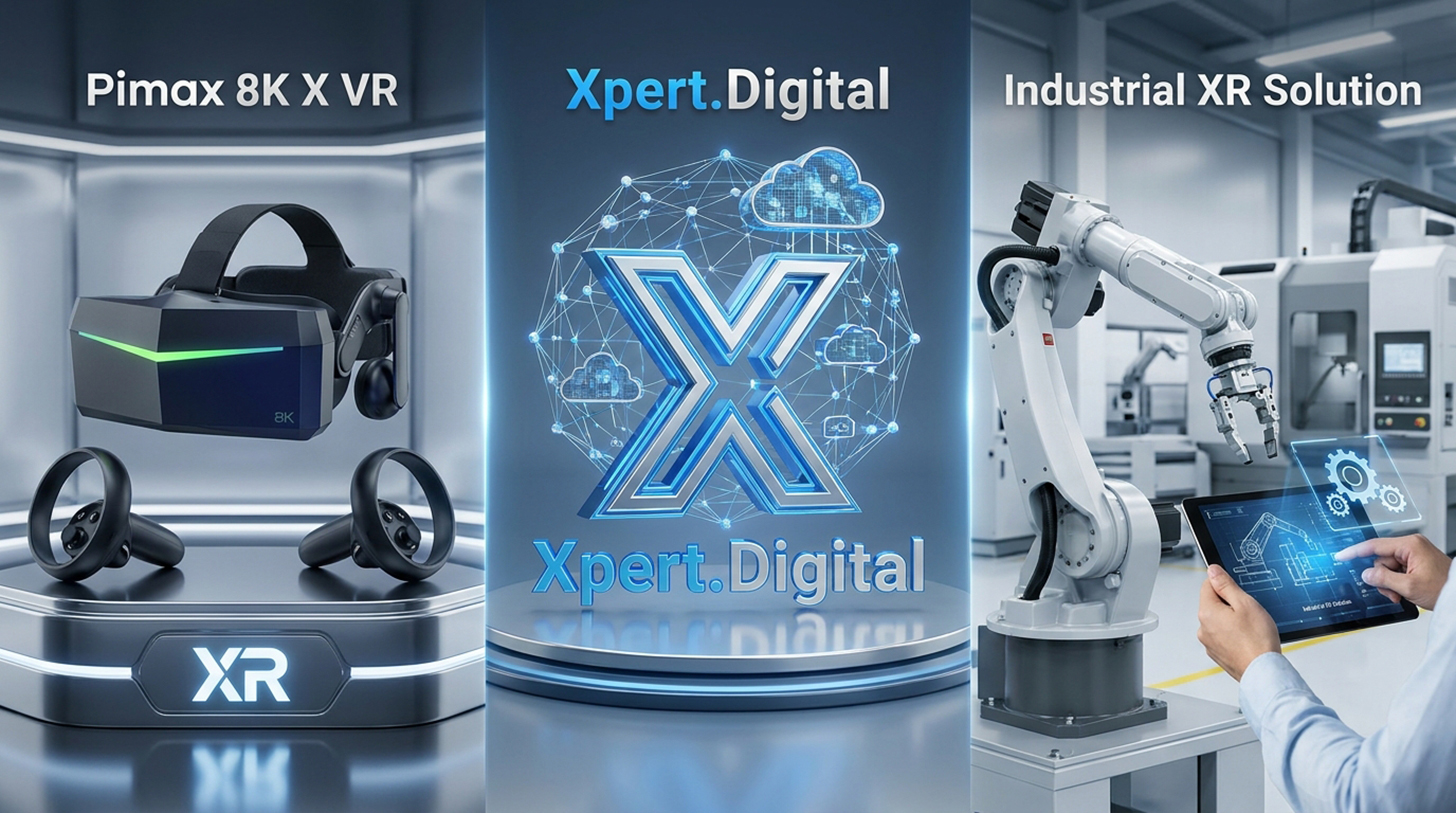
Enterprise XR Solution Hub for B2B projects – from digital twins to customized mixed reality solutions – Image: Xpert.Digital
Xpert.Digital acts as a holistic Enterprise XR Solution Hub, seamlessly integrating high-performance Pimax hardware into industrial B2B workflows. From digital twin analysis in engineering ("top floor") to immersive training on the production floor ("shop floor"), companies receive a customized, comprehensive solution including strategic consulting and support.
More information here:
Data sovereignty, continuous operation and the future of VR teaching: From the lecture hall to simulation
The Chinese market as an accelerator of global VR education adoption
The Beihang-Pimax project is emerging in one of the world's most dynamic markets for VR education technology. The Chinese market for VR education is estimated to reach US$3.2 billion in 2025 and is projected to grow to US$11.1 billion by 2031 – an annual growth rate of 23.1%. Globally, the picture is even more impressive: the worldwide VR education market was valued at US$37.66 billion in 2026 and is expected to expand to US$95.28 billion by 2031, representing an annual growth rate of 20.4%.
These figures did not emerge from a vacuum. They reflect a number of structural drivers that interact particularly intensely in China. First, Chinese education policy is actively promoting the digital transformation of universities and supporting pilot projects that integrate VR and AI into teaching. Pimax was recognized for the Beihang project as the first typical “VR+” case study in Zhejiang province—a state seal of approval that signals to other institutions that they should follow this path. Second, falling hardware prices are lowering the barrier to adoption: What was only affordable for well-funded pilot projects five years ago is now within the reach of regular university budgets. Third, there is a particularly urgent need for improved foreign language acquisition in China, as the country becomes increasingly involved in international collaborations, both economically and scientifically.
Sino-French educational relations provide a particularly revealing micro-example: Over 46,000 Chinese students study in France, while at the same time, French language and literature programs are offered at the bachelor's level at 148 locations in China. The linguistic and intercultural preparation of these students for their studies abroad is therefore a massive educational challenge – and consequently a massive market for technological solutions.
What makes the Beihang project significant beyond its immediate users is its power as a blueprint. The technical architecture—high-resolution VR headset, AI-driven virtual characters, NLP-based language assessment, real-time data tracking, and a teacher control interface—is modular and transferable. The same basic structure can be replicated for other languages, other cultural contexts, and other target languages. Mandarin for European university applicants, Arabic for business partners in the Gulf region, Japanese for engineers in the automotive industry: the scaling potential is considerable.
Pimax Technology: A hardware manufacturer with educational ambitions
Pimax Technology, a Chinese company founded in 2017, specializes in high-resolution VR headsets and has become internationally renowned within just a few years as a manufacturer of some of the most powerful consumer VR devices on the market. The Pimax Crystal offers specifications of 2,880 x 2,880 pixels per eye and a horizontal field of view of up to 125 degrees, significantly exceeding those of competing systems like the MetaQuest or PlayStation VR in the same price range. The latest generation, the Pimax Crystal Super, achieves an even higher resolution of 3,840 x 3,840 pixels per eye and a 135-degree field of view, making it the first commercially available headset with retina-level resolution.
For the education sector, this hardware excellence is strategically important, but not sufficient. What sets Pimax apart in the Beihang project is its ability to develop customized content: The company creates specific course modules depending on the institute's field of study – not just generic VR scenarios, but content tailored to business French, engineering vocabulary, or intercultural social skills. This combination of hardware leadership and software expertise positions Pimax differently in the education market than pure headset manufacturers.
At the same time, a critical assessment is warranted: Pimax is primarily a hardware company whose core competencies lie in optics and display technology. The quality of the AI-driven speech evaluation component, which is crucial for the system's educational effectiveness, depends on software partnerships and the state of the art in NLP technology—a rapidly evolving field in which specialized providers like Nuance, Microsoft, and Chinese AI companies are significantly more established. The long-term competitiveness of the Beihang system will therefore also depend on how Pimax cultivates its software partnerships and how quickly it synchronizes its NLP integration with the advancements of major language models.
Wired PCVR versus Standalone: Why the difference goes beyond gimmicks
Anyone procuring VR headsets for professional educational applications inevitably encounters a fundamental question: Should it be a wired, PC-controlled system – a so-called tethered PCVR – or a self-contained, standalone device like the MetaQuest 3 or 3S? In consumer circles, this question is often decided based on convenience. In a professional university context, as represented by the Beihang-Pimax project, the considerations are different – and structurally, they favor the wired system.
The fundamental technical argument is computing power. Tethered PCVR headsets offload all graphics processing to an external workstation, which can be equipped with desktop GPUs like the NVIDIA RTX 4090. This enables photorealistic scene rendering, complex physics simulations, low-latency NLP processing, and precise real-time speech recognition—precisely the requirements of a highly functional language learning system like the Beihang model. Standalone headsets, on the other hand, rely on mobile processors like the Qualcomm Snapdragon XR2, which, while remarkably powerful, fall far short of the visual quality and processing depth of a mid-range PCVR configuration. For scenarios where the credibility of virtual characters and the precision of speech analysis determine the depth of learning, this gap is pedagogically relevant.
Even more important than computing power in professional applications is the question of battery life. Tethered headsets draw their power directly from the connecting cable and can theoretically operate indefinitely. Standalone devices rely on batteries that last between two and three hours during active use – the Meta Quest Pro, the most powerful standalone Meta headset to date, often only manages one hour of operation in tests. For university courses that include several hours of immersive language exercises, this energy limit is not a minor issue, but an operational bottleneck that creates additional logistical effort due to rotation management, charging infrastructure, and service interruptions.
Added to this is the question of data sovereignty and institutional control – an aspect that has particular political significance in the educational context of publicly funded universities. Meta devices are structurally linked to the meta ecosystem. Until early 2026, every scalable enterprise or educational installation required a paid subscription to Meta Horizon Managed Services (MHMS) at a cost of $179.99 per device per year – in addition to third-party MDM solutions costing between $84 and $120 per device annually. While Meta made the MHMS subscription free of charge from February 20, 2026, it simultaneously discontinued sales of Enterprise and Education SKUs as well as the Horizon Managed Services program itself – with a program end for the Quest 3 and Quest 3S announced for January 4, 2030. Institutions currently relying on Meta are building their educational infrastructure on an ecosystem whose business continuity in the enterprise segment is already in question. Furthermore, in spring 2026, the European Parliament officially inquired with the European Commission whether Meta's data processing practices – particularly the transfer of biometric user data to external AI training processes – were compliant with the GDPR. For European and Chinese universities that process sensitive speech biometric and learning behavior data, the question of data sovereignty is not an abstract compliance debate, but an institutional due diligence obligation.
A PCVR system based on the Pimax Crystal, connected to an institution's own workstation infrastructure, structurally avoids these dependencies. The hardware belongs to the university, the data remains on the institution's own servers, and the operating model is not subject to any external subscription requirements imposed by a US social media company. This self-determination over their own learning infrastructure is a tangible strategic advantage for universities that operate internationally and must comply with the data protection requirements of different legal systems.
Finally, display quality deserves a precise assessment. The Pimax Crystal offers 2,880 × 2,880 pixels per eye, a horizontal field of view of 125 degrees, and a contrast ratio of 20,000:1. The Meta Quest 3 achieves 2,064 × 2,208 pixels per eye with a horizontal field of view of approximately 110 degrees. The difference may sound like a minor specification detail, but in practical terms, it is significant: sharper facial features of virtual characters, more believable depth of field, and legible text in simulated documents and signs. These are all parameters that are crucial for the cognitive persuasiveness of a learning simulation. The brain doesn't judge credibility based on resolution specifications—it judges it based on whether the scene appears like reality. And here, in 2026, the wired PCVR architecture still holds a clearly measurable advantage.
The decision to use tethered PCVR in the Beihang project is therefore not a preference for a cable over convenience. It is a decision for compelling visuals, energy efficiency in continuous operation, institutional data sovereignty, and long-term planning security – qualities that are deliberately sacrificed for mass compatibility in the consumer-driven standalone market. For a VR language learning environment intended for daily use over semesters and requiring highly precise AI-based speech analysis, these very qualities are crucial.
Related to this:

Beyond the classroom: Transfer potential in vocational education
Beihang University is not an isolated case. The transfer potential of the developed VR educational architecture to other areas is considerable – and probably even more economically significant than the original language teaching context.
In medical training, for example, VR enables the safe practice of surgical procedures without patient risk. Studies show that VR-based aseptic training in medical education can save up to $23,000 per trainee-trainer pair by reducing the need for physical lab work and instructor presence. In engineering—another core area of Beihang University—machine assembly processes, circuit design, and construction simulations can be practiced safely and repeatedly in VR. Walmart has achieved a 96% reduction in training time (from 8 hours to 15 minutes) with VR-supported training, while maintaining the same level of competence.
The potential in vocational training is particularly interesting. Industries with high safety risks—mining, chemicals, oil and gas—have seen reductions in workplace accidents of 30 to 43% after the introduction of VR safety training. One mining company reported a 43% decrease in work absences due to accidents after implementing VR safety training. Intel documented a 300% return on investment (ROI) for its VR safety program over five years.
The strategic implications of these figures for the Beihang-Pimax ecosystem are clear: The system, developed for French language teaching, is the prototype of an educational platform architecture with a significantly broader range of applications. Every new scenario developed further amortizes the basic infrastructure. Every new university or corporate academy that adopts the architecture strengthens the scaling logic of the entire ecosystem.
The geopolitical dimension: Educational technology as soft power
It would be analytically incomplete to consider the Beihang-Pimax project in isolation, without taking into account the broader geopolitical context. China's investments in VR education technology are not solely market-driven—they are part of a state strategy that combines soft power, technological self-sufficiency, and the development of internationally competitive talent.
Sino-French educational relations have a symbolic and strategic dimension. More than 46,000 Chinese students are studying in France. At the same time, China is investing heavily in institutions that prepare these students for their studies abroad—and thus in their cultural and linguistic competence, but also in their ability to act as bridge-builders between the two cultures. In this context, a VR classroom that simulates life in France is not just a teaching tool. It is an instrument for fostering cultural convergence and personal networking, combining state educational goals with private-sector innovation.
For Western educational institutions and EdTech companies, this is a clear call to action: The development of immersive language learning environments is not only a mark of pedagogical excellence, but also a geopolitically charged arena. Those who lead technologically in this field shape not only how languages are learned, but also which values, cultural narratives, and conceptions of internationality are conveyed in the process.
A new paradigm that is currently passing its practical test
The Beihang-Pimax project is no longer a future scenario – it's an ongoing experiment with tangible results. Feedback from the institute is consistently positive: students report French lessons that are lively and contextually grounded. Teachers observe a visible improvement in oral communication skills. The opportunity to experience France before traveling there reduces not only linguistic but also cultural anxiety – a factor that is empirically significant for the success of study abroad programs.
What makes this project so important in the long term is less the specific scenario of "French at an elite Chinese university" than the blueprint it provides: a didactically sound, technically robust, and economically scalable architecture for integrating VR into formal educational processes. The model can be replicated, adapted, and further developed—for other languages, other disciplines, and other cultural pairs.
The global VR education market is projected to reach almost $95 billion by 2031. The question is no longer whether VR will transform the educational landscape. The question is who sets the standards, who ensures quality, and who guarantees that this transformation reaches those who need it most—not just those who can most easily afford it. The Beihang-Pimax project doesn't yet provide definitive answers to these questions. But it poses them, and at such a high technological and institutional level, that it adds new substance to the debate.
Your global marketing and business development partner
☑️ Our business language is English or German
☑️ NEW: Correspondence in your native language!

Konrad Wolfenstein
I and my team are happy to be available to you as your personal advisor.
You can contact me by filling out the contact form here wolfenstein@xpert.digital:or simply call me at +49 7348 4088 965. My email address is
I'm looking forward to our joint project.
☑️ SME support in strategy, consulting, planning and implementation
☑️ Creation or realignment of the digital strategy and digitization
☑️ Expansion and optimization of international sales processes
☑️ Global & Digital B2B trading platforms
☑️ Pioneer Business Development / Marketing / PR / Trade Fairs
🎯🎯🎯 Data-driven B2B industry hub as a quasi-in-house solution


The quasi-in-house solution: How Xpert.Digital closes operational gaps in B2B marketing and sales – Smart Content-Driven Business - Image: Xpert.Digital
Xpert.Digital is a data-driven B2B industry hub led by Konrad Wolfenstein . The company acts as an external, quasi-in-house solution for industrial partners, closing operational gaps in marketing, content, and sales – without requiring additional resources on the client side.
More information here: