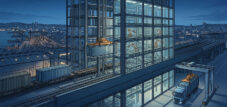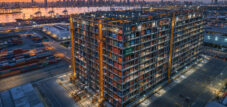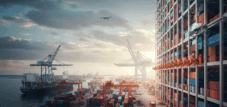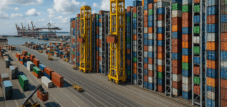
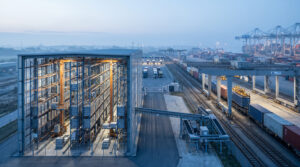
Vertical transshipment terminal: When land becomes scarce, logistics must go vertical – When ports run out of space – Creative image: Xpert.Digital
The multi-billion dollar market for container high-bay racking: Why the freight industry is now building upwards
No more container chaos: This revolutionary technology solves the biggest port problem
Up to 18 stories high: How fully automated container towers are changing global trade
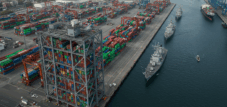
Global logistics faces an unprecedented challenge: While worldwide trade volumes continue to grow relentlessly and container ships become ever more gigantic, land-based infrastructure is reaching its absolute limits. Chronic land scarcity, skyrocketing property prices, and the urgent political call for greater sustainability make simply expanding traditional container terminals impossible. The current practice of blindly stacking containers en masse on vast areas is increasingly proving to be an economic and ecological bottleneck. The solution to this systemic dilemma lies not in expansion, but in height: Fully automated, vertical transshipment terminals – enormous high-bay container warehouses that completely redefine space. With direct, individual access to each loading unit, systems like BOXBAY promise not only to triple storage capacity on the same footprint, but also to drastically reduce handling times and operate with virtually zero emissions. Learn why the future of global freight transport is vertical, how the enormous investment costs will pay off in the long term, and which regions of the world are already setting the tone in this new multi-billion dollar market.
Related to this:

The question of space as a strategic systemic issue of global logistics
The vertical transshipment terminal is not merely a further development of proven infrastructure – it is a paradigm-shifting response to a systemic crisis rooted in the physical architecture of conventional terminals. The equation is simple: land scarcity meets growing trade volume, rising land prices, and the political imperative to shift freight traffic to rail. Those who cannot rewrite this equation will lose.
The global intermodal freight market was valued at US$52.4 billion in 2025 and is projected to grow to US$89.7 billion by 2034 – representing an annual growth rate of 6.2 percent. At the same time, the European Union notes that planned terminal capacity will increase by 18 percent by 2030, while the European Green Deal calls for a 50 percent increase in rail freight capacity. The structural gap between these two figures is the real economic driver behind the vertical terminal.
The conventional container terminal at its limit – anatomy of an inefficient system
Block stacks as an economic bottleneck
The traditional container yard (CY) operates on a simple principle: containers are stacked directly on top of each other to maximize the use of the limited floor space. What seems logical at first glance is, in practice, a source of profound inefficiency. Between 30 and 60 percent of all crane movements in a conventional yard are so-called unproductive restacking operations – movements that save neither time nor value, but serve solely to provide access to containers below.
Once a storage block reaches a fill level of 70 to 80 percent, its performance drops dramatically, and handling times become unpredictable. For combined transport (CT) terminals, which act as critical interfaces between ship, rail, and road transport, this unpredictability is disastrous: a single delayed container can delay the departure of an entire freight train, disrupting schedules across the entire rail network. The economies of scale offered by ultra-large container ships at sea are negated by massive inefficiencies on land.
The imperative of combined transport
Combined transport (CT) refers to freight transport where not the goods themselves, but the transport containers – containers, swap bodies, semi-trailers – are transferred between road and rail. The European combined transport system records a transport volume of 192 million tons with an average annual growth rate of 7.7 percent. CT is competitive with road transport alone on long distances of 500 kilometers or more, and in Alpine transit even from 300 kilometers.
Intermodal terminals – also known as container terminals – are the crucial interfaces of this system. In Germany, Deutsche Umschlaggesellschaft Schiene-Straße (DUSS) operates the leading network of these terminals, and DB InfraGO plans and implements new facilities and expansions. For example, the DUSS terminal in Ulm-Dornstadt is receiving a second automated module with an investment of €148 million, which will double its capacity to 300,000 loading units per year by 2028.
Vertical technology – How high-bay warehouses are reinventing space
The principle of direct individual access
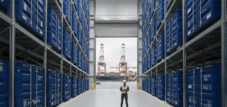
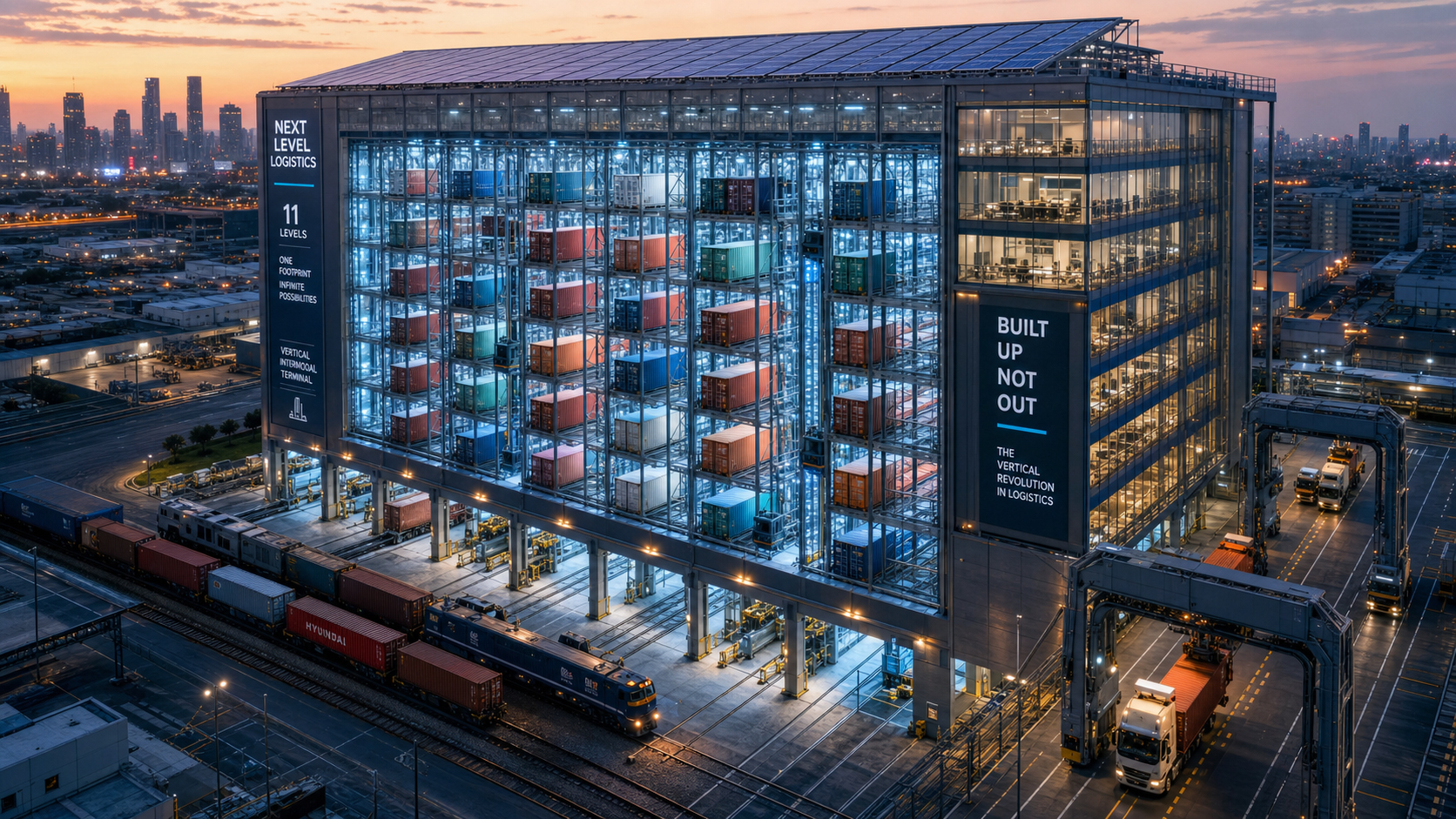
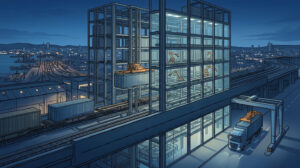
The vertical transshipment terminal, also known as a container high-bay warehouse (HBS), solves the fundamental dilemma of the conventional system through a single principle: direct individual access to each container. Instead of stacking containers directly on top of each other, each container receives its own individually addressable shelf space in a steel structure that can be up to eleven levels high for loaded containers and up to sixteen levels high for empty containers.
The technical heart of the system consists of fully automated storage and retrieval machines (SRMs), also known as stacker cranes. These rail-guided, high-speed cranes move autonomously through the aisles between the rows of racks and can directly access any container – without having to move a single other container. The train movements take place on integrated tracks within the building; up to 100 13.60-meter swap bodies can be stored within a width of just 12 meters per 100 meters of length.
Architecture of a vertical terminal
A complete system consists of several coordinated components. The loading track – with or without overhead contact lines – is integrated into the high-bay warehouse. Two rows of racks with storage spaces for all common containers and swap bodies flank the aisle, in which two or more fully automated storage and retrieval machines operate. Containers are transferred through transfer ports in the building wall to gantry cranes on the outside, which handle the loading and unloading of trucks. Since both storage and retrieval machines and gantry cranes are present in at least duplicate, operational readiness is ensured even during maintenance work or unplanned outages.
The entire system is designed to be fully electric, and the large roofs of the halls are ideal for photovoltaic systems. The BOXBAY system – the most prominent reference project – was designed from the outset to operate exclusively on electricity, with the entire energy demand met by rooftop solar panels. During the pilot phase in Dubai, energy costs were 29 percent lower than initially expected.
BOXBAY: The global proof of concept
The joint venture BOXBAY, a collaboration between the global terminal operator DP World and the German machinery and plant manufacturer SMS group, provided the most convincing practical demonstration of this technology with its pilot project at the Port of Jebel Ali in Dubai. The test facility with 792 container positions was tested under real port conditions; the handling capacity reached 19.3 movements per hour at the interface to the quay and 31.8 movements per hour at the landside truck cranes.
The system offers three times the capacity of a conventional storage area on the same footprint, reducing the terminal's footprint by up to 70 percent. In parallel, the Finnish company Konecranes is developing a competing system, the Automated High-Bay Container Storage (AHBCS), which allows for steel structures up to 14 containers high and can handle all container sizes from 10 to 53 feet. China's state-owned port technology company ZPMC is even using vertical stacking systems at Shanghai Yangshan that can store containers up to 18 levels high – a world record for storage density.
Related to this:

The economic equation – costs, benefits, and the reversal of investment logic
Paradigm shift in cost structure
The introduction of vertical transshipment terminals is fundamentally reversing the traditional cost structure of terminals. The traditional model, with low capital expenditures (CAPEX) for land and basic equipment but high operating expenses (OPEX) for personnel and diesel consumption, is giving way to a CAPEX-intensive but OPEX-light model. Projects of this type can involve investment volumes ranging from several hundred million to over one billion US dollars.
The economic benefits unfold through drastically reduced operating costs in the long term. Personnel costs, the largest expense in manual terminals, can be reduced by up to 70 percent. Added to this is the land-saving advantage, which acts as a significant financial lever: With land prices ranging from €2,000 to €3,000 per square meter, saving just three hectares of land can represent a value of between €60 and €90 million. In top German logistics hubs such as the Ruhr region, Hamburg, or Munich, where the shortage of land is particularly acute, this effect is considerably amplified.
Vertical logistics as a location strategy
Vertical logistics offers two solutions simultaneously: greater space efficiency and closer proximity to the end customer. Since its smaller footprint translates to lower land costs, it can be positioned more effectively than conventional logistics properties in strategically advantageous urban locations. All handling operations take place indoors, eliminating noise and light emissions and making such hubs feasible even in the immediate vicinity of office or residential buildings.
Another, rarely discussed advantage concerns the topography: Since the transport routes for rail and trucks do not have to be at the same level, construction is also possible on terrain with significant differences in elevation – for example, over tracks running in a cutting. This opens up location options that would simply not be feasible for horizontal terminals.
Critical economic viability thresholds
For the use of a fully automated high-bay warehouse in the intermodal sector, a rule of thumb applies: Process-oriented automation is worth considering if more than 150 containers or swap bodies are handled daily at a location with a rail siding. Below this threshold, the amortization periods are too long, and conventional operation is economically superior. This threshold is within reach for many medium-sized transshipment terminals in densely populated areas.
European intermodal terminals achieve competitiveness compared to pure road transport using vertical transshipment technology at distances of around 1,000 kilometers, and even at distances as low as 600 kilometers when considering ecological costs. Vertical crane methods (gantry cranes, reach stackers) account for 60 to 80 percent of total European transshipment capacity; horizontal systems, on the other hand, account for only around two percent.
LTW Intralogistics Solutions

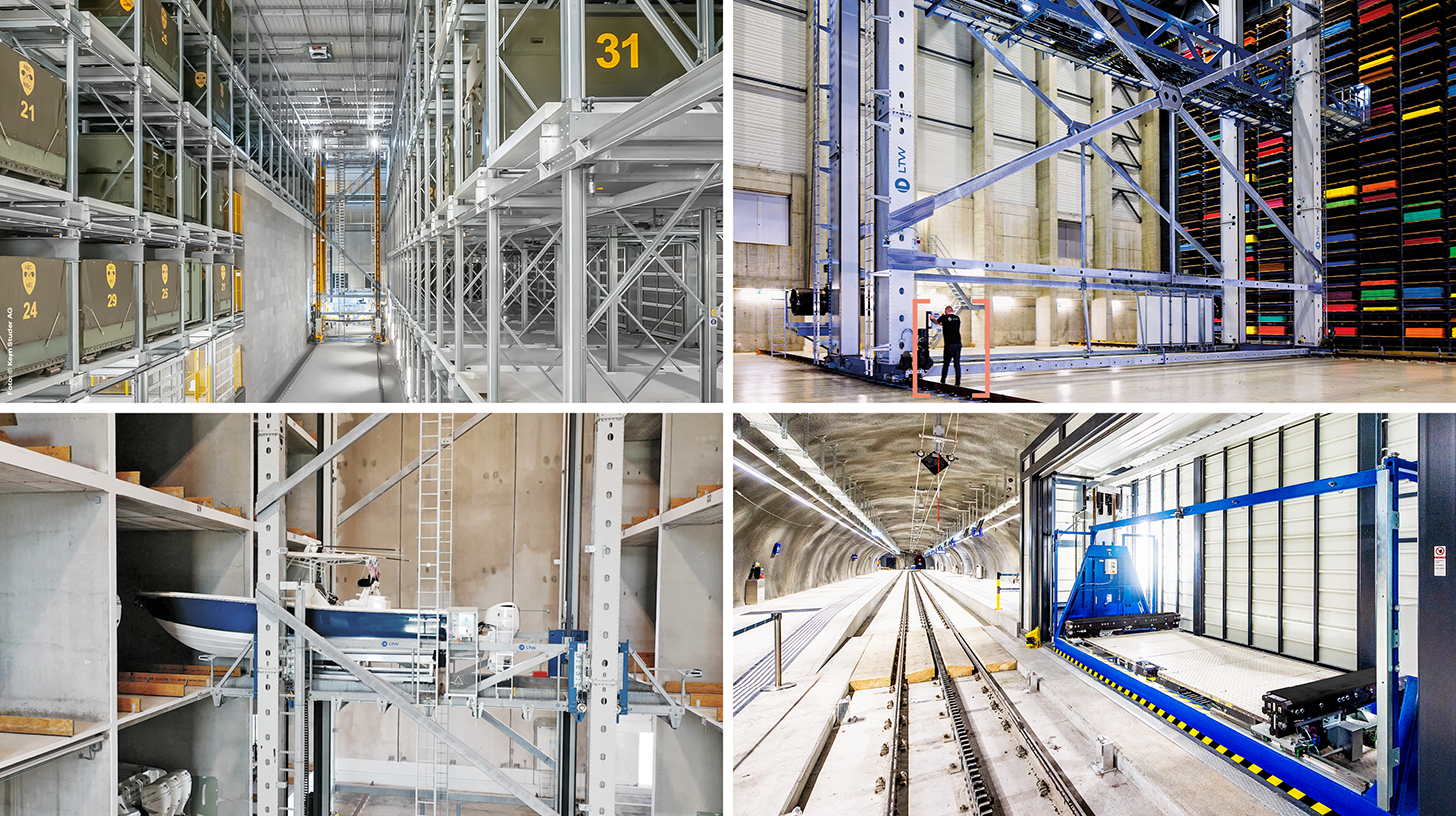
LTW Intralogistics – Engineers of Flow - Image: LTW Intralogistics GmbH
LTW offers its customers not individual components, but integrated complete solutions. Consulting, planning, mechanical and electrotechnical components, control and automation technology, as well as software and service – everything is networked and precisely coordinated.
In-house production of key components is particularly advantageous. This allows for optimal control of quality, supply chains, and interfaces.
LTW stands for reliability, transparency, and collaborative partnership. Loyalty and honesty are firmly anchored in the company's philosophy – a handshake still means something here.
Related to this:
Why automated high-bay warehouses are now becoming a key strategic investment
Regional areas of application in a global comparison – Structural differences and market dynamics
Germany: Land scarcity as a driver of innovation
Germany boasts one of the densest intermodal terminal networks in Europe, largely organized via the DUSS terminals and the DB InfraGO infrastructure. Space scarcity is particularly acute here: In the eight top logistics locations – the Ruhr region and the metropolitan areas of Hamburg, Frankfurt, Berlin, Munich, Cologne, Düsseldorf, and Stuttgart – land prices and building permit processing times are constantly rising, while the volume of new logistics space leases has declined drastically in recent years.
The political framework favors the vertical solution: municipalities are hesitant to designate new industrial parks due to land-use targets, and high-frequency logistics operations are often viewed critically at central locations. The vertical terminal, which requires a fraction of the space of a conventional intermodal terminal, can simplify permitting processes and is compatible with the political goal of urban infill development. The Ulm-Dornstadt reference project demonstrates how classic DUSS terminals can be expanded with automated modules; the next step is full vertical integration.
Europe: Capacity gap as a political program
Within the EU, vertical transshipment terminals are discussed not only as a business efficiency solution but also as a systemic necessity. According to a study by the European Commission (DG MOVE), vertical loading is considered the most effective method of transferring loading units onto railcars. Nevertheless, the transshipment capacity of European terminals will not be sufficient by 2030 to handle the planned expansion of rail capacity.
The European Green Deal aims to shift 75 percent of inland freight currently transported by road to rail and waterways. A key obstacle is the capacity deficit at terminals. Structural bottlenecks are particularly pronounced in Spain, France, and Italy, which together account for 75 percent of the rail lines that need to be upgraded to accommodate semi-trailers. In the Benelux countries, where land prices and urban density are among the highest in Europe, the incentive for vertical integration is especially strong. The European market for intermodal terminals is growing at a projected annual rate of over 5 percent, thus providing the necessary economic framework for investment in new technologies.
USA: Private dominance and horizontal system logic
In North America, which holds the largest share of the global intermodal freight market at 35.8 percent, terminal infrastructure follows a different, historically developed logic. The US has approximately 2,270 rail facilities, but less than ten percent of these are true intermodal container terminals. The system is entirely privately owned and dominated by seven major Class I rail operators.
Terminal technology preference in North America lies with horizontal TOFC (trailer-on-flat-car) and COFC (container-on-flat-car) systems, which operate horizontally rather than vertically. The sheer availability of land in the North American hinterland, along with the private ownership structure of terminals, has historically reduced the incentive for vertical densification. The North American intermodal market generated revenue of US$15.28 billion in 2023, with a projection of US$31.59 billion by 2030. However, increasing land scarcity around the major gateways of Los Angeles, New York, and Chicago, as well as environmental regulations, are beginning to increase interest in vertical concepts, particularly for last-mile hubs in metropolitan areas.
South America: Infrastructure gap and emerging market
The South American freight and logistics market was valued at US$256.29 billion in 2025 and is projected to grow to US$346.61 billion by 2031, with an annual growth rate of 5.16 percent. Brazil, the region's largest economy, is struggling with outdated infrastructure, port congestion, and inefficient hinterland connections, which systematically hinder its growth potential.
Brazil's port infrastructure is lagging behind the growth in trade volume: While the sector recorded growth of six percent and a 15 percent increase in container throughput between 2024 and 2026, chronically insufficient storage capacity and bureaucratic hurdles remain the dominant bottlenecks. Intermodal solutions – the combination of road, rail, and inland waterway transport – are the structurally correct approach for a country the size of Brazil, where distances of 500 kilometers and above are economically attractive for combined transport systems. However, vertical transshipment solutions are still largely in the discussion phase; concrete large-scale projects are still largely lacking, as both the regulatory framework and the willingness to invest in such capital-intensive systems still need to mature.
In the Pacific region of South America, the Chinese-funded megaport of Chancay in Peru is fundamentally changing trade flows: The continent's first smart and green deep-water hub has reduced shipping times between South America and Asia from around 35 to 25 days. This development is generating hinterland freight volumes that, in the medium term, will create a need for more efficient, space-saving terminal infrastructure in the South American hinterland as well.
Asia: Laboratory of Vertical Logistics
Asia – and China in particular – is the world's most ambitious user of vertical logistics and automated terminal concepts. The Yangshan Phase IV port in Shanghai opened in 2017 as the world's largest fully automated container port, operating with 130 driverless AGVs, 26 overhead cranes, and 120 rail-mounted gantry cranes without any human intervention. ZPMC, China's leading port technology group, implemented the world's first fully automated vertical storage system within a port for the Yangshan project – a system capable of storing containers up to 18 levels high.
The Nansha Phase IV port in Guangzhou is the first fully automated container port in the Pearl River Delta and operates with 5G communication and the Chinese Beidou navigation system. Its high-bay warehouse – 23.5 meters high on a footprint of approximately 6,000 square meters – illustrates the vertical densification approach under Asian land-use pressure conditions. Hutchison Ports Yantian handled over 15 million TEU in 2024 across 20 deep-water berths, with 33 rail-sea connections and 20 inland ports, demonstrating the maturity of the intermodal system.
Japan and South Korea are following suit with their own high-automation strategies. At the Port of Busan – Korea's most important container port – the first commercial order for the BOXBAY retrofit was placed to eliminate 350,000 unproductive restacking operations per year and reduce truck handling times by 20 percent. This order is considered a litmus test for the industrial scalability of the technology beyond its pilot project in Dubai.
System comparison of regional deployment logics
| region | Main driver | Technology preference | Ripening level | Structural hurdle |
|---|---|---|---|---|
| Germany | Land scarcity, KV funding | Vertical HRL, automated KV modules | Advanced | Approval times, high CAPEX |
| Europe (total) | Green Deal, capacity gap | Vertical crane handling (60–80% market share) | Expanding | Rail infrastructure, standardization |
| USA | Private competition, land availability | Horizontal TOFC/COFC systems | Ripe, barely vertical | Private property, system inertia |
| South America | Infrastructure deficit, e-commerce | Multimodal, still not very vertical | Early | Regulation, investment capital |
| Asia (China) | Volume pressure, government planning | Fully automated, vertical | Leading | Technology transfer, scale |
| Japan/South Korea | Premium logistics, space scarcity | Highly automated, HBS | Advanced | Investment costs, trade unions |
Sustainability and resilience – The vertical terminal as a climate protection instrument
Ecological superiority in system comparison
The vertical transshipment terminal sets new environmental standards. Electrifying the entire operation eliminates the local CO₂, NOₓ, and particulate matter emissions caused by diesel engines in conventional yards. Combined with renewable energy from photovoltaic systems on the hall roof, CO₂-neutral operation can be achieved, and the terminal could potentially even become an energy-plus system.
From a network perspective, the vertical terminal acts as a catalyst for the modal split: If freight forwarders and rail operators can rely on punctual and fast transfers, the incentive to shift transport to the more environmentally friendly rail network increases. The European Commission's study confirmed that environmental cost accounting – including external costs such as CO₂ emissions, noise, and accidents – already favors intermodal chains over pure road transport for distances as short as 600 kilometers.
Resilience through footprint reduction
Since all transshipment operations take place within a closed system, vertical terminals are independent of weather conditions and allow for nighttime operation without noise or light pollution for the surrounding area. The ability to construct such terminals even in topographically challenging locations – above tracks in cuttings or on steeply sloping terrain – increases site flexibility and thus the resilience of the overall network.
Challenges and risks – What is slowing down the diffusion of the technology
The investment hurdle and the CAPEX problem
The primary obstacle to technology diffusion lies in the financing structure. The enormous investment costs are prohibitive for many, especially smaller terminal operators and emerging economies. Projects require in-depth expertise in plant engineering, robotics, IT integration, and project management, which is not universally available. Furthermore, significant technical risks arise from integrating into existing, often outdated infrastructures—so-called legacy systems—which can lead to substantial delays and cost overruns.
New construction versus retrofitting – two fundamentally different challenges
The new construction approach offers complete design freedom and optimal system integration, but requires high initial investments without ongoing revenue during the construction phase. Retrofitting – by far the more common scenario – must integrate new technology into an ongoing 24/7 operation without unduly disrupting processes and customer service. Such projects can drag on for several years and are more susceptible to unforeseen costs and operational disruptions. The BOXBAY contract for Busan is therefore of paramount industrial importance as a real-world test case.
Socioeconomic transformation of the workforce
Automation eliminates manual tasks such as crane operation, yard truck driving, and lashing, but simultaneously creates a new demand for highly skilled professionals in IT, robotics, data analysis, and plant maintenance. Without proactive retraining programs and early, transparent communication with unions and employee representatives, resistance is likely to delay or increase the cost of implementation. Social support during this transition is not an optional extra, but an economic necessity to effectively meet the new demand for skilled workers.
Cybersecurity as a system vulnerability
With complete digitalization and networking, a critical new vulnerability emerges: the risk of cyberattacks on the central terminal operating system. A successful attack could cripple the entire port operation and have cascading effects on global supply chains. Multi-layered cybersecurity architectures, encompassing both IT and OT (Operational Technology) systems, are therefore an integral part of such a terminal – not an optional add-on.
Perspective – The vertical terminal as the logistics operating system of the future
The vertical transshipment terminal represents the transition from a warehouse-centric to an access-centric logic philosophy: The terminal transforms from a sluggish warehouse into a highly dynamic sorting and buffering hub. Traditional competitive factors such as pure throughput price and maximum speed recede into the background. They are replaced by predictability, reliability, resilience, and sustainability – values that are becoming increasingly important in a global economy that is becoming ever more prone to disruption.
The strategic outlook goes even further. More radical concepts, such as underground container logistics, where containers are transported fully automatically between vertical high-bay warehouse hubs in a tube system, are already in the development phase. In such a scenario, the vertical terminal would no longer be the final solution, but a central component in a three-dimensional, fully integrated logistics ecosystem.
For investors and port operators, this means that the focus must shift from pure investment costs to total cost of ownership and the strategic value of reliability and space efficiency. For policymakers, the task is clear: creating regulatory frameworks, promoting research and development, financing training programs, and establishing international standards for data exchange to ensure interoperability. Because the vertical revolution in logistics is not a question of if – it is a question of when and where.
Consulting - Planning - Implementation

Konrad Wolfenstein
I would be happy to serve as your personal advisor.
You can contact me at wolfenstein∂xpert.digital or
Just call me on +49 7348 4088 965 .
Your container high-bay warehouse and container terminal experts
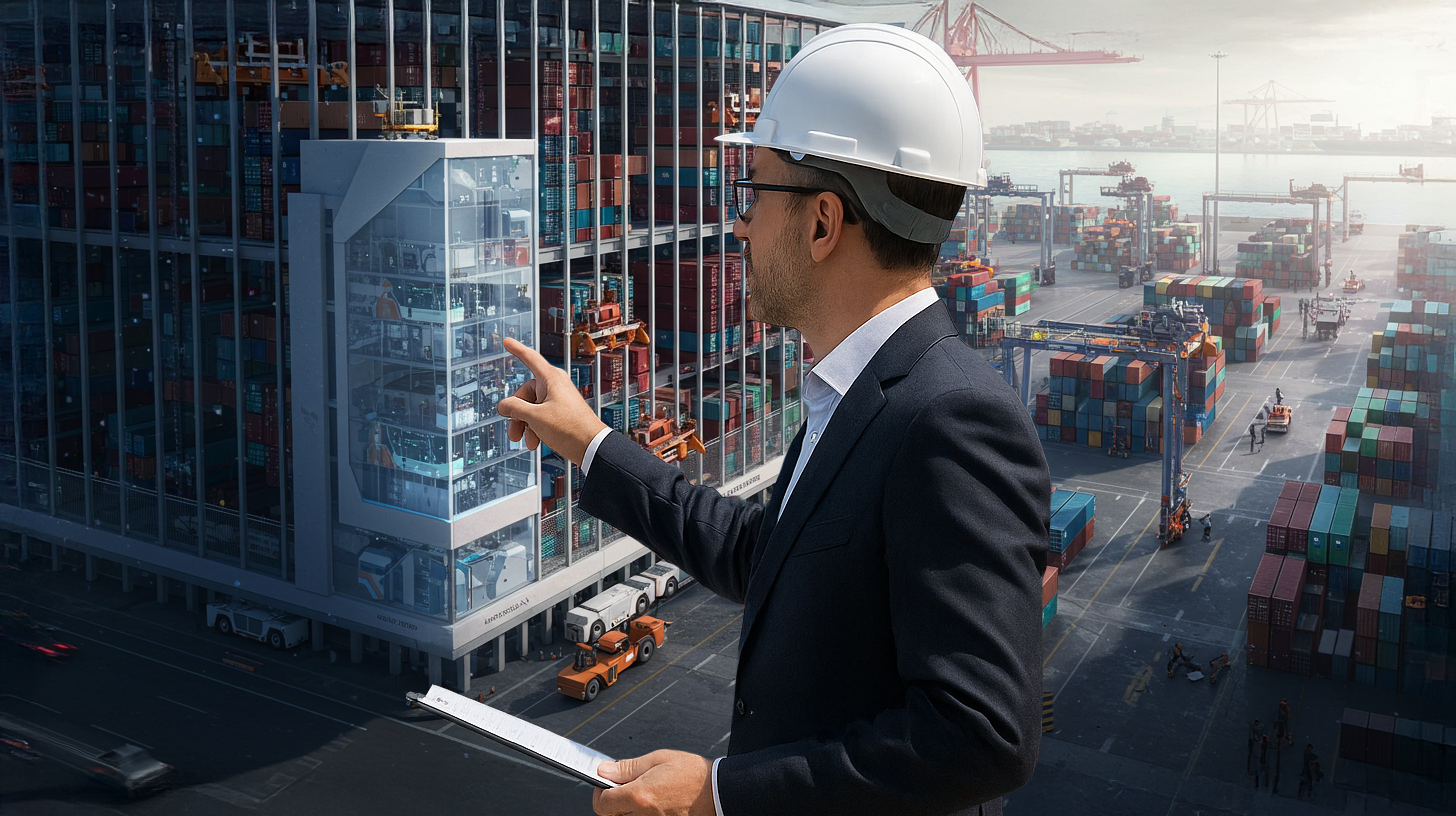
Container high-bay warehouses and container terminals: The logistical interplay – expert advice and solutions - Creative image: Xpert.Digital
This innovative technology promises to fundamentally change container logistics. Instead of stacking containers horizontally as before, they will be stored vertically in multi-story steel racking structures. This not only allows for a drastic increase in storage capacity within the same area, but also revolutionizes all processes at the container terminal.
More information here: