
90% organic clicks: The truth about the alleged “SEO death” – and what that really means for SEO strategies
Xpert Pre-Release

Available in 27 languages 📢
Prefer Xpert.Digital on GoogleⓘPublished on: January 30, 2026 / Updated on: January 30, 2026 – Author: Konrad Wolfenstein
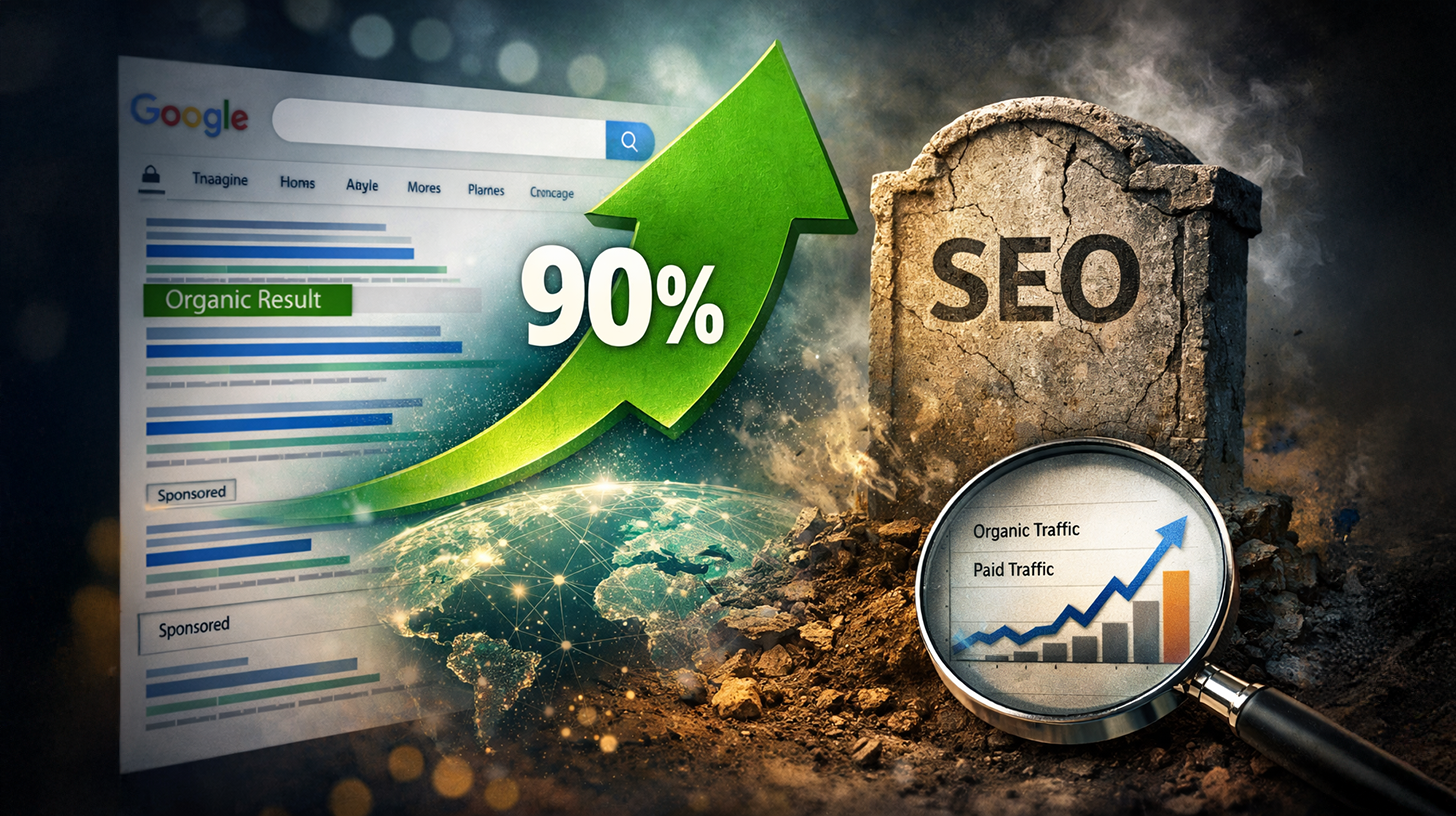
90% organic clicks: The truth about the alleged “SEO death” – and what that really means for SEO strategies – Image: Xpert.Digital
Why organic search traffic (SEO) is only declining minimally despite ChatGPT, AI overviews and dramatic forecasts
Forecast check: Why the warnings about SEO collapse have been completely wrong so far
Why you don't need to be afraid of AI Overviews
"SEO is dead" – this headline has haunted the industry almost as long as search engines have existed. But with the rapid rise of ChatGPT and the introduction of Google's AI Overviews, this sense of doom reached a new level. Renowned analysts like Gartner were already predicting a 25 percent drop in search volume by 2026. Many marketers fear that if AI provides the answer directly, no one will click on the website anymore.
But a look at the raw numbers reveals a strikingly different picture. A recent, large-scale analysis by Graphite and Similarweb, which evaluated data from over 40,000 of the most popular US websites, debunks the narrative of SEO collapse as a myth. The result: Organic search traffic has declined by only about 2.5 percent year-on-year – a barely noticeable dip instead of the expected crash.
While AI integration undoubtedly changes the search experience, the foundation remains stable. Over 90 percent of all clicks on Google still go to organic results. However, this is no reason to simply continue as before. The data also reveals a significant shift: While large brands and commercial providers remain stable or even grow, mid-sized publishers and purely informational content are increasingly under pressure.
Here we analyze why search remains so resilient despite AI competition, which industries now truly need to fear for their clicks, and why SEO isn't disappearing but evolving into a new discipline called "Search & Answer Optimization." Learn how you need to adapt your strategy to continue emerging as a winner in a world of AI answers and traditional search results.
Is it true that SEO is "practically dead" due to AI?
No. The available data clearly contradicts the narrative of "SEO collapse." A large-scale analysis by Graphite in collaboration with Similarweb of more than 40,000 of the largest US websites shows that organic search traffic has declined by only about 2.5 percent year-over-year, not by 25 or even 50 percent. This figure refers to organic traffic from search engines to websites and thus directly contradicts the widespread doomsday scenarios.
It's important to put this into perspective: A decline of 2.5 percent is measurable, but given the tectonic shifts in the search market—AI-powered answers, chatbots, new interfaces—it's more a sign of stability than collapse. The majority of web traffic via search still exists, but the rules of the game are visibly changing.
Where does the figure of only a 2.5 percent decline in search traffic come from?
The figure is based on a quantitative analysis of Similarweb data, which Graphite conducted for over 40,000 large US websites. Similarweb uses a very large data panel of hundreds of millions of devices, supplemented by ISP and carrier data as well as direct measurements from participating websites. These external traffic estimates were further compared with first-party data from Google Search Console. The median correlation of the trends was approximately 0.86, indicating a high degree of agreement with actual measured search clicks.
This is not an opinion poll or an anecdotal sample from individual publishers, but rather a broad, data-driven picture of the US search market. The key finding: Instead of a dramatic crash, it has so far been more of a mild dip.
But Gartner predicts a decline of 25 percent by 2026. Who is right?
Gartner makes a prediction, while Graphite/Similarweb document the status quo. Gartner says that by 2026, the volume of traditional search could decline by 25 percent, primarily because more and more search queries are answered directly by AI-powered response systems (chatbots, virtual agents, AI overviews) without requiring a click on a website. The Graphite analysis, however, shows that as of today – based on the observed data – the decline is around 2.5 percent.
This can be interpreted as follows:
- Gartner describes a possible future scenario if AI response systems are aggressively expanded and user behavior shifts accordingly.
- The actual usage data so far supports the theory of a gradual, rather than abrupt, change. The web and traditional search are still far from becoming obsolete.
Crucially for website operators and SEO managers: alarmism claiming "SEO will disappear in two years" is not supported by current figures. However, what is very real are qualitative changes in search behavior and traffic distribution – especially depending on the industry and type of search query.
Are people really using chatbots and LLMs instead of Google now?
LLMs and chatbots have clearly gained in importance, but they are not replacing Google across the board. Analysis of traffic data shows that traffic to traditional search engines remains largely stable; Google's visitor numbers even increased by around 1.4 percent in the fourth quarter of 2025 compared to the previous year. This means that users continue to search very intensively via search engines.
However, the line between Google search and AI use has become blurred in practice. Google is now massively integrating AI into its own product: AI Overviews, AI-powered summaries, a dedicated AI mode, and other features are based on LLM technology. So when a user "uses Google," they are increasingly also using AI – just embedded in the search experience, not necessarily in a separate chatbot like ChatGPT.
The picture can be summarized as follows: The "search" pie remains large. AI primarily changes how the slices within this pie are distributed – in other words, which answers on the results page receive visibility and clicks.
Are organic search results now being pushed out by ads?
The data contradicts the notion that Google is radically reducing organic results and showing almost exclusively ads. According to the analysis, while a slightly higher proportion of clicks are going to ads – clicks on ads increased by about 2.1 percent – around 90 percent of all Google clicks still go to organic results. The organic search area is therefore still roughly ten times larger than the ad search area.
In practical terms, this means that SEO remains the dominant lever for free or earned traffic from Google. SEA/Ads are important and have gained additional momentum through AI features, but they have by no means displaced organic search. Rather, the balance is shifting slightly as Google attempts to optimize advertising revenue through new ad formats and AI-powered placements.
Don't AI overviews still destroy the click-through rate on organic results?
AI overviews have a noticeable, but context-dependent, impact on the click-through rate (CTR). The analysis shows:
- When AI Overviews are displayed, the click-through rate on organic results drops by an average of about 35 percent.
- However, AI Overviews only appear in about 30 percent of search queries.
- In approximately 80 percent of the cases where AI Overviews now appear, Featured Snippets were previously shown – which also reduced the click-through rate.
This puts the supposed shock effect into perspective. It's true: where AI Overviews are available, classic organic search results receive fewer clicks. But these situations only affect a portion of search queries and partially replace existing features that also reduce clicks.
Furthermore, the type of queries affected is a factor: AI Overviews dominate primarily for informational search queries, such as typical knowledge-based questions, "how-to" topics, or general information. High-quality commercial keywords—for example, those with a clear purchase or comparison intent—often remain unaffected by AI Overviews or are less impacted. Therefore, the impact is lower for e-commerce, B2B lead generation, and many transactional search paths than for traditional content publishers.
B2B support and SaaS for SEO and GEO (AI search) combined: The all-in-one solution for B2B companies

B2B support and SaaS for SEO and GEO (AI search) combined: The all-in-one solution for B2B companies - Image: Xpert.Digital
AI search changes everything: How this SaaS solution will revolutionize your B2B ranking forever.
The digital landscape for B2B companies is undergoing rapid change. Driven by artificial intelligence, the rules of online visibility are being rewritten. For companies, it has always been a challenge not only to be visible in the digital mass, but also to be relevant to the right decision-makers. Traditional SEO strategies and managing local presence (geo-marketing) are complex, time-consuming, and often a battle against constantly changing algorithms and intense competition.
But what if there were a solution that not only simplified this process but also made it smarter, more predictive, and far more effective? This is where the combination of specialized B2B support with a powerful SaaS (Software as a Service) platform comes into play, specifically designed for the demands of SEO and GEO in the age of AI search.
This new generation of tools no longer relies solely on manual keyword analysis and backlink strategies. Instead, it leverages artificial intelligence to more accurately understand search intent, automatically optimize local ranking factors, and conduct real-time competitive analysis. The result is a proactive, data-driven strategy that gives B2B companies a decisive advantage: they are not only found, but perceived as the leading authority in their niche and location.
Here's the symbiosis of B2B support and AI-powered SaaS technology that transforms SEO and GEO marketing, and how your company can benefit from it to grow sustainably in the digital space.
More about it here:

Traffic crisis or huge opportunity? How AI is reshuffling the cards in SEO
Which websites are currently among the winners, and which are among the losers?
The observed decline of 2.5 percent is not evenly distributed; there are noticeable shifts between company size classes and industries:
Winning and stable segments:
- The top 10 largest websites even recorded a slight increase in SEO traffic of around 1.6 percent. Large platforms, brands, and dominant players were therefore able to maintain or even expand their visibility.
- Many smaller niche websites show stable or even growing organic traffic, often because they cater to very specific search intentions and are particularly relevant in their niches.
- Sectors such as apparel, shopping, and marketplaces are experiencing growth in search traffic. This demonstrates that transactional and commercial searches still largely rely on traditional search engines.
Losers and more heavily impacted segments:
- The sharpest decline is concentrated on websites in the mid-range segment, particularly those ranked between 100 and 10,000. These sites often have a certain size and dependence on SEO, but not the brand power of the absolute top players.
- Categories such as news, health, cooking, and entertainment are particularly affected, with declines of well over 10 percent in some cases. These topics are typically informational and overlap significantly with the application area of AI overviews and general AI answers.
The structural message: AI-powered responses primarily target those whose business model is based on mass-produced, information-oriented content, while highly commercial or transactional offerings remain relatively more robust – especially if they have been able to build a strong brand.
How reliable is the underlying data?
The authors of the analysis rightly emphasize that they rely on large-scale, quantitative data rather than subjective assessments. The key points are:
- Similarweb uses a very large panel of hundreds of millions of devices, supplemented by network partners and direct measurement data.
- Over 40,000 of the largest US websites with significant traffic volumes were analyzed, so outliers of individual sites have little weight.
- The accuracy of Similarweb's estimates was checked by comparison with Google Search Console and Google Analytics; the median correlation was 0.86, which can be considered high for trend analysis.
Of course, all external measurements involve estimates; absolute figures may vary. However, the accuracy is sufficient to answer the question of whether traffic falls by 2.5 or 25 percent. The data reveals robust trends and refute exaggerations based solely on isolated incidents or insufficient samples.
How can the apparent contradiction between "stable" search traffic and the declining visibility of many publishers be explained?
At the macro level, the search proves surprisingly robust, while at the micro level some segments experience noticeable declines. Several mechanisms are responsible for this:
- Redistribution within search engine results pages (SERPs): AI elements, AI Overviews, product widgets, local packs, and other SERP features compete for visibility, resulting in less attention and fewer clicks for traditional organic listings—especially for informational queries.
Focus on strong brands: Large, well-known brands and platforms benefit from higher trust, better user signals, and often greater technical resources. They are better positioned to compete for top positions and mentions in AI Overviews than smaller or medium-sized publishers. - Zero-click searches: A growing proportion of search queries are answered directly on the results page, whether through AI overviews, direct answers, knowledge panels, or other short-answer formats. For visible publishers, this means fewer clicks despite stable or growing search volume.
The result feels like a "collapse" to many publishers, even though the overall market remains large. It's more of a distribution and visibility crisis than a drop in search demand.
What does all this mean for the future of SEO – is traditional SEO still relevant?
Traditional SEO, in the sense of "pure keyword optimization for blue links," is losing its exclusivity, but not its relevance. The role of SEO is shifting:
- SEO remains crucial for achieving visibility in organic results, especially for commercial and transactional search queries.
- Additionally, it is becoming more important to prepare content in such a way that it can be understood, cited, and selected as a trusted source by AI systems – keyword: “Optimizing for AI Overviews and LLM responses”.
- Technical excellence, clean information architecture, clear entity structuring and high content quality are becoming even more crucial because AI systems are increasingly trained to prefer robust, consistent and verified sources.
So, there's no truth to the claim that "SEO is dead." SEO is evolving more towards "Search & Answer Optimization": visibility not only in classic SERPs, but also in AI-generated answers and new search interfaces.
What specific actions should companies, publishers, and brands take now?
Three strategic guidelines are emerging:
First, they should take the hysteria out of the discussion and look at their own data. Those who objectively analyze their Search Console, Analytics, and revenue data often find that while patterns and channel mixes change, the "organic search" channel remains crucial in many cases.
Secondly, it's crucial to examine one's reliance on purely informational traffic without clear monetization strategies. Areas like news, recipes, simple how-to guides, and general health information face particularly fierce competition from AI-generated content. This requires more differentiated business models, stronger brand building, community-based approaches, or additional value propositions that go beyond simply providing information.
Thirdly, companies should align their SEO strategy for an AI-driven search landscape. This includes, among other things:
- Focus on transactional, commercial, and problem-oriented keywords with clear business relevance
- Building authority and brand strength to be preferred as a source in both traditional rankings and AI overviews
- Improving structure, schema markup, and entities to make content machine-understandable and citable
- Strong content throughout the entire customer journey, not just as a traffic magnet, but as a foundation for trust and conversion
The key takeaway: SEO is changing, but it's not collapsing. Those who understand the changes and adapt their strategy accordingly can achieve substantial visibility and organic traffic even in the age of AI.
What is the overarching conclusion to be drawn from the current data?
The dramatic narrative of "AI is killing SEO" doesn't stand up to data-driven scrutiny. Organic search traffic has only declined moderately in aggregate; search engines remain highly frequented entry points to the web, and 90 percent of Google clicks still come from organic results. The real change lies in the distribution within the search results pages, the nature of search queries, and the shift between informational and transactional searches.
For commercial providers, e-commerce platforms, marketplaces, and strong brands, organic search remains a dominant and highly relevant channel. Publishers with primarily informational content and mid-sized generalist sites, on the other hand, are feeling the pressure from AI responses and SERP features on their click-through rates.
In short: SEO isn't dead, but naive "business as usual" approaches are. Those who take search behavior, AI integration, and their own data seriously can understand the current shifts as a call to adapt – not as an obituary.
Your global marketing and business development partner
☑️ Our business language is English or German
☑️ NEW: Correspondence in your national language!

Konrad Wolfenstein
I would be happy to serve you and my team as a personal advisor.
You can contact me by filling out the contact form or simply call me on +49 7348 4088 965 (Munich) . My email address is: wolfenstein ∂ xpert.digital
I'm looking forward to our joint project.
☑️ SME support in strategy, consulting, planning and implementation
☑️ Creation or realignment of the digital strategy and digitalization
☑️ Expansion and optimization of international sales processes
☑️ Global & Digital B2B trading platforms
☑️ Pioneer Business Development / Marketing / PR / Trade Fairs
🎯🎯🎯 Benefit from Xpert.Digital's extensive, five-fold expertise in a comprehensive service package | BD, R&D, XR, PR & Digital Visibility Optimization

Benefit from Xpert.Digital's extensive, fivefold expertise in a comprehensive service package | R&D, XR, PR & Digital Visibility Optimization - Image: Xpert.Digital
Xpert.Digital has in-depth knowledge of various industries. This allows us to develop tailor-made strategies that are tailored precisely to the requirements and challenges of your specific market segment. By continually analyzing market trends and following industry developments, we can act with foresight and offer innovative solutions. Through the combination of experience and knowledge, we generate added value and give our customers a decisive competitive advantage.
More about it here:
📈🔵 Order acquisition and organizational development: From classic sales to a strategic business function💡

Order acquisition and organizational development - Image: Xpert.Digital
Xpert.Digital supports companies in this complex transformation, whether it's building a modern order acquisition function from the ground up or optimizing existing processes. With comprehensive expertise in marketing, sales, data analysis, digital transformation, and organizational development, we guide your company toward strategic repositioning. Our approach is holistic: We not only optimize processes but also develop the people and organizational culture necessary to achieve sustainable, measurable success.
More about it here:







