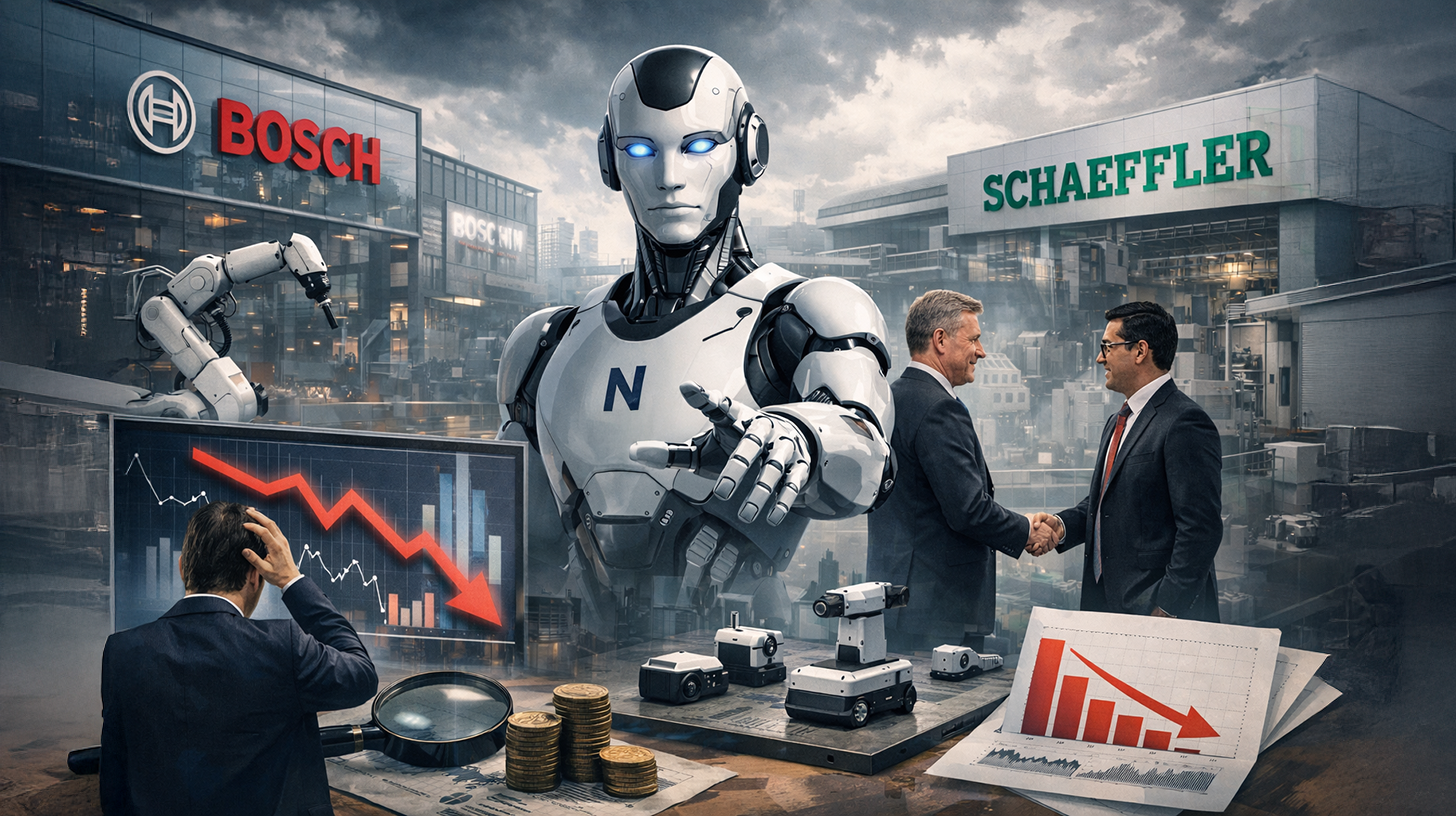
The Robotics Promise – Big Words, Small Markets | Critical Analysis – Creative Image: Xpert.Digital
The robotics promise: When children in crisis cling to the future – The escape from core competencies
Neura Robotics, Bosch and Schaeffler are staging a humanoid savior – but behind it lies the desperation of an uncertain industry
When German automotive suppliers suddenly rave about the robot revolution, investors should take notice. The partnerships forged by the Metzingen-based startup Neura Robotics with Schaeffler in November 2025 and with Bosch in January 2026 appear at first glance to herald the dawn of a new industrial era. However, a sober look at the figures reveals a different story: the story of an industry desperately searching for new business opportunities while its core business implodes.
The situation is dire. Schaeffler recorded a five percent drop in revenue to €11.85 billion in the first half of 2025, and operating profit plummeted by nine percent to €482 million. The electromobility division continues to post losses. 4,700 jobs are to be cut by 2027, 2,800 of them in Germany. Bosch announced it will have to save €2.5 billion annually by 2030. More than 14,000 jobs will be lost worldwide. This crisis is structural, not cyclical. The transformation to electromobility is destroying added value in highly profitable areas, while Chinese manufacturers dominate the market.
In this existential threat situation, robotics appears as a lifeline. In November 2025, Schaeffler announced a framework agreement worth €300 million with Neura Robotics. Several thousand humanoid robots are to be integrated by 2035. Bosch founded Robert Bosch Robotics GmbH and entered into a strategic partnership with Neura Robotics in January 2026.
Billions on paper, millions in reality
Neura Robotics presents itself as a German champion. Founded in 2019, the company raised €120 million in a Series B funding round in January 2025, bringing its total funding to over €185 million. Founder David Reger proudly announces an order backlog of €1 billion. The number of employees has more than doubled to over 300, and revenue has reportedly increased tenfold.
But what does an order backlog of one billion euros actually mean? Schaeffler's 300-million-euro framework agreement runs until 2035, a period of ten years. This equates to an average of 30 million euros per year – for a company of Schaeffler's size, a manageable bet, not a major transformation. Assuming unit costs between 20,000 and 40,000 euros, Neura would deliver between 7,500 and 15,000 units over the entire term. For comparison: The global market for installed industrial robots is estimated at around 16.7 billion US dollars in 2026. Neura would serve less than two percent of this market – assuming all orders are fulfilled.
Extending the timeframe obscures the fact that framework agreements are subject to numerous conditions and can be adjusted at any time if technical specifications are not met. A stated order backlog is not a guaranteed revenue.
The forecast illusion and first warning signs
The market for humanoid robots is projected to explode from $3.14 billion in 2025 to $81.55 billion by 2035. Goldman Sachs forecasts the deployment of 20 million humanoid robots by 2030. These figures follow a familiar pattern: market research firms extrapolate technological possibilities linearly without considering realistic adoption rates or economic viability. Similar forecasts have been made for autonomous vehicles and virtual reality.
Warning signs are mounting. Investors are increasingly warning of a robotics bubble. Daiva Rakauskaitė of Aneli Capital sees parallels to the dot-com bubble. In China, where over 150 startups are working on humanoid robots, authorities are officially warning of speculative overheating. MIT researcher Rodney Brooks is convinced that many startups are wasting resources. Even Chris Walti, who led Tesla's Optimus robot project until 2022, considers humanoid robots completely unsuitable for factories.
Related to this:

Technical reality instead of marketing promises
Humanoid robots sound fascinating, but their human-like appearance poses a fundamental problem from an industrial perspective. Factories are optimized for specialized machines, not for bipedal beings. A humanoid robot lifting a box competes with conveyor belts, forklifts, or robotic arms—tried, inexpensive, and highly efficient technologies.
Current humanoid robots cost between $80,000 and $500,000. For them to be economically competitive, the cost would need to drop to between $20,000 and $50,000. Battery life results in downtime exceeding 50 percent, payload capacity is limited, and fine motor skills are underdeveloped. Safety requirements further increase complexity and cost.
Even with the technical problems solved, the question of amortization remains. Amazon speaks of an 18-month pilot phase before scaling decisions. DHL's logistics chief made it clear that no meaningful return on investment can be generated with humanoid robots in their environment.
Price ranges and types
- Classic 6-axis industrial robots for production lines realistically often start at around US$30,000–50,000 and can go well over US$100,000 depending on payload and precision.
- Collaborative robots (cobots) with small to medium payloads (3–12 kg) typically cost somewhere between approximately US$6,000 and US$55,000, depending on payload, range and safety features.
- Humanoid robots currently range predominantly in price from around 80,000 to well over 150,000 US dollars; some entry-level models (e.g. Unitree R1) are significantly cheaper, but technically very limited.
Why very cheap robots are limited
- Mechanics and payload: Cheap arms under a few thousand dollars often only carry a few hundred grams to a few kilograms and have significantly lower stiffness and repeatability – sufficient for laboratory and education, but not for precise machine assembly or heavy parts.
- Sensors, safety, certification: For industrial use (e.g. CE, functional safety, collision monitoring), complex safety functions and certifications are required, which significantly increase costs.
- Robustness and lifespan: Inexpensive systems are not designed for millions of cycles in harsh environments (dust, oil, temperature, 24/7 operation), but for laboratory, R&D or occasional use.
Humanoid vs. classic industrial robots
- From the industry's point of view, humanoid robots are mostly pilot or show cases today: high acquisition costs, low payload, limited battery life, complex safety – therefore only economically interesting in very specific scenarios.
- In contrast, classic 6-axis robots or cobots in the 20,000–60,000 US dollar segment achieve high availability, clear ROI calculations and are already established for typical tasks such as machine loading, palletizing or parts handling.
Guiding questions for industrial use: Whether a "cheap" robot is suitable for industrial applications depends less on the price itself than on its specifications and ecosystem. Typical criteria:
- Load capacity and reach suitable for the task (e.g. >10 kg for palletizing).
- Repeatability, cycle time and 24/7 suitability for your cycle times.
- Safety concept (cage vs. cobot, certifications, collision detection).
- Integration: Interfaces to PLC/MES/WMS, grippers, vision, support and spare parts.
Diversification or diversionary tactic?
These partnerships must be viewed within the context of industry-wide diversification. While less than half of supplier acquisitions in 2011 were outside the automotive sector, this share rose to 65 percent by 2020. This strategy is rational given a shrinking industry. However, diversification requires real transfers of expertise, not symbolic bets on the future.
The danger lies in the fact that robotics partnerships primarily function as a communication strategy. They send signals to investors and the public: We are innovative, we are transforming. But while press releases talk of billion-euro contracts, cost-cutting programs and job reductions are underway behind the scenes. Schaeffler is investing €300 million in robotics over ten years, while simultaneously cutting 4,700 jobs to save €290 million annually. Cost reduction in the core business takes priority, not the robotics transformation.
The inconvenient truth
The robotics announcements are symptomatic of an industry in crisis. When the core business collapses, the future becomes the lifeline. Humanoid robots offer an attractive narrative: visible, understandable, revolutionary. They allow companies to position themselves as innovators while painful realities must be addressed in the background. But grand pronouncements don't create large markets. The technical and economic hurdles are considerable, and market forecasts are based on optimistic assumptions that rarely materialize. For Schaeffler and Bosch, robotics investments are manageable bets. For Neura Robotics, the stakes are much higher. The German economy needs new engines of growth. Whether humanoid robotics can fulfill this role remains to be seen. Until then, everyone should learn to distinguish between promises and reality.
Related to this:
📈🔵 Ambidexterity or doom: The only management concept that still works in the triple crisis💡

When proven strategies fail: Organizational adaptability in the digital transformation of ambidexterity - Image: Xpert.Digital
We are currently experiencing a period of economic turmoil that differs fundamentally from previous recessions. A deceptive silence prevails in the boardrooms of European and international companies – broken only by the sound of failing strategies that were considered a guarantee of success just yesterday. This is not merely a cyclical downturn, but a profound structural break. The tools with which companies achieved growth for over two decades simply no longer work.
More information here: