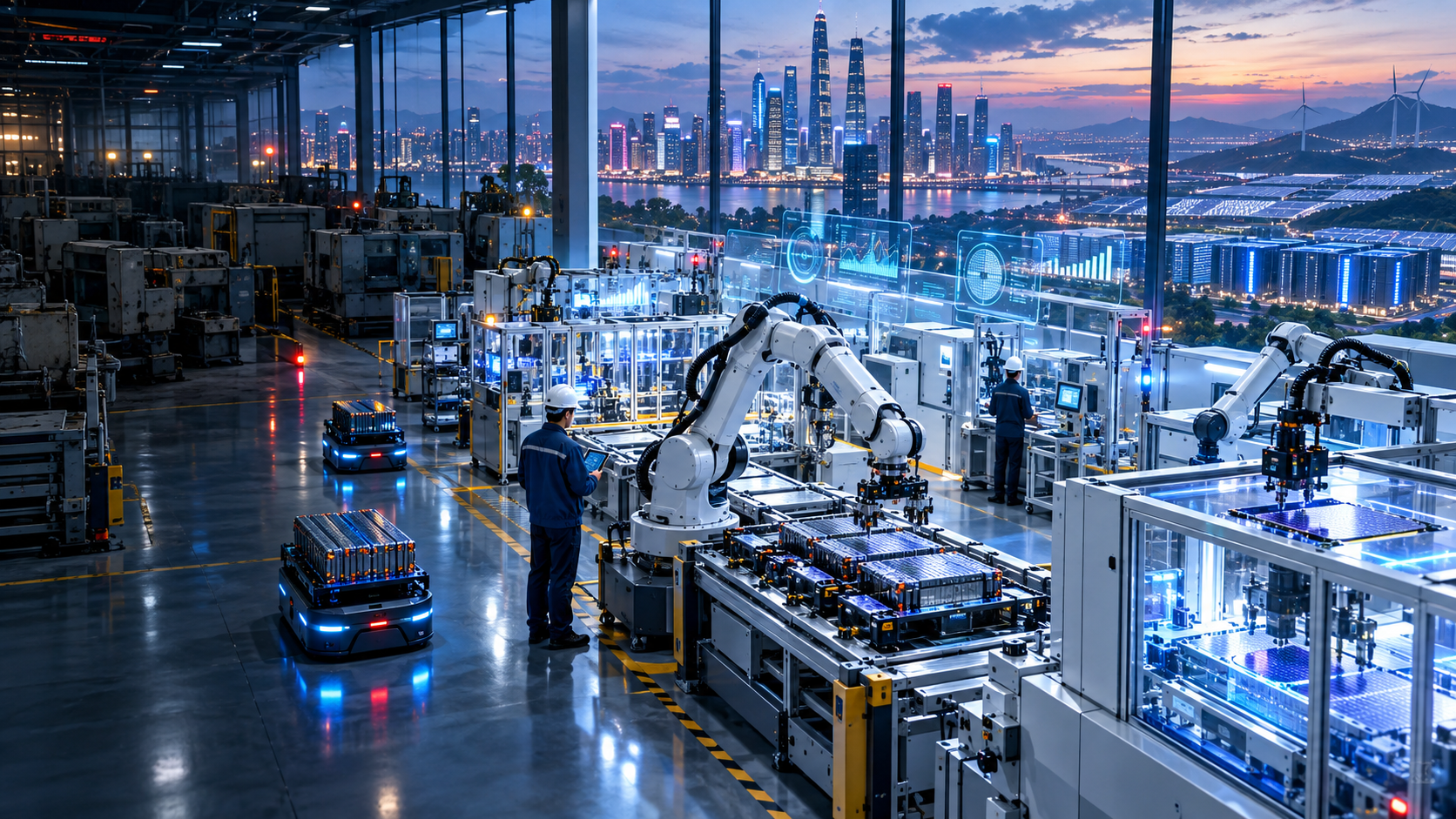
Beijing is sacrificing the old growth model – and forcing the world into a new technological conflict – Creative image on the topic, with AI: Xpert.Digital
Two worlds in one country: Why China's economy is at a turning point
Europe's dilemma: What China's relentless tech offensive means for us
30 trillion plan: This is how radically China is now restructuring its economy
China's economy is currently undergoing what is arguably the most radical and risky transformation in its recent history. While the once-dominant real estate sector is struggling and private consumption is stagnating, Beijing is pumping gigantic sums into high technology, automation, and green industries. The result is a picture of two completely different economies within one country: On the one hand, the pillars of the old growth model are crumbling, while on the other, sectors such as artificial intelligence, robotics, and electromobility are booming at an unprecedented pace. With this massive, politically driven redistribution of capital and resources, the government aims not only to cushion the looming demographic shift but also to transform China into the undisputed technological superpower. However, this industrial gamble carries enormous risks—for its own domestic economy, which is suffering from high debt and weak demand, as well as for global trade. The world is facing a new technological conflict, and Europe, in particular, is in danger of being crushed between price pressure and dependence. The following analysis sheds light on the profound facets of this transformation and shows why China's success is far from guaranteed.
China's big industrial bet: Two economies in one country
In late summer 2026, China's economy gives the impression of two distinct economic cycles running concurrently. On the one hand, industrial production is accelerating, high-tech factories are growing at double-digit rates, foreign trade remains dynamic, and strategic products such as lithium-ion batteries, industrial robots, and 3D printing equipment are experiencing exceptionally high production increases. On the other hand, private consumption, capital investment, and the real estate market are stagnating or contracting significantly. These discrepancies are not mere statistical noise. They demonstrate that the Chinese growth model is undergoing a profound and conflict-ridden transformation.
In August 2026, the real value added of larger industrial companies rose by 5.2 percent year-on-year, a faster increase than in July. Manufacturing grew by 6.1 percent, while mining contracted by 1.4 percent. The shift within the industrial sector was even more pronounced: the equipment manufacturing industry grew by 12.1 percent, and high-tech manufacturing by as much as 16.7 percent. At the same time, the Purchasing Managers' Index for the manufacturing sector, at 49.8 points, was just below the expansion threshold. The fact that measured production is growing despite company surveys indicating a slight contraction points to uneven development across company size, ownership structure, region, and industry.
At the heart of this development is a politically driven reallocation of capital, labor, and technological capabilities. China is no longer attempting to support every segment of its economy equally. Instead, resources are being redirected from real estate, traditional infrastructure, and low-productivity sectors toward electronics, automation, energy equipment, digitalization, and research. The decline in older activities is therefore partly intentional, but not entirely controlled. The weakness of the real estate market, the reluctance of private companies, and the low growth in consumer spending are not only the price of a successful transformation but also potential obstacles to its success.
The crucial distinction, therefore, lies between structural progress and macroeconomic stability. China can increase its technological capabilities and still suffer from weak domestic demand. It can be a world leader in selected industries while simultaneously grappling with declining asset values, municipal debt, and demographic pressures. The much-discussed metamorphosis is thus neither a linear ascent nor the beginning of an inevitable decline. It is a risky industrial gamble: future productivity gains are expected to more than compensate for current shortfalls in demand and balance sheet problems.
The production boom is masking the demand gap
The August data show remarkable strength on the supply side. Alongside growth in industrial value creation, the production of lithium-ion batteries rose by 57.2 percent, industrial robots by 34.6 percent, and 3D printing equipment by 29.9 percent. Information transmission, software, and IT services also grew strongly. These figures confirm that technological modernization is not just a political strategy paper, but is becoming visible in real factories, supply chains, and production volumes.
However, an economy cannot grow sustainably solely through supply expansion. In August, retail sales increased by only 0.4 percent year-on-year and fell by 0.13 percent compared to the previous month. For the first eight months of the year, retail sales growth was just 1.1 percent. Services performed better than goods consumption, and communication technology saw strong sales. Nevertheless, overall momentum remains weak, especially when measured against the rate at which industrial capacity is increasing.
This creates a macroeconomic tension. If companies produce more than households and domestic investors consume, the excess goods must either be exported, stored, or sold at lower prices. Exports can temporarily compensate for this, but increase dependence on foreign demand and exacerbate trade conflicts. Stockpiling supports measured production in the short term, but is not a sustainable driver of long-term growth. Price reductions, in turn, put pressure on margins, wages, and investment. The Chinese economy therefore faces the problem that industrial strength does not automatically translate into widely distributed incomes and consumption-driven growth.
While official price data for August do not paint a classic picture of deflation, with consumer prices 0.8 percent and producer prices 3.8 percent higher than the previous year, this does not alter the fundamental risk of an imbalance between strong supply and subdued private demand. Price increases can also arise from higher input costs without companies possessing sufficient pricing power. If purchase prices rise faster than sales opportunities and end-user demand, smaller producers in particular come under pressure.
The economic policy challenge, therefore, is not simply to produce more high-tech goods. China must create a cycle in which higher productivity leads to higher disposable incomes, better social security, and greater consumer spending. If this fails, the new industry will remain dependent on government contracts, loans, and export markets. In that case, the old investment-driven model would not truly be overcome, but merely technologically upgraded.
The slump in investment is both a correction and a warning signal
Investment in fixed assets outside rural households fell by 7.2 percent from January to August 2026. Excluding real estate development, the decline was 4.2 percent. Real estate investment plummeted by 19.9 percent, infrastructure investment by 4.0 percent, and investment in the manufacturing sector by 2.3 percent. The development of private investment is particularly problematic, shrinking by 10.1 percent overall and by 6.4 percent even excluding real estate.
These figures should neither be downplayed nor mechanically interpreted as a harbinger of collapse. Part of the decline reflects a necessary correction. For decades, China maintained exceptionally high investment rates. Roads, high-speed rail lines, industrial parks, housing developments, and large-scale municipal projects accelerated urbanization and productivity. However, as capital resources increased, the additional returns of many new projects diminished. Where modern transportation networks, large housing stocks, and extensive production capacities already exist, an additional unit of credit generates less real growth than before.
The decline can therefore improve overall capital productivity if unproductive construction projects are cancelled and funds are channeled into software, research, precision machinery, and industrial modernization. Indeed, investment in intellectual property products rose by 9.2 percent and in high-tech industries by 5.2 percent. Information services saw a 22.7 percent increase in investment, aerospace by 14.9 percent, and electronics and communications technology by 6.9 percent. Not all investment activity disappears; its composition changes.
Nevertheless, this optimistic interpretation has clear limitations. A qualitative improvement in investment does not automatically compensate for a sharp quantitative decline. High-tech projects are often capital-intensive but employ relatively few people. Research expenditures take time before they generate marketable returns. Software, patents, and databases can be productive, but in the short term, they do not replace the demand impact of large construction projects. Furthermore, it is unclear how much of the strategic investment is actually due to profitable private decisions and how much to political mandates, subsidies, or favorable loans.
The collapse in private investment is therefore particularly serious. Private companies react more strongly than state-owned enterprises to profit expectations, legal certainty, financing costs, and political predictability. If they remain hesitant despite extensive industrial policy programs, this signals weak confidence in future demand or doubts about stable framework conditions. State-directed investments can temporarily fill such a gap. However, entrepreneurial risk-taking cannot be permanently replaced by administrative means.
Automation is becoming a demographic survival strategy
The boom in industrial robots is more than a symbol of technological modernity. It represents the material response to China's demographic shift. The population has been shrinking for several years, and the proportion of people of working age is also declining. At the end of 2025, around 1.405 billion people lived in the country, about 3.39 million fewer than a year earlier. The 16- to 59-year-old age group comprised roughly 851 million people and lost several million members within a single year. At the same time, the proportion of elderly people is increasing, leading to higher expenditures for pensions, long-term care, and healthcare.
In an aging society, economic growth must stem more from productivity gains than from additional labor. Industrial robots can take over standardized, physically demanding, or dangerous tasks. Artificial intelligence can improve quality control, predict maintenance needs, optimize material flows, and shorten development times. Digital twins make it possible to test products and production lines virtually before physical resources are used. This reduces waste, energy consumption, and downtime.
Automation, however, is not a free substitute for demographically driven labor shortages. It requires high initial investments, a reliable energy supply, skilled technicians, and a high-performance digital infrastructure. Large companies in coastal regions can meet these requirements more easily than small businesses inland. This threatens to create a growing gap between highly automated, leading companies and a long line of less productive firms. While the exit of these latter companies may increase average productivity, it can also exacerbate regional employment problems and social tensions.
The skills structure is also changing. The demand for low-skilled jobs is decreasing, while the demand for engineers, software developers, maintenance personnel, and specialized skilled workers is increasing. The education system must therefore not only produce more university graduates but also strengthen vocational training, technical education, and lifelong learning. Otherwise, unemployment among the low-skilled and a shortage of skilled workers in modern industries will emerge simultaneously.
The demographic relief offered by technology also has its limits. Robots can produce goods, but they cannot generate their own final demand. A smaller and older population may consume more cautiously, especially if health, long-term care, and pension risks are privately borne. Automation thus solves the supply problem of a shrinking working-age population, but not automatically the demand problem of an aging society. The industrial strategy must therefore be complemented by social reforms that relieve households of the burden of precautionary saving.
Batteries, chips and AI form a new industrial system
China's technological strategy focuses not on individual prestige products, but on an interconnected industrial system. Batteries, power electronics, power grids, electric vehicles, robotics, semiconductors, sensors, cloud infrastructure, and artificial intelligence reinforce each other. Advances in one area reduce costs or improve performance in others. Cheaper batteries promote electromobility and stationary energy storage. Larger markets finance further research. Automated factories, in turn, lower the production costs of components.
This industrial density is a key competitive advantage. Innovation arises not only in laboratories but also through rapid feedback between suppliers, machine builders, software companies, and end producers. When a new battery cell is developed, material suppliers, plant engineers, and vehicle manufacturers can collaborate closely, both geographically and organizationally. Short development cycles and large production runs accelerate learning curves. China thus combines economies of scale, synergies, and speed that are difficult for competitors to replicate.
However, the high production growth carries the risk of a capacity trap. If local governments promote similar industrial clusters, companies prioritize market share over profitability, and credit is too readily available, supply can grow faster than demand. This leads to price wars, shrinking margins, and consolidation. For consumers worldwide, lower prices are initially advantageous. For manufacturers, however, they mean weaker profits, reduced self-financing capacity, and greater dependence on government support.
The situation is more complex for semiconductors than for batteries. China possesses significant strengths in assembly, electronics manufacturing, certain chip segments, and a vast sales market, but remains vulnerable in the most advanced manufacturing technologies, highly specialized machinery, and individual design tools. Foreign export controls increase costs and slow access to cutting-edge technology. At the same time, they create strong incentives to develop domestic alternatives. External pressure can accelerate innovation, but it does not guarantee a successful technological leap.
Artificial intelligence acts as a cross-cutting technology. Its economic value depends less on spectacular demonstrations than on its integration into existing processes. China possesses a large industrial database and numerous fields of application. The crucial test is whether companies actually use AI to reduce error rates, development times, and energy consumption, or whether subsidized projects primarily serve political objectives. In the long run, what will count is not the number of announced AI initiatives, but the measurable increase in total factor productivity.
Our China expertise in business development, sales and marketing


Our China expertise in business development, sales and marketing - Image: Xpert.Digital
Industry focus areas: B2B, digitalization (from AI to XR), mechanical engineering, logistics, renewable energies and industry
More information here:
A thematic hub offering insights and expertise:
- Knowledge platform covering global and regional economies, innovation and industry-specific trends
- A collection of analyses, insights, and background information from our key areas of focus
- A place for expertise and information on current developments in business and technology
- A hub for companies seeking information on markets, digitalization, and industry innovations
The ticking time bomb: How the real estate crisis and local debt are paralyzing the country
The five-year plan makes technology a matter of national interest
The plan for electronic information manufacturing, published in September 2026, for the period 2026 to 2030, underscores the strategic ambition. By 2030, larger companies in the sector are projected to generate combined revenues exceeding 30 trillion renminbi. Research and development intensity is targeted to reach 3.5 percent. Priority areas include integrated circuits, advanced computing, consumer electronics, basic electronics, and power electronics. Overall, the plan encompasses numerous tasks in the areas of industrial fundamentals, competitiveness, new growth drivers, and governance.
The plan is not a classic central production target like those of earlier planned economies. It sets goals, channels financing, influences procurement, and coordinates ministries, provinces, universities, state-owned enterprises, and private companies. Market mechanisms remain important, but operate within a politically defined framework. This combination can mobilize enormous resources. It can finance technological infrastructure whose benefits will only become apparent in the long term, and it can bear risks that private investors alone would avoid.
The strength of this model lies in its scalability. As soon as a region receives political priority, research programs, industrial parks, tax incentives, credit lines, training opportunities, and public contracts are created. The large domestic market makes it easier to quickly test new products in large quantities. Government coordination can also be beneficial for complex systems, such as power grids, charging infrastructure, space travel, or semiconductor supply chains.
The weakness lies in the risk of systematic misallocation. Local officials have incentives to implement central priorities in a highly visible manner. As a result, several regions can launch nearly identical projects, even though not all are economically viable. Political enthusiasm is no substitute for realistic demand forecasting. When losses are distributed via banks, state-owned enterprises, or local budgets, inefficient capacities persist longer than they would in a tougher market environment.
Successful industrial policy therefore requires selection mechanisms that allow for failure. Subsidies should be time-limited, tied to verifiable results, and terminated if progress is lacking. Competition between companies is productive; subsidy competition between provinces, on the other hand, can waste capital. The new five-year plan will ultimately not be judged by its revenue targets, but by whether it produces internationally competitive technologies, profitable companies, and resilient supply chains.
The real estate crisis is damaging wealth and trust
The real estate sector remains the most significant legacy of the existing model. From January to August 2026, investments in real estate development fell by 19.9 percent. The sales area of newly constructed commercial properties, primarily residential, declined by 12.1 percent; the sales value fell by 13.0 percent. While the sales area of existing properties recorded via online platforms increased by 10.6 percent, this may also indicate that buyers prefer more affordable existing apartments and are avoiding new construction projects.
The crisis is impacting the economy through several channels. First, property developers are losing revenue and finding it more difficult to complete ongoing projects. Second, demand for steel, cement, machinery, furniture, and household appliances is declining. Third, the situation is worsening for local governments, which have long relied on revenue from land leases. Fourth, household wealth and consumer confidence are suffering because homeownership is the primary store of wealth for many families.
A rapid return to the previous construction boom would not be a sustainable solution. In many cities, demographic weakness, already high housing stock, and speculative legacy issues converge. New loans could temporarily stabilize prices, but would prolong the perverse incentives. The more economically sound strategy is to complete unfinished housing, restructure over-indebted developers in an orderly manner, partially convert existing properties into affordable housing, and gradually decouple municipal financing from land sales.
This process is expensive and politically sensitive. If losses are fully socialized, public debt increases, and previous risk-taking is retrospectively rewarded. If they are borne solely by private households, banks, and businesses, there is a risk of a loss of confidence and a further decline in demand. The government must therefore distribute losses without triggering a systemic financial crisis. A spectacular, one-off cleanup is unlikely; instead, it will probably be a long-term process of debt restructuring, project takeovers, government support, and gradual write-offs.
The real estate downturn explains why technological success stories alone don't generate widespread optimism. A family whose home is losing value or whose pre-financed property isn't finished consumes more cautiously. An entrepreneur with uncertain collateral invests less. As long as the real estate market weighs on confidence and balance sheets, the transition to consumption-oriented growth remains difficult.
Local debt restricts political room for maneuver
China's local governments were key players in the old investment model. They developed land, established financing companies, took out loans, and built infrastructure. This approach accelerated development but often masked the true extent of the debt. Many projects failed to generate sufficient ongoing income and relied on rising land prices, refinancing, or transfers. With the decline in land sales, this financing logic has become fragile.
The problem is not just the amount of debt, but its structure. Short-term or high-interest liabilities are juxtaposed with projects that have long amortization periods. Revenues and liabilities are unevenly distributed across regions. Wealthy coastal provinces have a broader tax base, while structurally weaker areas are more dependent on transfers and debt-financed investments. A one-size-fits-all solution would therefore be inappropriate.
Debt restructuring can reduce acute pressure by replacing expensive liabilities with longer-term, cheaper bonds. However, it does not solve the fundamental problem of insufficient revenue. Repeatedly refinancing unprofitable projects merely buys time, but does not improve repayment capacity. What is needed is a reform of the fiscal relationship between the central government and local levels. Responsibilities, revenues, and liabilities must be more clearly aligned.
In the short term, the debt burden limits the ability to combat the decline in investment with a further municipal construction boom. This has a disciplining effect, but it exacerbates the economic weakness. The central government has more fiscal leeway and can intervene more effectively. However, it must decide which local risks it will assume. Overly generous bailouts weaken fiscal discipline; overly harsh measures could trigger defaults, investment freezes, and social problems.
The quality of the new growth strategy therefore also depends on an unspectacular budget reform. High-tech factories cannot automatically solve municipal balance sheet problems. Only when local finances are less dependent on land prices and off-balance-sheet loans can capital flow sustainably into more productive sectors. Without this correction, the new industrial system risks being built on the debt foundation of the old model.
Export strength becomes a geopolitical risk
Foreign trade acted as a counterweight to weak domestic demand in 2026. In August, merchandise trade rose by 19.8 percent compared to the previous year. Exports increased by 18.6 percent and imports by 21.7 percent. In the first eight months, exports grew by 14.6 percent; exports of mechanical and electrical products even increased by 21.9 percent. Private companies played a key role in this growth, and trade with partner countries of the Belt and Road Initiative also expanded strongly.
Economically, this export success stabilizes production, employment, and corporate profits. Strategically, it enables economies of scale and accelerates technological learning processes. Politically, however, it intensifies suspicions among other countries that China intends to offload its domestic overcapacity on global markets. The weaker Chinese consumption and the stronger its industrial support, the more easily the impression arises that the global balance is being unilaterally burdened.
The term "second China shock" only partially describes this situation. The first shock was primarily characterized by labor-intensive, inexpensive goods. The new competition affects capital- and technology-intensive sectors such as electric vehicles, batteries, solar technology, mechanical engineering, electronics, and digital systems. This not only impacts low-skilled industrial jobs but also strategic value creation, research locations, and supply chains relevant to security policy.
The response from the US and Europe increasingly consists of tariffs, subsidies, local production requirements, investment controls, and export restrictions. While these measures can protect domestic capacity, they also increase product costs and lead to duplication of effort. Global supply chains become more resilient to individual political shocks, but simultaneously less efficient. Companies must maintain larger inventories, qualify multiple suppliers, and geographically disperse production.
China is responding to this pressure with a strategy of dual circulation. The domestic market is intended to drive technological development, while international markets continue to enable scaling and foreign exchange earnings. Complete self-sufficiency is neither realistic nor economically viable. Rather, the goal is to reduce critical dependencies while simultaneously increasing foreign dependence on Chinese components. This does not eliminate interdependence, but rather strategically restructures it.
Europe's industry is caught between price pressure and dependence
For Europe, China's transformation is particularly ambivalent. European consumers and businesses benefit from inexpensive batteries, solar panels, electronic components, and machinery. These imports can accelerate the energy transition, reduce investment costs, and dampen inflation. At the same time, European manufacturers come under pressure when Chinese competitors emerge with larger production runs, denser supply chains, and state-backed financing.
Complete decoupling would be economically costly and hardly practical in many areas. Europe lacks both all the necessary raw materials and sufficient capacity at every technological level. Indiscriminate isolation would increase the cost of green technologies and make it more difficult for companies to access the Chinese market. Conversely, naively continuing with maximum dependence would be risky, as political conflicts or export controls could disrupt critical supplies.
The more sensible strategy is selective risk reduction. Europe must define which technologies are indispensable for safety and functionality, what minimum capacities should be available within its own economic area, and where diversified imports are sufficient. Instruments should address demonstrable market distortions instead of indiscriminately penalizing Chinese products. Protecting competition without a productivity strategy would merely perpetuate inefficient structures.
European companies also need to redefine their position. In standardized mass markets, it will become more difficult to survive solely on tradition or incremental improvements. Opportunities lie in specialized machinery, industrial software, materials, automation, energy efficiency, medical technology, and high-quality system solutions. Cooperation with Chinese partners can remain worthwhile, provided that intellectual property, data access, and supply chain risks are controlled.
Chinese pressure could force Europe to undergo long-overdue modernization. This requires faster permitting processes, cheaper energy, more integrated capital markets, increased venture capital, and a more consistent research and industrial policy. Tariffs can buy time, but they replace neither innovation nor scaling. If Europe fails to use this time wisely, protectionism will merely make managing its technological lag more expensive.
By 2030, consumption will determine success
By 2030, China is expected to make further progress in several strategic industries. The combination of a large domestic market, complete supply chains, technical education, government coordination, and high investment capacity is too powerful to ignore. Batteries, electric vehicles, power engineering, robotics, industrial AI, drones, electronics, and selected semiconductor segments are particularly promising. Even if China doesn't become a leader in every cutting-edge technology, it can gain significant market share through cost, speed, and system integration.
Overall economic success, however, is less certain than industrial success. Despite technological advances, real growth may remain significantly lower than in previous decades. The International Monetary Fund projected around 4.5 percent for 2026. In the medium term, a shrinking working-age population, the real estate correction, high debt levels, and trade policy uncertainty are putting downward pressure on the potential. For an already very large economy, growth of four percent would still be significant, but it would no longer automatically mask all distributional and balance sheet problems.
The development of private consumption will be crucial. Chinese households save a great deal because social risks, education costs, healthcare expenses, and retirement provisions demand substantial personal savings. Added to this are job market insecurity and declining property values. Therefore, sustainably boosting consumption requires more than just purchase premiums. It demands more reliable pension and health insurance, better unemployment protection, a reform of the household registration system, and higher disposable incomes.
The relationship between the state and the private sector is also becoming increasingly important. Technological breakthroughs can be encouraged, but not entirely mandated. Entrepreneurs invest when they expect profits, property rights are reliable, and regulation remains predictable. A policy that simultaneously requires private companies as drivers of innovation and subjects them to close political control creates tension. The greater the uncertainty surrounding interventions, the more likely companies are to withhold liquidity or invest abroad.
Three development paths are plausible. In the best-case scenario, China stabilizes its real estate market, reforms local finances, strengthens the welfare state, and translates productivity gains into higher consumption. This results in a more balanced model with lower but higher-quality growth. In a medium scenario, high-tech and exports remain strong, while consumption and real estate remain weak. The country continues to grow but generates persistent trade surpluses and conflicts. In the worst-case scenario, persistent weak demand, misallocation of resources in new industries, debt problems, and tougher trade barriers converge. In this case, technological advancement could fail to deliver its overall economic return.
An industrial revolution without a guarantee of prosperity
China's transformation is real. Double-digit growth in high-tech manufacturing and equipment industries, the expansion of robotics and batteries, and the new plan for electronic information manufacturing demonstrate a profound shift in the production structure. It would be wrong to interpret the decline in overall investment as mere decline. Part of it is the inevitable correction of an overstretched real estate and infrastructure model. However, it would be equally wrong to automatically equate every high-tech investment with higher productivity and sustainable prosperity.
The central question is not whether China can produce more robots, batteries, and chips. It undoubtedly can. The crucial question is whether these capabilities will generate a broadly based economy where households consume, private companies invest, and public finances remain sustainable. Industrial policy can build new capacity, but it cannot replace trust, social security, and profitable final demand.
The decline in traditional investment and the expansion of high-tech production are therefore not contradictory. Both developments are part of the same structural shift. Capital is leaving sectors whose old growth promise has become unbelievable and flowing into areas to which political leaders ascribe strategic importance. Whether this results in a more productive economic order depends on the quality of this redirection. If unprofitable construction projects are merely replaced by unprofitable technology factories, the surface changes, but not the underlying logic of the model.
The rationale is therefore neither euphoric nor alarmist. China possesses exceptional industrial strengths, a large pool of technical expertise, and a high capacity for long-term mobilization. At the same time, the housing crisis, demographic change, local debt, weak consumption, and geopolitical backlash represent structural burdens that cannot be resolved by record production. The outcome remains uncertain, but not arbitrary: Without a stronger role for households and private companies, industrial success will increasingly depend on export surpluses and state financing.
For the world, this development signifies a new phase of competition. China's rise is no longer primarily driven by cheap labor, but by scaled technology, integrated supply chains, and strategically directed capital. Other economies must respond with their own productivity, intelligent diversification, and precise industrial policies. Those who merely isolate themselves will become poorer. Those who ignore risks will become dependent. Anyone who views China solely as a winner or a candidate for crisis misunderstands the true dynamic: The country is rapidly building the industry of the future while still grappling with the financial and social legacies of its past.
🎯🎯🎯 Data-driven B2B industry hub as a quasi-in-house solution


The quasi-in-house solution: How Xpert.Digital closes operational gaps in B2B marketing and sales – Smart Content-Driven Business - Image: Xpert.Digital
Xpert.Digital is a data-driven B2B industry hub led by Konrad Wolfenstein . The company acts as an external, quasi-in-house solution for industrial partners, closing operational gaps in marketing, content, and sales – without requiring additional resources on the client side.
More information here:
Your global marketing and business development partner
☑️ Our business language is English or German
☑️ NEW: Correspondence in your native language!

Konrad Wolfenstein
I and my team are happy to be available to you as your personal advisor.
You can contact me by filling out the contact form here wolfenstein@xpert.digital:or simply call me at +49 7348 4088 965. My email address is
I'm looking forward to our joint project.