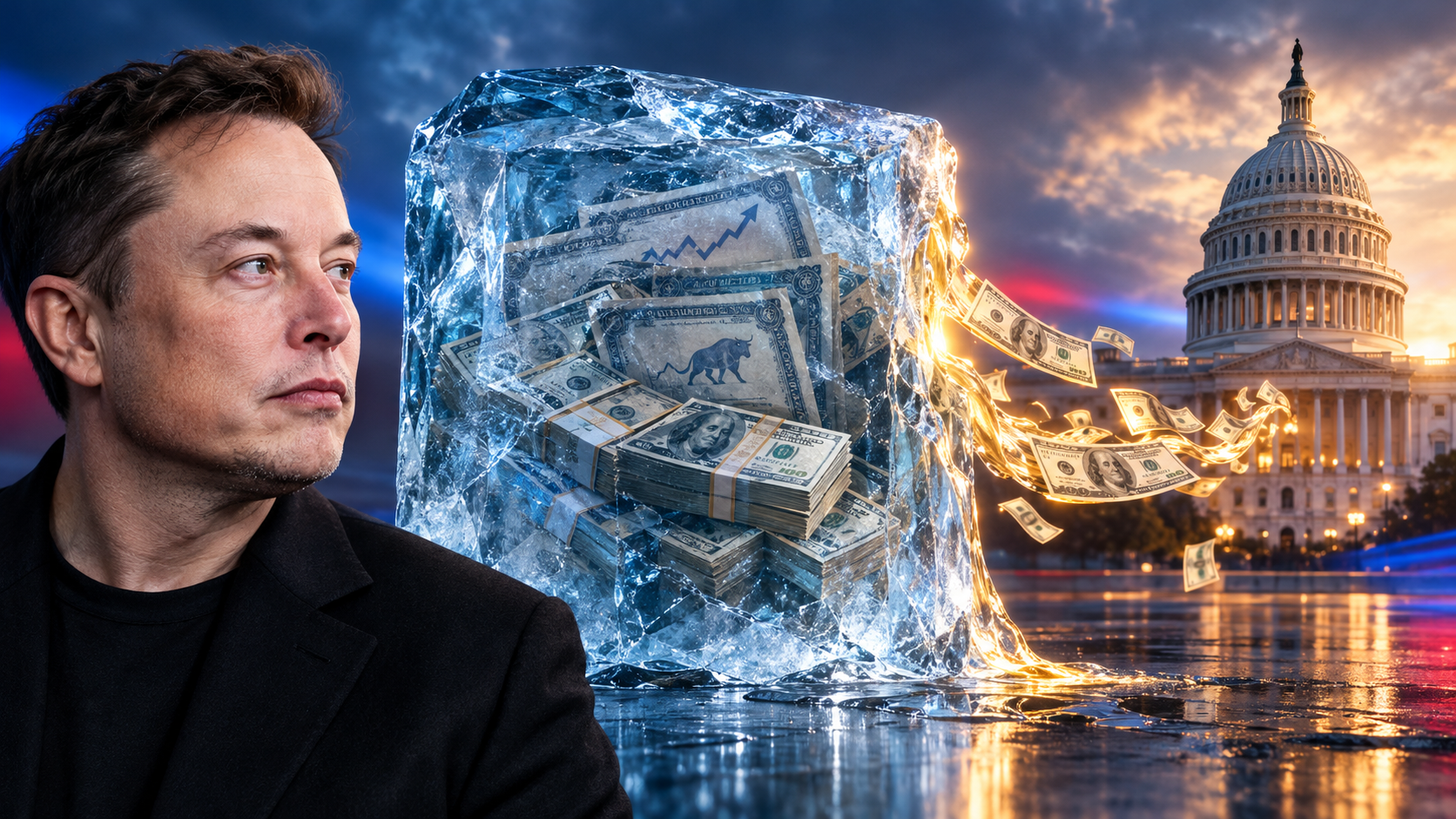
Can a billionaire finance politics but not pay taxes? The controversy surrounding Musk's wealth – a creative image on the topic, created with AI: Xpert.Digital
$458 million spent on the election campaign: Why Musk's money didn't prevent the defeat
Liquid for politicians, allegedly frozen for the tax authorities: The contradiction surrounding billionaire wealth
Musk mobilizes hundreds of millions of dollars: What this reveals about wealth taxes
According to calculations published immediately after the 2026 election cycle, Elon Musk allocated approximately $458 million to the campaign. A significant portion of his support went to Republican Senate candidate Ken Paxton in Texas. However, despite this exceptionally high stake, Democrat James Talarico won the race. Musk's money may have influenced the campaign, but it couldn't guarantee the outcome.
This case highlights a contradiction in the debate about billionaire wealth: Hundreds of millions of dollars can apparently be mobilized for political purposes within a short period. However, when it comes to higher taxes on large fortunes, the argument is often that the money is tied up in company shares, is unavailable, or can only be released at the cost of economic damage. The two cannot simply be equated: Stock ownership is not cash, and a one-time campaign donation is not the same as a recurring tax. But the Texas election raises a legitimate question: How plausible is the blanket assertion that very large fortunes are practically insolvent?
Paxton's defeat offers no easy answer. It demonstrates that even very high political spending cannot guarantee victory. At the same time, the campaign highlights the immense financial clout a single major donor can bring to an election. What this case reveals about liquidity, wealth taxation, and political influence—and where the limits of this comparison lie—deserves closer examination.
How billions in wealth can be politically liquidated – and why even almost half a billion dollars doesn't guarantee an election victory
The American midterm elections of November 3, 2026, produced a remarkable experiment: How much political clout can be generated with an extremely large personal fortune? According to calculations available immediately after the vote, Elon Musk allocated approximately $458 million for the election cycle. A particularly large portion of his support was focused on the Republican Senate candidate Ken Paxton in Texas. Nevertheless, the Democrat James Talarico won there. So the money was there, and so was the political will. Only the voters didn't reliably adhere to the investment plan.
This adds further urgency to the debate about billionaire wealth. When high taxes on large fortunes are discussed, the arguments regularly focus on a lack of liquidity, unrealized capital gains, and potential damage to businesses. However, when it comes to political influence, hundreds of millions of euros can apparently be mobilized within a few months. This doesn't automatically mean that every wealth tax would be economically sound. It does, however, mean that the blanket assertion of the practically insurmountable insolvency of very wealthy individuals requires considerably closer scrutiny.
The real contradiction isn't that owning stocks and holding cash are different things. They obviously are. It lies in the fact that this distinction is weighted remarkably differently depending on the intended use. For political influence, wealth represents economic power. For tax obligations, it's sometimes considered merely a non-binding number on a screen. An interesting asset class: extremely flexible with regard to political allies, yet almost geologically inert with regard to the tax authorities.
After the election, one important limitation remains despite the great effort
First, the timing is crucial. The election in the United States is now over. Therefore, post-midterm analysis shouldn't stop at the expectation that Musk could use his money to win Texas in favor of the Republicans. Talarico has beaten Paxton. The initial vote counts published immediately after the election showed approximately 55 percent for Talarico and 43 percent for Paxton. While this wasn't the final, certified result, it did indicate a clear lead in what was already a decided race.
This significantly alters the interpretation. The attempt to influence an election outcome with exceptionally large sums of money did not result in a resounding victory. Anyone claiming that a billionaire could simply buy a senator must distinguish between an exaggerated description of political power and an actual guarantee of success. Clearly, there was no such guarantee.
However, the opposite conclusion—that defeat proves the harmlessness of money—would be equally wrong. An unsuccessful market entry doesn't diminish a company. A lost campaign doesn't render its financier powerless. Money can garner attention, secure candidacies, finance staff, set the agenda, and force opponents into costly responses. Whether these activities ultimately shift enough votes is another question.
Texas, therefore, demonstrates two things simultaneously: democracy is not entirely for sale, but the conditions of political competition can be significantly altered by very large fortunes. These two observations are not contradictory. Together, they describe the problem more accurately than any simple narrative of an all-powerful billionaire or of immutably equal competition.
Almost half a billion is a significant figure, but not yet a final accounting
The figure of nearly $500 million is roughly accurate, but should not be treated as a final, verified total. A calculation published immediately after the election put Musk's contribution at around $458 million. Compared to $500 million, this represents a difference of $42 million. In everyday language, both figures might seem like less than half a billion. However, for an economic analysis, it is crucial to distinguish between reported donations, actual expenditures, and a preliminary total.
Exaggerations are particularly easy to create when the same funds pass through the accounting system multiple times. If a donor transfers $75 million to one fund, and that fund then transfers the same amount to another, $150 million in additional money has not been created. It is simply a transfer of the same funding. If the money is subsequently spent on advertising, this expenditure cannot simply be added to the original donation a third time.
Therefore, donations, forwardings, and final expenditures must be clearly distinguished. Otherwise, the analysis of political financial power inadvertently becomes an exercise in creative money creation. The actual scale is already impressive enough; it doesn't need any support through double counting.
The claim that Musk is the largest single donor in American history, adjusted for inflation, requires more than just a large current figure. It would necessitate comparable historical data, a standardized definition of political funding, and a verifiable inflation adjustment. The finding of an exceptionally large donation is a reliable indicator. However, a historical superlative is no substitute for a defined comparative analysis.
The Texas money route shows how political clout is organized
The structure of the support for Paxton is particularly revealing. Musk transferred $75 million to the Senate Leadership Fund on September 9th and another $83 million on September 23rd. The corresponding amounts were then forwarded to Texas PAC, a super-PAC specifically for Paxton's support, on the following days. These two payments alone total $158 million. The timing and amount of these payments clearly establish the connection between the funding, but this does not replace a more detailed legal assessment of each individual transaction.
The Senate Leadership Fund is not simply the Republican Party's cash cow. This distinction is important. The American election campaign system includes different types of organizations with varying rules. Super PACs are permitted to accept unlimited contributions and make their own political expenditures. However, they cannot distribute these funds to candidates in the same way as ordinary, unlimited direct donations. Separate restrictions apply to coordinated activities.
Economically, this funding created enormous additional capacity for political communication. Advertising slots could be booked, messages repeated, and geographic target groups addressed. A large, expensive state like Texas offers ample opportunities for such expenditures. It has many media markets, many potential voters, and consequently, many opportunities to convert money into public visibility.
This doesn't mean that every transfer is an impermissible obfuscation. It does mean, however, that institutional packaging doesn't make significant private influence disappear. A very large donor remains a very large donor, even if their money passes through several organizationally correct channels along the way.
Wealth is not cash – but it's also not economically meaningless decoration
The core of the liquidity argument is valid. Owning company shares worth billions doesn't automatically mean you have the same amount in a checking account. Stock market values fluctuate. Large sell orders can put downward pressure on share prices. Unlisted holdings are often difficult to sell and can result in significant discounts. A tax bill can therefore trigger payment problems, even if you have substantial assets on paper. Consequently, structuring payment terms and deferrals is crucial when it comes to wealth taxes.
However, there is a wide spectrum between complete immediate liquidity and total insolvency. Under certain conditions, owners can sell shares, receive distributions, utilize existing liquid assets, or take out loans secured by collateral. Not every option is always advisable. Not every option is risk-free. But the existence of such possibilities makes the assertion that company assets are fundamentally unusable for financing personal expenses or obligations less convincing.
The magnitude of the obligation is also crucial. No one has to liquidate their entire fortune to raise a small fraction of it. A tax debate is not usually about selling all of an owner's company shares within a week.
Political financing, therefore, does not prove unlimited liquidity. It provides concrete evidence of considerable mobilization capacity. This is less dramatic than a slogan, but analytically stronger. Anyone who can provide several hundred million dollars for political purposes is certainly not destitute in the ordinary sense. Their economic capacity simply has a different structure than that of an employee with a monthly salary.
The comparison between campaign donations and wealth tax needs a common denominator
A large absolute amount of money doesn't necessarily tell you much about the financial burden on a person. To understand that, you have to consider it in relation to their assets and available cash flow.
A purely hypothetical example illustrates this: With a net worth of $250 billion, $500 million would represent a share of 0.2 percent. An annual wealth tax of one percent, on the other hand, would amount to $2.5 billion. The assumed campaign financing would then be substantial, but would only amount to one-fifth of this annual tax demand.
This example is not an estimate of Musk's current net worth. It illustrates why observing a large donation alone does not allow for a complete assessment of the sustainability of a particular tax. One-off or irregular political expenditures and a regularly recurring tax differ economically.
However, this limitation works both ways. The fact that an annual tax may impose higher requirements does not justify the claim that any relevant taxation is impossible. It requires a concrete examination: Which tax rate? Which tax base? Which tax-free allowance? Which payment deadline? How should highly fluctuating company values be treated?
The serious question, therefore, is not whether billionaires can somehow raise money. It is what regular contribution, under what rules, is reasonable, manageable, and economically sound. Anything else is tax policy as a weather forecast: it could get difficult, so the event is being cancelled as a precaution.
Unrealized profits are not yet revenue – yet they still represent economic power
When a shareholding increases in value, its owner does not automatically receive a corresponding payment. Under the standard capital gains tax system, a taxable gain generally arises upon sale if the sale proceeds exceed the tax base. The distinction between realized and unrealized gain is therefore a central component of the current tax logic, not merely a linguistic pretext.
Economically, however, the significance of an increase in value does not end at this tax threshold. A more valuable shareholding increases one's wealth. Under suitable conditions, it can serve as loan collateral, expand financing options, and increase the capacity to take greater risks. Therefore, tax treatment and economic benefit are not the same thing.
This creates a politically relevant difference between various forms of income and wealth. Earned income is paid out regularly and taxed. In contrast, with capital gains, the point at which a taxable sale can be postponed for a considerable time. Those who can cover their ongoing financing needs in other ways have correspondingly more flexibility.
This does not mean that every loan should be taxable income. A loan involves a repayment obligation and is economically different from a final cash inflow. Nor does it mean that every price increase must be taxed immediately. But it does mean that a tax system should not completely disregard the economic control of large fortunes simply by pointing to a lack of sales.
A fortune can be simultaneously inalienable, subject to fluctuating values, and extremely useful. These qualities are not mutually exclusive.
Loans create liquidity, but not a free parallel world
In public discourse, borrowing against assets is sometimes portrayed as an unlimited source of cash. This is an oversimplification. A loan incurs interest. The bank requires collateral and considers risks. If the value of the pledged assets falls, additional collateral or repayments may be required. Therefore, those who heavily leverage their equity holdings can come under significant selling pressure, especially during a crisis.
Nevertheless, access to such financing options is a significant advantage. A household without substantial collateral receives different terms and has more flexibility than an owner of highly valuable investments. The difference lies not only in the amount of assets, but also in their affordability.
This necessitates a twofold caution in the tax debate. On the one hand, the state must not act as if all taxpayers can take out loans without risk at any time. On the other hand, the potential for borrowing must not be seen as an expression of entrepreneurial flexibility for politically desired expenditures, while suddenly appearing completely unthinkable when tax obligations are involved.
The appropriate conclusion is therefore neither a blanket obligation to provide credit nor a blanket exemption. Rules are needed for actual liquidity shortages. Such rules can include payment deferrals or installment plans. However, a deferral differs significantly from a permanent waiver: the claim remains, only its due date is made more economically manageable.
That would be less spectacular than claiming that wealth taxation would immediately end industrial civilization. It would, however, be closer to ordinary financial administration.
Our US expertise in business development, sales and marketing


Our US expertise in business development, sales and marketing - Image: Xpert.Digital
Industry focus areas: B2B, digitalization (from AI to XR), mechanical engineering, logistics, renewable energies and industry
More information here:
A thematic hub offering insights and expertise:
- Knowledge platform covering global and regional economies, innovation and industry-specific trends
- A collection of analyses, insights, and background information from our key areas of focus
- A place for expertise and information on current developments in business and technology
- A hub for companies seeking information on markets, digitalization, and industry innovations
The influence of billionaires on politics
There is a difference between an owner's private assets and the company's cash reserves
The argument that a personal wealth tax inevitably jeopardizes jobs is particularly effective. It links the interests of a very wealthy owner with the concerns of many employees. Thus, a question of private solvency quickly becomes a perceived decision about entire workforces.
However, from an economic perspective, a closer look is necessary. If an owner sells existing shares to another investor, the purchase price generally flows from the buyer to the seller. It is not automatically taken from the company's coffers. The factory does not immediately lose its machinery through this change of ownership, and the payroll does not disappear along with part of the share package.
The situation can be different if a tax payment is financed by an additional dividend that withdraws funds from the company. Similarly, share sales can raise issues of control, ownership structure, or financing. A tightly controlled family business with limited liquidity may face different problems than a broadly traded corporation.
This does not completely refute the job argument. It merely removes its blanket form. There must be a verifiable economic link between a tax claim and a job loss.
Anyone claiming this connection should therefore explain which investment will be cancelled, which financing will become more expensive, or which operational decision will change. Without these intermediate steps, the workplace remains primarily a rhetorical safety net for its owner's wealth.
A wealth tax is no substitute for a well-thought-out tax system
Criticism of weak counterarguments does not automatically make for a good tax. A recurring levy on net worth can cause significant problems if valuation, allowances, and interactions are poorly designed.
Unlike a tax on actual income, wealth tax is generally levied even if an asset generates little or no current income. A simple calculation illustrates its significance: A wealth tax of one percent, with an annual return of two percent, theoretically corresponds to half of that return, even before other taxes are taken into account. With a ten percent return, the same wealth tax would correspond to one-tenth of the return. Therefore, the same wealth tax rate does not necessarily mean the same burden on current income.
Valuation also presents different challenges. A publicly traded share package has observable market prices. For unlisted companies, complex ownership structures, or individual special assets, valuation is more complex and prone to disputes.
Furthermore, there are avoidance mechanisms. Very generous exemptions can reduce revenue and distort wealth allocation. Overly restrictive rules can create genuine hardship. The OECD therefore emphasizes that the evaluation of a wealth tax depends on the overall tax system. Where capital gains, capital gains, and inheritances are already broadly and effectively taxed, justifying an additional tax is more difficult than where significant gaps exist.
The sobering conclusion is: Not every wealth tax is wise. But not every rejection of such a tax is therefore economically sound.
The crucial question is what performance capacity is actually being measured
A meaningful tax debate doesn't begin with a single instrument, but with the problem itself. Is the goal to generate additional revenue? Should very large economic capacities be taxed more evenly? Is the aim to limit the concentration of dynastic wealth? Or is the focus on the concentration of political power?
These goals overlap, but are not identical. A tax can generate revenue without noticeably limiting political influence. A rule on campaign finance can improve political competition without changing overall tax revenue.
Furthermore, various approaches are possible for taxing large fortunes: current capital gains, realized capital gains, asset transfers, or the wealth itself. Each option has its own strengths and weaknesses. Therefore, a reform should not pretend that the only alternatives are a poorly designed wealth tax or a near-complete political capitulation.
The transitions between the systems are particularly relevant. In the United States, the tax base for inherited assets is generally often based on the market value at the time of death. This means that increases in value during the deceased's lifetime can be treated differently upon a later sale compared to a sale immediately before death. Any potential estate tax must be considered separately.
Such interfaces deserve at least as much attention as the sensationalist debate over a single tax rate. A tax system may appear strict on paper, yet still exhibit significant gaps at its transitions.
Large political donations can be viewed as investments without implying corruption
Why would a businessperson spend hundreds of millions of dollars on politics? A definitive answer cannot be derived from the flow of funds alone. Ideological convictions, personal loyalties, socio-political goals, and economic interests can all play a role simultaneously.
Nevertheless, an investment perspective is economically beneficial. Government decisions influence corporate profits through taxes, regulation, competition policy, permits, trade rules, and public demand. Those with significant economic interests can therefore see considerable potential benefit in a particular political course.
A hypothetical example makes the scale understandable. If a political decision were to increase the economic value of a $100 billion stake by one percent, this would amount to one billion dollars. Under such assumptions, a political expenditure of several hundred million dollars might appear financially rational from the owner's perspective. This proves neither a corresponding effect nor a specific motive. It merely explains why the amount of expenditure is not automatically irrational.
No explicit quid pro quo needs to be agreed upon. The mere prospect of a more favorable economic or tax policy can suffice. This is precisely why the structural issue is more significant than the criminal one. Not every problematic concentration of political power constitutes a corruption offense.
A system can function correctly in form and still offer highly unequal opportunities to influence political priorities. Proper accounting does not eliminate the magnitude of influence.
Having your own platform is an additional power factor, not a free magic wand
Musk's financial investment is complemented by his position as the owner of X. This distinguishes him from a major donor who simply has to buy public attention.
However, it would be an oversimplification to claim that political communication on a dedicated platform costs nothing. A platform has operating costs, its reach is not unlimited, and political positions can have economic or reputational consequences. Furthermore, not every post automatically reaches all users.
The key difference lies elsewhere: personal political communication, existing public profile, and control over a significant communications infrastructure converge. This creates a strategic advantage whose economic value is not fully reflected in donation statistics.
At the same time, a distinction must be made between several levels. An original contribution is different from paid advertising. Paid advertising is different from the algorithmic distribution of content. And a suspicion about preferential reach is not yet conclusive proof of concrete technical manipulation.
For critique to be considered credible, the observable combination of wealth, public profile, and platform ownership is sufficient. Additional, unsubstantiated claims do not strengthen them; they merely make it easier to defend against them.
The problem isn't that a wealthy platform owner shouldn't have a political opinion. It's how many different levers for shaping public opinion can be concentrated in the hands of a single individual.
Why more advertising eventually leads to fewer additional votes
Paxton's defeat fits a fundamental economic consideration: the benefits of additional spending do not necessarily grow proportionally with the budget.
The first million viewers can make an unknown candidate visible, build an organization, and reach key target groups. Later millions primarily increase the frequency of repetition. Eventually, the same voter sees a similar message repeatedly. Whether the next ad will still be convincing is then an open question.
At the same time, a candidate's negative characteristics, an unfavorable political environment, or a convincing opponent can limit the effectiveness of additional advertising. Communication changes perceptions, but it doesn't create an entirely new reality. A budget can mitigate organizational weaknesses; it cannot necessarily eliminate them.
Talarico was also not a financially unarmed outsider. His campaign raised approximately $64 million in the third quarter alone. This meant that considerable resources were also available on the Democratic side. The Texas race was therefore not simply a duel between a billionaire and a candidate with a photocopier, hope, and a borrowed pen.
However, the result doesn't allow us to calculate how many votes Musk's money actually influenced. We lack a comparison to the same election without his support. Paxton might have lost by an even wider margin without the expenditure. Similarly, some of the campaign's communication strategy might have been ineffective or even counterproductive. The election result alone doesn't separate these possibilities.
Money doesn't buy guaranteed majorities, but it does buy exceptional access to competition
The crucial democratic question is therefore not only whether a major donor wins. It is also what conditions he can change before a vote even takes place.
Those who provide very large sums of money can keep campaigns alive, add extra issues to the agenda, and make political organizations dependent on them. They can make a candidate less reliant on certain sources of funding. They can also send signals about which political directions will be particularly fundable in the future.
Not every one of these effects can be directly demonstrated from a single donation. Nevertheless, they are relevant as an institutional risk. Political actors don't need to receive an explicit mandate to understand which positions resonate with key supporters.
Herein lies the difference between formal and substantive equality. Every voter has one vote. Not every voter has comparable opportunities to influence the selection, perception, and reach of the candidates.
This is not an argument for denying political rights to wealthy people. It is an argument for not judging the rules of political competition solely on whether every single transaction is formally permissible.
Democracy has an interest in ensuring that public support is not dependent on a few private funding decisions. Precisely because voters ultimately have the freedom to choose, the conditions that precede this decision should remain as transparent as possible.
Tax policy alone offers only limited help against the concentration of political power
Better taxation of large fortunes could limit the concentration of economic resources. However, it would not automatically solve the problem of large-scale political financing.
Even a very large tax contribution leaves considerable room for maneuver for those with extremely high net worth. Anyone who still possesses billions after taxes can continue to mobilize exceptionally large political sums under a system of unlimited Super PAC contributions. Therefore, tax returns do not replace campaign finance reform.
Conversely, stricter limits on political financing do not render a fair tax system unnecessary. Both areas concern different aspects of the same concentration: economic power and its translation into political agency.
A coherent reform perspective would therefore have to examine several instruments separately: transparent and timely disclosure of political money flows, effective monitoring of the applicable coordination rules, traceable responsibilities, and viable models for broader political financing. Which measures are legally permissible and politically feasible would each have to be assessed individually.
Communication platforms also face their own transparency questions. Paid political reach, personal contributions, and potential preferential distribution should not be analytically conflated. Only then can it be properly assessed which power stems from ownership, which from money, and which from genuine public support.
Anyone who dismisses all problems under the heading of wealth tax is making things just as easy for themselves as someone who ends every tax discussion with the word "jobs".
Not every billionaire acts the same, and yet the problem persists
An objective analysis should not portray Musk as a representative of all wealthy individuals. Large fortunes differ in origin, composition, and liquidity. Political views and forms of engagement also vary.
An owner of a privately held industrial company may face different financing challenges than an investor with a diversified securities portfolio. One person might receive high regular dividends, while another is primarily invested in a rapidly growing but low-yielding company. These differences must be addressed through tax planning.
Similarly, criticism of large private donations should not depend on whether the donor supports the politically favored side. A democratic problem is not solved simply because the wealthier donor happens to share one's own views.
The consistent benchmark is therefore: How large can the financial gap between ordinary political participation and exceptional private influence become? What level of transparency is necessary? And what limits are compatible with freedom of expression, freedom of association, and fair competition?
These questions are more uncomfortable than searching for a single villain. However, they lead us closer to a robust institutional answer. People change, wealth shifts, political alliances crumble. A set of rules should still be plausible even if tomorrow the political opponent writes the bigger check.
What remains of the theory of the supposedly untaxable billions
The initial question can thus be answered precisely: Yes, it is justified to point out a contradiction when large fortunes appear as a mobilizable resource for political purposes, while their taxation is categorically deemed impossible. No, a large campaign donation does not imply that any wealth tax could be levied without economic repercussions.
The first sentence protects against self-serving obfuscation. The second protects against overconfidence in tax policy.
A convincing policy would have to solve actual liquidity problems instead of treating them as a universal exemption. It would have to differentiate between private assets and business financing. It would have to take valuation problems seriously without deriving from them a permanent valuation ban for the most economically powerful.
She would also have to acknowledge that large fortunes are more than just future consumption possibilities. They provide security, financial flexibility, control, and access. Those who only look at current income fail to fully grasp this potential.
Musk's investment and Paxton's defeat provide a vivid, but not all-encompassing, example of this. Nearly half a billion dollars couldn't guarantee an election victory. It could, however, finance an exceptionally large political apparatus. Both are part of the equation.
The driest conclusion is therefore also the most apt: wealth wasn't too illiquid for politics. It simply wasn't powerful enough to dictate the outcome to the voters. That the latter worked is good news for democracy. That the former will likely be forgotten again in the next tax debate would be less surprising.
🎯🎯🎯 Data-driven B2B industry hub as a quasi-in-house solution


The quasi-in-house solution: How Xpert.Digital closes operational gaps in B2B marketing and sales – Smart Content-Driven Business - Image: Xpert.Digital
Xpert.Digital is a data-driven B2B industry hub led by Konrad Wolfenstein . The company acts as an external, quasi-in-house solution for industrial partners, closing operational gaps in marketing, content, and sales – without requiring additional resources on the client side.
More information here:
Your global marketing and business development partner
☑️ Our business language is English or German
☑️ NEW: Correspondence in your native language!

Konrad Wolfenstein
I and my team are happy to be available to you as your personal advisor.
You can contact me by filling out the contact form here wolfenstein@xpert.digital:or simply call me at +49 7348 4088 965. My email address is
I'm looking forward to our joint project.