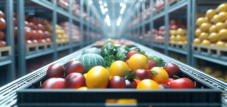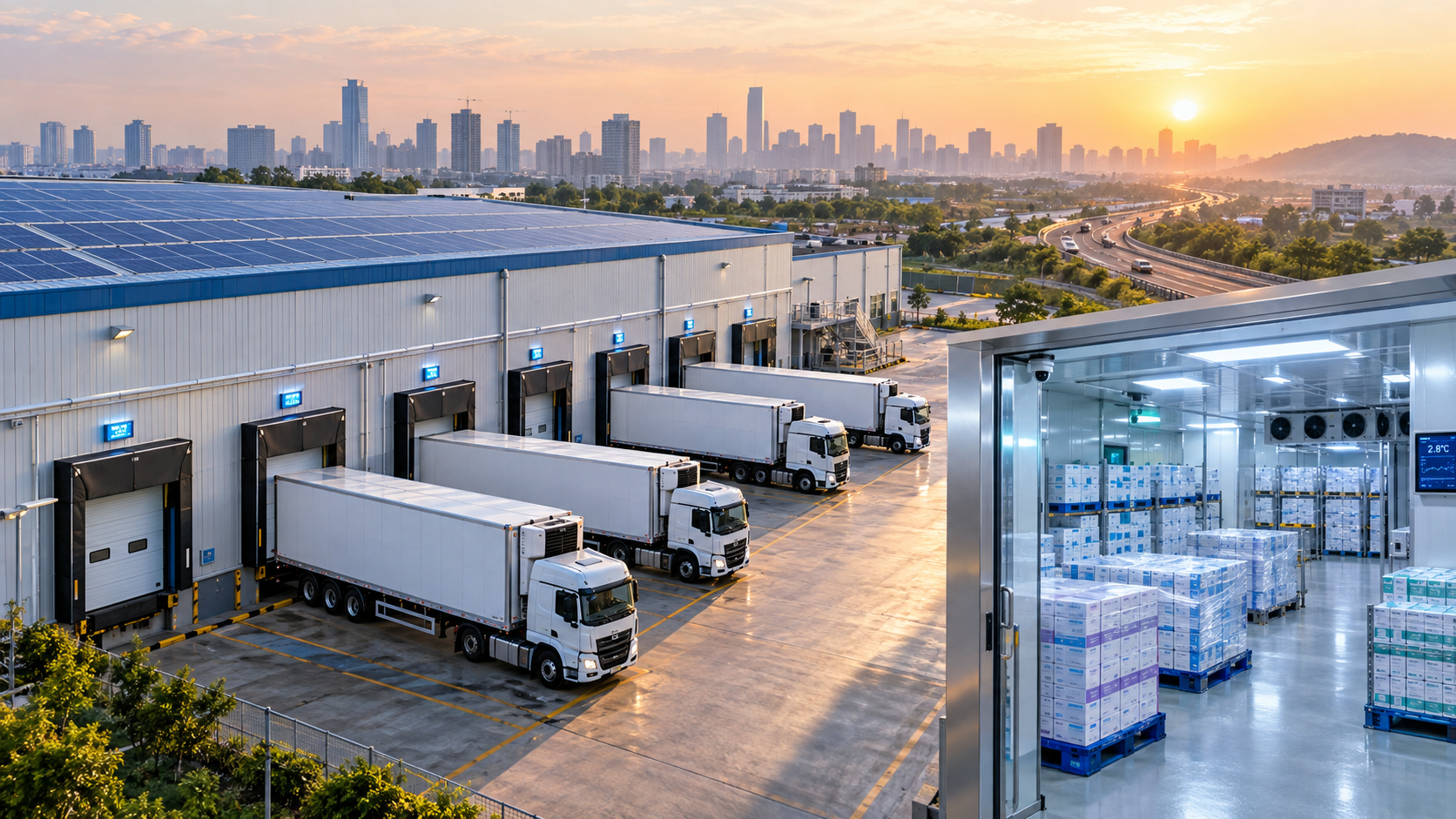
The future of cold chain logistics in India: A growth driver for the industry – Creative image on the topic, with AI: Xpert.Digital
Cold storage facilities in India: From niche to strategic infrastructure
How hygiene standards and temperature control are revolutionizing India's cold chains
India's cold chains: Key to food security and healthcare
The need to expand temperature-controlled supply chains is not only a technical challenge, but also an economic necessity for the country's food security and healthcare. Cold storage facilities, pharmaceutical warehouses, and refrigerated vehicles are no longer just a logistical niche; they have become an indispensable part of the strategic infrastructure driving the growth of Indian industry.
With the increasing demand for high-quality food, pharmaceuticals, and biologics, the cold chain is becoming an invisible quality assurance system along the entire value chain. The cold chain logistics market in India is growing rapidly, and it is crucial to assess existing capacities not only quantitatively but also qualitatively. In this context, the ability to provide seamless temperature control and product traceability is becoming a decisive competitive factor. Therefore, the expansion of cold chains is viewed not only as necessary infrastructure but also as an opportunity for companies that can adapt to the changing market demands and offer innovative solutions. In the following sections, we will examine the current trends, challenges, and opportunities of the Indian cold chain industry and demonstrate how these developments can sustainably transform the country's economic landscape.
India's cold chains are becoming strategic infrastructure
Whoever controls the temperature will control India's next industrial growth wave
India is at an economic turning point in the expansion of its temperature-controlled supply chains. Cold storage facilities, pharmaceutical warehouses, refrigerated vehicles, and digital monitoring systems are evolving from a niche technology into a fundamental infrastructure for food security, healthcare, export capability, and modern consumption. The key driver of this growth is not simply the volume of goods requiring refrigeration. Far more important is the increasing demand for quality, traceability, delivery speed, and product safety. With each additional modern food processing plant, pharmaceutical factory, fast-food restaurant, organized retail channel, or e-commerce platform, the need grows for supply chains that reliably maintain defined temperatures and comprehensively document any deviations.
Its economic significance therefore extends far beyond the logistics sector. An efficient cold chain extends the marketability of agricultural products, enables higher-value processing, reduces losses, and expands the geographical sales market. For pharmaceuticals, vaccines, biologics, and diagnostic products, it is even an integral part of product quality. A product transported or stored outside its permissible temperature range can lose its economic and medical value, even if the packaging and product appear outwardly undamaged. Refrigeration is thus not merely an additional service, but an invisible quality assurance measure along the entire value chain.
India's starting point is contradictory. The country has thousands of cold storage facilities and a total capacity of around 40 million tons. At the same time, there is a structural undersupply of integrated, multi-stage systems suitable for various product groups. A significant portion of the existing capacity is geared towards individual agricultural products, seasonal storage, and local business models. However, modern demand is primarily for multi-temperature facilities, pre-cooling, blast freezing, qualified pharmaceutical storage, reliable refrigerated transport, urban distribution, and data-driven control. The central question, therefore, is not how many cold storage facilities India has, but how much of the existing infrastructure actually functions as an unbroken cold chain.
The market is growing faster than its reliable data base
Market studies estimate the size of India's cold chain logistics sector very differently, depending on the definition and scope used. Some calculations project a market volume of around US$16 billion for 2025 and expect it to more than double by 2032. Others arrive at a figure of over US$23 billion for the same starting year and forecast significantly more moderate growth. This discrepancy is not a minor statistical issue, but rather reflects a fragmented market. Some analyses focus exclusively on specialized warehousing and transportation services, while others include additional services, in-house infrastructure, equipment, or parts of food and pharmaceutical distribution.
For a reliable economic assessment, the overall trend is therefore more important than a seemingly precise single figure. Demand is growing structurally, but not at the same rate in every segment. Traditional storage of simple agricultural products follows different cycles and margins than a pharmaceutical supply chain with temperature mapping, calibrated sensors, and auditable data sets. Frozen food requires different facilities than fresh produce, vaccines, or biologics. Anyone who views the Indian cold chain market as a single industry overestimates the interchangeability of capacities and underestimates the importance of specialization.
The existing infrastructure is nevertheless considerable. By mid-2025, 8,815 cold storage facilities with a capacity of approximately 40.2 million tons were recorded nationwide. A government analysis simultaneously estimated the total available capacity at roughly 37 to 40 million tons and identified a further gap of 10 to 15 million tons. A portion of the existing capacity is already occupied by pharmaceutical products and is therefore unavailable for food storage. Even more significant than the calculated gap is the qualitative discrepancy: storage space in a facility primarily focused on potatoes is no substitute for a multi-zone infrastructure for dairy products, frozen foods, meat, seafood, or sensitive pharmaceuticals.
The investment logic is therefore shifting from simply expanding floor space to functional enhancement. Added value is created through different temperature zones, flexible racking systems, automation, controlled handling areas, redundant power supply, qualified packaging, and digital tracking. Operators who combine these elements can gain longer contract terms, more demanding customers, and more stable capacity utilization. At the same time, capital requirements, technical complexity, and liability risks increase. Market growth is therefore real, but it doesn't automatically reward every capacity expansion.
Hyderabad demonstrates the new investment logic
A particularly striking example is the expansion of temperature-controlled storage capacity in Hyderabad. Snowman Logistics is building a new warehouse there with 10,000 pallet spaces. The facility is designed to cover a temperature range from -25 to +20 degrees Celsius, making it suitable for frozen, chilled, and temperature-controlled goods. It is being built along National Highway 44 in the northern logistics belt of the metropolis. This location combines regional access, long-distance transport, and the supply of growing consumer centers in Telangana and Andhra Pradesh.
The new capacity increases Snowman's pallet spaces in Hyderabad from 6,800 to 16,800. This represents a local increase of almost 150 percent. While the expansion is smaller across the country, it is strategically significant: prior to the expansion, the company had 154,319 pallet spaces in 21 cities. With the additional facility, national capacity grows by approximately 6.5 percent. This investment is therefore neither a symbolic, isolated project nor a leap that will transform the entire Indian market. Rather, it is a precise expansion at a location where multiple demand flows converge.
Hyderabad is particularly well-suited for this. The region combines a strong pharmaceutical and vaccine industry with a growing urban consumer market. Telangana boasts numerous manufacturers of active pharmaceutical ingredients, generics, biologics, and vaccines. The Genome Valley life sciences cluster houses research, development, and production activities, while further industrial sites and pharmaceutical facilities are planned or under development. For a cold chain operator, this density translates into short distances to industrial customers, recurring volumes, and the opportunity to combine warehousing, distribution, and value-added services.
At the same time, demand from the food industry is growing in Hyderabad. Seafood, ice cream, fruits and vegetables, as well as supplies for fast-food restaurants, require different temperature ranges but have similar requirements for availability and delivery reliability. A multi-zone facility can consolidate this demand and thereby stabilize its utilization across customers and seasons. This is precisely where its economic advantage lies compared to traditional cold storage facilities tailored to a single product.
Also noteworthy is the chosen built-to-suit model. The property is developed according to demand, while the logistics operator expands its capacity with comparatively little capital. This allows for faster scaling of investments and limits balance sheet risks. However, the model does not solve all economic problems. Long-term lease or usage obligations can become a burden if occupancy is low. Therefore, it remains crucial whether sufficient anchor customers, realistic volume forecasts, and a robust pricing model are in place before commissioning.
Pharmaceuticals make cooling a quality issue
Pharmaceutical logistics is one of the strongest structural drivers of the market. India's pharmaceutical industry achieved exports of approximately US$30.5 billion in fiscal year 2024/25, an increase of 9.4 percent compared to the previous year. Indian pharmaceuticals reach about 200 markets, with a large proportion going to highly regulated countries. This increases the pressure not only to produce cost-effectively but also to ensure verifiable product quality all the way to the recipient.
The need for refrigeration is growing, particularly with vaccines, biologics, certain injectable drugs, diagnostic materials, and specialized therapies. These products are more valuable and temperature-sensitive than many conventional tablets or active ingredients. At the same time, pharmaceutical logistics cannot be reduced to low-temperature storage alone. Different products require different storage conditions, and even controlled room temperature necessitates technical monitoring in hot climates. Adherence to the manufacturer's specified temperature range is crucial, not simply maximizing cooling capacity.
Good distribution practice requires a documented quality system, risk management, trained personnel, traceability, and controlled processes. Warehouses must be temperature-mapped under representative conditions to identify hot and cold zones. Measuring instruments require regular testing and calibration. Transport processes must be documented in such a way that, in the event of a deviation, a decision can be made as to whether the goods should be released, investigated, or discarded. Batch and expiration dates play a crucial role in recalls and inventory management.
This is changing the logistics business model. Customers are no longer just paying for space and distance, but also for risk control and verifiable process quality. An operator with qualified facilities, validated procedures, and reliable data management can compete on price with simpler warehouse providers. At the same time, the costs for audits, training, maintenance, documentation, and quality assurance are rising. Entering the pharmaceutical logistics sector is therefore attractive, but by no means straightforward. Without operational discipline, a seemingly high-margin segment can cause significant liability and reputational damage.
India's importance as a global pharmaceutical hub makes this capability economically relevant as well. A break in the cold chain can not only devalue a single shipment but also affect delivery dates, regulatory approvals, and international customer relationships. Especially for vaccines and biologics, logistics thus becomes a key factor in industrial competitiveness. The quality of a pharmaceutical export doesn't end at the factory gate.
Food products change volume and demand profile
While pharmaceuticals offer particularly high demands and attractive added value, the food industry accounts for the larger volume. India's agricultural and processed food exports reached approximately US$49.4 billion in 2024/25. The share of processed foods rose to just over 20 percent. At the same time, the domestic market for packaged products, dairy products, frozen foods, ready meals, and food service offerings is growing. Rising incomes, urbanization, and smaller households are increasing the demand for convenience, quality, and year-round availability.
This development is shifting the supply chain from seasonal storage to a continuous flow of goods. A traditional cold storage facility primarily profits from storing large quantities over extended periods. Modern retail and food service customers, on the other hand, require frequent turnover, smaller shipments, precise delivery windows, and multiple temperature zones. The economic value increasingly lies in order picking, inventory management, packaging, labeling, and regional distribution. As a result, cold chain logistics is approaching the model of a specialized contract logistics provider.
Fast-food restaurants and organized restaurant chains are particularly dynamic. They demand standardized ingredients, consistent product quality, and reliable delivery across numerous branches. A shortage of even a single item can negatively impact the sales of several menu items. This creates a predictable baseline capacity for logistics providers, provided they can guarantee high delivery quality. The fact that the new facility in Hyderabad explicitly targets this segment demonstrates how closely urban growth and the expansion of cold chain infrastructure are now intertwined.
In the agricultural sector, the impact is more complex. Cooling can reduce spoilage and give farmers greater flexibility in terms of timing and location when selling produce. However, it alone does not solve problems with harvest planning, sorting, quality standards, or market access. If pre-cooling is lacking at the point of production, products can lose quality even before storage. If small quantities are not consolidated, transport becomes uneconomical. If buyers are not willing to pay a premium for better quality, their willingness to pay for professional cooling remains limited.
A viable agricultural cold chain therefore doesn't begin in a large urban warehouse. It requires packing houses, pre-cooling, sorting and collection in production areas, as well as suitable transport solutions. Only the connection of these stages creates a true chain. This is precisely where one of the biggest gaps in the Indian system lies: there is ample storage capacity, but significantly less seamlessly integrated infrastructure between farm, processing plant, distribution center, and retail outlet.
The real deficit lies between the cold storage facilities
The notion that India simply needs to build more cold storage facilities is too simplistic. The most critical disruptions often occur during transitions between processing stages. Goods wait unrefrigerated for pickup, are transferred at an open loading dock, travel in a vehicle without reliable temperature recording, or are stuck in traffic for too long during urban deliveries. Each of these situations can compromise the previously meticulously established temperature control system.
The organized fleet of refrigerated vehicles is particularly limited. Industry analyses predict fewer than 20,000 professionally operated vehicles by 2025. Even if such estimates must be interpreted cautiously due to the fragmented market, the trend is clear: Transport capacity is not growing at the same pace as stationary storage everywhere. Outside of major corridors, vehicle availability, maintenance quality, and return loading remain problematic.
Refrigerated transport is economically demanding. The vehicle is more expensive than a conventional truck, the payload can be reduced due to insulation and refrigeration technology, and in addition to the engine, the refrigeration unit also requires energy. Empty return trips are particularly detrimental to profitability. Furthermore, differing temperature requirements complicate the combination of loads. A vehicle that has transported frozen goods is not automatically ideally suited for pharmaceuticals or fresh produce.
This is why platform models are gaining importance. An operator doesn't need to own every vehicle if they can integrate external fleets technically and procedurally. This requires standardized equipment, trained drivers, digital order management, sensors, and clear escalation processes. Such a network can grow faster than a purely in-house fleet. However, it carries quality risks if subcontractors work inconsistently or fail to provide reliable data.
The strategic scarcity therefore lies not only in physical assets, but also in the ability to control a heterogeneous network. Companies that combine warehousing, transportation, quality management, and data on a single platform create greater customer value than operators of isolated facilities. This integration is also likely to determine, in the long term, which market participants consolidate and which become acquisition targets.

Expert partner in warehouse planning and construction

Innovative approaches in Indian cold chain logistics
Energy determines the profit margin
Cold storage facilities are capital- and energy-intensive. Compressors, evaporators, pumps, fans, lighting, automation, and emergency power systems generate ongoing costs. In hot regions, thermal stress increases, while grid fluctuations or power outages necessitate additional reserves. An operator's contractual options for adjusting prices are limited if energy prices rise unexpectedly. Therefore, energy efficiency becomes a direct performance indicator.
Capacity utilization is equally important. Many costs are incurred regardless of whether a chamber is full or half empty. Underutilized space therefore disproportionately impacts profit margins. Seasonal agricultural products can generate high occupancy rates at times, but cannot guarantee stable year-round business. Multi-product and multi-temperature systems can reduce this risk because they combine customers from different sectors. However, they are more technically demanding and require professional sales and capacity management.
Rooftop solar panels can cover a portion of daily energy consumption and reduce dependence on the grid. Their benefits are particularly relevant in cold storage facilities, where high ambient temperatures and strong sunlight often occur simultaneously. However, photovoltaics do not replace off-peak electricity or emergency power reserves. Battery storage, thermal storage, or ice storage systems can shift loads, but initially increase investment costs. A combination of these systems becomes economically viable when operators don't consider individual components but instead optimize electricity tariffs, load profiles, operating times, and outage risks together.
The choice of refrigerant is also gaining importance. International climate regulations and national requirements are increasing the pressure to replace substances with high global warming potential. Alternative systems can offer long-term advantages, but require suitable components, trained technicians, and robust maintenance networks. Especially in refrigerated transport, new technologies must be carefully tested under Indian conditions with high ambient temperatures, dust, frequent door openings, and dense urban traffic.
For investors, this means that nominal capacity says little about profitability. More crucial factors are energy consumption per pallet space, utilization, customer mix, contract duration, maintenance status, power supply, and technical redundancy. Two warehouses of the same size can be completely different from each other economically. Therefore, as the market becomes increasingly professionalized, it will differentiate more sharply between mere space and high-performance infrastructure.
Digitalization is becoming a prerequisite rather than an add-on
Temperature-controlled logistics generates vast amounts of data. Sensors measure temperature and humidity, telematics records location and door openings, warehouse management systems document inventory levels, and quality platforms assign events to individual batches. However, the economic value only arises when this information is reliable, compatible, and actionable.
A simple warning message about a temperature deviation is insufficient. The system must identify which product is affected, how long the deviation lasted, whether it was within an acceptable tolerance range, and what action will be taken. Ideally, drivers, control centers, and quality management are automatically involved. For pharmaceutical customers, the data must be auditable and protected against subsequent alteration. In the food sector, similar systems can reduce spoilage, customer complaints, and unnecessary safety stock.
Digital transparency also improves efficiency. Operators can analyze energy consumption by chamber and customer, plan maintenance proactively, and better market available capacity. Transport networks can be optimized based on travel times, return loads, and door openings. This not only reduces costs but also increases the likelihood of meeting agreed temperature and delivery windows.
India's national logistics policy supports digital integration through shared data platforms and interfaces. Such systems can simplify permits, transport information, and port processes. However, an additional industry-specific layer remains necessary for the cold chain. Temperature data, calibration certificates, quality releases, and batch information are sensitive and must be exchanged in a controlled manner between manufacturers, logistics providers, distributors, and authorities.
Digitalization is simultaneously widening the gap between professional and informal providers. Small operators can now acquire modern sensors relatively cheaply, but technology alone does not guarantee process quality. Crucial factors are master data, responsibilities, training, and a consistent response to deviations. A dashboard without operational discipline creates visibility, but not security.
Government funding builds capacity, not automatically efficiency
The Indian government promotes integrated cold chain, processing, and agricultural infrastructure through several programs. Under the Pradhan Mantri Kisan Sampada Yojana, hundreds of cold chain projects have been approved. By mid-2025, 395 integrated projects had been approved, of which 291 were completed and operational. They created additional preservation and processing capacity and contributed to employment.
Funding increasingly focuses on linking infrastructure at the point of production with distribution centers and refrigerated transport. This approach makes economic sense because it doesn't just finance an isolated storage point, but aims for a functional chain. Grants can cushion high initial investments and enable projects in regions that would not be sufficiently profitable without support. Further financing instruments support warehouses, processing units, and shared agricultural infrastructure.
At the same time, the impact of government funding should not be confused with operational success. A subsidized cold storage facility may be technically complete and yet suffer from low utilization, an unsuitable location, or weak customer acquisition. Funding programs reduce capital costs but do not replace demand analysis. Furthermore, the number of approved projects says little about how reliably the facilities are operated and whether they actually reduce losses along the supply chain.
Effective policy should therefore focus more on utilization and results. Relevant key performance indicators would not only be installed tonnage capacity, but also utilization, the number of connected producers, avoided quality losses, energy consumption, transport integration, and the proportion of digitally documented shipments. For pharmaceutical logistics, audit quality, temperature stability, and traceability would be crucial. Such a results-oriented approach would transform the promotion of construction projects into the promotion of resilient supply chains.
National logistics policies and the expansion of multimodal logistics parks can generate additional efficiency gains. Connecting cold storage facilities to roads, railways, airports, ports, customs clearance, and packaging services reduces transfer losses and transit times. This interconnectedness is particularly important for exports of seafood, pharmaceuticals, and processed foods, more so than isolated capacity increases.
Capital discovers the consolidation opportunity
The interest shown by large infrastructure and financial investors demonstrates that cold chains are increasingly being perceived as a distinct asset class. I Squared Capital is considering entering the Indian market and has reportedly held talks with local companies about equity investments or takeovers. A potential platform model would be suitable for consolidating a fragmented market through acquisitions, technical standards, and joint management.
The sector is attractive to private equity and infrastructure funds because it combines long-term growth drivers with real assets. Cold storage facilities, if well-located and utilized, can deliver predictable cash flows. Pharmaceutical customers and large food companies often enter into long-term contracts because switching providers involves qualification processes, audits, and operational risks. Furthermore, there is potential to enhance smaller, regional operators through capital, digitalization, and professional management.
However, the risks are considerable. Cold chain infrastructure is not a passive real estate investment. Technical operations, customer acquisition, energy procurement, and quality assurance determine profitability. An aggressive buy-and-build strategy can fail if acquired sites have different systems, maintenance levels, and corporate cultures. Regional customer relationships also cannot be centralized at will.
The most likely consolidation path is therefore selective. Investors are likely to favor companies located in attractive production or consumption clusters, operating across multiple temperature ranges, and serving anchor customers in the pharmaceutical, food, or organized retail sectors. Complementary acquisitions can add transportation networks, geographic reach, or specialized expertise. Less attractive individual plants, on the other hand, could remain under price pressure despite overall market growth.
Finding listed winners is more difficult than the positive industry narrative might suggest. The Indian stock market offers few pure cold chain providers. Snowman Logistics is the most visible listed specialist, while other logistics companies only have partial operations. Additionally, suppliers of refrigeration, building technology, automation, sensors, and energy efficiency equipment are benefiting. However, a growing industry does not automatically translate into attractive stock returns. Valuation, return on equity, debt levels, and operational performance remain crucial.
Competition is shifting to networks and trust
India's cold chain market remains fragmented. Alongside nationwide companies, numerous regional operators, specialized pharmaceutical logistics providers, and local cold storage facilities exist. Large international logistics groups compete in selected segments, while industrial customers sometimes operate their own infrastructure. This diversity increases competitive pressure but also opens up opportunities for cooperation.
In basic warehousing, price is a dominant factor. However, as soon as multiple locations, validated processes, and complex transportation come together, the network becomes increasingly important. A national customer prefers providers who guarantee consistent standards across different regions. Regional specialists, on the other hand, can win customers through their proximity, flexible solutions, and detailed market knowledge. Therefore, the competition is not necessarily won by the largest companies, but by those that combine reach with local execution quality.
Trust is an economic asset. Manufacturers only supply valuable or perishable goods to service providers whose processes they can understand. A long series of flawless deliveries reduces perceived switching risks and strengthens pricing power. Conversely, a single serious temperature incident can damage customer relationships and brand value. Quality is therefore not just a cost center, but the foundation of recurring revenue.
Value-added services are becoming the most important area of differentiation. These include repacking, labeling, batch management, quality control, inventory financing, customs support, recall management, and urban distribution. Such services increase revenue per pallet and integrate the operator more deeply into the customer's processes. However, they also place higher demands on personnel, IT, and liability management.
For Snowman Logistics and similar providers, the key will be whether new capacities can be quickly filled with profitable contracts. The Hyderabad facility, with its wide temperature range and location, offers favorable conditions. However, its economic success still depends on capacity utilization, pricing discipline, customer mix, and transport integration. A full warehouse with poorly calculated contracts may be less valuable than a slightly lower capacity utilization with stable margins and long-term customers.
Skilled workers are becoming a hidden bottleneck
Technology and capital are at the heart of many investment debates, but qualified personnel are equally important. Cold chains require refrigeration technicians, maintenance specialists, quality managers, warehouse planners, data analysts, and drivers who can handle temperature-sensitive goods. Errors often arise not from a complete system failure, but from incorrect operation, poorly closed doors, delayed responses to warnings, or inadequate cleaning.
The demands are increasing with more modern refrigerants and digital systems. Technicians must not only understand mechanical components but also master sensors, controls, and software. In the pharmaceutical sector, documentation, deviation management, and auditability are added requirements. Companies that invest in training and standardized workflows therefore create a competitive advantage that is difficult to replicate.
The shortage of skilled workers further increases the potential for consolidation. Small operators can acquire modern equipment, but don't always have access to experienced personnel or systematic training. Larger platforms can establish training programs, central control centers, and mobile maintenance teams. This improves operational reliability and reduces costs per site in the long run.
For policymakers, it makes sense to more closely link skills development with infrastructure funding. A new cold storage facility should not only receive financing for buildings and equipment, but also access to certified training, technical standards, and operational consulting. Especially in smaller towns and production regions, the local availability of skilled workers determines whether investments are sustainable in the long term.
Sustainability is becoming an economic condition
Extending the cold chain reduces food waste, but simultaneously increases electricity consumption and emissions. This conflict of objectives cannot be resolved by considering only one side. Additional cooling can be economically beneficial if it saves more emissions from avoided production and waste than it generates during operation. This requires efficient planning of systems, high utilization rates, and a power supply of the cleanest possible energy.
In India, solar roofs, efficient insulation, variable-speed compressors, heat recovery, and intelligent load management are promising options. For transportation, improved route planning, higher return load rates, and well-maintained insulated structures can reduce energy consumption. New cooling technologies, such as phase-change materials, may offer advantages in certain applications but must be tested under real-world climatic and operational conditions.
Financiers and international customers are also increasing the pressure. Pharmaceutical and food companies are pursuing their own emissions targets and increasingly expect data from their supply chains. Operators who measure energy consumption and refrigerant losses can improve their position in tenders and long-term contracts. Sustainability is thus transforming from a communication issue into an integral part of customer qualification.
However, environmental requirements must not catch smaller market participants unprepared. High investment costs, limited spare parts availability, and a lack of technicians can delay the transition. Therefore, technology-neutral subsidies, transparent efficiency standards, and financing models that consider savings over the lifetime of the equipment are advisable. Otherwise, a rapid expansion of inefficient systems would lock in long-term costs and modernization needs.
The greatest risks lie in the implementation
The growth story of India's cold chain infrastructure is compelling, but not without risk. A key risk is overinvestment in attractive locations. If several operators build simultaneously in the same major cities, short-term overcapacity can arise. This leads to price reductions and prolongs the start-up phase of new facilities. Conversely, rural regions with more challenging demand aggregation may remain underserved.
A second risk is incorrect specialization. Facilities geared towards a narrow temperature range or a limited number of products can lose value if demand changes. However, flexibility comes at a price. Multi-zone warehouses cost more and are more complex to operate. The optimal solution depends on the regional customer mix and realistic contract prospects.
Third, energy prices and electricity quality can alter calculations. Long-term customer contracts protect revenue but carry risks if price adjustment clauses are lacking. Fourth, regulatory responsibility is increasing. The more data and quality must be documented, the more visible deviations become. This is positive for the market overall but can place a financial burden on insufficiently prepared operators.
Fifth, the last mile remains challenging. In densely populated cities, traffic jams, delivery windows, and frequent door openings create high thermal stresses. Large refrigerated vehicles are not universally applicable, while smaller vehicles have higher costs per unit. Micro-distribution centers and alternative cooling technologies can help, but they initially increase the number of delivery points.
Finally, there is a financing risk. High initial investments coincide with start-up phases during which occupancy rates and cash flow are not yet stable. Debt financing can increase the return on equity, but can quickly become a burden if delays occur. Asset-light models redistribute risks but do not eliminate them. Operators must meet their rental obligations even if customer volumes arrive later than planned.
Storage areas are being transformed into industrial platforms
In the coming years, the Indian market is expected to develop in three directions. First, the proportion of modern, multi-zone facilities will increase. Second, storage, transportation, and data will become more integrated. Third, specialization in pharmaceuticals, high-quality food products, and urban distribution will increase. Traditional cold storage facilities will not disappear, but their relative importance will decline.
Hyderabad exemplifies this development. The combination of a pharmaceutical industry, a large urban market, regional food production, and good transport connections creates a demand profile that favors integrated facilities. Similar logic applies to other production and consumption centers, but they differ in industry mix, climate, infrastructure, and competition. Successful expansion therefore requires regional precision rather than a schematic nationwide rollout.
For companies, the greatest opportunity lies in understanding cold chains not as a collection of equipment, but as an industrial operating system. This system connects physical capacity, quality standards, energy, transport, data, and skilled personnel. The more sensitive and valuable the goods, the greater the benefit of such integration. Pharmaceuticals and biologics represent the most demanding segment, food and the catering industry provide volume, while agricultural products have the greatest potential for societal benefit.
The clear perspective, therefore, is that India doesn't simply need more cold, but more reliable temperature control. Investments are particularly valuable economically when they close gaps between production, processing, storage, and distribution. Building additional facilities is only the visible part. Real competition hinges on the ability to manage temperatures, data, energy, and responsibility throughout the entire supply chain.
Those who develop this capability benefit from several long-term trends simultaneously: a growing pharmaceutical industry, rising demand for processed foods, organized trade, modern gastronomy, higher quality standards, and increasing export orientation. Conversely, those who merely build capacity without securing the network, customers, and processes risk low utilization and weak returns. India's cold chain boom is therefore not a simple story of volume. It is a demanding phase of industrial professionalization in which quality, integration, and capital discipline determine success.
Your intralogistics experts

Consulting, planning and implementation of complete solutions for high-bay warehouses and automated storage systems - Image: Xpert.Digital
More information here:
Your global marketing and business development partner
☑️ Our business language is English or German
☑️ NEW: Correspondence in your native language!

Konrad Wolfenstein
I and my team are happy to be available to you as your personal advisor.
You can contact me by filling out the contact form here wolfenstein@xpert.digital:or simply call me at +49 7348 4088 965. My email address is
I'm looking forward to our joint project.
☑️ SME support in strategy, consulting, planning and implementation
☑️ Creation or realignment of the digital strategy and digitization
☑️ Expansion and optimization of international sales processes
☑️ Global & Digital B2B trading platforms
☑️ Pioneer Business Development / Marketing / PR / Trade Fairs
Our global industry and economic expertise in business development, sales and marketing


Our global industry and economic expertise in business development, sales and marketing - Image: Xpert.Digital
Industry focus areas: B2B, digitalization (from AI to XR), mechanical engineering, logistics, renewable energies and industry
More information here:
A thematic hub offering insights and expertise:
- Knowledge platform covering global and regional economies, innovation and industry-specific trends
- A collection of analyses, insights, and background information from our key areas of focus
- A place for expertise and information on current developments in business and technology
- A hub for companies seeking information on markets, digitalization, and industry innovations