
Historic turning point: Switzerland seeks closer ties with the EU on security and defense issues – what does this mean for neutrality?
Xpert Pre-Release

Available in 27 languages 📢
Prefer Xpert.Digital on GoogleⓘPublished on: September 16, 2025 / Updated on: September 16, 2025 – Author: Konrad Wolfenstein
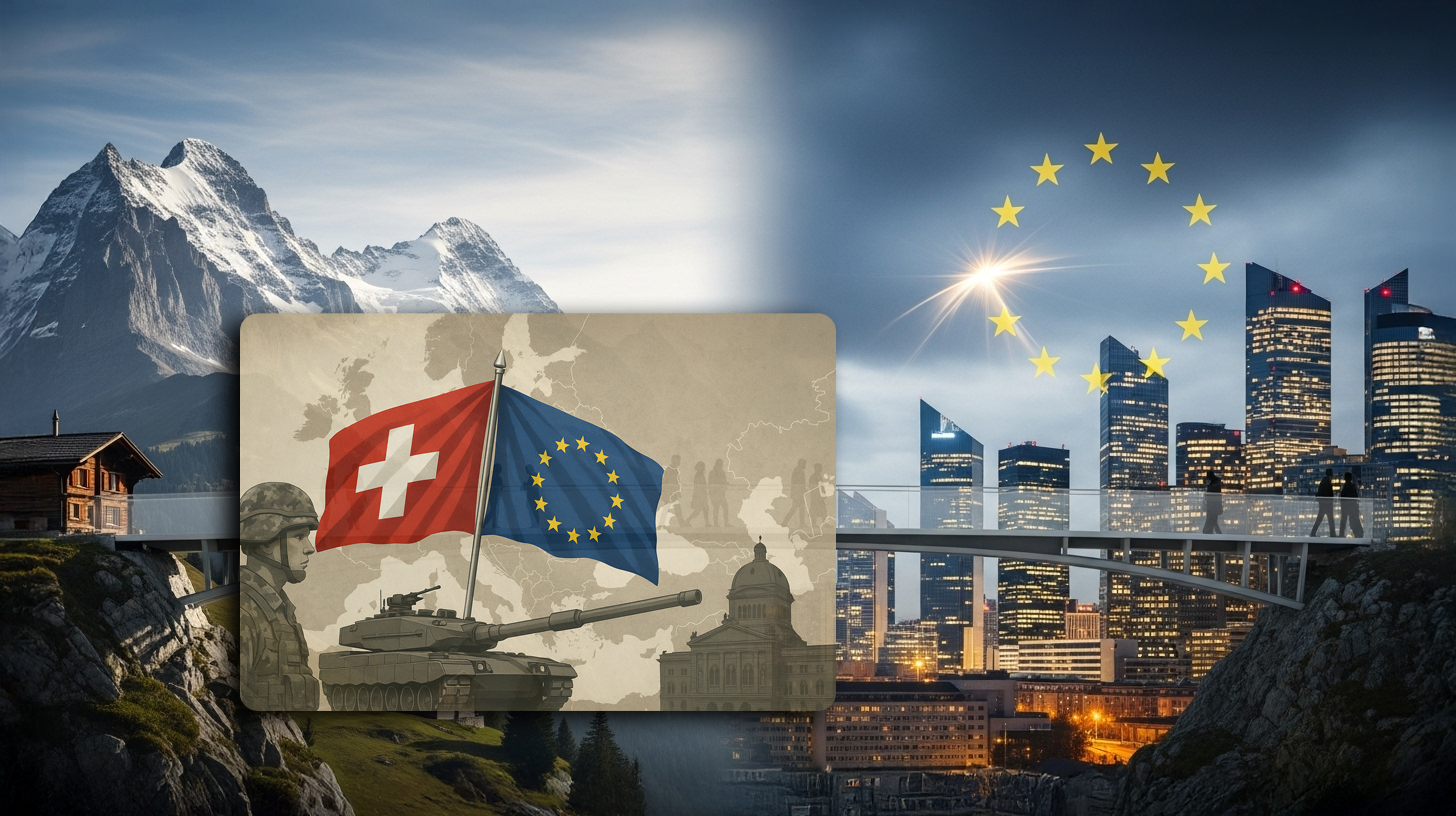
Historic turning point: Switzerland seeks closer ties with the EU on security and defense issues – what does this mean for neutrality? – Image: Xpert.Digital
Security before tradition: National Council decides on closer ties with the EU – a taboo broken?
PESCO and the defense fund: What Switzerland really wants when it talks about EU security
In a time of growing geopolitical tensions, Switzerland has taken a historically significant step: The National Council, by a clear majority, has instructed the Federal Council to examine closer cooperation with the European Union on security and defense policy. This initiative is a direct response to the fundamentally changed security situation in Europe, characterized by the war in Ukraine, hybrid threats such as cyberattacks, and increasing pressure from major powers.
At its core, the issue concerns potential participation in key EU initiatives such as Permanent Structured Cooperation (PESCO) and the European Defence Fund. Such a partnership would not only provide access to cutting-edge technology and joint research projects, but also open new economic doors for the domestic defense industry. However, the decision is hotly contested domestically and has sparked a fundamental debate that touches upon the country's self-image: How can such a partnership be reconciled with traditional Swiss neutrality? Switzerland is thus facing a strategic turning point, where it must weigh the necessity of modern security cooperation against the risk of a loss of sovereignty – a decision that will significantly shape the future of its foreign and security policy.
Suitable for:

The decision of the National Council
The National Council has decided by a clear majority that Switzerland should intensify its dialogue with the European Union in the area of security and defense. At the heart of this political signal is the demand that the Federal Council initiate talks with the EU to explore a formal partnership in security and defense policy. The initiative came from the Security Policy Committee, which placed the issue on the agenda and received broad support. The next step is for the Federal Council to prepare a concrete negotiating mandate following initial bilateral talks. This mandate will then be discussed in both the Security and Foreign Affairs Committees before any potential formal treaty negotiations take place.
Background: Why Switzerland is taking this step
The security situation in Europe has changed considerably in recent years. The Russian invasion of Ukraine, the increasing geopolitical pressure from major powers like China, and the heightened threat from hybrid dangers such as cyberattacks and disinformation have significantly impacted the European security order. Switzerland, too, seeks to redefine its position within this context. As a neutral country, it has traditionally been reserved when it comes to military alliances or security cooperation. Nevertheless, Switzerland has established numerous partnerships with international organizations over the past decades, including the Partnership for Peace (PfP) with NATO and close cooperation with the United Nations. Now, its focus is increasingly shifting to the European Union, which has been systematically expanding its security and defense capabilities for years.
Participation in European security programs would allow Switzerland to contribute to initiatives in defense cooperation, research, and technological development. In particular, participation in the so-called "Permanent Structured Cooperation" (PESCO) or the "European Defence Fund" offers the prospect of contributing to complex projects without having to be a member of the European Union.
Overview of European defence initiatives
Since 2017, the European Union has established PESCO, a framework that allows member states to pool their military capabilities, launch joint projects, and harmonize procurement structures. Dozens of projects are already underway, ranging from cyber defense to joint logistics. In parallel, the European Defence Fund (EDF) was created, providing billions of euros in funding for research and development in the defense sector. The fund supports projects such as the development of new drone technologies, secure communications infrastructure, and military artificial intelligence.
For third countries seeking closer ties with the EU, there is the possibility of associated participation in exceptional cases. For example, Norway is included in some programs, even though it is not a member of the Union. Switzerland now also intends to explore this option – with the aim of better contributing its own industrial capacities and benefiting from technology transfer.
The role of the Swiss arms industry
An important aspect of the discussion is the industrial dimension. Switzerland has a competitive defense industry, ranging from small and medium-sized enterprises to specialized technology companies and multinational corporations. Swiss firms are strongly represented in fields such as precision optics, special vehicles, drone technology, and communication systems. However, their access to European tenders has been limited so far, as the EU tends to favor its own member states. A formal security agreement could fundamentally change this situation.
Participation in the European Defence Fund would not only bring technological advantages but also give a new boost to the export opportunities of Swiss companies. At the same time, Switzerland would integrate itself into a more coordinated European defence sector, which is increasingly characterized by issues of resilience, supply chain stability and joint innovation strategies.
Hub for security and defense - advice and information

Hub for security and defense - Image: Xpert.digital
The hub for security and defense offers well-founded advice and current information in order to effectively support companies and organizations in strengthening their role in European security and defense policy. In close connection to the SME Connect working group, he promotes small and medium -sized companies (SMEs) in particular that want to further expand their innovative strength and competitiveness in the field of defense. As a central point of contact, the hub creates a decisive bridge between SME and European defense strategy.
Suitable for:
Security agreement with the EU – solution to modern threats or risk?
Neutrality and European security
Perhaps the most sensitive point in the domestic political debate is the question of how closer security and defense policy ties with the EU are compatible with Swiss neutrality. Opponents of such a partnership warn that Switzerland could abandon its traditional restraint and be drawn into military conflicts. Proponents, on the other hand, argue that such an agreement would not constitute an alliance commitment in the military sense, but rather cooperation in areas that are genuinely defensive and technically oriented. These include, for example, cyber defense, crisis prevention, disaster relief, and joint training and education platforms.
Switzerland is thus facing a strategic turning point. On the one hand, it must protect its neutrality and cultivate it as a credible feature of its foreign and security policy. On the other hand, it cannot confront the new threats entirely alone and needs functioning partnerships. Weighing these two aspects is at the heart of the current debate.
EU security policy interests
From the European Union's perspective, closer integration of Switzerland is also in its interest. Switzerland is centrally located on the European continent, possesses high-quality infrastructure, and is economically closely integrated into the single market. Furthermore, it is a stable actor in terms of security policy, having accumulated decades of experience with international peacekeeping operations and diplomacy.
An EU that wants to strengthen its defense capabilities is interested in having competent partners on board. Swiss capabilities could be of great value to the EU, particularly in areas such as logistics, cybersecurity, research and development, and training cooperation.
Parliamentary debates and domestic political dynamics
In the National Council, proponents of closer security policy alignment with the EU spoke out clearly. They emphasized that Switzerland could not stand on the sidelines while Europe realigned its defense. The war in Ukraine, in particular, had made it evident that isolated national structures were insufficient to respond to complex threat situations.
Opponents in parliament, however, argued that the proposal could lead to a loss of independence and the risk of a kind of security-related EU accession through the back door. They also criticized the fact that the exact scope of such a partnership was still unknown and that the country should not become dependent on others.
Historical development of Swiss security policy
A look back shows that Switzerland has always pursued a pragmatic approach to security policy. During the Cold War, it invested heavily in national defense and maintained its strict neutrality. After the end of the East-West conflict, the country increasingly opened itself to cooperation and joined, among other things, NATO's Partnership for Peace. Its participation in UN civilian and military missions was also continuously expanded.
The current debate thus builds on an existing tradition of defining security in an increasingly interconnected world not alone, but in dialogue with partners. The crucial difference, however, lies in the fact that the EU has now developed its own security and defense policy identity that goes far beyond mere coordination.
Suitable for:

Opportunities and risks of a partnership
Close cooperation with the EU can open up numerous opportunities for Switzerland: access to research projects, improved exchange of information in the field of threat analysis, expanded training opportunities, stronger integration of industry and, last but not least, a security policy standing at European level.
On the other hand, there are risks that are primarily politically sensitive: potential restrictions on neutrality, dependence on EU structures, or increased domestic polarization. Furthermore, there is the question of the extent to which Switzerland will actually gain access to EU programs. While there are precedents with Norway and the UK (as a third country after Brexit), each model is regulated differently and requires complex negotiations.
The way forward
The Federal Council now faces the task of implementing the National Council's political mandate and initiating a structured process with the EU. The first step will be to clarify the framework: Which programs are eligible, what is the scope of participation, what financial contributions are required, and what political obligations arise?
In parallel, Swiss domestic politics must continue the discourse. The population will have to prepare for an intensive debate, as security policy issues in Switzerland are always closely linked to the question of neutrality. A potential agreement could therefore ultimately be put to a popular vote, which further complicates the negotiations.
Security in a connected future
European security policy is undergoing a fundamental transformation. While NATO continues to form the backbone of military defense, the EU is seeking to strengthen its role as a security policy actor. This opens up new opportunities for Switzerland to find its place in the European order.
The crucial factor will be whether it is possible to define a partnership that both fulfills the requirements of cooperation and respects the specific characteristics of Swiss neutrality. Only by striking this balance can Switzerland find a sustainable solution.
A partnership-based security agreement with the EU promises to integrate Switzerland more closely into European cooperation without compromising its independence. Whether this promise can be fulfilled will be revealed by the political debate of the coming years – a debate whose urgency, given the current global political situation, could hardly be greater.
Your dual -use logistics expert

Dual -use logistics expert - Image: Xpert.digital
The global economy is currently experiencing a fundamental change, a broken epoch that shakes the cornerstones of global logistics. The era of hyper-globalization, which was characterized by the unshakable striving for maximum efficiency and the “just-in-time” principle, gives way to a new reality. This is characterized by profound structural breaks, geopolitical shifts and progressive economic political fragmentation. The planning of international markets and supply chains, which was once assumed as a matter of course, dissolves and is replaced by a phase of growing uncertainty.
Suitable for:
Advice - planning - implementation

Markus Becker
I would be happy to serve as your personal advisor.
Head of Business Development
Chairman SME Connect Defense Working Group
Advice - planning - implementation
Konrad Wolfenstein
I would be happy to serve as your personal advisor.
contact me at wolfenstein ∂ xpert.digital
Just call me on +49 7348 4088 965 (Munich) .





