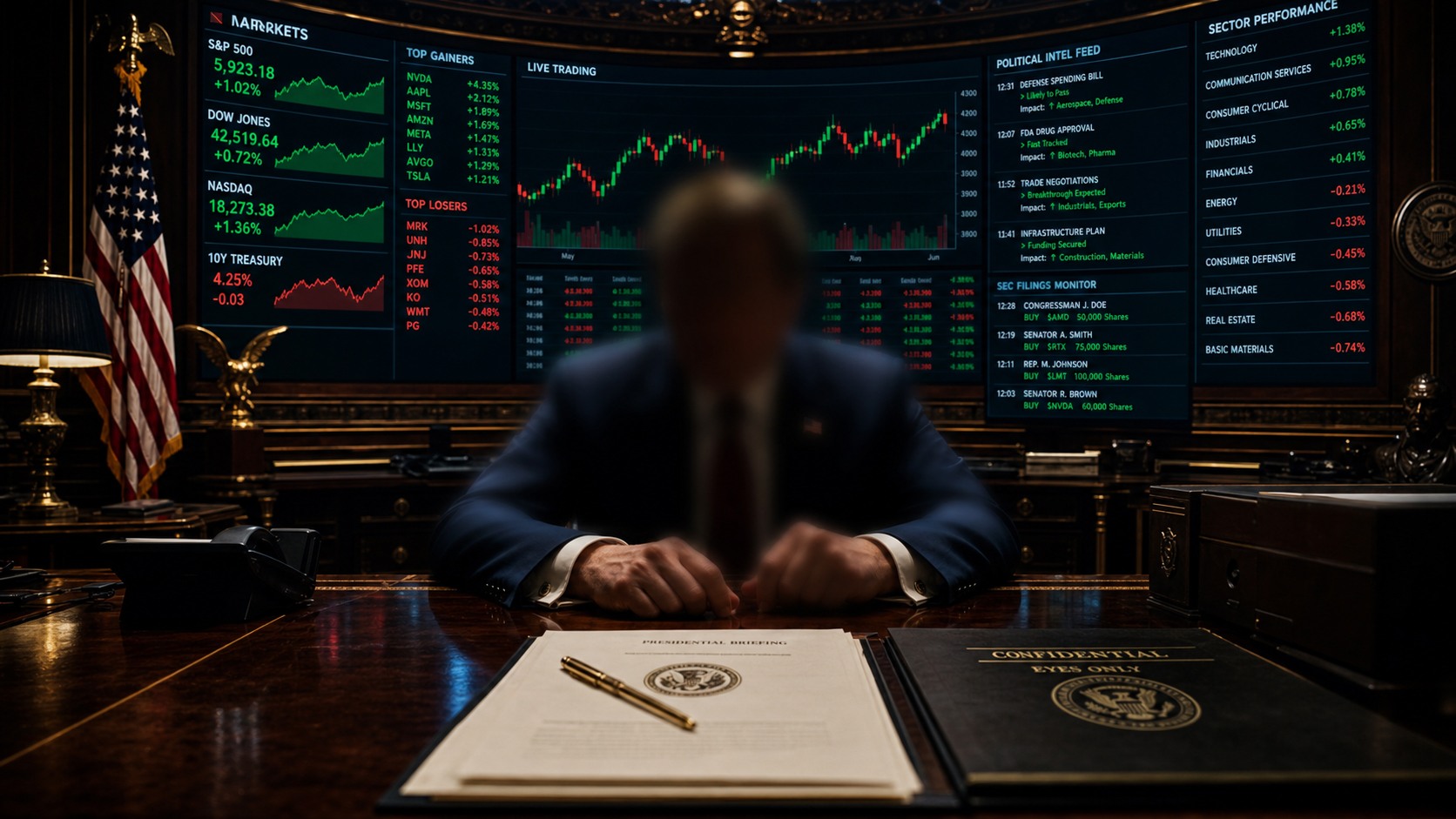
Suspicious timing: $2.2 billion in office – How the US president rakes in the cash on the stock market – Image: Xpert.Digital
The US president's controversial stock deals: Crypto instead of real estate – The White House's questionable new sources of income
Worse than Watergate? The unprecedented financial empire of the US president
Political gray area: How insider knowledge in Washington becomes billions
A president who not only passes laws but also apparently actively manipulates his own stock market performance: The latest financial disclosure report from the US reveals an unprecedented blurring of lines between the highest government office and private profit. With revenues exceeding $2.2 billion in 2025 alone – massively fueled by a booming crypto market and highly conspicuous stock transactions – the current president dwarfs all historical comparisons. While experts increasingly draw parallels to the Watergate scandal, an even more profound problem is emerging: a system operating in a legal gray area, where political decisions, exclusive social media posts, and private stock portfolios seamlessly intertwine. How political power has become an unprecedented business model, and why American regulatory bodies have so far stood by helplessly.
Related to this:


When the president is writing his own stock market curve
The annual financial disclosure report of the American president for 2025 paints a picture of a head of state whose private businesses have not shrunk during his term in office, but rather grown exponentially. The 927-page document, submitted to the Office of Government Ethics, lists revenues of at least $2.2 billion for 2025, compared to approximately $622 million the previous year. This represents a more than threefold increase in reported income within twelve months, while simultaneously the incumbent's political power grew over precisely those industries from which a large portion of this money originates.
To put things in perspective: The previous president had an estimated net worth of around $10 million by the end of his term, while earlier presidents like Barack Obama or George W. Bush increased their net worth to tens of millions only years after leaving office through books and speaking engagements. The current level of income during a single term is therefore unprecedented in modern American presidential history.
Digital money as the new main source of income for those in power
By far the largest item in the disclosure does not come from traditional real estate, but from the crypto economy. More than $1.4 billion in revenue is attributed to crypto and memecoin transactions, meaning that digital assets have overtaken traditional real estate as the largest source of income for the first time. Almost $800 million alone flowed from World Liberty Financial, a company co-founded by family members, divided between proceeds from the sale of governance tokens and the sale of company shares.
In addition, there are more than $635 million in licensing fees for so-called Celebration Coins, which are linked to the family's personal Memecoin business. An independent investigation by a major news agency estimated the group's income from crypto activities alone at over $800 million in the first half of 2025—an amount that far exceeded traditional business areas such as real estate, licensing, and golf courses. The contrast with the performance of the investors involved is remarkable: While the family businesses raked in billions, the Memecoins they promoted have lost over 90 percent of their value since their launch, and even the Bitcoin price has fallen by around 40 percent since the family took office.
The purchase that seems too perfect in terms of timing
Besides cryptocurrency revenues, public attention is particularly focused on specific stock purchases, the timing of which is strikingly linked to political decisions. On August 18, 2025, the president acquired shares in Apple, Microsoft, and Nvidia, each worth between $5 million and $25 million. The purchase of the Nvidia shares occurred shortly after the administration announced that Nvidia and its competitor AMD would have to pay 15 percent of their revenue from the sale of certain chips to China to the US government in exchange for export licenses—a regulation that paved the way for further lucrative business dealings in China by the chip manufacturers.
This sequence—first a political decision with immediate benefits for a company, then a personal investment in its stock—is considered one of the clearest examples of a potential conflict of interest in the entire disclosure process. An even larger buying spree occurred on April 8, 2025, when 327 stock transactions took place in a single day, with investments of between $100,001 and $250,000 simultaneously in Apple, Alphabet, Amazon, Microsoft, and Nvidia, just days before a drastic reversal in tariff policy was announced, which directly benefited these technology stocks.
When stock prices wait for a social media post
A study published in July 2026 by a major US news network, which used artificial intelligence to compare all reported stock transactions with posts on its own social media platform, yielded a revealing result. In more than 20 cases, a company was mentioned positively on the platform just a few days after an investment in its shares. In total, at least 44 purchases of 21 different companies were identified within a week before or after such positive posts.
A concrete example: On April 15, 2025, the platform announced that a chip manufacturer was investing $500 billion in building supercomputers exclusively in the United States, praising the investment as "very big and exciting." Just a few days earlier, shares in this very company, valued between $200,000 and $500,000, had already been purchased. The investigation also found 17 instances where, prior to negative comments about a company or its executives, corresponding positions had been sold. The White House denies any irregularity, stating that all transactions are carried out by independent, external asset managers at their own discretion, without the knowledge or influence of the officeholder.
Why a comparison with Watergate is flawed yet still apt
Harvard economist Kenneth Rogoff assesses the scale of the observed practices as historically unprecedented and draws a direct comparison to the Watergate scandal of the 1970s, which, in retrospect, seems like a harmless prank. This assessment may be rhetorically exaggerated, but it points to a structural difference between the two cases. Watergate was a covert, criminal act that was uncovered, prosecuted, and led to the resignation of a president. The current practices, on the other hand, are largely open, publicly documented, and take place in a legal gray area that has not yet been clearly established as criminal.
From an economic perspective, this is precisely where the real significance lies. While Watergate was a violation of existing rules, the current case reveals a loophole in the regulatory framework itself. The so-called STOCK Act of 2012, which explicitly prohibits insider trading based on non-public information for members of Congress, government employees, the president, and the vice president, formally exists for the highest office in the land. However, enforcement is largely the responsibility of agencies whose leadership is directly controlled by the president himself, making effective self-regulation virtually impossible in practice.
The silent tradition that was broken
Since the 1970s, sitting presidents have typically transferred their assets into so-called blind trusts, trust structures in which the officeholder has no insight into the day-to-day management of their assets and thus cannot know which specific stocks are held or traded. This practice was never legally mandated but was based on an informal, yet decades-long, norm of political decency.
The decision to forgo such a blind trust does not automatically constitute a legal violation, but it fundamentally alters the evidentiary situation. Without a separation between official duties and personal assets, it is difficult to refute the fact that knowledge gained from day-to-day government operations influences one's investment strategy, even if the specific purchase order is formally executed by an external asset manager. In this context, law professor Kathleen Clark of Washington University School of Law has been pointing out for years that the mere message that the market can be influenced with impunity through one's own public appearances represents a form of power demonstration in its own right.
Our US expertise in business development, sales and marketing


Our US expertise in business development, sales and marketing - Image: Xpert.Digital
Industry focus areas: B2B, digitalization (from AI to XR), mechanical engineering, logistics, renewable energies and industry
More information here:
A thematic hub offering insights and expertise:
- Knowledge platform covering global and regional economies, innovation and industry-specific trends
- A collection of analyses, insights, and background information from our key areas of focus
- A place for expertise and information on current developments in business and technology
- A hub for companies seeking information on markets, digitalization, and industry innovations
Legal, but unfair? The gray area between information advantage and insider trading
When milliseconds become money
A new level of escalation is represented by the announcement of the launch of a paid data service called Truth API or Truth PSI on August 1, 2026. This service will allow institutional clients, such as Wall Street trading firms, to receive posts from the platform's most influential accounts milliseconds faster than the general public. Since market movements in interest rates, bonds, and stocks regularly follow such posts immediately, this time advantage gives paying clients a tangible, monetizable edge over all other market participants.
Kathleen Clark describes this business model as yet another blatant form of enrichment through state power, because the president, as the largest shareholder of the parent company, directly profits from a product that essentially sells nothing more than accelerated access to his own official pronouncements. While other social networks offer similar data interfaces, none of them are controlled by an individual whose everyday pronouncements can themselves become a commodity, as is the case with a sitting president.
Related to this:


What is actually justiciable and what is not
From a legal perspective, several levels must be distinguished, which are often conflated in public debate. The so-called Emoluments Clause of the Constitution prohibits public officials from accepting gifts from foreign governments without congressional approval. However, this issue was not definitively resolved in several lawsuits during the first term, as the cases were deemed moot after the end of his term and the lower court rulings were overturned. Therefore, this constitutional question remains unresolved with regard to the reported revenues from Middle Eastern real estate projects in Qatar, the United Arab Emirates, Saudi Arabia, and Oman, amounting to approximately US$38 million in license fees, as well as an estimated US$300 million in payments from Gulf entities to companies associated with the incumbent.
The STOCK Act explicitly prohibits the use of non-public information for private gain, but proving that a specific purchase decision was actually based on internal knowledge and not on publicly available market assessments is extremely difficult in practice, especially when an external asset manager is formally involved. This very structure—independent decision-making power for the managers, but extremely close temporal proximity between political announcement and investment decision—significantly complicates a clear legal classification, even if the pattern, from an economic perspective, hardly seems explicable as mere coincidence.
Economic consequences beyond the legal question
Regardless of whether insider trading constitutes a criminal offense in the strict legal sense, this pattern of behavior generates measurable macroeconomic costs. First, confidence in the fairness of capital markets declines when market participants gain the impression that a small circle of insiders systematically benefits from informational advantages, which can impair the liquidity and attractiveness of a market for retail investors in the long term. Second, the prospect of regulatory favors distorts investment decisions by companies, which may increasingly base their capital allocation on political favoritism rather than business efficiency—an effect well documented in the literature on so-called crony economics.
Third, the close interrelationship between public office and private wealth creates a difficult-to-calculate uncertainty for international trading partners and investors, as political decisions such as customs regulations or export controls are now also suspected of pursuing private financial motives and not solely economic or foreign policy considerations. This uncertainty can manifest itself in higher risk premiums, for example in the valuation of government bonds or in the choice of location for foreign direct investment, even if such an effect is difficult to prove in isolation in the short term.
Between corruption, conflict of interest, and legal gray areas
The question of whether the described events constitute corruption in the strict legal sense cannot be answered categorically, because classic corruption usually requires a quid pro quo for a specific official act, which must be proven in each individual case. The term "systemic conflict of interest" is more appropriate, in which private economic interests and public office merge so closely that a clear distinction becomes virtually impossible, even if no single act can be proven to be classic bribery.
This distinction is by no means a trivialization, but rather describes a potentially even more problematic situation: A system in which the person who sets the rules simultaneously benefits from the most economically advantageous outcome of those rules does not require a single criminal act to undermine the fundamental principles of a fair market order. It is precisely this structural dimension that makes the current debate more economically significant than a single, isolated suspected transaction, and this is precisely the point of the warning that the far-reaching systemic consequences of these practices will not simply resolve themselves, regardless of the political outcome of future elections.
Related to this:


The political and institutional dynamics
In the past, members of Congress from various parties have repeatedly introduced legislation that would prohibit high-ranking officials, including the president, from trading stocks, but these initiatives have so far failed to garner sufficient support. The recent spate of revelations—from the record-breaking disclosure to the TruthSocial investigation and the announcement of paid fast-track access—could intensify this legislative pressure once again, though the outcome of such a move remains uncertain given the current balance of power.
In the long term, the crucial question will be whether American institutions, particularly the Securities and Exchange Commission and Congress, are capable of establishing effective and enforceable rules for the separation of public office and private wealth, regardless of the officeholder's political leanings. Until then, it must be noted that the available facts—a historic revenue record, a striking temporal pattern of stock purchases and policy announcements, and a business model that sells accelerated access to official pronouncements—combine to document an unprecedented degree of merging between public office and private profit-seeking, the final legal and political assessment of which is still pending.