Planning to build a solar carport or system in Gladbeck, Troisdorf, Dorsten or Detmold? Looking for a solar-powered carport roof?

Language selection 📢
Published on: October 17, 2021 / Updated on: October 18, 2021 – Author: Konrad Wolfenstein
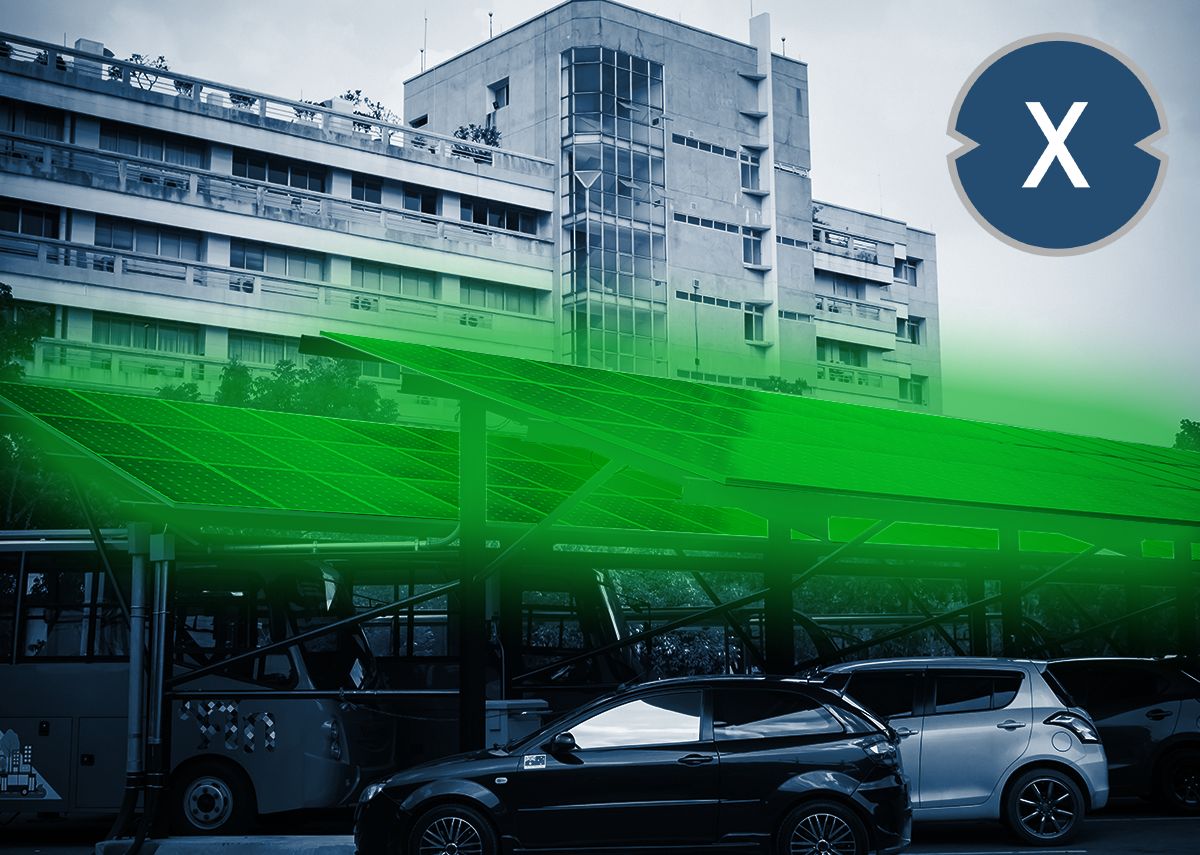
Carport solar roof – Image: Xpert.Digital / photosthai|Shutterstock.com
The modular solar carport system for all applications and situations
Three types of solar carports are currently the most popular:
- The practical and stable solar carport: durable, stable and largely protected against collisions.
- The solar carport features transparent glass/glass solar panels. Ideal when aesthetics are important; see the image below.
- The modular solar carport system can be used for 10, 20, 50, 100 and well over 1,000 parking spaces.
Naturally, all are optionally available with charging stations and energy storage.
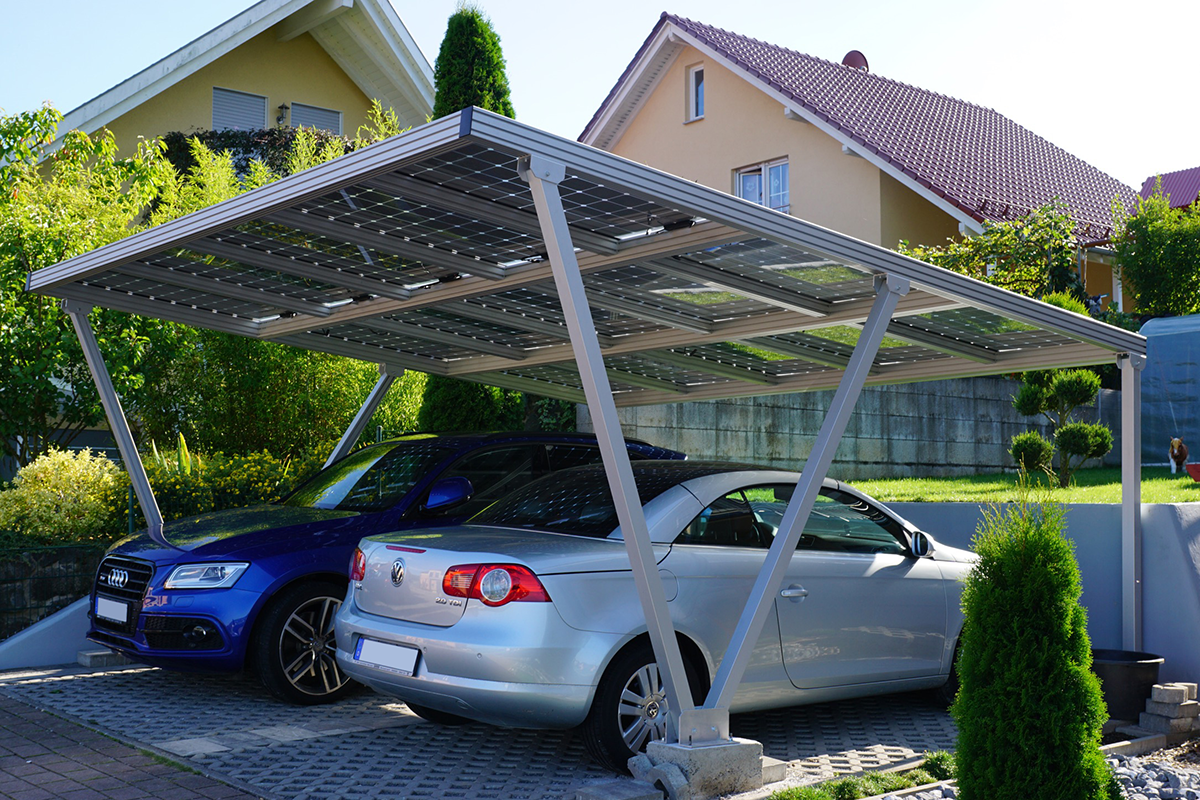
Photovoltaic carport system with transparent glass/glass solar modules
Our solar carport solutions for covering open parking areas are modular and scalable:
- Quick and easy assembly
- Individually customizable design (color, materials, surface, size, etc.)
- Installation of charging stations and inverters is possible at any time
- Scalable & modular: Available as a single, double or arbitrarily scalable row carport
- Suitable for use even in the standard version for very high wind and snow loads
- …and much more
📣 Open parking areas: Photovoltaic solutions for industry, retail and municipalities
Everything from a single source, specially designed for solar solutions for large parking areas. You refinance or counterfinance into the future with your own electricity generation.
🎯 For solar engineers, plumbers, electricians and roofers
Advice and planning including a non-binding cost estimate. We bring you together with strong photovoltaic partners.
👨🏻 👩🏻 👴🏻 👵🏻 For private households
We are positioned across regions in German-speaking countries. We have reliable partners who advise you and implement your wishes.
With over 1,000 specialist articles, we cannot present all topics here. Therefore, you will find a small excerpt from our work here and we would be pleased if we have piqued your interest in getting to know us better:
Our Solar PDF Library
Photovoltaic Library (PDF) – Image: Xpert.Digital / Benvenuto Cellini|Shutterstock.com
Large PDF library: Market monitoring and market intelligence on the topic of photovoltaics.
Data is viewed at regular intervals and checked for relevance. This usually brings together some interesting information and documentation, which we combine into a PDF presentation: our own data analyzes and marketing intelligence as well as external market observations.
More about it here:
Electricity prices by country worldwide
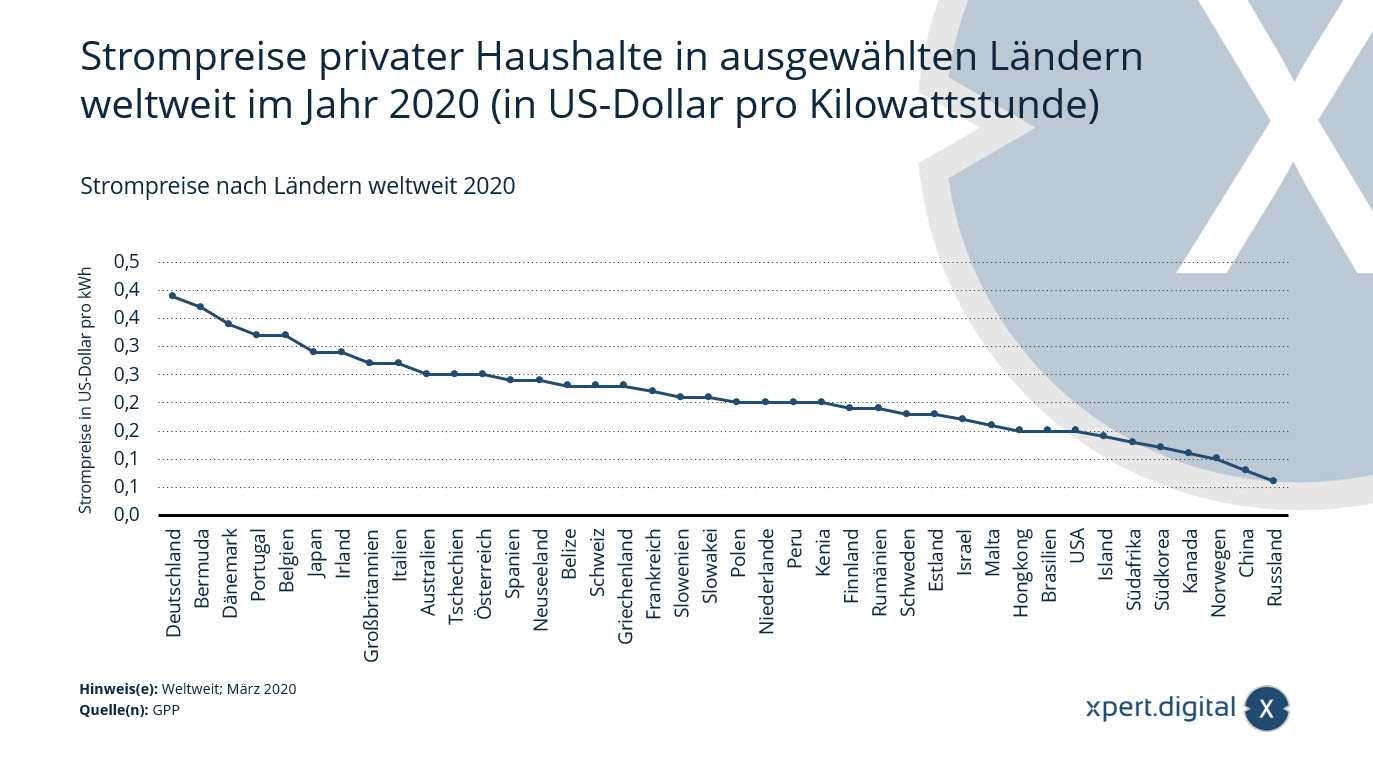
Electricity prices by country worldwide – Image: Xpert.Digital
In Germany, the electricity price for private households was the highest worldwide in March 2020: residents had to pay 39 dollar cents per kilowatt hour.
Global electricity consumption
Since 1980, global electricity consumption has tripled. Most recently, China and the USA were the world's largest electricity consumers. China used about ten times as much electricity as Germany. Looking at individual sectors, industry has consistently been the largest electricity consumer. Private households, on the other hand, accounted for around a quarter of global electricity consumption.
Electricity consumption in Germany
In Germany, industry was also the largest consumer of electricity, according to current data. However, unlike the global distribution, the second largest consumer group in Germany was commerce, trade, and services, followed by households. Germany's electricity consumption fluctuated between 530 and 630 terawatt-hours over the past 30 years. In the last ten years, however, the amount of electricity consumed has tended to decrease.
Electricity prices for private households in selected countries worldwide in 2020 (in US dollars per kilowatt hour)
- Germany – 0.39 US dollars per kilowatt hour
- Bermuda – US$0.37 per kilowatt hour
- Denmark – US$0.34 per kilowatt hour
- Portugal – US$0.32 per kilowatt hour
- Belgium – US$0.32 per kilowatt hour
- Japan – US$0.29 per kilowatt hour
- Ireland – US$0.29 per kilowatt hour
- Great Britain – 0.27 US dollars per kilowatt hour
- Italy – US$0.27 per kilowatt hour
- Australia – US$0.25 per kilowatt hour
- Czech Republic – US$0.25 per kilowatt hour
- Austria – 0.25 US dollars per kilowatt hour
- Spain – US$0.24 per kilowatt hour
- New Zealand – US$0.24 per kilowatt hour
- Belize – US$0.23 per kilowatt hour
- Switzerland – US$0.23 per kilowatt hour
- Greece – 0.23 US dollars per kilowatt hour
- France – US$0.22 per kilowatt hour
- Slovenia – US$0.21 per kilowatt hour
- Slovakia – US$0.21 per kilowatt hour
- Poland – US$0.20 per kilowatt hour
- Netherlands – US$0.20 per kilowatt hour
- Peru – US$0.20 per kilowatt hour
- Kenya – US$0.20 per kilowatt hour
- Finland – US$0.19 per kilowatt hour
- Romania – US$0.19 per kilowatt hour
- Sweden – US$0.18 per kilowatt hour
- Estonia – US$0.18 per kilowatt hour
- Israel – 0.17 US dollars per kilowatt hour
- Malta – US$0.16 per kilowatt hour
- Hong Kong – US$0.15 per kilowatt hour
- Brazil – US$0.15 per kilowatt hour
- USA – $0.15 per kilowatt hour
- Iceland – US$0.14 per kilowatt hour
- South Africa – US$0.13 per kilowatt hour
- South Korea – US$0.12 per kilowatt hour
- Canada – US$0.11 per kilowatt hour
- Norway – US$0.10 per kilowatt hour
- China – US$0.08 per kilowatt hour
- Russia – US$0.06 per kilowatt hour
Global electricity consumption
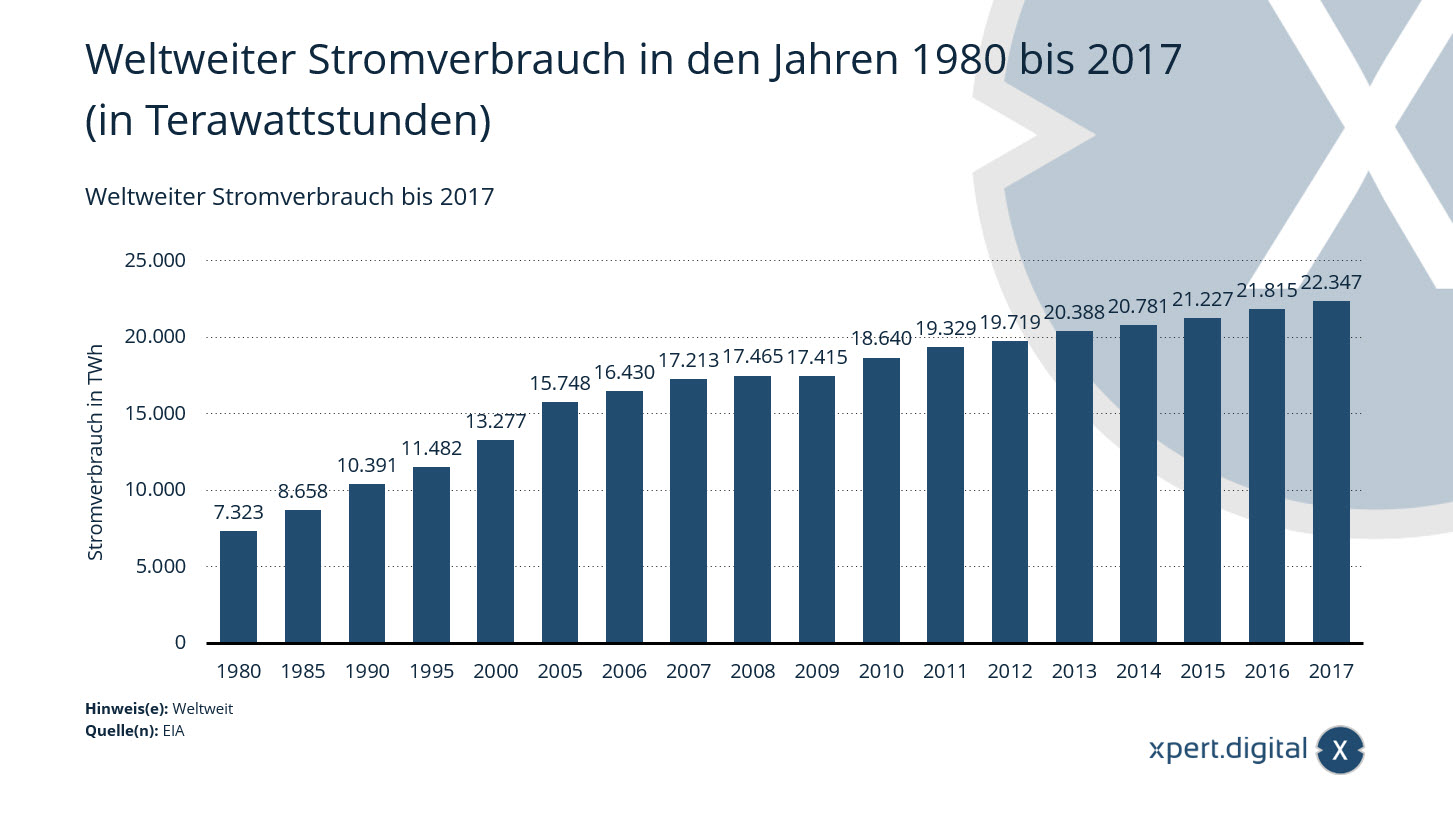
Global electricity consumption – Image: Xpert.Digital
In 2017, approximately 22.3 petawatt-hours of electricity were consumed worldwide. Compared to 1980, net electricity consumption has thus more than tripled. Net electricity consumption is calculated by subtracting net electricity exports and losses during transmission across the power grid from net electricity generation plus electricity imports.
Global electricity consumption
China was the largest electricity consumer recently. The Asian country consumed roughly ten times as much electricity annually as Germany. The USA was also among the largest electricity consumers. The industrial sector recorded the highest electricity consumption among all sectors. Private households accounted for approximately a quarter of global electricity consumption.
Electricity consumption in Germany
Net electricity consumption in Germany increased steadily until 2007. After a significant decline in 2009, consumption rose again and has since fluctuated slightly. Per capita electricity consumption has followed a similar pattern. The largest consumer group has been industry, followed by commerce, trade, and services, and households. Transportation accounted for a considerably smaller share.
Global electricity consumption from 1980 to 2017 (in terawatt hours)
- 1980 – 7,323 terawatt hours
- 1985 – 8,658 terawatt hours
- 1990 – 10,391 terawatt hours
- 1995 – 11,482 terawatt hours
- 2000 – 13,277 terawatt hours
- 2005 – 15,748 terawatt hours
- 2006 – 16,430 terawatt hours
- 2007 – 17,213 terawatt hours
- 2008 – 17,465 terawatt hours
- 2009 – 17,415 terawatt hours
- 2010 – 18,640 terawatt hours
- 2011 – 19,329 terawatt hours
- 2012 – 19,719 terawatt hours
- 2013 – 20,388 terawatt hours
- 2014 – 20,781 terawatt hours
- 2015 – 21,227 terawatt hours
- 2016 – 21,815 terawatt hours
- 2017 – 22,347 terawatt hours
Largest countries worldwide by electricity consumption
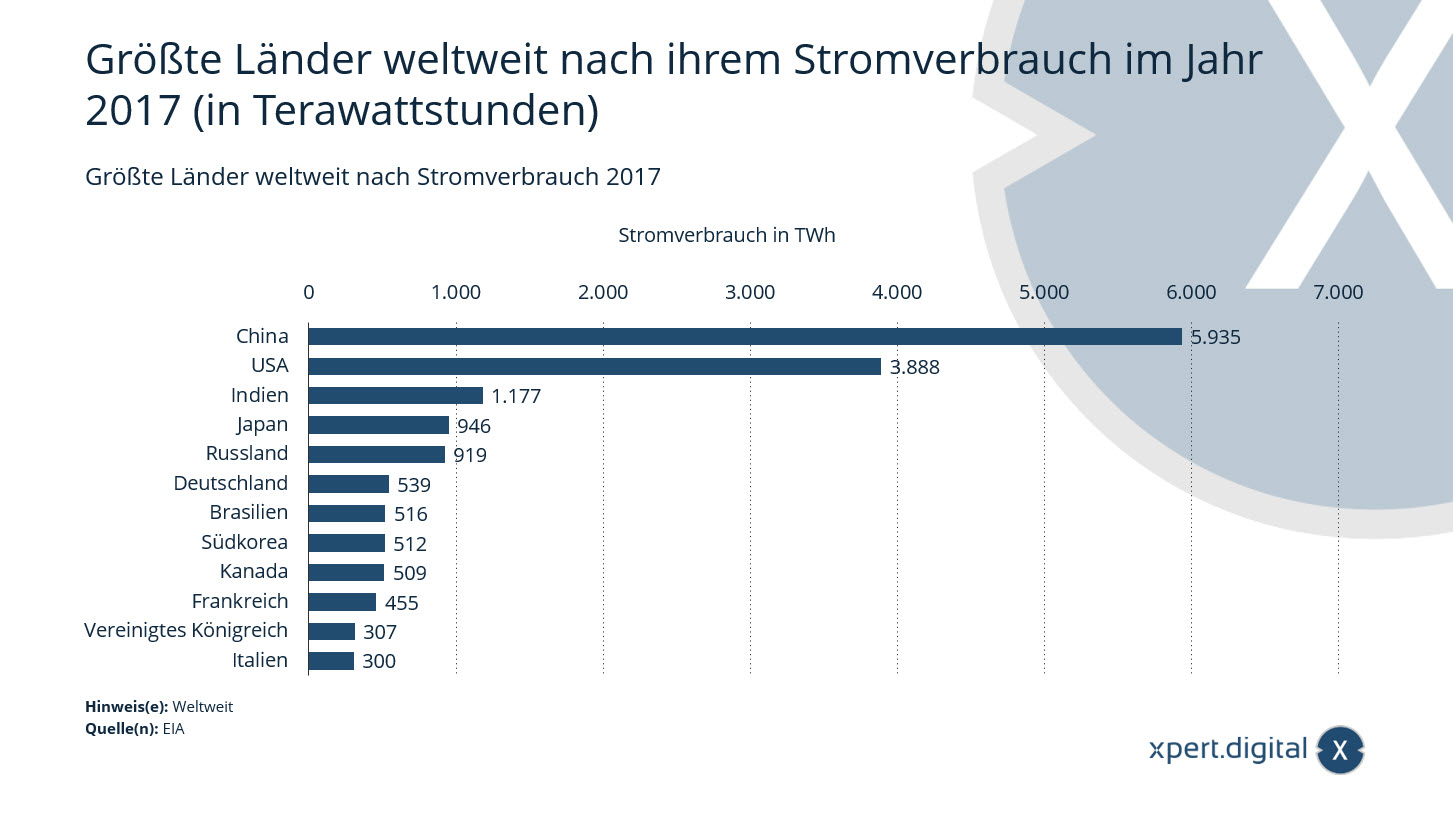
Largest countries worldwide by electricity consumption – Image: Xpert.Digital
China was the world's largest electricity consumer in 2017, consuming approximately 5,900 terawatt-hours. The USA was the second largest consumer, followed by India and Japan. Germany ranked seventh among the world's largest electricity consumers with 539 terawatt-hours.
Global electricity consumption
Global electricity consumption is constantly increasing – today it's roughly three times the amount used in 1980. The industrial sector accounts for the largest share, followed by private households, commerce, and the public sector. Transportation, on the other hand, makes up a relatively small portion of global electricity consumption.
Electricity consumption in Germany
Net electricity consumption in Germany is significantly higher today than it was almost 30 years ago. Industry is primarily responsible for this high consumption. However, German households also consume nearly a quarter of the electricity. Current electricity generation in Germany exceeds consumption. Therefore, the excess electricity is exported, among other countries, to neighboring countries such as the Netherlands and Austria.
Largest countries worldwide by electricity consumption in 2017 (in terawatt hours)
- China – 5,935 terawatt hours
- USA – 3,888 terawatt hours
- India – 1,177 terawatt hours
- Japan – 946 terawatt hours
- Russia – 919 terawatt hours
- Germany – 539 terawatt hours
- Brazil – 516 terawatt hours
- South Korea – 512 terawatt hours
- Canada – 509 terawatt hours
- France – 455 terawatt hours
- United Kingdom – 307 terawatt hours
- Italy – 300 terawatt hours
How economical are photovoltaic or solar power systems?

Economic efficiency of photovoltaic systems – Image: @shutterstock|petrmalinak
Since 2017, 600 MW of capacity for plants over 750 kW has been awarded annually through tenders. An additional 4 GW will be awarded through special tenders for the years 2019 to 2021.
Electricity from ground-mounted photovoltaic systems is subsidized under the Renewable Energy Sources Act (EEG). The remuneration for this type of system is lower than for photovoltaic systems mounted on or attached to buildings.
In 2009, the feed-in tariff was 31.94 cents per kilowatt-hour (kWh) of electricity fed into the grid. In 2010, it fell to 28.43 cents for new installations. From January 2013, it was 11.78 cents, decreasing by 2.5% per month. The 2014 amendment to the Renewable Energy Sources Act (EEG) stipulated that the level of support for ground-mounted photovoltaic systems would henceforth be determined by the Federal Network Agency through auctions, instead of the previous legally fixed feed-in tariffs. This was implemented in the Ordinance on the Auth of Financial Support for Ground-Mounted Systems of February 6, 2015 (Ground-Mounted Auth Ordinance). With the 2017 amendment to the EEG, these auctions are regulated by law. Smaller PV systems up to 750 kWp receive a legally fixed feed-in tariff without an auction.
The first bidding deadline was April 15, 2015, with a tendered capacity of 150 megawatts. The tender volume was significantly oversubscribed. The German Renewable Energy Federation (BEE) expressed concern that citizen cooperatives and plants could be squeezed out of the market, as their lower capital reserves mean they can make fewer upfront investments and bear less risk.
Tenders are criticized because international experience and economic models suggest that they counteract the intended goals of cost efficiency, expansion targets, and a diverse range of stakeholders. The pilot project for ground-mounted PV systems was intended to test the practical impact of tenders in the renewable energy sector.
More about it here:
When will China, for example, be climate-neutral?

When will China be climate neutral? – Image: @shutterstock|Harvepino
According to data on the plan presented by the Institute of Energy, Environment and Economics at Tsinghua University, China has stipulated that 84 percent of its total energy sources should come from non-fossil fuels. This is a huge increase from the current level, as China's non-fossil fuel production was only 15 percent last year. Tsinghua University shows how the massive shift to cleaner energy will start slowly but gain momentum after 2030.
Currently, China is the world's leading consumer and producer of coal-fired power generation, with an estimated 2.86 billion tons projected for 2025. According to Bloomberg, reducing this fossil fuel is China's top priority for clean energy production, and it hopes to generate only 110 million tons of coal-fired power by 2060 – a 96 percent reduction. Other fossil fuels in the country, including natural gas and oil, account for only half of what is generated from coal. What China loses in coal, it intends to replace with a near-equal mix of wind, solar, and nuclear power.
More about it here:
Investments in renewable energies

Who is driving investment in renewable energies? – Image: @shutterstock|Krisana Antharith
Sustainable investments in the energy sector, once a flagship of renewable energy policy, are performing particularly poorly in the case of wind power investments due to complex approval procedures that often deter investors.
Global investment in renewable energy has nearly doubled in the last decade. During this period, Europe lost its position as the leading investor in renewable energy and was overtaken by China and the United States. According to a publication by Bloomberg New Energy Finance, the United Nations, and the Frankfurt School of Finance & Management, investment in China nearly tripled between 2009 and 2019. The data includes R&D spending by companies and governments, investments in venture capital, private equity, and public markets, as well as funds spent on renewable energy facilities and other such assets, with the latter representing the largest share of global investment.
More about it here:
How important are energy storage systems for renewable energies?
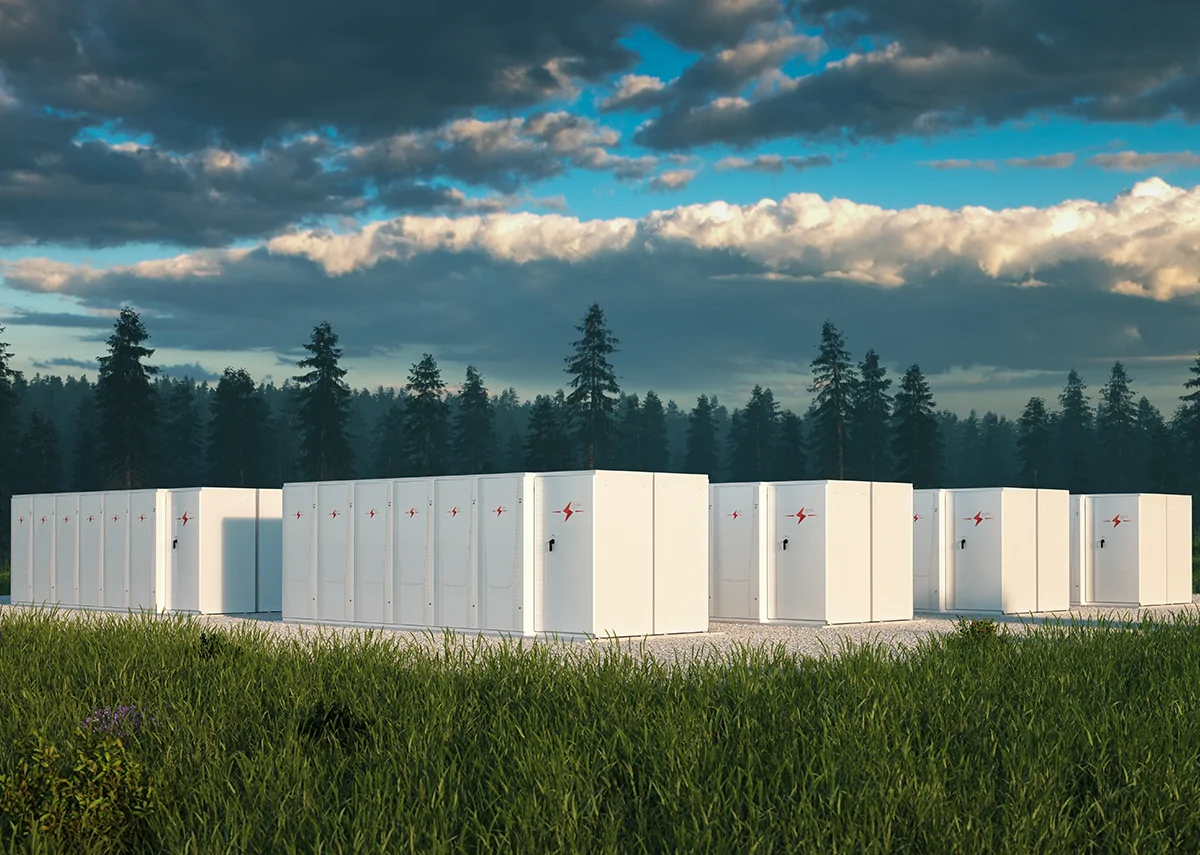
Renewable energies: Now it all comes down to energy storage systems – Image: petrmalinak|Shutterstock.com
The renewable energy market is growing. Global investments in renewable energy have almost doubled in the last ten years. While we are experiencing the biggest boom worldwide, these investments are declining in Germany, except for photovoltaics. In 2019, around 11 billion euros were invested in Germany. The focus of these investments was on solar energy.
Since 2014, the market for photovoltaics in Germany has been developing upwards again.
Global investments in wind energy technologies amounted to approximately US$143 billion in 2019. Investments in solar energy technology most recently stood at US$141 billion.
The nationwide electricity grid is also changing with the rise of renewable energies. While centralized power generation grids have dominated until now, the trend is shifting towards decentralized generation facilities. This applies to generation from renewable sources such as photovoltaic systems, solar thermal power plants, wind turbines, and biogas plants.
“Generating electricity from solar and wind power plants makes the supply system significantly more fragmented and weather-dependent than operating conventional power plants,” said Prof. Dr. Clemens Hoffmann, head of the Fraunhofer IEE.
More about it here:

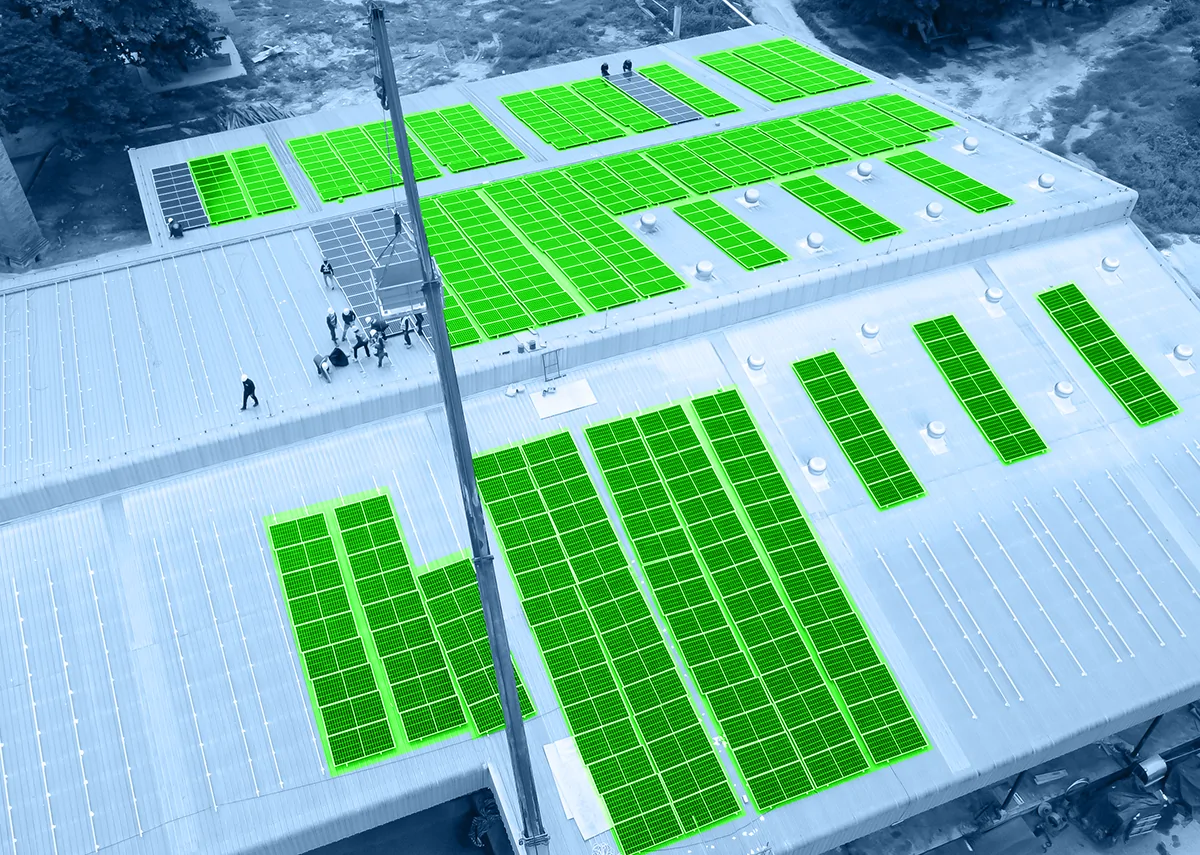
- Warehouses, production halls and industrial halls with their own power source from a photovoltaic roof system - Image: NavinTar|Shutterstock.com
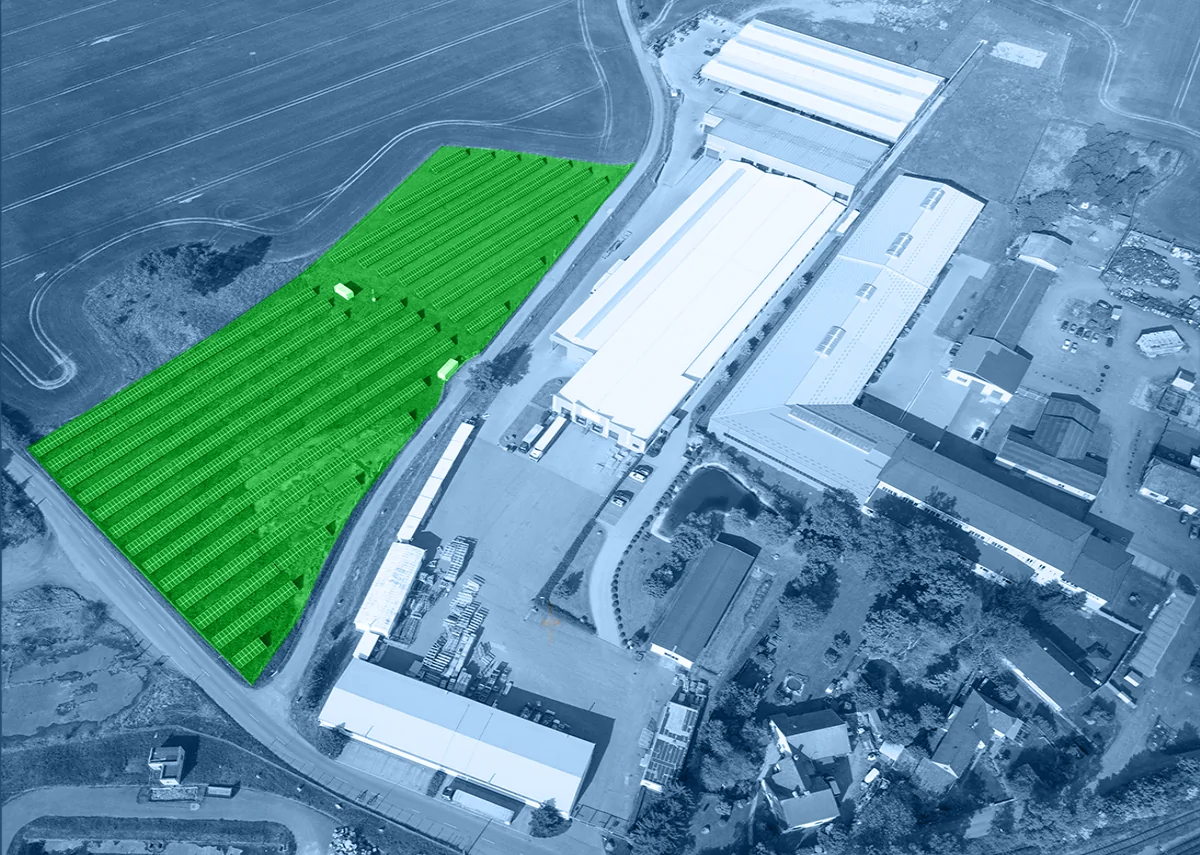
- Industrial plant with its own power source from an outdoor photovoltaic system - Image: Peteri|Shutterstock.com
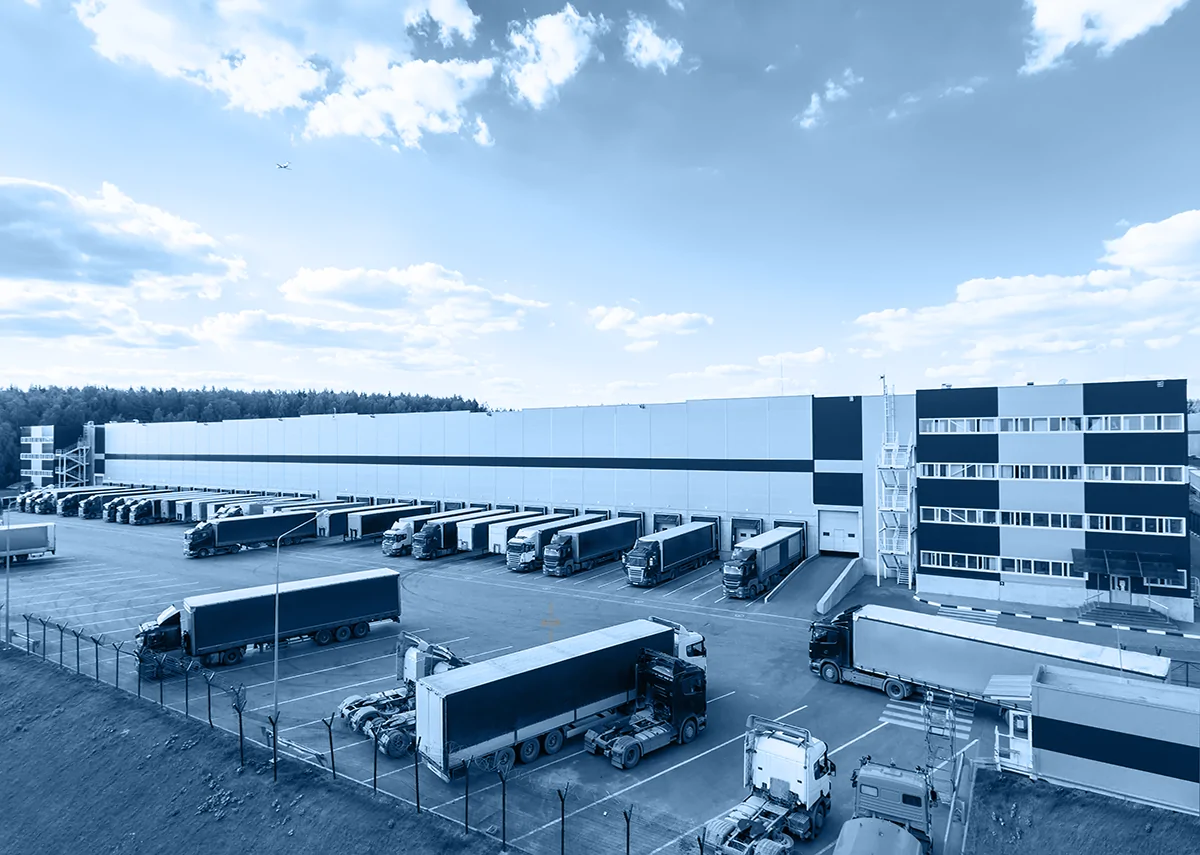
- Plan solar systems with photovoltaic solutions for freight forwarding and contract logistics
- B2B solar systems and photovoltaic solutions & advice
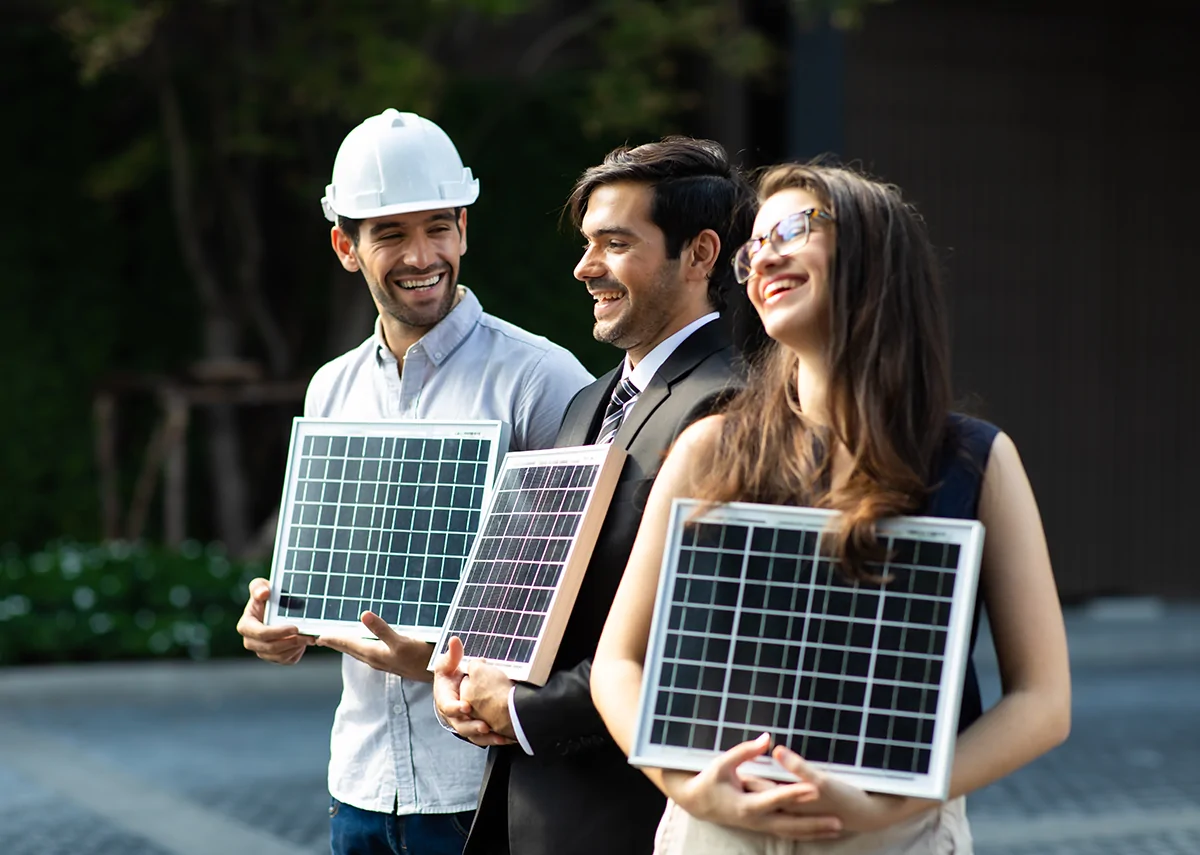
- Plan photovoltaics for warehouses, commercial halls and industrial halls
- Industrial plant: Plan a photovoltaic open-air system or open-space system
- Plan solar systems with photovoltaic solutions for freight forwarding and contract logistics
- B2B solar systems and photovoltaic solutions & advice
Solar system solutions: Xpert.Solar for planning and consulting in the area of solar carports, photovoltaic systems on roofs and in general for Gladbeck, Troisdorf, Dorsten and Detmold
Konrad Wolfenstein
I would be happy to serve as your personal advisor.
You can contact me by filling out the contact form below or simply call me on +49 89 89 674 804 .
I'm looking forward to our joint project.
Write to me

Xpert.Digital – Konrad Wolfenstein
Xpert.Digital is a hub for industry with a focus on digitalization, mechanical engineering, logistics/intralogistics and photovoltaics.
With our 360° business development solution, we support well-known companies from new business to after sales.
Market intelligence, smarketing, marketing automation, content development, PR, mail campaigns, personalized social media and lead nurturing are part of our digital tools.
You can find out more at: www.xpert.digital – www.xpert.solar – www.xpert.plus
Keep in touch