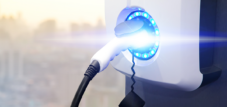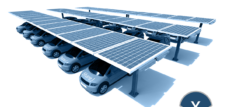
Solar carport installations for electromobility – Image: Xpert.Digital & Heliographer|Shutterstock.com
Electromobility in Germany
Germany sees electromobility as a driving force for a potential energy transition in the country, namely the phase-out of fossil fuels. Given that the German automotive industry is one of the most important pillars of the economy and also plays a key role globally, widespread access to electric vehicles could, at a time when industries are expected to find climate-friendly and environmentally sound solutions for production and use, be both the beginning of a new, greener era and a massive source of revenue.
In short, ideally, electric cars should lead to reduced emissions, sustainable energy efficiency, and more flexible mobility solutions for consumers. The vehicles are connected to a charging station and charged via the existing power grid. The stations can be either privately or publicly accessible. Electric cars are powered by rechargeable batteries. The types of electric cars available on the German market are hybrid, mild hybrid, battery electric, and plug-in hybrid, and Renault is the best-selling electric car brand in the country. Tesla is the world's leading electric car manufacturer.
The German government aims to promote electromobility through various measures. These include expanding the country's charging infrastructure and enabling public procurement for public institutions that wish to purchase electric vehicles. Electric vehicles encompass not only passenger cars but also public transport such as buses. Implementing and integrating electromobility at the national level entails a number of necessary fundamental changes. These changes essentially mean collaboration between the electricity and automotive industries, requiring extensive overhauls for both. Electricity from renewable energy sources is desirable for charging in order to achieve sustainability goals. However, for a successful launch of electromobility in Germany, the vehicles must be connected to the electricity and transport networks, and automotive manufacturers and suppliers face the transition to the regular production of parts and systems for electric cars.
Charging infrastructure and charging stations
Should the generated energy be fed into the grid or stored in energy storage systems? What are the load profiles, the technical connection requirements, the number of charging stations, the vehicle parking time, and ultimately, the total PV output? How will the charging sessions be recorded by the company if the employee charges their company car from home? These are questions we will have to address in the future. It's different from what we're used to today.
Related to this:
- Charging infrastructure for electric mobility in Germany
- Electromobility is coming slowly, but it is coming
Distribution of charging stations for electric vehicles in Germany
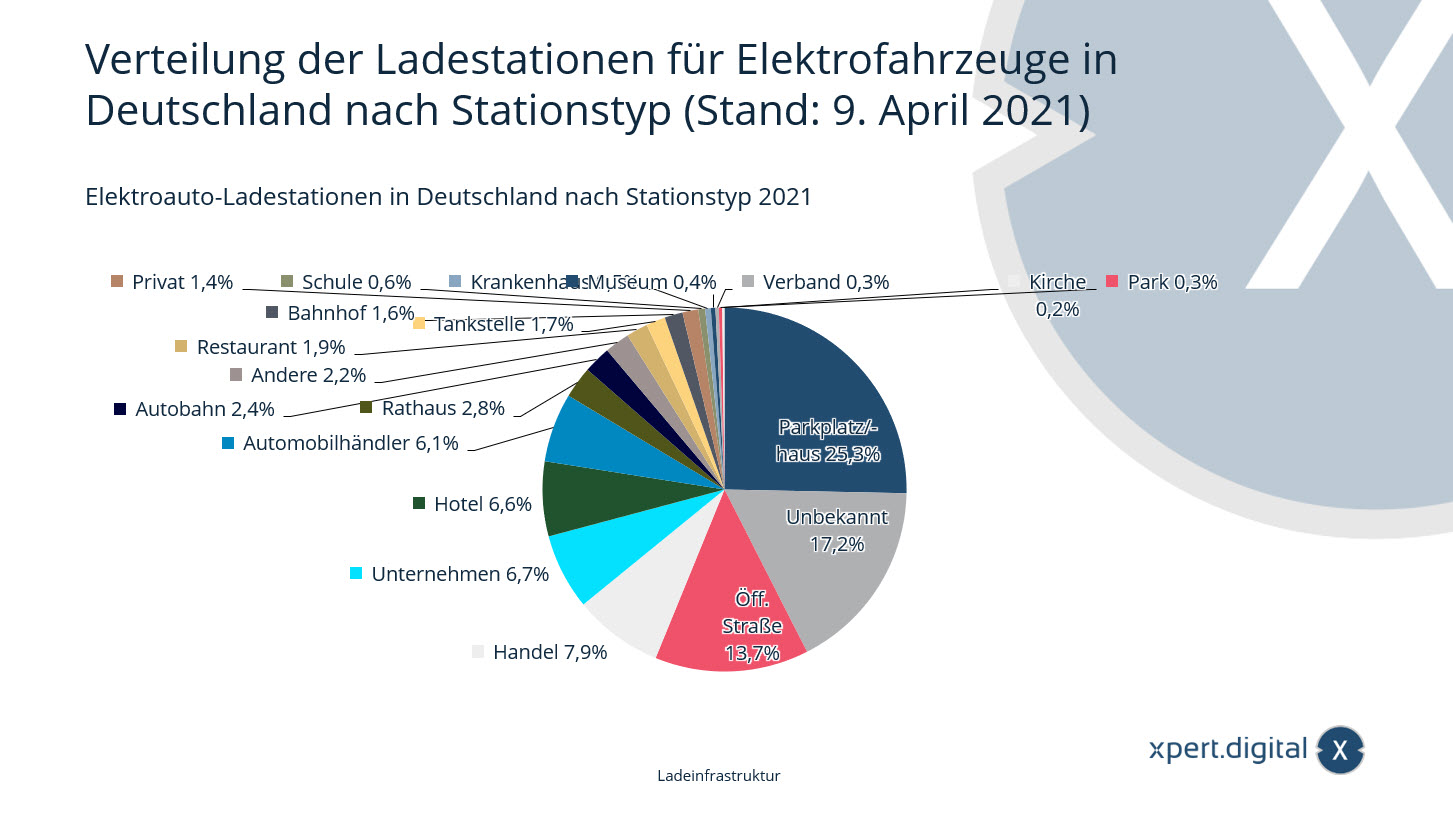
Distribution of charging stations for electric vehicles in Germany – Image: Xpert.Digital
The statistic shows the distribution of charging stations for electric vehicles in Germany by station type (as of April 9, 2021). In April 2021, just under 1.6 percent of the charging stations were located at train stations.
Electric car charging stations in Germany by station type 2021
- Parking lot/parking garage: 25.2%
- Unknown: 17.1%
- Public road: 13.6%
- Trading: 7.9%
- Companies: 6.7%
- Hotel: 6.6%
- Car dealers: 6.1%
- Town Hall: 2.8%
- Highway: 2.4%
- Other: 2.2%
- Restaurant: 1.9%
- Gas station: 1.7%
- Train station: 1.6%
- Private: 1.4%
- School: 0.6%
- Hospital: 0.5%
- Museum: 0.4%
- Association: 0.3%
- Park: 0.3%
- Church: 0.2%
Electric car charging station connections in Germany according to charging speed
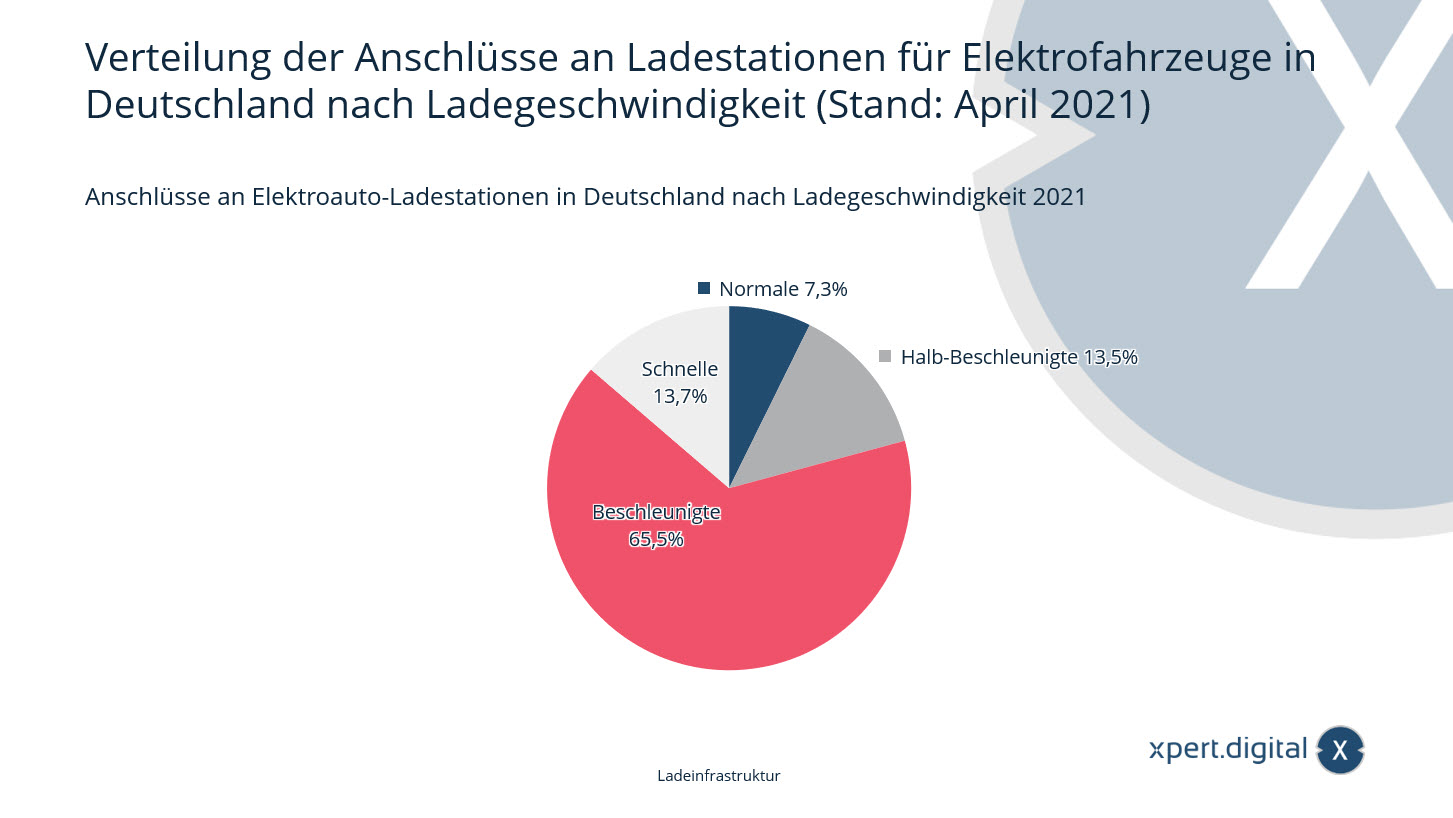
Distribution of charging points for electric vehicles in Germany according to charging speed – Image: Xpert.Digital
The statistic shows the distribution of charging points for electric vehicles in Germany according to charging speed (as of April 2021). In April 2021, approximately 7.3 percent of the charging points were for charging stations with standard charging capability.
Distribution of charging points for electric vehicles in Germany by charging speed 2021
- Normal: 7.3%
- Semi-accelerated: 13.5%
- Accelerated: 65.5%
- Fast: 13.7%
Cities in Germany with the highest number of public charging points for electric vehicles

Cities in Germany with the highest number of public charging points for electric vehicles – Image: Xpert.Digital
The statistic shows the cities in Germany with the highest number of charging points for electric vehicles in 2021 (as of February 23). At that time, the city of Munich had a total of 1,310 charging points for electric cars and plug-in hybrids.
Public charging points for electric vehicles by German city 2021
- Berlin: 1,694 public charging points
- Munich: 1,310 public charging points
- Hamburg: 1,226 public charging points
- Stuttgart: 616 public charging points
- Wolfsburg: 467 public charging points
- Essen: 398 public charging points
- Regensburg: 283 public charging points
- Hanover: 278 public charging points
- Karlsruhe: 261 public charging points
- Cologne: 260 public charging points
Number of publicly accessible charging points for electric vehicles in the German federal states
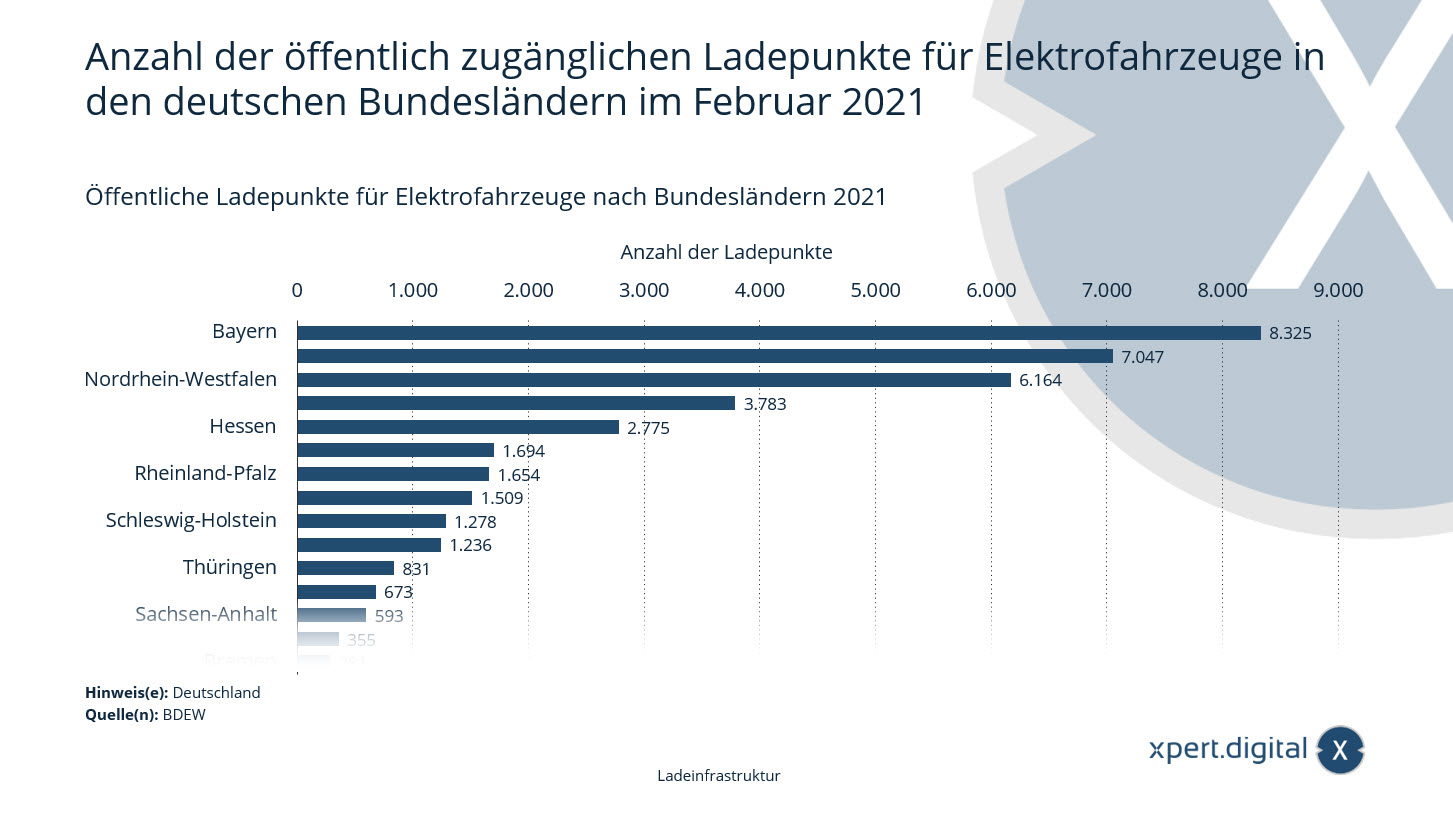
Number of publicly accessible charging points for electric vehicles in the German federal states – Image: Xpert.Digital
This statistic shows the number of publicly accessible charging points for electric vehicles in the German federal states in 2021 (as of February 23). The federal state of Bavaria had a total of 8,325 charging points at that time.
Public charging points for electric vehicles by federal state 2021
- Bavaria: 8,325 public charging points
- Baden-Württemberg: 7,047 public charging points
- North Rhine-Westphalia: 6,164 public charging points
- Lower Saxony: 3,783 public charging points
- Hesse: 2,775 public charging points
- Berlin: 1,694 public charging points
- Rhineland-Palatinate: 1,654 public charging points
- Saxony: 1,509 public charging points
- Schleswig-Holstein: 1,278 public charging points
- Hamburg: 1,236 public charging points
- Thuringia: 831 public charging points
- Brandenburg: 673 public charging points
- Saxony-Anhalt: 593 public charging points
- Mecklenburg-Western Pomerania: 355 public charging points
- Bremen: 281 public charging points
- Saarland: 278 public charging points
Interest in and demand for solar carports is growing
Solar carports are relatively new. Compared to solar installations on house roofs or flat roofs of production halls, as well as solar parks orground-mounted , there is hardly any comparative data available. Studies on the subject are also still quite rare. Only in recent years, with the rise of decarbonization and climate neutrality, has the idea grown of using open parking spaces as solar charging stations in combination with charging points.
Related to this:
The term "carport" itself was coined in the 1930s by the American architect Frank Lloyd Wright. He had his own ideas and rejected garages because, in his opinion, homeowners used them not for parking cars, but as storage rooms. Since carports, with their open design, were not intended for storing items, he built carports onto his houses.
Carports are typically made of wood, steel, or aluminum, although plastic versions are also available. Carports generally have a flat roof, while higher-quality models feature more elaborate designs such as a gable roof, hipped roof, or barrel roof. A carport can be open on all sides, and some models offer elements that allow individual sections to be fully or partially enclosed.
In addition to solar fields and rooftop solar panels, the available space on carport roofs is increasingly being used for solar installations . The solar panel mandate already introduced in some German states , particularly in Baden-Württemberg, which primarily applies to open parking areas with more than 75 spaces, is also contributing to significant developments in this area in the coming years. This is especially true in the commercial and industrial sectors, affecting both customer and employee parking.
Related to this:
As early as 2013, commercial and industrial sectors accounted for 27 percent of installed photovoltaic capacity in Europe, directly behind ground-mounted systems with 34 percent. Industry ranked fourth at that time with a 17 percent share.
According to projections, around 3.31 million people were considering purchasing or upgrading a solar energy system in 2020. Of this group, 71.1% lived in their own homes, compared to 36.8% of the general population. The majority (33.2%) lived in small towns with populations between 5,000 and 20,000. The proportion of men (54.9%) and women (45.1%) was relatively balanced. Interest in solar energy systems is equally strong among men and women and is not a gender-specific domain.
The solution is the HELIOS solar carport system from T.Werk:
- Quick and easy assembly
- Stable strip foundation as impact protection
- Customizable design (color, materials, surface, size, etc.)
- Installation of charging stations and inverters is possible at any time
- Scalable & modular: Available as a single, double or infinitely scalable row carport
- Even in its standard version, it can be used for very high wind and snow loads (sk= 2.2 kN/m²).
- Extra-large and wide parking spaces and very easy parking thanks to W-shaped supports
- High-quality design for demanding and long-lasting requirements: Hot-dip galvanized steel construction (DIN EN 10346, DIN EN 1461)
Related to this:
Industrial flat roof solar systems and solar parks or photovoltaic open-field systems are another alternative
Anyone considering investing in a solar carport for their company premises and/or open parking areas should also consider installing a solar panel system on the company roof. Utilizing all available energy potential for an emission-free and autonomous power supply is also a competitive advantage and helps secure market share.
More information here:
That's why Xpert.Solar is the ideal partner for advising on solar carport installations in industry and trade

Konrad Wolfenstein
I would be happy to serve as your personal advisor.
You can contact me by filling out the contact form below or simply call me on +49 7348 4088 965 .
I'm looking forward to our joint project.
Write to me


Xpert.Digital – Konrad Wolfenstein
Xpert.Digital is a hub for industry focusing on digitalization, mechanical engineering, logistics/intralogistics and photovoltaics.
With our 360° Business Development solution, we support renowned companies from new business to after-sales.
Market intelligence, smarketing, marketing automation, content development, PR, mail campaigns, personalized social media and lead nurturing are part of our digital tools.
You can find more information at: www.xpert.digital – www.xpert.solar – www.xpert.plus
Keep in touch