
Online retail confronted with a lull in consumption – Flat entertainment partly responsible – New perspectives through XR / Metaverse

Available in 27 languages 📢
Prefer Xpert.Digital on GoogleⓘPublished on: September 28, 2023 / update from: October 13, 2023 - Author: Konrad Wolfenstein
Online retail confronted with a slump in consumption – flat entertainment partly responsible – Image: Xpert.Digital
📉 The end of the winning streak? Declines in sales at Amazon, Otto & Co.
🛒 Dip in consumption instead of desire to buy: The decline in sales and the negative trend make both large players such as Amazon, Otto and Zalando as well as smaller online retailers thoughtful
In 2022, the online business in Germany achieved sales of around 90.4 billion euros. Compared to the previous year, sales fell by almost nine percent. The growth has been enormous in recent years - in 2010, e-commerce sales of goods in Germany were around 18.3 billion euros.
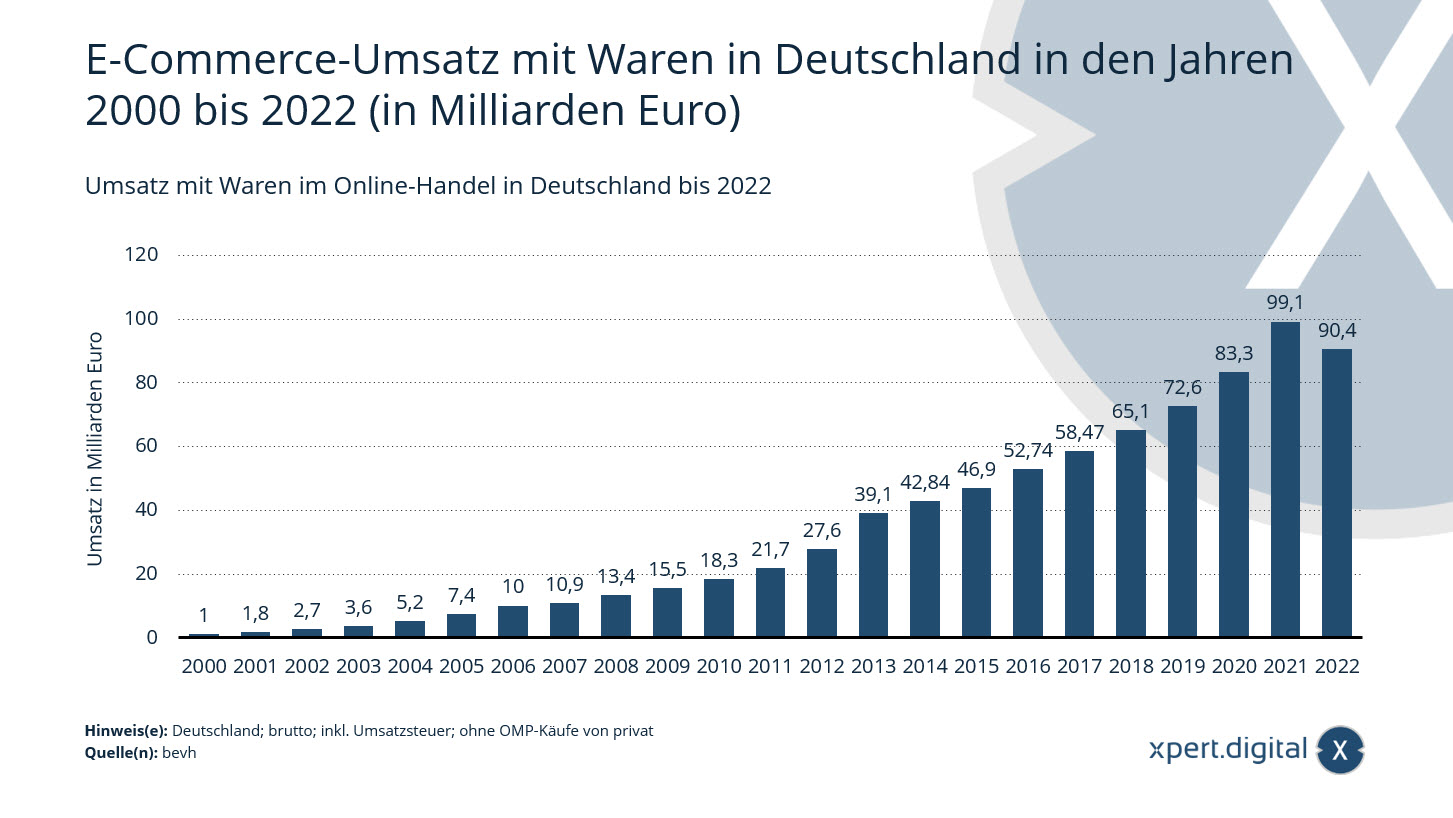
Sales of goods in online retail in Germany by 2022 – Image: Xpert.Digital
📉 Decline in sales: Why the boom is over
For a long time it seemed as if online trading continues to grow. But now it becomes clear that the market is more complex. On the one hand, saturated markets could play a role. On the other hand, we experience a kind of “hangover effect” through the pandemic: people bought a lot online during the lockdowns, and now the consumption is followed.
🛒 Consumer behavior: What the customer really wants
Online retailers should focus more on the needs and expectations of consumers. Customers today are looking for more than just a simple purchasing process; they want a shopping experience. This includes personalized offers, excellent customer service and the ability to try out products virtually, perhaps even through XR technologies.
📺 Entertainment & Distraction: The influence of shallow entertainment
The consumption flaut is sometimes also caused by the “flat entertainment”. People spend more time with entertainment media that offer little or no incentive to buy. This shows that online trading not only focuses on improving the shopping experience, but should also offer exciting content.
🌐 XR and Metaverse: The Next Frontline
If traditional online retail is weakening, the solution could lie in new technologies such as XR (Extended Reality) and the Metaverse. These technologies could not only revolutionize the shopping experience, but also open up new revenue streams.
📣 Similar topics
- 🛒 How online retailers can react to the slump in consumption
- 📊 E-commerce sales trends: What’s next?
- 💡 Creative strategies for online trading in difficult times
- 🎮 The influence of entertainment on purchasing behavior
- 📱 Personalization in e-commerce: A must for every retailer
- 🕶 XR in retail: future or fad?
- 🌍 The influence of global trends on German online retail
- 🚀 Start-ups that are revolutionizing online retail
- 📈 How big data can save online trading
- 💳 Payment methods: What do Germans prefer?
#️⃣ Hashtags: #Onlinecommerce #Consumption Slack #ECommerceTrends #Metaverse #XRImHandel
🗒️ Xpert.Digital: A pioneer in the field of extended and augmented reality

Find the right Metaverse agency and planning office such as a consulting firm - Image: Xpert.Digital
🗒️ Find the right Metaverse agency and planning office such as a consulting firm - search and search for top ten tips for consulting & planning
In the age of digitalization, where technologies such as Extended Reality (XR) and the Metaverse are constantly becoming more relevant, Xpert.Digital positions itself as an opinion leader and pioneer. With over 1,500 specialist articles, Xpert.Digital has established itself as a central point of contact for the industry.
🌌 Extended Reality (XR): The best of both worlds
Extended Reality is a collective term that includes virtual reality (VR), mixed reality (MR) and augmented reality (AR). Xpert.Digital is committed to creating immersive XR experiences that are both informative and entertaining.
- Interactive Experiences: XR allows users to immerse themselves in virtual worlds and interact with their surroundings in ways previously unimaginable.
- Education and Training: XR can be used for educational purposes to convey complex topics and concepts in an understandable and tangible way.
- Entertainment: Whether games, films or art – XR opens new horizons in digital entertainment.
🔮 Augmented Reality (AR): See the world through digital eyes
Augmented Reality, a particular focus of Xpert.Digital, makes it possible to integrate digital information or graphics into the real world. The possibilities are nearly unlimited.
- Marketing and Advertising: AR can be used to create interactive advertising campaigns that engage customers in a whole new way.
- Everyday help: From navigation apps that project the route directly onto the street to furniture apps that show what a new sofa would look like in the living room - AR makes it possible.
🌐 The Metaverse: The Next Big Thing
The Metaverse is a virtual world where people can interact through avatars and create shared experiences. Xpert.Digital recognizes the enormous potential of the Metaverse and is working to translate this potential into usable products and services.
- Social Interaction: The Metaverse offers the opportunity to connect with people from all over the world and share common experiences.
- Economy and trade: Virtual goods and services can be traded in the metaverse, which opens up completely new business models and sources of income.
- Creative Freedom: From building your own worlds to designing custom avatars, the Metaverse is a place of endless creative possibilities.
🚀 Xpert.Digital at the forefront of innovation
Xpert.Digital shows how a company can be at the forefront of the technological revolution. With their focus on XR, AR and the Metaverse, they are well positioned to shape and define the future of digital interaction.
More about it here:
📈 The rise of online trading in the Corona period
The corona pandemic has caused changes in many sectors, but online retail is one of the few industries that have benefited from it. Many of the largest online retailers recorded significant increases in sales, particularly in the first year of the pandemic.
😃 Big players dominate, but small ones catch up
Amazon, Otto and Zalando are still the market leaders, but the trends show an interesting development: smaller online shops have been able to increase their sales, while the ten largest online shops have experienced declines in sales.
🌐 Online marketplaces are changing
Even though Amazon continues to dominate the online marketplace market, there is evidence of declining sales among the top 10 online marketplaces. This could be an opportunity for smaller marketplaces to gain market share.
🛠️ SEO and content strategies for online trading
🤑 Keyword research is king
For small and medium-sized online shops, the right SEO strategy is crucial in order to climb up the search results. Keywords should not only be frequently searched for, but also relevant to the business in question.
📝 Content is queen
Good content is essential for the success of an online shop. A blog with useful tips, product descriptions that highlight a product's benefits, and social media posts that expand your customer base are just a few examples.
🎯 Backlinks and social signals
Creating quality content that gets shared and generating backlinks are crucial for ranking. Partnerships with other websites and influencers can be very useful here.
📣 Similar topics
1️⃣ 🛒 How online shops are booming during the pandemic
2️⃣ 🏆 SEO strategies for small online shops
3️⃣ 💡 How do I create appealing content for my online shop?
4️⃣ 🤝 Partnerships and backlinks: The way to the top
5️⃣ 📊 Market analysis: Who are the big players in online trading?
6️⃣ 📉 Decline in sales at major online shops: What happened?
7️⃣ 🚀 How smaller online shops are conquering the market
8️⃣ 🌍 Global online retail: trends and forecasts
9️⃣ 💰 Increase in sales through the right pricing strategy
🔟 🤖 AI in online retail: The future is now
#️⃣ Hashtags: #Online trade #SEO #ContentMarketing #SmallerShops #Markettrends
Our Industrial Metaverse configurator
Just try out our universally applicable (B2B/Business/Industrial) Metaverse configurator for all CAD / 3D demo options:

Xpert (B2B/Business/Industrial) Metaverse configurator for all CAD / 3D data can be used on all devices, one platform!
Suitable for:
🛒 E-commerce: Why the shine is fading and how the industry can shine again 🌟
📈 The golden era of e-commerce
E-commerce has spoiled us with a ton of benefits: easier payment methods, fantastic UX design and a seemingly endless selection of products. So far, the sector only seemed to be heading in one direction: upwards.
🤔 The crux of the matter: Why e-commerce is lame 🐌
But even the most beautiful boom ends. In a world that is becoming more and more networked and digitized, it is no longer enough to be “there”. Compared to emerging industries such as online gaming, which constantly comes up with immersive elements and innovations, e-commerce takes the place. "Never Change A Running System" was the mantra - but now it is no longer so round.
💡 Reasons for the disillusionment:
1. Economic situation
The current economic uncertainty is dampening the willingness to buy.
2. Sensory overload
Customers are faced with a flood of shops and offers.
3. Monotony in marketing
Instead of real innovation, there are usually just different versions of the same discount offers.
Consumers in industries such as cosmetics and sports nutrition have now adjusted to the flood of daily discount campaigns. Given the immense level of competition, such purchasing incentives are almost indispensable - a benefit for consumers, but a killer of innovation for the industries affected.
😴 Market fatigue and consumer frustration 🚫
It is not just the economy; The customer is just tired. Even if there are new “great offers” and events like Black Friday every day, it no longer pulls. Either the market is over -saturated, or the consumer is tired - or both.
🚀 Ways out of the crisis: what now? 🤷♀️
One could learn from online gaming: more interaction, more personalization and, above all, more surprises. Here are a few suggestions:
🎯 Gamification
Integrates elements from the gaming world into the shopping experience.
📱 Mobile first
An intuitive mobile experience is essential as more and more people shop primarily via their smartphone. But please: keep it simple!
🌍 Localization
Not every market is the same. What works in the USA does not necessarily have to work in Europe.
🔄 Agile marketing
Away from the same discount campaigns and towards new marketing.
Suitable for:
- Triosmarket is an innovative marketing strategy
- Reorganization of the marketing mix with New Digital Marketing: The Triosmarket model
- Triosmarket model and the important market attributes: speed, automation, flexibility and scalability
"It is interesting that many marketing methods that are established today such as SEO or social media were once considered an experimental marketing before they established themselves in Marketing & Sales Mainstream."
🤝 Conclusion: Together for a bright future 🌈
E-commerce may be past its best, but that doesn't mean it can't shine again. What is needed is innovation, courage and the willingness to learn from other industries.
📣 Similar topics
- 🎮 What e-commerce can learn from online gaming
- 🛍️ The Fading Glory of E-Commerce: An Analysis
- 💡 Innovation potential in e-commerce
- 📊 Why e-commerce stumbles: A data analysis
- 🤖 AI in e-commerce: curse or blessing?
- 🌐 Global vs. Local: E-commerce strategies in comparison
- 📱 Mobile Shopping: The future of e-commerce?
- 🎯 Gamification in e-commerce: More than just a trend?
- 🚀 Startups revolutionizing e-commerce
- 🤷♀️ Customer loyalty in e-commerce: What really counts
#️⃣ Hashtags: #ECommerce #Innovation #OnlineGaming #Customer Retention #Market Fatigue
🗒️ If you don't understand something or need advice, we also offer training and workshops

Metaverse & Extended Reality training, lecture or workshop for augmented, mixed and virtual reality – Xpert.Digital
In today's digital era, technology is evolving at a rapid pace. There are constantly new terms and technologies that need to be understood and mastered. If you're having trouble keeping up with topics like Metaverse, XR technologies, or immersive 3D, you're not alone.
More about it here:
🌐 From e-commerce to v-commerce: The ultimate game changer for customer loyalty and entertainment 🎉
🛒 What is V-Commerce?
V-Commerce, or Virtual Commerce, is the next evolutionary stage of e-commerce. Instead of just scrolling through product listings and images, customers can shop in a simulated environment. Think of virtual fitting rooms or 3D product views that you can rotate and zoom.
🎯 Why is V-Commerce so important?
1. Unforgettable experience
A shopping trip is not just a transaction; it is an experience. And in the digital age, this experience must be innovative and interactive.
2. Increase customer loyalty
Once customers enjoy the full V-commerce experience, they are likely to come back.
3. Customer entertainment as a USP
In a sea of similar products and services, a strong entertainment experience can be a real unique selling point (USP).
🕹️ How do you integrate V-Commerce into your existing business model?
1. Getting started with AR and VR
Start with augmented reality (AR) or virtual reality (VR) elements integrated into your website or app.
2. Personalized AI recommendations
Use artificial intelligence to offer personalized recommendations.
3. Community building
Create online community spaces where customers can meet and share experiences.
📊 Measuring success
Customer reviews and feedback
This provides insight into customer satisfaction.
Repeat purchases
A direct indicator of successful customer loyalty.
engagement
Usage time, click-through rate and other KPIs show how engaged customers are.
📣 Similar topics
- 🌐 How V-Commerce is revolutionizing the shopping world
- 🎯 Why entertainment is no longer optional in e-commerce
- 🛒 Virtual changing rooms: the future or just hype?
- 🕹️ The influence of AI on V-Commerce
- 📊 How to measure V-Commerce ROI
- 🛍️ Personalization: The invisible seller in V-Commerce
- 💡 Innovative V-Commerce Startups to Watch
- 👥 V-Commerce and Generation Z
- 🤝 This is how V-Commerce promotes customer loyalty
- 🎮 V-Commerce and the Gaming Industry: An Unexpected Partnership
#️⃣ Hashtags: #VCommerce #Customer Loyalty #Entertainment #DigitalTransformation #Innovation
🗒️ New territory for newbies: What you should know now about blockchain, tokens, NFTs, wallets, cryptocurrency and the metaverse

(Consumer) Metaverse New territory for newbies – What you should know now – Image: Xpert.Digital
In today's digital world, terms such as blockchain, NFTs, wallets, cryptocurrencies and the metaverse have become increasingly present. For newcomers, these terms may seem confusing and complex at first. Here we try to explain these terms in an understandable way and give you important and interesting details about them.
More about it here:
📊 The plight of the e-commerce sales slump and the role of social media
📉 Social media: a sinking ship?
Gone are the days when social media was considered the holy grail of brand awareness and sales growth. In many cases, the mass of social channels and paid influencers no longer provide the sales to absorb the immensely increased costs. This is also because users have now developed a certain “advertising fatigue”.
💸 The dilemma of discount systems
Another thing we have already touched on is one-sided optimization for discount systems. While these can lead to spikes in sales in the short term, they contribute to the erosion of brand integrity in the long term. This means shoppers could get used to only buying discounted products, which reduces profit margins.
🌐 Omnichannel: More than just a buzzword?
Omnichannel is definitely a viable concept, but implementation is often flawed or incomplete. The reasons are varied, from technical challenges to inadequately trained employees. Companies must invest to integrate and execute these channels effectively.
💡 Solutions for sustainable growth
1. Return to core competencies
It is important to review your own business model and recalibrate it if necessary.
2. Customer loyalty instead of discounts
Try to retain repeat customers through excellent service and high-quality products rather than luring them with constant discounts.
3. Invest in education and training
Invest in training your employees to provide customers with a better shopping experience.
4. Smart use of data
Analyze customer behavior and preferences to adapt your strategy.
5. Explore hybrid strategies
Combine the best of online and offline sales to offer your customers a holistic shopping experience.
📣 Similar topics
- 📈 How does social media impact e-commerce?
- 🛒 Why discount strategies can do long-term harm
- 🤖 Technology and People: Finding a Balance
- 🌐 Omnichannel as the Holy Grail?
- 🎯 Core competencies as a success factor in e-commerce
- 📚 The importance of employee training
- 💡 Innovative strategies for sustainable growth
- 📊 Data analysis in e-commerce
- 🔄 The advantages of hybrid sales strategies
- 🛍️ Customer retention vs. customer acquisition
#️⃣ Hashtags: #ECommerceTrends #SocialMediaFall #OmnichannelStrategy #CustomerRetention #SustainableGrowth
🔄 Omnichannel: A seamless shopping experience 🛒 Much praise, many failures
Omnichannel refers to a multi-channel approach in which all sales channels are linked together. This means that a customer can seamlessly transfer their shopping experience from one channel to another, for example from the online store to the mobile app or to the physical store. The focus is on providing the customer with a consistent and integrated experience, regardless of the channel used.
🤝 Hybrid: The fusion of online and offline 🌐
The term “hybrid” is often used to describe models that use a combination of online and offline elements. A hybrid business model could be, for example, a retailer who runs an online shop and physical business.
⚖️ So is omnichannel hybrid? 🤷♀️
In a sense, one could argue that a well-implemented omnichannel approach is a “hybrid” strategy because it integrates both online and offline channels. However, the main difference lies in the orientation:
- Omnichannel focuses on the seamlessness and consistency of the customer experience across different channels.
- Hybrid describes the combination of different elements (e.g. online and offline) in a single model or system.
Therefore, one could say that omnichannel can be a form of hybrid strategy, but not necessarily the other way around. In an omnichannel model, all elements are linked together to create a seamless customer experience, while a hybrid model can simply combine different elements without necessarily being integrated.
But the implementation of the omnichannel strategy doesn't really work for most people, and when it does, it doesn't work well enough.
🌐 An example of a working omnichannel 🎉
A good understanding of omnichannel is best illustrated with a practical example. Let's imagine a retailer that operates both an online store and a physical store.
🏁 Beginning of the customer journey: online research 📱
Our customer, let's call him Max, starts his journey by looking for new sneakers in the online shop. He finds a few styles he likes, but isn't sure what size he needs. Max sees the option to check the availability of the sneakers at a nearby physical store.
📍 Phase Two: In the physical store 🏬
Max goes into the store and tries the sneakers. Since the shop is part of the Omnichannel system, a sales employee Max 'online behavior recognizes via customer management software. The employee can therefore specifically advise Max and show him other products that match his online search inquiries.
💳 The purchase: Flexibility is the be-all and end-all 🔄
Max opts for a few sneakers, but wants to buy it online to use a discount code that he can only redeem there. No problem! With Omnichannel this is a noise. Max buys the sneaker online and selects the option “Collect in the shop”.
📦 After purchase: customer service and returns 🔄
After purchasing, Max will receive a notification about the shipping status of his order. He can choose to have the order delivered to his home or pick it up at the store. If there are problems or you want to change the size, you can return the product either online or directly in store.
💡 Customer loyalty through personalized offers 🎯
Thanks to the collected data on Max 'buying behavior both online and offline, the dealer can send him personalized offers and recommendations that are tailored to his taste and needs.
🎉 Conclusion: A seamless experience 🌟
Omnichannel allows Max to seamlessly switch between online and offline channels without losing context. All of his interactions with the brand are connected and enrich his shopping experience.
In an omnichannel model, it's not just the product that's being sold, but the entire experience surrounding the purchase. This is the key to customer retention and long-term loyalty – if it works.
🌐 Omnichannel: What are the problems that mean that this usually doesn't work?
Omnichannel strategies are an ideal that many companies strive for, but implementation is complex and fraught with challenges. Here are some of the most common problems:
🔍 Lack of data integration 📊
Often the different channels (online, offline, mobile, social media, etc.) are not fully integrated with each other. This results in customer data being fragmented and incomplete. The end result is a fractured customer experience.
🤖 Technological limitations ⚙️
Omnichannel requires modern, flexible technology. However, many companies still operate with legacy systems that are not designed for today's connected retail needs.
👥 Inadequate staff training 🎓
Employees must be able to use the omnichannel model effectively. This requires training and retraining, which in turn costs time and money.
💸 High cost and complex implementation 🏗️
Omnichannel solutions can be expensive to purchase and complicated to implement. This particularly deters smaller companies.
🎭 Inconsistent brand communication 📝
If communication between channels is not consistent, it can lead to customer confusion and distrust.
⏲️ Time factor ⌛
Implementing an omnichannel strategy is time-consuming and the ROI (return on investment) is often only visible in the medium to long term.
🔄 Resistance to change 🚫
In many companies there is a natural inertia or even resistance to change. This can significantly hinder the implementation of an effective omnichannel strategy.
📋 Lack of strategy and vision 👓
Without a clear omnichannel strategy and vision, companies can easily lose focus and waste resources.
🤝 Customer acceptance and behavior change 🧠
Customers also have to get used to the new model and adapt their behavior accordingly. This is not always easy and often requires incentives from the company.
🌐 Global and local requirements 🌍
Companies operating internationally must consider the specific requirements and expectations of different markets, which increases complexity.
Despite these challenges, the value of a well-executed omnichannel strategy remains undeniable. Companies that successfully overcome these hurdles better position themselves for long-term success and customer loyalty.
🗒️ E-commerce, omnichannel and customer data at discounters
🎯 The dilemma of anonymity at discounters 🤷♀️
An interesting phenomenon that can be observed at discounters is the anonymity of customers. Since most customers are rarely members of a customer loyalty program, discounters often don't know who their customers actually are. This is a big problem, especially when trying to enter the hybrid market characterized by e-commerce and omnichannel marketing.
📊 Why customer data is so important 🤔
In the age of data, customer data is worth its weight in gold. They help companies understand purchasing habits, create personalized offers and develop effective marketing strategies. Especially in the hybrid market, where e-commerce and omnichannel strategies dominate, customer data is crucial for success.
🚨 The missteps in the omnichannel approach 💣
It's obvious that by jumping into e-commerce, discounters haven't fully thought through the omnichannel approach. They are entering an already oversaturated market, hoping to make up for the lost sales of their physical stores that they previously thought they had lost to online competition. However, without a clear omnichannel strategy, this is doomed to failure.
In addition, most e-commerce systems are not smart enough to cover the hybrid scenario. In fact, we only know of 1 (!!!) system that even makes something like this possible.
🚀 The way forward: V-Commerce and Omnichannel 🌐
Discounters should recognize the signs of the times and invest in v-commerce and omnichannel strategies. Virtual shops, augmented reality and linking the various sales channels can enormously improve customer loyalty and the customer experience.
📑 Conclusion 🎯
In order to be successful in the hybrid market, discounters have to get to know their anonymous customers. By using modern technologies and strategies, they can not only learn more about their customers, but also adapt their business model to today's requirements. Not yet taken into account are the challenges, possibilities and opportunities associated with the 2D matrix code, which is scheduled to be introduced worldwide in 2027 .
📣 Similar topics
- 📈 How discounters can harness the power of customer data
- 🛒 From discount to luxury: the path to customer loyalty
- 📊 Data-Driven Marketing for Retailers
- 🎯 Why omnichannel is essential in retail
- 📱 The role of apps in customer loyalty
- 🌐 V-Commerce: The Future of Retail
- 🛍️ Why anonymity is a problem in retail
- 💳 Customer data and payment methods: A look behind the scenes
- 📍 Geolocation in retail: opportunities and risks
- 🚀 How discounters can conquer the hybrid market
#️⃣ Hashtags: #VCommerce #Omnichannel #Customer Data #Discounter #HybriderMarkt
🗒️ V-Commerce: The next level of e-commerce with Omnichannel, XR and Metaverse
😎 A new era of e-commerce is dawning
V-commerce not only sounds futuristic, it is too. The combination of e-commerce with virtual and augmented reality creates a completely new shopping experience that not only binds, but also enthusiastic. If you imagine going shopping in a virtual world where you can "touch" every product and look at all perspectives, you have reached V-Commerce.
🛒 Omnichannel was yesterday, today is V-Commerce 👽
The classic omnichannel concept is adopted here, just in an expanded, improved version. While Omnichannel optimizes the shopping experience across multiple channels, V-Commerce takes the whole thing to a new level. Just think about integration into the Metaverse! An all-round experience that includes not only shopping but also entertainment. Imagine attending concerts in a virtual world while doing your shopping at the same time.
🎮 XR technologies & customer loyalty: The perfect duo 🤝
The use of XR technologies (this includes virtual and augmented reality) enables a new way of engaging customers. Personalized avatars, interactive product presentations or even virtual sales advisors could completely revolutionize the normal online shopping experience.
🛍️ 2D Matrix Code: The revolution is just around the corner 🔐
The 2D matrix code, which is scheduled to be introduced globally in 2027, is another highlight. This technology could ensure secure transactions and provide additional information about each product that would not be possible in a traditional e-commerce environment.
More about it here:
📊 Conclusions and Outlook 🌈
The concept of V-Commerce sounds very promising and could significantly influence your shopping behavior in the future. The technologies are there; they just have to be integrated in a sensible and customer-friendly way. Above all, V-Commerce offers an excellent opportunity to stand out from the competition and create truly unique customer loyalty.
📣 Similar topics
- 😎 The Future of E-Commerce: An Insight into V-Commerce
- 🛒 V-Commerce vs. Omnichannel: What's the difference?
- 🎮 XR technologies in retail: The next revolution?
- 🛍️ Security and E-Commerce: How 2D Matrix Code Changes the Game
- 🎉 The Metaverse as a shopping paradise: fiction or soon reality?
- 👽 Virtual Worlds, Real Profit: The Economy of the Metaverse
- 🤝 Customer retention through XR: The next big step
- 📱 Mobile V-Commerce: The role of smartphones in virtual retail
- 🔐 Data protection in V-Commerce: What you need to know
- 🌈 V-Commerce: The end of the e-commerce world as we know it?
#️⃣ Hashtags: #VCommerce #Omnichannel #XRTechnologies #Metaverse #2DMatrixcode
📊 E-commerce: Declining sales for the first time
The times of growth in German online retail are over for the time being. For the past year 2022, the 1,000 B2C online shops with the highest sales, which make up the majority of all B2C online trade, recorded a decline in sales of 2.8 percent in Germany (net, not adjusted for prices). This corresponds to a decrease of 2.2 billion euros to a total of 77.7 billion euros compared to 2021, as the results of the “E-Commerce Market Germany 2023” study by EHI and ecommerceDB show. This means that the continuous growth of online trading has stopped for the first time in the 15-year history of the study.
“Some shops are struggling with major declines in sales or even appear in this year’s study for the last time due to going out of business. However, smaller shops in particular show strong relative growth in the new ranking. Overall, top 1,000 sales are 1.5 times higher than before the pandemic. For the current year, we as EHI initially expect the downward trend to continue,” says Lars Hofacker, head of the e-commerce research department at EHI, assessing the current situation.
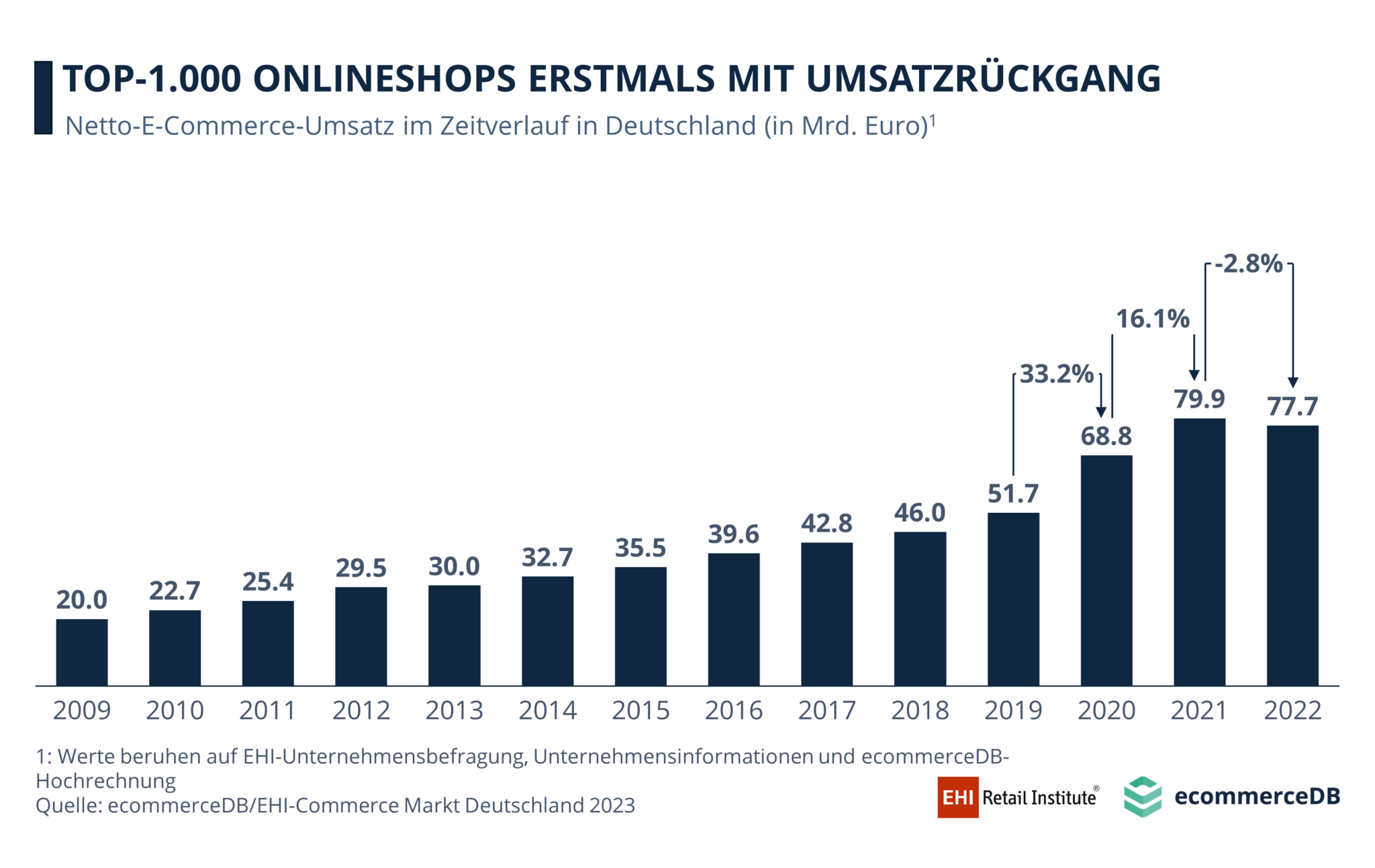
Declining sales in e-commerce Germany for the first time – Image: EHI Retail Institute
Smaller shops win, market concentration decreases slightly
After the strong growth in the pandemic year 2020 (33.1 percent), the top 1,000 were able to achieve double-digit growth of 16.1 percent in 2021. In 2022, however, the general consumer mood and thus also the willingness to buy online weakened in Germany. Nevertheless, in the pre-Covid comparison (2022 with 2019) there is still growth of 50.2 percent.
The smaller B2C online shops in the bottom 500 places in this year's ranking grew relatively the most at 7.3 percent compared to the bottom 500 places last year. The German e-commerce market is still highly concentrated; after all, the top 100 generate over 70 percent of the sales of the top 1,000. Since the large online shops in particular have to cope with declines in sales, market concentration has fallen slightly: The net e-commerce sales of this year's top 10 fell by 9.7 percent compared to last year's top 10, so that the share is 38 .2 percent below the previous year (-2.9 percentage points).
AboutYou in the top 10 for the first time
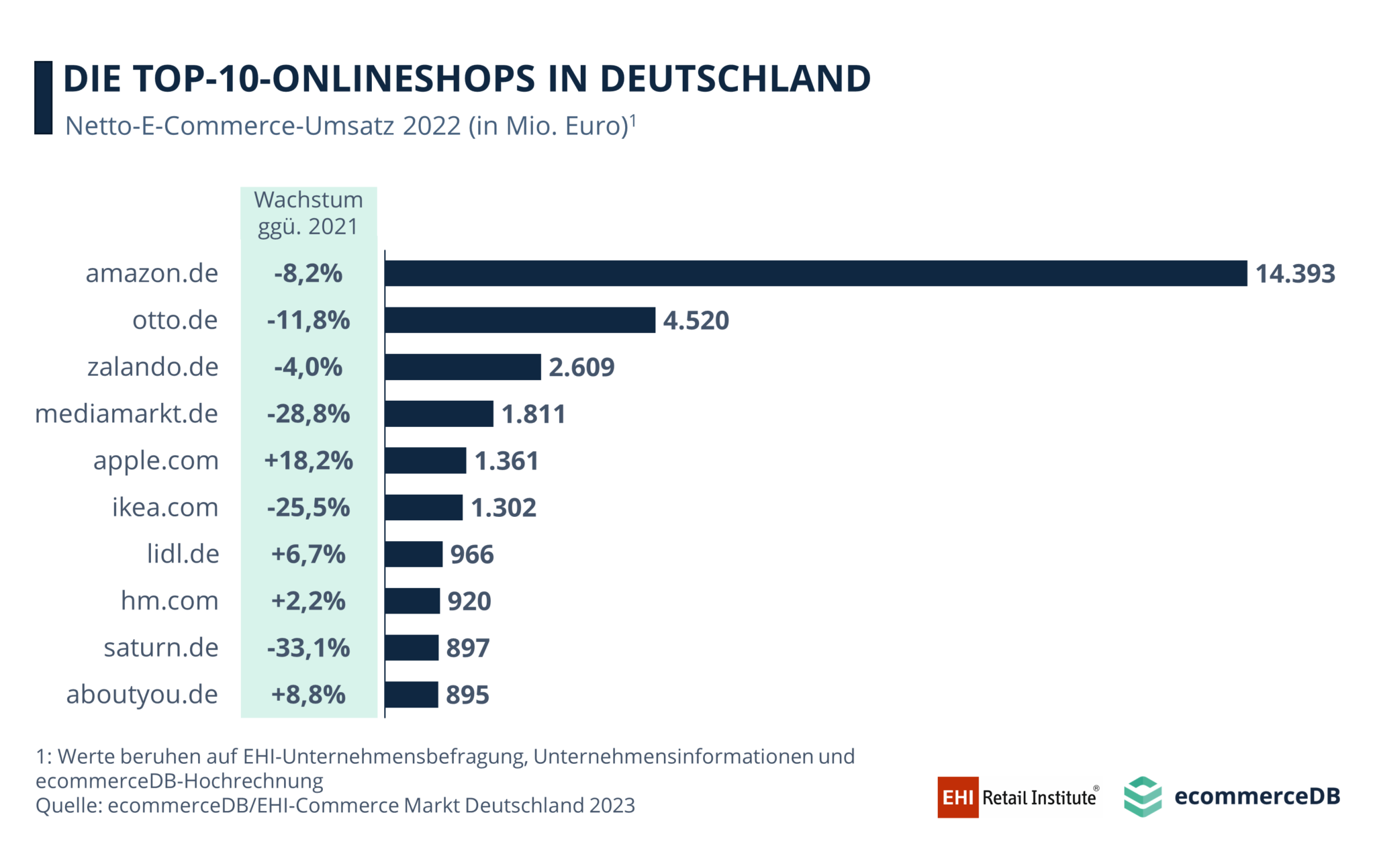
Top ten online shops in Germany – Image: EHI Retail Institute
In the race for the top positions, aboutyou.de climbs into the top 10 with growth of 8.8 percent. As in the last 15 years, the ranking is led by amazon.de (with 14.4 billion euros) and otto.de (with 4.5 billion euros). Last year's fourth place, zalando.de (2.6 billion euros), made it onto the winner's podium this time, displacing mediamarkt.de (1.8 billion euros) from third place.
With shop.rewe.de and bestsecret.com there are also two newcomers in the top 20. The biggest growth drivers here are apple.com (+18.2 percent), breuninger.com (+16.1 percent) and shop-apotheke.com (+15.9 percent).
Top 10 B2C marketplaces
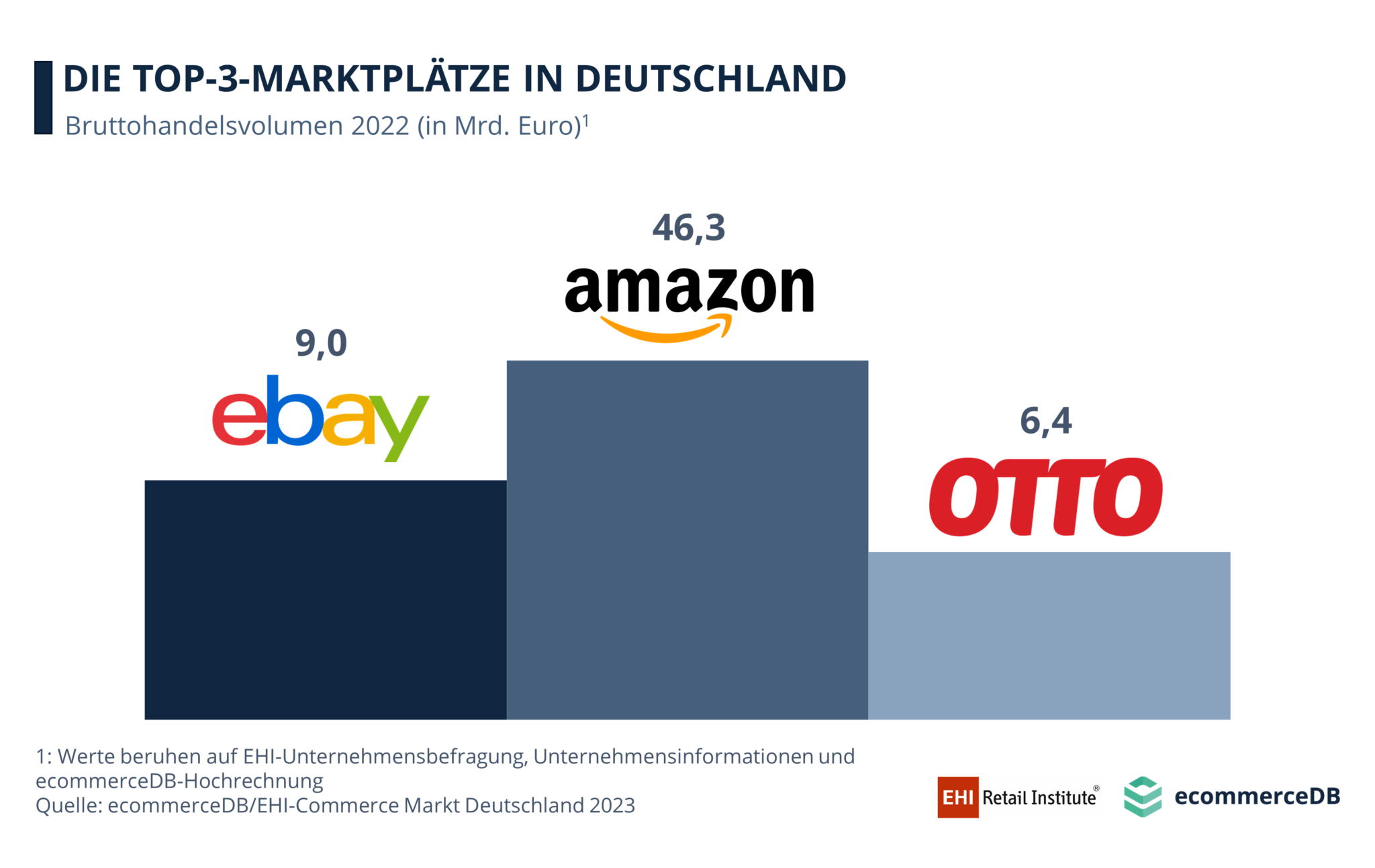
In addition, the study shows for the first time the top 10 B2C marketplaces that will generate sales of 72.8 billion euros in 2022, thus losing 2.4 percent compared to the previous year. The top dog, amazon.de, maintains its top position with a gross trading volume (GMV) of 46.3 billion euros, followed by ebay.de (9.0 billion euros) and otto.de (6.4 billion euros).
Top 3 marketplaces in Germany – Image: EHI Retail Institute
The E-Commerce Market Germany 2023 study includes the top 1,000 data sets on the B2C online shops examined as well as the top 10 B2C marketplaces and is available in the EHI shop. In addition, the top 100 B2C online shops and top 5 B2C marketplaces are available as digital posters free of charge.
Definitions
B2C online shop
Place on the Internet where end consumers can purchase goods from a company.
Pure B2C marketplace
Place on the Internet where end consumers can purchase goods from more than one company. The provider of a pure B2C marketplace operates the platform and does not offer any goods for sale itself.
Hybrid B2C marketplace
Place on the Internet where end consumers can purchase goods from more than one company. The provider of a hybrid B2C marketplace operates the platform and itself offers goods for purchase.
methodology
This study focuses on B2C online shops as well as pure and hybrid B2C marketplaces that offer physical goods. B2C online shops as well as pure and hybrid B2C marketplaces were not taken into account if they generate their sales exclusively or largely via apps. For B2C marketplaces, the e-commerce GMV was taken into account.
Source: Press release EHI Retail Institute – September 27, 2023


We are there for you - advice - planning - implementation - project management
Xpert.Digital - Pioneer Business Development
Smart Glasses & KI - XR/AR/VR/MR industry expert
Consumer metaverse or meta -verse in general
If you have any questions, further information and advice, please feel free to contact me at any time.

Konrad Wolfenstein
I would be happy to serve as your personal advisor.
You can contact me by filling out the contact form below or simply call me on +49 7348 4088 965 (Munich) .
I'm looking forward to our joint project.
Write to me

Xpert.Digital - Konrad Wolfenstein
Xpert.Digital is a hub for industry with a focus on digitalization, mechanical engineering, logistics/intralogistics and photovoltaics.
With our 360° business development solution, we support well-known companies from new business to after sales.
Market intelligence, smarketing, marketing automation, content development, PR, mail campaigns, personalized social media and lead nurturing are part of our digital tools.
You can find out more at: www.xpert.digital - www.xpert.solar - www.xpert.plus
Keep in touch










