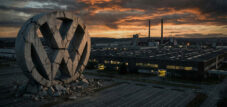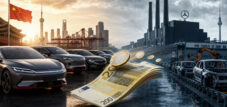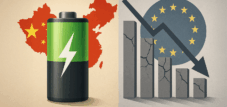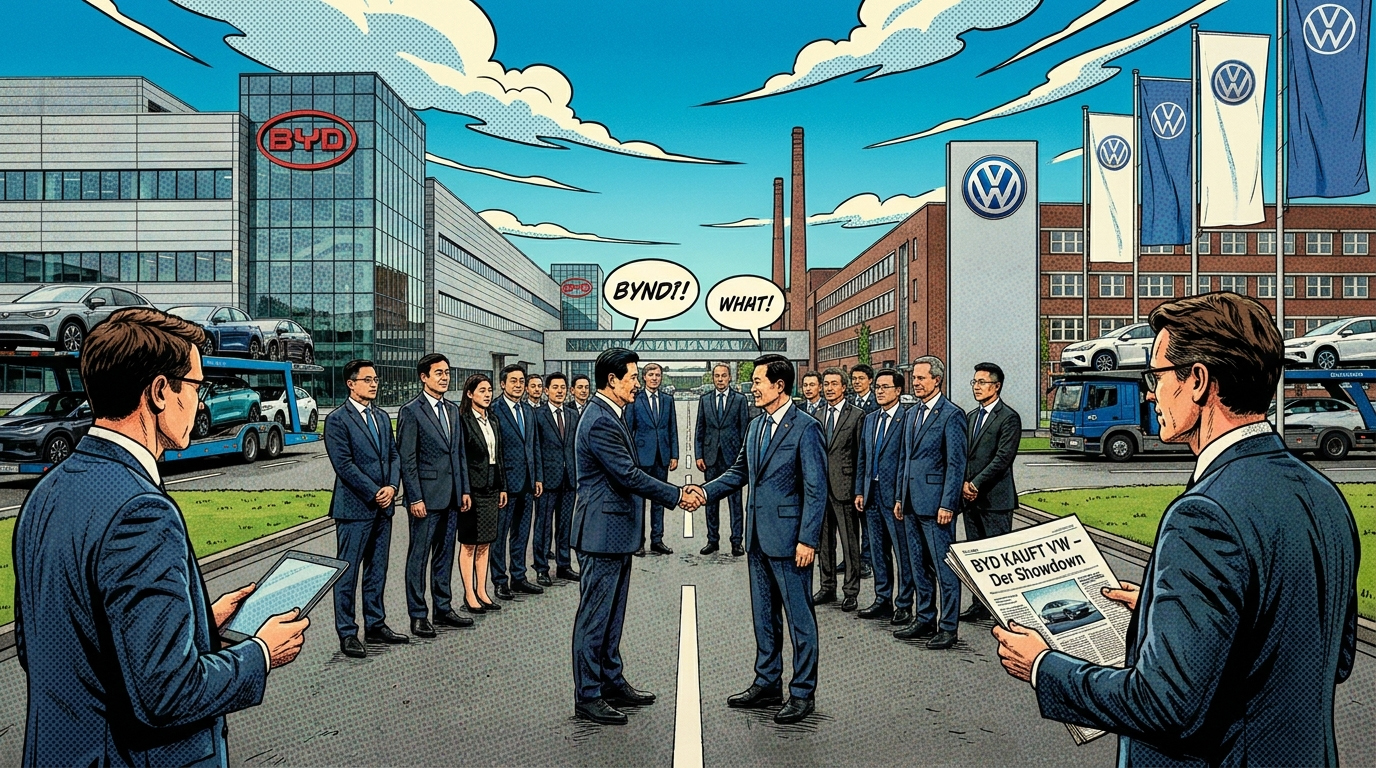
BYD buys VW – The showdown of two automotive worlds: Realistic scenario or calculated provocation? – Image: Xpert.Digital
When an economist scares the auto industry: Is Wolfsburg facing an existential crisis? Will China's auto giant BYD soon swallow up Volkswagen?
Bitter truth for VW: What's really behind the explosive takeover rumors
From world champion to takeover target: How VW is being overrun by China
It was just a single sentence, but it struck at the most vulnerable nerve of the German economy: "VW will probably be bought out by a Chinese automaker. Perhaps by BYD." With this provocative prediction, renowned economist Moritz Schularick shook up the automotive industry. Even though a hostile takeover is currently considered legally impossible due to the strict VW law and the ownership structure, the idea reveals a bitter reality. Volkswagen, once the undisputed king of the Chinese market and the global pride of German engineering, is mired in the deepest structural crisis in its history. While VW struggles with historic profit slumps, dramatic sales declines, and unprecedented factory closures, its Chinese rival BYD is racing from record to record and aggressively pushing into Europe. This article examines why the spectacular takeover scenario, while legally improbable, has already begun the Wolfsburg-based automaker's gradual loss of power – and what future scenarios remain for Volkswagen to avoid being dismantled piece by piece by its new Far Eastern competitor.
How one statement shook up an industry
It was a single sentence that sparked a heated debate about the future of the German automotive industry in June 2026. Moritz Schularick, president of the Kiel Institute for the World Economy (IfW) and one of Germany's most influential economists, answered the question of whether Volkswagen could go bankrupt in an interview with the Süddeutsche Zeitung with the words: "VW will probably be bought by a Chinese car manufacturer. Perhaps BYD." This prediction landed like a bombshell – not because of its accuracy, but because of its source and timing.
Schularick explicitly formulated this statement as a long-term forecast, not as a description of concrete negotiations or imminent steps. The underlying calculation is clear: The statement by a renowned economist serves less as an operational prediction and more as a rhetorical wake-up call to politicians and business leaders to finally take seriously the structural weakness of what was once Germany's proudest industrial conglomerate. Volkswagen reacted accordingly, tersely and distantly: A company spokesperson described the thesis as "baseless speculation" to which they would not comment. Nevertheless, the response both at home and abroad demonstrates how deeply the statement struck a nerve.
The patient's situation: VW between record restructuring and existential crisis
To understand the explosive potential of Schularick's prediction, one must soberly analyze the current state of the Volkswagen Group. The figures are distressing. In fiscal year 2025, the group's net profit after taxes plummeted by almost 44 percent to 6.9 billion euros – the worst result since the diesel scandal ten years ago. Revenue fell by 0.8 percent to just under 322 billion euros, and group deliveries, at 8.98 million vehicles, dropped below the nine million mark for the first time since the COVID-19 pandemic.
This trend continued in the first quarter of 2026: The group delivered around two million vehicles worldwide, a decrease of approximately four percent compared to the same period of the previous year. The declines in the two most important individual markets are particularly alarming. In China – once the primary engine of growth – the core VW brand delivered only 2.02 million vehicles in 2025, a drop of 8.4 percent. The situation worsened in the first quarter of 2026: China recorded a decline of almost 15 percent. In the USA, sales shrank by more than 13 percent, and electric vehicle sales in America even plummeted by 80 percent.
In light of these developments, it is becoming clear where the strategic journey must lead. VW CEO Oliver Blume presented the supervisory board with a restructuring program that is unprecedented in the company's history in its radical nature: plans call for the gradual phasing out of production at the German plants in Emden, Zwickau, Hanover, and Neckarsulm. Manager Magazin reported that up to 100,000 jobs could be lost worldwide in the coming years – out of a current global workforce of approximately 657,000. The supervisory board was scheduled to discuss the 2030 target vision on July 9, 2026.
Internally, the situation is apparently considered even more dramatic than public statements suggest. According to reports, an anonymous survey of VW board members revealed that six out of nine consider the company's existence to be at risk, while the remaining three view the situation as at least tense – not a single member gave the all-clear.
The Chinese mirror scenario: What VW lost in China
The deep-rooted nature of the Volkswagen crisis in China is not a short-term blip, but the result of years of structural failure to anticipate technological trends. Volkswagen has not only lost market share in the People's Republic, but has also forfeited its historically dominant position, built up over decades. In 2018, Volkswagen delivered 4.21 million vehicles in China; by 2025, this number had fallen to just 2.69 million – a decline of almost 36 percent over seven years. Its Chinese market share dropped from 12.2 to 10.9 percent.
The picture is even more dramatic in the crucial future segment of electromobility. While more than half of all new vehicle registrations in China were projected to be electric vehicles by 2025, VW's electric car sales in the Chinese market plummeted by 44 percent, reaching only around 115,000 units. The Group's NEV (New Energy Vehicle) market share is thus negligible. Volkswagen is no longer the leading automaker in China, having fallen to third place behind BYD and Geely. By comparison, BYD holds a NEV market share of approximately 29 percent in China.
This development has a deeper reason: Volkswagen systematically underestimated the pace of innovation among Chinese manufacturers in software, battery technology, and connectivity. Furthermore, around 100 Chinese competitors are active in the market, engaging in intense price competition with state-subsidized vehicles. VW itself acknowledges that it "reacted too late to the needs of Chinese customers." The response now is: "In China for China"—a strategy of local development and manufacturing, which will be supported by over 30 new models by 2027.
Also noteworthy is a brief reversal at the beginning of 2026: When purchase incentives for electric cars expired in China, BYD temporarily lost market share, and VW, with its Chinese joint ventures FAW and SAIC, moved into first place in the first two months of 2026. BYD slipped back to 7.1 percent. This shows that subsidy policies can shift the balance of power in the short term – however, the structural dominance of the Chinese in the electric vehicle segment remains undisputed.
A profile of the challenger: BYD caught between dynamism and its own headwinds
BYD – which stands for "Build Your Dreams" – is the antithesis of Volkswagen's structural crisis. Founded in Shenzhen in 1995 as a battery company, it has become the world's number one in electric and hybrid vehicles in three decades. In 2025, BYD eclipsed Tesla as the world's largest BEV manufacturer with 2.26 million deliveries of pure electric vehicles (BEVs). Including plug-in hybrids, BYD delivered 4.6 million vehicles – an increase of eight percent compared to 2024. Furthermore, BYD exported over one million vehicles for the first time.
BYD's revenue in 2025 was around 804 billion yuan (approximately 105 billion euros), an increase of 3.5 percent. However, the net profit paints a worrying picture: it plummeted by 19 percent to 32.6 billion yuan (approximately 4.1 to 4.4 billion euros) – the first profit decline in four years. The main reason is the intense price competition in its Chinese home market. The gross margin shrank from 19.4 to 17.7 percent.
BYD's market capitalization stood at approximately €117 billion as of March 2026. This more than doubles Volkswagen's market capitalization, which had fallen to around €46 billion as of May 2026. This comparison illustrates the shifting power dynamics in the automotive industry: a company that was virtually unknown internationally just a few years ago is now, from a capital market perspective, worth more than twice as much as Europe's largest car manufacturer.
BYD's global expansion is clearly defined: The export target for 2026 has been raised to 1.5 million vehicles. In Europe, BYD aims to double its sales locations to 2,000 by the end of 2026. In Hungary, BYD began test production at a new plant in early 2026, and another factory is under construction in Turkey. In the first nine months of 2025, BYD's sales in Europe tripled to over 80,000 units. In Germany, BYD reported sales growth of 318 percent in the first half of 2026 compared to the previous year, achieving a market share of 1.77 percent with 26,264 vehicles.
Nevertheless, despite all its dynamism, BYD remains largely a Chinese phenomenon: 80 to 90 percent of sales are in its home market. The challenge of gaining traction in European mature markets with their demanding clientele, different purchasing behavior, and persistent brand awareness remains the company's unresolved task.
The Dresden prelude: Symbolism of a factory sale
Even before Schularick's high-profile statement, another incident from May 2026 provided a more concrete backdrop for the takeover debate: reports in Chinese media, particularly CarNewsChina, claimed that BYD was in talks with Volkswagen about acquiring the so-called "Transparent Factory" in Dresden. The prestigious plant, opened in 2002 and once producing the Phaeton and later the ID.3, ceased production at the end of 2025, becoming the first permanently closed plant in VW's German history.
The alleged plan envisioned a division of the site: BYD would use half for the assembly of electric vehicles – bearing the highly valued "Made in Germany" label – while the other half, in collaboration with the Technical University of Dresden, would be developed into an innovation and technology center for artificial intelligence, robotics, and microelectronics. The estimated conversion costs were around €50 million. In addition to BYD, MG/SAIC and VW partner Xpeng were also said to have expressed interest in unused European VW production capacity.
Volkswagen immediately and firmly denied the rumors. A spokesperson stated that there were no confirmed talks and pointed out that the plant was to be repositioned as an innovation campus. Nevertheless, VW CEO Oliver Blume had shortly before suggested that sharing production capacity with Chinese manufacturers could be a "smart solution" to reduce overcapacity. This ambivalent signal – an official denial coupled with an open door – demonstrates the seriousness of the situation. The symbolic significance is also considerable: the idea of a Chinese manufacturer producing its vehicles in Dresden's pristine flagship of German automotive culture carries far greater political weight than any financial figure.
Our global industry and economic expertise in business development, sales and marketing

Our global industry and economic expertise in business development, sales and marketing - Image: Xpert.Digital
Industry focus areas: B2B, digitalization (from AI to XR), mechanical engineering, logistics, renewable energies and industry
More information here:
A thematic hub offering insights and expertise:
- Knowledge platform covering global and regional economies, innovation and industry-specific trends
- A collection of analyses, insights, and background information from our key areas of focus
- A place for expertise and information on current developments in business and technology
- A hub for companies seeking information on markets, digitalization, and industry innovations
Three future scenarios for Volkswagen: independence, splitting up, or gradual erosion
The architecture of property ownership: A bulwark of law, family, and politics
Anyone seriously considering a takeover of Volkswagen by BYD or any other foreign investor quickly encounters a complex web of ownership rights and special regulations that has made VW virtually takeover-proof for decades. As of December 31, 2025, voting rights at Volkswagen are distributed as follows: 53.3 percent are held by Porsche Automobil Holding SE (Porsche SE), behind which stand the Porsche and Piëch families. The state of Lower Saxony controls 20.0 percent of the voting rights, and Qatar Holding LLC 17.0 percent. The free float is a mere 9.7 percent.
The VW Law forms the second line of defense. It is a German federal law that has imposed specific restrictions on Volkswagen for decades, restrictions that go far beyond normal stock corporation law. The built-in blocking minority for the state of Lower Saxony is particularly relevant: For fundamental decisions—such as approval of a sale or takeover—the law stipulates a majority of over 80 percent of the votes cast. This means that even if Porsche SE, Qatar Holding, and all other shareholders were to agree, the state of Lower Saxony, with its 20 percent stake, could block any fundamental decision.
The practical consequence is clear: A hostile takeover is structurally impossible with this ownership structure. Less than ten percent of the shares are publicly traded. The Porsche and Piëch families hold an absolute majority of the voting rights through Porsche SE and have no interest in relinquishing them. The state of Lower Saxony, as the politically responsible actor with tens of thousands of VW jobs on its territory, would never agree to a takeover by a Chinese state-owned enterprise – and BYD operates in an environment permeated by state subsidies and strategic state interests.
Furthermore, there is the geopolitical dimension: If BYD were to actually acquire VW, the combined group would immediately lose access to the US market, as the United States imposes strict regulations on Chinese automotive technology and Chinese-controlled companies. This significantly limits the strategic benefits of a complete takeover for BYD.
Three scenarios for VW: From independence to breakup
Beyond the spectacular but legally hardly viable takeover scenario, three different future paths can be outlined for the Volkswagen Group, which experts consider more realistic.
The first scenario is that of a successful restructuring. VW leverages its collaborations with Chinese technology partners – particularly Xpeng for the electric architecture and Rivian for the US strategy – to rapidly develop competitive products without altering its ownership structure. With the announced "In China for China" strategy, more than 20 new electrified models for China alone in 2026, and a massive consolidation of plants, personnel, and brands, profitability is to be restored. This scenario assumes that the pace of transformation is sufficient and that markets remain stable.
The second scenario is a gradual split. VW could divide itself into separate units based on its technology partnerships: a China-oriented arm, technologically based on Xpeng, and a US-oriented arm based on Rivian technology. Furthermore, VW is considering spinning off individual brands from the group and making them accessible to the capital markets. VW CEO Blume indicated that he is considering transferring the core brand and the components division into independent companies. Following this logic, minority stakes by Chinese partners in the spun-off units could also arise – not as a takeover of the entire group, but as a strategic equity investment in defined areas.
The third scenario, considered dramatic but also conceivable, involves significant equity involvement without a transfer of control. In this model, a Chinese investor – such as BYD or CATL – would acquire a substantial minority stake in VW or one of its subsidiaries without gaining a controlling majority. This pattern is familiar from the automotive industry: VW itself holds five percent of Xpeng. The Geely-Daimler example (Geely acquired a stake in what is now the Mercedes-Benz Group in 2018) demonstrates that Chinese capital can be invested in European automotive companies without assuming strategic control.
The precedent argument: Geely, Volvo and the limits of comparison
Critics of the "BYD buys VW" prediction often point to the Geely-Volvo example: In 2010, the Chinese automaker Geely acquired the Swedish-American manufacturer Volvo Cars from Ford – and, contrary to initial fears, with sustainably positive results. Volvo is now more profitable than before the takeover. This example shows that Chinese acquisitions of Western automotive brands do not necessarily have to result in a loss of quality or identity.
However, the comparison is limited in several respects. Volvo was not a national symbol with political protection mechanisms, not an employer of hundreds of thousands of people in a structurally sensitive industrial region, and not a company with a legally enshrined blocking minority held by a federal state. Furthermore, VW operates on a different scale: with annual sales of nearly €322 billion, the group exceeds BYD's own revenue of €105 billion by more than three times. A complete takeover of VW by BYD would far exceed BYD's financial resources, even if all legal and political obstacles were overcome.
Another counterargument lies in BYD's own financial profile. The 19 percent drop in profits in 2025, negative free cash flow, and capital expenditure exceeding 131 percent of EBITDA demonstrate that BYD is investing heavily and barely possesses the balance sheet strength necessary for the acquisition of a huge and sometimes loss-making corporation like VW.
What the thesis nevertheless reveals: Schularick's real message
Schularick's statement should be read less as a concrete market analysis than as a diagnosis of symptoms and a political signal. In the same interview, the economist formulated a broader threat scenario for Europe: "China and the USA will devour Europe, piece by piece." For him, VW is the prime example of this erosion – a corporation that was once the global flagship of German engineering and now threatens to succumb in a cutthroat competition that it itself could have helped shape.
This interpretation explains why the thesis, despite its legal unfeasibility, resonated so strongly. It strikes a collective nerve: the suspicion that Germany and Europe have acted too slowly, too uninnovatively, and too complacently in their industrial structural transformation to keep pace with Chinese state capitalists. The fact that BYD increased its market share in China from 3.5 percent in 2021 to over 16 percent in 2024, while VW's fell from 14.4 to 10.9 percent, speaks volumes.
The geopolitical dimension is also present. BYD's expansion into Europe is not merely a business calculation, but serves Beijing's strategic interests: local production within the EU is intended to circumvent tariffs, the "Made in Germany" label is meant to build trust, and a presence in Europe is a geopolitical bargaining chip. Reports indicate that Beijing has instructed Chinese automakers to pause major investments in EU countries that voted for European anti-subsidy tariffs – a clear signal that automotive investments are being used as a tool for foreign policy.
What is realistic?
A complete takeover of Volkswagen by BYD is not realistic given the current legal, political, and financial circumstances. The ownership structure, with the dominant Porsche SE and the state of Lower Saxony holding a blocking minority, the VW Law with its 80 percent majority requirement, and the political will at the state and federal levels to prevent such a move, form a coalition of protective factors that no capital market acquirer can overcome in the short term. The assessment by industry observers, who describe the scenario as "purely theoretical," is justified.
A more realistic scenario, however, is a gradual increase in power for Chinese automakers in Europe below the threshold of a formal takeover: through cooperation agreements, licensing of technology, manufacturing partnerships, and possibly minority stakes. The talks surrounding the Transparent Factory in Dresden – however vehemently they were denied – illustrate that VW, in its predicament, is even considering the option of collaborating with Chinese competitors. BYD's Vice President, Stella Li, indicated that the company is open to acquisitions "if the opportunity arises.".
The crucial variable is time. Schularick's scenario is not an attack on the present, but a warning to the future: If VW fails to resolve its structural problems, if its profitability continues to decline, and if the company does not regain ground in China and the US, then the current owners' options will diminish. Not because BYD could buy voting rights, but because a financially weakened corporation loses strategic freedom of action – and thus increasingly relinquishes control over the fate of its brands and factories to others.
Erosion instead of takeover: The more likely end
The real danger for VW lies not in a dramatic takeover deal completed overnight, but in a gradual process of strategic decline. VW is not Toyota, endowed with a globally revered culture of efficiency and high return on equity. Nor is it the confident corporation that, ten years ago, looked to the future with a sales target of twelve million vehicles. Overcapacity in Europe is estimated at 2.5 million cars; clearing it up will cost hundreds of billions and political capital.
The truly provocative question posed by Schularick's thesis is not: "Will BYD buy VW?" The truly relevant question is: "Can VW transform its business model so profoundly that it will still be an independently operating global car manufacturer in ten years?" And to this day, no one has given a convincing answer to that – neither in Wolfsburg nor in Berlin nor in Hanover.
🎯🎯🎯 Data-driven B2B industry hub as a quasi-in-house solution

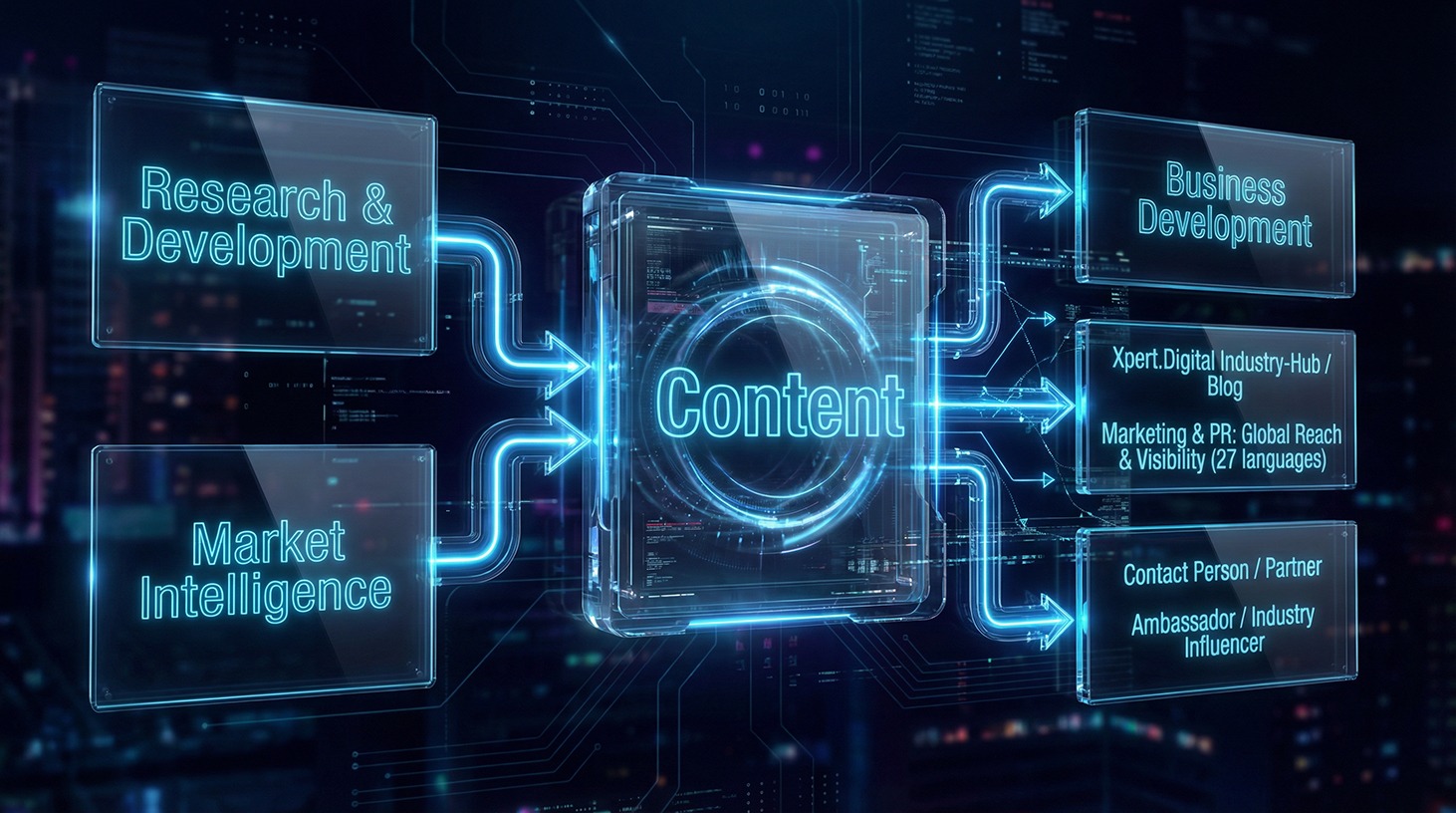
The quasi-in-house solution: How Xpert.Digital closes operational gaps in B2B marketing and sales – Smart Content-Driven Business - Image: Xpert.Digital
Xpert.Digital is a data-driven B2B industry hub led by Konrad Wolfenstein . The company acts as an external, quasi-in-house solution for industrial partners, closing operational gaps in marketing, content, and sales – without requiring additional resources on the client side.
More information here:
Your global marketing and business development partner
☑️ Our business language is English or German
☑️ NEW: Correspondence in your native language!

Konrad Wolfenstein
I and my team are happy to be available to you as your personal advisor.
You can contact me by filling out the contact form here wolfenstein@xpert.digital:or simply call me at +49 7348 4088 965. My email address is
I'm looking forward to our joint project.