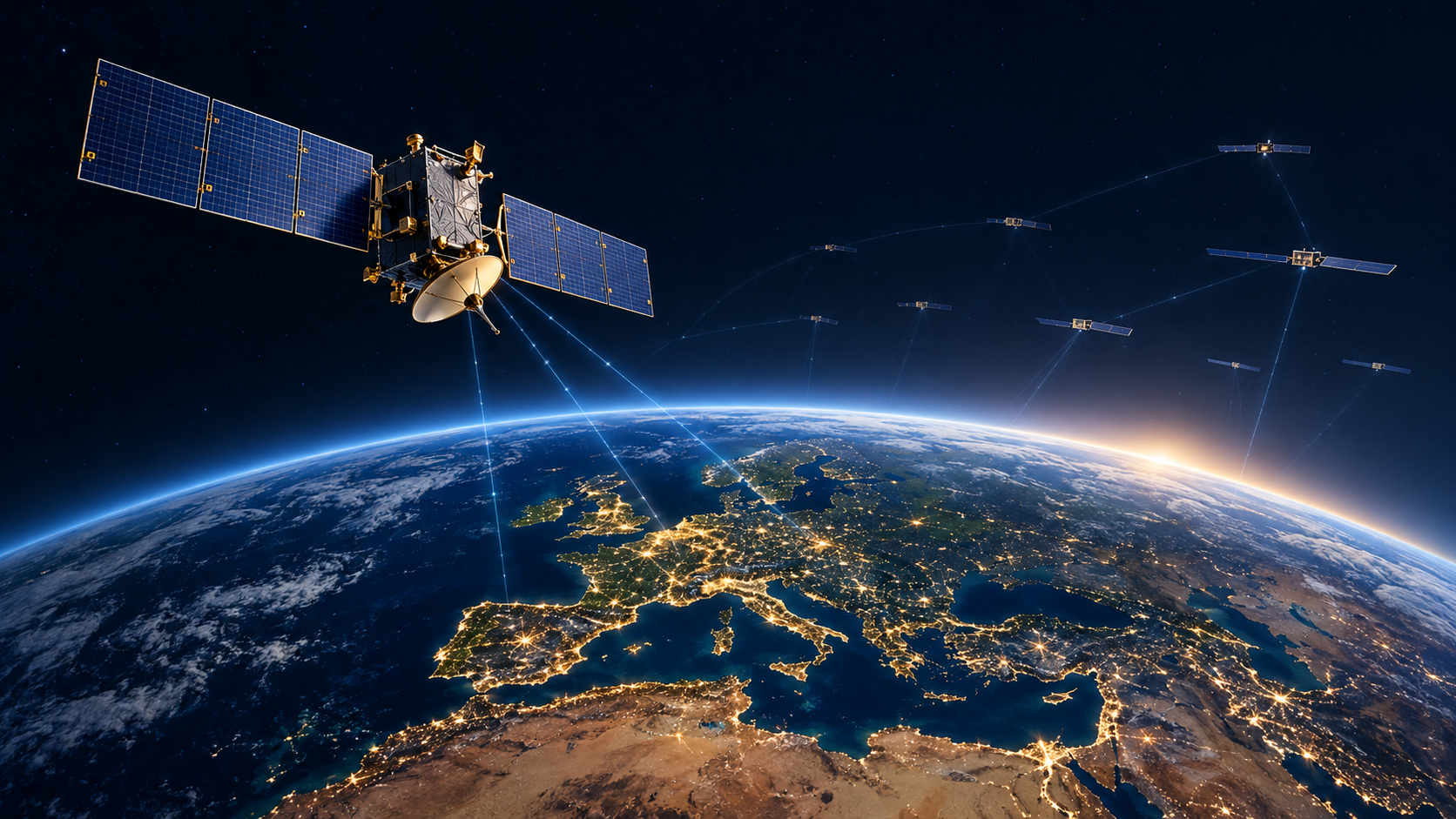
Europe versus Starlink? The costly battle for control in space – satellite internet becomes a question of power – creative image on the topic, with AI: Xpert.Digital
What Europe's plans really cost: Europe wants to slow down Starlink – but still lacks its own alternative
Greater independence, high costs: Europe's difficult path away from Starlink
Starlink is far ahead – why Europe still needs its own satellite networks
Europe wants to reduce its dependence on Starlink without jeopardizing the performance of its digital infrastructure. This lies at the economic heart of a conflict that, in October 2026, extends far beyond space policy: While European states seek greater control over the next generation of satellite communications, SpaceX defends its technological and economic leadership. At the center of the conflict is a fundamental question of modern industrial policy: How much of its own infrastructure does an economy need when particularly powerful networks are operated by companies outside its political sphere of influence?
The answer lies neither in blanket distrust of Elon Musk nor in blind faith in international competition. Starlink offers considerable practical benefits. At the same time, the concentration of critical communication services can create risks that are not reflected in the monthly connection fee. Europe's task, therefore, is not to symbolically push back an American provider. The crucial point is to develop economically viable alternatives, demonstrably reduce technological dependencies, and maintain sufficient competition. Strategic autonomy would be of little value if, in the end, it primarily resulted in one thing: the costly protection of a few established companies.
Europe's costly revolt against Starlink: Those who hold Musk back win nothing
Europe must reduce its dependence on Starlink without weakening the performance of its digital infrastructure. This is the economic core of a conflict that, in October 2026, extends far beyond space policy: Europeans want more control over the next generation of satellite communications, while SpaceX defends its technological and economic leadership. Behind this political clash lies a fundamental question of modern industrial policy. How much of its own infrastructure does an economy need when particularly powerful networks are operated by companies outside its political sphere of influence?
The answer cannot be reduced to either a blanket distrust of Elon Musk or unconditional trust in international competition. Starlink has created significant practical benefits. At the same time, a strong concentration of critical communication services can generate risks that are not fully reflected in the monthly connection fee. Europe's challenge, therefore, is not to symbolically push back an American provider. It is to build economically viable alternatives, demonstrably reduce technological dependencies, and maintain sufficient competition so that strategic autonomy does not become a costly shield for a few established companies.
The sky remains global
The idea that the skies over Europe will be redrawn in 2027 is appealing, but technically and economically misleading. Satellites in low Earth orbit do not remain permanently above a single continent. European policy cannot simply demarcate space like a piece of national land. What matters are the conditions under which satellite networks can offer their services in European markets and use specific radio frequencies.
The focus is on frequencies around 2 gigahertz, which are particularly interesting for direct connections between satellites and mobile devices. This refers to the ranges from 1980 to 2010 megahertz for transmission from Earth to the satellite and from 2170 to 2200 megahertz for the return direction. This equates to two 30-megahertz bands. This distinction is important: the specification 2 gigahertz refers to the approximate frequency range, not an available transmission bandwidth of 2 gigahertz.
The European proposal envisions a three-part structure. One part would serve secure government communication services, another commercial offerings under European control, and a third open to non-European providers as well. This structure will not be finalized by October 2026. Nor does it constitute a general ban on Starlink. From an economic perspective, the aim is to avoid considering dependency in a strategically important future market only after the market structure has already become entrenched.
Market power instead of a complete monopoly
To describe Starlink as a monopoly is an oversimplification. Europe has its own satellite operators, and other networks are being developed worldwide. Furthermore, residential internet, communication services for ships, specialized government applications, and direct smartphone connections differ considerably. A company can be particularly strong in one market segment without dominating all adjacent markets. Therefore, a sound competitive analysis must always first determine which services are truly interchangeable.
Undeniably, Starlink's enormous lead in scale is undeniable. As of September 30, 2026, the reported consumer metric reached 13.6 million customer connections. A year earlier, it had been 7.2 million. This figure includes private connections as well as certain business customer tariffs, but not the separately managed corporate and government customers. Therefore, it describes neither exclusively households nor the total number of people using the network.
At the beginning of October, SpaceX reported operating more than 11,000 Starlink satellites in low Earth orbit. The exact number depends, among other things, on whether satellites still in orbit or those already scheduled for decommissioning are included. For economic evaluation, the order of magnitude is more important than the final figure. A network with this level of deployment, a large customer base, and ongoing technological upgrades creates barriers to market entry that a new competitor cannot overcome solely through political support.
Why size finances more size
The economic advantage is evident in the financial figures. In the third quarter of 2026, SpaceX's Connectivity segment generated $5.248 billion in revenue. Of this, $3.121 billion came from consumer business and $2.127 billion from enterprise and government customers. Total revenue for this segment was thus 69 percent higher than in the same quarter of the previous year. The segment's operating income reached $2.367 billion.
These figures illustrate a reinforcing relationship. Recurring revenues facilitate the financing of additional capacity. More capacity enables more customers and new applications. A broader business, in turn, spreads development and operating costs across more paying connections. This doesn't create a classic social network effect: an internet connection doesn't improve simply because more people use the same provider. However, it does create an industrial scaling effect that links production, sales, financing, and continuous improvement.
At the same time, size should not be confused with unlimited capacity. Too many users in a service area can strain the available capacity. Additional connections only create lasting value if the network can keep pace technically. Similarly, the operating segment result is not readily available corporate cash flow. Capital expenditures in the Connectivity segment alone amounted to US$1.543 billion in the third quarter. A sound economic analysis must therefore consider growth and earnings strength as well as ongoing capital requirements.
Musk's advantage begins on the ground
Starlink's position is not solely based on the number of its satellites. SpaceX combines satellite development, manufacturing, launch capabilities, and network operations within a single corporate group. This vertical integration facilitates coordination between technical development and the provision of additional capacity. An independent satellite operator, on the other hand, must coordinate schedules and economic interests with manufacturers, launch service providers, and other partners.
The advantage, therefore, lies not solely in a potential price difference per rocket launch. Availability, learning curves, and the ability to coordinate technical changes across multiple development stages are equally important. If a company regularly expands its infrastructure, the speed of this cycle can become a significant competitive factor. A competitor with a long development phase is not competing against the current state of Starlink, but rather against the performance that Starlink achieves by the time it enters the market.
Europe should not interpret this as a demand for a complete copy of SpaceX. Another industrial organization can also be successful. However, it must establish comparable decision-making capacity and reliable interfaces. Political support loses some of its economic value if technical decisions are subsequently delayed by too many stakeholders. Therefore, for a European network, what matters is not only how much money is available, but also how quickly functioning and regularly updated infrastructure is created.
The smartphone is changing the market
The most competitive future market is direct connections between satellites and mobile devices. These so-called direct-to-device services differ fundamentally from the familiar satellite internet with a separate receiving antenna on a house, vehicle, or ship. A smartphone has significantly smaller antennas and a limited power supply. Satellite technology must take these limitations into account.
Furthermore, there are different technical approaches. Some solutions use frequencies otherwise reserved for terrestrial mobile networks. Others utilize frequency bands specifically designated for mobile satellite communication. This results in varying requirements for devices, network technology, and international coordination. Therefore, the statement that satellites will provide every existing smartphone with full broadband everywhere in the future is too general. Crucial factors include supported frequencies, chipsets, software, line-of-sight conditions, and the actual service quality available.
Deutsche Telekom plans to launch its Starlink direct connection, announced in March 2026, specifically for compatible smartphones. The rollout is scheduled for early 2028 in several European markets, including Germany. This timeframe and technical limitation is economically significant. Even with a satellite network in place, a large, usable end-customer market will only emerge once enough compatible devices are available and integration with existing mobile services is reliable. Infrastructure, end devices, and distribution must develop concurrently.
Supplementation is more valuable than replacement
Satellite communication should not be considered a viable replacement for all terrestrial networks. Fiber optic and mobile networks can transport large amounts of data across densely populated areas, distributing them over short distances. A satellite, on the other hand, covers larger areas where active users share capacity simultaneously. It is therefore particularly attractive where additional transmission towers or fixed-line connections are expensive, slow to implement, or practically impossible.
The crucial difference lies between area coverage and available capacity. A region can be reachable in principle, but not necessarily with every user within it receiving the same data rate at all times. Similarly, high speeds during a demonstration say little about the capacity a network can deliver under heavy concurrent use. Therefore, for economic evaluation, not only peak speeds but also the reliably available capacity in actual use is what matters.
This is especially true during crises. If a terrestrial network fails, the demand for satellite connections can suddenly increase dramatically. At precisely such times, it is crucial to determine which applications are prioritized and how many users can be served. An emergency call, a brief status update, or a small sensor data transmission requires significantly less capacity than parallel video connections. A European approach can therefore be economically sound if it initially reserves limited capacity for particularly critical applications, rather than promising an unlimited backup network.
Four corporations, different interests
Deutsche Telekom, Orange, Telefónica, and Vodafone confirmed a joint initiative for direct satellite links on October 19, 2026. The plan includes European control structures, ground infrastructure, and coordination and monitoring functions. The companies do not intend to directly finance a satellite constellation themselves. The space component will be provided by a partner, which has not yet been determined.
This division of labor follows a sound economic logic. Mobile network operators contribute customer relationships, billing systems, distribution channels, and existing networks. A satellite partner complements the geographical reach. This means that not every group of companies has to bear all development risks alone. At the same time, a shared technical infrastructure can simplify integration and prevent the same foundations from being built independently multiple times.
However, the interests of these parties are not aligned. Mobile network operators want to maintain direct access to customers. Satellite operators need sufficient revenue and investment security. Policymakers expect strategic control, while customers desire minimal additional costs and ease of use. These goals can complement each other, but they can also conflict. Therefore, a viable partnership requires clear responsibilities for network quality, expansion, data processing, and disruptions. A joint announcement provides a starting point, but it does not replace a fully operational satellite partner or reliable long-term financing.
Cooperation beats simple factionalism
Reality doesn't fit the image of a united European camp against American companies. Deutsche Telekom is already working with Starlink and is simultaneously planning to participate in the joint European initiative. Vodafone is connected to AST SpaceMobile via Satellite Connect Europe. This Luxembourg-based joint venture combines European operational structures with American satellite technology. Existing partnerships are explicitly not intended to be replaced by the new initiative.
This is not necessarily contradictory. Companies can utilize the most efficient available infrastructure in the short term while simultaneously developing alternatives for the future. Economically, this can be understood as hedging against different technological and political developments. Those who commit to only one path early on bear a greater share of the risk of delays, limited equipment support, or unfavorable conditions.
This leads to a nuanced understanding of independence for Europe. Complete in-house production of all components would be a different goal than legal control of network operation or the ability to switch between multiple satellite systems. International cooperation can even reduce dependencies if it creates genuine choice. However, it can also obscure them if several European brands ultimately remain reliant on the same critical infrastructure. Therefore, what matters is not the number of partnerships on paper, but the number of genuinely independent technical options.
Europe's alternative is growing, but remains smaller
Europe isn't starting from scratch. Eutelsat, with its OneWeb service, has a constellation of more than 600 satellites. In the fiscal year ending June 30, 2026, LEO revenue increased by 69.5 percent on a like-for-like basis to €297 million. This represents significant growth for an existing European business. It would be factually incorrect to portray European satellite communications solely as a future prospect.
At the same time, the other business figures illustrate the challenge. Eutelsat Group revenue reached €1.2359 billion, nominally down 0.6 percent year-on-year, while increasing by 3.0 percent on a like-for-like basis. Adjusted EBITDA amounted to €632.4 million. Strong growth in low Earth orbit thus coincides with a company that must also manage changes in its other business areas. Eutelsat also reported the completion of a €5 billion refinancing program.
A direct comparison of scale with Starlink requires caution. Annual European revenue in euros and quarterly American revenue in dollars are not directly comparable metrics. Furthermore, different customer groups and business models exist. Nevertheless, the financial asymmetry is significant. Equally important is the technical distinction: the existing OneWeb broadband network with its own user terminals is not automatically a readily available direct connection network for ordinary smartphones. Existing space technology expertise facilitates the development of new services, but does not replace their concrete development.
Competition has more than two sides
Outside of Europe, Starlink isn't the only satellite infrastructure. Amazon is building another large satellite infrastructure with Amazon Leo. By October 2026, more than 1,000 satellites had been produced and 396 launched. These two figures also illustrate the importance of precise terminology. A manufactured satellite creates industrial substance, but not yet usable network capacity in orbit. Only launch, commissioning, and integration into the ground infrastructure transform it into a marketable service.
Additional providers could increase competitive pressure on Starlink. For European customers, this would generally be positive, as more technical alternatives could improve their negotiating position. However, switching from one American network to another does not automatically equate to greater European political agency. It can reduce corporate risks without completely dissolving shared legal or geopolitical dependencies.
Conversely, Europe should not measure its own capabilities solely by low Earth orbit. SES operates, among other things, communication systems in medium Earth orbit and develops multi-orbit solutions. Different orbital altitudes and network architectures can meet different requirements. Therefore, the most economically advantageous solution is not always the provider with the most satellites. For businesses and government agencies, the right balance of capacity, latency, security, availability, and total cost of ownership is crucial, as is the ability to effectively combine multiple networks.
Our EU and German expertise in business development, sales and marketing


Our EU and German expertise in business development, sales and marketing - Image: Xpert.Digital
Industry focus areas: B2B, digitalization (from AI to XR), mechanical engineering, logistics, renewable energies and industry
More information here:
A thematic hub offering insights and expertise:
- Knowledge platform covering global and regional economies, innovation and industry-specific trends
- A collection of analyses, insights, and background information from our key areas of focus
- A place for expertise and information on current developments in business and technology
- A hub for companies seeking information on markets, digitalization, and industry innovations
IRIS²: Europe's ambitious satellite project under scrutiny
IRIS² will be larger and more expensive
The key long-term European project is IRIS². However, older figures are now outdated. In August 2026, the main constellation was expanded to 348 satellites: 330 in high low Earth orbit and 18 in medium Earth orbit. Initial launches are planned for 2029, with initial services starting in 2030. This does not necessarily mean that a fully available European replacement system for Starlink will be in place by 2027.
The updated total investment amounts to over €15.6 billion. Of this, €11.6 billion is earmarked as public funding and up to €4 billion as contributions from the participating operators. Compared to the previous figure of approximately €10.55 billion, this represents an increase of almost half. However, it is not simply a matter of maintaining the same, unchanged scope of services becoming more expensive. The architecture and planned security capacities have also been expanded. For a fair assessment, cost developments and changed requirements must be considered together.
The expansion aims to increase secure government communications capacity within the EU by 60 percent and worldwide by 54 percent compared to previous plans. These are target values, not measured service levels. The economic benefit depends on whether reliably usable services result from this additional capacity. Satellite numbers and investment volume describe the effort involved. Only availability, security, and actual usage will reveal the performance that justifies this investment.
Sovereignty is an insurance benefit
The economic justification for a European satellite system does not lie solely in its potential commercial revenue. Additional, politically controlled communication channels can have an insurable value. Their benefit becomes particularly evident when other infrastructure fails, is restricted, or is no longer sufficiently available under exceptional circumstances. This benefit may only be partially captured by ordinary market prices.
From the perspective of an individual user, it may be economically sensible to simply choose the most powerful and affordable connection. However, if a large number of critical facilities make the same decision, this can create a shared dependency. This is not automatically a market failure, but a potential difference between individual and macroeconomic risk assessment. Public support is justifiable if it creates a concrete, quantifiable additional security benefit.
However, this does not imply unlimited financial freedom. Insurance coverage must be appropriate to the insured risk. Not every private data transmission requires the same level of protection as military communications or the coordination of emergency services. The more precisely the applications requiring particular protection are defined, the more effectively additional infrastructure can be dimensioned. A differentiated European strategy could therefore stipulate strict control requirements for sensitive services while simultaneously maintaining broader international competition for ordinary commercial applications.
A European seat is not enough
Sovereignty is only practically relevant if it functions even under difficult conditions. A company headquarters in Europe or a European data center does not automatically answer all control questions. For example, it is necessary to examine who approves software updates, who prioritizes network functions, which components can be replaced, and whether operations could be maintained without the continuous support of a single external partner.
Data location and data control are also not identical. Processing European data on the continent can simplify certain requirements. Nevertheless, questions remain regarding administrative access rights, encryption keys, corporate governance, and the applicable legal frameworks. The economic value of a sovereign offering therefore lies not solely in its geographical location, but also in verifiable technical and organizational capabilities.
For companies, this means that switching providers is only a viable option once it has been practically prepared. Different terminals, differing interfaces, additional training, or a new security audit can complicate the switch. Such costs increase loyalty to the existing provider, even if several competitors formally exist. European policy should therefore also improve the conditions for switching. Interoperability and transparent technical standards can, in some cases, create more effective competition than a larger number of European company names without sufficiently interchangeable services.
Washington defends a future market
American resistance is economically understandable, even if the political tension complicates the debate. In October 2026, US Ambassador Andrew Puzder warned of serious consequences for European companies if European regulations discriminated against American suppliers. At that time, no concrete countermeasures were specified. Therefore, suggesting that sanctions had already been decided upon would be an exaggeration.
Under the current US President Donald Trump, the protection of American technology companies is linked to a fundamental right to market access. For SpaceX, more is at stake than just its European consumer business. Direct smartphone connections could more closely integrate satellite communications with the entire mobile communications market. Restrictions in one major economic area could also serve as a model for other regions. From a company perspective, the long-term international scalability of its business model is therefore also at stake.
The scale of this strategic interest is evident in SpaceX's frequency acquisitions. The agreement with EchoStar, announced in 2025, for AWS-4 and H-block frequencies was valued at approximately US$17 billion. Later, additional frequencies were acquired for around US$2.6 billion. While these figures don't directly explain the value of the European market, they demonstrate that frequency access, alongside satellites, rockets, and customer acquisition, is among the key investment areas for the next phase of development.
Safety arguments require technical evidence
SpaceX has warned of potential disruptions caused by European plans, specifically citing communication services in Ukraine. Such warnings should be taken seriously, but not treated as proven consequences. A company's position on a regulatory conflict is not the same as an independent technical assessment. Likewise, the European claim that greater control automatically leads to better service is insufficient.
Satellite communications transcend national borders. When multiple systems use closely spaced frequencies, technical compatibility, clearance distances, and operating conditions must be carefully coordinated. The International Telecommunication Union coordinates frequency usage at the international level. However, this coordination does not replace all regional regulations. Similarly, radio interference and physical security in orbit are distinct responsibilities. Therefore, a discussion about frequency interference should not be conflated with a discussion about satellite collisions.
The situation in Ukraine clearly demonstrates the practical value of available satellite communication in a severe crisis. This does not mean that every objection raised by SpaceX is valid, nor that political dependencies should be accepted without question. The sensible course of action is a verifiable technical risk assessment. Where evidence is lacking, uncertainty must be acknowledged. Security communication loses credibility when potential risks are presented as certainties or when real coordination problems are prematurely dismissed as mere lobbying.
Open networks need fair rules
Cooperation among large European mobile network operators can share development costs and facilitate market launches. However, it also entails competitive risks. If a few established corporations jointly control a key upstream service, smaller operators and independent service providers can become unfavorably dependent. A European counterpart to Starlink would not automatically be consumer-friendly if it merely creates another form of concentrated market power.
The participating companies are therefore announcing open and non-discriminatory access for other mobile network operators. This promise only becomes economically relevant once the specific conditions are met. These include transparent pricing, available capacity, standardized technical interfaces, and the swift integration of additional providers. Even formally open access can be practically worthless if the largest shareholders receive preferential capacity or independent competitors are hampered by lengthy integration periods.
Public support should therefore be linked to measurable performance requirements. Crucial factors are the actual availability of services, technical reliability, and the ability to connect additional market participants. Equally important is ensuring that scarce resources are not permanently tied up in underdeveloped projects. Protection for the development of new capabilities can be useful in the short term. However, permanent protection without verifiable progress would increase the costs of the European strategy and weaken the pressure for technical improvement.
Customers pay for the proof of performance
For private users, the geopolitical narrative alone isn't the deciding factor. They want to know which devices are supported, which services actually work outside of mobile network coverage, and what additional costs are involved. Starlink's average monthly consumer revenue was $69 in the third quarter of 2026. This global average is neither a binding German tariff nor a price benchmark for future direct smartphone services. It encompasses different markets and tariff groups.
Especially with direct connections, the design of the offer is crucial. Options include included emergency functions, optional add-on packages, or specifically guaranteed business services. These models distribute costs and risks differently. An occasionally used security service can be valuable to customers, even if it generates little data traffic. Conversely, a theoretically large geographical coverage area doesn't justify a high price if the actually usable functions remain severely limited.
For enterprise customers, additional criteria come into play. They require reliable operational support, defined troubleshooting processes, and transparent integration into their existing networks. A seemingly inexpensive connection can become costly overall if additional hardware, installation, and internal support require significant effort. European providers can therefore compete by offering integrated services. However, the underlying satellite service must be sufficiently reliable. Good support cannot permanently compensate for an inadequate technical foundation.
The benefit lies in operational processes
The economic benefits are particularly tangible in logistics and industry. For example, an additional connection for vehicles, containers, or mobile service teams in areas with insufficient terrestrial coverage is conceivable. Even a brief location or status report can help to better coordinate operations. However, this does not mean that every such application immediately requires its own satellite connection. The crucial question is whether the additional information gained actually justifies the higher costs.
Satellite communication can also be a valuable addition to remote energy facilities, construction sites, or temporary operating locations. It could accelerate the establishment of an initial connection or transmit critical messages if another access point fails. A distinction must be made between simple sensor data, comprehensive remote maintenance, and safety-critical real-time control. These applications place very different demands on data rate, latency, and availability. A network suitable for occasional messages is not necessarily capable of supporting sophisticated process control.
The most effective business approach therefore often lies in the targeted safeguarding of individual processes. Companies should first determine which information absolutely must be passed on in the event of a disruption. Then, they can examine which communication channels are necessary. In this way, the abstract demand for greater connectivity becomes a concrete investment decision. The value of an additional connection is then measured by the damage avoided, fewer interruptions, or better coordination, not by the inherent fascination of the satellite itself.
Redundancy must actually be independent
Multiple connections do not automatically equate to multiple independent safeguards. Two services may use the same ground stations, power supply, or critical control components. Similarly, two different satellite providers may rely on the same local access point. Therefore, a seemingly comprehensive technical safeguard can fail simultaneously under certain conditions.
For economic evaluation, the independence of the sources of failure is crucial. A company should not only ask how many communication channels exist, but also what events could affect them all simultaneously. This includes local power outages as well as software problems, physical damage, or legal restrictions. A backup system is particularly valuable if it remains usable under precisely the conditions in which the primary connection fails.
This requires testing, not just product descriptions. Switchover, power supply, available data rate, and access to key applications must be tested under realistic conditions. It should also be clearly defined which services will be deliberately restricted during emergency operation. If scarce satellite capacity is reserved for mission-critical communications, even a limited system can provide significant benefits. Europe's strategic goals thus only become tangible at the level of concrete operational capability: Resilience is not created simply by the existence of a second network, but by its proven functionality at the crucial moment.
Growth needs a responsible orbit
The economic debate must not ignore the long-term costs of space exploration. The ESA Space Environment Report 2026 describes the continued growth of commercial constellations and increasing collision risks. More satellites do not automatically mean more safety. Without effective coordination, additional objects can worsen operating conditions for other systems as well.
The orbital altitude is crucial. In higher, low-level orbits, non-functional objects can remain longer than in areas more heavily influenced by the atmosphere. Therefore, for a fair comparison, in addition to the number of satellites, the ability to avoid collisions, reliability, controlled decommissioning, and the lifespan of potential debris are also relevant. A smaller network is not necessarily more sustainable if individual failures have more problematic long-term consequences.
Economically, these are costs that are not always borne entirely by the operator who caused them. Collision risks, additional monitoring, or disruptions to scientific observation can also affect other actors. A viable European strategy should therefore establish equal and verifiable requirements for responsible operation, regardless of a company's origin. Sovereignty would be incomplete if it creates additional infrastructure in the short term but weakens the long-term usability of the shared orbital environment. Technological capability and responsible operation are not separate objectives, but rather prerequisites for a sustainably viable business.
2027 will not yet decide a winner
Several developments are conceivable for 2027, but none should be presented as a fixed outcome. One possibility is an orderly transition to more European-controlled structures, while continuing to utilize international partnerships. This would gradually expand Europe's options without prematurely displacing existing services. The drawback would be slower, more visible progress compared to political expectations.
A second possibility is a more intense transatlantic confrontation. This could lead to a closer link between market access and other economic interests. As long as concrete countermeasures remain undecided, their impact cannot be reliably quantified. However, this uncertainty alone could complicate investment decisions. A third possibility is that Europe formulates far-reaching goals, but technical integration, financing, or industrial implementation fall behind schedule. In this case, protection would not automatically generate additional usable output.
A proper measure of progress must therefore differentiate between time periods. In 2027, the focus is primarily on market alignment. Certain direct commercial connections are planned for 2028. IRIS² is scheduled to launch its first satellites starting in 2029 and subsequently provide services. These various stages of development should not be condensed into a single, supposed breakthrough. Anyone wishing to assess progress should observe whether compatible devices become available, ground infrastructure is established, multiple providers actually collaborate, and security promises translate into verifiable operational capability.
Europe's success requires genuine choice
The clearly reasoned economic perspective is this: Europe should not exclude as much American technology as possible, but rather reduce the costs of critical dependence. This includes developing its own capabilities, open interfaces, and sufficiently independent alternatives. A purely nationalistic approach would be too simplistic. Equally inadequate would be a policy that views every current market performance as proof that additional safeguards are fundamentally unnecessary.
Success should be demonstrated by the ability of public authorities and companies to continue providing essential communication services even under challenging conditions, while simultaneously maintaining sufficient competitive pressure. Public funds should create additional security benefits and industrial capacity, rather than simply shielding existing providers from better offers. Private operators, in turn, must accept that the importance of their infrastructure entails legitimate demands for transparency, reliability, and technical cooperation.
Starlink's lead is real, but it doesn't render European alternatives pointless. European security interests are also real, but they don't make every expensive project economically viable. The crucial test lies between these two insights. A successful strategy would enable Europe to use international services out of self-interest, rather than being forced to use them due to a lack of alternatives. Only when this choice is technically feasible and financially sustainable will the political claim to independence translate into genuine economic freedom of action.
🎯🎯🎯 Data-driven B2B industry hub as a quasi-in-house solution


The quasi-in-house solution: How Xpert.Digital closes operational gaps in B2B marketing and sales – Smart Content-Driven Business - Image: Xpert.Digital
Xpert.Digital is a data-driven B2B industry hub led by Konrad Wolfenstein . The company acts as an external, quasi-in-house solution for industrial partners, closing operational gaps in marketing, content, and sales – without requiring additional resources on the client side.
More information here:
Your global marketing and business development partner
☑️ Our business language is English or German
☑️ NEW: Correspondence in your native language!

Konrad Wolfenstein
I and my team are happy to be available to you as your personal advisor.
You can contact me by filling out the contact form here wolfenstein@xpert.digital:or simply call me at +49 7348 4088 965. My email address is
I'm looking forward to our joint project.