
Protests in Europe: Europe's promise of prosperity is crumbling – High spending, dilapidated schools, expensive housing
Xpert Pre-Release

Available in 27 languages 📢
Prefer Xpert.Digital on GoogleⓘPublished on: October 20, 2026 / Updated on: October 20, 2026 – Author: Konrad Wolfenstein
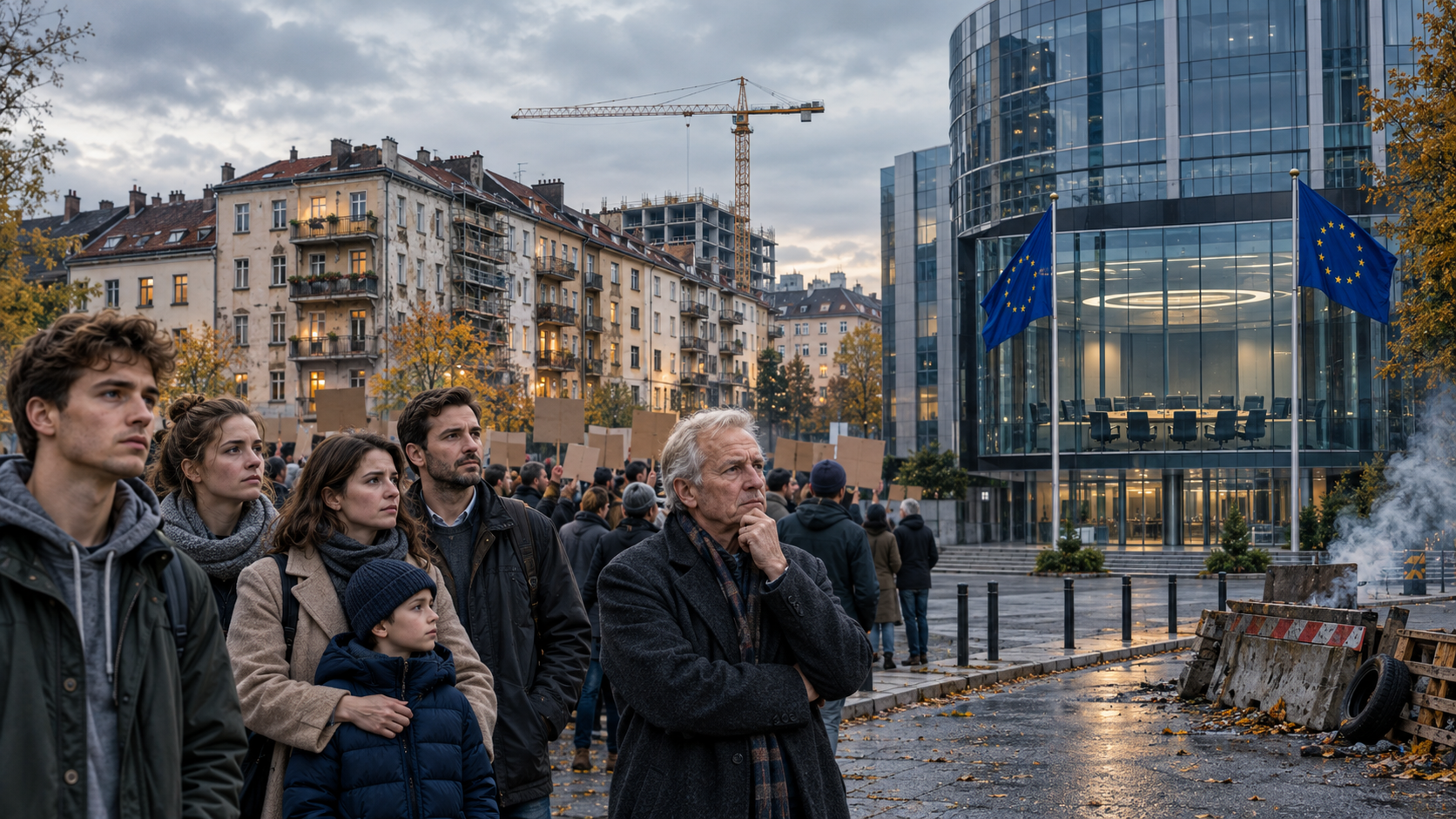
Protests in Europe: Europe's promise of prosperity is crumbling – High spending, dilapidated schools, expensive housing – Creative image on the topic, created with AI: Xpert.Digital
Europe's crisis of confidence: Why good intentions don't solve problems
When work is no longer enough: Europe's growing social security crisis
Housing, education, care: Why Central Europe is reaching its limits
In many European countries, discontent is growing: housing is becoming increasingly difficult for young people to access, public institutions are under pressure, and rising costs often make even earned income seem less secure than it should be. At the same time, some indicators reveal a more nuanced trend than the general feeling of decline would suggest. Real wages have recently risen, and the number of people at risk of poverty or social exclusion in the EU has decreased slightly. But such averages don't capture every aspect of life – and they don't answer the question of why so many people doubt their future.
The protests in France, Italy, Belgium, Spain, and Portugal have different causes and political backgrounds. What they have in common, however, is the concern that hard work is increasingly failing to translate into a reliable future. This article examines what lies behind this loss of trust: from housing shortages, education, and public services to the tax burden, pension financing, and European fiscal policy. It is not about assigning blame in general terms, but rather about a more precise question: How can a political system that aims to combine social security, economic performance, and the rule of law break free from the reform deadlock—and renew the promise that work, responsibility, and shared rules will enable a future?
Those who only take a stand lose the middle ground: What's really behind the growing discontent
Europe does not suffer from a lack of political messages, but from a lack of credible problem-solving. When work no longer guarantees a sufficiently secure life, when owning one's own home becomes an unattainable goal, and when public institutions can only partially fulfill their basic mandate, it is not just the government that comes under pressure. The social contract itself is called into question: the expectation that performance, responsibility, and adherence to common rules will provide a reliable future.
This is the crux of European unease. What is meant is a policy that combines social security, economic performance, national democratic responsibility, and the rule of law. It does not protect every inherited privilege, but rather the prerequisites for a functioning society. These include affordable housing, good schools, reliable services, and a state that enforces its rules and can finance its commitments.
The crucial dividing line, therefore, does not run between people with supposedly right or wrong attitudes. It runs between a politics that exposes conflicting objectives and organizes viable solutions, and a politics that merely addresses problems verbally until they can no longer be ignored materially. However, it would be equally simplistic to interpret all European protests as a unified left-wing revolt or every negative development as a deliberately engineered outcome of Brussels politics. A sound critique must make sharper distinctions than the slogans it targets.
Different protests, the same loss of trust
The protests of autumn 2026 intertwined various national conflicts. In France, disputes over teacher shortages, teaching conditions, and dilapidated school buildings had broadened into a wider movement against high living costs and declining public services. On October 17, according to the Interior Minister, some 550,000 people took to the streets across the country. While large crowds demonstrated peacefully, violent groups attacked public buildings, businesses, and police forces.
In Italy, student protests targeted, among other things, inadequate school funding and political spending priorities. Attacks on security forces and property damage occurred in several cities. In Belgium, rising education costs and concerns about access to higher education were central to student protests. In Spain and Portugal, mobilization focused particularly on housing costs, rental conditions, and the difficulties young people face in establishing their own households.
These movements are neither organizationally nor politically identical. Their respective dynamics of violence also differ. What they share, however, is an experience that carries more economic weight than individual slogans: personal commitment seems increasingly less likely to translate into social advancement and reliable life planning. Anyone who takes this commonality seriously need not adopt every protest demand or excuse violations of the law. They must recognize that a state cannot defend its authority in the long run solely with security forces, but also with demonstrable effectiveness.
Why 1968 is only partially suitable
Barricades, school blockades, and university occupations evoke memories of earlier protest movements. However, comparing them to May 1968 only partially explains the current situation. Historical movements were more contradictory than their later glorification suggests. Back then, too, social upheaval, political radicalization, and violence existed side by side. Conversely, it would be wrong to categorically deny today's demonstrators any hope or vision of social improvement.
The crucial economic difference lies in the nature of expectations. Many current conflicts are not about completely overcoming a perceived stagnant welfare state. They revolve around access to its fundamental promises: affordable housing, a decent education, a job with prospects, and reliable public services. The revolt is thus often directed against the experience that normality itself has become a privilege.
Politically, this is particularly dangerous. A society can cope better with demanding changes if its citizens expect improvements. If, on the other hand, they anticipate permanently higher burdens with decreasing benefits, even objectively necessary reforms appear as a further loss. Politicians should understand this crisis of expectations as a warning signal: a social order can only be preserved if its institutions are renewed in a timely manner.
Purchasing power is growing, but security is lacking
Economic analysis must distinguish between inflation, price levels, and income. A lower inflation rate does not mean that previous price increases are reversing. It simply means that prices are rising more slowly. Families must therefore cope with a permanently higher level of expenditure even after an inflationary surge has subsided. Costs that are difficult to avoid in the short term are particularly burdensome: rent, heating, groceries, and commuting expenses.
At the same time, the claim of a continuous general decline in purchasing power would be inaccurate. In Germany, real wages rose by 1.9 percent in 2025. After the declines of 2020 to 2023, the real wage index thus almost reached the 2019 level again. In the second quarter of 2026, real wages were a further 1.5 percent higher than in the same quarter of the previous year. These are real improvements, not mere political spin.
However, averages don't explain every life situation. The real wage index describes the development of gross earnings taking consumer prices into account, not the individually available amount after taxes, social security contributions, and actual housing costs. An employee with an old lease experiences the same overall economic development differently than a young family who have to rent a new place. The discrepancy between improved average figures and persistent dissatisfaction can therefore have a factual basis.
The apartment becomes a class barrier
The housing question is at the heart of the European distribution crisis. In the second quarter of 2026, residential property prices in the EU were 4.7 percent higher than in the same quarter of the previous year. In Portugal, the increase was 16.5 percent, and in Spain, 12.1 percent. France, by contrast, recorded a decline of 0.8 percent, and Germany a comparatively small increase of 0.6 percent. These differences alone demonstrate why a general explanation for the entire continent is insufficient.
Property purchase prices should not be equated with rents. For homebuyers, financing costs, equity, and closing costs are just as important as the purchase price. For renters, on the other hand, the local supply, existing contracts, and prices for new rentals are crucial. Even stagnant purchase prices can coincide with a tight housing market. Therefore, a relaxation in one indicator does not necessarily mean that the housing situation is easing.
The social consequences extend far beyond apartment viewings. High housing costs hinder professional mobility, delay starting a family, and increase the importance of family wealth. Those who receive financial support or an inherited property start under different conditions than someone who relies solely on their earned income. From a social perspective, this is problematic because a system of property ownership loses its broad acceptance when homeownership becomes practically unattainable for large segments of the working population.
Young adults are waiting for independence
In 2025, young people in the EU left home at an average age of 26.3. In Spain and Italy, the average age of leaving home was 30.2. These differences cannot be explained solely by housing costs. Family cultures, educational pathways, and labor market conditions also play a role. Nevertheless, they indicate that economic independence is achieved later in parts of Europe.
Further data makes the burden clearer. In 2025, 26.9 percent of 15- to 29-year-olds in the EU lived in overcrowded households, compared to 16.8 percent in the general population. A dwelling is considered overcrowded according to a statistical space-based key that takes into account household size, age, and composition. At the same time, 9.1 percent of young people lived in households where housing costs amounted to at least 40 percent of their disposable income. In the general population, this figure was 7.7 percent.
Moving out later can mitigate the measured financial burden because young adults remain financially secure within their parents' home. However, it can also mask the fact that independent living is not financially feasible. Social policy should therefore consider not only the ability of existing households to pay their own way, but also the possibilities for establishing a household. Societal stability is not achieved by keeping young people economically dependent for as long as possible, but by enabling them to actually assume responsibility.
Without more housing, there can be no relaxation
Germany illustrates the supply side of the crisis. In 2025, around 206,600 apartments were completed, 18 percent fewer than in 2024. The number had already fallen by 14.4 percent in 2024. From 2021 to 2023, it had been around 294,000 annually. A weak supply of new construction cannot be replaced in the short term by additional subsidies. Where supply remains tight, some of the additional purchasing power can be absorbed by higher prices and rents.
A sustainable housing policy must therefore simultaneously protect and enable. People in acute need require support, and municipal and community-based housing stock can play a stabilizing role. At the same time, the mobilization of building land, densification, conversion of existing housing, standardized construction methods, and faster permitting processes must expand the supply. Private investment is also needed. Those who portray every private landlord as a social enemy hinder a solution just as much as those who view social hardship solely as a market correction.
Local differences are crucial when it comes to short-term rentals. In areas with high tourist demand, the conversion of permanent residences can further reduce the supply for locals. However, this does not provide a convincing argument for blanket bans across the country. Verifiable local regulations, transparent registration, and effective enforcement are more sensible. Immigration and internal migration must also be considered in the demand analysis. Additional households require housing; at the same time, skilled immigrants can help build housing. Effective management requires considering both sides without exclusion or glossing over the realities.
Saving money doesn't explain every failure
The claim that housing shortages and educational deficiencies are solely consequences of EU-driven neoliberalism is analytically too simplistic. It conflates various decisions: privatizations, insufficient investment, restrictive building regulations, demographic changes, financing costs, and national budget priorities. Anyone who lumps everything together under a single political label can hardly explain which specific measure caused which specific problem.
France illustrates the problem of criticizing government spending solely on quantitative grounds. According to annual data published in May 2026, government spending reached 57.3 percent of economic output in 2025. At the same time, the deficit was 5.1 percent and the debt-to-GDP ratio was 115.7 percent. A government can therefore spend a great deal and still be insufficiently efficient in certain areas. High overall spending does not preclude local underfunding, unfavorable distribution of resources, and inefficient structures.
Similarly, a high expenditure ratio does not prove that additional investments are unnecessary. The crucial factor is the budget's composition. If ongoing commitments dominate the budget, school buildings, transportation infrastructure, and digital infrastructure can suffer. The sensible alternative, therefore, is neither blanket cuts nor unlimited expansion. It consists of reliably funding long-term projects, reviewing ineffective expenditures, and prioritizing investments according to their societal benefit.
Brussels shares responsibility, but is not solely to blame
European budgetary rules influence national policy options. The economic governance framework, reformed in 2024, obliges member states to adopt medium-term fiscal and structural plans and multi-year spending paths. The standard four-year adjustment period can be extended to up to seven years in the case of certain reform and investment commitments. This creates real pressure for consolidation, but not a blanket order to let schools fall into disrepair or neglect housing construction.
Crucial distribution decisions remain largely national and regional. Member states also participate in European decision-making. The notion that a completely detached EU imposes rules on politically uninvolved governments is therefore misleading. Criticism should demand subsidiarity: decisions should be made as close as possible to those who will bear the consequences and who can democratically hold those responsible accountable. It should also acknowledge that unsound fiscal policy in a monetary union affects other countries as well.
The blanket statement that the EU leadership is simply turning a blind eye is now too simplistic. In December 2025, a European plan for affordable housing was presented, combining increased supply, investment, simplification, and support for particularly affected groups. This response refutes the claim of complete inaction, but not the accusation of addressing the problem too late or inadequately. The crucial question remains whether these initiatives result in additional housing, shorter procedures, and tangible relief.
The center manages its blockades
The strongest argument against the established political center is not that it is fundamentally incapable of recognizing problems. It is that it frequently fails to translate recognizable problems into timely reforms. This is not simply a matter of individual failure. Coalition constraints, federal responsibilities, organized interests, and the fear of short-term electoral losses can create a political structure in which postponement appears rational to everyone involved.
The costs of this postponement are distributed and shifted over time. A single group immediately notices when its benefit is reduced. The advantages of a better overall system, on the other hand, often only become apparent later and benefit many people simultaneously. Therefore, well-organized minorities can block change, while the less organized middle class bears the growing overall costs. In this sense, reform gridlock is also a problem of political incentives.
A genuine political renewal must begin precisely here. It should not mistake political leadership for maximum volume, but rather consolidate responsibilities, establish transition periods, and make the effects of reforms transparent. Not all caution is cowardice, as poorly prepared interventions can destroy trust. But indefinite postponement is also a choice: it protects the status quo at the expense of those who will have to finance it in the future.
Political correctness is no substitute for performance
Respectful language and protection against discrimination are not economic evils. They are integral to a free society. Political correctness becomes problematic when moral judgments replace objective assessments: when references to overburdened municipalities, perverse incentives, educational deficits, or limited integration capacities are prematurely dismissed as unacceptable attitudes. Then the debate shifts from the question of effective solutions to the question of permissible language.
The more accurate criticism concerns a potential communication culture: Good intentions and symbolic recognition are easier to present publicly than difficult distribution decisions. When this presentation overshadows the material balance, it creates the impression of a policy driven by its own moral self-affirmation.
This entails a twofold obligation for politicians. They must be allowed to name uncomfortable facts without devaluing people wholesale. At the same time, they must not pursue a substitute policy that mistakes linguistic provocation for reform. A harsher tone doesn't build any apartments, fill any teaching positions, or finance any care services. What matters is not whether a government sounds particularly correct or particularly incorrect, but whether it achieves results under the rule of law.
Violence affects one's own community
Attacks on police forces, arson, looting, and the destruction of public facilities are not social policy. They destroy assets, disrupt services, and burden people who often have little to do with the political decisions being targeted. It becomes particularly absurd when schools are damaged while there are calls for better education. The costs of repair then compete with the very spending whose lack is being criticized.
The formula that the left is rioting remains too undifferentiated. It equates peaceful demonstrators, unions, opposition parties, radical activists, and violent perpetrators. In France in October, large crowds demonstrated peacefully, while violent fringe groups carried out attacks. A fact-based critique is directed at specific acts and at political actors who relativize, promote, or treat violence as a legitimate means of exerting pressure. It does not require collective guilt.
The rule of law applies equally to state power. Allegations of disproportionate police use must be investigated independently. In France, corresponding investigations were launched during the student protests, and certain resources were temporarily suspended. This does not weaken the state, but rather binds its authority to law and oversight. A functioning public order policy defends security forces when they act lawfully and demands clarification in cases of potential misconduct. Both are inextricably linked.
Education determines the performance standards
The education crisis is more than just a nuisance for affected families. It damages an economy's ability to increase productivity, train skilled workers, and enable social mobility. Anyone who talks about competitiveness but neglects basic literacy, numeracy, and language skills is starting from the wrong end. Modern industry, administration, and services require a sound foundation, not just additional technology programs.
The German Municipal Panel 2026 quantifies the perceived investment backlog of municipalities at €231.2 billion. Of this, €68.9 billion is attributed to school infrastructure and €53.7 billion to roads and transportation. These figures are based on a representative survey and extrapolation of municipal assessments; they do not represent a detailed technical inspection of every single building. This distinction is crucial. The figures document a significant need for action without implying that every euro identified represents a previously assessed renovation requirement.
At the same time, the 2022 PISA results for Germany show a gap of 111 mathematics points between socially advantaged and disadvantaged students, compared to 93 points in the OECD average. This is not proof of the effect of a single educational policy decision. However, it does show how closely educational success remains linked to social background. A meritocratic society must therefore strengthen early support, binding standards, reliable instruction, and vocational training. Performance requirements and social support are not opposites, but rather mutually dependent.
Work carries too many burdens
A social economic policy must take seriously the perspective of those who finance the welfare state. For a single, average-earner without children, the German tax and social security wedge in 2025 amounted to 49.3 percent of total labor costs. The OECD average was 35.1 percent. This placed Germany second among the 38 member countries. The figure includes income tax as well as employee and employer contributions; it does not mean that 49.3 percent of every employee's gross salary is deducted.
This distinction does not change the economic problem. A large gap between business labor costs and disposable income makes it difficult to combine higher net incomes with competitive costs. Therefore, when social spending increases, the same funding base—employment subject to social security contributions—is often burdened even further. The conflict is exacerbated when housing costs and necessary private expenses rise simultaneously.
However, any relief must be financially justified. Shifting contributions to taxes does not eliminate the costs, but merely redistributes them. It can be sensible if the goal is to finance societal tasks more broadly. But it is no substitute for efficiency, employment, and economic growth. Anyone promising a sustained increase in net income must explain which expenditures will decrease, which revenues will increase, or what additional value creation will actually be generated.
Pensions need honest limits
Old-age security clearly demonstrates why political reassurance is no substitute for long-term financing. In a pay-as-you-go system, current pensions are primarily financed through current contributions and supplementary tax revenue. If more people receive benefits and the contributory working population does not grow accordingly, contributions, tax subsidies, pension benefits, or employment histories must be adjusted. This fundamental relationship cannot be changed by simply choosing different words.
The 2025 pension insurance report, in its medium-variant scenario, projected contribution rates of 18.6 percent until 2027, 19.8 percent in 2028, and approximately 21.2 percent in 2039. These are model calculations based on specific assumptions regarding employment and wages, not definitive predictions. Nevertheless, they illustrate the direction of the financing pressure. Anyone promising consistently stable contributions, unchanged benefit levels, and no additional tax burdens must be assuming exceptionally favorable economic conditions.
A socially balanced reform approach should facilitate longer employment where health and job characteristics permit, and treat demanding employment histories differently than well-paid, flexible office jobs. Supplementary capital funding can distribute risks, but it is not self-financing: existing pensions must continue to be paid during its development. A broader insured base also creates additional entitlements in the long term. The sound approach consists of several adjustment mechanisms, transparent transitions, and clear protection against poverty in old age.
Health needs better organization
In 2024, Germany spent approximately €538.2 billion on healthcare, equivalent to 12.4 percent of its economic output. Compared to the previous year, expenditures increased by 7.6 percent nominally and by 3.9 percent in real terms. The claim that the entire system is simply being starved of funds is inaccurate. Nevertheless, individual facilities may be under pressure, staff may be overburdened, and regional gaps in care may exist. Total expenditure and actual quality of care are two different things.
International comparisons also do not paint a picture of complete failure. Germany has many doctors, nurses, and hospital beds; financial access to care is comparatively good. At the same time, the OECD Health Comparison 2025 shows significantly more avoidable hospital admissions than average. Such findings suggest that discussions should not only focus on additional funding, but also on care pathways, prevention, responsibilities, and collaboration between outpatient and inpatient care.
The average supplementary contribution to statutory health insurance announced for 2026 is 2.9 percent, with individual health insurance funds setting their own rates. The actual average collected at the end of March was already 3.13 percent. Further contribution increases can close short-term funding gaps, but they do not solve organizational problems. What is needed are verifiable quality targets, less redundant documentation, and a reimbursement system that rewards medical benefit rather than the sheer number of individual services provided. Changes must be prepared regionally; a more efficient structure on paper is of little use if the actual quality of care suffers.
Caregiving should not consume families
Long-term care is simultaneously an insurance issue, a labor market issue, and a family policy issue. The burden is not solely borne by the billing of a care facility. When family members reduce their working hours, additional financial costs arise, often resulting in long-term disadvantages regarding income and retirement security. A debate that focuses solely on contribution rates therefore underestimates the overall economic importance of reliable support.
The draft long-term care reform law, approved by the cabinet at the end of September 2026, demonstrates that political inaction is not a complete description of the situation. The federal government intends to maintain the general contribution rate at 3.6 percent and generate additional revenue through measures including changes to assessment ceilings and specific insured groups. At the time of the cabinet decision, these proposals were not yet legally binding. Furthermore, a stable general contribution rate does not automatically guarantee an unchanged burden for every insured individual.
From a social perspective, the focus should be on the actual care needs and relieving the burden on family caregivers. This requires reliable counseling services, short-term care, practical support services, and working conditions that retain skilled professionals in the field. Family responsibility deserves recognition, but it should not be treated as an unlimited, free resource. A society does not protect its families by constantly shifting more organizational and financial risks onto them.
Civil service reforms require a long-term perspective
When it comes to civil service pensions and the public sector, a sober perspective is particularly important. A high-performing state needs reliable administration, an independent judiciary, functioning security authorities, and qualified personnel. Salaries and pensions also fulfill institutional functions in this context. In Germany, lifelong, appropriate remuneration, including retirement benefits, is constitutionally protected. This does not prohibit all changes, but it does entail the obligation to design reforms in a legally sound and long-term manner.
The notion that all civil servants simply need to contribute to the statutory pension insurance scheme and its financing problem will be solved underestimates the transitional costs. Existing pension obligations do not disappear. At the same time, contributions would become due for newly included employees, and new pension entitlements would arise later. The overall effect therefore depends on the design, the timeframe, and any supplementary pension arrangements. Without a complete calculation, a seemingly plausible standardization can prove fiscally disappointing.
Transparent long-term pension calculations, honest financing of future obligations, and a review of where special status rules are objectively necessary are essential. Equally important is the modernization of work organization. Blanket condemnations of civil servants also affect those who actually bear the burden of overburdened schools, government agencies, and security structures. Reform policies should not pit the state against its employees, but rather create an efficient public service with comprehensible rules and sustainable costs.
Without productivity, the distribution breaks down
All social policy reforms reach their limits if the economic base does not grow. Higher productivity means producing more or better output with the same amount of working time. This can lead to higher wages, additional investments, and a broader financial base. It does not guarantee a fair distribution, but it does facilitate it. Without corresponding progress, every additional entitlement becomes more of a source of conflict between existing groups.
The 2024 European competitiveness analysis estimated an additional annual investment requirement of approximately €750 to €800 billion for already established European objectives. This figure includes both public and private investment; it does not represent a sum of public money that has already been approved. This scale illustrates the complexity of simultaneously modernizing energy supply, industry, digitalization, and security. These tasks cannot be accomplished solely through austerity measures or new debt.
The political perspective should therefore treat industry, small and medium-sized enterprises (SMEs), skilled trades, and productive services as fundamental to society. Affordable energy, reliable grids, good transport infrastructure, and predictable regulations are simultaneously economic and social policy. Artificial intelligence and automation can create additional opportunities if they genuinely improve workflows and are accompanied by training and development. However, technological promises should not be accepted as future budget revenues without scrutiny, just as political slogans about growth should not be.
Trust is built through verifiable results
The link between economic insecurity and political distrust is empirically evident. In the OECD Trust Survey, conducted in 2023 and published in 2024, an average of 39 percent of respondents in the surveyed countries expressed high or fairly high trust in their national government, while 44 percent had little or no trust. Among people with financial worries, the level of trust was 35 percent, compared to 52 percent among those with less financial worries. These correlations do not demonstrate a simple cause-and-effect relationship, but they do highlight economic security as a political factor.
At the same time, not all Europeans live in a constantly deteriorating social situation. In 2025, 92.7 million people in the EU were at risk of poverty or social exclusion, corresponding to 20.9 percent of the population. This was a slight decrease compared to 2024. This figure combines various risks and does not mean that everyone affected is materially poor in the same way. Critical analysis, in particular, must take such improvements and definitions into account so that legitimate warnings do not tip into an unsubstantiated collapse scenario.
The political task remains considerable. A government should be measured by a few easily understood results: How long do permits take? How much instruction is lost? How are housing costs developing for newly established households? How reliably is access to essential services? How are disposable incomes and long-term financial burdens changing? Not every goal can be maximized simultaneously. Credibility is built by justifying priorities, communicating progress, and correcting mistakes.
Renewal instead of managing decline
A functioning central government must first define which fundamental functions of the state take precedence. Education, internal security, basic services, and the maintenance of public infrastructure must not be regularly sidelined by additional individual commitments. This requires a financial system that aligns responsibilities and resources. Municipalities should not be forced to take on new obligations on an ongoing basis without receiving sufficient personnel, funding, and decision-making authority.
What's needed is a reform architecture that doesn't distribute burdens unilaterally. Protection for particularly vulnerable groups, reliable transitions, and the demonstrable participation of well-protected interests are prerequisites for social acceptance. At the same time, work incentives, investment conditions, and personal responsibility must be strengthened. A policy is only economically sustainable if it not only organizes additional demands but also relieves the burden on the people and businesses that finance it.
The political perspective ultimately gains its legitimacy not through nostalgic invocations of past conditions, but through responsibility for the continuation of a free and democratic order. This includes the courage to change outdated structures before their costs destroy the foundations of social cohesion. Europe's citizens need neither a morally pristine, idealized world nor a politics of perpetual outrage. They need a state that offers protection, enables achievement, recognizes limits, and keeps its promises.





