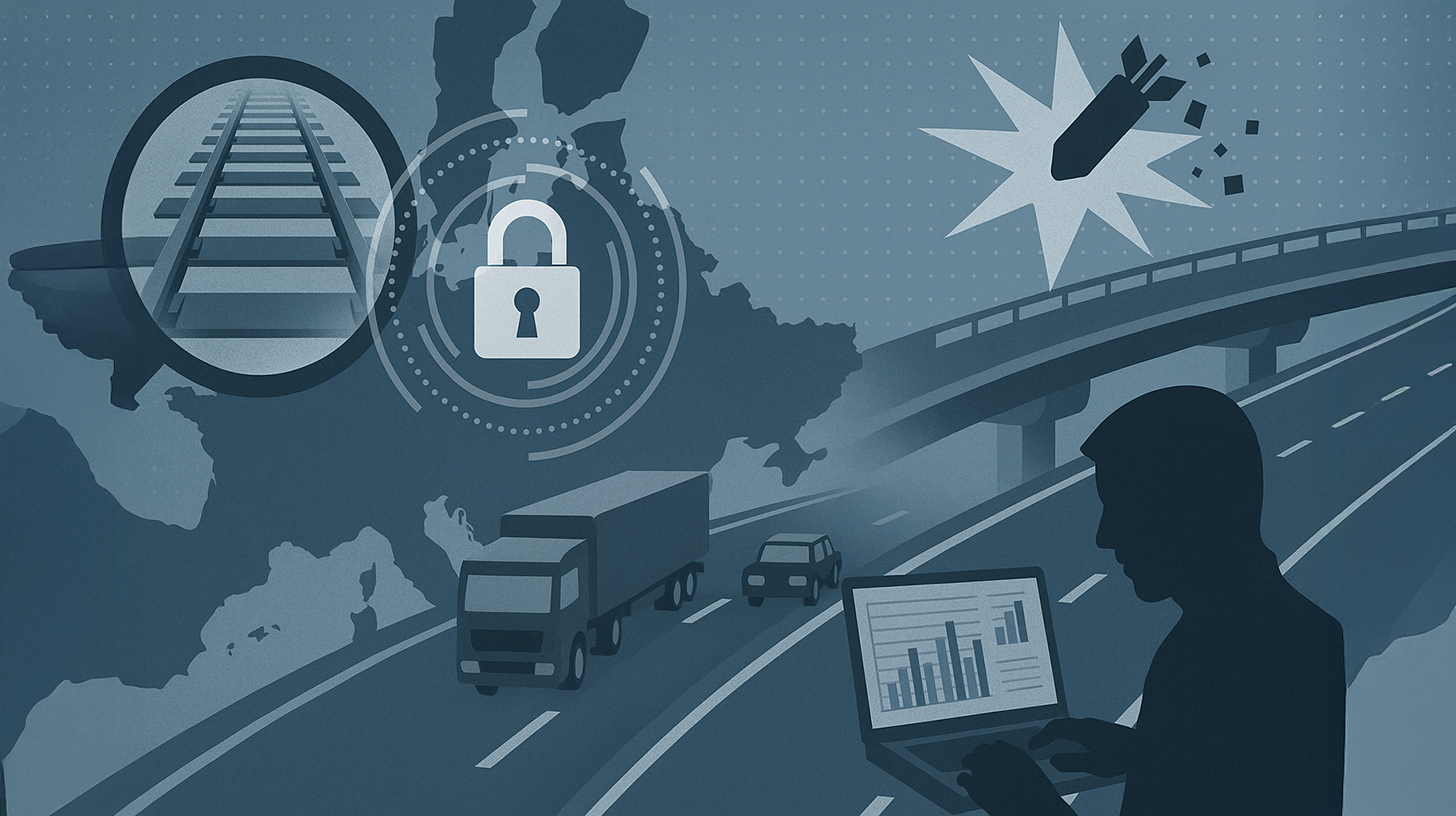
Analysis of the security and resilience of rail and road infrastructure against sabotage and attacks – Image: Xpert.Digital
The railway paradox: Why our safest mode of transport becomes a target for sabotage
A fundamental safety assessment of transport modes – Why rail is indispensable despite all its weaknesses
How safe are rail and road transport in general comparison, and why is this distinction important for the debate on sabotage security?
The fundamental safety assessment of transport modes under normal operating conditions forms the starting point for any further analysis of their vulnerability to deliberate disruptions. Statistically, rail transport is by far the safest mode of land transport in Germany and Europe. Data from the Alliance for Rail (Allianz pro Schiene) shows that the risk of being killed in a car accident in Germany is 52 times higher than when traveling by train. The risk of suffering a serious injury is even 137 times higher in a car. The European average for the years 2013 to 2022 was 0.07 rail passengers per billion passenger-kilometers; in Germany, this figure was significantly lower at 0.03. This outstanding safety record is the result of high technical standards, the inherent track constraints of rail systems, centralized control by train dispatchers, and technical systems that largely eliminate human error, such as intermittent train control (PZB) and continuous train control (LZB).
This high level of operational reliability, which refers to preventing accidents caused by technical or human error, should not be equated with security against deliberate, malicious attacks such as sabotage or terrorism. Sabotage security describes resilience, that is, a system's ability to withstand targeted attempts at disruption. The urgency of this debate has been underscored by events such as the sabotage of the Nord Stream pipelines and the targeted attack on Deutsche Bahn's communications network in October 2022. These incidents have brought the vulnerability of critical infrastructure (KRITIS) into sharp focus for national security.
This analysis therefore examines the structural, technological, and operational characteristics of rail and road infrastructure to assess their respective vulnerability and resilience to sabotage. Particular attention is paid to verifying the assumptions that rail is easier to monitor and quicker to repair. This reveals a paradox: the mechanisms that make rail extremely safe under normal operating conditions—centralized control, complex signaling technology, and standardized communication networks—turn out to be concentrated vulnerabilities in the event of a targeted attack. A saboteur doesn't need to attack the physically robust train itself, but rather the very nervous system that guarantees its safety. The road network, on the other hand, which is more dangerous in everyday use due to its decentralized nature and the freedom of individual actors, exhibits greater structural resilience to local failures because it lacks comparable central Achilles' heels.
Related to this:

Structural differences and their implications for safety
What are the fundamental structural differences between the rail and road networks, and how do these affect their vulnerability to attacks?
The fundamental differences in the network architecture of rail and road define their respective strengths and weaknesses in the context of sabotage protection. The rail network is designed as a linear, hierarchical, and centralized system. Trains are track-bound, follow fixed routes predetermined by signal boxes and control centers, and cannot deviate from them on their own. This structure enables high efficiency and safety in regular operation. In contrast, the road network is a decentralized, highly interconnected network that offers enormous flexibility in route selection and high redundancy through countless alternative connections.
In terms of capacity, rail is far superior to road transport. On a track of the same width (3.5 meters), a train can transport up to 30 times more people per hour than a car (40,000 to 60,000 compared to 1,500 to 2,000). Rail is also significantly more efficient and cost-effective for transporting large quantities of goods over long distances.
Access to the systems is also fundamentally different. The rail network is a largely closed system. Access to critical facilities such as tracks, signal boxes, and maintenance areas is strictly regulated and controlled. The road network, on the other hand, is by definition an open system freely accessible to everyone, making comprehensive access control practically impossible. The following table summarizes these structural characteristics and their implications for security.
Comparative analysis of the safety and resilience characteristics of rail and road infrastructure
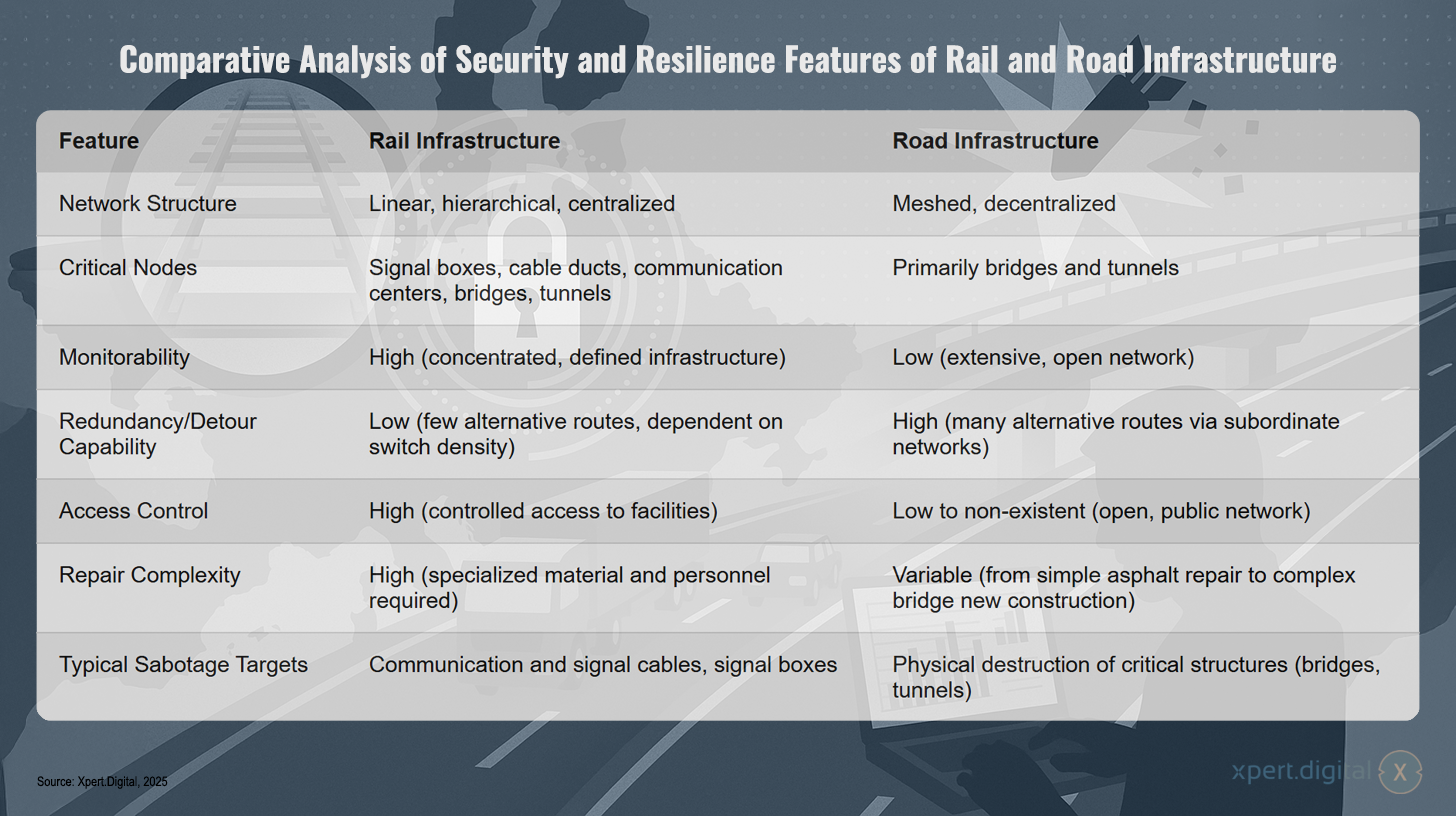
Comparative analysis of the safety and resilience characteristics of rail and road infrastructure – Image: Xpert.Digital
A comparative analysis of the safety and resilience characteristics of rail and road infrastructure reveals significant differences. Rail infrastructure is characterized by a linear, hierarchical, and centralized network structure, while road infrastructure is meshed and decentralized. Critical nodes in rail infrastructure include signal boxes, cable ducts, communication centers, bridges, and tunnels, whereas in road infrastructure, they are primarily bridges and tunnels. Rail infrastructure is highly monitorable due to its concentrated and clearly defined structure, in contrast to road infrastructure, which, due to its extensive and open network, is difficult to monitor. Regarding redundancy and diversion capabilities, rail infrastructure exhibits low flexibility, as there are few alternative routes, and these depend on the density of switches, whereas road infrastructure offers high diversion capabilities with numerous alternative routes via subordinate networks. Access to rail infrastructure is well-controlled, which is rarely the case for road infrastructure, as it is generally open and publicly accessible. Repairs to rail infrastructure are complex and require specialized materials and personnel, while road infrastructure exhibits varying levels of complexity, ranging from simple asphalt repairs to complex bridge reconstruction. Typical targets for sabotage also differ: rail infrastructure focuses on communication and signal cables as well as signal boxes, whereas road infrastructure typically involves physical damage to critical structures such as bridges and tunnels.
To what extent has the investment policy of recent decades influenced the vulnerability of the two systems?
Investment policies over the past decades have actively exacerbated the structural weaknesses of rail infrastructure and significantly increased its vulnerability to disruptions and sabotage. Between 1995 and 2018, 30 European countries studied spent a total of €1.5 trillion on expanding their road networks, while only €930 billion flowed into rail infrastructure. Germany exhibits a particularly large discrepancy: during the same period, more than twice as much (110% more) was invested in roads than in rail. This trend continued; from 1995 to 2021, investments in roads amounted to €329 billion, compared to only €160 billion for rail.
This chronic underfunding had direct physical consequences for the network. While the German motorway network grew by 18% (over 2,000 km) since 1995, the rail network for passenger and freight transport shrank by 15% between 1995 and 2020, from around 45,100 km to 38,400 km. No other European country closed more railway lines during this period. This dismantling included not only branch lines but also the removal of switches, passing loops, and parallel tracks on the main network.
The direct consequences of this policy are a drastically reduced redundancy and resilience of the rail network. If a main line fails due to sabotage or a technical malfunction, there are often no or only inadequate alternative routes. The lower density of switches per kilometer of track in Germany compared to countries like Switzerland or Austria severely restricts operational flexibility for rerouting trains. In addition, there is a significant backlog of maintenance work, which further weakens the network. For example, one-third of all railway bridges are over 100 years old and in need of repair. Investment policy has thus directly increased the systemic vulnerability of the railways by systematically weakening their ability to compensate for disruptions, which is in clear contradiction to the political goals of modal shift.
Analysis of physical vulnerabilities and acts of sabotage
What specific vulnerabilities do rail and road infrastructures have against physical sabotage?
The physical vulnerabilities of rail and road infrastructure differ fundamentally and reflect their respective system architectures. In the rail network, the most critical points are concentrated on centralized components essential for safe operation. Foremost among these are cable ducts, which bundle a multitude of communication and control cables, particularly the fiber optic cables for the GSM-R digital train radio system and signaling technology. A targeted attack on these cables at strategically important, often remote and unguarded locations can paralyze train traffic across regions. Other key vulnerabilities include signal boxes, which act as the brains of rail operations, controlling points and signals, and overhead lines, damage to which brings electric train operation to a standstill. Critical engineering structures such as bridges and tunnels also represent vulnerable bottlenecks. The complexity of these systems means that perpetrators often require specific knowledge to cause maximum disruption with minimal effort.
In the road network, the primary targets for physical sabotage are large and difficult-to-replace structures such as bridges and tunnels. Their destruction can have devastating consequences and disrupt important transport routes for extended periods. However, due to the interconnected network structure, such attacks usually result in regionally limited disruptions, as traffic can divert to numerous other roads. The road network itself, i.e., the road surface, is relatively robust against widespread paralysis through sabotage, unless massive destruction is carried out or blockades are erected at strategic bottlenecks. Historically, attacks on the railway often aimed at the crude destruction of tracks or the demolition of bridges. Modern acts of sabotage are more subtle and increasingly target technological control and communication systems.
What do past acts of sabotage, such as the incident in October 2022, teach us about the tactics of attackers and the responsiveness of the railway system?
Recent acts of sabotage provide precise insights into the tactics of attackers and the vulnerability of railway infrastructure.
The case study from October 2022 serves as a prime example. In a coordinated action, unknown perpetrators deliberately severed fiber optic cables of the GSM-R network, essential for train radio communication, at two widely separated locations – Herne (North Rhine-Westphalia) and Berlin-Karow. The choice of these two locations disabled both the primary system and the redundant backup system, indicating detailed knowledge of the railway infrastructure. The result was a complete standstill of long-distance and regional train services across large parts of northern Germany for approximately three hours, as communication between trains and control centers was disrupted. Although investigations later considered the possibility of a coincidental copper theft, the incident demonstrated the extreme vulnerability of the central communication system.
Another case study is the arson attack on a cable duct between Düsseldorf and Duisburg. Perpetrators placed a detonator in a cable tunnel, thus paralyzing one of Germany's most important north-south rail connections. Repair work was delayed because further damaged cables were discovered during the work. The incident, for which a left-wing extremist group claimed responsibility, led to massive train cancellations and delays in both long-distance and local services.
These events have sparked an intense debate about the inadequate protection of critical infrastructure in Germany. They made it clear that existing security concepts were not designed to withstand such targeted, sophisticated attacks. In response, the federal government and Deutsche Bahn developed a 63-point package of measures to improve the protection of railway facilities. The incidents revealed the need to reassess the system's resilience and implement a comprehensive security architecture.
How does access control to critical facilities on the railway differ from that on the generally open road network?
Access control concepts differ fundamentally between rail and road. The rail system is designed as a closed system, with critical areas subject to strict access restrictions. Entering the track area is generally prohibited and permitted only to authorized personnel performing specific tasks after prior instruction. Detailed safety regulations apply, such as wearing high-visibility clothing and obeying warning signals, primarily for occupational safety. Access to highly sensitive areas like signal boxes is also strictly regulated. DB Sicherheit GmbH is responsible for the physical security of stations, track systems, and maintenance depots, employing security personnel for this purpose. A modern access control tool is the electronic certificate of competence (ElBa), a mobile app that digitally verifies the qualifications of personnel on construction sites, thereby increasing safety and making fraud more difficult.
Despite these comprehensive regulations, an “illusion of control” exists. Past acts of sabotage have shown that these protocols can be circumvented in practice, as they are designed more for managing regular operations and protecting employees than for defending against determined external attackers. The sheer size of the network, exceeding 38,000 kilometers, makes continuous physical surveillance impossible. The attacks in October 2022 took place on remote, unguarded sections of track where massive concrete covers of cable ducts did not pose an insurmountable obstacle.
The road network, on the other hand, is designed as a public space and is therefore, in principle, freely accessible to everyone. Physical access control systems such as bollards or barriers are only used very selectively to secure specific zones such as pedestrian areas or traffic-calmed zones. Comprehensive access control of the road network is neither possible nor intended.
Both modes of transport fall under the legislation for critical infrastructure (KRITIS), which obliges operators to implement minimum security standards. However, these regulations primarily target the operators of facilities and their IT security and cannot negate the fundamental openness of the road network or the geographical expanse of the rail network.
Your dual-use logistics experts

Dual-use logistics experts - Image: Xpert.Digital
The global economy is currently undergoing a fundamental transformation, a watershed moment that is shaking the foundations of global logistics. The era of hyper-globalization, characterized by the relentless pursuit of maximum efficiency and the "just-in-time" principle, is giving way to a new reality. This new reality is marked by profound structural breaks, geopolitical power shifts, and increasing fragmentation of economic policy. The once taken-for-granted predictability of international markets and supply chains is dissolving and being replaced by a period of growing uncertainty.
Related to this:
Modern sensor technology and human-machine concepts for road safety: a comparison
Surveillance and prevention: A technological and personnel comparison
What monitoring technologies are used to ensure the safety of rail and road, and how effective are they?
Monitoring strategies for rail and road are tailored to the respective system requirements and are technologically diverse. In rail transport, monitoring is multi-layered and serves both operational safety and hazard prevention. Operational control includes traditional systems such as signals, track magnets (PZB), and the automatic train control system (LZB), which monitor trains and can brake automatically in emergencies. Increasingly, innovative technologies such as distributed fiber optic sensors (DFOS) are being installed along tracks and on bridges to detect strain, vibrations, or cracks in real time. To combat crime and investigate incidents, there is massive investment in CCTV at train stations and on trains; by the end of 2024, every major train station in Germany is to be equipped with modern video technology. In addition, drones, some with thermal imaging cameras, are used to inspect difficult-to-access sections of track. Future trains will also be equipped with a comprehensive sensor setup of cameras, lidar, and radar for environmental perception, which is a prerequisite for automated driving.
Traffic monitoring primarily focuses on optimizing traffic flow and enforcing traffic regulations. Traffic management systems (TMS) use sensors such as induction loops, infrared sensors, or video cameras to collect traffic data and dynamically implement speed limits, warnings, or detour recommendations based on this data. Intelligent image processing systems are used for automatic license plate recognition for toll and speed enforcement. However, systematic monitoring of the extensive road network for acts of sabotage does not take place.
The effectiveness of these technologies requires a nuanced assessment. Video surveillance at train stations and on trains can demonstrably contribute to solving crimes and increase passengers' subjective sense of security. However, its preventive effect against planned acts of sabotage in remote locations is limited, as perpetrators can avoid such monitored areas. Infrastructure sensors like DFOS can detect and report damage early on, but cannot prevent the actual act of sabotage.
What role does staff – from train drivers to security teams – play in ensuring safety, and how do the protocols differ between rail and road?
Personnel play a crucial, yet differently structured, role in both systems. In rail transport, safety is characterized by a system of shared but clearly defined responsibilities. Train drivers undergo rigorous psychological and physical aptitude tests as well as comprehensive training, including regular simulator sessions for handling malfunctions and emergency situations. During operations, they are in constant contact with control centers and are monitored by technical systems such as the dead man's switch (DSS), which must be activated every 30 seconds. Train staff, consisting of conductors and DB Security teams, are trained to ensure passenger safety, enforce house rules, and de-escalate conflicts. The presence of security personnel at stations and on trains is continuously being expanded as a key measure to increase both objective and subjective safety.
In road traffic, however, responsibility lies almost exclusively with the individual driver. While professional truck and bus drivers must comply with legal regulations such as driving and rest times and conduct regular vehicle checks, there is no central authority monitoring and controlling every single journey in real time. Modern vehicles are equipped with a variety of driver assistance systems, such as emergency braking assistants, lane keeping assistants, and adaptive cruise control, which significantly increase safety, but ultimate control and responsibility remain with the driver. Bus drivers are subject to additional protocols to ensure passenger safety, such as mandatory seatbelt use and rules of conduct on board. The fundamental difference, therefore, lies in the system architecture: Rail relies on a redundant human-machine system with centralized monitoring, while road transport relies on the decentralized responsibility of the individual, supported by vehicle technology.
How is cybersecurity addressed in the increasingly digitized control and management systems of both modes of transport?
The ongoing digitalization of rail transport presents both modes of transport with significant cybersecurity challenges. While the introduction of technologies such as the European Train Control System (ETCS) and digital interlocking systems (DSTW) leads to increased efficiency and capacity in the rail sector, it also opens up new attack vectors. Until now, the critical signaling and safety systems (LST) have been relatively well protected, as they were based on proprietary, isolated ("air-gapped"), and often outdated technologies that were difficult for external attackers to access. Previous cyberattacks on the railways have therefore mostly targeted less critical "convenience functions" such as websites, passenger information systems, or payment systems. With the transition to standardized, IP-based networks (e.g., for FRMCS/5G) to increase interoperability and performance, this distinction is becoming less clear. These standard technologies are well-documented and vulnerable to known hacking tools, which lowers the barrier to entry for attackers. In response, companies like Siemens Mobility are developing holistic cybersecurity solutions for the entire lifecycle of rail vehicles, and research projects like HASELNUSS are working on hardware-based security platforms specifically for the railway sector. Nevertheless, experts still consider the overall cybersecurity maturity of the railway sector to be insufficient.
In road traffic, intelligent transport systems (ITS), particularly traffic management systems (TMS), are a potential target for cyberattacks. Compromising these systems could lead to manipulated speed displays, false warnings, or deliberately created traffic jams. Germany's national cybersecurity strategy, along with European directives such as the NIS-2 Directive and the ITS Directive, establishes a legal framework that obligates operators of critical transport infrastructure to implement higher security standards. However, some of the technical rules and algorithms used in existing TMS are considered outdated and no longer state-of-the-art, posing an additional risk. Both systems thus face the dilemma that the modernization and digitalization necessary for the future inherently create new and complex security risks that must be addressed proactively.
Hub for Security and Defense - Advice and Information

Hub for Security and Defense - Image: Xpert.Digital
The Security and Defence Hub offers expert advice and up-to-date information to effectively support companies and organizations in strengthening their role in European security and defence policy. Working closely with the SME Connect Defence Working Group, it particularly promotes small and medium-sized enterprises (SMEs) that wish to further develop their innovative capacity and competitiveness in the defence sector. As a central point of contact, the Hub thus creates a crucial bridge between SMEs and European defence strategy.
Related to this:
Rapid repairs after attacks: Advantages of rail infrastructure
Resilience and recovery after a disruption
How do experts assess the theory that railway tracks can be repaired more quickly after an attack than roads?
The claim that rail infrastructure can generally be repaired more quickly needs to be viewed in a differentiated manner, as the repair time depends crucially on the type and extent of the damage.
Damage to the railway's operational infrastructure, such as cable runs frequently affected by acts of sabotage, necessitates highly specialized repairs. Technicians must completely replace the damaged cables, which can extend over dozens of meters, and then conduct extensive tests and measurements before the line can be safely reopened. As incidents in Düsseldorf and northern Germany have shown, these repairs can take anywhere from several hours to several days. Deutsche Bahn maintains a 24/7 emergency service, DB Bahnbau Gruppe, specializing in such incidents and capable of rapid response nationwide. Compared to major road construction projects, repairs to tracks, switches, or signals can often be completed more quickly because the components are standardized and the processes are well-established.
The situation is quite different with road infrastructure, especially when it comes to damage to large engineering structures. While a simple pothole or damaged road surface can be repaired relatively quickly, repairing or rebuilding a damaged or destroyed bridge is an extremely complex, expensive, and lengthy undertaking that can take months or even years. This requires elaborate structural calculations, lengthy curing processes for concrete, and the complex integration of construction work into the flow of traffic. Regular structural inspections according to DIN 1076 do serve to detect damage early, but they cannot shorten the duration of repairs after a sudden destructive event.
In conclusion, it can be said that when damage occurs to the "active" infrastructure (cables, tracks, signals), the rail system tends to be restored more quickly. However, in the case of catastrophic damage to key "engineering structures" such as bridges or tunnels, both systems are severely and for a very long time affected.
How do the concepts for diversions and maintaining operations during disruptions in the rail and road network differ?
The ability to compensate for disruptions through diversions is one of the most fundamental differences between rail and road networks and a key aspect of their respective resilience.
Due to its inherent design, the rail network offers very limited rerouting options. These depend directly on the network's density and the availability of switches and parallel tracks. Decades of dismantling have resulted in low redundancy in the German network, particularly compared to Switzerland or Austria. Therefore, when a main line is closed, trains often have to be rerouted over long distances, leading to significant delays and capacity bottlenecks on alternative routes. Alternatively, they may terminate prematurely at a station, from where a rail replacement bus service is organized. The high utilization of the network exacerbates this problem, as there is hardly any spare capacity for diverted traffic. Deutsche Bahn informs passengers via digital channels such as the DB Navigator app and its website, with information frequently updated at short notice due to the dynamic nature of the situation.
In contrast, the road network possesses a high degree of natural redundancy. Its interconnected structure means that if a major traffic artery, such as a highway, is closed, a multitude of alternative routes via federal, state, and county roads are usually available. Modern traffic management centers actively utilize this flexibility. With the help of traffic control systems, particularly dynamic wayfinding systems with integrated congestion information (dWiSta), traffic is strategically and extensively rerouted to less congested alternative routes to avoid or minimize congestion. This concept of active network control makes the road system inherently more resilient to local disruptions. The efficiency-optimized but thinned-out rail infrastructure, by comparison, is a fragile system in which local disruptions can quickly lead to cascading, network-wide effects.
What overarching strategies is Germany pursuing to strengthen the resilience of its critical transport infrastructure?
In light of the identified vulnerabilities, Germany has begun implementing overarching strategies to strengthen the resilience of its critical infrastructure. In July 2022, the Federal Government adopted the "German Strategy for Strengthening Resilience to Disasters." This strategy pursues a comprehensive all-risks approach, ranging from natural disasters to terrorism and sabotage, and defines resilience as a national and societal task requiring close cooperation between the federal government, states, municipalities, the private sector, and civil society.
A key legislative instrument for implementing this strategy is the KRITIS umbrella law. For the first time, it establishes uniform federal minimum standards for the physical protection and resilience of operators of critical infrastructure and obliges them to take appropriate measures and to report security incidents to the relevant federal authorities.
To improve coordination, the "Joint Coordination Staff for Critical Infrastructure" (GEKKIS) was established at the government level. This body is intended to create cross-departmental situation reports, identify challenges, and act as a crisis management team in the event of acute incidents.
Specifically for the transport sector, concrete measures were initiated following the acts of sabotage. The federal government and Deutsche Bahn have developed a joint package for the improved protection of railway infrastructure. This includes the increased use of video and sensor technology at critical points, a heightened presence of security personnel from the Federal Police and DB Security, and the targeted redundant expansion of particularly critical cable connections to reduce individual points of failure. In parallel, cybersecurity is being strengthened through the implementation of the European NIS-2 Directive, which obligates more companies to adhere to higher IT security standards.
Synthesis and further advantages of rail transport
What other advantages, beyond mere sabotage protection, does rail transport offer that are relevant for a broader societal assessment?
Beyond the debate surrounding sabotage security, rail transport offers a number of fundamental advantages that are crucial for a comprehensive societal assessment of transport modes. First and foremost is environmental and climate protection. Rail transport is significantly more environmentally friendly than road transport. Every ton of freight transported by rail instead of road results in 80 to 100 percent less CO2 emissions. Given that the transport sector is the only sector in the EU that has failed to reduce its emissions since 1995, shifting traffic to rail is a key lever for climate protection.
Another significant advantage is superior space efficiency. A single railway line can transport many times more people or goods than a motorway lane on the same width. Specifically, up to 30 times more people per hour can be transported by rail than by car on a 3.5-meter-wide track, drastically reducing land use in densely populated regions.
From an economic perspective, a more nuanced analysis is also necessary. While truck transport over short distances is often perceived as more flexible and cost-effective, road traffic causes massive external costs through accidents, congestion, noise, and pollution. These costs are not borne entirely by those responsible, but by the general public. Rail transport, in contrast, has a significantly more positive overall balance.
Finally, the aspect of safety during normal operation, already mentioned at the beginning, is an invaluable advantage. The significantly lower probability of being killed or seriously injured in an accident compared to a car saves lives every year and prevents human suffering as well as high subsequent costs for the healthcare system.
Defense logistics in wartime: The strategic advantage of the defender
The importance of the fast vanguard
In combat, the rapid advance guard plays a crucial strategic role. These initial units must be ready for deployment on the eastern flank within 48 to 72 hours to establish the initial defensive lines. NATO has already implemented this understanding in its Enhanced Forward Presence (EFP), which involves the permanent deployment of multinational battle groups on the eastern flank.
Panzer Brigade 45 in Lithuania exemplifies this vanguard function: Equipped with state-of-the-art vehicles such as the Leopard 2A8 main battle tank and the Puma S1 infantry fighting vehicle, German armed forces ensure the initial supply of defensive materiel to the eastern flank. This rapid response capability is supported by pre-positioned equipment and ammunition, thus saving critical time in establishing defensive lines.
The rapid construction of defensive lines
The success of the defense depends significantly on the rapid construction of robust defensive lines. The Baltic states have already begun installing mobile tank barriers and fortified defense installations along their borders with Kaliningrad and Belarus. These measures follow the principle of "defense in depth"—a layered defense strategy that creates various obstacles and levels of defense.
Time is a critical factor: While the defender can prepare and reinforce their positions, the attacker must operate under time pressure and without knowledge of the terrain. The defender uses this time to:
- Construction of barriers and obstacles
- Preparation of combat positions
- Construction of ammunition and supply depots
- Establishment of secure communication lines
Establishment and expansion of secure supply
After the initial defense phase, the focus shifts to establishing a sustainable and secure supply system. The Bundeswehr Logistics Command, with its 18,000 personnel, is specifically structured for this task. Defense logistics benefits from several crucial advantages:
Established infrastructure
The defender can utilize existing transport routes, warehouses, depots, and communication networks. Germany, as a "hub" of NATO logistics, has a dense network of 80 logistics locations.
Protected supply lines
Within its own territory, logistics operate in a relatively secure environment, protected by its own frontline defense forces. This enables:
- Continuous material supply without constant threat
- Use of civilian transport capacities and infrastructure
- Redundant supply routes via known alternative routes
Decentralized logistics network
Modern military logistics relies on distributed, small supply points instead of large, vulnerable depots. This "logistical network" with many nodes significantly increases resilience.
The challenges for the attacker
In contrast, the attacker faces enormous logistical challenges:
Lack of infrastructure
The attacker must operate in enemy territory, where neither secure transport routes nor protected storage facilities are available. Every bridge, every road could be mined or destroyed.
Vulnerable supply lines
The attacker's supply lines are under constant attack – by artillery, drones, special forces, or partisans. Experience from Ukraine shows how vulnerable long supply lines are.
Time pressure and resource consumption
The attacker is under considerable time pressure, as every day without progress depletes their resources and gives the defender time to reinforce. The rule of thumb is that an attacker needs a three-fold superiority to succeed.
The strategic advantage of homeland defense
Military theory, especially Clausewitz, emphasizes the inherent advantages of the defender:
- Familiarity with the terrain: Local knowledge enables optimal positioning and freedom of movement
- Prepared positions: Time to establish fortifications and obstacles
- Inner lines: Shorter routes for reinforcements and supplies
- Supporting the population: Access to local resources and information
Modern defense logistics reinforces these traditional advantages through:
- Digital networking and real-time information
- Predictive maintenance and AI-powered demand forecasting
- Integration of civilian and military logistics capacities
What is the conclusion in the safety comparison between rail and road in the context of sabotage and attacks?
Defense logistics enjoys crucial systemic advantages over offensive logistics. While the defender operates in a secure, familiar environment with established infrastructure, the attacker must manage all logistical challenges under hostile pressure and without local support. Modern NATO strategy, with its Enhanced Forward Presence and focus on rapid response capabilities, optimally leverages these advantages. Germany, as NATO's logistical hub, demonstrates how well-planned defense logistics contributes to deterrence and can make the decisive difference in a crisis.
A final assessment of the security of rail and road against sabotage reveals a complex and ambivalent picture without a clear winner. Both systems exhibit specific, structurally inherent strengths and weaknesses.
The railway benefits from its centralized and controlled nature, which enables targeted and technologically advanced monitoring. Its superior safety during normal operation is undisputed, and this also applies in the event of an attack, as described above. However, centralization also creates critical nodes and "individual points of failure," particularly in the communication and control network. These make the system vulnerable to targeted acts of sabotage, which, with relatively little effort, can cause widespread, cascading failures across the entire network. Decades of political and financial neglect have exacerbated this systemic vulnerability through the reduction of redundancies and a significant backlog of necessary upgrades. However, the problem can be resolved relatively quickly.
Due to its decentralized, meshed, and open network structure, the road is inherently more resilient to local disruptions. A single attack, even on a critical structure like a bridge, rarely leads to a widespread collapse, as traffic can divert to numerous alternative routes. At the same time, this openness makes comprehensive surveillance impossible and, in everyday operation, leads to a far higher number of accidents and casualties due to the multitude of individual, fallible actors.
The faster repairability of the railway is achievable with appropriate modernization measures in the surrounding infrastructure. This applies to damage to existing infrastructure such as cables or tracks, where standardized processes allow for relatively quick repairs. However, in the event of the destruction of major structures such as bridges or tunnels (a large-scale enemy attack with no or weak defenses), both modes of transport are severely disrupted for very long periods, and this also affects roads to the same extent.
Protecting the railway from sabotage therefore depends crucially on future strategic investments. These must go beyond simply installing cameras and sensors and focus primarily on strengthening network resilience. This means the targeted expansion of redundancies through multi-track lines, additional switches and alternative cable routes, as well as the physical and digital hardening of critical infrastructure components. The recent security policy debate and the measures initiated by the federal government and the railway indicate a beginning shift in thinking. However, transforming the existing, efficiency-driven but fragile system into a truly resilient network remains an immense, costly, and long-term undertaking.
Consulting - Planning - Implementation

Markus Becker
I would be happy to serve as your personal advisor.
Head of Business Development
Chairman SME Connect Defense Working Group
Consulting - Planning - Implementation
Konrad Wolfenstein
I would be happy to serve as your personal advisor.
You can contact me at wolfenstein∂xpert.digital or
Just call me on +49 7348 4088 965 .