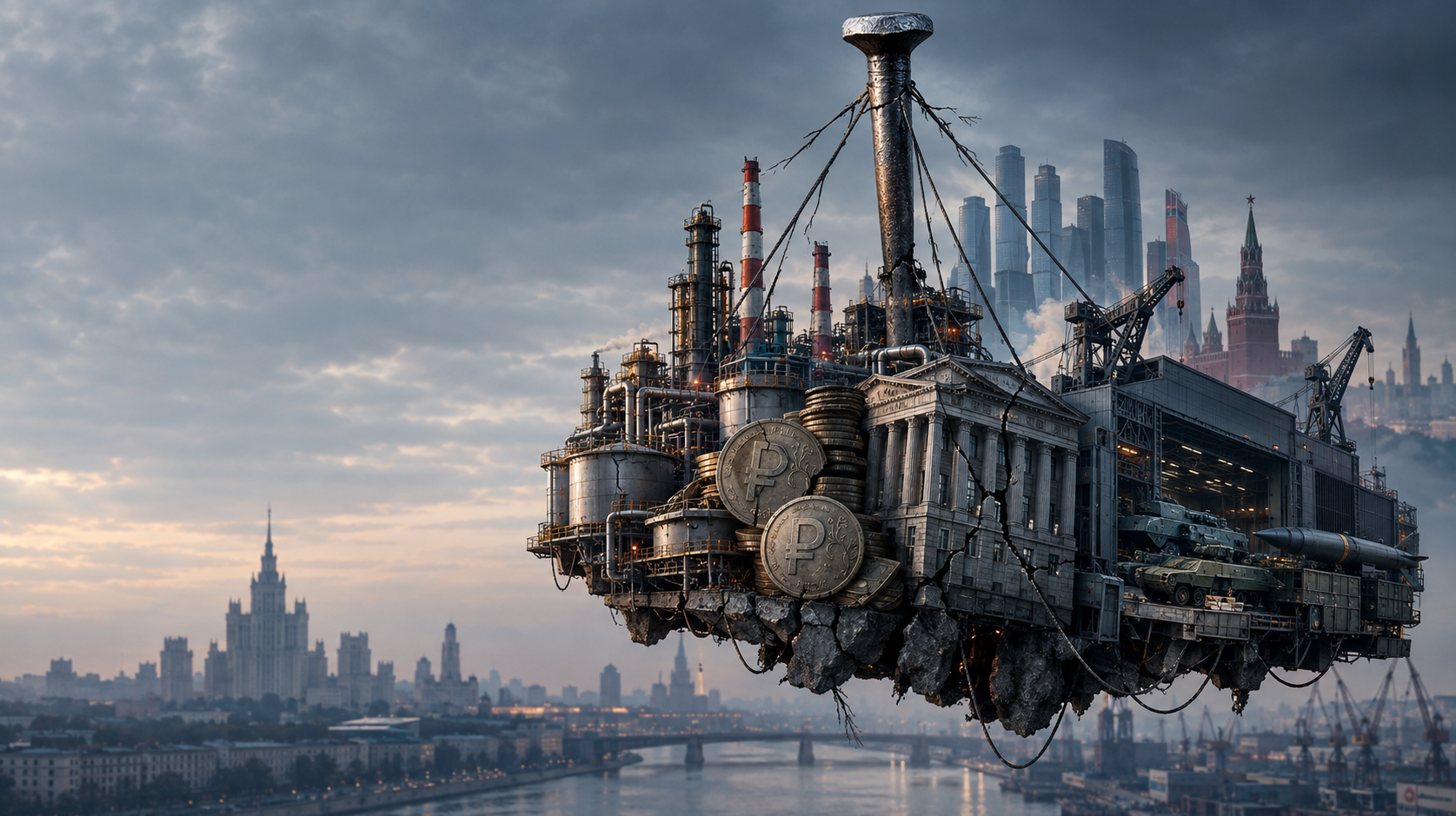
Russia's economy at its limit: The Kremlin is waging war on credit – and a central banker is holding the system together – Creative image on the topic, with AI: Xpert.Digital
The Russian economy hangs on one crucial nail: the central bank
Russia's economy: Is the central nail holding the line of stability?
2027 in focus: The future of the Russian central bank and its impact on the economy
The Russian economy stands at a critical juncture where numerous challenges converge and the stability of the system is being tested. The central bank, under the leadership of Elvira Nabiullina, is often described as the “single nail” holding the fragile economic structure together. This metaphor, coined by the Russian economist Alexandra Prokopenko, highlights the exceptionally important role of the central bank in an increasingly contradictory economic model. As Russia struggles to manage the burdens of military spending, inflation, and Western sanctions, the question of the future of the central bank and its president is becoming ever more pressing. A collapse of confidence in the central bank, or a shift in its political support, could have far-reaching consequences for the country’s economic stability. While the economy has not yet collapsed, the current situation points to a governance risk stemming from a dangerous dependence on a single institution. In this context, Russia’s situation is defined not only by the challenges of war but also by the need for a long-term, sustainable economic strategy.
What the image of the single nail actually means
The image of the nail originates with the Russian economist Alexandra Prokopenko . The now-academic scholar worked as an advisor to the Russian Central Bank from 2017 to 2022, where her responsibilities included communicating inflation trends. On May 24, 2026, she used the metaphor in an English-language article accompanying an analysis she co-authored with financial expert Alexander Kolyandr for the independent Russian economic magazine *The Bell*. In it, she described the Central Bank and its president, Elvira Nabiullina, as the crucial nail still holding the Russian economy together.
The German statement that Russia's economy is hanging by a single nail (Stern) is thus a journalistic exaggeration of the original formulation. Prokopenko did not explicitly speak of the single nail, but of the most important one. The difference is economically significant: Russia still possesses several supporting elements, including raw material exports, government arms contracts, trade with China, capital controls, domestic borrowing, and an adaptable business landscape. The thesis therefore does not claim that the entire system depends solely on one person or institution. Rather, it describes the unusually large importance of the central bank for the stability of an increasingly contradictory economic model.
The full original quote from Alexandra Prokopenko dated May 24, 2026 reads:
"Russia's economy has more runway than some predict — but it's far less resilient than the Kremlin wants to admit. The main nail holding it together is the Central Bank and Elvira Nabiullina, who has exactly one year left. Her term ends June 24, 2027."
The crucial point is that Prokopenko wrote "the main nail," meaning "the most important nail," not "the only nail." The phrase "the only nail" is therefore a journalistic exaggeration.
The central bank must manage several tensions simultaneously. It is tasked with curbing inflation, stabilizing the ruble, maintaining the functionality of the banking system, and preventing rising government and military spending from leading to uncontrolled currency devaluation. At the same time, it faces increasing pressure from businesses, state-owned enterprises, and political actors demanding lower interest rates and more readily available credit. Without a restrictive monetary policy, high government spending would hit an economy already strained by shortages of labor, industrial capacity, and numerous intermediate goods. Additional demand would then drive prices up more than it would expand real production.
Within this system, Elvira Nabiullina embodies a comparatively professional and stability-oriented technocracy. Her significance stems not only from her personal expertise. Behind her stands a large institutional apparatus encompassing monetary policy, banking supervision, payment systems, statistics, and crisis management. Since 2013, the supervision of banks, insurance companies, pension funds, and securities markets has also been consolidated under the umbrella of the Russian Central Bank. This gives the institution an unusually large influence over virtually all areas of the financial system.
Prokopenko had already explained the importance of this institutional role to Radio Free Europe/Radio Liberty She described the central bank as the institutional anchor that had maintained its credibility in the markets and kept inflation on track. From this perspective, replacing Nabiullina would not simply be a normal personnel change. It could unsettle precisely the institution that has thus far ensured economic policy predictability.
The real "nail in the coffin," therefore, is neither Nabiullina alone nor the central bank as a mere authority. What is meant is the combination of a functioning central bank, its professional credibility, and the political trust that Vladimir Putin has thus far placed in its president. According to Prokopenko, the central bank's de facto independence rests less on legal guarantees than on this personal relationship of trust. It protects the bank, at least partially, from demands by powerful business representatives, state lobby groups, and political factions that are calling for cheaper loans and greater influence over interest rate decisions.
This is precisely where the system's weakness lies. Institutional stability in Russia depends heavily on personal relationships and informal power structures. As long as Nabiullina enjoys the president's confidence, the central bank can implement decisions that are painful for businesses, debtors, and parts of the state apparatus. If this political protection were to disappear, monetary policy could be more strongly subordinated to the short-term financing interests of the state and the arms industry.
The question of succession makes the year 2027 particularly important. Nabiullina's third and, under current law, final term ends on June 24, 2027. The president must propose a candidate to the State Duma no later than three months beforehand. Unlike in many Western countries, Russia lacks a transparent process with candidates known well in advance and ample preparation time for the financial markets. The decision effectively rests with Putin and could be announced only shortly before the end of the term.
There are essentially three options. The Kremlin can appoint a successor, distribute the central bank's responsibilities among several institutions, or amend the law to allow Nabiullina another term. None of these options resolves the fundamental problem. New leadership would first have to establish credibility. Splitting up the central bank would be organizationally complex and could create new friction. Extending Nabiullina's term would merely postpone the decision without dissolving the institutional dependence on her and Putin's trust.
The loss of this confidence could have significant economic consequences. If a new central bank leadership were to cut interest rates too early or too drastically, loans and investments could increase in the short term. At the same time, however, inflation, ruble pressure, and import costs would rise. Households and businesses might increasingly turn to foreign currencies or tangible assets. The government could initially finance its debt more cheaply, but would have to accept higher inflation and a further loss of confidence.
The nail metaphor therefore does not describe an automatically imminent collapse. Even after a change at the top of the central bank, its specialist departments, supervisory functions, and monetary policy instruments would remain in place. Russia could also react with capital controls, price controls, forced loans, and other administrative interventions. This could potentially allow a crisis to be concealed for a long time or shifted to companies, banks, savers, and regions.
The comparison points, rather, to a governance risk. Russia's economy survived the early years of the war not only because of its raw material revenues and government spending, but also because the central bank possessed sufficient authority and credibility to respond to inflation and financial market risks. Prokopenko's statement makes it clear that this authority is not automatically institutionally secured. It is highly dependent on Nabiullina and her position within the power structure.
The most important nail, therefore, does not hold a sound building together. It stabilizes an increasingly distorted economic structure in which high military spending, weak civilian growth, labor shortages, inflation, sanctions, and rising financing needs interact against each other. As long as the central bank can contain these tensions, the system remains controllable. If its ability to act is politically weakened, the risk increases that the creeping economic erosion will erupt into an open currency, inflation, or financial crisis.
Stability without economic health
Since the beginning of the full-scale war against Ukraine, a rapid collapse of the Russian economy has been repeatedly predicted. It has not occurred. This fact is often interpreted in political debates either as proof of the ineffectiveness of Western sanctions or as evidence of the exceptional strength of the Russian economy. Both conclusions are too simplistic.
Russia weathered the initial shock of sanctions primarily because, even before 2022, it possessed substantial foreign exchange reserves, relatively low government debt, significant raw material exports, and a banking system stabilized after previous crises. Added to this were swift capital controls, a drastic increase in interest rates, export restrictions, the redirection of trade flows, and massive government spending. As a result, the economy did not collapse but rather shifted into a different mode of operation.
This mode can be described as a negative equilibrium. The economy does not collapse, but it generates little productive momentum. Government spending prevents a deep recession, while high interest rates, labor shortages, sanctions, and uncertainty stifle private investment. Defense companies grow, while many civilian industries suffer from rising costs, weak demand, and reduced access to technology. Employment remains high, but productivity growth is weak. Wages rise in high-demand sectors, but some of these gains are eroded by inflation.
For 2026, reliable growth forecasts range only between roughly 0.5 and 1 percent. For 2027 and 2028, many expect only around 0.5 percent. This is exceptionally low for an economy with significant pent-up demand, high commodity revenues, and substantial government spending. This weak growth indicates that additional government demand is barely creating new capacity. It is increasingly encountering an economy where machinery, skilled workers, logistics, credit, and imported intermediate goods are scarce.
The Russian system is therefore not stable in the sense of a healthy, innovative economy. It is stable in the sense of a politically controlled distribution of scarcity. This distinction is crucial. A state can remain militarily capable for years even as civilian prosperity, productivity, and long-term growth prospects decline. Authoritarian systems, in particular, can distribute economic costs unequally and suppress political dissent. The absence of collapse, therefore, does not mean that the economic damage is minor.
The central bank as a counterweight to war financing
The Russian central bank faces a classic dilemma. The state is increasing its spending on defense, security agencies, arms manufacturers, soldiers, and war-related infrastructure. This spending generates income and demand. However, since the economy has hardly any spare capacity left, the additional demand does not translate into a corresponding increase in real production. Instead, prices, wages, and import requirements rise.
The central bank is responding with high interest rates. While the key interest rate was lowered from 21 to 14 percent during 2026, 14 percent remains an exceptionally high level. Inflation is still expected to be around 6 to 7 percent in 2026, significantly above the long-term target of 4 percent. The real interest rate, adjusted for inflation, remains restrictive. This makes loans more expensive, dampens consumption and investment, and attempts to limit excess demand.
This policy is economically understandable, but politically inconvenient. Business associations, industrialists, and state-owned corporations are demanding cheaper loans. Many companies are suffering from financing costs that make new investments difficult and increase the cost of servicing existing debt. This creates a conflict of objectives for the Kremlin: it needs high levels of investment in defense and infrastructure, but at the same time wants to prevent the ruble from depreciating and inflation from burdening the population.
The central bank therefore acts as an institutional brake within an economy whose political leadership is simultaneously pressing the accelerator. As long as this brake remains credible, households and businesses can trust that a complete devaluation of the ruble is not the preferred instrument of government financing. This expectation is itself an economic asset. If the central bank loses its credibility, even the fear of future inflation can lead to capital flight, higher import prices, ruble sales, and accelerated wage demands.
Nabiullina's particular significance does not lie in the fact that she alone has the power to set interest rates. Behind her stands a large apparatus of specialist departments, banking supervision, statistics, payment systems, and crisis management. Rather, her personal weight stems from the combination of her professional reputation, experience, and political trust. She can defend unpopular decisions and apparently possesses sufficient support to at least partially counter calls for an overly loose monetary policy.
The year 2027 as an institutional stress test
The central bank governor's term of office ends in June 2027. Under current law, this is her third and final term. The law could be amended, and an extension is by no means politically out of the question. Likewise, a qualified successor could be appointed who continues the current course. Nevertheless, a real risk remains because the decision regarding the central bank's leadership is ultimately highly personalized.
The crucial question is not just who takes over the post. More important is what mandate that person will actually receive. A successor could continue the current stability policy and maintain high interest rates until inflationary pressures subside sustainably. However, they could also be tasked with providing stronger support for growth, arms production, and government financing. In that case, monetary policy would become more politically driven and short-term oriented.
An early or excessive interest rate cut might initially provide relief. Companies could invest more cheaply, banks could lend more easily, and the government could finance its debt more cheaply. However, the costs would likely materialize with a time lag: higher inflation, a weaker ruble, rising import prices, and a greater flight to tangible assets or foreign currencies. The more the government simultaneously increases its spending, the more difficult it would be to rein in this dynamic later.
2027 is also a critical year because several burdens are converging. The defense budget is slated to rise to 17.1 trillion rubles. That's roughly 27 percent more than originally planned and the highest amount since the start of the full-scale invasion. At the same time, social spending is to be reduced, while education, healthcare, and civilian infrastructure are also facing budget cuts. The state is thus not attempting to scale back the war economy, but rather financing a new stage of its consolidation.
This year will therefore not automatically become a year of collapse. Rather, it will be a test of whether Russia can maintain its current division of labor: the state spends expansively on the war, while the central bank limits the inflationary consequences. If this division of labor fails, the current negative equilibrium will transform into a significantly more unstable system.
The budget is losing its buffer
Russia's public finances are contradictory. On the one hand, its formal national debt remains low by international standards. This allows the state to take on additional debt domestically. On the other hand, access to Western capital markets is limited, interest rates are high, and the pool of potential buyers is heavily concentrated among Russian banks, funds, and state-influenced investors.
A budget deficit of up to 3 percent of gross domestic product is now projected for 2026. This is almost twice as high as originally planned. While the government aims for lower deficits in subsequent years, this plan relies on additional tax revenues, high commodity sales, and disciplined spending. Experience from recent years has shown that military expenditures often exceed initial estimates.
For 2027, government bond issuance of approximately 7.7 trillion rubles is planned, about 43 percent more than the previous year. This will shift war financing more strongly into the domestic financial system. Banks will buy government bonds and simultaneously provide loans to strategically important companies. Formally, this remains market-based financing. However, in an increasingly controlled system, the line between voluntary investment decisions and politically desired capital allocation becomes blurred.
The National Welfare Fund still provides a buffer, but its freely available resources are limited. At the beginning of September 2026, the total fund amounted to approximately 13.19 trillion rubles. Of this, just under 4 trillion rubles were liquid, corresponding to about 1.7 percent of the expected gross domestic product. The difference between the total volume and liquid assets is crucial: a large portion of the fund consists of equity investments and long-term holdings that cannot be readily used for day-to-day budget financing.
Russia is therefore not on the verge of insolvency. The state can raise taxes, issue bonds, postpone spending, and impose higher levies on businesses. It can also resort to financial repression, meaning it can divert savings and bank balance sheets more heavily into state financing. However, this does not eliminate the costs. They are simply shifted to private investments, savers, businesses, and future budgets.
🎯🎯🎯 Data-driven B2B industry hub as a quasi-in-house solution


The quasi-in-house solution: How Xpert.Digital closes operational gaps in B2B marketing and sales – Smart Content-Driven Business - Image: Xpert.Digital
Xpert.Digital is a data-driven B2B industry hub led by Konrad Wolfenstein . The company acts as an external, quasi-in-house solution for industrial partners, closing operational gaps in marketing, content, and sales – without requiring additional resources on the client side.
More information here:
Guns are displacing the civilian state: The impact on the Russian economy
Guns are displacing the civilian state
Rising military spending is changing the structure of the Russian budget. Defense expenditures are projected to reach 17.1 trillion rubles by 2027. If internal security, the National Guard, police, and intelligence services are included, an even larger portion of the state budget will be tied up in military and repressive activities.
At the same time, funding for social programs is set to decrease by approximately 7 percent. Education, healthcare, and infrastructure will also face reduced real spending. Even if nominal expenditures increase in certain areas, inflation could erode some of these gains. The real impact, therefore, is not only reflected in cut budget lines but also in missed opportunities for investment: hospitals that remain unmodernized, schools that are of a lower standard, transportation projects that are postponed, and reduced support for civilian research.
Military spending can increase the gross domestic product in the short term. A produced tank, missile, or drone is recorded as value added in the statistics. From an economic perspective, however, this only generates limited future benefits. A machine for a civilian factory can produce additional goods for years. Ammunition is consumed or stored. It increases statistical output but does not increase a society's productive capital to the same extent.
The war economy thus creates a growth paradox. It can generate high employment, rising wages in arms-producing regions, and fully utilized factories, while long-term production potential declines. Skilled workers migrate to militarily prioritized companies, and civilian businesses lose staff, loans, and parts. The state buys at inflated prices, making inefficiencies less visible. Profits are privatized or politically redistributed, while risks increasingly end up in state-owned banks and public coffers.
Full employment as a warning signal
Very low unemployment is usually considered a sign of economic strength. In Russia, it is increasingly a sign of scarcity. Mobilization, emigration, demographic decline, heavy war losses, and the expansion of arms production have reduced the labor supply. At the same time, the army, security agencies, defense companies, the construction industry, and civilian enterprises are all competing for the same workers.
Engineers, technicians, drivers, construction workers, IT specialists, and skilled industrial workers are in particularly short supply. Companies are responding with higher wages, signing bonuses, less stringent hiring criteria, and poaching staff. This increases the incomes of certain groups, but not automatically productivity. When companies have to pay significantly more for the same work, unit costs rise, and with them, price pressure.
Furthermore, there is a regional distortion. Arms production centers and regions with high recruitment bonuses benefit in part from government funding. Other areas lose young men, skilled workers, and their tax base. Families receive military pay or compensation, but these transfers do not replace sustainable regional development. They create income that is directly linked to participation in the war and loyalty to the state.
The problem is exacerbated demographically. Russia's population is aging, birth rates are low, and some of its well-educated younger population has left the country. Immigration from Central Asia can alleviate shortages, but it is politically controversial and insufficient to fill all skills gaps. The labor shortage is therefore not merely a temporary consequence of the war; it is becoming a long-term limit to growth.
Oil remains the material lifeline
If the central bank is the institutional anchor, then oil and gas remain the most important source of material revenue. Export earnings from raw materials provide foreign currency, support the ruble, and finance the state budget. Russia has redirected large parts of its oil trade to Asia and established a shadow fleet, alternative insurance, and new payment systems. This has allowed it to partially limit the impact of Western sanctions.
This adjustment, however, is not without its drawbacks. Longer transport routes, price reductions, intermediaries, higher insurance costs, and technological limitations all reduce revenue. The crucial factor is not just the exported quantity, but the actual price achieved after all discounts and costs. If the global oil price falls or sanctions are more rigorously enforced, the budget situation could deteriorate rapidly.
The planned reduction of the oil price, which determines the budget rule, to $50 per barrel starting in 2027 shows that the government itself is calculating more cautiously. A more conservative rule can stabilize the economy in the long term, but in the short term it necessitates higher taxes, additional borrowing, or lower spending. The higher the military commitments, the more sensitive the system becomes to fluctuating commodity revenues.
The diesel and refinery industries have also become a risk. Attacks on refineries, repair costs, temporary shortages, and export restrictions directly impact fuel prices and logistics. The government can limit exports to supply the domestic market, but this reduces potential foreign exchange and tax revenue. Infrastructure attacks exert their economic impact less through the complete destruction of individual facilities than through recurring repairs, production interruptions, additional security costs, and insecurity.
China stabilizes Russia while simultaneously increasing its dependence
China has become Russia's most important economic partner, now accounting for approximately 35 percent of Russian foreign trade. The country buys energy and raw materials, and supplies machinery, vehicles, electronics, industrial components, and a large proportion of goods that can be used directly or indirectly for military purposes. Without Chinese trade channels, adapting to Western sanctions would have been significantly more difficult.
The relationship is asymmetrical, however. Russia needs China more than China needs Russia. Beijing can influence prices, payment terms, and supply chains. Russian companies must adapt to Chinese standards, platforms, and financing options. Where Western suppliers have left the market, Chinese companies often appear not just as replacements, but as dominant competitors.
New trade relationships are emerging for small and medium-sized enterprises, but many Russian suppliers are simultaneously under pressure from cheaper Chinese products. Russia remains dependent on imports for future technologies and sophisticated industrial components. Cooperation in nuclear energy, infrastructure, and raw materials can be strategically important, but it cannot replace broad-based technological modernization.
China is thus preventing an abrupt economic collapse, but it is not solving Russia's structural problems. It is merely postponing them. A previous dependence on European markets and Western technology is giving way to a greater dependence on a single Asian partner. For Moscow, this is geopolitically acceptable because China mitigates the pressure of Western sanctions. Economically, however, it means less bargaining power.
North Korea, Iran and new bypass routes
Cooperation with North Korea and Iran is primarily significant from a military and logistical perspective. North Korea can provide ammunition, military equipment, and manpower. Joint infrastructure projects, including new cross-border transport links, facilitate long-term exchange. For Russia, this expands the circle of states willing to politically disregard Western sanctions.
Iran is providing expertise and components for drone production. The cooperation encompasses not only finished systems but also production know-how, supply chains, and military applications. This allows Russia to localize parts of its weapons production and reduce its dependence on direct imports. At the same time, it creates new dependencies on electronics, machinery, and intermediate products.
Relations with countries like Malaysia and other nations of the Global South are also gaining importance. They open up sales markets, payment channels, intermediary trade, and investment opportunities. These contacts are valuable for Russia, but should not be equated with a complete economic reorientation. Many of these countries want to trade without becoming permanently tied to Moscow. They are exploiting Russia's need for alternative partners to negotiate favorable terms.
The new network makes sanctions more permeable and increases resilience. At the same time, trade becomes more complex, expensive, and opaque. More intermediaries mean higher margins, longer delivery times, and greater legal risks. Russia can still procure many goods, but often at higher costs and with lower quality assurance.
Expropriations create short-term control and long-term distrust
The takeover or temporary management of foreign companies is part of Russia's economic isolationist strategy. Assets of Western corporations can be placed under state control, transferred to Russian owners, or sold under politically determined conditions. For the Kremlin, this offers several short-term advantages: production facilities remain operational, jobs are secured, and domestic actors acquire assets on favorable terms.
In the long run, however, this policy worsens investment conditions. Property rights become dependent on geopolitical loyalty. Even companies from countries not directly involved in sanctions must factor in higher political risk. Capital then demands higher returns, remains in the short term, or doesn't flow into the country at all.
The consequences extend beyond individual brands or factories. Modern production networks require reliable contracts, spare parts, software, quality control, and long-term financing. A factory can be physically acquired, but management expertise, international supply chains, and technological advancements are not so easily transferred. Short-term import substitution can therefore lead to long-term losses in quality and productivity.
Attacks and sabotage increase the overall cost of the economy
The growing importance of attacks on energy, logistics, and industrial facilities is changing the cost calculation of war. Not only Russian refineries and warehouses are affected, but also infrastructure in Ukraine and other Eastern European countries. Attacks on warehouses belonging to international companies demonstrate that civilian logistics networks are being drawn into the military conflict.
The economic damage isn't limited to destroyed buildings. Companies invest in air raid shelters, surveillance, redundancies, warehouse redistribution, and insurance. Transportation is rerouted, inventories are increased, and delivery times are extended. While these expenditures create demand, they don't increase productivity. They represent the cost of maintaining an existing level of performance.
Alleged acts of sabotage in European countries and the strengthening of border security, for example on the Finnish-Russian border, also contribute to this expanded cost landscape. Europe is investing more in protection, surveillance, and military preparedness. Russia, in turn, must allocate additional resources to protect its own facilities, ports, railway lines, and energy infrastructure. The war thus generates permanently higher transaction and security costs for both sides.
The banking system is becoming the state's financing channel
Russian banks weathered the early years of the war better than many observers had expected. Capital controls, government support, regulatory relief, and high interest margins helped stabilize the system. But its function is changing. Banks are increasingly becoming instruments of government priorities.
They finance arms companies, buy government bonds, and extend loans to strategically important businesses. As long as the state indirectly hedges against losses, risks can remain hidden. Problems arise when companies can no longer earn enough due to high interest rates, declining civilian demand, or a lack of technology. Then, non-performing loans increase, while banks simultaneously hold ever-larger holdings of government securities.
A close relationship develops between the state, banks, and the arms industry. If one sector comes under pressure, the other must support it. The state can recapitalize banks, but this reduces its fiscal flexibility. Banks can extend loans to companies, but this ties up capital. The central bank can provide liquidity, but overly generous assistance risks additional inflationary pressure.
An open banking crisis is therefore not the most likely short-term scenario. A gradual deterioration in credit quality, masked by government guarantees, balance sheet rules, and debt restructuring, is more probable. The price is an increasingly inefficient allocation of capital.
Military strength and economic weakness are compatible
The increasing strain on the Russian economy does not automatically mean that the military threat to NATO will decrease in the short term. A state can sacrifice civilian development and still mobilize considerable resources for armed forces, missiles, drones, and security agencies. The planned increase in defense spending for 2027, in particular, demonstrates that military priorities are not being scaled back despite economic weakness.
It would therefore be dangerous for Europe to mistake economic fatigue for a strategic all-clear. Russia can maintain or expand its military capabilities at the expense of future prosperity. A weaker civilian economy could even increase the political incentive for confrontation if the regime increasingly derives its legitimacy from war, threat narratives, and national mobilization.
At the same time, economic factors limit the quality and duration of military power. Labor shortages, technological lags, high financing costs, and damaged infrastructure make it difficult to efficiently convert money into weapons, personnel, and operational effectiveness. Therefore, what matters is not only the size of the defense budget, but also what real goods and capabilities can be produced with it.
The political ties of individual European governments to Moscow, debates about negotiations, and differing assessments of the Russian threat also influence Western unity. For Russia, diplomatic contacts, economic interests, and internal political conflicts in Europe can be just as important as direct trade relations. Economic resilience is therefore also a geopolitical function of the ability to circumvent sanctions and split opposing coalitions.
Even peace would be economically difficult
An end to hostilities would provide economic relief to Russia, but would not automatically lead to a return to a normal peacetime economy. Millions of employees, numerous regions, and large companies now depend directly or indirectly on military contracts. A rapid reduction in this demand could cause production, wages, and regional budgets to collapse.
At the same time, soldiers would need to be reintegrated, wounded people cared for, and military personnel transferred to civilian jobs. Defense companies could not simply switch to competitive civilian products. Sanctions would likely only be eased gradually and depending on political agreements. Foreign investors remained cautious due to legal and geopolitical risks.
The Kremlin therefore has an economic incentive not to abruptly end military demand. Even in the event of a ceasefire, high levels of military spending, troop build-up, and security investments could continue. The war economy would then potentially transform into a permanently militarized economy.
The peace paradox lies in the fact that an end to the war would open up better development opportunities in the long term, but could trigger an adjustment crisis in the short term. The longer militarization lasts, the more difficult the return to a civilian growth model becomes.
What the public discourse reveals and what it conceals
An analysis of 68 articles on the Russian war economy and geopolitics reveals a strong focus on military losses and the immediate consequences of the war in Ukraine. Thirty-one articles, or 45.6 percent, address this topic. A further 12 articles, or 17.6 percent, examine Russia as a military and strategic threat to NATO. Together, these two perspectives dominate almost two-thirds of the analyzed reports.
Significantly less attention is paid to the nationalization of foreign companies, cooperation with North Korea, economic exchange with China, international arms spending, sabotage cases, drone cooperation with Iran, and diplomatic initiatives. Individual articles address the diesel industry, the northern territories, economic relations with Malaysia, Finnish border security, attacks on Western logistics warehouses, and Hungary's political ties to Moscow.
This distribution accurately reflects the visible dynamics of the conflict, but underestimates the silent economic mechanisms. Central bank policy, credit quality, government financing, productivity, labor shortages, and fiscal displacement generate less spectacular headlines than drone strikes or military offensives. However, they are crucial for the long-term viability of Russia's war economy.
Furthermore, there is a methodological problem. Multiple or nearly identical reports can overemphasize certain topics. If the same report appears on several portals or an agency report is picked up by many media outlets, the number of articles increases without generating any additional independent information. Media frequency measures attention, not automatically economic significance.
A balanced monitoring approach should therefore include separate categories for monetary policy, the budget, energy revenues, the labor market, banks, industrial capacity, foreign trade, and technological dependence, in addition to military events. Only the combination of these indicators reveals whether the system is merely becoming poorer or is actually heading towards acute instability.
Five possible development paths
In the Kremlin's most favorable scenario, the central bank remains professionally managed, inflation gradually declines, oil prices remain sufficiently high, and China keeps trade channels open. Growth would remain weak, but the system could function for several years. The population would suffer real losses in prosperity without an open financial crisis.
In a second scenario, monetary policy becomes more politicized after 2027. Interest rates would be cut too early to relieve pressure on businesses and the government. In the short term, this could stimulate investment and lending. In the medium term, however, a weaker ruble, higher inflation, and growing distrust in bank deposits and government bonds would be likely.
A third development path would be fiscal dominance. In this scenario, monetary and fiscal policy would increasingly be aligned with the state's financing needs. Banks would hold more government bonds, preferentially finance strategic companies, and crowd out private borrowers. The system would remain controllable, but would become increasingly dependent on the state and less productive.
The fourth scenario would be an external shock. A significant drop in oil prices, stricter sanctions against transport and payment networks, or severe damage to refineries could simultaneously impact export earnings and tax revenues. In that case, the government would have to implement faster cuts, raise taxes, use reserves, or loosen monetary and credit policies.
In the fifth scenario, Russia transitions to an even more comprehensive mobilization economy. Prices, capital, production, and labor would be more heavily controlled administratively. This might allow military output to be prioritized for a longer period. However, civilian prosperity, innovation, and economic efficiency would decline further. Such a state of affairs could persist politically longer than market-based models suggest, but it is associated with increasing repression.
The true price of stability
The Russian economy is not on the verge of a spectacular collapse. It possesses too many raw materials, too many means of state control, and too many international escape routes for a single shock to necessarily bring down the entire system. At the same time, the idea of a robust, self-sustaining war economy is misleading.
Growth is weak, inflation too high, interest rates restrictive, and civilian investment is hampered. The government is increasing taxes and debt while sacrificing social and productive spending in favor of military priorities. China is stabilizing foreign trade but is thereby gaining influence. High employment masks a severe shortage of people and skills. Revenues from raw materials remain indispensable, while their extraction is becoming more expensive and risky.
The central bank has so far prevented these contradictions from escalating simultaneously. This is the core of the single-nail metaphor. The metaphor becomes inaccurate if it is interpreted as a prediction of an automatic collapse following Nabiullina's potential departure. Institutions, controls, and fiscal coercion would then remain in place. It is accurate, however, as a warning against a dangerous concentration of economic stability on a limited number of professional technocrats and the political trust still afforded to them.
The crucial point is not whether Russia will default in 2027. A more likely scenario is a harsher form of economic stability: less growth, more state intervention, higher taxes, reduced civilian prosperity, and increasing reliance on military spending. This could allow the system to last longer than its critics expect, but at an ever-increasing cost.
Russia's economy is therefore not hanging by a single nail. It depends on oil, China, forced financing, state demand, administrative control, and an adaptable business landscape. But the central bank is the nail that prevents these contradictory supports from becoming a chaotic mess. Should this nail be replaced, loosened, or politically bent in 2027, an immediate collapse would not necessarily follow. But the risk would increase significantly that creeping economic erosion would escalate into an open macroeconomic crisis.
📈🚀 From visibility to trust 👀🤝 Your scalable path with Xpert.Digital


From visibility to trust: Your scalable path with Xpert.Digital - Image: Xpert.Digital
In industrial B2B, sustainable business relationships rarely emerge overnight. They develop step by step – through visibility, professional relevance, recurring touchpoints, and growing trust. Xpert.Digital's 4-stage model addresses precisely this: It offers a structured path that begins with a manageable entry point and can evolve into deeper collaboration in business development if needed.
Instead of relying on loud marketing promises, this model puts the relationship at the forefront. Companies start with clearly defined, easily calculable measures and then decide, based on their own experience, how far they want to expand the collaboration. A key factor for this undisturbed trust-building process: The platform completely avoids annoying advertising ads, so the editorial focus remains solely on the companies' expertise.
More information here:
Your global marketing and business development partner
☑️ Our business language is English or German
☑️ NEW: Correspondence in your native language!

Konrad Wolfenstein
I and my team are happy to be available to you as your personal advisor.
You can contact me by filling out the contact form here wolfenstein@xpert.digital:or simply call me at +49 7348 4088 965. My email address is
I'm looking forward to our joint project.