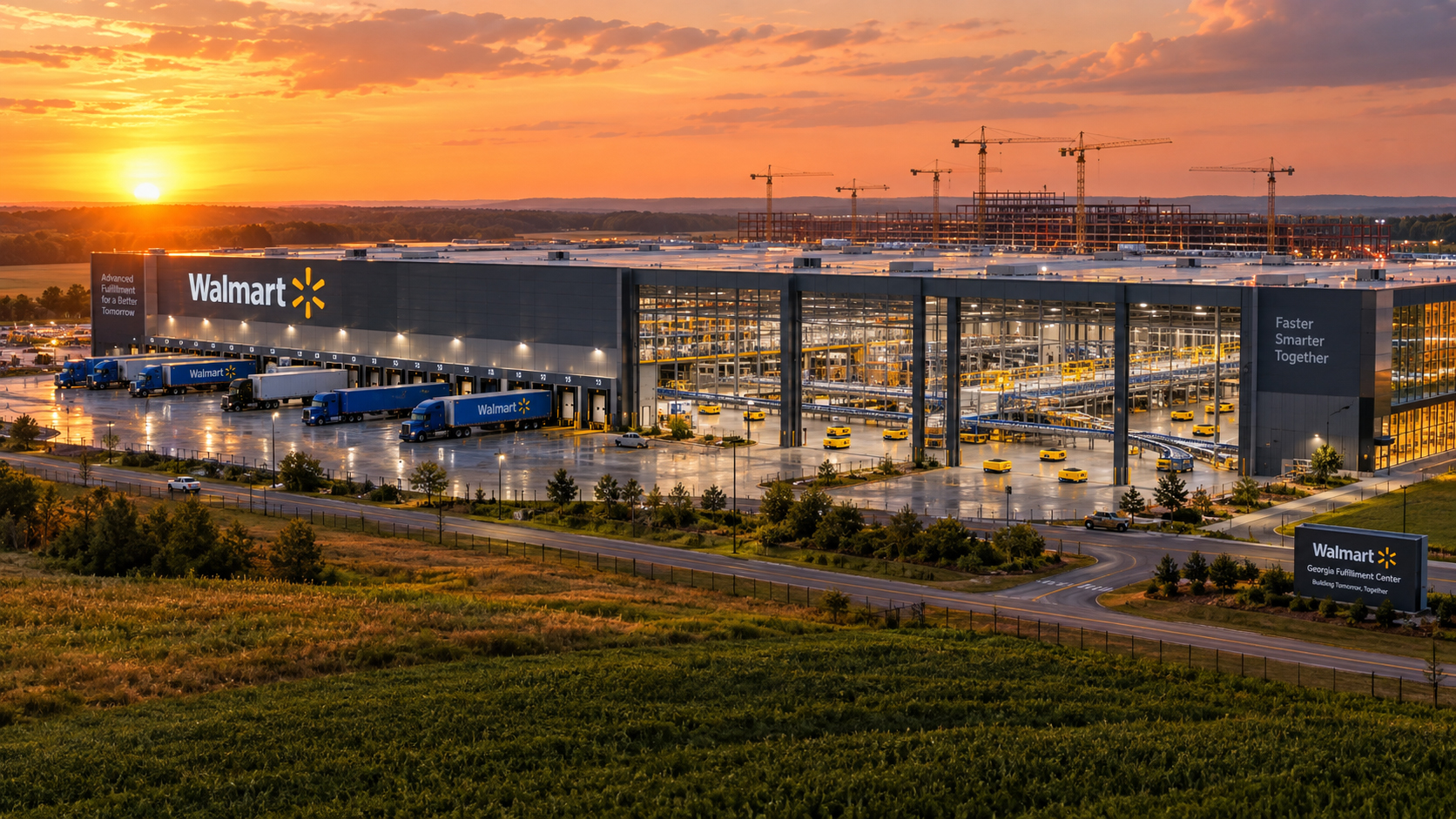
$1.3 billion for 850 residents of Carnesville, Georgia: Why Walmart is buying an American village – Creative image on the topic, created with AI: Xpert.Digital
Robots instead of shelf stockers: The truth behind Walmart's new mega-logistics
Attack on Amazon: Walmart's gigantic new center will change US retail forever
1,000 new jobs or ruthless downsizing? What Walmart's new mega-project really means
Walmart is investing an astounding $1.3 billion in a new fulfillment center—in a village of just 850 people in rural Georgia. At first glance, the announcement of 1,000 new jobs seems like an economic miracle for the small town of Carnesville. But behind the gigantic sum and the celebratory words of local politicians lies far more than just an ordinary warehouse. It's a highly technological piece of the puzzle in a relentless automation offensive, a direct attack on the dominance of rival Amazon, and a lesson in the enormous power shifts between global corporations and rural communities. What does it mean for the people and the local economy when a company pumps more capital into a village than it could ever generate on its own? And how is the rapid arrival of robotics changing the future of work in retail? An analysis of Walmart's ambitious billion-dollar bet on rural America.
Walmart's $1.3 billion bet on rural America: When a corporation becomes bigger than the town that houses it
When a single company pumps more capital into a community than that community could ever generate on its own, the question inevitably arises: who actually needs whom? At the end of August 2026, Walmart announced plans to build a new fulfillment center in Carnesville, Franklin County, Georgia, at a cost of $1.3 billion and expected to create around 1,000 jobs. Carnesville itself has a population of just 850, meaning that the number of people in the town will more than double during the center's operating shifts. This discrepancy between the size of the investment and the size of the site is no coincidence, but rather follows a deliberate location strategy that has been observed in the US for years and is fundamentally shifting the economic and geographical power dynamics between corporations and local communities.
A fulfillment center as a geopolitical puzzle piece in the southeastern USA
The development is not an isolated location decision, but rather part of a clearly identifiable expansion strategy. The new center at the Franklin 85 Logistics Center along Interstate 85, about 130 kilometers northeast of Atlanta and roughly 260 kilometers southwest of Charlotte, is already the sixth so-called Next-Generation Fulfillment Center that Walmart is building or has announced in the US. With an area of 1.5 million square feet, equivalent to about 140,000 square meters, it is a facility roughly the size of twenty football fields. According to Walmart, the existing network of these Next-Generation centers can already reach 75 percent of the US population with deliveries within one to two days, and the Carnesville facility is intended to further expand this coverage in the economically important southeastern United States. Construction is scheduled to begin at the end of 2026; a specific opening date has not yet been announced.
Why Walmart is investing in a community of 850 people
The decision to locate in such a small, rural area may seem surprising at first glance, but it follows a sound economic logic. Rural regions like Franklin County typically offer significantly lower land prices, reduced acquisition and operating costs, and more generous government incentive programs than established logistics corridors in metropolitan areas. The project was realized through close collaboration between the Georgia Department of Economic Development, the Franklin County Industrial Building Authority, the Georgia Energy Management Corporation (GEMC), and the Georgia Quick Start training program. Such partnerships between the state government and local authorities are typical of US location policy, where states compete for large-scale investments by offering tax breaks, infrastructure assistance, and training programs. Significantly, Governor Brian Kemp described the project during a business delegation trip to Peru as a major investment in a rural part of the state, demonstrating the symbolic political value such projects hold for state governments.
The wages behind the headline: Between opportunity and reality
Job figures always seem impressive at first glance, but a closer look at the wage structure tempers the enthusiasm. National hourly wages for the approximately 1,000 new positions are expected to range from around $17.85 to $40.40, indicating a significant spread between entry-level positions and specialized technical roles. For a region with comparatively low wages and limited industrial alternatives, even the lower end of this range represents a noticeable improvement over many existing employment opportunities. At the same time, it's important to consider that modern fulfillment centers increasingly rely on highly automated systems, meaning that a growing proportion of jobs require technical qualifications for operating and maintaining robotics and conveyor systems, while traditional, low-skilled warehouse work tends to decline. The Georgia Quick Start training initiative will have to play a key role in qualifying the local population for these new roles.
Your intralogistics experts

Consulting, planning and implementation of complete solutions for high-bay warehouses and automated storage systems - Image: Xpert.Digital
More information here:
Between efficiency and job cuts: Walmart's radical automation offensive
Automation as the actual core of the investment
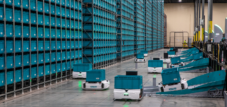
Anyone who interprets this announcement simply as a classic warehouse investment is missing the true strategic dimension. The Carnesville center is being built in partnership with the Austrian automation specialist Knapp and relies on automated storage systems, conveyor belts, shuttle systems, scanners, and robot-assisted workstations that deliver products directly to employees. This approach reduces the previous twelve-step order fulfillment process to just five steps and, according to the company, roughly doubles the daily order volume compared to traditional fulfillment centers. Carnesville is thus part of a much larger, company-wide automation initiative: By the end of fiscal year 2026, around 65 percent of all Walmart stores in the US are to be supplied via automated distribution centers, while approximately 55 percent of the fulfillment volume will be handled by automated systems. Walmart CEO John Furner has already spoken of 2026 as a peak year for automation investments, with several thousand locations undergoing technological upgrades.
The Symbotic Factor: A corporation builds its own robot partner
Particularly revealing is the close, now almost symbiotic, relationship between Walmart and the robotics company Symbotic, which extends far beyond a typical supplier relationship. The two companies have been collaborating since 2017, and since May 2022, Walmart has committed to implementing the Symbotic platform in all 42 of its regional distribution centers in the US. In January 2025, Symbotic even acquired Walmart's internal robotics and automation division, while Walmart, in return, committed to investing approximately $520 million in a new system called Accelerated Pickup and Delivery, which is slated for deployment at over 400 store locations. This transaction alone could increase Symbotic's order backlog by more than $5 billion, demonstrating the scale of this industrial partnership. Already, more than half of Walmart's e-commerce fulfillment volume is handled by automated systems, and over 60 percent of its US stores receive at least some of their merchandise from automated distribution centers.
Between efficiency gains and job displacement
The business logic behind this wave of automation is unambiguous, as internal statements from Walmart managers suggest: Automation has already reduced net shipping costs per order in the US by around 40 percent and unit costs by about 20 percent. Such efficiency gains explain why Walmart, despite its already extremely low-margin business model, is willing to invest billions in robotics instead of simply hiring more traditional workers. At the same time, history shows that such automation pushes don't happen without friction: As early as 2023, Walmart announced the elimination of more than 2,000 jobs at its online order fulfillment centers as part of its automation initiative. The figure of 1,000 new jobs in Carnesville must therefore always be considered in the context of parallel streamlining at other, older locations, even if these two developments are rarely mentioned together in the media.
The structural reorganization of American retail
What the example of Carnesville illustrates on a small scale reflects a much larger structural transformation of the American retail landscape. Over the past decade, brick-and-mortar retail has increasingly evolved into a hybrid model, where physical stores simultaneously function as sales areas and micro-logistical hubs for online delivery. Fulfillment centers like the one in Carnesville form the second, less visible layer of this system, ensuring that orders from the rural southeastern United States can reach customers within a day. This densification of the logistics infrastructure is a direct response to competitive pressure from Amazon, whose own fulfillment network has been considered the benchmark for delivery speed in the US for years. It is also noteworthy that Amazon has simultaneously entered into its own partnership with AutoStore, demonstrating that the race for the fastest and most cost-effective automated supply chain is currently intensifying across all industries.
Regional economic effects beyond the pure job creation effect
For Franklin County and the surrounding region, the economic consequences are likely to extend far beyond the sheer number of newly created jobs. Experience shows that large logistics developments trigger a whole chain of secondary effects, such as the expansion of local suppliers, maintenance providers, and food and retail offerings for the new employees, as well as additional tax revenue for municipal infrastructure. At the same time, however, there are also burdens that are often overlooked in public reporting: increased heavy truck traffic on local roads, a higher electricity demand for automated systems, which poses new challenges for the local energy provider, Georgia EMC, and a potential rise in housing costs due to the influx of workers into a community that has historically been very rural. The true extent of these side effects will only become apparent in the coming years after the facility is operational.
A pattern with a repetitive character
Anyone who considers the announcement from Carnesville in its historical context will recognize a recurring pattern in American regional economies: Large corporations deliberately locate in economically disadvantaged but easily accessible rural areas because they encounter less political and financial resistance there than in urban centers, while the respective states, in turn, compete for such investments with substantial subsidy packages. For Walmart, Carnesville is not an isolated event, but merely the latest component in a strategy pursued for years to restructure its logistics network through a combination of geographic consolidation and radical automation. The true economic significance of this investment therefore lies less in the number of 1,000 jobs itself, but in what it reveals about the future of work in American retail as a whole: It is an industry that is gradually evolving from a labor-intensive mass-market business to a capital-intensive, highly technological logistics system in which human labor increasingly assumes the role of a supplementary, but no longer the central, factor of production.
Your global marketing and business development partner
☑️ Our business language is English or German
☑️ NEW: Correspondence in your native language!

Konrad Wolfenstein
I and my team are happy to be available to you as your personal advisor.
You can contact me by filling out the contact form here wolfenstein@xpert.digital:or simply call me at +49 7348 4088 965. My email address is
I'm looking forward to our joint project.