
Robots gain a sense of touch – Why the future of human-machine interaction depends on the hand
Xpert pre-release

Available in 27 languages 📢
Prefer Xpert.Digital on GoogleⓘPublished on: August 22, 2025 / Updated on: August 22, 2025 – Author: Konrad Wolfenstein
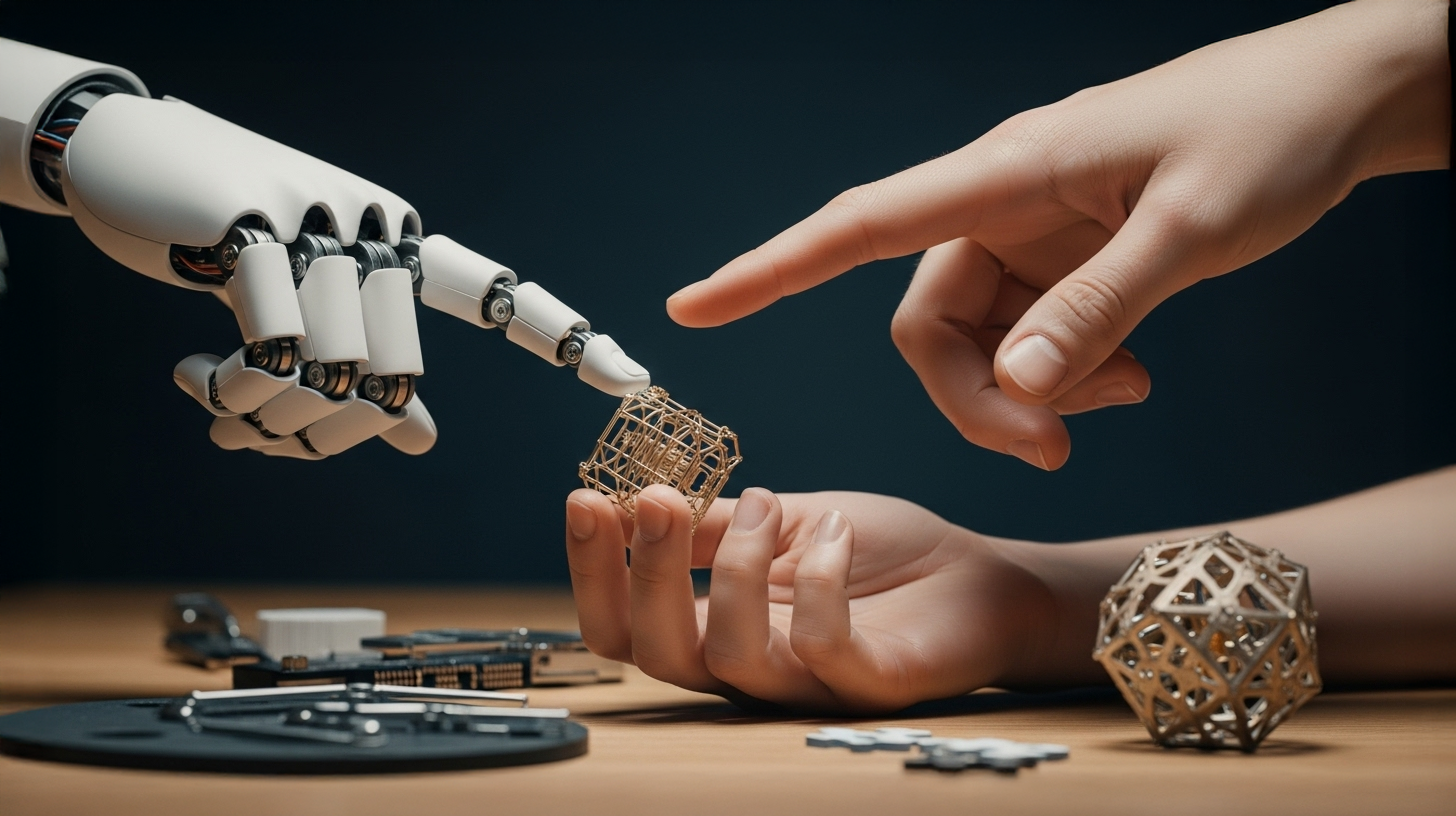
Robots are developing fine motor skills – Why the future of human-machine interaction depends on the hand – Image: Xpert.Digital
Robots are learning to feel: Why this new sense of touch is changing everything
The key to the trillion-dollar industry: Why the robotic hand is more important than you think
Robots often appear clumsy as soon as they leave the sterile halls of a factory. While they can lift heavy loads and weld with precision, they often fail at the simplest human task: grasping gently but securely. The human hand, a masterpiece of bones, muscles, and nerves, has so far been the biggest hurdle on the path to becoming an intelligent everyday helper. Holding an egg without crushing it, or grasping a bottle without dropping it, has remained a nearly insurmountable challenge.
But this era is coming to an end. Thanks to rapid advances in artificial intelligence, miniaturized sensors, and new, soft materials, we are on the verge of a breakthrough that will change robotics forever: robots will gain dexterity. The race for the perfect robotic hand is in full swing, spearheaded by tech giants like Tesla with its “Optimus” project and specialized companies worldwide. This is about far more than a technological gimmick—it's about a future trillion-dollar market.
From support in nursing homes and household helpers to precision missions in medicine and space travel – the potential applications are revolutionary. This article explores why the development of "fingertip sensitivity" is redefining robotics, which companies are setting the pace, and what profound societal questions we must address now before the machines of tomorrow literally take over our daily lives.
Why hands are so crucial
For decades, scientists and engineers have dreamed of giving robots genuine dexterity. While machines in industry have been reliably welding components together, tightening screws, or moving pallets of goods for generations, they still lack something that is taken for granted by humans: the dexterity of their own hands.
The ability to grasp an apple without crushing it, to pull a smartphone from a pocket without dropping it, or to apply precisely measured pressure when closing buttons requires a coordinated interplay of muscles, nerve impulses, sensors, and brain control. Replicating a system of such precision has been one of the greatest challenges in robotics. Now, however, significant progress is on the horizon – driven by advances in artificial intelligence, materials science, and sensor technology.
The vision: Robots as helpers in everyday life
Until now, most robots have been specialized for narrowly defined tasks: industrial robots screw, clamp, or weld. However, in caregiving, households, or transport tasks, many models failed due to the fundamental inability to handle differently shaped, delicate, or difficult-to-grasp objects.
The vision is clear: robots should one day not only take over monotonous and dangerous tasks, but also complex everyday activities. They could assist people with shopping, help seniors prepare meals, or look after children. For this to become a reality, hands with dexterity are absolutely essential.
Tesla's "Optimus" and the controversy surrounding robot hands
A prominent example of this race is Tesla's humanoid robot "Optimus." Elon Musk repeatedly describes it as one of the greatest future sources of value for his company. Musk sees Optimus not just as a factory assistant, but as a robot that could, in the medium term, take over almost all tasks currently performed by a human.
However, one of the project's major hurdles is developing functional and sensitive hands. Engineer Zhongjie Li, who worked on crucial sensors, played a key role. After he left Tesla and founded his own startup, Tesla filed a lawsuit. The accusations: He had stolen highly sensitive data essential for the development of the robotic hands.
This legal dispute illustrates that whoever is able to develop the perfect robotic hand may hold the key to a multi-billion dollar market.
Why robot hands are so difficult to develop
The complexity of human hands is impressive. Each hand has 27 bones, 39 muscles, and an extremely dense network of nerves and touch receptors. It can precisely control not only force but also subtle movements.
The biggest challenges for engineers lie in three areas:
- Mechanics: The simulation of the mobility and fine control of joints.
- Sensors: The ability to detect pressure, temperature, and surface texture.
- Control: An artificial intelligence that interprets the recorded data in such a way that an appropriate movement is initiated.
For a long time, robotic hands could be mechanically constructed, but without sensors they functioned like rigid tools. Now, development is progressing because miniaturized sensors and adaptive algorithms enable sensitive control.
Advances in sensor technology
The core of modern robotic hands are touch sensors. These can detect the force with which a surface is touched by measuring pressure, changes in resistance, or capacitive signals. Some systems use optical sensors that detect the deformation of elastic materials and use this information to infer pressure and shape.
In the latest generation, researchers are going a step further: They are combining tactile detection with temperature sensors and even an "artificial sense of pain." If a robot grips with too much force, the hand registers this and adjusts its movement. Such systems prevent damage to objects and increase safety when interacting with people.
New materials make fingertip sensitivity possible
Besides sensors, materials development plays a crucial role. Rigid metals are stable, but too inflexible to behave like human skin. Therefore, many developers are focusing on so-called soft robotics. This involves creating hands from elastic, soft materials that deform like muscles or skin.
These materials smooth movements and allow adaptation to different object shapes. One example is silicone skin with embedded sensors. It reacts similarly to human skin and can register both pressure and stretching.
The role of artificial intelligence
Without artificial intelligence, these advances would be worthless. Even the best sensors need to be interpreted. AI makes it possible to recognize patterns in the vast amounts of data that a robotic hand generates with every movement.
Neural networks learn, for example, how much pressure is needed to hold an egg without breaking it, or how to grip a glass firmly enough without it slipping. Instead of controlling every movement with a pre-programmed algorithm, modern robotic hands learn from experience. This is achieved through machine learning, simulations, or practical experiments. The more data is collected, the more precise the actions become.
Markets and economic potential
A functioning system of such hands will not only revolutionize everyday life but also create new markets. Forecasts predict that a market worth nearly one trillion US dollars could emerge by 2040. Potential applications range from logistics and healthcare to space travel.
Nursing homes could use robots to support elderly people when getting up or to sort medications. In hospitals, surgical assistants could perform delicate movements. In space exploration, humanoid robots could accompany astronomical missions where intricate tasks must be carried out under extreme conditions.
Global competition: China, USA and Europe
The field is fiercely competitive internationally. In China alone, over 100 different robotic hand models are currently available. Many are developed by startups that focus on combining AI and robotics. The USA is particularly strong in the integration of software and hardware – Tesla is just one example; Boston Dynamics and Agility Robotics are also driving humanoid robotics forward significantly.
Europe has particular strengths in specialized robotics, for example in industrial automation or in high-tech start-ups like Shadow Robot in the UK or Poweron from Dresden. Germany is also known for precision mechanics and automation technology, which represents a significant competitive advantage.
Ethical and social questions
Beyond the technology itself, fundamental societal questions arise. The more realistic and powerful robots become, the more the responsibility of their developers comes to the fore. Which tasks should robots truly perform? Should they replace humans in caregiving or merely supplement them? What legal framework is needed when robots interact directly with people?
Furthermore, the question of trust is crucial. People must feel safe when robotic hands touch them or handle delicate objects. Transparent standards, certifications, and safety protocols will be indispensable.
Future prospects: When will the breakthrough become visible?
Robotics has made great strides in recent years, but the next decade could be crucial. Experts expect humanoid robots with sensitive hands to be deployed in factories and large warehouses in less than five years. Everyday applications, such as shopping or childcare, are still further off, but could become a reality in the 2030s.
Hands are the key to the robot revolution
Humanity is facing a technological revolution. Robots with dexterity are no longer just visions from science fiction films, but are becoming a tangible reality. However, one thing is clear: without hands equipped with precise sensors and sensitive controls, the vision of a true everyday helper remains unattainable.
The international race for the best robotic hand is in full swing – and it will not only change markets, but also the way we as a society interact with artificial intelligence and machines. The hand is thus becoming a symbol of human connection in technology, but also of the greatest challenge: making robots truly appear human.
🎯🎯🎯 Benefit from Xpert.Digital's extensive, five-fold expertise in a comprehensive service package | BD, R&D, XR, PR & Digital Visibility Optimization

Benefit from Xpert.Digital's extensive, fivefold expertise in a comprehensive service package | R&D, XR, PR & Digital Visibility Optimization - Image: Xpert.Digital
Xpert.Digital has in-depth knowledge of various industries. This allows us to develop tailor-made strategies that are tailored precisely to the requirements and challenges of your specific market segment. By continually analyzing market trends and following industry developments, we can act with foresight and offer innovative solutions. Through the combination of experience and knowledge, we generate added value and give our customers a decisive competitive advantage.
More about it here:
Case studies: How companies worldwide are working on the robotic hand of the future
Shadow Robot Company: Pioneering work from Great Britain
One of the best-known specialist companies for robotic hands is the London-based Shadow Robot Company. Since the 1990s, it has been developing highly complex humanoid hands that are used in numerous research projects and laboratories worldwide.
Their "Shadow Dexterous Hand" is considered one of the most feature-rich robotic hands ever. It boasts more than 20 degrees of freedom and a multitude of sensors that can register pressure, position, and force. What makes it special is that the hand can be controlled autonomously by AI as well as remotely, for example in medical applications.
For example, doctors can perform operations where the robotic hand acts as an exact copy of their hand movements. In the space sector, the European Space Agency (ESA) has used the Shadow Hand to test experiments with telepresence control – allowing astronauts or even doctors on Earth to operate machines in space without having to be physically present.
Shadow Robot thus serves as a prime example of how highly specialized companies can become world market leaders through decades of focusing on a niche topic.
Festo: Inspiration from nature
The German automation specialist Festo, based in Esslingen, is particularly known for its Bionic Learning Network, which derives technical solutions from nature. One of its most renowned projects is the development of the "BionicSoftHand".
The BionicSoftHand consists of soft materials that are moved by pneumatic control. It imitates the human grasp, with artificial tendons and muscles controlled by air pressure.
A particular advantage: The hand can flexibly adapt to differently shaped objects without requiring complicated calculations or precise positioning. For example, if the robot hand grasps a crumpled plastic bag, it automatically adjusts to its shape.
Festo is thus making a crucial contribution to soft robotics, i.e., flexible, biomimetic robotics. The BionicSoftHand demonstrates how flexible materials can make robots safer and more suitable for everyday use.
Toyota: Human-robot cooperation in Japan
In Japan, Toyota is particularly focused on developing humanoid robots. The automotive giant sees robots not only as a way to relieve pressure on production, but also, and perhaps more importantly, as a solution for an aging society.
Toyota has developed a platform called "Human Support Robot" (HSR) designed to help people in wheelchairs or seniors in their daily lives. Initially, the focus was on mobile platforms, but in recent years the development of hands has taken center stage.
HSR robots need hands that can not only grasp bottles or remote controls, but also perform delicate tasks such as picking up thin newspaper sheets or folding clothes. Toyota is focusing on robotic hands with versatile finger movements and AI-supported grasping strategies learned by observing human actions.
Toyota is pursuing a clear societal benefit with this: robots are intended to relieve the burden on caregivers and enable older people to live self-determined lives for longer.
Boston Dynamics: Between Power and Sensitivity
The US company Boston Dynamics is known for spectacular robots like Atlas and Spot. So far, the focus has been heavily on mobility and balance. But without hands, humanoid robots like Atlas remain limited in their range of actions.
In recent years, Boston Dynamics has increasingly focused on enabling Atlas not only to walk and jump, but also to manipulate complex objects. To achieve this, they are testing modular hand concepts that can be exchanged depending on the task.
One variant is designed for heavy-duty industrial use, such as moving heavy boxes. Another version is designed for precise tasks, like operating tools. In the long term, Atlas will be equipped with fully functional, humanoid hands trained by AI to grasp and place objects "as if by chance"—similar to a person casually setting down a cup of coffee without giving it much thought.
Agility Robotics: Practical Application in Logistics Centers
Another up-and-coming company is Agility Robotics. Their humanoid robot "Digit" was developed primarily for warehouse logistics. There, robots are intended not only to move boxes, but also to be integrated into existing work environments – which in turn requires hands that can handle objects of different shapes.
Digit already has rudimentary grippers, which are to be expanded over the next few years. The vision: Digit could supplement the workforce in logistics centers like those of Amazon or DHL by taking products from the shelves, sorting them, and repackaging them.
For such scenarios, robotic hands are not just a bonus, but an absolute necessity. The variability of the goods – from fragile glass bottles to bulky cardboard boxes – presents an enormous challenge.
Medical applications: Robotic hands as surgical assistants
Besides industry and everyday life, robotic hands are also playing an increasingly important role in medicine. Systems like the "Da Vinci Surgical Robot" already work with mechanical gripping arms that assist surgeons during operations.
Future robotic hands could accomplish much more: they could palpate tissue, place delicate sutures, or even perform operations independently under human supervision. This requires a level of precision and dexterity that is in no way inferior to the human hand – in some cases, it could even surpass it, for example, through the ability to execute microscopic movements that are barely controllable by the human nervous system.
Space travel: Robotic hands as helpers in space
Robotic hands could also become crucial in space travel. Human astronauts reach their physical and safety limits on missions. Robots with sensitive hands could perform repairs on satellites in space, conduct experiments on space stations, or carry out extravehicular activities that are risky for humans.
NASA and ESA have experimented with projects like "Robonaut" in the past. This humanoid robot was equipped with highly developed hands to operate tools in space. While the first practical test wasn't perfect, the direction is clear: hands give robots the same capabilities in harsh environments as an astronaut.
Societal impacts: work, care and everyday helpers
The proliferation of robotic hands raises further questions that extend far beyond the technology itself. If robots are equipped with true gripping capabilities, they could replace human workers in many sectors. In logistics and manufacturing, this could reorganize entire industries.
In the field of caregiving, the question is hotly debated: Are robotic hands suitable for helping or even caring for people? While some proponents see them as a relief, critics fear the loss of human connection.
In private households, robotic hands could make everyday life easier: from tidying the living room to assisting with cooking. Opportunities also arise for people with disabilities – robots could act as personal assistants and even take over fine motor tasks.
Hands as the final step towards the true integration of robots
The last few years have shown that robotic legs, mobility, and machine vision have made enormous progress. But the greatest achievement is yet to come: the development of functioning hands with fingertip sensitivity.
Whether it's Tesla with Optimus, Shadow Robot with its high-end hand, or Festo with its nature-inspired soft robotics – they all demonstrate that the hand is the key to the robot revolution. Markets such as industry, medicine, aerospace, and healthcare are waiting for this breakthrough.
The robotic hand is far more than just a technical detail. It is the actual link between humans and machines – and thus a symbol of both the opportunities and the responsibilities that come with artificial intelligence.
Our recommendation: 🌍 Limitless reach 🔗 Networked 🌐 Multilingual 💪 Strong sales: 💡 Authentic with strategy 🚀 Innovation meets 🧠 Intuition

From local to global: SMEs conquer the global market with clever strategies - Image: Xpert.Digital
At a time when a company's digital presence determines its success, the challenge is how to make this presence authentic, individual and far-reaching. Xpert.Digital offers an innovative solution that positions itself as an intersection between an industry hub, a blog and a brand ambassador. It combines the advantages of communication and sales channels in a single platform and enables publication in 18 different languages. The cooperation with partner portals and the possibility of publishing articles on Google News and a press distribution list with around 8,000 journalists and readers maximize the reach and visibility of the content. This represents an essential factor in external sales & marketing (SMarketing).
More about it here:
The technical workings of modern robot hands
Sensory system: The nervous system of the artificial hand
Like human skin, the robot hand is equipped with a dense array of sensors. This so-called haptics allows it to perceive the slightest differences in pressure or surface texture. Several sensor principles are combined for this purpose:
- Force sensors: They measure how hard fingers or palms press against an object. Typical systems use strain gauges or piezoelectric elements.
- Capacitive sensors: Similar to a smartphone touchscreen, they register how electrical fields change when in contact with a material.
- Optical touch sensors: Here, the robot hand's skin is made of a transparent material. A camera underneath observes how the material deforms under pressure. From this, the object's shape and texture can be derived.
- Temperature sensors: These are used to detect thermal properties. For example, a robot can detect whether it is touching a hot pot or a frozen water bottle.
- Multimodal sensory technology: The most advanced systems combine various technologies in an artificial skin composite. This creates a kind of distributed perception, similar to the human sense of touch.
These sensors deliver immense amounts of data per second. A single finger with multiple pressure sensors generates hundreds of measurements – for every single movement. Without complex software, this data would be practically useless.
AI methods for sensitive grasping
Controlling a robotic hand is a highly complex task. Traditional programming quickly reaches its limits here because it is impossible to accurately predict all possible scenarios – from smooth glasses to irregular pieces of fruit.
This is where artificial intelligence comes into play today. Three main methods dominate current developments:
1. Supervised Learning
Robotic hands "learn" by observing human movements. Researchers have people grasp specific objects and analyze the positions of their fingers and the forces involved. This data is then fed into neural networks that learn to mimic similar movements.
2. Reinforcement Learning
In this process, robotic hands try out various actions in simulation and real-world scenarios and are optimized using a reward strategy. For example, if a gripping action successfully lifts a glass, the system receives positive feedback. If the object slips out or is crushed, negative feedback is given. With millions of such training cycles, the AI develops strategies that are robust and reliable.
3. Sim-to-Real Transfer
A major problem is that robots learn much more slowly in reality than in computer simulations. Therefore, modern systems are initially trained virtually using highly realistic physics simulations. This allows a robotic hand model to "learn" to grasp millions of different types of objects in just a few days. The learned behavior is then applied to the actual hardware and refined through further adjustments.
Control architecture: From sensor to finger
The functionality of a robot hand can be roughly divided into three levels:
- Sensor input: Signals from touch sensors, cameras and force meters are fed into the control system.
- Interpretation: AI algorithms process the measurement data and translate it into "grasping decisions." For example: gentle pressure with two fingers or a full-hand grip.
- Motor output: Micro servomotors, hydraulic systems or pneumatic muscles directly translate the decisions into movements.
Extremely low latency is crucial. If the hand reacts too late, the object slips from the fingers. Modern systems therefore operate with reaction times in the millisecond range.
Differences between hard and soft robotics
While classic robot hands consist of metal elements and electric motors, soft robotics is increasingly coming to the fore.
- Rigid frame hands: They are robust, precise, and suitable for heavy loads. Their weakness lies in their inability to gently grip objects with complex shapes. Typical applications include industrial arms or manufacturing robots.
- Soft robotic hands: These are made of elastic materials such as silicone or hydrogel. They can flexibly adapt to the shape of the object, but are often less durable. Their advantage lies in safety – they are better suited for contact with humans.
Future visions rely on hybrid systems that combine the best of both worlds: the power and precision of hard mechanics with the compliance and adaptability of soft robotics.
The energy issue: electricity consumption and autonomy
An underestimated problem with many robotic hands is their energy consumption. Sensitive sensors and constant data processing require large amounts of electricity. In addition, there are electric motors or pump systems that control the movement.
Energy efficiency is crucial for mobile robots, as batteries offer only limited operating times. Therefore, developers are working on more efficient motors, optimized software, and new energy sources, such as miniaturized fuel cells.
A young field of research is investigating energy-autonomous sensor skins that generate some of their own energy through deformation or temperature differences.
Learning grasping strategies
The real art, however, lies not just in building a hand, but in making it as versatile as possible. Future-proof systems have a library of gripping patterns.
This is how the hand knows:
- Tweezers handle for fine objects such as needles or coins.
- Power grip for heavy and larger objects.
- Cylinder handle for bottles or rods.
- Adaptive flat handle for flat objects such as plates.
The AI decides in real time which pattern is the best fit. Experience plays a role here: After grasping a crumpled plastic bottle a hundred times, a robot can reliably decide which strategy works even on the 101st attempt – much like a human acts out of habit.
Safety: When robots touch humans
In all scenarios where robots and humans interact, safety is paramount. Robotic hands must not only be skillful but also absolutely reliable. Nobody wants to be accidentally squeezed too hard by a machine.
That's why developers rely on force limiting systems: If the resistance is too strong, the hand gives way immediately. Redundancies are also built in – if the software fails, the mechanics ensure natural compliance.
In the future, standards such as a kind of "robot TÜV" for hands will probably be necessary to allow them to be used in everyday life.
The technical in-depth
What the human hand has learned over millions of years of evolution is a century-long project in engineering. However, modern robotic hands are more advanced than ever before – thanks to sophisticated sensors, adaptive AI, soft robotics, and highly precise control systems.
The coming years will determine whether the leap from research to the mass market succeeds. It's conceivable that robotic hands will become a key technology like smartphones or industrial robots – invisible, but ubiquitous.
We are there for you - advice - planning - implementation - project management
☑️ SME support in strategy, consulting, planning and implementation
☑️ Creation or realignment of the digital strategy and digitalization
☑️ Expansion and optimization of international sales processes
☑️ Global & Digital B2B trading platforms
☑️ Pioneer Business Development

Konrad Wolfenstein
I would be happy to serve as your personal advisor.
You can contact me by filling out the contact form below or simply call me on +49 7348 4088 965 (Munich) .
I'm looking forward to our joint project.
Write to me

Xpert.Digital - Konrad Wolfenstein
Xpert.Digital is a hub for industry with a focus on digitalization, mechanical engineering, logistics/intralogistics and photovoltaics.
With our 360° business development solution, we support well-known companies from new business to after sales.
Market intelligence, smarketing, marketing automation, content development, PR, mail campaigns, personalized social media and lead nurturing are part of our digital tools.
You can find out more at: www.xpert.digital - www.xpert.solar - www.xpert.plus
Keep in touch









