
US government revenue: The future of public finances – New ways to stabilize US revenue

Available in 27 languages 📢
Prefer Xpert.Digital on GoogleⓘPublished on: November 22, 2024 / Updated on: November 22, 2024 – Author: Konrad Wolfenstein

US government revenue: The future of public finances – New ways to stabilize US revenue – Image: Xpert.Digital
💡 US Government Revenue: An Analysis of the Revenue Structure and its Implications
🔍📊 US government revenues are comprised of a variety of different sources that form the basis for financing government spending. Income taxes play a particularly dominant role. In fiscal year 2023, they contributed the largest share of total revenue, amounting to $2.176 trillion. This represents approximately half of all US government revenue and underscores the fundamental importance of this type of tax for public financing. However, other revenue sources, such as social security and pension contributions, corporate taxes, and smaller items like tariffs, excise taxes, and inheritance taxes, also play a significant role. A detailed analysis of the revenue structure reveals the associated economic dependencies and challenges.
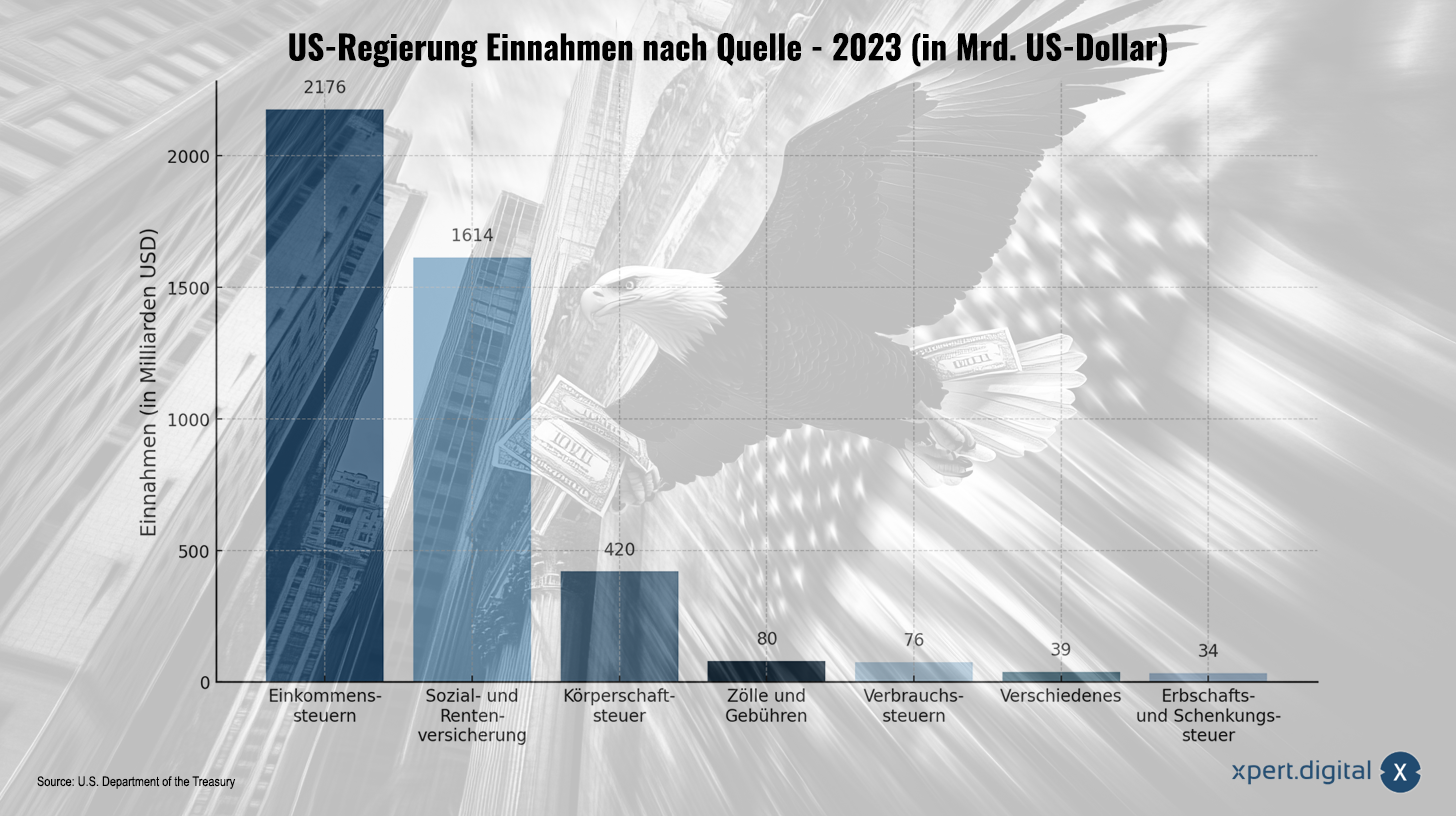
US government revenue in 2023 – Tariffs and their limits: How economically sound are they really? – Image: Xpert.Digital
📊 The role of income taxes as the main source of revenue
With $2.176 trillion, income taxes form the backbone of US public finances. This tax is levied on individuals and households and is progressive, meaning that higher incomes are taxed proportionally more. This not only helps cover government spending but also serves as a tool for income redistribution and promoting social justice.
However, the high dependence on income taxes carries risks. For example, an economic recession typically leads to falling incomes, which can significantly reduce revenue from this source. Therefore, it is essential for the government to diversify its revenue sources to counteract financial fluctuations.
🏦 Social security and pension contributions: A stable second pillar
At $1.614 trillion, social security and pension contributions rank second among government revenue sources. These contributions are collected directly from employees and employers and fund social benefits such as social security and Medicare. Because they are typically levied as fixed amounts on wages and salaries, they provide a relatively stable source of revenue, even during times of economic uncertainty.
However, the system faces long-term challenges. Demographic trends – particularly the aging population – mean that spending on pension and healthcare programs is growing faster than revenue. Without reforms, these programs risk facing funding shortfalls in the coming decades.
🏢 Corporate taxes: A source of revenue under pressure
Corporate income tax generated $420 billion in revenue in 2023. While this is a significant sum, a look at the trend over the past few decades shows that the relative contribution of this tax is declining. The main reasons for this are tax breaks for companies, international tax competition, and the increasing use of tax havens.
While corporate tax is often seen as a means of encouraging companies to contribute to the financing of public goods, critics argue that high tax rates can stifle investment and innovation. Nevertheless, there is a growing consensus that multinational corporations should be taxed fairly to minimize tax evasion and avoidance.
⚙️ Customs duties and fees: A marginal source of revenue with political significance
At just $80 billion, tariffs and duties contribute only 1.8% to total revenue. Although this figure appears small compared to other sources, they nevertheless play a significant role in trade policy. Tariffs are traditionally used as a means of protecting the domestic economy by making foreign goods more expensive and thus facilitating competition for domestic companies.
The limited revenue generated by tariffs becomes clear when compared to income tax. While tariffs are often portrayed in political debates as an economic panacea, their fiscal contribution remains modest. Higher tariffs might increase revenue in the short term, but they would raise import costs and potentially trigger trade conflicts that could stifle economic growth in the long run.
🛢️ Excise taxes: An underestimated instrument
Excise taxes, which generated $76 billion in revenue in 2023, represent another important, albeit comparatively small, source of income. These taxes are levied on specific products such as tobacco, alcohol, and gasoline and often serve not only fiscal purposes but also the regulation of consumer behavior. For example, high taxes on tobacco products are intended to reduce consumption and thus promote public health goals.
Increased use of consumption taxes could be a way to generate additional revenue without raising the income tax burden. However, potential social consequences must be considered, as these taxes could disproportionately burden low-income households.
🏠 Inheritance and gift tax: A controversial instrument
In the 2023 fiscal year, inheritance and gift taxes generated only $34 billion in revenue. Despite their small contribution, these taxes are frequently the subject of controversy. Proponents argue that they help reduce wealth inequality and ensure that large fortunes cannot be passed down untaxed for generations. Critics, however, view them as double taxation and fear negative consequences for the middle class, particularly family businesses.
Reforming this tax could help increase revenue without burdening the general population. This could involve a more progressive approach, taxing large fortunes more heavily while leaving small and medium inheritances largely unaffected.
📦 Miscellaneous: Small but diverse sources of income
The "Miscellaneous" category comprises $39 billion in revenue and covers a variety of smaller items, including fees, fines, and income from government investments. Although its contribution is relatively small, this category demonstrates the diversity of government revenue sources.
📌 Challenges and strategies for a sustainable revenue policy
The US government's revenue structure exhibits both strengths and weaknesses. The dominance of income tax creates a strong dependence on the population's economic performance, while other sources such as corporate taxes and tariffs contribute comparatively little. To ensure long-term stability, the following strategies could be considered:
1. Diversification of revenue streams
Increased use of consumption taxes, CO₂ taxes, or financial transaction taxes could generate new revenues while simultaneously creating incentives for change in behavior.
2. Reform of corporate tax
A global minimum tax, as proposed by the OECD, could reduce tax avoidance and stabilize corporate tax revenues.
3. Modernization of social security
To secure the long-term financing of social security and pension insurance, measures such as raising the contribution assessment ceiling or increasing taxes on high incomes could be introduced.
4. More efficient administration and control
Improved tax administration could help curb tax evasion and avoidance, thereby increasing revenue.
⚖️ The balance between income and expenses
Analyzing the revenue structure of the US government reveals both the challenges and opportunities for sustainable fiscal policy. While some revenue sources are stable and reliable, others need to be reformed or expanded to meet growing demands. A balanced mix of direct and indirect taxes, combined with efficient administration, can help ensure fiscal stability while promoting social justice.
📣 Similar topics
- 📊 An overview of the US government's revenue structure
- 💰 Income tax: The backbone of public finances
- 🏛️ Social security and pension contributions: A stable but vulnerable pillar
- 📉 Corporate taxes: Declining revenues and global challenges
- 🌍 Tariffs and trade policy: A fiscal fringe phenomenon with political relevance
- 🚬 Consumption taxes: More than just revenue – controlling consumption
- 🏘️ Inheritance tax: A small but controversial instrument
- 💡 Strategies for a sustainable revenue system of the future
- ♻️ Revenue policy and social justice: Finding the balance
- 📈 Financial reforms: Ways to diversify revenue sources
#️⃣ Hashtags: #GovernmentRevenue #IncomeTax #FiscalPolicy #TaxSystem #SocialJustice
Our recommendation: 🌍 Limitless reach 🔗 Connected 🌐 Multilingual 💪 Sales power: 💡 Authentic with strategy 🚀 Innovation meets 🧠 Intuition

From local to global: SMEs conquer the world market with a clever strategy - Image: Xpert.Digital
In an era where a company's digital presence determines its success, the challenge lies in creating an authentic, personalized, and far-reaching presence. Xpert.Digital offers an innovative solution that positions itself as the intersection of an industry hub, a blog, and a brand ambassador. It combines the advantages of communication and sales channels in a single platform and enables publication in 18 different languages. Cooperation with partner portals and the ability to publish articles on Google News and a press distribution list with approximately 8,000 journalists and readers maximize the reach and visibility of the content. This represents a crucial factor in external sales and marketing (SMarketing).
More information here:
🌍💰📈 Economic impact of high tariffs
🛒📉 Costs for consumers
High tariffs on imported goods are generally passed on to consumers, leading to higher prices. An example of this is the tariffs on washing machines introduced during the Trump administration. These resulted in an average price increase of 12%, placing an additional burden on US households each year. Higher consumer prices can reduce citizens' purchasing power and thus weaken the domestic economy.
🏭📦 Impact on businesses
Companies that rely on imported raw materials or components face increased production costs due to high tariffs. This can negatively impact their competitiveness in both domestic and international markets. Some companies might be forced to raise their prices, which could reduce demand for their products. Others might relocate production abroad to cut costs, leading to job losses at home.
⚖️🔄 Economic distortions
High tariffs can distort international trade. They reduce import volumes, which in turn diminishes the potential revenue from these tariffs. Furthermore, they can impair the efficiency of national economies, as resources may no longer be allocated optimally. Companies might be forced to use more expensive or less efficient domestic alternatives, increasing production costs and reducing competitiveness.
💥🌏 Retaliatory measures and trade wars
The imposition of high tariffs can prompt other countries to retaliate with their own tariffs, potentially leading to a trade war. Such retaliatory measures can harm US exports, jeopardize jobs, and slow economic growth. Historically, trade wars rarely produce winners; they usually result in a deterioration of economic conditions for all parties involved.
📜🕰️ Historical perspective on tariffs in the USA
In U.S. history, tariffs once played a more significant role as a source of revenue. In the 19th century, tariffs were one of the primary sources of funding for the federal government. However, with the introduction of income tax in the early 20th century, the focus of government revenue shifted. Globalization and various free trade agreements have led to a further reduction in tariffs over time.
💡🌟 Alternative approaches and considerations
🏗️📚 Investments in the local economy
Instead of relying on high tariffs, investments in education, infrastructure, and technological innovation could strengthen the competitiveness of the US economy in the long term. By improving productivity and efficiency, companies can compete better in the global market without relying on protectionist measures.
🤝🌐 Free trade agreements and international cooperation
Free trade agreements can improve access to foreign markets and strengthen the export sector. International cooperation also helps to better address global challenges such as unfair trade practices or patent infringements. Active participation in multilateral organizations such as the World Trade Organization (WTO) can contribute to resolving trade disputes through diplomatic channels.
🎯💼 Targeted economic policy
Instead of blanket tariffs, targeted economic policy measures could be more effective. Tax incentives for specific industries, investments in research and development, or support programs for small and medium-sized enterprises can boost the economy without causing the negative effects of high tariffs.
🔍⚡ The role of tariffs in Donald Trump's economic policy
Donald Trump repeatedly emphasized tariffs as a key economic and political tool during his presidency and political campaigns. He argued that tariffs were not only a source of revenue but could also be used strategically to achieve economic goals, such as boosting domestic industry or reducing the trade deficit. Among other things, Trump proposed using tariff revenue to finance tax cuts or pay off debt. One particularly radical proposal even included the idea of replacing income tax entirely with tariffs.
Related to this:
🛑❌ Why tariffs are not a realistic alternative to income tax
The idea of replacing income tax with tariffs has been widely deemed unrealistic and economically impractical by economists. This is due to the limited amount of tariff revenue compared to the substantial income tax revenue. To compensate for the loss of income tax, tariffs of approximately 58–70% would have to be levied on all imports. Such a universal tariff would not only drastically increase import prices but also have far-reaching negative consequences for the economy.
Such a high tariff would significantly disrupt trade, drastically reduce import volumes, and thus diminish the potential revenue from these tariffs. Furthermore, the consequences for consumers, businesses, and international trading partners would be severe. Everyday consumer goods heavily reliant on imports would become considerably more expensive, potentially weakening consumer purchasing power. At the same time, trade conflicts could arise, as affected countries might retaliate with tariffs, further straining international trade.
📊🌎 Economic impact of tariffs: Key topics at a glance
Tariffs have not only fiscal but also profound economic consequences. These can be felt at both the national and international levels and particularly affect consumers, businesses, and trading partners. The most important aspects are:
1. Costs for consumers
📈💸 Tariffs generally lead to higher prices for imported goods. These costs are often passed directly on to consumers. Studies have shown that tariffs, such as those introduced during Trump's presidency, had a significant impact on prices. One example was the tariffs on washing machines, which led to a price increase of approximately 12%. For US households, this meant an additional financial burden without any immediate benefit.
2. Economic distortions
⚖️🔁 High tariffs can significantly impair trade. When imports become more expensive, the import volume often decreases, which in turn reduces tariff revenue. At the same time, protectionist measures such as high tariffs can weaken the competitiveness of domestic industries by isolating them from necessary international market mechanisms. This can lead to lower efficiency gains and innovation rates in the long run.
3. Trade Wars and Retaliation
🌐⚔️ Tariffs can also exacerbate geopolitical tensions, especially when affected countries respond with retaliatory tariffs. This type of "retaliation" was clearly visible during Trump's trade conflicts with China. Both sides imposed ever-increasing tariffs on each other, straining trade relations and slowing economic growth in both the US and China.
Related to this:
4. Labor market and economic growth
💼📉 The introduction of tariffs can also have an impact on the labor market. While they may create jobs in certain sectors – such as the steel industry – in the short term, they jeopardize jobs in other sectors that depend on international supply chains. The higher production costs resulting from more expensive imports can force companies to cut jobs or even relocate operations abroad.
⚖️🏢 Political and economic limits of tariffs 🌐📊
🏭🚢 Dependence on international trade
The US is one of the world's largest economies and deeply integrated into global trade. Withdrawing from international trade agreements or imposing extremely high tariffs would not only harm trading partners but also significantly weaken the US economy. Companies that rely on global supply chains could be forced to adapt their business models, which would entail considerable costs.
🛍️💵 The role of consumer markets
A large part of the US economy is consumption-driven, and higher prices for imported goods could significantly reduce consumers' purchasing power. This would not only impact economic growth but could also exacerbate social inequality, as lower-income households would be disproportionately affected by price increases.
🌎🔍 A limited source of income and the future of economic policy
Tariffs are a limited source of revenue for the US government and cannot replace income tax. Imposing extremely high tariffs would lead to significant economic disruption, including higher costs for consumers, trade conflicts, and a stunted economic growth. Although Donald Trump considered tariffs a central element of his economic policy, their actual effectiveness as a source of revenue and an instrument of economic control remains severely limited.
Sustainable economic policy should be based on a balanced mix of domestic development and international cooperation. Investment in the domestic economy and constructive trade relations with other countries can achieve stable and positive long-term results. It is important to consider the complex interrelationships of the global economy and to seek solutions that strengthen the domestic economy while also fostering international partnerships.
📣 Similar topics
- 📊 Economic consequences of high tariffs
- 🌍 Trade wars and global tensions: The role of tariffs
- 🛒 Consumer focus: How tariffs reduce purchasing power
- 💼 Companies under pressure: Tariffs and their economic consequences
- ⚖️ Tariffs versus free trade agreements: A strategic comparison
- 📈 Protectionism and growth: Limits of tariff policy
- 🇺🇸 The historical significance of tariffs in the USA
- 💰 Tariffs as a source of revenue: Illusion or viable option?
- 🔄 Production shifts due to tariffs: Are domestic jobs at risk?
- 🧩 International cooperation instead of isolation: Alternatives to high tariffs
#️⃣ Hashtags: #TradeWars #EconomicPolicy #Protectionism #ConsumerCosts #FreeTrade
We are here for you - Consulting - Planning - Implementation - Project Management
☑️ SME support in strategy, consulting, planning and implementation
☑️ Creation or realignment of the digital strategy and digitization
☑️ Expansion and optimization of international sales processes
☑️ Global & Digital B2B trading platforms
☑️ Pioneer Business Development

Konrad Wolfenstein
I would be happy to serve as your personal advisor.
You can contact me by filling out the contact form below or simply call me on +49 7348 4088 965 .
I'm looking forward to our joint project.
Write to me

Xpert.Digital - Konrad Wolfenstein
Xpert.Digital is a hub for industry focusing on digitalization, mechanical engineering, logistics/intralogistics and photovoltaics.
With our 360° Business Development solution, we support renowned companies from new business to after-sales.
Market intelligence, smarketing, marketing automation, content development, PR, mail campaigns, personalized social media and lead nurturing are part of our digital tools.
You can find more information at: www.xpert.digital - www.xpert.solar - www.xpert.plus
Keep in touch










