Blog/Portal for Smart FACTORY | CITY | XR | METAVERSE | AI (AI) | DIGITIZATION | SOLAR | Industry Influencer (II)

Industry Hub & Blog for B2B Industry - Mechanical Engineering - Logistics/Intralogistics - Photovoltaics (PV/Solar)
For Smart FACTORY | CITY | XR | METAVERSE | AI (AI) | DIGITIZATION | SOLAR | Industry Influencer (II) | Startups | Support/Advice

Business Innovator - Xpert.Digital - Konrad Wolfenstein
More about this here

Returns management: A challenge for warehouse logistics


Konrad Wolfenstein - Brand Ambassador - Industry InfluencerOnline Contact (Konrad Wolfenstein)

Language selection 📢

Published on: May 16, 2014 / Updated on: November 25, 2018 – Author: Konrad Wolfenstein

Returned packages

Shutterstock / Quant Ho

introduction

The e-commerce market has been characterized by steadily increasing sales for years, so it's no surprise that the number of returns is also rising in tandem with these increases. Customer returns pose a growing challenge for online retailers, making targeted returns management a crucial success factor for businesses. Successful returns management doesn't just focus on processing returns as efficiently as possible; it also includes proactive planning to prevent returns even before the purchase process begins. This includes, for example, creating detailed product descriptions and optimizing customer communication, giving customers the opportunity to contact the retailer before, during, and after their purchase. Financial aspects, such as selecting suitable payment methods (PayPal, credit card, etc.), are also crucial.

Below, we outline the challenges posed by the increase in returns and how companies are adapting their warehouse logistics to meet them.

Returns – a major problem, especially in Germany
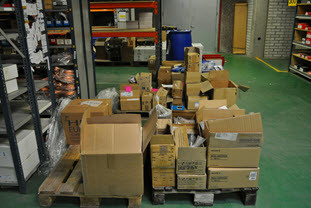
Pallet of returnsRetailers in the clothing industry are particularly affected by returns, with return rates averaging 35-40%. These rates vary considerably from company to company, reaching as high as 60% in the worst-case scenario. The primary reason for returns in the clothing sector is that customers can only try on the merchandise after delivery. According to a study by the University of Regensburg, four out of ten customers consciously factor in the possibility of returns when making a purchase. The study also found that online retailers incur costs of up to €10 per return, with almost 70% of these costs attributable to processing and restocking the goods.

Efficient returns processing is therefore essential for online retailers to remain competitive. Its benefits can be easily illustrated with an example: An online shop with an annual volume of 1.5 million shipments has a return rate of 40%. With annual labor costs of €30,000 per employee, every minute saved per return would equate to an annual saving of €180,000.

For the area of ​​warehouse logistics, this means, on the one hand, the constant pressure to optimize transport logistics processes (efficient location strategy, easily handled packaging, etc.). Above all, however, it requires the optimal design of internal processing procedures, which often involves significant investments in warehousing.

Returns and warehousing

Shuttle systems manage processes in Europe's largest returns operation

As returns increase, so does the importance of professional handling of returned goods. Hermes Fulfilment GmbH Otto Versand , has continuously expanded its returns facility in Hamburg since 2010, making it the largest returns center in Europe. Around 1,200 employees work there in three shifts across 13,500 square meters, processing between 50 and 60 million returned items annually. To achieve this, the company invested in the installation of the world's largest shuttle warehouse system. The centerpiece of the new returns warehouse is a dynamic OSR shuttle system with approximately 176,000 storage locations. This provides a storage capacity of around 1 million items, of which up to 15,000 can be processed and picked per hour during peak periods. This enables the mail-order company to process, inspect, and prepare returned goods for resale quickly and with a high degree of automation.

With the help of a fully electronic sorting robot (the so-called sorter ), the automated transport of returns from goods receipt to restocking is enabled. Since the introduction of this system, returned goods can be processed even more efficiently, stored more quickly in the shuttle high-bay warehouses, and released for reshipment more rapidly. The fully automated recording of order data and return reasons via computer-aided cameras also leads to an additional increase in productivity. As a result, the operational throughput time for textile returns has been reduced to one hour, significantly lowering the costs for processing and re-picking the items.

The returns process in the warehouse

The following illustrates the process using the example of the returns warehouse of Hermes Fulfilment in Hamburg. Returns processing comprises the following steps:

  • Goods received
  • Product preparation
  • Product evaluation
  • Packaging
  • Restoration

The goal in each step is to reduce the resources used to the bare minimum in order to keep the returns process as short as possible.

GOODS RECEIPT
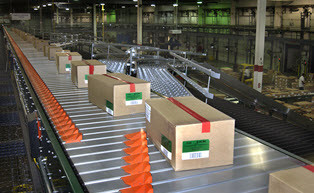
eCommerce and logisticsIn the receiving area of ​​the Hamburg warehouse, flexible telescopic conveyors facilitate the unloading of incoming containers. Here, employees place all incoming parcels, bags, and packages containing returns onto the conveyor belts at equal intervals, with the return label barcodes facing upwards. This allows the scanners to record the returns individually with a very low error rate. The returns then travel via a total of six conveyor belts to the goods preparation area.

GOODS PREPARATION
Here, the sorter controls both the flow of goods and the workload of the workstations in goods preparation. It sorts and transports the returned shipments via chutes to the individual workstations, where photocells installed there continuously monitor the allocated workload, thus preventing overloading of the respective workstations with packages.
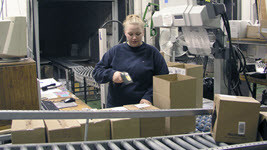
Product preparationEmployees unpack the returned items, perform an initial check of the customer-related data, and dispose of the packaging material. The individual items are then sent via conveyor belt for product assessment. The unpacked items are then fed onto the sorter by computer-controlled cameras. These cameras recognize all customer- and product-related data and also register the reasons for the return. If the cameras cannot clearly identify the data on the return labels, the returns are routed via an automatic lifting device for manual processing.

MERCHANDISE ASSESSMENT
Textiles make up the majority of incoming returns. At nearly 200 computer-aided workstations, the items are first identified using their barcode labels. Employees scan the item and check whether the goods match the specified data. The employees involved in merchandise assessment possess specially trained expertise to carefully check all items for newness.

Up to 98 percent of returned textiles are resold, with only about two percent requiring reprocessing. Subsequently, 80 percent of these can be reintegrated into inventory as new.

In cases where a returned item is declared not to be in new condition, it is either returned to the manufacturer, resold at a discount, or destroyed.

PACKAGING
If the items are assessed as being in like-new condition, they are automatically repackaged in most cases. They are transported via conveyor belt to one of the film packaging machines, where so-called polypackers automatically seal the items in film and affix new barcode labels. Each machine can seal more than 1,000 items per hour. Afterwards, the sorter directs the majority of the items to restocking.

RE-STOCKING
Larger items and shoes are sorted manually. The remaining items, however, are automatically collected in return bins and prepared for immediate resale. Using item barcodes, volume specifications, and quantity limits, the sorter can optimally assemble and utilize these bins.

Conveyor belts transport the filled containers to the goods dispatch area and the corresponding loading points. There, they are loaded fully automatically for transport.

Simplifying the re-sorting process through dynamic intermediate buffers

However, returns intended for resale do not necessarily have to be returned to the original warehouse. In some cases, they can be stored in a dynamic buffer, where retailers keep (primarily fast-moving) goods in easily accessible locations within the warehouse until they are sold. The advantage of these buffers lies, firstly, in the reduced logistical lead time and the resulting faster availability of the goods for sale. Secondly, it reduces the effort required for storing returned goods. However, their use is not always economically viable, as it requires a "critical" quantity of goods to be profitable. Therefore, in this specific case, a higher volume of returns may be what makes setting up a buffer worthwhile.

Strategies for avoiding returns

The problem of exceptionally high return rates is not unique to Germany, although the situation is particularly strained here. But why is the situation so different in France or England? Their online marketplaces are characterized by customers returning up to four times fewer products than their German counterparts.

Return prevention can begin with the fact that our European neighbors prefer to pay by credit card or prepayment, and sometimes even by check (in France). According to retailers, the return rate is directly related to the payment methods offered. In Germany, almost two-thirds of end customers order on account. They are accustomed to only paying for goods once they have received them. This tempts customers to order more than they actually intend to keep. As a result, an average of four out of ten ordered items are returned to the sender, according to industry figures. This makes Germans the European champions in returning goods. In France, for example, retailers ship 90 percent of orders only after prepayment, which significantly increases the reluctance to return purchased items.

For companies, adding credit card payments while simultaneously reducing payments on account represents a first step towards improving their return rate.

Furthermore, surveys among participating retailers consistently show that detailed product descriptions and accurate product presentations are the foundation for low return rates. As a result, retailers are increasingly providing their customers with as much information as possible upfront: zoom functions, 360° views, detailed product descriptions, and customer reviews already have a positive impact on return rates. Size charts can also help keep the number of returns to a minimum. For technical devices, it is also important to provide customers with the option of contacting the retailer if needed, in addition to detailed product information.

Appealing to customer purchasing behavior also helps. For example, the French luxury goods retailer Vente Privée openly communicates the dilemma of returns to the press and its more than 17 million customers in Europe. Jean-Michel, the company's CEO, explains: "We tell our members: We offer branded goods at very competitive prices. If you want to continue to do so, we both have to play by the rules." According to Guarneri, the company has been very successful with this strategy.

Conclusion

The profitability of online retailers hinges on the efficient handling of returns. They are therefore compelled to optimize their returns logistics to keep costs under control. Crucially, in addition to preparatory measures to reduce the return rate, it is essential to reintegrate returned goods into inventory as quickly as possible and prepare them for resale. This is best achieved by companies with sophisticated logistics and extensive automation in their returns warehouses. Only in this way can goods classified as new be returned to the market within the shortest possible time.


Keep in touch

other topics

  • E-commerce and warehouse logistics
    E-commerce and warehouse logistics - growth engine and challenge...
  • Manage returns fully automatically
    Returns management: Manage returns fully automatically - desire & reality...
  • Smart logistics for start-ups
    Smart logistics for startups - growth, competition, logistics: success strategies for online retailers...
  • Graphic sort2ship
    sort2ship - the efficient sorting solution for warehouse logistics...
  • Robotics in warehouse logistics
    Robotics in warehouse logistics - why it's not (quite) ready yet...
  • Urbanization & Working Conditions: Growing need for automation in fresh and refrigerated logistics
    Smart logistics solutions: Increasing demand for fresh logistics due to urbanization and the challenge of refrigerated logistics...
  • Autonomous warehouse logistics
    Is it coming, warehouse logistics without people?...
  • Refrigerated Logistics: Challenges of Cold Storage - From Technology to Temperature Control
    Solution and example of frozen storage: Fresh logistics and refrigerated logistics represent a demanding challenge in the supply chain...
  • Bossard Germany expands warehouses and optimizes processes
    Bossard Germany expands warehouse and optimizes processes - A milestone in warehouse logistics for even more satisfied customers | Warehouse optimization...
Partner in Germany and Europe - Business Development - Marketing & PR

Your partner in Germany and Europe

  • 🔵 Business Development
  • 🔵 Trade Fairs, Marketing & PR

Xpert.Digital R&D (Research & Development) in SEO / KIO (Artificial Intelligence Optimization) - NSEO (Next-gen Search Engine Optimization) / AIS (Artificial Intelligence Search) / DSO (Deep Search Optimization)Contact - Questions - Help - Konrad Wolfenstein / Xpert.DigitalInformation, tips, support & advice - digital hub for entrepreneurship: start-ups – business foundersArtificial Intelligence: Large and comprehensive AI blog for B2B and SMEs in the commercial, industrial and mechanical engineering sectorsBlog/Portal/Hub: Logistics consulting, warehouse planning or warehouse consulting – storage solutions and warehouse optimization for all types of storageBlog/Portal/Hub: Augmented & Extended Reality – Metaverse planning office/agencyBlog/Portal/Hub: Outdoor & roof systems (also industrial and commercial) - Solar carport advice - Solar system planning - Semi-transparent double glass solar module solutions️Blog/Portal/Hub: Smart & Intelligent B2B - Industry 4.0 -️ Mechanical engineering, construction industry, logistics, intralogistics - Manufacturing industry - Smart Factory -️ Smart Industry - Smart Grid - Smart PlantIndustrial Metaverse online configuratorOnline solar system roof & area plannerUrbanization, logistics, photovoltaics and 3D visualizations Infotainment / PR / Marketing / Media 
  • Material Handling - Warehouse Optimization - Consulting - With Konrad Wolfenstein / Xpert.DigitalSolar/Photovoltaics - Consulting Planning - Installation - With Konrad Wolfenstein / Xpert.Digital
  • Connect with me:

    LinkedIn Contact - Konrad Wolfenstein / Xpert.Digital
  • CATEGORIES

    • Logistics/intralogistics
    • Artificial Intelligence (AI) – AI blog, hotspot and content hub
    • New PV solutions
    • Sales/Marketing Blog
    • Renewable energy
    • Robotics/Robotics
    • New: Economy
    • Heating systems of the future - Carbon Heat System (carbon fiber heaters) - Infrared heaters - Heat pumps
    • Smart & Intelligent B2B / Industry 4.0 (including mechanical engineering, construction industry, logistics, intralogistics) – manufacturing industry
    • Smart City & Intelligent Cities, Hubs & Columbarium – Urbanization Solutions – City Logistics Consulting and Planning
    • Sensors and measurement technology – industrial sensors – smart & intelligent – ​​autonomous & automation systems
    • Augmented & Extended Reality – Metaverse planning office / agency
    • Digital hub for entrepreneurship and start-ups – information, tips, support & advice
    • Agri-photovoltaics (agricultural PV) consulting, planning and implementation (construction, installation & assembly)
    • Covered solar parking spaces: solar carport – solar carports – solar carports
    • Power storage, battery storage and energy storage
    • Blockchain technology
    • NSEO Blog for GEO (Generative Engine Optimization) and AIS Artificial Intelligence Search
    • Digital intelligence
    • Digital transformation
    • E-commerce
    • Internet of Things
    • USA
    • China
    • Hub for security and defense
    • Social media
    • Wind power / wind energy
    • Cold Chain Logistics (fresh logistics/refrigerated logistics)
    • Expert advice & insider knowledge
    • Press – Xpert press work | Advice and offer
  • Further article: E-commerce and warehouse logistics – growth engine and challenge
  • New article: Delivery time – THE logistics topic in 2014 – The trend that is redefining delivery times
  • Xpert.Digital overview
  • Xpert.Digital SEO
Contact/Info
  • Contact – Pioneer Business Development Expert & Expertise
  • contact form
  • imprint
  • Data protection
  • Conditions
  • e.Xpert Infotainment
  • Infomail
  • Solar system configurator (all variants)
  • Industrial (B2B/Business) Metaverse configurator
Menu/Categories
  • Managed AI Platform
  • AI-powered gamification platform for interactive content
  • LTW Solutions
  • Logistics/intralogistics
  • Artificial Intelligence (AI) – AI blog, hotspot and content hub
  • New PV solutions
  • Sales/Marketing Blog
  • Renewable energy
  • Robotics/Robotics
  • New: Economy
  • Heating systems of the future - Carbon Heat System (carbon fiber heaters) - Infrared heaters - Heat pumps
  • Smart & Intelligent B2B / Industry 4.0 (including mechanical engineering, construction industry, logistics, intralogistics) – manufacturing industry
  • Smart City & Intelligent Cities, Hubs & Columbarium – Urbanization Solutions – City Logistics Consulting and Planning
  • Sensors and measurement technology – industrial sensors – smart & intelligent – ​​autonomous & automation systems
  • Augmented & Extended Reality – Metaverse planning office / agency
  • Digital hub for entrepreneurship and start-ups – information, tips, support & advice
  • Agri-photovoltaics (agricultural PV) consulting, planning and implementation (construction, installation & assembly)
  • Covered solar parking spaces: solar carport – solar carports – solar carports
  • Energy-efficient renovation and new construction – energy efficiency
  • Power storage, battery storage and energy storage
  • Blockchain technology
  • NSEO Blog for GEO (Generative Engine Optimization) and AIS Artificial Intelligence Search
  • Digital intelligence
  • Digital transformation
  • E-commerce
  • Finance / Blog / Topics
  • Internet of Things
  • USA
  • China
  • Hub for security and defense
  • Trends
  • In practice
  • vision
  • Cyber ​​Crime/Data Protection
  • Social media
  • eSports
  • glossary
  • Healthy eating
  • Wind power / wind energy
  • Innovation & strategy planning, consulting, implementation for artificial intelligence / photovoltaics / logistics / digitalization / finance
  • Cold Chain Logistics (fresh logistics/refrigerated logistics)
  • Solar in Ulm, around Neu-Ulm and around Biberach Photovoltaic solar systems – advice – planning – installation
  • Franconia / Franconian Switzerland – solar/photovoltaic solar systems – advice – planning – installation
  • Berlin and the surrounding area of ​​Berlin – solar/photovoltaic solar systems – consulting – planning – installation
  • Augsburg and the surrounding area of ​​Augsburg – solar/photovoltaic solar systems – advice – planning – installation
  • Expert advice & insider knowledge
  • Press – Xpert press work | Advice and offer
  • Tables for desktop
  • B2B procurement: supply chains, trade, marketplaces & AI-supported sourcing
  • XPaper
  • XSec
  • Protected area
  • Pre-release
  • English version for LinkedIn

© December 2025 Xpert.Digital / Xpert.Plus - Konrad Wolfenstein - Business Development