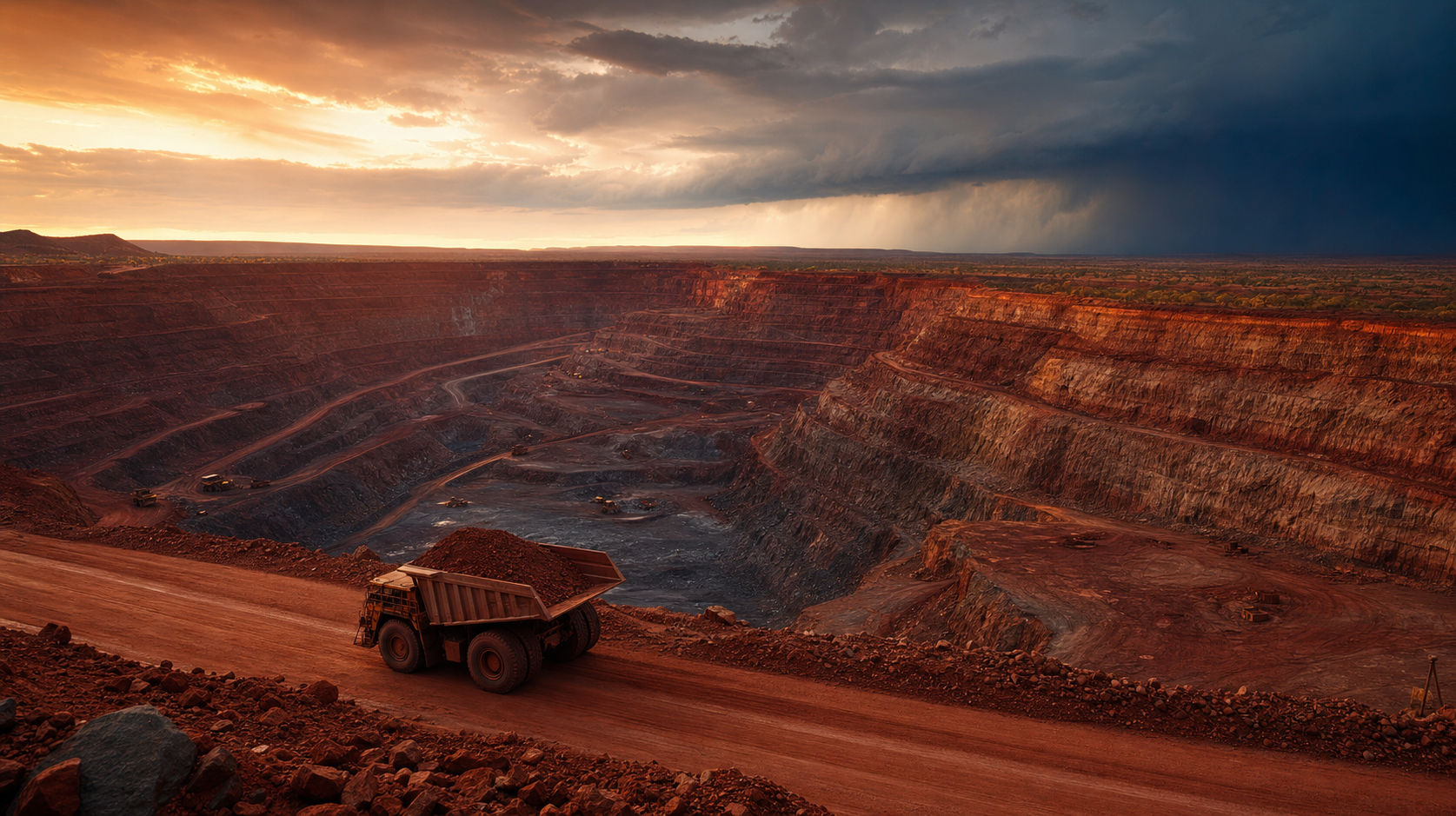
The iron ore shock: China's secret plan against Australia's mining giants – Image: Xpert.Digital
The Billion Dollar Trap: Is China's New Purchasing Cartel Destroying Australia's Economy?
When the best customer dictates: Australia's dangerous dependence on China
Resource war over iron ore: Why Australia is now resorting to drastic countermeasures
For decades, iron ore was the undisputed guarantee of Australia's unstoppable economic rise. The rust-red rock from Western Australia's Pilbara region brought in billions and made the continent one of the world's most influential resource-rich nations. But this unprecedented boom has come at a risky price: an overwhelming and strategic dependence on its largest customer – China. While Australia profited for years from astronomical profit margins, Beijing is now radically changing the rules of the game. With a state-created purchasing cartel and massive investments in African mega-mines, China is building unprecedented geopolitical pressure. For Australia, the once highly lucrative trade is increasingly becoming a strategic trap. The following text examines the complex power architecture behind the global iron ore trade, Australia's desperate search for countermeasures, and the pressing question of whether the resource-rich country can still escape the growing dictates of its most powerful customer.
How China is strategically expanding its purchasing monopoly: When the buyer resorts to dictating – Australia's raw material dependency becomes a geopolitical trap
The foundation of a continent: What iron ore means for Australia
Australia is one of the world's leading resource-rich nations, and no single commodity shapes the country's economic destiny as profoundly as iron ore. With exports reaching nearly 138 billion Australian dollars last year alone, iron ore is not only the most important single export category but also a structural pillar of the entire economy. To put this in perspective, all Australian ports combined contribute approximately 264 billion Australian dollars annually to the gross domestic product – and a large portion of these cargo flows consists of the rust-red rock from the Pilbara region in Western Australia. The two largest producers, Rio Tinto and BHP, together extract hundreds of millions of tons a year there, flanked by Fortescue as the third major player. This trio controls around 52 percent of the world's maritime trade in iron ore, thus securing Australia's undisputed dominance as a global supplier.
This market position has generated enormous wealth over decades. But precisely because Australia concentrates its iron ore exports so heavily on a single customer, the country's economic base is riddled with a structural vulnerability that has long been underestimated. China purchases nearly 85 percent of all Australian iron ore shipments, and the bilateral trade volume between the two countries recently amounted to around 280 billion Australian dollars. Five percent of Australia's gross domestic product alone is directly dependent on iron ore exports to China. A dependency of this magnitude is not merely an economic risk – it is a geopolitical tool that Beijing is increasingly willing to use.
The Architecture of Demand Power: How China is Building its Purchasing Cartel
In 2022, China established the China Mineral Resources Group – better known by its acronym CMRG. This state-owned enterprise was created with a clear mandate: to consolidate China's iron ore imports, which were scattered across dozens of steel mills and traders, thereby gaining significantly more negotiating power vis-à-vis the Australian mining giants. Around 70 percent of China's iron ore imports are now said to be channeled through this institution. In November 2025, the CMRG held its first annual meeting in Beijing and elected its own committees for the first time – a demonstrative act intended to show that the organization was not a temporary experiment, but a permanent part of the Chinese state apparatus.
The history of the CMRG is directly linked to China's historical frustration with iron ore pricing. Although China consumes around 70 percent of the world's maritime iron ore trade, the price was traditionally set based on Western benchmarks such as the Platts Index – a mechanism that Chinese analysts considered absurd. With production costs sometimes below ten US dollars per ton, market prices occasionally reached 130 dollars, securing gross margins of more than 50 percent for BHP, Rio Tinto, and Fortescue for many years. From Beijing's perspective, the CMRG is the institutional lever to correct this profit distribution.
The effectiveness of this leverage was strikingly demonstrated in the autumn of 2025. At that time, the CMRG informed steel mills and traders that they should temporarily refrain from purchasing new shipments of BHP iron ore – particularly shipments denominated in US dollars. BHP shares subsequently fell by as much as five percent in London. Australian Prime Minister Anthony Albanese publicly expressed his concern, and comparisons to the 2020 coal embargo were inevitable. Although immediate escalation did not occur, and the first BHP shipments were eventually resold shortly after the Chinese National Day holiday, the episode illustrated the new power structure: the CMRG does not need to impose a formal boycott to exert pressure. Creating uncertainty is sufficient.
Step by step – How small concessions trigger major erosion
What is particularly alarming in this dispute is not the dramatic individual conflict, but the creeping accumulation of small concessions that, in the long run, add up to a fundamental deterioration of the negotiating position of Australian mining companies. Industry sources describe a tactic whereby the CMRG, in each round of negotiations, secures moderate discounts that appear justifiable on their own—freight surcharges, quality deductions, payment terms—which, over several years, accumulate into a significant price erosion. For example, last year the CMRG reportedly secured a freight-linked discount of one US dollar per ton from Rio Tinto for certain large cargo vessels.
The involvement of Gina Rinehart's Hancock Prospecting goes even further: The CMRG became the sole authorized Chinese seller of iron ore from their Roy Hill mine. This means that the Chinese state-owned buyer not only acts as a purchaser but also effectively controls the distribution of Australian iron ore in the Chinese market – a dual role that deprives Australian producers of any direct market access to end users. In December 2025, the CMRG extended its purchasing restrictions to a second BHP product line, which analysts interpreted as a serious escalation signal: Never before had the organization blocked multiple product categories from a single supplier simultaneously.
Market power against market power: The demand for coordinated resistance
In light of these developments, several major Australian mining companies have called on the government under Prime Minister Albanese to take action. Their core demand: that the Australian government examine the legal framework under which domestic producers can negotiate jointly or at least exchange information without violating Australian antitrust law. Currently, such coordination is prohibited – and this is no coincidence, but rather the consequence of a precedent from 2010, when the Australian Competition and Consumer Commission (ACCC) blocked the planned merger of the iron ore divisions of BHP and Rio Tinto.
Graeme Samuel, the ACCC's chairman at the time, now sees things differently. In a remarkable statement, he declared that cooperation between the major mining companies was more acceptable under current conditions. Australia had to compete in a market where a single major buyer had centralized its purchasing – and in such a situation, bargaining power on the supplier side was not anti-competitive, but necessary. It would be a historic turning point: Two companies that had been legally prevented from pooling their market power for 16 years would now suddenly be allowed to act jointly – because their counterpart was already doing so.
Meanwhile, Rio Tinto and BHP signaled initial operational steps toward collaboration. In January 2026, both companies signed non-binding letters of intent regarding cooperation on adjacent iron ore mines in the Pilbara region, which could potentially unlock up to 200 million tons of additional ore. The collaboration aims to share existing infrastructure at minimal additional cost. However, the final investment decision is still pending, and regulatory approvals and the involvement of indigenous landowners are also required.
The Simandou Project: China's strategic trump card beyond Australia's borders
The complete picture includes a project whose long-term significance for Australia can hardly be overstated: the Simandou mine in Guinea, West Africa. This iron ore deposit is considered the largest and highest-quality undeveloped iron ore deposit in the world – with estimated reserves of 2.4 billion tons of ore with an iron content of 65 percent. The project officially commenced operations in November 2025, and the first export shipments left Guinea for China in December 2025.
The project's ownership structure reads like a strategic manifesto: Chinese state-owned enterprises – primarily Baowu Steel and Chinalco – hold over 50 percent of the equity stakes in the southern and northern blocks. With a planned annual capacity of 120 million tons, Simandou, at full capacity expected around 2030, will structurally transform the global iron ore market. This would roughly correspond to one-eighth of Australia's total annual export volume – a new supply source directly controlled by China.
China is pursuing two goals simultaneously: First, it is geographically diversifying its iron ore imports, thereby reducing its dependence on Australia. Second, it gains a new bargaining chip in negotiations – the ability to at least partially replace Australian ore with Guinean ore without jeopardizing its own steel supply. Forecasts from investment banks like Bernstein already predict that the iron ore price will fall to around US$96 per ton in 2026, while the BMI forecast suggests that a level of US$78 is even possible in the long term. For Australian mining companies, which are currently still seeing prices of around US$102 per ton, this would represent a significant blow.
🎯🎯🎯 Global Sourcing & Commodity Trading with integrated logistics


Raw materials, global procurement & trade - Image: Xpert.Digital
State-of-the-art cargo planes, optimized transport routes, and multimodal logistics chains are interchangeable—they can be bought, leased, or outsourced. What money can't buy are direct contacts with producers in Peruvian mines, reliable supply relationships in the CIS countries, and years of built-up trust in markets that are unfamiliar to outsiders. The decisive competitive advantage in global commodity trading lies not in transporting the good from A to B, but in knowing where the good comes from, who produces it, and how to gain access before others even know the market exists. Whoever owns the network sets the price. Everyone else pays it.
More information here:
From prosperity to vulnerability to blackmail: Why Australia's resource model is faltering
Raw materials as a geopolitical weapon: China's broader resource strategy
The iron ore issue is not an isolated matter, but rather part of a broader Chinese resource strategy aimed at controlling critical minerals on a global scale. The Center for Strategic and International Studies (CSIS) aptly describes this dynamic: Chinese companies are increasingly acquiring stakes in rare earth, lithium, nickel, and copper resources—not primarily as investments, but as a strategic means of securing future supply chains and denying competitors access. China now controls over 90 percent of global rare earth processing capacity and more than half of global mining production. In the lithium sector, China dominates the processing stage through direct investments and trade relationships, despite geographically dispersed mining locations.
Xi Jinping himself described this dominance in strategic technologies and raw materials as China's strategic trump card in 2020. The export controls that China imposed on rare earths and magnets in April and October 2025 illustrate how concretely this instrument can be used. For Australia, as a resource-rich country, this represents a twofold threat: on the buyer side, from the consolidated purchasing power of the CMRG, and on the investor side, from Chinese capital inflows that are deliberately building influence in strategically important mining companies.
China's investment offensive and Canberra's resistance: The case of Northern Minerals
The Australian government has responded to this investment boom with a series of countermeasures. The most prominent recent case involves Northern Minerals, an Australian company developing a significant deposit of heavy rare earth elements—particularly dysprosium and terbium—in Western Australia. These elements are essential for high-performance magnets in electric vehicles and military applications. In May 2026, Treasury Minister Jim Chalmers ordered six shareholders with Chinese ties to divest their shares within two weeks. Together, these investors held nearly 27 percent of the company.
This was not the first government intervention of this kind. As early as 2023, Chalmers had prevented a Chinese-linked fund from increasing its stake in Northern Minerals, and in 2024 he issued initial divestment orders for five foreign shareholders – one of whom refused to comply and had to be summoned to federal court. The persistence with which Australian authorities are pushing Chinese holdings out of this company demonstrates that Canberra no longer treats critical mineral resources as mere investment assets, but rather as security-sensitive infrastructure.
As expected, China protested these moves. Beijing demanded that the rights of Chinese investors be protected and that a transparent, non-discriminatory investment environment be created. From a Chinese perspective, this amounts to economic protectionism under the guise of national security. From an Australian perspective, however, it is about preventing a single foreign power from gaining de facto control over resources that are crucial for its own defense industry, energy transition, and long-term economic survival. Both positions are internally consistent – and that is precisely why the conflict is so difficult to resolve.
The structural trap: Why simple solutions don't exist
The real analytical challenge lies in recognizing that Australia's dilemma cannot be resolved by a single measure. The concentration of roughly 85 percent of iron ore exports on a single buyer is the result of decades of geographical, logistical, and market-structural realities – Australia is closer to China than any other major supplier, the Pilbara deposits are of exceptional quality and size, and the entire infrastructure of the iron ore industry has been geared towards the Chinese market. Rapid diversification of the buyer structure is not hindered by a lack of political will, but by hard economic realities.
At the same time, Australian mining companies cannot simply reduce their supply to create price pressure. Any unilateral production cut by one Australian producer is offset by the others – a classic prisoner's dilemma that structurally weakens suppliers. This is precisely why the debate about permissible coordination on the supply side is so politically sensitive. It touches upon the foundations of Australian competition law, while simultaneously putting Australia's export interests at stake.
Added to this is a deeper economic uncertainty: Chinese steel demand will decline structurally, not just cyclically. The crisis in the Chinese real estate market has triggered a wave of excess steel production and driven down prices – Rio Tinto recorded a 14 percent year-on-year decline in profits in 2025, primarily due to lower iron ore prices. At the same time, the steel surplus from China is flooding global markets and putting downward pressure on global steel prices, increasing the pressure on iron ore buyers to reduce their own purchasing costs.
Australia's search for alternatives: Green iron and market diversification
Faced with this multifaceted threat, Australia is seeking structural solutions beyond short-term negotiation tactics. A key initiative is the development of domestic value creation through the production of so-called green iron – iron ore refined into green steel using hydrogen instead of coke. Rio Tinto, BHP, and BlueScope Steel are jointly exploring the construction of a pilot plant for an electric smelter in Australia. However, commercial production before the 2030s is considered unlikely.
Alongside this, Australia is attempting to underpin its foreign policy diversification with economic factors. The Albanese government is intensifying trade relations with Japan, India, and the ASEAN countries. Economists at the Commonwealth Bank note that Australia's export dependence on China is structurally declining—albeit from a very high level and at a significantly slower pace than politically desirable. Australia's trade balance shrank in 2025 to its lowest level since 2018 because the value of commodity shipments to China fell, while at the same time cheap Chinese imports—from electric vehicles to e-commerce goods—increased.
The Allianz country risk analysis identifies Australia's dependence on Chinese demand as one of the country's key structural weaknesses. Australia's gross domestic product is projected to grow by 2.4 percent in 2026 – but this forecast is explicitly contingent on persistent geopolitical risks and a further weakening of Chinese demand for raw materials. A sustained decline in iron ore prices towards the forecasts of $96 or even $78 per ton would create significant budget deficits and strain the social infrastructure of a country already suffering from a budget deficit that most recently stood at 2.7 percent of GDP.
Between Beijing and Washington: Australia's geopolitical tug-of-war
Australia's situation is also complex because the iron ore issue is not being resolved in an economic policy vacuum. The country is closely linked to the US through AUKUS and the Quad Initiative and clearly positions itself within the American-led Indo-Pacific security alliance. This strategic orientation increases China's incentive to use Australia's economic dependence as leverage – just as it did with coal, wine, and barley in 2020 after launching an investigation into the origins of the Covid-19 virus, by imposing informal import restrictions.
At the same time, the history of this relationship shows that both sides have an economic interest in stability that limits dramatic escalations. Australia cannot ignore its dependence on iron ore, and China cannot do without Australian iron ore—at least not immediately. Chinese analysts describe this relationship with the term "dou er bu po," which can be translated as "fighting without breaking." This is the current state of affairs: a structurally tense, increasingly institutionally organized confrontation that is nevertheless kept in check by mutual self-interest.
The crucial question is whether this balance is sustainable. As the Simandou project ramps up, China will strengthen its negotiating position year by year. Until Simandou reaches its full capacity of 120 million tons annually – projected around 2030 – China realistically has the option, should negotiations fail, to at least partially replace Australian ore with Guinean ore. This will shift the structural balance of power to Australia's disadvantage in the long term.
A resource empire undergoing structural change
Australia's iron ore industry is not facing imminent collapse, but rather a gradual, structural erosion of its bargaining power. China is systematically expanding its institutional purchasing power through the CMRG, diversifying its sourcing through projects like Simandou, and using its investment capital to secure stakes in strategically important resources worldwide. Australia is responding with defensive measures on the investment side, hesitant reform of competition law, and the establishment of new trade partnerships – steps that are necessary but too slow to significantly reduce its structural dependence in the foreseeable future.
The truly provocative insight from this complex situation is this: the successful model of the Australian resource economy, geared towards maximizing production for the Chinese market, contained the seeds of its own strategic vulnerability from the very beginning. The deeper the integration, the greater the leverage of the other side. For decades, Australia sold iron ore and bought prosperity. Now the country must learn that this same prosperity came at the price of economic blackmail, a vulnerability that only becomes fully apparent when the buyer stops asking and starts dictating.
Your contact for raw materials ⛏️ Global sourcing 🚢🌐 & trading 📦

Dmitry Kovalenko
I would be happy to serve as your personal advisor.
Dmitry Kovalenko
Tel: +49 7348 4088 961
Your contact for raw materials ⛏️ Global sourcing 🚢🌐 & trading 📦

Konrad Wolfenstein
I would be happy to serve as your personal advisor.
Konrad Wolfenstein
Email: wolfenstein@xpert.Digital
Our global industry and economic expertise in business development, sales and marketing

Our global industry and economic expertise in business development, sales and marketing - Image: Xpert.Digital
Industry focus areas: B2B, digitalization (from AI to XR), mechanical engineering, logistics, renewable energies and industry
More information here:
A thematic hub offering insights and expertise:
- Knowledge platform covering global and regional economies, innovation and industry-specific trends
- A collection of analyses, insights, and background information from our key areas of focus
- A place for expertise and information on current developments in business and technology
- A hub for companies seeking information on markets, digitalization, and industry innovations