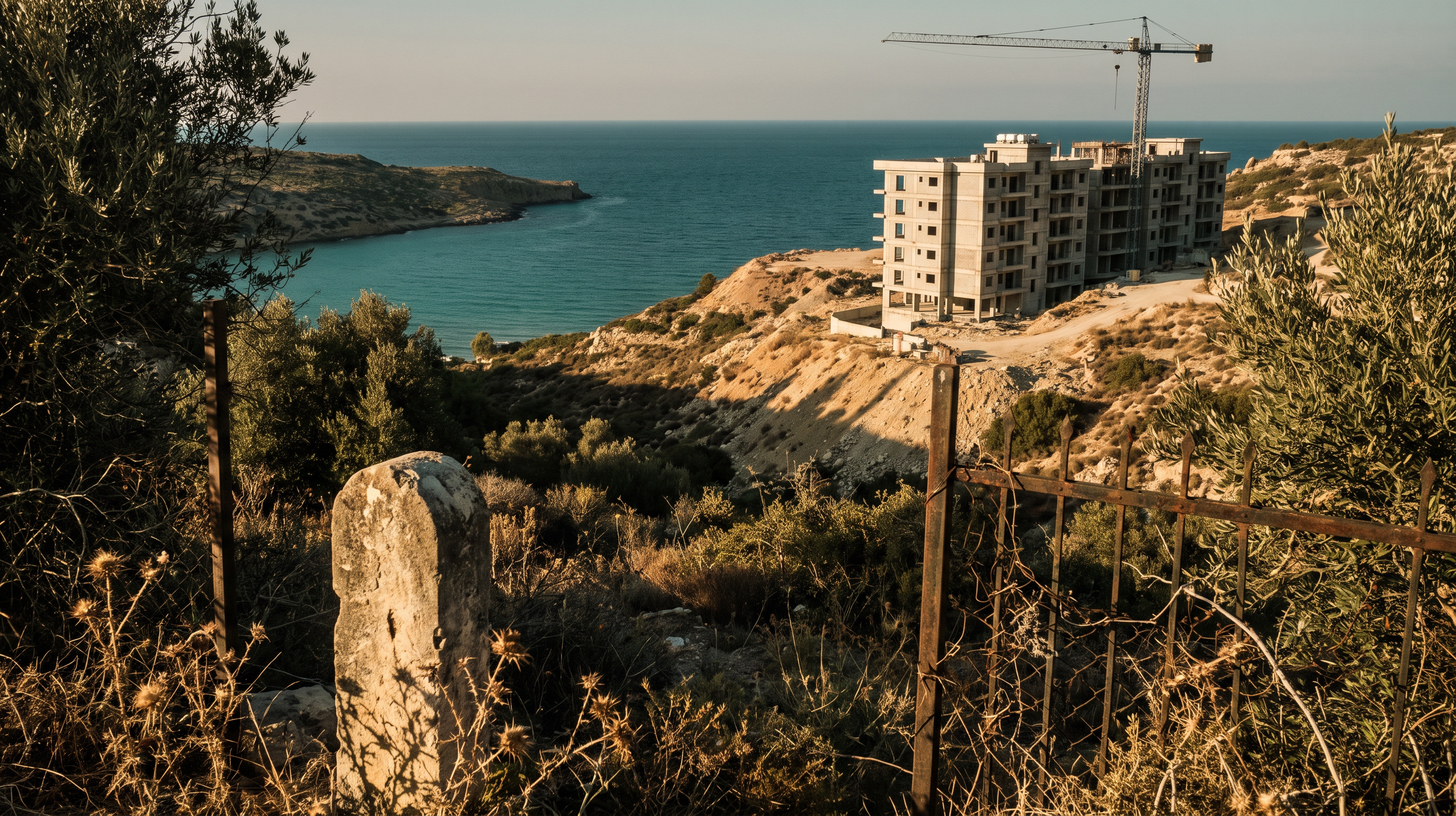
Real estate trap in Northern Cyprus: Why German buyers face prison sentences and total loss – Creative image on the topic, created with AI: Xpert.Digital
Dream house with a sea view? The dark secret behind the real estate boom in Northern Cyprus
Up to 7 years in prison: This is why buying a house in Northern Cyprus is now extremely dangerous for EU citizens
German real estate agent in pre-trial detention: The bitter truth about Northern Cyprus's cheap dream properties
Anyone dreaming of owning property on the Mediterranean inevitably comes across Northern Cyprus. Real estate agents and developers tout the region as the last affordable growth market in Europe: newly built apartments with direct sea views, extremely low entry prices, and fantastic returns of up to twelve percent are increasingly attracting German investors to the island. But what appears in glossy brochures and on social media to be a lucrative insider tip turns out, upon closer inspection, to be a legal minefield with enormous potential for danger. In the shadow of the real construction boom, a historical property conflict simmers, in which two completely incompatible legal systems clash. Those who buy here are often investing in land that, according to international law, still belongs to displaced Greek Cypriots. And the EU-recognized Republic of Cyprus in the south is now taking serious action: with European arrest warrants, years-long prison sentences, and the threat of asset seizure in their home countries, it is cracking down hard on buyers, real estate agents, and developers. The following in-depth analysis reveals why the low price per square meter in northern Cyprus is actually the premium for an incalculable risk, and why even German real estate agents are not safe from prosecution.
Real estate in Northern Cyprus: When the sea view is on someone else's land: A market with two legal realities
Northern Cyprus is being marketed to German and other European investors as a Mediterranean growth market: new apartments near the sea, low entry prices, flexible repayment plans, and returns that established EU markets can scarcely promise anymore. This narrative isn't entirely false. Precisely for that reason, it's dangerously simplistic. In northern Cyprus, a genuine construction boom is colliding with an unresolved property ownership issue, an internationally unrecognized administration, two incompatible land registry systems, and increasingly rigorous prosecution by the Republic of Cyprus. Therefore, the buyer isn't simply acquiring an apartment. They're taking on a bundle of ownership, enforcement, currency, developer, and liquidity risks, the correlation of which is rarely considered in standard return calculations.
The internationally recognized Republic of Cyprus has been a member of the European Union since 2004. However, it has not controlled the north of the island since 1974. The self-proclaimed Turkish Republic of Northern Cyprus is recognized exclusively by Turkey. EU law is suspended in the territory to the extent that the government of the Republic of Cyprus does not exercise effective control. The Republic nevertheless considers its property registers from before 1974 to be valid. The Northern Cypriot administration created its own titles and reallocated land after 1974. Therefore, one and the same plot of land may appear transferable in Kyrenia or Famagusta with a Northern Cypriot koçan, while the land register of the Republic of Cyprus still lists a displaced Greek Cypriot or their heirs.
This is not an abstract dispute about historical legitimacy. Around 200,000 Greek Cypriots were expelled from the north in 1974. According to more recent analyses based on land registry data, there are 105,612 owners of affected properties; the recorded area amounts to approximately 1.29 billion square meters. Older conflict research speaks of about 46,000 abandoned properties and a Greek Cypriot share of 78 percent of private land in the north. The figures use different units and categories, but show the same order of magnitude: Disputed property is not a marginal segment of the North Cypriot market, but its structural core.
Historical proportions help to put things into perspective. In 1974, Turkish Cypriots constituted approximately 18.4 percent of the island's population. After the intervention, the Turkish army controlled around 37 percent of the territory. Claims that Turkish Cypriots owned only about ten percent of the land are based on specific political negotiation scenarios and are not consistent with all land registry data. More reliable is the official Cypriot figure that Greek Cypriots owned approximately 78 percent of the private land in the subsequently occupied territory before 1974. Anyone who speaks of a normal foreign real estate market today ignores this historical over-ownership.
The Künzel case as a warning signal for European distribution
The case of Ewa Isabella Künzel demonstrates that the risks are not limited to buyers or those traveling across the Green Line. The German real estate agent and managing director of VePa GmbH Immobilien from Aschaffenburg was arrested at Larnaca Airport on July 7, 2024. According to consistent reports, the suspicion against her began with a conversation on a flight in which she allegedly told a fellow passenger about her business dealings in the north. Media outlets described the fellow passenger partly as an off-duty police officer, and partly as Geadis Geadi, who later became an ELAM MEP. This discrepancy is of minor importance from a legal perspective, but it does call for critical source analysis regarding biographical details.
The charges against her evolved over the course of the proceedings. Initially, there were 56 counts, later 44, and finally 46. According to the most recently documented information, she is accused of, among other things, fraudulent transactions involving other people's land, using property without the consent of the registered owners, and money laundering. She is alleged to have advertised 19 plots of land in the occupied village of Agios Amvrosios (Esentepe in Turkish), purchased an apartment on disputed land, and acted as a real estate agent in five sales. The alleged proceeds, or commission, are stated to be approximately €169,150. The advertising included projects with names such as Olive Trees Village, Aelita, and Albatros; publicly available asking prices ranged from approximately €250,000 to €460,000. Künzel denies the charges. She is presumed innocent.
The case is also a textbook example of the rules of evidence and pre-trial detention. In October 2025, the criminal court in Nicosia, presided over by Judge Nicolas Georgiades, declared the search of the luggage and the seizure of the telephone, hard drive, and documents unconstitutional. The police had failed to sufficiently demonstrate a concrete connection between the items and the suspected crime; furthermore, a valid waiver of legal counsel had not been proven. The evidence was inadmissible, but the arrest itself was deemed lawful. This represented a significant, though not necessarily fatal, setback for the prosecution, as investigators were also relying on websites, social media, and evidence gathered in Germany.
In January 2026, the court rejected a renewed review of Künzel's release. At that time, she had been in pretrial detention for approximately 18 months. In March, another bail application was unanimously rejected. In May, the defense's objections to four European Investigation Orders issued on July 18 and 26, and September 2 and 13, 2024, were unsuccessful. The court held that the District Court of Nicosia had jurisdiction. An additional point of contention concerned the language of the proceedings: the court assumed that Künzel could follow the trial with Polish interpretation but ordered a German translation of one of the decisions. In June 2026, the Supreme Court also rejected her request to overturn the interlocutory decision and suspend the main proceedings through special legal remedies.
As of the research deadline of August 8, 2026, no published final verdict against Künzel could be verified. The most recent reliable court report, dated June 12, 2026, explicitly stated that the trial before the Nicosia Criminal Court was continuing. Earlier reports announcing a verdict date apparently referred to interim rulings. This distinction is crucial for a scholarly article: The case is a strong warning signal, but not yet a legally binding conviction.
From isolated incidents to systematic prosecution
Künzel is not the only case. Two Hungarian nationals were charged with 63 counts; they were accused of misappropriating approximately €271,000 and €271,744 respectively from the marketing and sale of projects in Kyrenia, Agios Amvrosios, and Akanthou. They later pleaded guilty to part of the charges and were convicted. Turkish Cypriot lawyer Akan Kürşat was arrested on New Year's Eve 2023 in a Rome hotel on the basis of a European Arrest Warrant and extradited to Cyprus in 2024. The underlying case involved unfinished property transactions from 2004 and 2005; according to British estimates, around 400 buyers lost more than €40 million.
The case of Simon Mistriel Aykut is particularly striking. The founder of the Afik Group was arrested at the Deryneia crossing in June 2024. In October 2025, after he pleaded guilty to 40 charges, the Nicosia Criminal Court sentenced him to five years in prison. The affected areas, totaling approximately 400,000 square meters, were valued at around €40 million. Projects in the Caesar series in Agios Amvrosios, Trikomo, Gastria, and Akanthou were specifically mentioned. This verdict refutes the assumption that the Republic of Cyprus would only take symbolic action against smaller intermediaries.
Law enforcement is intensified by political and civil society pressure. In 2024, the Cypriot Green Movement published a list of 24 companies accused of developing Greek Cypriot land. Among those listed were Lewis Trust Group, Arkin Group, DND Homes, Uzun Construction, Avrasya Construction, Özok Estate, Kıbrıs Developments, Noyanlar, Döveç Construction, NorthernLand, Akol Group, Özyalçın Construction, Carrington Group, and a German developer. This publication is not an official blacklist and does not, in itself, prove a crime. However, it does indicate which companies and projects are the subject of public debate and potentially under investigation. For investors, it would be negligent to dismiss such a list as mere propaganda; equally wrong to treat every mention as legally binding evidence.
Article 303A and the scope of Cypriot criminal law
The central provision is Article 303A of Chapter 154 of the Cypriot Penal Code, introduced by Law 130(I)/2006 and entering into force on October 20, 2006. It covers intentional, deceptive transactions involving another person's real estate. This includes sale, rental, transfer, encumbrance, and granting of use, as well as advertising, promotion, contracting, and acceptance of such transactions. The completed offense is punishable by up to seven years' imprisonment, and the attempt by up to five years' imprisonment. From the Republic's perspective, the relevant owner is the person registered in the Republic of Cyprus's Land Registry. The provision does not apply retroactively to acts completed before its entry into force but may cover subsequent advertising, brokering, or contractual acts.
Article 281 addresses the possession, cultivation, or use of land without the consent of the registered owner. An amendment of March 17, 2005, increased the then-existing maximum sentence from six months to two years and explicitly aimed to reach the threshold for a European Arrest Warrant. More recent versions and Cypriot appellate case law now stipulate up to five years' imprisonment or a fine of up to €10,000. The historical two-year term remains important for understanding the legislative history but is now obsolete as the maximum sentence.
For German real estate agents, it is particularly relevant that Article 303A covers not only physical sales in the north. Websites, social media videos, consultations, and contract preparation in Germany can be considered as promoting a transaction involving real estate in Cyprus. Whether this fulfills the required intent to deceive and territorial connection in a specific case is a matter of evidence. However, the risk cannot be eliminated by arguing that all activities took place in Germany.
Even German citizenship does not guarantee protection. Article 16, paragraph 2 of the Basic Law permits extraditions to EU member states, provided the rule of law is upheld. According to Section 80 of the German Act on International Legal Assistance in Criminal Matters (IRG), the extradition of a German citizen for prosecution generally requires a commitment to return them for the subsequent enforcement of their sentence and a significant connection between the offense and the requesting state. If this connection is lacking, additional requirements apply, including, regularly, dual criminality and a balancing of interests. The EU Framework Decision on the European Arrest Warrant waives the examination of dual criminality for 32 listed offenses with sufficient penalties. These include fraud and money laundering. A Cypriot legal classification as one of these offenses can therefore significantly reduce the protection against extradition.
Why a North Cypriot title does not automatically guarantee property security
Several types of titles are distinguished in the North Cypriot market. A Pre-1974 Turkish Title pertains to properties that belonged to Turkish Cypriot owners before the division of the country. A Pre-1974 Foreign Title refers to properties previously owned by foreign nationals. Both categories generally carry the lowest risk of disputed claims, provided the historical chain of ownership is genuine, unbroken, and free of encumbrances. They are scarce and often command a premium on the market. Industry figures cite 15 to 25 percent, but there is no official, transaction-based index for this. Even a historically unencumbered title does not protect against mortgages, double sales, missing building permits, or developer insolvency.
The Eşdeğer or Exchange title arose when Turkish Cypriots received points or replacement land in the north for property they had left behind in the south. Before 1974, the allocated land often belonged to a Greek Cypriot. Northern Cypriot law treats the exchange as the basis for ownership; however, the Republic of Cyprus does not automatically recognize the original loss of title. Therefore, the risk profile is not identical to that of a pre-1974 title. Crucial factors include the origin, the valuation of the exchange, any potential proceedings before the Immovable Property Commission, and the specific parcel of land.
TMD, Tahsis, or Allocation Titles are based on allocations by the Northern Cypriot administration, for example to settlers, fighters, or other beneficiaries, without necessarily requiring the relinquishment of equivalent property in the south. They typically carry the highest political and legal risk of reversal. However, the term TRNC Title is used inconsistently in marketing and can obscure both exchange and allocation arrangements. Those who only examine the title of the Koçan (title deed) will not understand the economic chain of claims.
The frequently encountered claim that exchange titles have been automatically cleared by the Immovable Property Commission is too broad. The Commission decides on individual applications and can order compensation, exchange, or return. This does not imply a general legalization of all titles created after 1974. Equally misleading is the statement that pre-1974 titles are internationally guaranteed. While they are significantly more secure in the event of a dispute, they, like any property, must be individually checked against the Republic of Cyprus's land registry, the documentation in Northern Cyprus, and with regard to all encumbrances.
The IPC resolves claims, but not the entire title dispute
In 2010, the European Court of Human Rights recognized the Immovable Property Commission in Northern Cyprus as a fundamentally effective domestic remedy in the case of Demopoulos v. Turkey. Some promotional materials infer from this that the European Court recognized the entire property regime in Northern Cyprus. This is incorrect. The Court required Greek Cypriot claimants, in principle, to first exhaust this available remedy. It did not declare the Turkish Republic of Northern Cyprus a recognized state, nor did it declare all titles issued by it to be indisputable property.
The Commission's record is considerable, but limited in light of the overall problem. By July 17, 2026, 8,715 applications had been received and 3,288 examined. Compensation awarded totaled £662.9 million, equivalent to just under €776 million. Only a few cases resulted in restitution or combined solutions: seven outright restitutions, eight restitutions with compensation, two exchange and compensation decisions, and a few exceptional cases. There is a significant backlog between submitted and completed applications. Furthermore, the former owners sometimes remain registered in the Republic of Cyprus's land register, even after compensation has been paid through the IPC. This creates additional information and coordination problems.
For buyers, this means that an IPC decision regarding a specific parcel can significantly alter the risk, but neither the mere existence of the commission nor a general inquiry replaces due diligence. The file number, scope of the decision, payment details, waivers, heirship status, and the entry in the land register must be clarified. Without these documents, a reference to IPC clearance is more of a sales pitch than due diligence.
Apostolides v. Orams: The claim can follow the buyer home
The civil law dimension was shaped by Apostolides v. Orams. On April 28, 2009, in case C-420/07, the European Court of Justice ruled that, under the EU rules then in force, judgments of Cypriot courts concerning real estate in the north must, in principle, be recognized and enforced in other member states, even though EU law is suspended in the north. The English Court of Appeal implemented this ruling on January 19, 2010. The British couple, the Orams, had to accept the consequences of a Cypriot judgment, even with respect to assets in the United Kingdom.
Economically, this is the decisive factor. While the property in Northern Cyprus may be protected from immediate enforcement by the Republic, the buyer may possess income, accounts, or real estate in Germany or another EU member state. The risk is therefore not limited to the purchase price and is not confined to the territory of the north. Legal costs, damages, and claims for injunctive relief or removal can reach the buyer's other assets. Since the United Kingdom left the EU, different enforcement rules apply there; however, for EU citizens, the fundamental message of the ECJ case remains as strong as ever.
A real estate boom without a reliable market benchmark
The North Cypriot market is large enough to appear professional, but statistically remarkably opaque. There is no independent, high-frequency house price index comparable to those published by the central bank or the statistics office in the south. Reliable annual transaction volumes in euros or pounds are also not consistently reported publicly. Many figures come from real estate agents, developers, or analysis platforms that evaluate asking prices rather than transactions officially recorded by a notary or land registry. Anyone attempting to derive a precise market size from this data is creating a false sense of accuracy.
A useful indicator is the number of purchase permits issued. According to data from northern Germany, 6,951 foreigners received permission to purchase property in 2024; this included 4,410 apartments, 1,186 single-family homes, and 568 plots of land. Following a relaxation of restrictions in May 2025, another 2,250 permits were issued by mid-July. However, permits are not the same as completed purchases and may lag behind the contracts. A publicly verifiable breakdown by British, German, Israeli, Russian, or Iranian nationals is lacking. Market reports traditionally cite British nationals as the largest group and describe growing demand from Germany, Russia, Israel, Iran, Kazakhstan, and the Gulf States. This trend is plausible, but the exact nationality percentages are marketing data, not official market statistics.
In terms of prices, supply analyses at least provide an order of magnitude. An evaluation of primary new-build supply put the median price at the end of 2024 at £172,000 for apartments and £456,000 for houses. The median price per square meter was £2,287 for apartments and £2,186 for houses. According to the analysis, apartment prices remained largely unchanged in 2024, while house prices rose by more than seven percent due to supply. Individual studios were advertised from around £70,000 in 2026, and typical off-plan one-bedroom units around £150,000. These are asking prices; discounts, closing costs, completion risks, and resale deductions are not reflected in them.
The contrast with the south is revealing. There, according to PwC analysis, real estate turnover in 2025 amounted to €6.5 billion; 15,853 residential transactions reached €4.4 billion. Foreign buyers accounted for approximately 28 percent of all transactions. Average apartment prices ranged from around €150,000 in the controlled district of Famagusta and €177,000 in Nicosia to €403,000 in Limassol. The central bank's housing price index rose by 7.06 percent in the fourth quarter of 2025 compared to the previous year. The south is by no means risk-free or cheap, but it offers EU law enforcement, recognized registries, bank financing, and verifiable data. The price difference is therefore not automatically undervaluation, but partly a premium for differing institutional quality.
Promised returns and the cost of risk
Northern Cypriot developers are advertising net rental yields of eight to twelve percent and annual capital appreciation of 15 to 25 percent for 2026. Examples include a studio apartment costing £70,000 with a monthly rent of £450 to £500, or, in a holiday rental model, £50 to £80 per night and 55 to 65 percent occupancy. Some developers promise six percent cashback on deposits during the construction phase. Such calculations are not worthless, but they are not independently verified proof of returns. A guaranteed return, in particular, is often nothing more than a cash flow pre-financed through the purchase price, later installments, or the developer's margin.
In the south, the average gross rental yield in the first quarter of 2026 was around 4.88 percent. For apartments, yields of approximately 4.7 to 5.5 percent were reported, depending on the source and segment; net yields are typically 1.5 to 2 percentage points lower. The apparent yield advantage of the north must therefore be weighed against vacancy rates, seasonal occupancy, management fees, furnishings, maintenance, unpaid guarantees, tax and transfer costs, and limited resale value. Even more important is the legal risk premium. A yield of ten percent does not compensate for a potential total loss if its probability of occurrence is unknown and correlated with the political scenario.
Lira, pound and the illusion of simple currency protection
Northern Cyprus uses the Turkish lira, but properties are often offered and sold in British pounds. For a buyer from the Eurozone, this creates not just a single, but a triple currency system. The purchase price and payment plan may be fixed in pounds, local rents may be agreed upon partly in pounds or euros, while wages, fees, and some operating costs are paid in lira. A weak lira can reduce local operating costs in euros, but at the same time erode the purchasing power of local tenants and increase construction costs for imported materials.
Inflation in the north reached approximately 83.6 percent in 2023. In March 2024, the annual rate stood at 94.45 percent; the consumer price index rose by 6.91 percent compared to the previous month alone. Such figures make nominal price increases a poor indicator of real value creation. A new building, denominated in pounds sterling, can increase in value while the local economy is impoverished in real terms. Dependence on Turkey exacerbates the problem: the north lacks an independent monetary policy, is heavily reliant on imports, and depends on Turkish transfers. Turkish support of 20.7 billion lira has been agreed upon for 2026. This stabilizes infrastructure and the state budget but further ties the market to Ankara's fiscal, interest rate, and foreign policies.
Off-plan purchases: When the contract is completed before the building is finished
Selling newly built properties off-plan is a key business model. Buyers pay upfront, and developers use the money to finance the land, construction, and sales. This can work in a growing market, but it shifts bank risks onto private buyers. Critical issues include missing individual land registers, unregistered purchase agreements, mortgages on the entire property, unclear building permits, changing building plans, and the sale of the same unit or the same share of the land to multiple buyers. If the developer becomes insolvent, the buyer is often left not as the owner, but as an unsecured creditor.
The AGA Development case demonstrates that this risk is historically real. Hundreds of British buyers lost substantial sums on unfinished properties. Even newer regulations cannot completely eliminate enforcement loopholes. Obtaining purchase approval from the Council of Ministers, registering a contract, and subsequently transferring individual title are all separate steps. Years can pass between taking possession and legal ownership. During this time, the developer's creditors, tax claims, or new statutory deadlines can alter the buyer's position.
The rules for foreigners changed several times in 2024, 2025, and again in May 2026. In May 2024, acquisition was generally limited to one property; exceptions applied, among others, to citizens of recognized countries. A regulation from May 2025 again allowed up to three apartments or two villas in developments, depending on the category, and limited the proportion of foreigners in developed housing projects to 80 percent. Since the decree of May 11, 2026, foreigners can acquire up to three apartments with the approval of the Council of Ministers; for detached houses and plots of land, there are limits on size and usage. The result is less planning certainty, not more. Existing contracts must be registered on time, and surplus holdings must be transferred or converted into usage rights. According to the rules documented in 2025, foreign buyers pay a transfer fee of nine percent; stamp duty, value-added tax, and other charges may also apply.
Peace talks are both an opportunity and a risk
In July 2026, following talks with Nikos Christodoulides and Tufan Erhürman, UN Secretary-General António Guterres announced another meeting in the 5+1 format. Participants include the two Cypriot sides, Greece, Turkey, the United Kingdom, and the United Nations. Since the collapse of substantive negotiations in 2017, the focus has been on confidence-building measures. A breakthrough is not in sight, but even a permanent division is not a legally risk-free baseline scenario.
A political solution would have to explicitly regulate property rights. Possibilities include restitution, compensation, exchange, protection of existing rights after substantial development, or combinations thereof. Which category would be prioritized depends on the negotiating package. Pre-1974 Turkish and foreign titles would be relatively robust. Exchange titles could be protected by crediting previous losses or providing compensation. Allocation titles without corresponding losses would be the most vulnerable. An agreement could enhance the market in the long term, but in the short term, it could reclassify titles, trigger payments, or limit usage rights. Therefore, peace is beneficial for the economy as a whole, but not necessarily a price increase for the individual buyer of a disputed property.
What Crimea teaches us about real estate in conflict zones
Comparisons with Crimea should not obscure the historical and legal differences. Nevertheless, the peninsula annexed by Russia in 2014 reveals a general pattern: de facto control creates a local legal system but does not automatically replace the internationally recognized property order. Expropriations of Ukrainian companies have led to numerous investment arbitration proceedings. In the Everest Estate case, more than US$150 million was awarded; Ukrnafta received approximately US$44.5 million plus costs. The years-long proceedings and difficult enforcement also demonstrate that a strong legal claim does not guarantee a timely return of capital.
For private investors, the lesson is sobering. In conflict zones, the value of a judgment depends on which court has jurisdiction, which state effectively controls the situation, where the debtor holds assets, and whether a judgment is enforceable. Northern Cyprus differs from Crimea in that the International Criminal Court (IPC) provides a legal remedy recognized by the European Court of Human Rights, and the Republic of Cyprus is an EU member. However, EU membership itself increases the enforcement risk outside the north. Local assets may appear stable, while the personal liability position in Europe remains precarious.
The economic conclusion: Cheap is a legal category here
Buying property in Northern Cyprus can be economically viable. A completed property on a demonstrably valid pre-1974 title, free of encumbrances, with a registered individual title, independent legal due diligence, and conservatively calculated rental income is not the same as an off-plan studio on allocation land. Blanket judgments fail to account for the heterogeneity of the market. Equally sweeping, however, is the sales claim that a Northern Cypriot title and ministerial purchase approval guarantee a safe deal.
From an EU citizen's perspective, the investment calculation must integrate at least four legal systems: the registration status in the Republic of Cyprus, the documentation in Northern Ireland, German criminal and extradition law, and EU-wide recognition of judgments. Added to this are the developer's creditworthiness, the currency structure, permits, tax burden, and exit liquidity. The review should not be conducted solely by the developer's lawyer or a service provider recommended by the real estate agent. Independent advisors on both sides of the island and, if necessary, in Germany are required. The specific plot of land, not the project name, is the crucial unit of analysis.
The German Foreign Office now explicitly warns of significant legal and financial risks, as well as prosecution and even imprisonment. The German Real Estate Association (IVD) followed suit on February 23, 2026, issuing a warning to real estate agents and project developers. These warnings are not a political statement on the lifestyle in the north, but rather a reaction to actual legal proceedings. The Künzel and Aykut cases demonstrate that advertising, brokerage, and development are subject to criminal prosecution; Apostolides v. Orams illustrates the cross-border scope of civil litigation.
The provocative, yet economically precise, thesis is therefore this: The low price of many North Cypriot properties is not primarily a gift of the market. It is the discounted value of institutional uncertainty. Where data is lacking, securities compete, and political scenarios determine capital value, a double-digit prospect yield is not an exceptional opportunity, but rather the price of an exceptional risk. For professionally acting EU investors, abstaining is in many cases not a missed opportunity, but the most rational form of risk management.