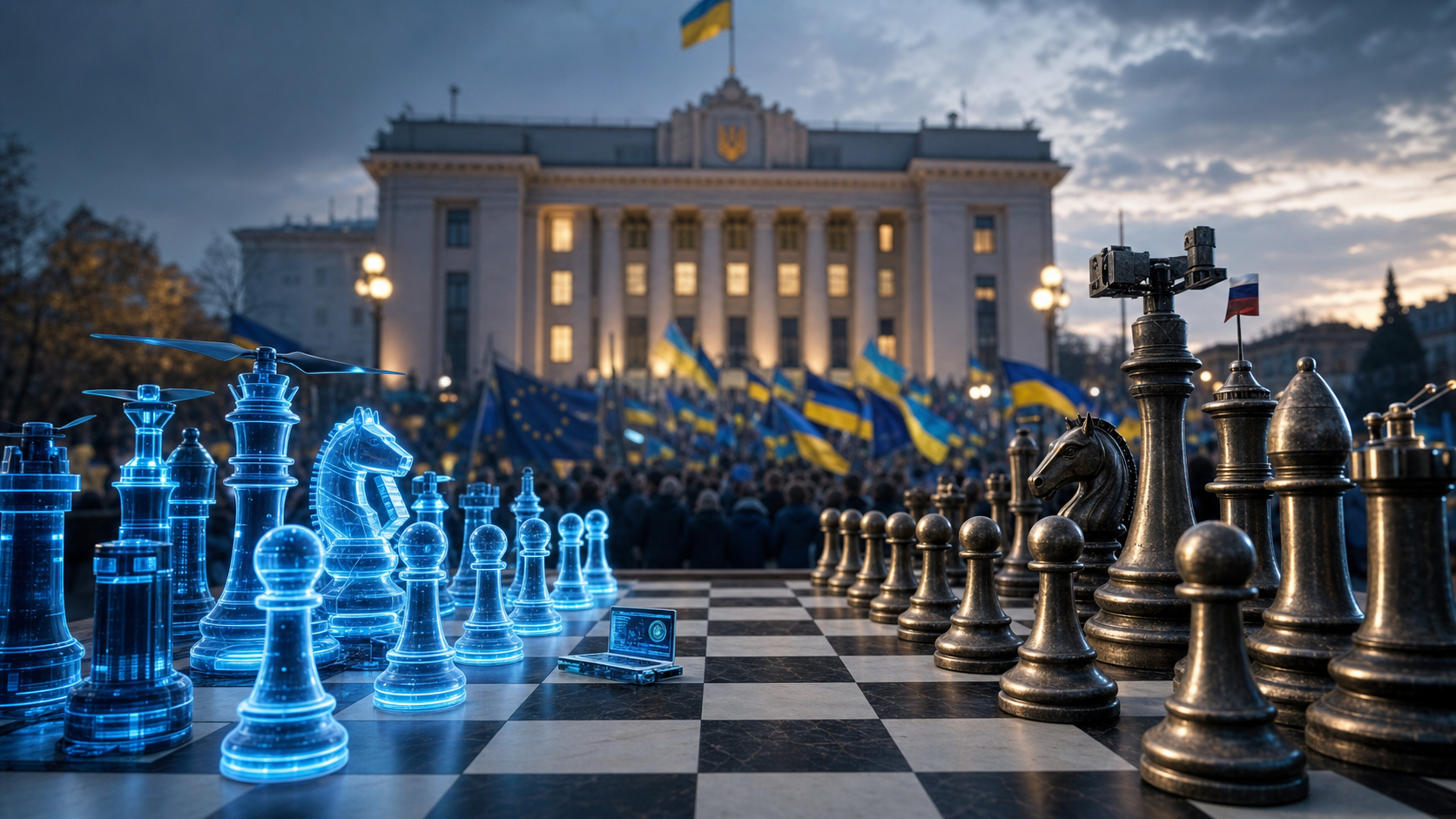
Power struggle in Kyiv: Ukraine in conflict – When reformers and generals vie for power – Image: Xpert.Digital
Drone mastermind versus generals: The real reason for the ministerial upheaval
Despite martial law: This is why Ukrainians are suddenly taking to the streets against Zelenskyy
A test of endurance in war: Is Ukraine losing its technological edge?
In the midst of its existential struggle against Russia, Ukraine is experiencing a political earthquake that goes far beyond a mere cabinet reshuffle: The dismissal of the popular Defense Minister Mykhailo Fedorov in July 2026 not only triggered rare mass protests in the streets of Kyiv and other major cities, but also revealed a profound power struggle at the heart of the Ukrainian leadership. On one side is a young, technology-driven reform movement that aims to win the war through drone innovations and data-driven transparency. On the other, the traditional, hierarchical military leadership under Commander-in-Chief Oleksandr Syrskyi insists on established command structures. While President Volodymyr Zelenskyi, by appointing the head of the security services as the new Defense Minister, is banking on continuity and control, critics fear for the country's technological edge and democratic legitimacy. This is an analysis of the fragile balance between civilian control, arms innovation, and military necessity in times of martial law.
How a change of ministers reveals the limits of wartime democracy
A country caught between a breach of trust and the necessity of war
The dismissal of Ukrainian Defense Minister Mykhailo Fedorov in July 2026 marks far more than a routine personnel change in a wartime cabinet. It exposes a deep fault line running through the Ukrainian power structure: the conflict between a young, technology-driven reform movement and a traditional, hierarchical military leadership. The fact that thousands of citizens spontaneously took to the streets to protest a presidential personnel decision in a country that has been engaged in an existential war of defense against Russia for more than four years sends an extraordinary signal. It demonstrates that Ukrainian civil society, despite martial law, censorship restrictions, and an already tense security situation, is not prepared to accept every decision of the government without question. At the same time, the event reveals just how fragile the balance between civilian control and military necessity is in a country fighting for its survival.
The Fedorov case is so economically and politically significant because it raises the question of how modern, technology-driven warfare can interact with traditional military command structures without friction paralyzing the state's ability to act. In recent years, Ukraine has established itself as one of the world's most innovative countries in the field of drone warfare and digital defense procurement. This innovative strength was closely linked to Fedorov, who, as Minister of Digital Affairs since 2019 and later as Deputy Prime Minister, had significantly shaped the technological backbone of the state. His departure therefore raises not only a domestic political question but also a structural one: Can Ukraine maintain its technological lead in war against a superior adversary in terms of personnel and resources if the very figures who made this lead possible are forced out of the system?
The power struggle between the Ministry of Reform and the General Staff
At the heart of the crisis lies a serious institutional conflict between the Ministry of Defense under Fedorov and the military leadership under Commander-in-Chief Oleksandr Syrskyi. Fedorov had pursued his own strategic approach, which relied on asymmetric warfare: the increased use of drone swarms, data-driven and transparent arms procurement, and the technological modernization of the numerically inferior Ukrainian armed forces. This strategy was intended to compensate for the fact that Ukraine lacked both comparable personnel resources and a similarly large arms industry compared to Russia. Internally, Fedorov repeatedly attempted to oust Syrskyi and Chief of the General Staff Andriy Hnatov from their positions, believing them to be obstructing necessary reforms. These efforts, however, were unsuccessful, as President Volodymyr Zelenskyi placed his personal trust in the army chief and considered his military successes, particularly the defense of Kyiv and the swift recapture of the Kharkiv region in 2022, as proof of his competence.
The conflict eventually escalated into a kind of ultimatum: either the president opted for the popular but controversial reform minister (within parts of the military leadership), or he would stick with his long-serving commander-in-chief. Fedorov himself publicly denied having issued this ultimatum in such a pointed form, but confirmed that he had been pushing for Syrsky's replacement because, in his view, Syrsky had been unwilling to openly discuss structural problems in the cooperation between the ministry and the military leadership. Zelensky ultimately opted for continuity in the military leadership and against the civilian reformer. This decision is understandable from both an economic and security policy perspective, because a change in leadership at the top of the armed forces amidst ongoing combat operations poses significant risks to operational stability on the front lines. Politically, however, it triggered a considerable loss of trust among parts of the population.
Why the streets reacted: Legitimacy in times of martial law
The spontaneous protests in Kyiv, Kharkiv, Dnipro, Lviv, and other cities are a remarkable phenomenon because public demonstrations have become rare under martial law in Ukraine. The fact that citizens are nevertheless taking the risk of publicly criticizing the government points to a deep-seated frustration that goes beyond mere personnel issues. Many demonstrators perceived Fedorov's dismissal as an expression of a democratic legitimacy deficit: the impression that important decisions are being made over the heads of the population, despite the country having made enormous sacrifices for its national self-preservation for years, creates a sense of alienation between the governed and the governing. Students, artists, and ordinary citizens alike expressed the impression that their government is not listening to them, even though martial law, while justifying expanded executive powers, must not completely suspend democratic feedback.
It is also noteworthy that the protests were not solely emotionally motivated, but were based on a relatively precise political analysis. Many demonstrators pointed out that Fedorov had acted as an exposer of inefficiencies and alleged corruption within the procurement system, and that his dismissal served the interests of established power structures rather than the interests of national defense. This perception, whether entirely accurate or not, highlights a fundamental problem in Ukrainian military economics: arms procurement during a state of emergency is inherently prone to conflicts of interest because enormous sums of public funds are allocated under time pressure and with limited parliamentary oversight. A minister who attempts to make these processes more transparent almost inevitably comes into conflict with established networks that benefit from the existing procurement practices.
The economic dimension of drone warfare
Fedorov's political capital rested largely on his role in building the Ukrainian drone industry, which in recent years has developed into a key economic sector of considerable strategic importance. Despite limited industrial capacity, Ukraine has managed to establish one of the world's most advanced drone production facilities, delivering cost-effective and mass-marketable systems for air defense and attacking Russian targets. This model is based on a close integration of private innovation, government support, and a significantly accelerated development and certification process compared to traditional arms procurement procedures. As Minister of Digital Affairs and later as Minister of Defense, Fedorov played a crucial role in shaping this ecosystem, also promoting investment and technological cooperation internationally, for example in Berlin and at Western partner conferences.
From an economic perspective, it is significant that the procurement reforms initiated by Fedorov relied on data-driven needs analysis, which aimed to evaluate military equipment based on effectiveness and cost-benefit ratio, rather than relying solely on established supplier relationships. While such an approach increases transparency in the short term, it can unsettle existing market participants who have benefited from opaque procurement practices. Critics from the defense industry, as well as from parts of the military, accused Fedorov of implementing reform plans that were, in practice, sometimes underdeveloped, hardly financially sustainable in the long term, and occasionally more focused on media impact than on operational feasibility. This criticism tempers the image of him as a pure reform hero, without, however, invalidating the fundamental direction of his efforts to achieve greater efficiency and transparency in procurement.
Zelenskyy's calculation: maintaining power or the necessity of war
The question of whether Zelenskyy's decision was primarily driven by strategic considerations to maintain military stability or should be interpreted more as an expression of his desire to retain power cannot be definitively answered. Both interpretations contain plausible elements. On the one hand, from a purely security policy perspective, it is understandable not to replace an experienced commander-in-chief during ongoing hostilities, a commander who has repeatedly demonstrated his ability to successfully conduct complex military operations. A change of leadership at the top of the army carries operational risks that seem hardly justifiable during a period of intense Russian offensive efforts. On the other hand, the fact that Fedorov was considered one of the most popular and internationally visible politicians of the Zelenskyy era fuels the suspicion that the president may have seen him as a potential political rival whose growing influence within and outside Ukraine was perceived as a threat to his own position of power.
This ambivalence is typical of authoritarian structures of warfare, where democratic accountability and executive capacity are in constant tension. The Ukrainian constitution stipulates that the president has the right to nominate the defense minister, while parliament must make the final confirmation. This constitutional construct is intended to ensure a balance of power between the executive and legislative branches. However, since parliament was not scheduled to reconvene until August, Zelenskyy was able to create a fait accompli by appointing a new minister on an interim basis, before any democratic oversight body had even had the opportunity to consider the appointment. This procedure is legally permissible, but it raises questions about the substance of democratic control in times of war.
Our EU and German expertise in business development, sales and marketing


Our EU and German expertise in business development, sales and marketing - Image: Xpert.Digital
Industry focus areas: B2B, digitalization (from AI to XR), mechanical engineering, logistics, renewable energies and industry
More information here:
A thematic hub offering insights and expertise:
- Knowledge platform covering global and regional economies, innovation and industry-specific trends
- A collection of analyses, insights, and background information from our key areas of focus
- A place for expertise and information on current developments in business and technology
- A hub for companies seeking information on markets, digitalization, and industry innovations
Western partners alarmed: Consequences of the personnel reshuffle for aid and trust
The new strongman: From the intelligence service to the Ministry of Defense
With the appointment of Yevheniy Khmara, the former head of Ukraine's domestic intelligence service, the SBU, as acting defense minister, Zelenskyy is taking a remarkable structural step. Khmara has a distinguished security and operational background, including as the former head of the anti-terrorist special forces unit Alpha, and has made a name for himself particularly through the organization of large-scale attacks on Russian territory. This appointment signals a strategic realignment: instead of a civilian reform minister focused on transparency and technological modernization, a figure deeply entrenched in the security apparatus is now taking the helm of the defense ministry. This can be interpreted, on the one hand, as an attempt to improve coordination between intelligence services, special operations, and the regular armed forces, and on the other hand, as a concentration of security policy power in the hands of close confidants of the president.
From an economic perspective, it is relevant that a change from a technology-driven reform minister to one with a strong security service focus could also shift priorities in arms procurement. While Fedorov had placed a strong emphasis on civilian innovation ecosystems, private drone manufacturers, and transparent procurement processes, under a more security-oriented leadership, the emphasis could revert to intelligence-coordinated operations and traditional military procurement logics. Whether this will ultimately increase or decrease the efficiency of Ukraine's defense economy cannot be definitively assessed at this time, as the decisive factor will be how strongly the new minister continues or revises the existing reform approaches.
The role of Koretsky and the fourth government reshuffle since the start of the war
Fedorov's dismissal is part of a broader government reshuffle that also saw Prime Minister Yulia Zvyrydenko resign and be replaced by former energy executive Serhiy Koretskyi, who previously headed the state-owned energy company Naftogaz. This personnel decision can be explained economically by Ukraine's view that, given repeated Russian attacks on critical energy infrastructure, particularly in the run-up to the coming winter, a particularly close link between the government leadership and the energy sector is essential. This marks the fourth major government reshuffle since the start of the Russian invasion in 2022, suggesting structural instability within the Ukrainian executive branch, which, despite its impressive military and technological adaptability, is repeatedly shaken by internal power struggles.
These recurring cabinet reshuffles are problematic from the perspective of economic and administrative stability because they hinder continuity in key reform processes. Each change of minister typically also entails a change of advisors, specialists, and strategic priorities, which can significantly delay the implementation of long-term structural reforms, for example, in procurement or energy policy. At the same time, it can be argued that a certain degree of personnel flexibility is necessary in a dynamically evolving wartime environment in order to respond to changing military and economic circumstances. The outcome of these reshuffles will ultimately depend on whether the new officials are actually able to continue the initiated reform processes instead of effectively bringing them to a standstill through personnel changes.
International reactions and geopolitical implications
The events in Kyiv are being closely followed internationally, particularly by Western partner states that provide substantial financial and military support to Ukraine. A perceived instability in the government structure could undermine the confidence of international donors and arms suppliers, as they rely on dependable partners and continuous reform processes to politically legitimize their support. At the same time, Western commentators, especially security analysts, are concerned that dismissing a reform minister considered highly competent in the midst of an existential war appears strategically risky, as it could weaken the technological innovation momentum of Ukraine's defense.
From a Russian perspective, the event was naturally observed with a certain degree of satisfaction, although the Kremlin officially declared that the personnel issue was of no consequence to Moscow. This official reticence, however, contradicts the strategic logic that internal political instability in Ukraine is fundamentally in Russia's interest, as it can weaken the adversary's ability to act and potentially undermine Western support. The manner in which such a popular minister was forced out of office is likely to be interpreted in the Kremlin as confirmation of the perception that significant tensions exist within the Ukrainian leadership, tensions that can be exploited for propaganda purposes.
What the Fedorov case reveals about the future of Ukrainian warfare
The conflict surrounding Fedorov's dismissal raises fundamental questions about the future direction of Ukrainian defense strategy. If the new leadership under Khmara adheres more closely to traditional military hierarchies, this could facilitate cooperation between the Ministry of Defense and the General Staff in the short term, as less institutional friction between a reform-oriented civilian leadership and a more conservative military hierarchy would be expected. In the long term, however, there is a risk that the technological innovation drive that has significantly shaped Ukrainian defense in recent years will lose momentum if the new leadership is less committed to data-driven procurement reforms and decentralized innovation ecosystems.
At the same time, the reaction of civil society shows that, despite all the war-related restrictions, the Ukrainian population is keeping a watchful eye on the decisions of its political leadership. This democratic vigilance, however inconvenient it may be for the government in Kyiv at the moment, is ultimately an asset for the long-term stability and legitimacy of the Ukrainian state, especially compared to authoritarian systems where such public protests would not even be possible. Whether Zelenskyy will be swayed by public pressure to change course, or whether, as previous statements suggest, he will consistently adhere to his decision, will show in the coming weeks how resilient the relationship of trust between the Ukrainian leadership and the population truly is. Regardless, Fedorov's political future is unlikely to be over. His public support, coupled with the image of a reformer held back, could make him one of the most influential political figures in the country in the medium term, irrespective of whether he holds a government office or not.
An unresolved power question
The events surrounding the dismissal of Mykhailo Fedorov reveal that, despite all its military and technological advances, Ukraine continues to grapple with unresolved structural tensions between its civilian reformist impulses and its military traditions. These tensions are not merely a sign of weakness, but also an expression of a vibrant, albeit war-hampered, democratic culture that resists purely top-down decisions. How this power struggle unfolds will not only shape the future direction of Ukraine's defense strategy, but will also signal the true resilience of the country's democratic checks and balances under the extreme conditions of a protracted defensive war.