
Are German ports a threat to NATO? Is the new port strategy just a paper tiger while Rotterdam invests?
Xpert Pre-Release

Available in 27 languages 📢
Prefer Xpert.Digital on GoogleⓘPublished on: July 28, 2025 / Updated on: July 28, 2025 – Author: Konrad Wolfenstein

Are German ports a threat to NATO? Is the new port strategy just a paper tiger while Rotterdam invests? – Image: Xpert.Digital
German Maritime Infrastructure at a Crossroads: An Analysis of Investment Backlog, Strategic Importance and Future Prospects
Germany's energy transition in jeopardy? The plan could fail without modern ports – More than just trade: Why dilapidated German ports could now become a threat to NATO
What challenges does Germany's maritime infrastructure face, and why is a reassessment of its situation urgently needed?
Germany's maritime infrastructure, particularly its seaports and inland ports, is at a critical juncture. For years, it has been operating at a reduced capacity, resulting in a significant backlog of investment. However, the traditional view of ports as mere transshipment points for global trade falls short in light of new, complex realities. The current debate is not simply a matter of financing, but requires a fundamental paradigm shift in the strategic assessment of this key national resource. The restructuring of global supply chains, the need for robust national security of supply, the ambitious goals of the energy transition, and a fundamentally altered security landscape in Europe necessitate a comprehensive reassessment.
German ports are no longer merely gateways to the world for the export nation of Germany; they have become multifunctional, systemically important hubs whose performance is inextricably linked to national security, economic resilience, and the success of the climate transformation. Recent geopolitical upheavals and the increasing confrontation with hybrid threats have exposed the vulnerability of maritime infrastructure. At the same time, ports are essential hubs for the development of a renewable energy-based economy, particularly for hydrogen imports and as bases for offshore wind energy.
These overlapping dimensions demonstrate that the crisis facing German ports is not merely a financial deficit, but reveals a conceptual gap. Existing financing mechanisms and political priorities have failed to keep pace with the rapidly growing strategic importance of the ports. This analysis therefore examines the causes and consequences of the investment backlog, illuminates the multidimensional strategic relevance of the ports, and analyzes political and financial solutions within the national and European context. It argues that modernizing maritime infrastructure is not an optional expenditure, but an essential investment in Germany's future viability and sovereignty.
Suitable for:

The investment backlog: Extent and consequences
What is the estimated investment backlog in German seaports and inland ports, and what specific infrastructure deficiencies exist?
The investment backlog in German port infrastructure has reached an alarming level, amounting to approximately €18 billion. Of this, €15 billion is earmarked for seaports alone, and a further €3 billion for inland ports. These figures are not abstract numbers, but rather manifest themselves in concrete and serious deficiencies that directly impair the functionality and competitiveness of the ports.
A key problem is the dilapidated state of quay walls, which exhibit structural damage at many locations. This not only poses a safety risk but also limits load-bearing capacity and thus the use of modern, heavy handling equipment. Closely related to this is the lack of adequately sized and reinforced heavy-load areas. Such areas, however, are a fundamental requirement for handling increasingly larger containers and, in particular, for the multi-ton components of offshore wind turbines, such as nacelles and rotor blades.
Another critical deficiency lies in the outdated and inadequate hinterland connections via road, rail, and waterways. A port's efficiency doesn't end at the quayside but depends crucially on the effectiveness of the connecting transport routes. This includes dilapidated locks and waterways, whose condition, according to reports from the Federal Court of Auditors, is steadily deteriorating. The Court criticizes the fact that the funds allocated for the maintenance of federal waterways are insufficient and that construction projects are being prioritized incorrectly, increasing the risk of disruptions to vital transport arteries.
Finally, outdated digital infrastructure and inadequate communication systems are also identified as significant shortcomings. In a globally networked logistics system, efficient digital processes for managing the flow of goods and communication between all stakeholders are essential.
This backlog of repairs is not a static problem, but a dynamic, self-accelerating process. Progressive wear and tear leads to a vicious cycle: neglected maintenance exponentially increases future repair costs and simultaneously undermines the physical foundation essential for forward-looking modernization projects, such as the facilities required for the energy transition. The investment backlog is therefore not just a burden from the past, but an active barrier to shaping the future. Every postponement not only increases the financial burden, but also the complexity of the tasks at hand, as fundamental structural problems must be solved before value-creating future projects can even be undertaken.
What are the economic consequences of neglecting port infrastructure for Germany's competitive position in Europe?
Chronic underfunding and the resulting investment backlog have serious economic consequences for Germany as a business location. German seaports face intense competition from the Western European ARA ports (Antwerp, Rotterdam, Amsterdam), particularly the dominant universal ports of Rotterdam and Antwerp-Brugge. These competitors benefit from massive government investment and strategic national support, leading to an unequal competitive environment.
The most direct consequence is a loss of market share. While German ports struggle with capacity bottlenecks and inefficiencies due to outdated infrastructure, competing ports are steadily expanding their capacities. This leads to shipping companies increasingly handling their cargo via Rotterdam or Antwerp, even if the final destination is in Germany or the European hinterland. German seaports facilitate around 60% of Germany's foreign trade and are therefore a key driver of the export-oriented economy. A weakening of their position jeopardizes this crucial economic factor.
Furthermore, enormous economic effects and a large number of jobs are linked to the port industry. Directly and indirectly, German seaports and inland ports secure around 4.5 million jobs in Germany, of which approximately 1.5 million are in industry. In Lower Saxony alone, over 74,000 jobs depend on the seaports, which generate a gross value added of almost €5.9 billion. Every container that is handled in Rotterdam instead of Hamburg or Bremerhaven represents a loss of added value and jeopardizes these jobs in Germany.
A particularly problematic asymmetry arises in the financing of hinterland infrastructure. When goods are transshipped in the Netherlands or Belgium and then transported by truck or rail to or through Germany, Germany must bear the costs of maintaining the road and rail networks. However, the actual value creation of port handling – port fees, logistics services, warehousing, customs clearance – remains abroad. Germany thus risks becoming a mere transit country for its own goods. By providing the expensive hinterland infrastructure, it indirectly subsidizes the competitiveness of foreign ports and, consequently, the dismantling of its own maritime value chain. This effect represents a significant net economic loss and underscores the urgent need to restore the competitiveness of its own ports through targeted investments.
Financing models under scrutiny
How does the current port burden equalization system work and why is it criticized as insufficient?
The current core instrument of federal participation in port costs is the so-called port burden equalization. This instrument is enshrined in the Fiscal Equalization Act (FAG) and is based on Article 107 of the Basic Law. It is an exception that allows coastal states to deduct a portion of the financial burden they incur for the maintenance of their seaports from their tax revenues when calculating their financial capacity. Currently, this amount totals only 38 million euros per year for all German seaports combined.
The mechanism is complex: The deduction reduces a state's calculated financial capacity. Within the system of fiscal equalization among the German states, this results in donor states paying less and recipient states receiving higher equalization payments. However, it is not a direct transfer of 38 million euros from the federal government to the states. Criticism of this mechanism is fundamental and multifaceted.
The most obvious criticism is the completely inadequate amount of the sum. The 38 million euros bears no relation to the 15 billion euro investment backlog in the seaports or the 400 to 500 million euros in annual investment required, as estimated by business associations. Furthermore, the sum has not been significantly adjusted for decades to reflect rising costs or increased requirements, a situation deemed unacceptable by business representatives.
The deeper, structural criticism, however, targets the fundamental conception of the instrument. The port burden equalization scheme treats port financing as a primarily regional responsibility of the coastal states, for which the federal government provides only partial compensation. This approach overlooks the national importance of ports. They not only serve the local economy but are crucial for the entire German export industry, national security of supply, the energy transition, and collective defense. These tasks are inherently national, not regional. Yet, the financing is borne almost exclusively by the states and municipalities.
The port burden equalization scheme is therefore not only quantitatively insufficient, but also qualitatively and structurally flawed. It is based on the false premise that this is a regional burden that needs to be compensated. The demands for fundamental reform therefore aim not only at increasing the total amount, but at a fundamental reorientation of the financing philosophy: away from compensation for a regional burden, towards a direct and permanent federal investment in a national strategic asset.
What new and expanded financing instruments are being proposed and discussed by the Federal Government and the port industry?
Given the obvious inadequacy of the existing system, various new and expanded financing instruments are being discussed. The German Federal Government has taken a first step by pledging an additional €400 million from the Climate and Transformation Fund (KTF) for the period from 2026 to 2029. These funds are earmarked for the climate-friendly transformation of maritime infrastructure. Specifically, they are intended to support the development of shore power facilities, bunkering infrastructure for alternative fuels, and the creation of climate-neutral shipping corridors. This funding is considered an important but by no means sufficient step.
The port industry, represented by the Central Association of German Seaport Operators (ZDS), is calling for a more fundamental and, above all, permanent solution. The core demand is an increase in the annual federal contribution to at least €500 million, which should be provided consistently and reliably. This demand aims for a structural adjustment of basic funding, rather than time-limited project grants.
Furthermore, a strategic approach of cross-departmental financing is being pursued. This idea is based on the understanding that port modernization serves the objectives of several ministries. Investments in port infrastructure are relevant to the ministries of transport, economic affairs, climate, and defense. Consequently, the costs should also be shared from the respective budgets.
One option being discussed particularly intensively is the partial financing from the German Armed Forces' €100 billion special fund. The rationale lies in the "dual-use" nature of the port infrastructure, which serves both civilian and military purposes. Since the ports are crucial for national and collective defense as logistical hubs for NATO, it is argued that investments in their capacity are also investments in defense capabilities. One claim is that just 3% of the special infrastructure fund would be sufficient to sustainably address the backlog of necessary repairs.
These differing approaches reveal a fundamental disagreement about the nature of the problem. The German Federal Government offers temporary, project-based financing for the “climate-friendly transformation” through its Climate Funding Program (KTF). In contrast, the port industry and coastal states are demanding a permanent, structural increase in base funding to manage the ongoing tasks of maintenance, renewal, and adaptation. Without bridging this conceptual gap, there is a risk that the cycle of investment backlogs will begin anew once the project funding expires.
Your intralogistics experts

Consulting, planning and implementation of complete solutions for high-bay warehouses and automated storage systems - Image: Xpert.Digital
More about it here:
From logistics hub to security anchor: Seaports are the secret superheroes of Germany's supply security
The Multidimensional Strategic Importance of Seaports
To what extent are German seaports systemically important as critical infrastructure (KRITIS) for national supply security and economic resilience?
German seaports are, by definition, a central component of critical infrastructure (KRITIS). KRITIS encompasses organizations and facilities of essential importance to the functioning of society, whose failure or impairment would lead to significant supply shortages, disruptions to public safety, or other dramatic consequences. The ports fall under the "transport and traffic" sector and are of vital importance to the functioning of society and the economy.
Their systemic importance for national supply security is manifested in their function as primary entry points for a large proportion of the goods Germany needs. This includes raw materials and intermediate products for industry, energy sources, food, and consumer goods for the population. A disruption of these ports would have cascading effects on the entire economy and daily life. The restructuring of global supply chains following the pandemic and in light of geopolitical tensions has further underscored the importance of resilient and reliable maritime logistics chains.
The vulnerability of these maritime critical infrastructures has come into sharp focus in recent years. Threats are diverse, ranging from physical sabotage, such as the attacks on the Nord Stream pipelines, to cyberattacks on digitized port systems, and hybrid operations aimed at disrupting supply chains. Particularly vulnerable are not only the port facilities themselves, but the entire maritime ecosystem, including undersea data and power cables, pipelines, and even the shipping lanes themselves.
The concept of maritime critical infrastructure (KRITIS) is therefore expanding from the mere securing of fixed installations such as terminals to the protection of entire logistics systems and waterways. This necessitates a paradigm shift in protection concepts. Simply erecting fences around port facilities is no longer sufficient. The true vulnerability lies in the extensive and often transnational connections of the network. Protecting this distributed infrastructure requires new approaches such as multidimensional maritime surveillance encompassing the seabed, the water surface, and the airspace, as well as strengthened international cooperation and the rapid response capabilities of maritime security forces such as the navy and coast guard. The resilience of national supply chains thus depends directly on the ability to protect these complex maritime networks and to quickly restore them in the event of disruptions.
What central role do ports play in the success of the energy transition in Germany?
Germany's seaports are not passive observers, but active and indispensable players in the success of the energy transition. They are developing into central "energy hubs," without whose high-performance infrastructure Germany's ambitious climate policy goals cannot be achieved. Their role is twofold: they are the logistical base for the expansion of renewable energies and, at the same time, the crucial landing points for the import of new, green energy sources.
Firstly, ports serve as base ports for the massive expansion of offshore wind energy. The construction and maintenance of offshore wind farms require the handling of extremely heavy and large components such as foundations, tower sections, nacelles, and rotor blades. This places enormous demands on port infrastructure. Extensive, heavy-load-bearing assembly and storage areas, as well as high-strength quay walls and powerful cranes, are needed. It is estimated that up to 200 hectares of additional heavy-load-bearing area will be required for the construction of new offshore wind farms alone by 2029.
Secondly, ports are the central hubs for the import of energy carriers intended to replace fossil fuels. Since Germany has to import a significant portion of its energy needs, ports are the logical points of entry for liquefied natural gas (LNG) as a transitional technology, and, looking ahead, for green hydrogen and its derivatives such as ammonia or methanol. This requires massive investments in new infrastructure, including dedicated terminals, storage tanks, and connections to pipeline networks for onward transport inland.
Herein lies a direct and critical conflict between the goals of the energy transition and the current state of port infrastructure. Germany cannot build its green energy future on crumbling foundations. The “resilient quay walls” and “heavy-duty surfaces” required for the energy transition are precisely the elements identified as “dilapidated” and “inadequate” in the current investment backlog. A quay wall that is already too weak for modern container cranes certainly cannot support a wind turbine nacelle weighing several tons. This creates an unavoidable path dependency: The first step must be the fundamental renovation and upgrading of the core infrastructure. Only then can the second step, the specialized expansion for the purposes of the energy transition, take place. Therefore, financing cannot focus solely on “green” flagship projects, but must necessarily include the “gray” preparatory work required to restore structural integrity.
Suitable for:

What strategic importance do ports have for national and alliance defense within the framework of NATO?
The strategic importance of German seaports for national and alliance defense has increased dramatically with the "turning point" in history and NATO's renewed focus on collective defense. Due to its geographical location in the heart of Europe, Germany plays a key role as a logistical hub for NATO. In the event of a crisis or conflict on the alliance's eastern flank, troops and heavy equipment from allied partners, particularly from North America, must be transported quickly and efficiently through Germany. The seaports are the primary landing points for these strategic deployments.
To accelerate and simplify these deployments, the "Military Mobility" initiative was launched, promoted by both NATO and the EU within the framework of Permanent Structured Cooperation (PESCO). One concrete project is the establishment of a model military corridor connecting the North Sea ports of the Netherlands with Germany and Poland, in order to reduce bureaucratic hurdles and standardize transport procedures. However, the functionality of this corridor depends significantly on the capacity of the participating ports and the subsequent infrastructure.
This is where the concept of “dual-use” logistics comes into play. It states that port infrastructure must be designed to meet both civilian trade flows and military logistics requirements. These requirements are often identical: military transport of tanks and heavy equipment requires robust quays, heavy-duty loading areas, powerful cranes, and efficient rail and road connections, just like the civilian handling of large containers or wind turbines. The dilapidated infrastructure in German ports thus represents not only an economic but also a significant security policy problem. It is a direct obstacle to fulfilling alliance obligations and severely impairs NATO's deterrence and defense capabilities.
This military dimension provides a strong justification for co-financing the port's modernization from the defense budget, particularly from the special fund for the German Armed Forces. An investment in "military mobility" is not a niche project, but rather acts as a powerful catalyst for the comprehensive modernization of the entire transport infrastructure. It creates massive positive spillover effects for the civilian economy. An investment in a "militarily capable" port is simultaneously an investment in a "globally competitive" port. The security policy argument can thus become a decisive lever for accelerating the economic and infrastructural modernization that has been neglected for years.
Your dual -use logistics expert

Dual -use logistics expert - Image: Xpert.digital
The global economy is currently experiencing a fundamental change, a broken epoch that shakes the cornerstones of global logistics. The era of hyper-globalization, which was characterized by the unshakable striving for maximum efficiency and the “just-in-time” principle, gives way to a new reality. This is characterized by profound structural breaks, geopolitical shifts and progressive economic political fragmentation. The planning of international markets and supply chains, which was once assumed as a matter of course, dissolves and is replaced by a phase of growing uncertainty.
Suitable for:
Billion-dollar investment: Germany's ports between competition and the future
Political strategies and the European context
What are the core objectives of the National Port Strategy and what criticisms exist regarding its implementation?
In March 2024, the German Federal Government adopted its first National Port Strategy, intended to serve as a comprehensive roadmap for the future of Germany's seaports and inland ports. The strategy outlines five overarching strategic goals:
- Strengthening competitiveness: The position of Germany as a port location in European competition is to be improved, among other things by simplifying EU state aid law.
- Sustainability and energy transition: The ports are to be developed into sustainable hubs for climate-neutral shipping and industry, as well as hubs for shifting traffic to more environmentally friendly modes of transport.
- Digital transformation: Digitization in port logistics should be actively shaped and promoted in order to increase efficiency.
- Education and employment: Skilled workers should be secured and training should be designed to be future-proof in order to counter demographic change.
- Infrastructure: The transport and communication infrastructure should be maintained, expanded and protected according to demand.
The adoption of the strategy is generally welcomed by the coastal states and the port industry as an important and long-overdue step. It represents a clear commitment by the federal government to shared responsibility for the ports and establishes a national strategic framework for the first time.
The implementation of the strategy, however, faces a central and significant hurdle that is unanimously criticized by all stakeholders: the unresolved financing. The National Port Strategy sets ambitious goals and lists approximately 140 measures, but fails to back them up with additional, binding financial commitments from the federal government. Instead, the strategy refers to a joint federal-state working group yet to be established, tasked with developing financing concepts. Many interpret this as a postponement of the core problem indefinitely.
The port strategy thus manifests itself as a political paradox: On the one hand, it is a significant breakthrough, as it places port policy on the national agenda and creates a broad consensus on the tasks to be tackled. On the other hand, it is a major disappointment, as it leaves the crucial question of "how"—financing—unanswered. The federal government's stance of "plan first, money later" confirms this sequential approach. This uncertainty undermines the long-term planning security necessary for private investors and threatens to stifle the positive momentum that the strategy was intended to generate. Without a solid financial foundation, the National Port Strategy risks remaining a paper tiger.
How do German ports position themselves in competition with major western ports like Rotterdam and Antwerp, especially with regard to government investment?
The competition between German seaports and their Western European counterparts in the Netherlands and Belgium is largely characterized by fundamentally different financing philosophies and investment levels. While in Germany the financing of port infrastructure is traditionally seen as the primary responsibility of the federal states with minimal compensation from the federal government, the Netherlands and Belgium consider their ports to be national strategic assets of the highest priority and support them accordingly.
In the Port of Rotterdam, Europe's largest port, quay walls are treated as part of the national flood protection system and are therefore fully financed by the state. German terminal operators, on the other hand, have to pay high rents and leases for the use of the quay walls, which puts them at a direct competitive disadvantage. Investment activity reflects this different strategic focus. The Port of Rotterdam Authority alone invested around €295.4 million in port infrastructure in 2023 and even €320.6 million in 2024. These sums far exceed the total annual German port equalization payments. Major strategic projects such as the expansion of Maasvlakte II, the Porthos CO2 storage project, and the development of a national hydrogen network are being pursued with substantial public support.
The situation is similar in the Port of Antwerp-Bruges, the second largest port in Europe. Here, too, strategic projects, such as the Antwerp@C CO2 Export Hub, are specifically promoted with national funds and substantial co-financing from the European Union. The merger of the ports of Antwerp and Zeebrugge itself was a strategic move to pool resources and strengthen their competitive position.
The following table systematically presents the key differences and highlights the structural disadvantages faced by German ports.
Suitable for:

Container port transformation: North Sea ports race for global competitiveness
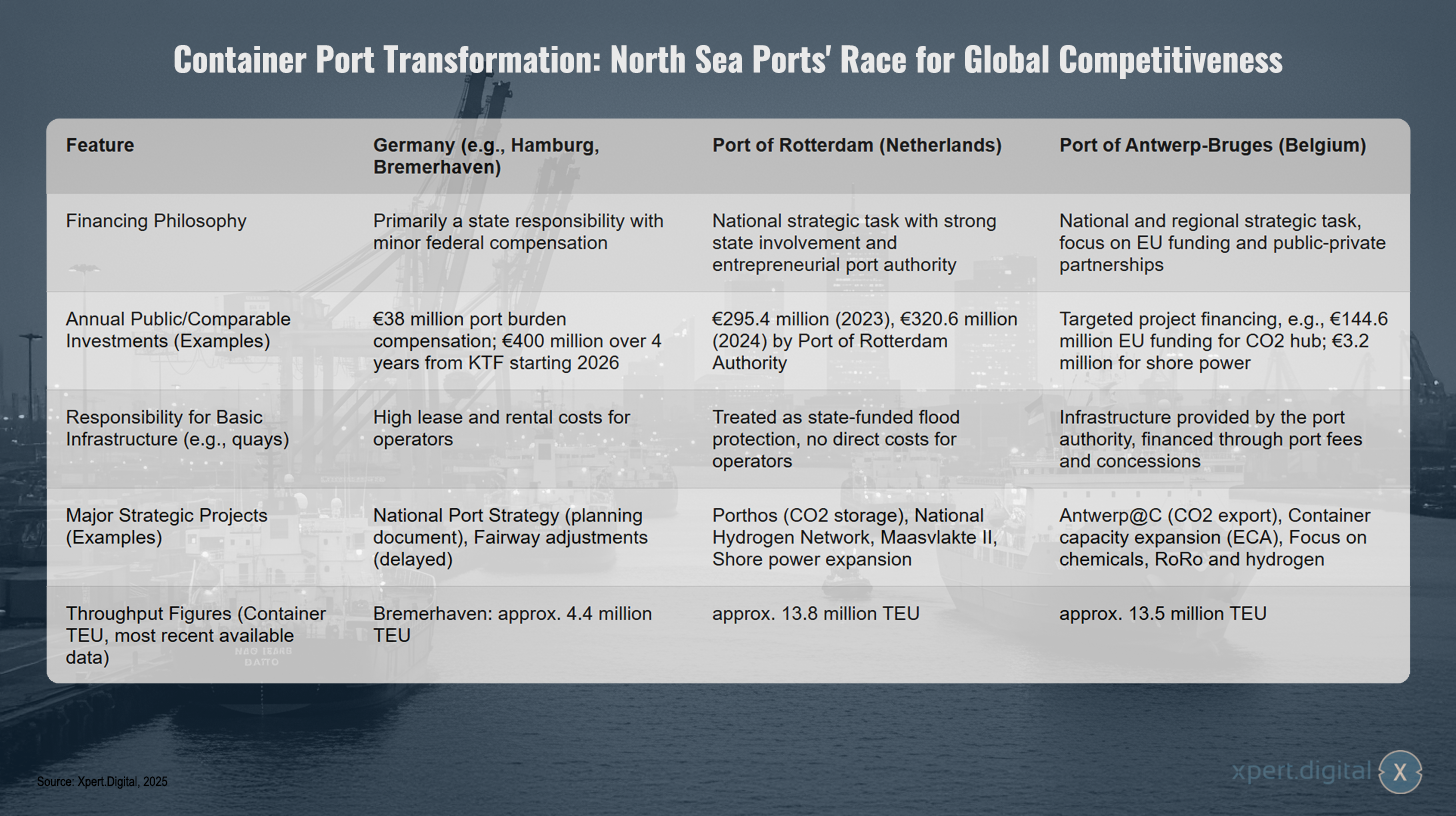
Container port transformation: North Sea ports race for global competitiveness – Image: Xpert.Digital
The transformation of container ports in Northern Europe reveals intense competition for global competitiveness between Germany, the Netherlands, and Belgium. The ports of Hamburg, Bremerhaven, Rotterdam, and Antwerp-Bruges are pursuing different strategies for infrastructure and future development.
Germany focuses on a primarily state-specific financing philosophy with limited federal equalization payments. Annual public investments amount to approximately €38 million in port burden compensation and €400 million over four years starting in 2026. Cargo throughput in Bremerhaven reaches approximately 4.4 million TEU.
The Port of Rotterdam presents itself as a national strategic priority with strong government participation. With investments of €295.4 million (2023) and €320.6 million (2024), it is focusing on projects such as CO2 storage, hydrogen networks, and the expansion of shore power. Cargo throughput is approximately 13.8 million TEU.
Antwerp-Bruges pursues an approach with national and regional strategic goals and a strong focus on EU funding. Targeted project financing, such as €144.6 million for a CO2 hub and €3.2 million for shore power, characterizes its strategy. With a container throughput of around 13.5 million TEU, the port competes on a level playing field with Rotterdam.
All three locations share the goal of strengthening their global competitive position and developing future-proof port concepts through innovative infrastructure projects, sustainability and strategic investments.
This comparison makes it clear that German ports are not operating on a level playing field. The lack of comparable strategic and financial backing from the federal government is the main reason for the loss of market share and the growing gap with the leading European ports.
Billion-dollar investment: How seaports are transforming our economy and security
What cross-departmental synergies (economy, climate, defense) must be used to ensure sustainable financing and modernization of German seaports?
The solution to the chronic underfunding and backlog of renovations at Germany's seaports does not lie solely with a single ministry. The multidimensional strategic importance of the ports is not merely an analytical insight, but the key to their future financing. A whole-government approach, which integrates the interests of the ministries of transport, economic affairs and climate protection, and defense, is essential.
The investments must be understood as synergistic. A modernized, robust quay wall serves not just one purpose, but fulfills the goals of several ministries simultaneously: It increases the competitiveness of the German economy through more efficient container handling (interest of the Ministry of Economic Affairs and Transport), it enables the handling of heavy components for offshore wind farms and the import of hydrogen, thus being a prerequisite for the energy transition (interest of the Ministry for Climate Action), and it ensures the rapid deployment of heavy military equipment within the framework of collective defense (interest of the Ministry of Defense).
This convergence of interests at a physical location—the port—opens up the possibility of forging a broad political and financial coalition strong enough to overcome the fiscal reluctance and bureaucratic inertia that have hampered progress for years. Instead of each department fighting over separate, competing budgets, a coordinated, cross-departmental funding strategy can pool resources. The defense budget can justify upgrading basic infrastructure for dual-use purposes, the climate fund can finance green add-ons like shore power facilities, and the transport and economic budgets can ensure essential hinterland connections. This pooling creates a political and financial critical mass that a singular approach focused solely on the Department of Transport could never achieve.
What long-term strategic decisions must policymakers make to ensure the future viability of Germany's maritime infrastructure?
Securing the future viability of Germany's maritime infrastructure requires bold and far-reaching strategic decisions that go beyond short-term financial injections. The key political shift must be the transition from reactive, project-based funding to a proactive, long-term, and structural financing strategy. Specifically, this means implementing the demand for a permanently and significantly increased annual federal contribution to port costs, as estimated by the port industry at €500 million.
Policymakers must view investments in ports not merely as a cost item, but as what they truly are: a strategic investment in Germany's technological, economic, energy, and security sovereignty. The efficiency of the ports is a direct prerequisite for the success of the export sector, the success of the energy transition, and the credibility of collective defense.
The ultimate decision facing Germany is not whether to spend the money, but how. The €18 billion investment backlog is a bill that must be paid. The choice is to pay it proactively through planned, strategic investments that create future capabilities and generate economic and security returns. The alternative is to pay it reactively and at a far greater cost: through the gradual loss of added value to foreign competitors, through failure to meet national climate targets and the resulting costs, through emergency repairs to collapsing infrastructure, and through a weakened geopolitical position due to a lack of military mobility. Inaction is not a cost-saving measure; it is simply the most expensive and inefficient course of action. Further hesitation not only exacerbates the competitive disadvantage but also actively jeopardizes Germany's ability to safeguard its core national interests and shape its future successfully.
Hub for security and defense - advice and information

Hub for security and defense - Image: Xpert.digital
The hub for security and defense offers well-founded advice and current information in order to effectively support companies and organizations in strengthening their role in European security and defense policy. In close connection to the SME Connect working group, he promotes small and medium -sized companies (SMEs) in particular that want to further expand their innovative strength and competitiveness in the field of defense. As a central point of contact, the hub creates a decisive bridge between SME and European defense strategy.
Suitable for:
Advice - planning - implementation

Markus Becker
I would be happy to serve as your personal advisor.
Head of Business Development
Chairman SME Connect Defense Working Group
Advice - planning - implementation
Konrad Wolfenstein
I would be happy to serve as your personal advisor.
contact me at wolfenstein ∂ xpert.digital
Just call me on +49 7348 4088 965 (Munich) .





