

Looking for a parking space canopy with solar panels: Planning a solar carport or building a system in Velbert, Minden, Viersen or Rheine?

Available in 27 languages 📢
Prefer Xpert.Digital on GoogleⓘPublished on: October 18, 2021 / Updated on: October 18, 2021 – Author: Konrad Wolfenstein
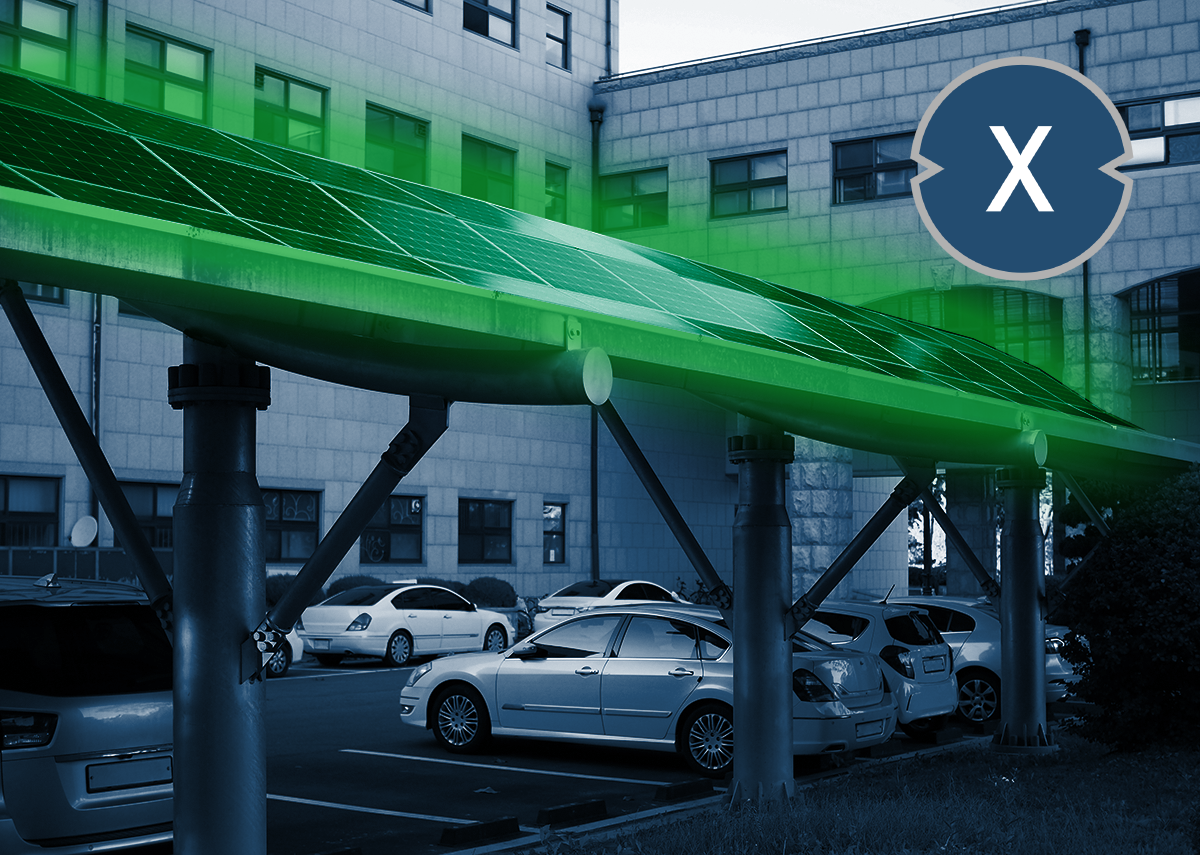
Parking lot canopy with solar panels – Image: Xpert.Digital / sungsu han|Shutterstock.com
The future is solar carports
Solar carports will have many tasks to fulfill in the future. On the one hand, they should offer convenient parking space, and on the other hand, they should also provide protection from the elements, such as wind, rain, and sun. In line with EU CO2 reduction policies and the shift in transportation from combustion engines to electric vehicles, solar carports are expected to generate the electricity produced by their solar panels.
The electricity, in turn, has a wide range of uses. It can be used for optional charging stations, for households, or for other purposes. The use of energy storage systems is also possible to bridge periods without sunlight, such as at night.
Solar carports are available in various sizes and for all requirements. Single carports, double carports, and row carports up to double row carports are all options. For large covered solar parking areas, for example, it's important that they are stable and durable. They should require little maintenance and not be completely destroyed in the worst-case scenario of a minor collision, requiring extensive repairs.
On the other hand, there are other requirements for solar carports, which must also have a representative design. This applies to municipalities, hotels, and event venues. Transparent glass-glass solar modules for a solar carport are the ideal solution.
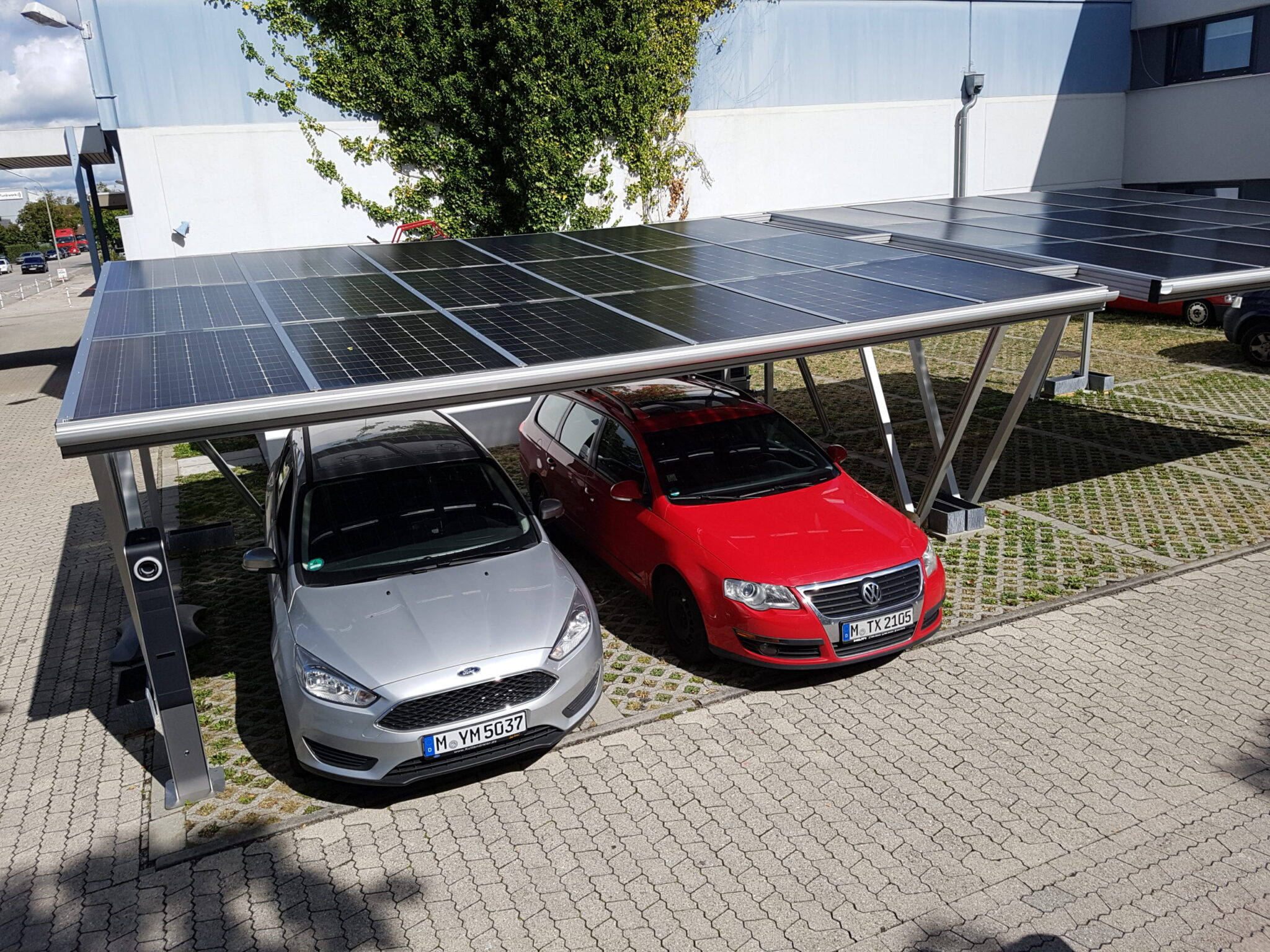
Photovoltaic carport system with transparent solar modules
Our solar carport solutions for covering open parking areas are modular and scalable:
- Quick and easy assembly
- Individually customizable design (color, materials, surface, size, etc.)
- Installation of charging stations and inverters is possible at any time
- Scalable & modular: Available as a single, double or arbitrarily scalable row carport
- Suitable for use even in the standard version for very high wind and snow loads
- …and much more
📣 Open parking areas: Photovoltaic solutions for industry, retail and municipalities
Everything from a single source, specially designed for solar solutions for large parking areas. You refinance or counterfinance into the future with your own electricity generation.
🎯 For solar engineers, plumbers, electricians and roofers
Advice and planning including a non-binding cost estimate. We bring you together with strong photovoltaic partners.
👨🏻 👩🏻 👴🏻 👵🏻 For private households
We are positioned across regions in German-speaking countries. We have reliable partners who advise you and implement your wishes.
With over 1,000 specialist articles, we cannot present all topics here. Therefore, you will find a small excerpt from our work here and we would be pleased if we have piqued your interest in getting to know us better:
Our Solar PDF Library

Photovoltaic Library (PDF) – Image: Xpert.Digital / Benvenuto Cellini|Shutterstock.com
Large PDF library: Market monitoring and market intelligence on the topic of photovoltaics.
Data is viewed at regular intervals and checked for relevance. This usually brings together some interesting information and documentation, which we combine into a PDF presentation: our own data analyzes and marketing intelligence as well as external market observations.
More about it here:
Households - Electricity prices in Germany
Households – Electricity prices in Germany – Image: Xpert.Digital
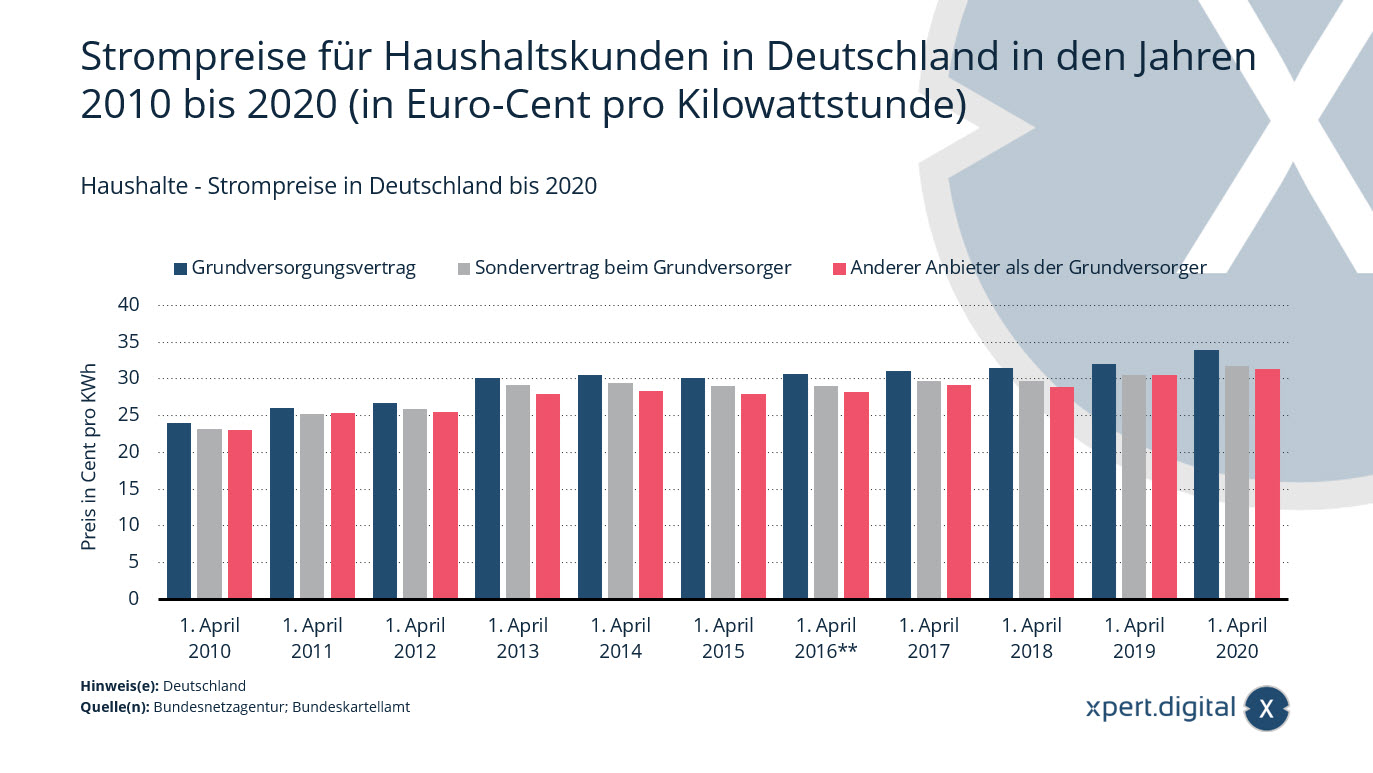
As of April 1, 2019, residential customers in Germany paid an average of 33.8 cents per kilowatt-hour of electricity under the basic supply tariff. The stated electricity prices correspond to an annual electricity consumption of between 2,500 and 5,000 kilowatt-hours from 2016 onwards.
Electricity prices for a 3-person household
In a typical household with an electricity consumption of 3,500 kilowatt hours, three people in Germany paid an average of €91.50 per month for electricity (as of January 2020). The electricity price for private individuals consisted primarily of network charges, procurement and distribution costs, and the EEG surcharge. The latter finances the expansion of renewable energies in Germany.
Electricity prices compared across countries
With an annual consumption of 2,500 to 5,000 kilowatt-hours, Germany ranked first in the EU in terms of household electricity prices. Electricity was cheapest in Bulgarian households. Globally, Germany was also among the countries with the highest household electricity prices. Furthermore, an examination of the index values for the development of household electricity prices clearly shows that electricity prices in Germany are continuing to rise.
Electricity prices* for household customers in Germany from 2010 to 2020 (in euro cents per kilowatt hour)
Volume-weighted averages. Until 2015, electricity prices corresponded to an annual electricity consumption of approximately 3,500 kilowatt hours. From 2016 onwards, electricity prices correspond to an annual electricity consumption of between 2,500 and 5,000 kilowatt hours.
The figures prior to 2020 were taken from the respective previous year's publications.
Households - Electricity prices in EU countries
Households – Electricity prices in EU countries – Image: Xpert.Digital
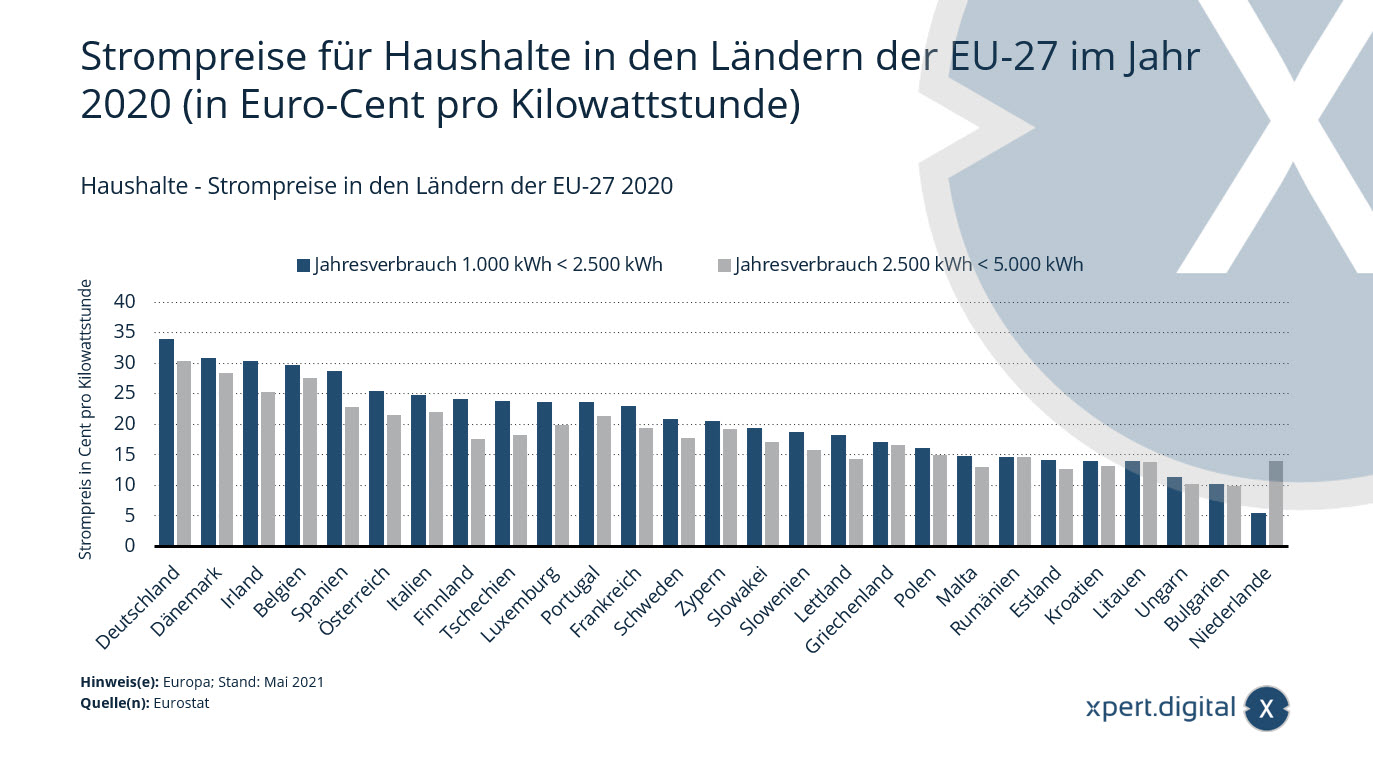
The statistic shows the electricity prices for household customers in the EU-27 countries in 2020. The electricity price for private households in Denmark in 2020 was approximately 28.26 cents per kilowatt hour for an annual consumption of 2,500 to 5,000 kilowatt hours.
Electricity prices* for households in the EU-27 countries in 2020 (in euro cents per kilowatt hour)
As of May 2021. Including all taxes. The figures are annual averages.
Annual consumption 1,000 kWh < 2,500 kWh
- Germany – 33.87 cents
- Denmark – 30.80 cents
- Ireland – 30.22 cents
- Belgium – 29.68 cents
- Spain – 28.64 cents
- Austria – 25.39 cents
- Italy – 24.69 cents
- Finland – 24.05 cents
- Czech Republic – 23.74 cents
- Luxembourg – 23.57 cents
- Portugal – 23.53 cents
- France – 22.84 cents
- Sweden – 20.77 cents
- Cyprus – 20.42 cents
- Slovakia – 19.29 cents
- Slovenia – 18.71 cents
- Latvia – 18.14 cents
- Greece – 17.02 cents
- Poland – 16.08 cents
- Malta – 14.75 cents
- Romania – 14.60 cents
- Estonia – 14 cents
- Croatia – 13.98 cents
- Lithuania – 13.97 cents
- Hungary – 11.29 cents
- Bulgaria – 10.19 cents
- Netherlands – 5.45 cents
Annual consumption 2,500 kWh < 5,000 kWh
- Germany – 30.25 cents
- Denmark – 28.26 cents
- Ireland – 25.15 cents
- Belgium – 27.47 cents
- Spain – 22.69 cents
- Austria – 21.39 cents
- Italy – 21.90 cents
- Finland – 17.57 cents
- Czech Republic – 18.18 cents
- Luxembourg – 19.86 cents
- Portugal – 21.27 cents
- France – 19.26 cents
- Sweden – 17.72 cents
- Cyprus – 19.16 cents
- Slovakia – 17.05 cents
- Slovenia – 15.71 cents
- Latvia – 14.26 cents
- Greece – 16.58 cents
- Poland – 14.93 cents
- Malta – 12.91 cents
- Romania – 14.54 cents
- Estonia – 12.64 cents
- Croatia – 13.04 cents
- Lithuania – 13.74 cents
- Hungary – 10.20 cents
- Bulgaria – 9.90 cents
- Netherlands – 13.94 cents
Average monthly electricity bill in Germany
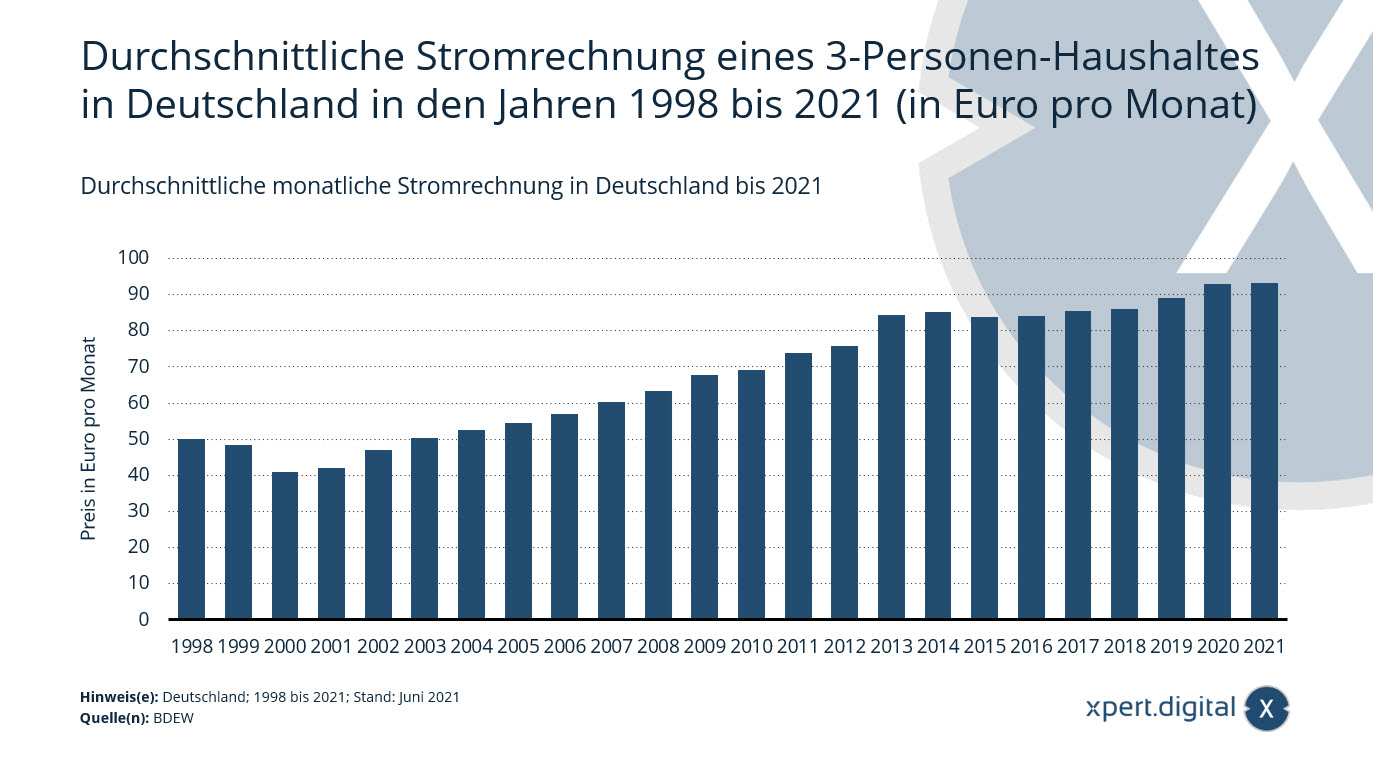
Average monthly electricity bill in Germany – Image: Xpert.Digital
With an electricity consumption of 3,500 kWh, a typical three-person household in Germany paid an average of €93.17 per month for electricity (as of June 2021). The electricity price was primarily composed of network charges, procurement and distribution costs, and the EEG surcharge.
Germany has the highest electricity prices in the EU
When comparing electricity prices for households in the EU-28 countries with an annual consumption of 2,500 to 5,000 kilowatt-hours, Germany recently ranked first. Electricity was cheapest in Bulgarian households. Even in a global comparison, Germany was a country with comparatively high electricity prices for households. The fact that electricity prices in Germany are continuing to rise is also evident when looking at the index values for the development of household electricity prices.
Electricity supply in Germany
In Germany, a large portion of electricity is now generated from renewable energy sources. At the same time, the amount of electricity generated using nuclear power and hard coal is decreasing. In terms of electricity consumption, industry is the largest consumer in Germany. The consumer groups "commerce, trade, and services" and "households" each consume approximately one quarter of the total electricity.
Average electricity bill for a 3-person household in Germany from 1998 to 2021 (in euros per month)
- 1998 – 49.90 euros per month
- 1999 – 48.21 euros per month
- 2000 – 40.66 euros per month
- 2001 – 41.76 euros per month
- 2002 – 46.99 euros per month
- 2003 – 50.14 euros per month
- 2004 – 52.39 euros per month
- 2005 – 54.42 euros per month
- 2006 – 56.76 euros per month
- 2007 – 60.20 euros per month
- 2008 – 63.15 euros per month
- 2009 – 67.69 euros per month
- 2010 – 69.09 euros per month
- 2011 – 73.59 euros per month
- 2012 – 75.51 euros per month
- 2013 – 84.13 euros per month
- 2014 – 85.00 euros per month
- 2015 – 83.70 euros per month
- 2016 – 83.99 euros per month
- 2017 – 85.42 euros per month
- 2018 – 85.94 euros per month
- 2019 – 88.84 euros per month
- 2020 – 92.78 euros per month
What to do when subsidies for supposedly old photovoltaic systems expire?

What to do? Subsidies for old photovoltaic systems are expiring – Image: @shutterstock|alaj
Anyone in Germany who installed a photovoltaic system before 2001 now faces a difficult decision: What should happen to the electricity generated from next year onwards? These systems will then no longer be eligible for feed-in tariffs under the Renewable Energy Sources Act (EEG). The consumer advice center of North Rhine-Westphalia recommends that those affected carefully review initial offers from energy suppliers and wait for the upcoming legal regulations.
The guaranteed feed-in tariff under the Renewable Energy Sources Act (EEG) for electricity from photovoltaic systems expires on December 31, 2020, and the grid operator is no longer obligated to purchase the energy. However, a follow-up regulation, particularly for small systems older than 20 years, has not yet been decided and is still being negotiated in the German Bundestag. Nevertheless, a deadline of November 30th applies – by then, the grid operator must be informed how electricity will continue to be fed into the grid in 2021.
More about it here:
Is waste incineration a renewable energy source?

EU: Waste incineration is renewable energy – Image: @shutterstock | DeawS – atabik yusuf djufni
Non-renewable energy can only be used once. It is a limited resource and not available indefinitely. This includes nuclear power. Nuclear power plants require enriched uranium, which must first be produced industrially. Depleted uranium is produced as a waste product. What happens to this waste, as well as to the fission products generated during nuclear fission—that is, highly toxic radioactive waste—is another matter. In contrast, fossil fuels cause environmental pollution and global warming through the release of greenhouse gases.
Up to this point, everything is logically comprehensible: Renewable energy is available in unlimited quantities and does not harm the environment.
More about it here:
How did wind and solar energy develop in 2020?

Development of wind and solar energy in 2020 – Image: @shutterstock|Goodmorning3am
According to new data from the climate think tank Ember, global electricity generation from solar and wind power has increased by 19 percent and 11 percent, respectively. Major countries such as China, India, Russia, and the USA are experiencing massive increases in wind and solar power production. Russia is making significant strides in renewable energy, with a 55 percent increase in solar power and an astonishing 236 percent increase in wind power.
Electricity generated from wind and solar power has doubled in the last five years, according to Ember and Bloomberg. While the global share of annual wind and solar energy production has generally increased by less than one percent, it is projected to rise by over three percent by 2020.
More about it here:
Are hydrogen and electric cars a topic in China?

China is focusing on hydrogen and electric cars – Image: @shutterstock|Alexander Kirch
The data shows how China has expanded its wind and solar energy capacity over the past decade, creating the infrastructure to rely on cleaner energy sources in the future. According to Bloomberg, hydrogen energy is also much cheaper to purchase in China compared to other countries, suggesting an imminent boom in clean hydrogen energy. Nevertheless, the country is a world leader in coal demand and the production of new coal-fired power plants, and it will be the most difficult for China to move away from this type of fossil fuel in the coming decades.
More about it here:

- Warehouses, production halls and industrial halls with their own power source from a photovoltaic roof system - Image: NavinTar|Shutterstock.com

- Industrial plant with its own power source from an outdoor photovoltaic system - Image: Peteri|Shutterstock.com

- Plan solar systems with photovoltaic solutions for freight forwarding and contract logistics

- B2B solar systems and photovoltaic solutions & advice
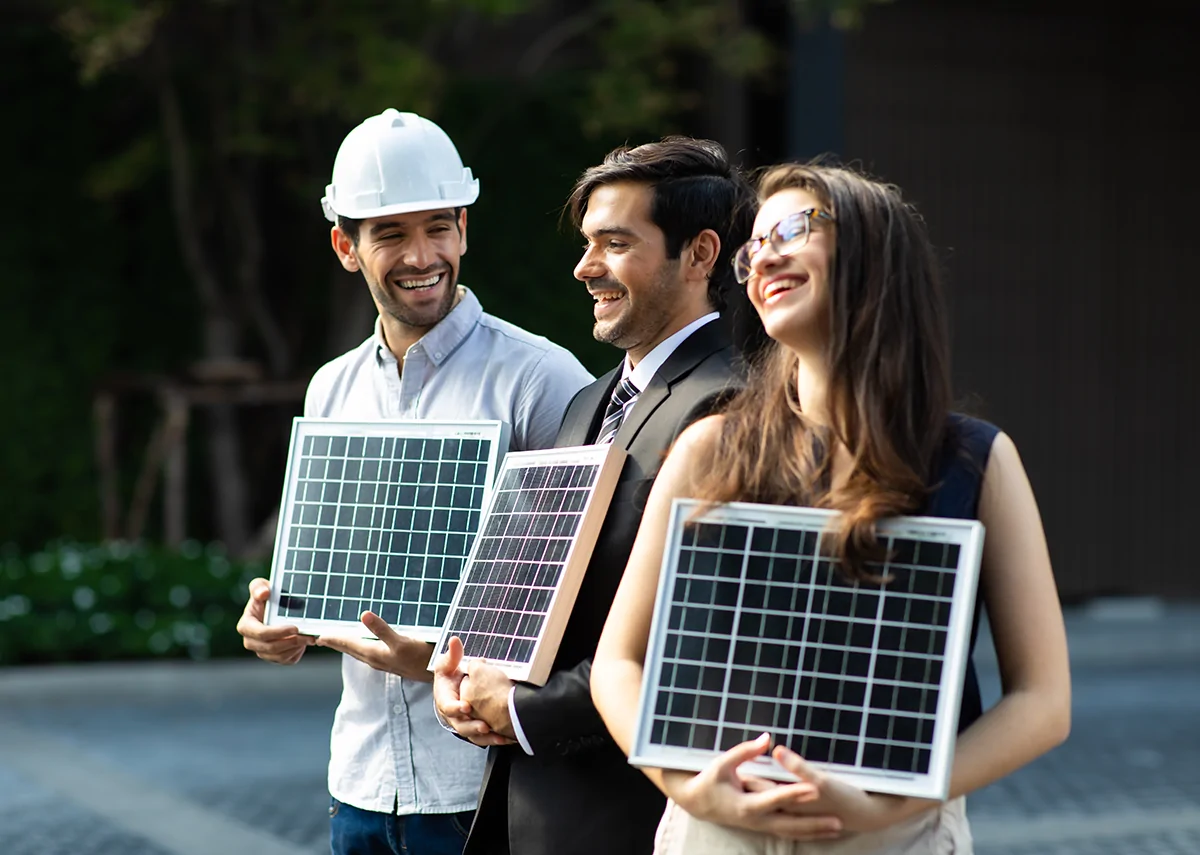
- Plan photovoltaics for warehouses, commercial halls and industrial halls
- Industrial plant: Plan a photovoltaic open-air system or open-space system
- Plan solar systems with photovoltaic solutions for freight forwarding and contract logistics
- B2B solar systems and photovoltaic solutions & advice
Photovoltaic system solutions: Xpert.Solar for planning and consulting in the area of solar carports, rooftop solar systems and photovoltaic systems in general for Velbert, Minden, Viersen and Rheine

Konrad Wolfenstein
I would be happy to serve as your personal advisor.
You can contact me by filling out the contact form below or simply call me on +49 7348 4088 965 .
I'm looking forward to our joint project.
Write to me

Xpert.Digital – Konrad Wolfenstein
Xpert.Digital is a hub for industry with a focus on digitalization, mechanical engineering, logistics/intralogistics and photovoltaics.
With our 360° business development solution, we support well-known companies from new business to after sales.
Market intelligence, smarketing, marketing automation, content development, PR, mail campaigns, personalized social media and lead nurturing are part of our digital tools.
You can find out more at: www.xpert.digital – www.xpert.solar – www.xpert.plus
Keep in touch









