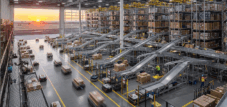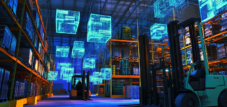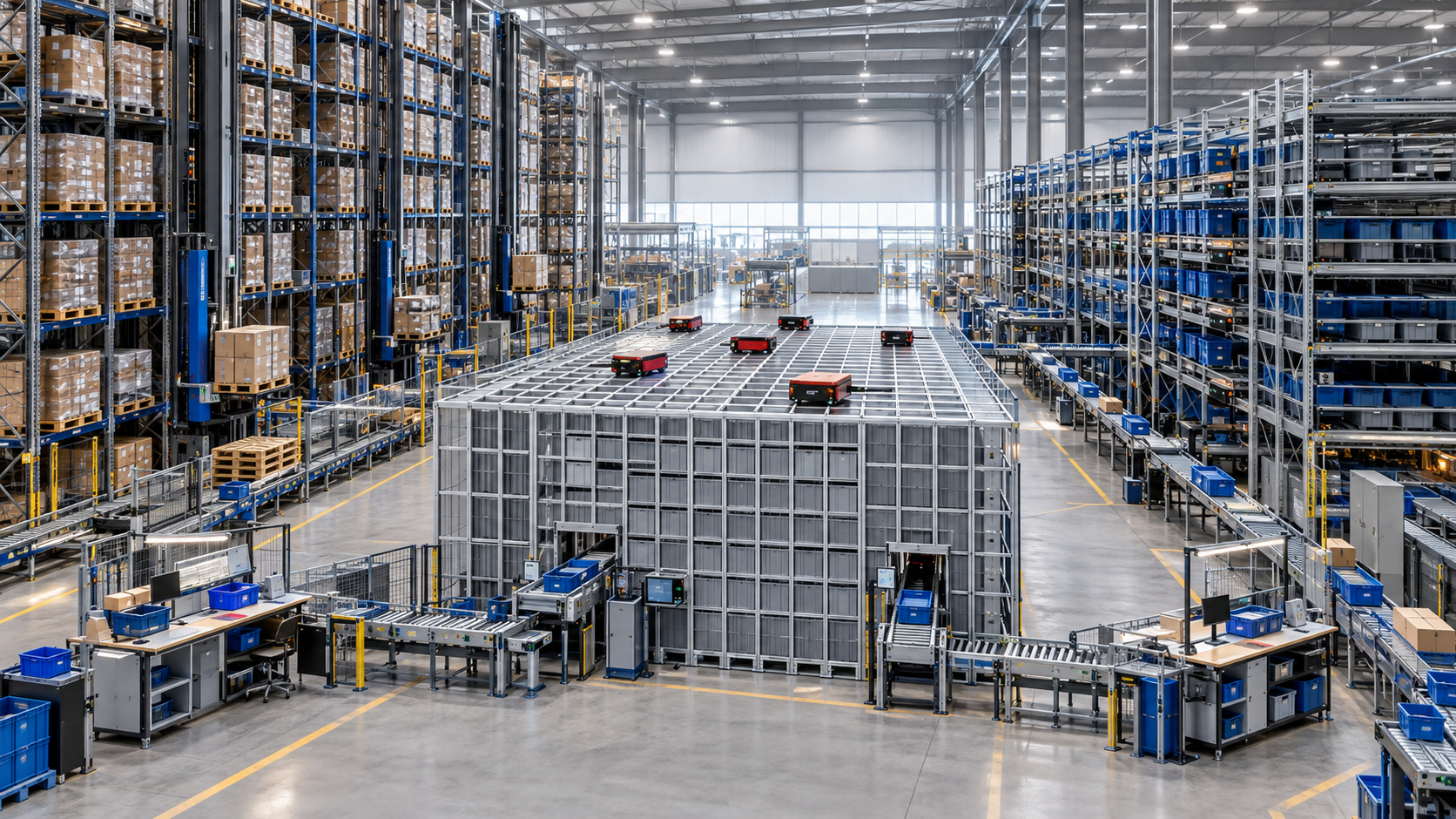
Optimal storage solutions: AutoStore in combination with other systems – Forcing everything into a cube leads to automation that misses the mark – Creative image on the topic, with AI: Xpert.Digital
Why AutoStore is not a universal warehouse: The pitfalls of warehouse automation
The limits of automation in warehouse operations: Where technology fails
AutoStore has established itself as one of the most significant innovations in intralogistics. The system enables the efficient storage of small parts by consolidating them in standardized containers and stacking them in an aluminum grid without traditional aisles. Robots transport the required containers to the workstations, ensuring high storage density and short walking distances for employees. However, despite these impressive advantages, this seemingly universal solution also carries risks. Reality shows that not every item is suitable for automation in AutoStore. From an economic perspective, the greatest benefit is not achieved by forcing any item into the system, but rather by the targeted automation of suitable inventory. Pallets, bulky goods, or items with special requirements present challenges that are often overlooked in many warehouse operations. In this article, we examine the suitability of AutoStore, highlight the limitations of the technology, and demonstrate how a deliberate combination of different storage solutions can lead to more economical logistics.
AutoStore is not a universal storage system
AutoStore is considered one of the most groundbreaking innovations in modern intralogistics. The system compacts small parts in standardized containers, stacks them in an aluminum grid without traditional aisles, and allows robots on top to transport the required containers to workstations. The result can be impressive: high storage density, short walking distances for employees, good scalability, and a largely standardized technical design. However, the system's apparent elegance can lead to a dangerous oversimplification. In presentations, a powerful tool is quickly transformed into a supposed universal solution for the entire warehouse.
Economically, this view is flawed. AutoStore generates its greatest benefit not by forcing every possible item into the system, but by automating precisely the appropriate inventory. Pallets, bulky goods, very heavy items, certain hazardous materials, highly fluctuating high-performance processes, and directly access-dependent workflows follow different logistical principles than small items in containers. Those who ignore these differences pay for complexity that doesn't deliver any corresponding added value.
The crucial question, therefore, is not whether AutoStore works in principle. The technology has proven itself in numerous applications. Rather, the decisive factor is for which part of the product range, for which order structure, and within which overall solution the system operates economically. In many warehouses, the best answer lies not in an either-or approach, but in a deliberately designed combination of AutoStore, pallet storage, high-bay warehouses, and automated bin or container storage.
Technology thrives on clear boundaries
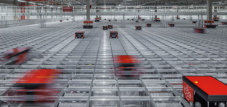
AutoStore is essentially an automated bin storage system based on the goods-to-person principle. Employees no longer walk through long aisles; instead, goods arrive in containers at an ergonomically designed workstation. Robots move along the grid, lifting containers from vertical stacks and temporarily rearranging containers above them. Frequently accessed items tend to move upwards as they are used, while less frequently accessed containers remain lower in the system. This natural, access-dependent reordering is a key component of the system's performance model.
Standardization is both a strength and a limitation. The available containers have a footprint of approximately 600 by 400 millimeters in the usable interior and are available in various heights. The permissible weight is typically a maximum of 30 kilograms per container. This makes the system ideal for many spare parts, electronic products, fashion items, pharmaceuticals, tools, consumables, and small merchandise. However, this suitability quickly diminishes as soon as products are too long, too tall, too heavy, sensitive to being stored together, or require special load carriers for handling.
The building height is also utilized differently than in a conventional high-bay warehouse. Depending on the container type, the grid reaches approximately six meters; above this, space is required for robot operation, maintenance, and safe access. In a low-ceilinged or irregularly shaped existing building, this construction method can be exceptionally advantageous. In a 20, 30, or 40-meter-high hall, however, an AutoStore concept alone would only partially utilize the available height. Therefore, the high floor area density should not be confused with optimal space utilization in every building volume.
The container determines its suitability
The first and most critical filter is the physical nature of the item. If a product doesn't fit securely into a suitable container, AutoStore isn't an appropriate primary solution. This applies to long goods, pipes, profiles, large spare parts, furniture components, tires, canisters, bags, numerous machine parts, and many items from the construction, plumbing, or wholesale sectors. Theoretical storage isn't enough. The item must also be reliably stored, separated, picked, counted, and retrieved without packaging protruding or containers deforming.
Weight sets another clear limit. An item weighing 28 kilograms may technically fit in a container, but still create an unsuitable process. If employees regularly lift it manually at the port, ergonomic risks arise, and additional requirements for lifting aids are imposed. If several heavy items are stored together, the weight limit is quickly reached. Furthermore, while a heavily filled container may be technically permissible, it offers less flexibility for assortment changes and incorrect loading. Therefore, planning must consider not only the average weight but also extreme cases, packaging changes, and the future product range.
Volume and shape are also economically relevant. A large, lightweight item can almost completely fill a container, even if its value and access frequency are low. In this case, expensive automated storage space is wasted on empty space and packaging. Conversely, very small parts can be efficiently managed within a container using dividers. The better the volume, weight, and access patterns match the container structure, the greater the economic benefit per storage location. Therefore, the number of stored item numbers alone is not very informative. What matters is how much usable volume of goods is actually contained within the containers.
Maximum density does not automatically equal maximum efficiency
High storage density is one of the strongest arguments for AutoStore. Compared to manual shelving systems, the same quantity of items can be stored in a significantly smaller footprint. In suitable applications, capacity can be increased several times over in the same area. This is particularly valuable when land is expensive, expansion space is limited, or relocation is to be avoided. Freed-up space can also be used for production, consolidation, packaging, or additional value-added processes.
However, structural density and economically usable density are not identical. If containers are only partially filled because items cannot be mixed or stock levels are inefficiently sized, a significant portion of the geometric volume remains unused. Safety stock, batch separation, expiration dates, client segregation, and quality status can also necessitate additional containers. Therefore, a warehouse can appear extremely compact on the floor plan yet exhibit poor volume utilization.
Economically, what matters is not how many containers fit into the grid, but how many relevant inventory units are reliably available per square meter. This includes the space for ports, conveyor technology, goods receiving, decanting, packaging, maintenance, fire protection, and potential expansions. Simply comparing grid space with shelf space underestimates the system's limitations. A sound calculation considers the entire process from goods receipt to shipping, taking into account the actual storage capacity, usable fill level, and the necessary operating space.
Particularly critical are items whose packaging sizes change frequently. A product range might fit perfectly into the containers in the planning year, but two years later, larger sales units, promotional packs, or pre-assembled components could push the limits. The technical lifespan of the equipment is longer than many product cycles. Therefore, the investment analysis requires not only historical data but also several future scenarios.
When the trench becomes a performance risk
AutoStore achieves its density by stacking bins on top of each other. The price of this density is the so-called "digging" effect. If the requested bin is located deep within a column, robots must first pick up the bins above and move them to available positions. With stable access patterns, the system logic counteracts this effect: frequently used bins tend to be located higher up, and less frequently used ones lower down. This works particularly well when demand can be identified sufficiently early and orders are somewhat predictable.
Abrupt changes become problematic. If a previously rarely needed item suddenly becomes a top seller due to a promotion, a disruption in the supply chain, a change in weather, or a viral effect, its container may initially be buried deep in the system. Numerous simultaneous accesses generate additional repositioning movements. The robots then have to deal not only with providing sales-relevant containers but also with uncovering and restacking them. This increases fluctuations in access times and can limit performance during an already busy peak period.
A shallow access pattern can also be disadvantageous. If many items are requested with a similar probability, fewer consistently high-moving items remain at the top. The system then has to access deeper levels more frequently. In contrast, an assortment with clearly defined fast, medium, and slow-moving items is easier to organize. Therefore, the blanket statement that AutoStore is suitable for many item numbers is incomplete. The crucial factor is the combination of the number of items, inventory depth, access distribution, order structure, and required response time.
For extremely short delivery times and highly volatile order volumes, a shuttle system with direct bin access can be more advantageous. In such a system, each storage location has a clearer access path, whereas AutoStore achieves its higher density at the cost of potential relocation movements. Which architecture is more economical does not depend on a single peak performance indicator. Key factors include guaranteed performance, fluctuation range, number of workstations, duration of peak load, and the cost of the required redundancy.
Ports and people remain a bottleneck
The number of robots is visible and therefore often becomes the focus of performance discussions. In practice, however, the workstations and the associated processes often limit throughput. A port can only operate as fast as containers can be fed in, items identified, quantities removed, orders confirmed, and destination containers changed. Complex quality checks, serial number recording, delicate packaging, multiple removals, or time-consuming consolidation reduce the actual performance significantly below a theoretical maximum.
Depending on the port type, several hundred container retrievals per hour are technically possible. However, this does not automatically translate into the same number of completed order items. A single container can facilitate multiple retrievals, while a single item may require multiple source containers. Crucial factors include average retrieval time, confirmation method, error handling, destination container exchange, replenishment, and the availability of suitable orders. Therefore, performance analysis must be based on actual process times, not on forecasted figures.
Ergonomics and staff qualifications remain relevant. Goods-to-person significantly reduces walking distances and physically demanding search movements. At the same time, it intensifies the workload at the workplace. A high, consistent work pace can be monotonous and create new ergonomic challenges. Screen orientation, lighting, reach zone, container tilt, lifting aids, break schedules, and workplace rotation all influence productivity and error rates. The system does not completely replace humans, but rather transforms their tasks from repetitive, sequential work to focused, pace-based processing.
Another bottleneck arises after the port. If order picking speeds up, but packaging, labeling, hazardous materials checks, consolidation, or shipping preparation don't keep pace, the queue simply shifts. Therefore, an economically viable concept doesn't size AutoStore in isolation, but rather the entire process chain. Additional robots are of little use if the ports are already at capacity or if destination containers aren't being emptied on time.
Unsuitable environmental and safety conditions
Standard modules typically operate within a controlled temperature range of approximately 2 to 35 degrees Celsius and at non-condensing humidity. Special multi-temperature solutions now exist for refrigeration and deep-freeze applications, but these alter investment, energy requirements, and the operating concept. A standard system therefore cannot simply be adapted to freezing, highly fluctuating, humid, or condensing environments. Outdoor storage facilities, washing areas, food processing plants, and cold chain logistics require a separate technical assessment.
The protection rating of the standard components is not suitable for every dusty, wet, or cleanroom-critical environment. Fine conductive dust, aggressive fumes, humidity, or special hygiene requirements may necessitate additional enclosures and process rules, or even preclude the system altogether. Just because an item physically fits into the container does not guarantee that the environment is compatible with robotics, electronics, and maintenance concepts.
Fire protection is not an afterthought. The tightly stacked plastic containers and the difficult-to-access internal structure necessitate a coordinated protection concept. Ceiling- or system-specific sprinklers, smoke detection, oxygen reduction, fire compartments, insurance requirements, and local permits can incur significant costs. The required effort depends, among other things, on the stored goods, the building, the container material, and regional regulations. Those who only consider fire protection after the system selection risks costly modifications or a project that is no longer economically viable.
Particular care must be taken with hazardous materials, highly flammable liquids, aerosols, fragile energy storage devices, and substances that could react with each other in the event of a leak. While closed containers can contain leaking liquids locally, they do not replace a hazardous materials assessment. Lithium batteries, for example, require a differentiated consideration of their condition, charge level, packaging, quantity, monitoring, and fire suppression strategy. Such items should only be included in the system if fire safety regulations, permits, insurers, and operational risk analysis explicitly cover their use.
The building could destroy the business case
AutoStore can be flexibly planned around columns, walls, and other obstacles. This adaptability is a significant advantage in existing buildings. However, the system is by no means undemanding. The floor must be perfectly level, sufficiently load-bearing, and stable across the entire grid area. The bins sit directly on the warehouse floor, and even small deviations can affect the geometry and operation via the stacking height. Grinding, repairs, coating, or even the installation of a new floor layer may become necessary.
The loads are also not trivial. Fully loaded containers, grids, and robots generate a high surface load. Therefore, a structural analysis is essential in older halls, on mezzanines, or above basements. The same applies to ceiling height, maintenance access, escape routes, sprinkler spacing, cable routing, and power supply. A seemingly favorable existing location can become more expensive than an alternative solution due to flooring, structural, and fire protection measures.
The grid height makes good use of low-ceilinged halls, but misses out on potential in very tall buildings. If a company is located on expensive land and can build 30 meters high, an automated high-bay warehouse can accommodate significantly more pallets per square meter of floor space. For containers, on the other hand, a miniload or shuttle warehouse can utilize the hall height much more effectively. AutoStore often maintains a denser footprint, but is not automatically denser overall.
Expansion areas must also be realistically secured. Additional robots only increase performance as long as the grid, traffic areas, and ports allow for it. Additional container capacity requires an expansion of the grid or better utilization of existing space. If the system is squeezed between building sections, its theoretical modularity may be practically limited. Future viability arises not only from modular technology, but also from reserved space, sufficient interfaces, and a robust expansion plan.
Your intralogistics experts
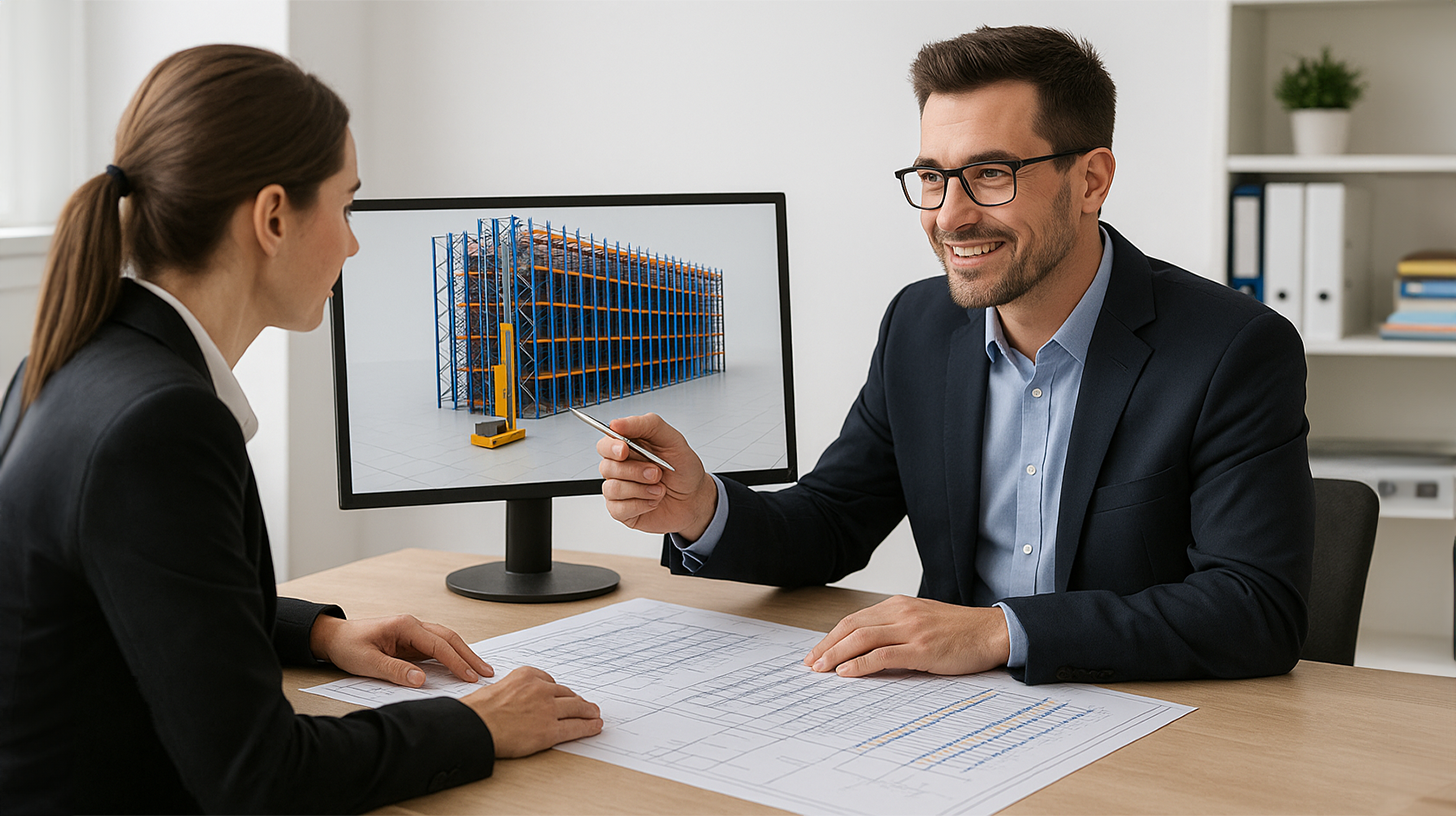
Consulting, planning and implementation of complete solutions for high-bay warehouses and automated storage systems - Image: Xpert.Digital
More information here:
Cost-effectiveness of AutoStore and pallet storage
When the investment doesn't pay off
An AutoStore project incurs costs not only for grids, bins, robots, and ports. It also includes planning, floor preparation, fire protection, electrical and network infrastructure, conveyor technology, workstations, software integration, training, spare parts, maintenance, and internal project work. During operation, license, service, and maintenance costs are incurred. Furthermore, the conversion requires skilled personnel and can lead to productivity losses during the start-up phase.
In well-suited applications, such investments can pay for themselves within a few years. Reference models show that space savings, reduced travel distances, increased accuracy, and lower costs per order item can create significant value. However, these results are not directly transferable. A company with inexpensive space, low personnel costs, a low order volume, and a highly variable product range has a different business case than a growing e-commerce business in an expensive metropolitan area.
AutoStore systems are often not economical for very small volumes. If only a few employees reliably operate a manageable warehouse with short distances, the capital tied up can be higher than the labor saved. The same applies to short usage periods. A single-shift operation with seasonally low utilization spreads depreciation and fixed costs across a small number of order items. Multi-shift or long operating hours, on the other hand, improve the utilization of the investment.
A very high proportion of complete cartons or pallets also argues against comprehensive storage in bins. Transferring goods from pallets into AutoStore bins only to later retrieve them almost entirely by the carton creates unnecessary handling. The system is particularly economical when efficiently retrieving individual items or small quantities. Pallet or carton storage is usually more suitable for complete loading units.
The capital calculation should therefore not rely on a blanket increase in productivity. It must, at a minimum, account for investment expenditures, operating costs, residual value, financing, taxes, personnel development, energy, space, service level, cost of failure, and growth options. Additionally, a scenario is required in which sales or order structure fall short of projections. A facility that is only profitable under optimistic growth scenarios carries a considerable economic risk.
The pallet warehouse remains indispensable
Pallets are the natural unit for incoming goods, reserve stock, large orders, and heavy or bulky items. A pallet warehouse can be operated manually using narrow-aisle technology, semi-automatically with automated guided vehicles (AGVs), or fully automatically with stacker cranes. It is particularly suitable for full load units, high inventory levels per item, and robust material flows. AutoStore does not replace this functionality but can effectively complement it.
The economically compelling combination usually follows a clear division of tasks. Reserve stock and complete cartons remain on pallets. Only the quantity required for individual order picking is replenished in the AutoStore system. This prevents the expensive storage capacity from being blocked by excessive reserve stock. At the same time, the manual travel time during order picking is reduced. The pallet storage system handles depth and volume, while AutoStore manages variety and individual item access.
This separation requires well-managed replenishment. The warehouse management system must be aware of inventory levels, open orders, replenishment times, and minimum stock levels. If replenishment occurs too late, orders will be stalled despite sufficient overall inventory. If it occurs too early, unnecessarily many containers will be filled, generating additional decanting work. An optimal solution is dynamic replenishment that considers consumption, delivery time, port utilization, and planned order waves.
The combination is particularly valuable for mixed customer orders. An order might contain a full pallet of a fast-moving item, several cartons from the pallet warehouse, and individual pieces from AutoStore. Instead of forcing all items into a single system, the partial quantities are picked in parallel and consolidated at a central point. This way, each product category utilizes the most economically suitable technology. The challenge shifts from storage to synchronization.
The high-bay warehouse utilizes height; AutoStore consolidates diversity
An automated high-bay warehouse demonstrates its strengths when large quantities on pallets, tall buildings, and predictable inbound and outbound flows converge. Storage and retrieval machines can access heights well over 30 meters, thus replacing land area with vertical capacity. AutoStore, on the other hand, consolidates smaller goods in a comparatively low-rise building and enables flexible access via numerous robots.
In a combined architecture, the high-bay warehouse can accommodate incoming goods pallets, reserve stock, bulk goods, and finished loading units. AutoStore simultaneously supplies the picking area. Conveyor technology connects goods receiving, depalletizing, decanting, AutoStore ports, consolidation, and shipping. A higher-level warehouse management system determines from which area an order is fulfilled and when partial quantities are combined.
Economic strength arises from different scaling logics. Pallet capacity increases through additional racking aisles or taller buildings. Picking performance increases through additional robots and ports. Container capacity increases through grid area and the number of containers. This allows investments to be more precisely targeted to bottlenecks. A company doesn't need to design its entire warehouse for the highest possible throughput, nor does it need to store every single item in an expensive high-bay pallet rack.
Practical applications demonstrate that such combinations can cover a wide range of scales. Smaller industrial applications connect a few thousand AutoStore bins with a large pallet racking system. Large multi-customer systems combine tens of thousands of bin locations with tens of thousands of pallet spaces. The crucial factor is not the size ratio, but the allocation of product profiles. Even a relatively small AutoStore module can be economical if it handles a particularly labor-intensive subprocess.
However, this combination increases technical and organizational complexity. Conveyor technology, control systems, warehouse management, and order logic must work together. If central consolidation fails, independent subsystems offer only limited help. The architecture therefore requires buffers, alternative pathways, and clearly defined emergency procedures. System diversity creates flexibility but can generate new dependencies without proper orchestration.
The container depot is both a complement and a competitor
The term container storage is frequently used in intralogistics for automated container or tray storage systems. Typical examples include miniload systems with stacker cranes and shuttle warehouses with vehicles operating on multiple levels. Unlike AutoStore systems, the containers in these systems are stored on shelves and are usually directly accessible or require minimal relocation. These systems utilize warehouse heights of twelve, eighteen, or more meters and can achieve high, consistent throughput.
A shuttle warehouse is particularly advantageous when direct accessibility, strict sequencing, and very high peak throughput are more important than maximum floor density. Containers can be transported to lifts and conveyors in the required sequence, facilitating the supply of fast sorting, production, or packaging processes. The trade-off is the need for aisles, lifts, pre-zones, and more complex mechanics. A bottleneck or failure at a lift can disrupt an entire area, whereas AutoStore's decentralized robot fleet offers a different form of redundancy.
A miniload warehouse can be advantageous if the building is tall, different containers or trays need to be used, or direct access is required. It can also serve as a buffer for full cartons. AutoStore, on the other hand, is usually more suitable when maximum storage density, flexible grid geometry, and a large inventory of small items are paramount. Therefore, the selection is not a ranking, but rather a weighting of density, height, throughput, access, flexibility, and cost.
A combination of both systems can be beneficial, even though they appear to address the same product category at first glance. AutoStore can compactly accommodate the broad range of slow- and medium-moving items, while a shuttle warehouse handles very fast-moving items, order containers, or sequence-critical goods. Similarly, a container warehouse can serve as a buffer between AutoStore and packaging. This relieves the grid of short-term order consolidation and allows for more precise control of the shipping sequence.
However, this combination is only economical if the functions are clearly separated. Two systems with nearly identical tasks double the interfaces, spare parts inventory, and know-how without creating a corresponding benefit. Every technology must solve a demonstrable bottleneck. This could be density, altitude, peak performance, sequencing, temperature zone, or resilience. If such a difference is lacking, a simpler architecture is often superior.
Software decides on the network
In a hybrid plant, it's not enough for each subsystem to function independently. A warehouse management system must manage inventory and orders across the entire system. A warehouse control or material flow system coordinates the technical movements. It prioritizes orders, controls replenishment, assigns destinations, monitors buffers, and prevents conveyor lines from blocking each other.
The key economic challenge is the correct placement of items and inventory. An item might be stored entirely in pallet storage, entirely in AutoStore, or in both. Another might be stored as a fast-moving item in shuttle storage and as a reserve on pallets. This allocation should not be treated as a one-time master data decision. Demand, packaging, supplier structure, and inventory range are constantly changing. Therefore, a high-performance system regularly checks whether an item is still in the correct storage system.
Order release must also be adapted to actual capacity. Starting too many orders simultaneously leads to bottlenecks at ports, conveyors, and during consolidation. Releasing too few orders results in wasted resources. Effective control smooths out peaks, prepares low-lying containers in advance, and synchronizes pallet, carton, and piece counts. This allows software to utilize a significant portion of existing hardware capacity without the need to purchase additional robots or workstations.
Transparency regarding the root causes is particularly important. A metric like order processing time is insufficient. The company must identify whether waiting times are caused by low-lying containers, insufficient replenishment, port utilization, slow handling, conveyor technology, consolidation, or shipping. Only then can targeted investments be made. Without this transparency, a process problem is easily addressed with additional hardware.
Interfaces to ERP, shipping, production planning, and automation should be standardized as much as possible, but not superficially planned. Inventory adjustments, blocking, batches, serial numbers, returns, and malfunctions create complex exceptions. It is precisely these rare occurrences that determine stability in real-world operation. A system is not well integrated when the ideal order is processed, but when errors are handled transparently and inventory levels are maintained consistently.
Resilience doesn't develop on its own
AutoStore boasts high technical availability thanks to its numerous robots and distributed access routes. If a single robot fails, others can take over. Multiple ports also provide redundancy. However, this does not guarantee complete operational reliability. Central software, power supply, network, fire safety clearance, conveyor technology, or a shared consolidation area can still represent critical dependencies.
In hybrid systems, task allocation can increase resilience. Pallet and container areas are physically separated, and certain orders can be partially fulfilled from alternative stocks in case of disruptions. Suitable bypass processes are a prerequisite. If all shipping orders are forced to pass through a single automated node, this node becomes a system-wide point of failure. Redundancy must therefore be planned at the process level, not just at the component level.
Emergency operations can, for example, keep selected high-speed shipments outside the regular grid, connect manual packing stations, and allow the direct dispatch of complete cartons from the pallet warehouse. Such reserves require space and, on paper, reduce maximum efficiency. However, they can still be economically viable because the costs of a shutdown lasting several hours or days are considerable. The appropriate scope depends on delivery commitments, seasonality, and the potential for damage.
Spare parts, maintenance access, and personnel expertise are also part of resilience. A system that can only be restarted by external specialists requires different service contracts than a system with a trained in-house team. Operators should clarify response times, critical spare parts, software recovery, and manual inventory access contractually and organizationally. High nominal availability is valuable, but it does not replace a robust restart strategy.
Energy efficiency requires a comprehensive calculation
These small robots operate with relatively high energy efficiency and recover energy during braking. Furthermore, their compact design reduces the space required for heating, cooling, and lighting. This can offer a significant advantage compared to extensive manual storage or mechanically complex solutions. This effect becomes particularly important economically with long operating times and high energy costs.
A serious sustainability assessment, however, cannot stop at the robots' electricity consumption. Soil stabilization, steel and aluminum grids, plastic containers, conveyor technology, building services, and potential cooling systems also have an ecological footprint. If the high density avoids the need for new construction or allows for a smaller building, this indirect effect can be more important than the pure electricity consumption of the systems. Conversely, if a functioning system is replaced prematurely, the embodied energy must also be considered.
Hybrid systems don't automatically consume more energy, even though they incorporate multiple technologies. When each technology performs its appropriate task, unnecessary movements are reduced. Full pallets don't move through picking processes, slow-moving items don't block high-performance shuttles, and AutoStore doesn't have to manage unsuitable large items. Therefore, the key metric isn't kilowatt-hours per machine, but rather energy per correctly and promptly processed order unit.
Higher density also impacts real estate economics. Less floor space potentially means lower rents, reduced land requirements, and shorter internal transport routes. In high-demand logistics regions, this can dominate the business case. However, in locations with cheap land and high conversion costs, this advantage becomes less significant. Sustainability and profitability are therefore not automatically linked, but with the right location profile, they can reinforce each other.
The right decision begins with the order data
A sound system selection process doesn't begin with a technology demonstration, but with data. At least twelve months are needed, and two to three years are preferable in cases of strong seasonality. The analysis should include article dimensions, weights, inventory levels, order items, quantities per item, access distribution, returns, replenishment, daily sales patterns, and peak periods. Additionally, planned growth, new sales channels, and assortment effects must be considered.
The combined consideration of speed and inventory is particularly revealing. A fast-moving product with a short shelf life has different requirements than one with a high reserve inventory. Similarly, a slow-moving product can occupy a significant amount of space despite infrequent access. Segmenting by access, volume, weight, inventory depth, and order type provides a realistic picture of the technology's suitability.
This is followed by a process simulation. It should depict not only average days, but also peaks, disruptions, and changing demand profiles. For AutoStore systems, bin depth, digging movements, robot density, port utilization, and preparation time are relevant. For shuttle and high-bay warehouses, aisles, lifts, stacker cranes, and conveyor technology play a more significant role. For the combination of systems, the synchronization of sub-orders is crucial.
A cost-benefit analysis requires several alternatives. These include at least an improved manual solution, a pure AutoStore variant, and a hybrid architecture. Depending on the specific requirements, shuttles, miniloads, automated guided vehicles (AGVs), or traditional conveyor technology should also be considered. Only a comparison will reveal whether the additional level of automation actually creates value or merely appears technically attractive.
The key factor is marginal utility. The first automated items can eliminate a large proportion of the transport routes. Each additional item may offer less benefit while simultaneously creating additional containers, replenishment, and complexity. Therefore, the economic optimum is often not achieved at 100 percent automation. A small residual area for special shapes, long goods, hazardous materials, or rare large parts can make the overall solution significantly more cost-effective and robust.
AutoStore works best when used by specialists
AutoStore does not function effectively if items exceed bin limits, if the goods are too heavy or bulky, if environmental and fire safety conditions are unmanageable, if direct access is essential, or if the necessary peak throughput can only be achieved with a disproportionately large number of robots and ports. It is also critical if the building's height could be better utilized with a high-bay racking system, if the system is underutilized, or if full cartons and pallets dominate the process.
The system's greatest strength lies in its ability to handle a large number of suitable small parts, limited space, a significant proportion of piece picking, and sufficiently stable access patterns. Under these conditions, walking distances are reduced, inventory is managed more efficiently, and additional capacity can be gradually built up via robots and ports. The benefits increase further if an existing building can be used for a longer period, thus avoiding costly expansion.
In combination with a pallet warehouse, AutoStore handles the individual item level, while pallets carry reserves and large quantities. Together with an automated high-bay warehouse, it combines high vertical capacity with high-density picking of small parts. Alongside a shuttle or miniload warehouse, it can accommodate the broad, less time-critical product range, while the other system handles fast-moving items, cartons, or strictly sequenced processes. This division of tasks is not a technical weakness, but rather the result of an economically sound architecture.
The most important planning rule is therefore: Don't adapt the warehouse to AutoStore, but rather place AutoStore in the right place within the warehouse. Forcing every product into the cube means losing the advantages of specialization. By considering items, orders, buildings, and service commitments in a differentiated way, a solution can be created from multiple systems that is ultimately more compact, efficient, and economical than any supposed one-size-fits-all technology.
Your global marketing and business development partner
☑️ Our business language is English or German
☑️ NEW: Correspondence in your native language!

Konrad Wolfenstein
I and my team are happy to be available to you as your personal advisor.
You can contact me by filling out the contact form here wolfenstein@xpert.digital:or simply call me at +49 7348 4088 965. My email address is
I'm looking forward to our joint project.