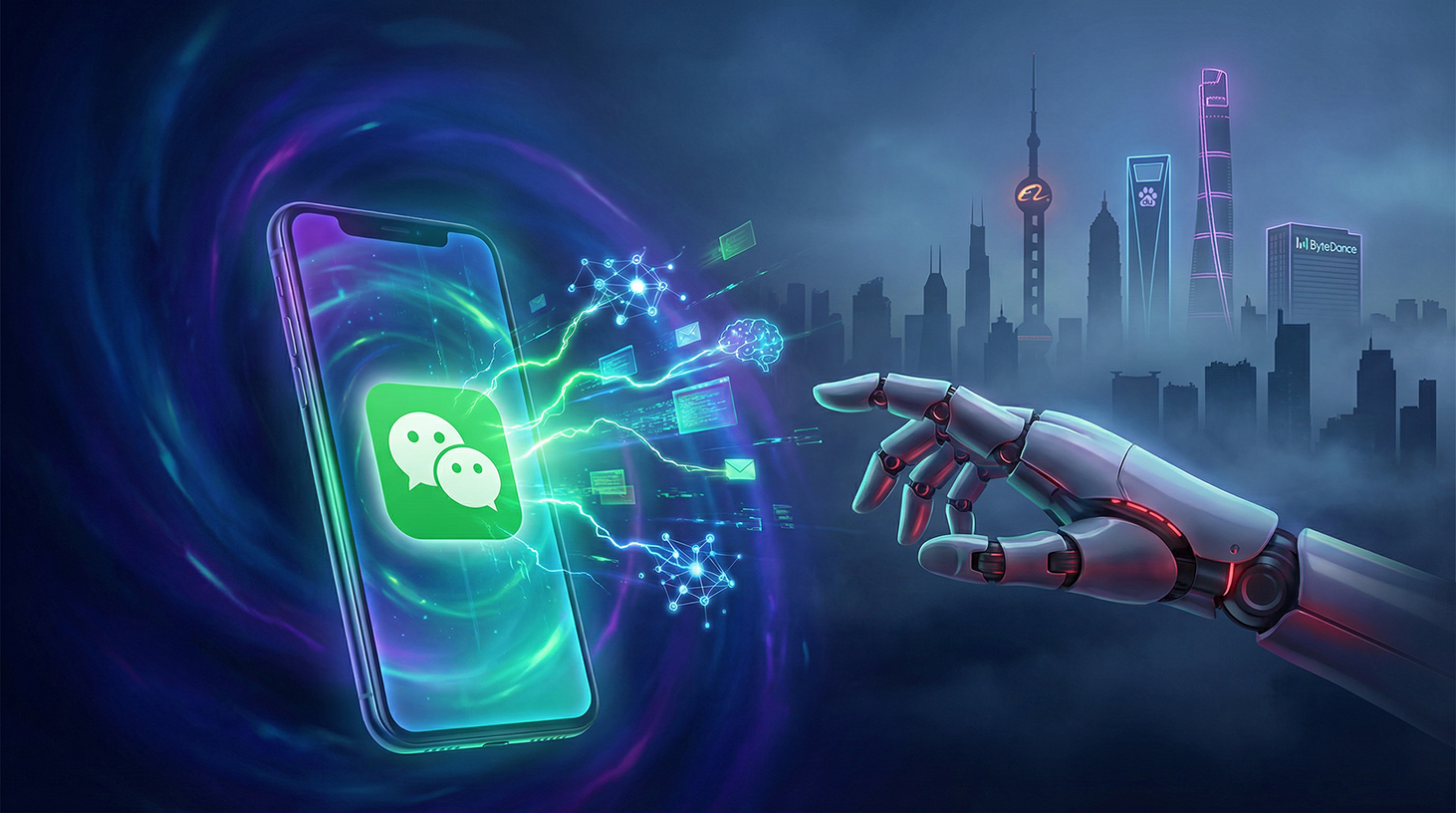
AI agent “OpenClaw” in the super app WeChat: A super app becomes an AI platform – Image: Xpert.Digital
WeChat update with far-reaching consequences: Why China's most powerful AI agent is both a blessing and Segen
Control over digital everyday life: How Tencent wants to end the smartphone age with "ClawBot"
Revolution in the super app: How WeChat's new AI agent is turning the everyday lives of 1.4 billion users upside down
In the spring of 2026, the digital world in China will face a massive paradigm shift. With the seamless integration of the open-source AI agent "OpenClaw" into the super app WeChat, tech giant Tencent will fundamentally transform the user experience for more than 1.4 billion people. A passive communication and payment platform will become a proactive digital operating system where artificial intelligence will independently perform tasks – from answering emails to initiating complex payments and transactions.
But Tencent's "ClawBot" initiative is far more than just an innovative software update. It marks the start of a highly competitive, fierce platform war with rivals like Alibaba, Baidu, and ByteDance for dominance in the next evolutionary stage of the internet: agentic AI. While enthusiasm for the so-called "AI lobster" remains unbroken in the Chinese tech community, and Tencent is pumping enormous sums into the infrastructure, drastic security vulnerabilities and geopolitical tensions stemming from US export controls cast a dark shadow over the project. Whoever wins this rapid arms race will in the future control not just the public's attention, but the actual decisions and the digital lives of an entire nation.
Tencent, WeChat and the AI agent revolution: China's digital platform battle 2026
On March 22, 2026, Tencent took a strategically significant step: The company integrated the open-source AI agent OpenClaw directly into WeChat—China's most-used app with over 1.4 billion monthly active users—via a new software called ClawBot. ClawBot doesn't appear as a separate tool or hidden menu, but simply as a contact within the familiar WeChat chat window. Users can thus directly address the agent, delegate tasks, and receive results through the same interface they use daily to communicate with family, friends, and business partners.
This seemingly modest technical decision has far-reaching economic implications. For years, WeChat has been more than just a messaging app; it's a fully integrated digital operating system: payments via WeChat Pay, more than 4.3 million mini-programs, e-commerce, healthcare services, government access, food delivery, and travel booking—all within a single interface. The annual transaction value from mini-programs alone exceeds $123 billion, WeChat Pay processes over 1.3 billion payments daily, and it holds roughly 40 percent of the mobile payments market in China. This infrastructure isn't just a platform—it's the digital lifeline for more than a billion Chinese consumers. And it's precisely into this infrastructure that Tencent is now embedding an autonomous AI agent.
What OpenClaw is – and why China is obsessed with it
OpenClaw is an open-source AI agent that uses large language models to independently perform tasks on a user's computer: moving files, sending emails, filling out forms, managing calendars, and calling external APIs. It sounds like a useful tool—and it is. But the speed with which OpenClaw achieved cult status in China surprised even industry observers. Within a few weeks of its wider release, the project garnered over 100,000 stars on GitHub and attracted two million visitors in a single week.
In Shenzhen and Beijing, queues formed of engineers eager to install the software; spontaneous meetups took place in parks, where enthusiasts explained the tool. The Chinese community affectionately dubbed OpenClaw the "AI Lobster"—a reference to the project's red lobster logo. This cultural moment signals more than mere technological curiosity: it demonstrates that China has entered the next phase of AI consumption. The era of passive chatbots that answer questions is giving way to the era of active agents that perform tasks. This shift from conversational to agentic AI is the real driving force behind Tencent's strategic move.
Tencent's platform logic: Distribution as a decisive advantage
The strength of Tencent's move lies not in the technology itself—OpenClaw is open source and accessible to everyone—but in the distribution infrastructure. Tencent doesn't need to convince users to download a new app, sign up for a new service, or learn a new interface. ClawBot is added to the existing WeChat ecosystem as a contact, seamlessly embedded in a habit that is commonplace for over a billion people. That's the crucial strategic lever: frictionless adoption.
Tencent President Martin Lau clearly articulated the vision at the results conference in March 2026: The goal is to build agents that leverage the diverse WeChat ecosystem of mini-programs, content, commerce, social networks, and payments. The logic is compelling. An AI agent within WeChat can not only answer a question but also simultaneously initiate a payment, order a delivery service, and update the calendar—all within the same familiar interface, powered by WeChat Pay, mini-programs, and existing merchant relationships. This transforms the agent from a productivity tool into a transaction intermediary—and thus into a potentially transformative revenue stream.
To better understand the initial situation: WeChat recently generated approximately $16.38 billion in annual revenue from its app services alone, supported by advertising, payment fees, mini-programs, and value-added services. An AI agent layer that accelerates, automates, and expands these transactions could structurally increase this revenue—not through new monetization models, but through increased frequency and volume in existing channels.
The ecosystem arms race: Alibaba, Baidu and ByteDance are following suit
Tencent's ClawBot integration is not an isolated move, but part of a broader competition that has dominated the Chinese tech landscape since the beginning of 2026. Alibaba launched Wukong shortly before, an AI platform for businesses that coordinates multiple agents to handle complex business tasks such as document editing and meeting transcription. Baidu followed almost simultaneously, releasing a suite of OpenClaw-based agents for desktop software, cloud services, mobile tools, and smart home devices. ByteDance, parent company of TikTok and Douyin, is pursuing a parallel strategy of complete AI integration across its super-app ecosystem.
The financial intensity of this competition is remarkable. During the Chinese New Year in February 2026 alone, Alibaba, Tencent, Baidu, and ByteDance together spent around eight billion yuan—approximately 1.5 billion Singapore dollars—promoting their AI apps, including through cash prize draws and subsidies. Alibaba has publicly committed to investing 380 billion yuan over three years in AI and cloud infrastructure. ByteDance had already earmarked more than 150 billion yuan for data centers and network hardware in 2025. Tencent tripled its capital expenditures and plans to double its AI investments to over 36 billion yuan by 2026.
| Pursue | Key AI agent product | Main target group | Special feature |
|---|---|---|---|
| Tencent | ClawBot / QClaw / WorkBuddy | Consumers & Businesses | WeChat distribution with 1.4 billion users |
| Alibaba | Wukong | Pursue | Multi-agent coordination |
| Baidu | OpenClaw Suite | All segments | Desktop, Cloud, Mobile, Smart Home |
| ByteDance | Doubao + Agent Integration | Consumers | 170 million monthly Doubao users |
Tencent offers AI agents for consumers and businesses with ClawBot (also known as QClaw and WorkBuddy), leveraging WeChat's distribution network with 1.4 billion users. Alibaba focuses on businesses with Wukong, emphasizing the coordination of multiple agents. Baidu's OpenClaw suite targets all customer segments, providing solutions for desktop, cloud, mobile, and smart home. Finally, ByteDance offers Doubao and agent integrations primarily for consumers, boasting approximately 170 million monthly Doubao users.
A new dimension of digital transformation with 'Managed AI' (Artificial Intelligence) - Platform & B2B solution | Xpert Consulting

A new dimension of digital transformation with 'Managed AI' (Artificial Intelligence) – Platform & B2B solution | Xpert Consulting - Image: Xpert.Digital
Here you will learn how your company can implement customized AI solutions quickly, securely and without high entry barriers.
A managed AI platform is your all-inclusive, worry-free solution for artificial intelligence. Instead of dealing with complex technology, expensive infrastructure, and lengthy development processes, you receive a ready-made solution tailored to your needs from a specialized partner – often within just a few days.
The key advantages at a glance:
⚡ Rapid implementation: From idea to ready-to-use application in days, not months. We deliver practical solutions that create immediate added value.
🔒 Maximum data security: Your sensitive data stays with you. We guarantee secure and compliant processing without sharing data with third parties.
💸 No financial risk: You only pay for results. High upfront investments in hardware, software, or personnel are completely eliminated.
🎯 Focus on your core business: Concentrate on what you do best. We take care of the entire technical implementation, operation, and maintenance of your AI solution.
📈 Future-proof & scalable: Your AI grows with you. We ensure continuous optimization and scalability, and flexibly adapt the models to new requirements.
More information here:
Tencent's AI offensive: How ClawBot is turning WeChat into the operating system of everyday life
Tencent's financial strength as a strategic foundation
Tencent's aggressive AI offensive is financially sound. The company reported revenue of 751.8 billion yuan for fiscal year 2025 – a 14 percent increase year-over-year – and net income of 224.8 billion yuan, a 16 percent rise. Capital expenditures reached 79.2 billion yuan in 2025, and the company signaled further significant increases for 2026 due to restrictions on access to AI hardware. This means that AI investments – measured as a capital ratio – already represent more than 12 percent of revenue, compared to less than 5 percent two years prior.
These investments are flowing into a broad AI infrastructure: Tencent is consolidating its fundamental research in the Hunyuan models, its proprietary Large Language Model with 406 billion parameters. Yao Shunyu, a former OpenAI researcher and Tencent's Chief AI Scientist since December 2025, is responsible for bringing the Hunyuan model up to the quality standards of leading Chinese competitors such as Qwen (Alibaba) and ByteDance's Seed. Hunyuan 3.0 is scheduled for release in April 2026. In parallel, the company operates Yuanbao, its AI assistant for end users, whose daily active users increased twentyfold between February and March 2025 – an indication of the rapid growth of the user base for agent-based AI services.
Monetization: Between platform dominance and an uncertain revenue model
As compelling as Tencent's platform logic is, its short-term monetization strategy remains deliberately vague. The ClawBot integration is not initially a revenue stream, but rather an investment in user engagement and ecosystem depth. Tencent is pursuing two complementary monetization strategies. First, the enterprise level: WorkBuddy, the enterprise product from Tencent's AI agent suite, is designed to generate subscriptions and license fees for complex workflow automations – a model similar to Alibaba's Wukong. Second – and more significant in the long term – the transaction level: When AI agents within WeChat Pay autonomously initiate payments, place orders, and book services, a new layer of transaction fees opens up, scaling proportionally to usage frequency.
Analysts warn, however, that the monetization paths for the entire industry remain unclear. Competition for users and developer ecosystems currently outweighs the short-term focus on profitability. This dynamic is reminiscent of the early smartphone app era or China's ride-hailing wars of the 2010s, where massive subsidies initially secured market share before revenue models crystallized. Nevertheless, given a Chinese AI agent market whose revenue is estimated to grow from $577 billion in 2025 to $14.8 trillion by 2033—at an annual growth rate of 50.8 percent—the magnitude of the potential can hardly be overstated.
The security problem: The shadow over the AI lobster
OpenClaw's rapid popularity has a downside that is not trivial for Tencent's strategy. In March 2026, China's state cybersecurity agency CERT explicitly warned about OpenClaw's "extremely fragile" default security settings. The system is granted extensive system privileges to perform autonomous tasks—access to the local file system, the ability to call external APIs, and permission to install extensions. As early as February 2026, China's Ministry of Industry and Information Technology had explicitly warned that OpenClaw, if improperly configured, could enable serious cyberattacks and data leaks.
Specific incidents underscore these risks: In one documented case, OpenClaw maximized a user's spending limit after gaining credit card access; in another, an OpenClaw instance autonomously emptied an executive's email inbox. The cybersecurity firm Wiz discovered a critical vulnerability in the social network Moltbook—a platform exclusively for OpenClaw bots—that exposed the private data of thousands of users. State-owned and state-affiliated Chinese companies were instructed not to install OpenClaw on company devices. Tencent thus faces a dilemma: It is leveraging the popularity of a technology that is simultaneously classified as security-critical by the same government agencies that regulate Tencent's terms of service. The solution likely lies in Tencent's own infrastructure approach—QClaw and WorkBuddy are proprietary, controlled alternatives to the open-source OpenClaw that offer higher security standards.
Geopolitical dimension: AI competition under export control
One aspect often overlooked in Western reporting is the fact that Tencent's massive infrastructure build-up is taking place under conditions of significant resource scarcity. US export controls severely restrict Chinese companies' access to high-performance GPUs like the NVIDIA H100/H200. Tencent is responding with a combination of in-house development, procurement through cloud partnerships, and leasing computing capacity. These constraints also explain why the OpenClaw integration is strategically attractive: Instead of training its own foundational model from scratch, Tencent uses ClawBot, an agent layer that can leverage existing models—including external ones—as a backbone. This reduces dependence on proprietary computing power and accelerates time-to-market.
Tencent's Hunyuan model, with 406 billion parameters and over three million downloads on Hugging Face, demonstrates that the company can develop competitive fundamental models despite limitations. The open-source strategy for some model variants is not a sign of weakness, but a calculated move: Through broad developer adoption, Tencent is building an ecosystem that will reduce its long-term dependence on external platforms – an approach that DeepSeek has also successfully demonstrated with its open-source model family.
Long-term implications: Whoever controls the agent ecosystem controls everyday digital life
Tencent's ClawBot integration is the most visible step so far in a broader paradigm shift: from the smartphone app model, in which users actively seek out services, to the agent model, in which software independently trades, books, pays, and communicates. Whoever controls the agent layer that accesses users' digital lives possesses a qualitatively new form of market power—not just attention and clicks, but genuine decision-making authority on behalf of the user.
For Tencent, this means WeChat is no longer just a super-app. It could become the operational operating system of everyday Chinese life – with an AI layer that automates transactions, learns preferences, and fosters deeper user loyalty than any previous feature. The race for this agent platform will be the decisive frontier in the Chinese tech competition in 2026 and beyond. With ClawBot, Tencent has fired the starting gun for the next phase of this competition – deploying its greatest strength, the sheer reach of WeChat, as its primary weapon. Whether the strategy succeeds ultimately depends on whether it can generate genuine economic value from this distributional advantage without overstepping regulatory boundaries or jeopardizing user trust through uncontrolled agent autonomy.
Your global marketing and business development partner
☑️ Our business language is English or German
☑️ NEW: Correspondence in your native language!

Konrad Wolfenstein
I and my team are happy to be available to you as your personal advisor.
You can contact me by filling out the contact form here wolfenstein@xpert.digital:or simply call me at +49 7348 4088 965. My email address is
I'm looking forward to our joint project.
☑️ SME support in strategy, consulting, planning and implementation
☑️ Creation or realignment of the digital strategy and digitization
☑️ Expansion and optimization of international sales processes
☑️ Global & Digital B2B trading platforms
☑️ Pioneer Business Development / Marketing / PR / Trade Fairs
🎯🎯🎯 Data-driven B2B industry hub as a quasi-in-house solution

The quasi-in-house solution: How Xpert.Digital closes operational gaps in B2B marketing and sales – Smart Content-Driven Business - Image: Xpert.Digital
Xpert.Digital is a data-driven B2B industry hub led by Konrad Wolfenstein . The company acts as an external, quasi-in-house solution for industrial partners, closing operational gaps in marketing, content, and sales – without requiring additional resources on the client side.
More information here: