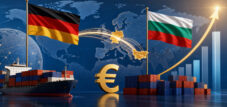
Save up to 50% on costs: Why Bulgaria is becoming Europe's nearshoring alternative – with three building blocks for location security – Image: Xpert.Digital
Production out of Asia: How the EU country of Bulgaria is becoming a magnet for SMEs
Not just affordable, but smart: Why Bulgaria is replacing Poland as a top location
The perfect tax haven with the Euro? What German companies need to know about Bulgaria now
In times of fragile global supply chains and persistently high production costs in Western Europe, one country is rapidly moving into the spotlight for German businesses: Bulgaria. With its full accession to the Schengen Area in 2025 and the historic introduction of the euro in early 2026, the Balkan nation has cleared the crucial institutional hurdles to transform itself from a former low-wage country into a highly attractive and secure nearshoring location. An unprecedented combination in Europe—the lowest tax rates in the EU, significant cost advantages in energy and labor, and growing expertise in the technology and IT sectors—is attracting an increasing number of medium-sized businesses and corporations. Many are already actively relocating their value chains here from Asia or Western Europe. However, this rise to a sought-after destination for production and service relocations brings not only opportunities but also requires addressing new challenges. Read on to discover why Bulgaria is currently one of the most exciting location alternatives for European companies—and where, despite all the enthusiasm, nuanced planning remains essential.
Euro, Schengen and subsidies: Why Bulgaria is becoming attractive for nearshoring
On January 1, 2026, Bulgaria took a historic step, becoming the 21st member state of the Eurozone. This accession was based on the decision of the Council of the European Union on July 8, 2025, which set the final exchange rate of 1.95583 Bulgarian leva per euro. This rate was by no means arbitrary, but corresponds exactly to the central rate at which the lev had been pegged to the euro under the Exchange Rate Mechanism (ERM II) since July 2020. For businesses, this means the disappearance of a risk that was never particularly pronounced anyway, but which always lingered as a psychological uncertainty factor in investment calculations. The timing of the introduction is noteworthy: Bulgaria implemented the change amidst a domestic political crisis triggered by mass protests, demonstrating that monetary policy convergence largely decoupled from day-to-day politics. At the same time, it is by far the poorest member of the European Union that is now rising into the exclusive circle of the monetary union, which at first glance seems paradoxical, but on closer inspection proves to be a consistent continuation of decades of stability policy.
The three building blocks of the new location security
Bulgaria's attractiveness as a nearshoring destination for German and Western European companies stems not from a single factor, but from the interplay of three institutional developments that have converged within just a few years. Full Schengen accession across land, air, and sea was completed at the beginning of 2025, after Bulgaria had previously only participated at air and sea borders. With the elimination of border controls, the logistical framework has improved significantly; goods flows more quickly and supply chains have become more reliable, a development that particularly benefits the economically strong centers of Sofia, Plovdiv, and Varna. This is further enhanced by the country's integration into five trans-European transport corridors, including Corridor IV, which is especially relevant for German trade, as well as by its four international airports and the two major seaports of Varna and Burgas on the Black Sea. The introduction of the euro, as the third building block, acts as a catalyst, fully realizing the existing location advantages by reducing transaction costs and increasing planning certainty for cross-border value chains.
Numbers that speak for themselves
A business survey conducted in 2026 provides solid evidence of the changing perception of Bulgaria as a business location. 89 percent of the surveyed companies rate Bulgaria's position as a nearshoring location as stable or even improved, and 26 percent see its attractiveness as having increased compared to the previous year. The indicator of location loyalty is particularly revealing: 77 percent of the companies do not plan to relocate their production or branches, and 56 percent are increasing their investments in the country or intend to do so. Thirteen percent of the surveyed companies report that they are already actively shifting investments from Germany to Bulgaria, an indication that this is no longer a matter of isolated pilot projects, but rather a broader structural shift. The digital infrastructure is also rated positively by 95 percent of the companies, a figure that is above the average of recent years and puts the narrative of a purely cost-based location advantage into perspective. This microeconomic confidence of local businesses stands in interesting contrast to the macroeconomic skepticism that prevails in parts of the public in light of the political instability and government crisis.
Cost advantages that make the difference
Perhaps the most visible and immediately effective driver for production relocation remains the cost structure. According to Eurostat data, average labor costs per hour in Bulgaria's manufacturing sector are around eight to ten euros, compared to 35 to 45 euros in Germany for comparable work. This advantage is complemented by a uniform corporate tax rate of ten percent, the lowest in the entire European Union, as well as an equally high flat-rate income tax, making Bulgaria attractive as both a production and holding company location. A significant difference is also evident in energy costs: while German companies recently paid around 26 cents per kilowatt-hour, Bulgarian electricity prices were at about half that level. For labor-intensive and energy-intensive manufacturing processes, these effects add up to total cost savings of 30 to 50 percent compared to Western European locations. In certain situations, Bulgaria can even achieve savings of up to 60 percent, making it more competitive than Poland, another highly sought-after nearshoring location. The picture is similar in the IT and service sector: A senior software developer in Bulgaria incurs employer costs of around 5,900 to 7,300 euros per month, while comparable positions in Western Europe are significantly more expensive, which, with an IT workforce of more than 110,000 employees, opens up considerable scaling potential.
Tax incentives beyond the flat rate
Beyond the standard corporate tax rate of ten percent, the Bulgarian Ministry of Finance offers a differentiated system of additional investment incentives. These include tax credits calculated as a percentage or in full based on the investment volume, accelerated tax depreciation, and the option to carry forward tax losses over several years. Particularly noteworthy is a provision allowing manufacturing companies located in municipalities with high unemployment to receive a complete corporate tax exemption, meaning a 100 percent waiver. This targeted regional development deliberately directs investments to structurally weaker parts of the country, thereby contributing to the reduction of regional disparities within Bulgaria. For German SMEs already considering alternative locations within Eastern Europe, such a complete tax exemption significantly shifts amortization periods in Bulgaria's favor. Combined with the already low property tax rates, this creates a comprehensive tax package that is virtually unbeatable within the EU.
Find a partner in Bulgaria 🇧🇬 🔍🤝 and become a partner ➕


Bulgaria - Find and become a partner - Image: Xpert.Digital
Bulgaria is transforming from an underestimated EU market into a strategic nearshoring hub for European industrial SMEs. With low location costs, EU legal certainty, access to the Eurozone, and strong logistics networks on the Black Sea, the country offers robust alternatives to Asian supply chains.
At the same time, Bulgarian companies also benefit from this growing economic network, which serves as a strong springboard for their own expansion into Germany, Europe and global markets.
More information here:
A thematic hub offering insights and expertise:
- Knowledge platform covering global and regional economies, innovation and industry-specific trends
- A collection of analyses, insights, and background information from our key areas of focus
- A place for expertise and information on current developments in business and technology
- A hub for companies seeking information on markets, digitalization, and industry innovations
From cost-effective location to tech hub: Why Bulgaria is becoming the first choice for German SMEs as a nearshoring location
EU funding programs as an additional lever
In addition to national tax policies, investors in Bulgaria benefit from substantial EU funding specifically directed towards infrastructure, innovation, and regional development. European programs particularly support the decarbonization of industry and the automation and digitalization of small and medium-sized enterprises (SMEs), making Bulgaria even more attractive to companies with sustainability and digitalization agendas. German foreign trade promotion agencies classify both Bulgaria and Romania as locations with significant remaining growth potential, precisely because they still have considerable purchasing power growth and modernization needs compared to Western European economies. Bulgaria's full integration into the Banking Union and its direct supervision by the European Central Bank since the beginning of 2026 also strengthen the confidence of international investors, as this establishes a uniform European supervisory standard that goes beyond mere national regulation. Taken together, this creates a comprehensive support system that provides additional security for strategic investment decisions beyond the purely wage and tax advantages.
Practical examples demonstrate the structural change
The theory of relocation can be illustrated using concrete examples from companies. The case of electric vehicle manufacturer SEVIC shows how a German-Bulgarian joint venture shifted the production of electric commercial vehicles from China to Bulgaria, benefiting from lower corporate taxes, labor costs, and energy prices compared to Germany, while simultaneously ensuring a sufficient supply of skilled workers for manufacturing. Also noteworthy is the deep integration into European supply chains: According to the responsible manager, the company now sources all components from European suppliers, significantly reducing production and repair times. Such case studies demonstrate that the Bulgaria strategy of German industrial companies is not simply about cost arbitrage, but rather the deliberate development of more robust, geographically closer supply chains in response to geopolitical upheavals and increased freight risks associated with Asian suppliers. German companies can now find maintenance engineers, machine operators and quality technicians in manufacturing clusters around Plovdiv, Stara Zagora and Vraza who can manage structured industrial processes at a fraction of the cost of their Western European counterparts.
Not without risks and friction losses
Despite the predominantly positive assessment of Bulgaria as a business location, structural challenges remain that require a more nuanced analysis. Companies repeatedly cite the shortage of skilled workers and bureaucratic hurdles as key obstacles that could limit further development. While Bulgaria's technical universities and dual vocational training system ensure a certain supply of skilled workers, they cannot completely prevent the emigration of qualified personnel to other EU countries. Rising energy prices and ongoing geopolitical tensions remain significant uncertainties that are also relevant for Bulgaria as an investment location, even if the country appears to be less affected by these developments compared to other European nations. Furthermore, the political instability, most recently manifested in mass protests and the government's resignation surrounding the introduction of the euro, raises the question of how resilient the political consensus on the chosen market-oriented and European integration path truly is in the long term. Even though infrastructure has improved considerably in recent years, it continues to exhibit bottlenecks in rural areas, which must be considered when choosing a business location within Bulgaria.
From extended workbench to technology hub
An often overlooked aspect of Bulgaria's development is the qualitative shift from a purely cost-driven location to an increasingly technology-oriented economy. While early waves of nearshoring primarily affected labor-intensive manufacturing processes, Bulgaria is now seeing rising investments in research and development, indicating a higher level of skills development within its industrial base. The division of labor with Germany can be described as a complementary model, in which Germany strengthens research, development, and high technology, while Bulgaria expands its manufacturing capacities. This, viewed holistically, is more accurately described as a strategically planned relocation with win-win characteristics than as one-sided deindustrialization. This development is also evident in the IT sector, where, with over 110,000 IT professionals and a mature software engineering market, Bulgaria has moved far beyond simple call center and back-office services and is increasingly undertaking more demanding development projects, including machine learning and AI applications. For German SMEs, this opens up the possibility of bringing not only production steps, but also parts of software development and digital process design closer to the core European market, without having to forgo the legal certainty of the European single market.
Strategic location choice: Why Bulgaria is winning for German SMEs
The complete switch to the euro as the sole invoicing currency will further reduce administrative complexity for companies doing business in Bulgaria in the coming months, particularly once the mandatory dual pricing in lev and euro is finally abolished at the beginning of 2027. Until then, companies will need to adapt their point-of-sale and accounting systems, catalogs, and online shops to the transitional arrangements. This will mean additional administrative work in the short term, but will lead to a fully unified currency environment in the medium term. The combination of eurozone membership, full Schengen integration, low tax rates, and a growing technological expertise base positions Bulgaria as one of the structurally best-positioned nearshoring locations within the European Union. Whether this potential can actually be translated into sustainable, broad-based economic growth depends significantly on whether the country's political stability can keep pace with its economic and institutional integration. For German companies that want to diversify their supply chains and bring them closer to the core European market, Bulgaria, in the current situation, offers a rare and favorable combination of cost advantages, legal certainty, and institutional maturity.
🎯🎯🎯 Data-driven B2B industry hub as a quasi-in-house solution


The quasi-in-house solution: How Xpert.Digital closes operational gaps in B2B marketing and sales – Smart Content-Driven Business - Image: Xpert.Digital
Xpert.Digital is a data-driven B2B industry hub led by Konrad Wolfenstein . The company acts as an external, quasi-in-house solution for industrial partners, closing operational gaps in marketing, content, and sales – without requiring additional resources on the client side.
More information here:
Your global marketing and business development partner
☑️ Our business language is English or German
☑️ NEW: Correspondence in your native language!

Konrad Wolfenstein
I and my team are happy to be available to you as your personal advisor.
You can contact me by filling out the contact form here wolfenstein@xpert.digital:or simply call me at +49 7348 4088 965. My email address is
I'm looking forward to our joint project.