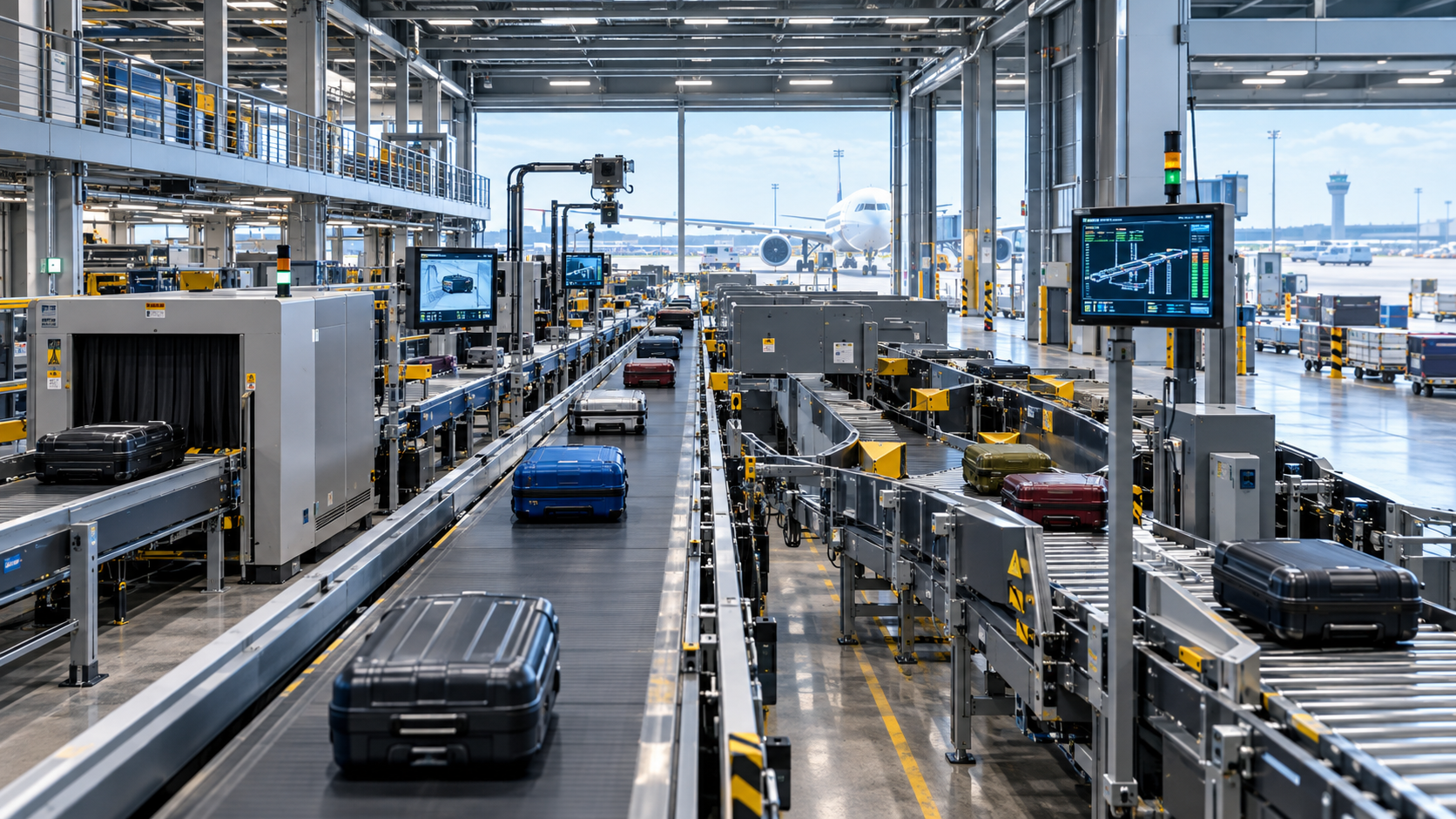
Munich Airport is building a new baggage hall – why it's important for millions of travelers – creative image on the topic, created with AI: Xpert.Digital
2,500 suitcases per hour: What the new sorting hall at Munich Airport is designed to achieve
Munich Airport: This invisible system determines on-time connections
More long-haul flights, more luggage: Why Terminal 1 in Munich needs to be modernized
Munich Airport is growing – and with it, the demands on the processes behind the terminals. Around 43.4 million passengers will use the airport in 2025. At the same time, Terminal 1 is being expanded and the existing infrastructure needs to be modernized. To ensure that baggage handling continues reliably during the construction work, an additional sorting hall is planned at apron position 113. It will be connected to the existing conveyor system and will be able to sort up to 2,500 pieces of luggage per hour.
At first glance, the project appears to be a purely technical undertaking. In reality, it's about more than that: the hall is intended to help avoid bottlenecks during the renovation and to make baggage logistics more resilient in the long term. After all, additional gates and more passengers are of little use if suitcases aren't checked, sorted, and transported to the correct aircraft in a timely manner. A closer look behind the scenes reveals why the project could be crucial for the efficiency of Munich Airport – and what's important in terms of costs, technology, and operation.
Munich's invisible bottleneck: Why the new baggage sorting hall will determine the airport's future
An airport is only as strong as its weakest conveyor belt
The modernization of baggage logistics at Munich Airport's Terminal 1 may initially appear to be a technically limited construction project. In reality, it touches upon the economic core of an international air traffic hub. An additional baggage sorting hall is planned for apron position 113, which will be directly connected to the existing baggage handling system. Its purpose is to stabilize baggage operations during the phased modernization of the terminal and simultaneously lay the foundation for safe, efficient operations until at least 2050. Therefore, the project is not merely an ancillary building, but a strategic bridging infrastructure between the current facilities and the future terminal system.
The economic significance of baggage handling stems from the way an airport functions. Passenger terminals, security checkpoints, apron processes, aircraft handling, and baggage handling form a tightly integrated system. If even one part of this system becomes a bottleneck, the efficiency of the entire facility suffers. Delayed baggage handling can delay departures, jeopardize connecting flights, tie up additional staff, and trigger costly forwarding services. The quality of baggage handling therefore affects not only operational punctuality but also costs, customer satisfaction, airline relationships, and the airport's competitive position.
The planned hall will therefore play a significantly larger role than its name suggests. It will sort baggage, facilitate security checks, accommodate manual reprocessing, support customs procedures, and reintegrate baggage into the ongoing conveyor system. With a planned sorting capacity of up to 2,500 pieces of luggage per hour, it will create an independent yet integrated buffer within the system. This buffer is economically valuable because it allows for the modernization of existing facilities without significantly impacting baggage handling. The airport is thus acquiring not just additional conveyor capacity, but above all, operational flexibility.
Growth meets aging infrastructure
The timing of the measure is economically sound. Munich Airport handled approximately 43.4 million passengers in 2025. This was about 1.8 million, or 4.4 percent, more than in the previous year. The number of takeoffs and landings increased by 3.1 percent to around 337,400 movements. At the same time, passenger volume only reached approximately 91 percent of the 2019 level. This sends a twofold message: The airport is already experiencing significant growth again, but also possesses additional recovery potential if demand continues to normalize.
The structure of this growth is particularly relevant. Long-haul traffic developed more strongly than the overall market and had already exceeded pre-crisis levels by 2025. International and intercontinental connections place higher demands on baggage logistics than simple point-to-point services. Transfer baggage must be identified, checked, re-sorted, and routed to the correct connecting flight within tight timeframes. Different airlines, handling companies, security regulations, and destination regions increase the number of interfaces. The more international the traffic profile becomes, the less sufficient it is to simply provide conveyor belts with adequate mechanical capacity. Data quality, system integration, and the ability to manage deviations in real time will be crucial.
In addition, Terminal 1 is being expanded with a new concourse for non-Schengen traffic. The additional terminal area of approximately 95,000 square meters creates capacity for up to six million passengers per year. It can simultaneously accommodate up to six wide-body aircraft or twelve smaller planes. This significantly increases passenger capacity on the visible side of the airport. However, such an expansion only delivers its full benefits if the underlying systems keep pace. More gates, larger aircraft, and additional long-haul connections increase baggage throughput and exacerbate peak loads. The new sorting hall should therefore also be seen as a necessary component of a more comprehensive capacity strategy.
The economic error lies in defining terminal capacity solely in terms of handling areas, security lanes, and aircraft positions. The actual usable capacity always corresponds to the performance of the weakest subprocess. If the baggage handling system processes fewer pieces of luggage per hour than check-in, security, and gates can handle passengers, it becomes the limiting factor. Investments in prestigious terminal areas would then only be partially productive. The hall at position 113 therefore serves to safeguard existing and planned assets.
Renovating without crippling operations
The real challenge lies not in the new construction alone, but in modernizing a highly busy airport while it remains operational. Airports cannot shut down their core processes for months without causing massive revenue losses and disruptions to the route network. Baggage systems, in particular, are deeply embedded in buildings, security areas, IT networks, and apron operations. Their modernization is therefore akin to open-heart surgery: the system must continue to function while essential components are replaced or temporarily taken out of service.
The additional baggage sorting hall serves a decoupling function in this context. Because parts of the existing conveyor system will only be available to a limited extent during the renovation, it provides replacement capacity and alternative process routes. This allows individual areas to be modernized one after the other, instead of shutting down the entire system at once. From a business perspective, this reduces the opportunity costs of the renovation. Avoidable flight schedule restrictions, handling disruptions, and capacity losses can be minimized while the airport renews its long-term infrastructure.
This logic is fundamental to aging transport infrastructure. Many European airports have been expanded over decades, with new technology being integrated into existing facilities. The result is complex structures with varying construction dates, control systems, and maintenance requirements. An additional, clearly defined operational unit can not only provide capacity but also make modernization more manageable. It creates a space where functions can be temporarily relocated, tested, and gradually reintegrated into regular operations.
However, this flexibility comes at a price. A temporary or supplementary infrastructure must be planned in such a way that it doesn't itself become an isolated temporary solution. It requires robust interfaces, redundant communication, clearly defined responsibilities, and a technical architecture that can be used economically even after the renovation is complete. The greatest benefit arises when the hall not only compensates for short-term outages but also permanently improves the terminal's resilience, maintainability, and peak load capacity.
2,500 pieces of luggage as an economic indicator
The planned sorting capacity of up to 2,500 pieces of luggage per hour is more than just a technical specification. It describes the ability to handle traffic flows within a defined timeframe. However, the maximum value alone is not sufficient for economic evaluation. Crucial factors include how reliably this capacity is achieved under real-world conditions, how the system performs under highly fluctuating loads, and what reserves exist to accommodate disruptions or future growth.
Airport processes are characterized by pronounced peaks. Daily traffic volume is not evenly distributed but concentrated in waves during which numerous aircraft arrive or depart within a short period. During these phases, baggage volume increases dramatically. A facility that appears adequately sized on average throughout the day can be overloaded during the critical 30 or 60 minutes. Therefore, the key metric is not the average throughput, but rather stable performance during peak times, taking into account security checks, special baggage, manual interventions, and short-notice flight schedule changes.
With a nominal throughput of 2,500 pieces of luggage per hour, a five percent reduction in throughput theoretically equates to 125 pieces of luggage per hour. If such deviations are not quickly addressed, backlogs can occur, which then affect downstream processes. Conversely, a small improvement in the recognition rate or automatic sorting accuracy can avoid significant amounts of manual labor over the course of a year. The economic impact, therefore, often lies not in spectacular individual measures, but in thousands of small, recurring efficiency gains.
Performance also includes quality. A piece of luggage that quickly ends up in the wrong processing path does not contribute to productivity. Therefore, meaningful key performance indicators (KPIs) include, in addition to throughput, the error-free sorting rate, system availability, the average duration of manual rework, energy consumption per piece of luggage, and restart time after malfunctions. Only the combination of these metrics reveals whether the facility is truly operating economically.
The cost of a misdirected suitcase
Baggage errors often appear to individual passengers as an annoying service problem. For the aviation industry, however, they represent a significant cost factor. Worldwide, approximately 24 million pieces of luggage were misrouted, delivered late, damaged, or permanently lost in 2025. The average cost was estimated at around US$260 per affected piece of luggage; this resulted in a total burden of approximately US$6.3 billion for the industry. A large portion of these costs is attributable to tracing, rerouting, storage, delivery, customer communication, and compensation.
Transfer processes are particularly critical. Recently, transfers accounted for around 39 percent of baggage errors. This is of great importance for a hub like Munich, as its economic strength is based not only on its local catchment area but also on the consolidation of traffic flows. A transfer passenger expects their baggage to automatically reach the correct onward flight within short connection times. If this doesn't happen, not only does the individual airline lose money, but trust in the airport as a reliable hub also suffers.
The cost impact is asymmetrical. A functioning baggage handling system is taken for granted by passengers and generates barely noticeable additional revenue. A malfunction, on the other hand, immediately triggers extra costs and dissatisfaction. This is precisely why investments in baggage handling systems are easily underestimated in traditional business cases. Their benefits are primarily evident in avoided damage, more stable processes, and a protected reputation. These effects are more difficult to communicate than new retail space or additional gates, but can contribute more to long-term value.
However, to evaluate the new hall, it would be irresponsible to directly derive concrete savings for Munich from global average costs. Reliable public data on local error rates, baggage volumes, transfer volumes, personnel costs, and existing process quality are lacking. Economically, however, it is clear: the larger the baggage volume and the higher the proportion of complex transfer connections, the more valuable additional sorting capacity, end-to-end tracking, and rapid recovery processes become.
Automation does not replace process discipline
Modern baggage handling systems combine mechanical conveying technology, identification, security checks, control software, and operational control centers. Scanners read baggage tags, switches distribute suitcases to their designated routes, sensors monitor positions and speeds, while software connects to flight, check-in, and handling data. In an ideal world, every piece of luggage moves automatically through a fully documented process. Reality, however, includes damaged tags, delayed check-ins, last-minute gate changes, special baggage, and technical malfunctions.
Therefore, the new hall explicitly includes manual post-processing. This is not a contradiction to automation, but rather a sign of realistic system design. Highly automated systems require defined procedures for exceptional cases. If a label cannot be read or a security check requires additional inspection, the baggage must be removed from the automated flow, processed, and then correctly reintroduced. Without such an exception procedure, a single problem can tie up a disproportionate amount of personnel or block entire conveyor sections.
The economic benefits of automation therefore do not arise from the maximum replacement of human labor, but from the optimal division of labor. Machines are suitable for fast, repeatable, and data-driven sorting processes. Humans are indispensable where unclear situations need to be assessed, physical peculiarities handled, or safety decisions made. An economically robust system reduces the number of unnecessary manual interventions, but provides a sufficient number of ergonomic and well-connected workstations for unavoidable exceptions.
This also shifts the required skill set of employees. In addition to traditional baggage handling, system monitoring, data analysis, fault diagnosis, and coordinated maintenance are gaining in importance. The number of personnel required per piece of baggage processed may decrease, while the demands on qualifications and response speed increase. For operators and service providers, this means that technical investments must be linked to further training, clear operating models, and appropriate shift planning.
The actual system is the data network
Conveyor belts are visible, but the decisive productivity lever increasingly lies in the data. Each piece of luggage must be clearly identified at central transfer points, and its status must be made accessible to all involved parties. International standards require tracking at least during acceptance, loading, transfer, and arrival. This creates a verifiable chain of events that can not only clarify errors retrospectively but also prevent them early on.
A new baggage sorting hall should therefore be understood as a cyber-physical system. The physical transport and its digital representation must match at all times. If data is transmitted late, incompletely, or in incompatible formats, even modern mechanics can make incorrect decisions. Conversely, high data quality allows risks to be identified before an actual failure occurs. Systems can, for example, determine that a piece of luggage is unlikely to reach its scheduled connection on time and automatically initiate an alternative process.
Artificial intelligence expands these possibilities, but it is not an end in itself. Meaningful applications lie in predicting traffic jams, dynamic route selection, the visual detection of damaged or misplaced luggage, and predictive maintenance. This requires consistent historical data, real-time information, and clearly defined decision rules. Without clean master data and reliable interfaces, AI merely adds another layer of complexity.
At the same time, the importance of cybersecurity is growing. Baggage handling systems are part of critical airport processes. A disruption in the control system, manipulated data, or the failure of central communication systems can have significant operational consequences. Network segmentation, access management, logging, tested fallback levels, and regular security updates are therefore essential components of economic lifecycle planning. A cheap technical solution that ignores future security and integration costs can become significantly more expensive over its lifespan.
Security checks and customs as part of the value chain
The hall is intended not only for sorting but also for security and customs functions. This combination demonstrates that modern baggage logistics cannot be treated as an isolated transport task. Every piece of luggage moves through a regulated process in which security, documentation, and physical forwarding are intertwined. Additional checks must not unnecessarily slow down the overall flow but must be reliably integrated into the flow of materials and data.
From an economic perspective, safety processes are initially cost centers. They require technology, qualified personnel, space, and time. Their benefit lies in preventing extremely high risks of damage and securing operating licenses. The crucial management task, therefore, is not to make safety controls as cheap as possible, but to integrate their prescribed quality into the overall process with minimal friction.
The close proximity of sorting, manual reprocessing, inspection, and re-entry can shorten distances and reduce interfaces. This lowers processing times and facilitates clear allocation of responsibility. At the same time, this consolidation requires careful zoning to ensure that secure and unsecured areas, customs status, and access rights remain clearly separated. The building design is therefore an integral part of the process design.
Especially during busy airport operations, every additional transfer counts. Where baggage changes hands between organizations, systems, or security zones, information gaps and delays arise. An integrated terminal concept can standardize these transfers. The economic value lies in reduced waiting times, lower error rates, and improved traceability, not just in shorter transport routes.

Expert partner in warehouse planning and construction

Innovative solutions for airport security
A functional building with a complex interior
The baggage sorting hall is designed as a single-story industrial building with a steel mezzanine, sandwich panel facade, and flat roof. This functional design prioritizes its purpose. Large, column-free areas facilitate the arrangement of conveyor lines, inspection stations, and maintenance zones. The steel mezzanine allows for the vertical organization of technical equipment and process flows without the need for an entire additional floor. Sandwich panels and a flat roof enable a relatively quick and standardized building envelope.
However, outward simplicity should not be mistaken for low complexity. In such an industrial building, structural engineering, fire protection, materials handling, electrical supply, ventilation, IT, security systems, and maintenance access all converge. Even minor planning errors can lead to detours, poor accessibility, or costly modifications later on. Collisions between steel structures, pipework, and materials handling are particularly critical. Therefore, early digital coordination of the building model is more economically important than purely architectural representation.
Maintainability must also be considered from the outset. Conveyor systems are subject to high mechanical stress and require regular inspections. If motors, scanners, or switches are difficult to access, maintenance windows and downtimes increase. Additional access points and reserves may appear as extra costs during the construction phase, but can generate significant savings over decades of operation. Therefore, the cheapest construction method is not automatically the most economical solution.
The location on the apron further increases the demands. Building materials, personnel, and equipment must pass through controlled security boundaries. Work areas compete with operational traffic routes. Dust, light, cranes, or temporary closures can affect flight operations. This results in higher coordination costs than for a comparable industrial building on a greenfield site. Scheduling and construction processes themselves become production factors.
Construction during ongoing flight operations
An airport is a high-security system operating around the clock. Construction work in the apron area must be subordinate to this system. Each construction phase requires clear separations, secured access routes, and coordinated time slots. Work that would be carried out simultaneously outside an airport may have to be done sequentially. This increases the duration and can drive up costs, but reduces operational risks.
The key economic metric is not the isolated speed of construction, but rather the sum of construction costs and operational disruptions. A faster construction method can be disadvantageous if it causes extensive closures or high risks of disruption. Conversely, a more expensive construction phase can be economically advantageous if it ensures stable flight operations. Therefore, the overall assessment must also consider avoided delays, maintained handling capacity, and reduced safety risks.
Integrated control of construction and technology is particularly important for this type of project. The building cannot be completed independently of the conveyor system and only connected to it at the end. The load-bearing structure, utilities supply, fire protection, and technical equipment must be coordinated with the later operational processes. This is further complicated by testing, trial runs, and phased commissioning. Only when mechanics, software, safety functions, and personnel processes work together seamlessly does a usable system emerge.
This interdependence explains why airports may prefer a centralized project responsibility for specialized infrastructure projects. While this doesn't automatically eliminate all risk, it does reduce the number of unclear interfaces. Precise requirements management is a prerequisite. If objectives are described too generally, partial technical solutions may function formally without achieving the expected performance in the overall process.
From construction costs to life cycle costs
For airport infrastructure used long-term, the initial construction cost is only part of the economic picture. Over decades, energy, personnel, maintenance, spare parts, software, and modernization costs accrue. Added to this are the costs of downtime and limited availability. A solution with higher initial investment can therefore be more cost-effective if it is more energy-efficient, easier to maintain, and more reliable.
For conveyor technology, drives, controls, and wear parts are particularly relevant. Efficient motors and demand-based controls can reduce energy consumption by ensuring conveyor sections only run when actually needed. Condition monitoring enables maintenance based on load rather than fixed intervals. Standardized components simplify spare parts inventory and reduce dependence on individual manufacturers. These factors often have a greater impact on total operating costs than minor differences in initial purchase price.
Adaptability also has measurable value. Air traffic could change significantly by 2050 in terms of baggage volumes, security requirements, marking technologies, and airline processes. A system optimized only for today's conditions risks costly retrofitting. Modular conveyor lines, open data interfaces, space reserves, and upgradeable control technology increase strategic flexibility.
Finding the right balance is still challenging. Oversizing ties up capital and incurs ongoing costs for barely used capacity. Conversely, undersizing leads to bottlenecks and early reinvestment. A robust base capacity with strategically planned expansion points makes economic sense. This doesn't pre-finance every conceivable future scenario, but it ensures that adjustments remain technically and spatially feasible.
The balance sheet provides leeway, but not a free pass
Munich Airport is back on a significantly more stable financial path. Group revenue rose to approximately €1.76 billion in 2025, with operating profit before interest, taxes, depreciation, and amortization (EBITDA) reaching nearly €417 million and net income after taxes around €169 million. At the same time, the group invested approximately €378 million. These figures demonstrate that the airport has regained profitability and can now undertake major infrastructure projects from an improved operational base.
Nevertheless, financial discipline is necessary. Free cash flow was only slightly positive in 2025, while debt remained high relative to operating profit. Airport infrastructure is capital-intensive and has long amortization periods. Several parallel modernization programs compete for financial and human resources. Therefore, every investment must plausibly demonstrate its contribution to capacity, reliability, safety, or efficiency.
The baggage sorting hall has the advantage of serving multiple categories simultaneously. It protects ongoing operations during the renovation, increases process capacity, creates redundancy, and enables technical modernization. However, without published project costs and detailed operating data, a reliable return on investment cannot be calculated. Statements about margins or specific amortization periods would be speculative.
A proper valuation should explicitly include avoided disruption costs. Traditional investment calculations favor projects with directly attributable revenues. Resilience infrastructure, on the other hand, creates value by preventing rare but costly events or limiting their consequences. Scenario analyses with varying failure probabilities are therefore more suitable than a simple comparison of construction costs and additional fee revenues.
Climate goals are decided in the engine room
Munich Airport aims to reduce its controllable emissions in Scope 1 and Scope 2 categories by at least 90 percent by 2035 at the latest and to permanently remove any remaining emissions from the atmosphere. Baggage handling systems are explicitly among the technical systems whose drives are to be made more energy-efficient. The new hall is therefore also a component of the decarbonization of airport operations.
The greatest potential lies in the combination of efficient mechanics and intelligent control. Conveyor systems don't need to run at full speed continuously. Sensors can detect baggage flows, activate individual sections as needed, and coordinate peak loads. Highly efficient motors, regenerative drives, and optimized motion profiles reduce energy consumption. At the same time, predictive maintenance can prevent worn components from consuming unnecessary amounts of energy.
The building itself also influences the overall energy balance. A well-insulated building envelope, efficient lighting, demand-based ventilation, and precise controls reduce ongoing energy consumption. Flat roofs generally offer suitable surfaces for photovoltaics, provided that structural integrity, shading, safety requirements, and technical usage permit it. Crucially, energy efficiency should not be treated as an afterthought, but rather integrated into the layout, technology, and operational concept from the outset.
Climate impact and economic viability should be considered together. Lower energy consumption reduces operating costs and dependence on volatile electricity prices. At the same time, stricter regulatory requirements and rising CO2 costs can make inefficient existing facilities more expensive. Therefore, a long-term infrastructure that only reaches the end of its planning horizon in the middle of the century must be designed much more ambitiously than a short-term interim solution.
Resilience is a unique form of productivity
The pandemic, geopolitical tensions, supply chain problems, and extreme weather events have shown that maximum capacity utilization does not equate to maximum efficiency. Systems without reserves typically operate efficiently but are sensitive to disruptions. For an airport, even brief interruptions can trigger cascading effects because aircraft, crews, slots, and connecting flights are interdependent.
The additional baggage infrastructure increases the number of possible process routes. This allows the operator to better plan maintenance, bypass disrupted areas, and distribute loads. Economically, this capability should be understood as a real option: the terminal creates the right to react flexibly in an uncertain future without having to predict every specific disruption today. The value of this option increases with the volatility of traffic and the costs of a failure.
However, resilience should not be confused with mere duplication. Two systems are only effectively redundant if the same power, data, or control components do not form a common point of failure. Personnel and operating procedures must also be prepared for alternative operating conditions. Regular tests and exercises are therefore part of infrastructure performance.
From a management perspective, availability should be treated as a strategic key performance indicator. In addition to the technical availability of the equipment, factors such as the time to fault detection, the duration of recovery, and the ability to operate in a controlled manner at reduced capacity are crucial. A system that continues to operate smoothly despite partial malfunctions can be more economically valuable than a nominally more powerful system that fails completely due to a single fault.
Winners along the industrial value chain
This project exemplifies a growing market at the intersection of industrial construction, intralogistics, security technology, and software. Not only construction companies are needed, but also materials handling specialists, automation engineers, electrical planners, IT integrators, fire protection experts, and baggage screening providers. The value chain is distributed across a broad industrial spectrum.
Services requiring a high degree of technical specialization and low interchangeability are particularly attractive. Standardized building components are subject to greater price competition, while system integration, commissioning, and long-term service have higher barriers to entry. Those who can reliably combine mechanical systems, control software, and airport interfaces have a competitive advantage. This is even more true if they have experience operating critical infrastructure.
The regional economy benefits from both direct and indirect effects. Planning, construction, and maintenance generate demand for qualified services. Furthermore, a more efficient airport infrastructure enhances the international accessibility of Bavaria and southern Germany. While this locational benefit cannot be attributed solely to the baggage claim area, reliable handling is a necessary prerequisite for attractive flight connections.
At the same time, industrial benefits should not be confused with guaranteed high profitability. Work in safety-critical areas, volatile material prices, complex interfaces, and tight deadlines can increase risks. Companies must manage these risks technically and calculate them realistically. The market rewards not only capacity, but above all, experience in flawless integration during ongoing operations.
Munich in the competition among European hubs
European airports handled approximately 2.6 billion passengers in 2025, an increase of about 4.4 percent compared to the previous year. This growth was primarily driven by international traffic, while domestic demand remained virtually stagnant. This shift mirrors the development in Munich, where long-haul and international traffic are showing particular dynamism. At the same time, ground and airspace capacity remain structural bottlenecks in Europe.
In the competition among hubs, size is not the only factor. Airlines evaluate transfer quality, punctuality, minimum connection times, handling costs, and operational stability. Baggage handling directly impacts several of these criteria. An airport that allows passengers to transfer quickly but whose baggage is not reliably transferred does not have a compelling hub product.
The new sorting hall strengthens Munich Airport, particularly in terms of quality. It enables the modernization of the terminal infrastructure without unnecessarily weakening current performance, while simultaneously creating additional operational reserves. Together with the new concourse, this results in a logic of visible capacity expansion and invisible process assurance. Both elements must function in tandem for the airport to expand its intercontinental profile.
Nevertheless, demand remains uncertain. Economic conditions, ticket prices, geopolitical conflicts, environmental regulations, and airline behavior can all alter growth. A sound infrastructure strategy should therefore not rely on a single transport plan. Modularity and multiple uses are more important than rigid maximum capacity.
The decisive risks lie at the interfaces
The greatest project risk rarely lies in a single conveyor belt or building section. The critical points are the interfaces between the building structure, conveyor technology, safety controls, IT, and ongoing operations. Differing planning stages or unclear responsibilities can lead to components being technically correct but incompatible when used together. Such errors often only become apparent during commissioning, when modifications are particularly costly.
Another risk is the migration. The new hall must be directly connected to the existing baggage handling system. This involves the interaction of new technology and older systems. Data formats, control logic, and physical transfer points must be compatible. Transition phases require fallback solutions because a single error could affect not only the new hall but the entire baggage handling process.
The deadline also has economic implications. Delays can postpone planned renovation phases and thus prolong the limited availability of the existing infrastructure. Conversely, time pressure must not lead to shortened tests. A robust trial run with realistic load cases, malfunctions, and safety incidents is essential. The formal completion of a building is not the same as the operational readiness of a baggage handling system.
Finally, supply chain and obsolescence risks exist. Control components and specialized technology can have long delivery times. With a service life extending to at least 2050, it must also be clarified how spare parts, software maintenance, and security updates will be guaranteed. Open interfaces and documented system architectures reduce the risk of long-term dependence on individual suppliers.
What success must be measured by
The success of the baggage sorting hall should not be measured solely by its opening or adherence to a construction schedule. What matters is whether it stabilizes terminal operations during the renovation and generates lasting economic benefits afterward. This includes high technical availability, reliable throughput during peak times, and a low error rate.
Equally important are recovery capability and energy consumption. A system that quickly isolates malfunctions and continues operating at reduced power protects the flight schedule better than a system with high theoretical capacity and low fault tolerance. The power consumption per piece of processed luggage reveals whether efficiency gains actually translate into operational benefits.
Work quality is also part of the key performance indicator (KPI) system. Ergonomic post-processing workstations, clear user interfaces, and short distances reduce errors and physical strain. Otherwise, employee turnover and a shortage of skilled workers can undermine technical performance. Automation is only productive if people understand the system, monitor it, and can reliably manage deviations.
In the long term, the system should be judged by its ability to adapt to change. New security regulations, different baggage labeling, additional airlines, or altered traffic patterns should not necessitate extensive modifications every time. Adaptability is not a mere quality indicator, but rather a safeguard against future investment costs.
True value lies in avoided crises
The new baggage sorting hall at Terminal 1 is primarily an investment in continuity from an economic perspective. It creates additional sorting capacity, enables the modernization of existing facilities, and integrates security, customs, and post-processing functions into the ongoing conveyor system. Its value stems less from immediately visible revenue than from avoided bottlenecks, reduced disruption costs, and increased utilization of the entire terminal infrastructure.
Munich's traffic growth, the increase in long-haul flights, and the additional capacity of the new concourse are intensifying the pressure to act. If up to six million more passengers per year can be handled in Terminal 1, the baggage logistics must be correspondingly robust. Otherwise, a classic infrastructure paradox threatens: modern capacity is being created on the passenger side, while outdated processes are limiting the economic benefits behind the scenes.
The rationale, therefore, is that the hall makes strategic sense if it is implemented as an integrated life-cycle project and not as a short-term temporary building. Open data interfaces, modular expandability, energy-efficient drives, robust fallback systems, and rigorous testing are more important than the lowest possible initial cost. Likewise, the facility should retain a permanent role in peak load management, maintenance flexibility, and resilience after the completion of the refurbishment phase.
The provocative core of the argument is therefore justified: An airport is only as efficient as its most invisible systems. Travelers see airplanes, gates, and new terminal areas. However, the true quality of the hub often hinges on a suitcase that lands on the right conveyor belt at the right moment. Hall 113 is therefore not a side issue in Munich Airport's development, but rather a litmus test for whether growth, modernization, and operational reliability can be combined into a robust and economically viable overall system.
Your intralogistics experts

Consulting, planning and implementation of complete solutions for high-bay warehouses and automated storage systems - Image: Xpert.Digital
More information here:
Your global marketing and business development partner
☑️ Our business language is English or German
☑️ NEW: Correspondence in your native language!

Konrad Wolfenstein
I and my team are happy to be available to you as your personal advisor.
You can contact me by filling out the contact form here wolfenstein@xpert.digital:or simply call me at +49 7348 4088 965. My email address is
I'm looking forward to our joint project.
☑️ SME support in strategy, consulting, planning and implementation
☑️ Creation or realignment of the digital strategy and digitization
☑️ Expansion and optimization of international sales processes
☑️ Global & Digital B2B trading platforms
☑️ Pioneer Business Development / Marketing / PR / Trade Fairs
Our global industry and economic expertise in business development, sales and marketing


Our global industry and economic expertise in business development, sales and marketing - Image: Xpert.Digital
Industry focus areas: B2B, digitalization (from AI to XR), mechanical engineering, logistics, renewable energies and industry
More information here:
A thematic hub offering insights and expertise:
- Knowledge platform covering global and regional economies, innovation and industry-specific trends
- A collection of analyses, insights, and background information from our key areas of focus
- A place for expertise and information on current developments in business and technology
- A hub for companies seeking information on markets, digitalization, and industry innovations