
AI revolution overslept? Why Germany threatens to lose connection to the USA and China
Xpert pre-release

Available in 27 languages 📢
Prefer Xpert.Digital on GoogleⓘPublished on: June 20, 2025 / update from: June 20, 2025 - Author: Konrad Wolfenstein
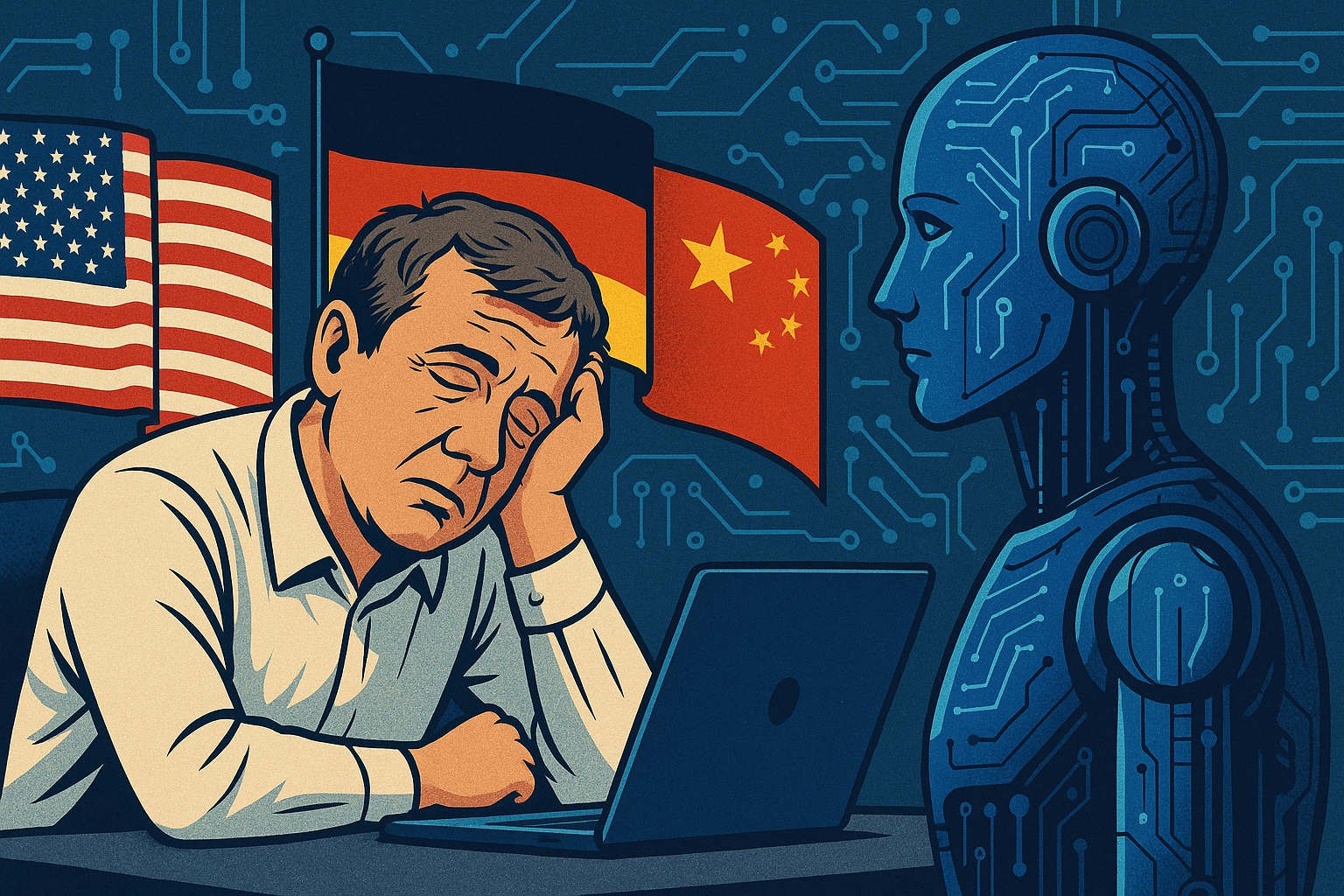
AI revolution overslept? Why Germany threatens to lose connection to the USA and China - picture: xpert.digital
Technological progress: Germany and the AI revolution-a critical inventory
The challenge of artificial intelligence
In a world in which artificial intelligence (AI) increasingly shapes our everyday life, our economy and our society, Germany is facing a decisive course. The question of whether the Federal Republic is prepared for the next big AI breakthrough must unfortunately be answered with a clear “no”. Despite numerous initiatives and strategy papers, there is a lack of consistent implementation and a comprehensive vision for the digital future of the country. While other nations invest massively in AI infrastructure and build innovative ecosystems, Germany threatens to lose connection.
The dimension of this challenge can hardly be overestimated: If intelligence is available, copable and scalable to previously unimaginable extent, the foundation of our economic and work world is fundamentally changing. This transformation not only requires technological adjustments, but also a complete rethinking in education, research, corporate culture and state control.
Suitable for:

The status quo: Germany's position in the international AI competition
Germany has had a national AI strategy since 2018, which has been updated several times in the following years. With a total volume of five billion euros by 2025, Germany should be strengthened in research, development and application of AI. The strategy comprises twelve fields of action and aims to establish “Ki Made in Germany” as an international trademark. Particular importance is placed on responsible and common good -oriented development - an approach that is supposed to school as a “AI made in Europe” across Europe.
But reality looks different: in international comparison, Germany falls continuously. While the United States invested around $ 54.8 billion in AI start-ups in 2023 and China $ 18.3 billion, only $ 2.2 billion flowed into this future-oriented area in Germany. This discrepancy reflects a fundamental problem: Germany and Europe have lost their initially leading role in AI research to the USA and China.
The gap between claims and reality in German companies is particularly alarming. According to a current study, 77 percent of German companies have a clear AI strategy, but only 36 percent have the necessary technical infrastructure to actually integrate AI applications into their processes. Even more serious: only 40 percent have enough specialists to implement their ambitious plans.
The transformative power of the AI: why she changes everything
The importance of AI goes far beyond incremental improvements - it represents a fundamental transformation, comparable to the introduction of the Internet or smartphone. Today AI systems can take on tasks that were previously reserved for people: They generate texts, create images, program software and make increasingly complex decisions.
The revolutionary of AI lies in their scalability and copy. Unlike human intelligence, which is bound to individuals, AI can be reproduced and scaled as desired. A Ki system that was once trained can theoretically be used in an unlimited manner without any loss of quality. This property leads to exponential effects: As soon as a AI dominates a certain task, this ability can be made globally available immediately.
The economic implications are enormous. According to studies, AI could contribute up to 14% to global gross national product by 2030, which corresponds to an additional value of around $ 15.7 trillion. For Germany, experts predict a possible additional economic growth of up to 11.3% through the use of AI in industry. These figures illustrate: AI is not an optional future topic, but an economic necessity.
Change in labor market: the double-facility of the AI revolution
The effects of AI on the labor market are profound and ambivalent. On the one hand, there is a risk of massive upheaval of existing job profiles: up to 300 million full -time jobs worldwide could be affected by AI. In Germany, up to three million changes of job are expected by 2030. Administrative office activities, customer service, sales and production are particularly at risk.
Contrary to earlier assumptions, the wave of automation does not primarily meet low -qualified, but increasingly also highly qualified “knowledge workers”. Professional groups such as accountants, mathematicians, programmers, interpreters, writers and journalists have to expect AI to take on at least part of their previous tasks. Chatgpt and similar systems can already do at least half of the tasks in accounting much faster than humans.
On the other hand, new employment opportunities are also created by AI. According to a study by the Federal Institute for Vocational Training (BIBB), the very limited use of AI in Germany has already created around 48,000 new jobs between 2016 and 2018. In particular in technology -related service areas such as IT or information processing, individual companies expect employment, sometimes with increases of over ten percent.
The challenge is to make this transformation process socially compatible. Lifelong learning and continuous training become central requirements for employees. The demand for technological and social-emotional skills will increase significantly, while repetitive activities lose importance.
Infrastructure and investments: Germany's Achilles heel
One of the largest weaknesses in Germany's AI strategy is the inadequate infrastructure. According to a current Deloitte study, Germany has to massively expand its AI infrastructure and data centers in order to secure economic competitiveness and national sovereignty. By 2030, up to 60 billion euros would have to be invested in order to close a capacity gap of 1.4 GW and to meet the growing need for AI applications.
The capacity of powerful data centers for AI applications must be tripled in Germany by 2030-from currently 1.6 GW to 4.8 GW. However, only 0.7 GW are under construction and a further 1.3 GW in development. The proportion of Germany in the global data center capacity has dropped by around a third since 2015.
This infrastructure gap is particularly problematic because modern AI systems require enormous computing capacities. The development and operation of powerful AI models require high-performance calculators and specialized hardware. Without appropriate investments, Germany threatens to fall behind in the development of their own AI solutions and to become dependent on foreign technology providers.
B2B procurement: supply chains, trade, marketplaces & AI-supported sourcing

B2B procurement: supply chains, trading, marketplaces & AI-supported sourcing with accio.com-Image: xpert.digital
More about it here:
A shortage of skilled workers and AI: How the German middle class misses its chance
SME and AI: The unused opportunity
The low penetration of German middle class with AI technologies is particularly worrying. Small and medium -sized companies (SMEs) that form the backbone of the German economy are difficult to integrate AI into their business processes. While large companies are increasingly investing in AI, medium-sized companies often lack know-how, financial resources and strategic orientation.
This reluctance is fatal because AI offers enormous potential for increases in efficiency and innovations. By automating work processes, companies can use their operational capacities more efficiently and at the same time achieve scalability. AI enables efficient resource management, a faster response to market requirements and cost -effective growth.
Ki could play a crucial role, especially in times of a shortage of skilled workers. The integration of AI into different industries and work areas can make a significant contribution to relieving the shortage of skilled workers in Germany. Companies that do not implement AI quickly enough run the risk of losing essential competitive advantages.
Suitable for:

Education and competencies: the key to AI future
A central factor for Germany's AI future is training and further education. According to a representative survey, around 60 percent of employees in Germany are already using AI technologies in the workplace. However, use is strongly influenced by individual and professional factors: While almost 80 percent of employees use a university, master or technician degree KI, it is just under a third for employees without an educational qualification.
This educational gap threatens to strengthen existing social inequalities. In order to counteract this, AI competencies have to be anchored in the population. Initiatives such as the “KI B³” joint project aim to integrate AI competencies into professional training and further education. Three new educational qualifications as an additional qualification and on DQR levels 5 and 6 were developed to bring the topic of artificial intelligence into vocational training.
As part of the AI strategy, the Federal Ministry of Education and Research also promotes the “AI campus” as a central learning platform for artificial intelligence. Over 40 partners from science and business are continuously developing new innovative online courses to understand artificial intelligence, which are accessible to everyone interested free of charge.
However, these measures are far from sufficient. Germany needs a comprehensive educational offensive that provides AI skills from primary school to vocational training. This is the only way to ensure that the population is prepared for the requirements of the Ki era.
Ethics and regulation: Germany's chance of differentiation
An area in which Germany and Europe could potentially take on a leadership role is the ethical and regulatory framework for AI. With the AI Act, the European Union 2024 has adopted the world's first comprehensive law to regulate artificial intelligence - a milestone, comparable to the GDPR in the field of data protection.
The AI Act pursues a risk-based approach and distinguishes AI systems according to the risk that they represent for individuals, society or fundamental rights. Forbidden AI systems that violate human dignity or EU values are prohibited. High-hazard-ki systems in sensitive areas such as medicine, human resources or creditworthiness tests are subject to strict requirements regarding risk assessment, documentation, transparency and human supervision.
This regulatory pioneering role could become a competitive advantage if it succeeds in combining ethical principles with funding for innovation. "Responsible and common good-oriented development and application of AI systems should be made an integral part and thus trademark of an 'Ai Made in Europe'," says the German AI strategy.
However, there is a risk that excessive regulation inhibits innovation. Germany and Europe have to find a middle ground that ensures ethical standards without hindering technological progress.
The new coalition agreement 2025: A glimmer of hope?
In its 2025 coalition agreement, the new federal government has brought artificial intelligence at the center of its innovation and economic policy. Germany should rise to “AI nation”-an ambitious goal that is to be achieved through targeted infrastructure investments, innovation-friendly regulation and close cooperation between state, business and science.
Specifically, the “Massive Investments” coalition plans to digital infrastructure and the expansion of AI capacities. Central measures include the establishment of a national AI gigafactory with at least 100,000 graphics processors for research institutions and universities as well as the establishment of AI-Reallabores, in which innovative AI applications can be tested under real conditions.
It remains to be seen whether these plans will actually be implemented and the hoped -for effect. The experience of the past few years teaches that a significant gap often gives way between political declarations of intent and concrete implementation.
Recommendations for action: What Germany has to do now
In order to catch up in the global AI competition and to take advantage of the opportunities of the AI revolution, Germany must act determined. The following measures are urgently required:
1. Massive investments in AI infrastructure
Germany has to significantly expand its capacities for AI data centers and invest in high-performance computers. The forecast capacity gap of 1.4 GW by 2030 must be closed.
2. Promotion of AI in medium -sized businesses
Small and medium -sized companies need specific support in the integration of AI into their business processes. Funding programs, advisory services and cooperation with research institutions can help close the AI gap in medium-sized companies.
3. Educational offensive for AI competencies
AI skills must be taught from school to further vocational training. Digital educational platforms, practical training programs and lifelong learning are crucial to prepare the population for the requirements of the Ki era.
4. Strengthening the transfer between science and economy
Germany has excellent research institutions, but the transfer to economic practice must be improved. Cooperation platforms, joint research projects and incentives for outputs can help to increase innovative strength.
5. Balanced regulation
Germany should work for a regulatory framework that ensures ethical standards without inhibiting innovation. “Ai Made in Europe” could become a quality feature that stands for trustworthy and human -centered AI.
6. International cooperation
In the global AI competition, Germany can only exist if it bundles its strength-national, European and internationally. Cooperation with leading AI nations and strengthening European initiatives are essential.
Design the future instead of suffering
The AI revolution will come-with or without Germany. The crucial question is whether Germany is actively designing this transformation or suffering passively. The previous efforts are far from sufficient to survive in the global AI competition. Despite a solid basis and ambitious strategy papers, there is a lack of consistent implementation and sufficient investments.
The challenge is huge, but the chances are also enormous. AI could lead to a productivity boost, enable new business models and solve social problems - from health care to climate protection. For Germany, it is no less than securing its prosperity and competitiveness in an increasingly shaped world.
The key to success lies in a holistic approach that integrates technological, economic, educational policy and ethical aspects. Germany has to raise the courage to participate in the top of the world in the world leaders and to transfer these breakthroughs into new added value. This is the only way to use the transformative power of the AI for the benefit of society and to make “Ki Made in Germany” a success model.
Time is pushing. Other nations invest hundreds of billions in AI technologies and expand their management position. Germany now has to act so as not to be left behind. The next industrial revolution has already started - it is up to us whether Germany plays a leading role or becomes a viewer.
We are there for you - advice - planning - implementation - project management
☑️ SME support in strategy, consulting, planning and implementation
☑️ Creation or realignment of the AI strategy
☑️ Pioneer Business Development

Konrad Wolfenstein
I would be happy to serve as your personal advisor.
You can contact me by filling out the contact form below or simply call me on +49 7348 4088 965 (Munich) .
I'm looking forward to our joint project.
Write to me

Xpert.Digital - Konrad Wolfenstein
Xpert.Digital is a hub for industry with a focus on digitalization, mechanical engineering, logistics/intralogistics and photovoltaics.
With our 360° business development solution, we support well-known companies from new business to after sales.
Market intelligence, smarketing, marketing automation, content development, PR, mail campaigns, personalized social media and lead nurturing are part of our digital tools.
You can find out more at: www.xpert.digital - www.xpert.solar - www.xpert.plus
Keep in touch







