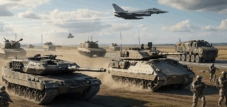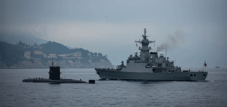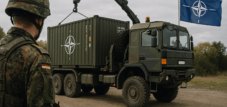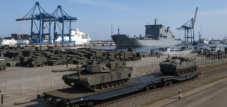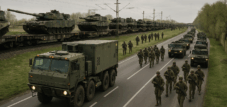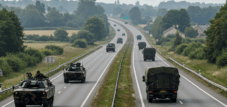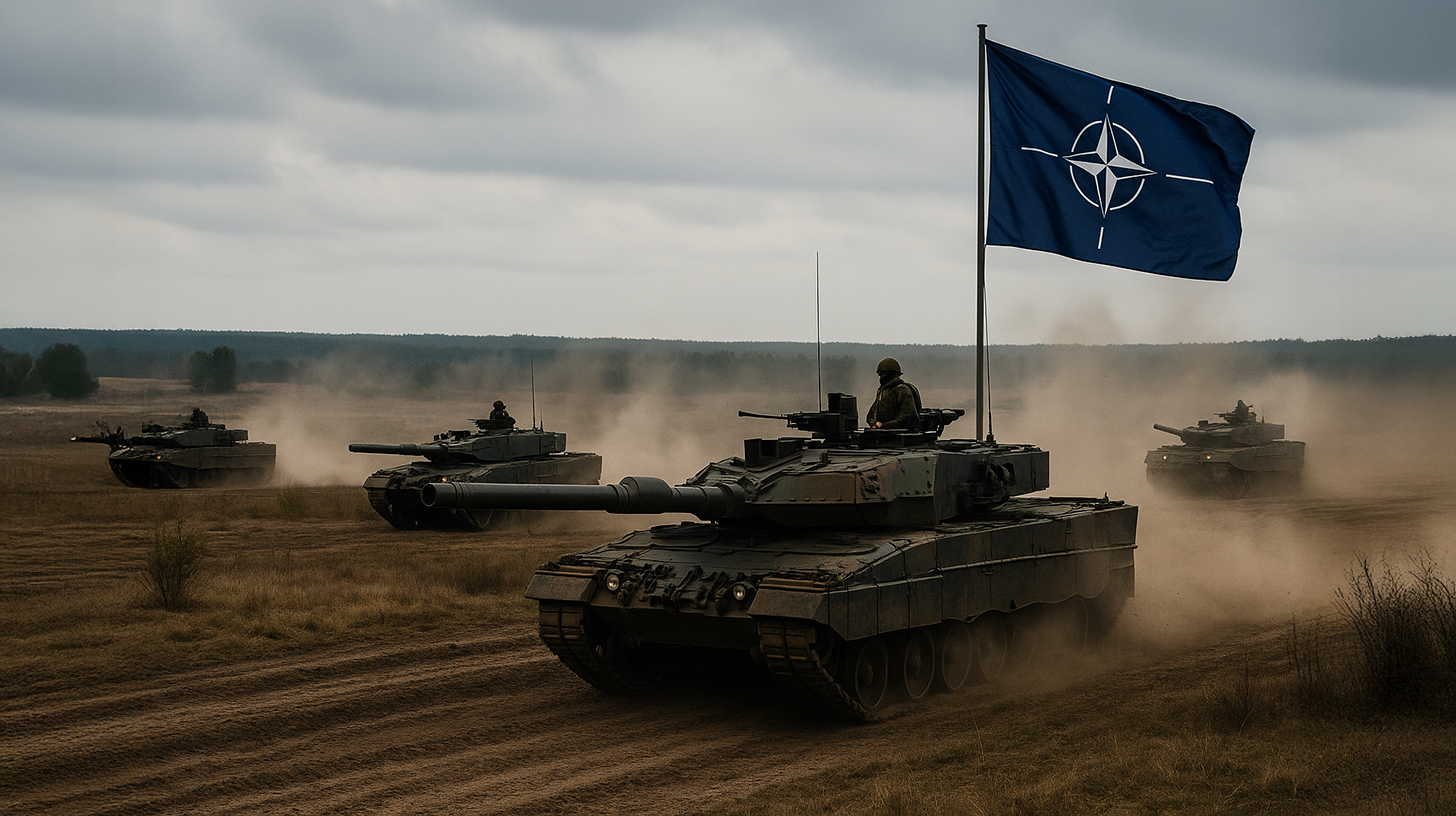
NATO & Military: “Quadriga 2025” exercise series and “Thunder Strike” defense exercise – Creative image: Xpert.Digital
Tanks to Lithuania, Eurofighters to Poland: This is how massively Germany is reacting to Putin's next maneuver
NATO's Achilles' heel: the Suwalki Gap – Europe's fate could be decided on this 65-kilometer strip
In late summer 2025, the Baltic Sea region will become the stage for one of the largest military displays of power since the end of the Cold War. With the "Quadriga 2025" exercise series, the German Armed Forces, together with 13 NATO partners and around 8,000 German soldiers, will rehearse for a real-world scenario: the defense of NATO's eastern flank under realistic wartime conditions. The operation is a direct and unambiguous response to the concurrent Russian-Belarusian military exercise "Zapad-2025," which is causing considerable concern in the West – not least because previous Zapad exercises served as preparation for actual invasions such as the one in Ukraine.
At the heart of Quadriga 2025 is not only the deployment of armored brigades to Lithuania and the securing of air and sea areas, but also a fundamental shift in Germany's role. From a former frontline state, the Federal Republic has evolved into the central logistical hub of the alliance, which, in a crisis, must coordinate the deployment of hundreds of thousands of allied soldiers.
Meanwhile, partners like Poland and Lithuania are also responding with their own large-scale military exercises and drastic measures such as imposing curfews. The exercises are therefore more than just maneuvers: they are a test of new command structures, a litmus test for alliance solidarity, and a clear signal of deterrence and unity in an increasingly tense security situation.
Related to this:

The NATO exercise series Quadriga 2025
The exercise, under the overall responsibility of the Naval Command in Rostock, serves the stated goal of increasing the operational readiness of the German Armed Forces and making a visible contribution to national deterrence. The newly established Operational Command of the German Armed Forces, which achieved full operational readiness on April 1, 2025, is assuming operational command of such a complex series of exercises for the first time.
Sub-exercises and key areas:
Grand Eagle – Deployment of Panzer Brigade 37
Exercise Grand Eagle is a key component of Quadriga 2025. During this exercise, the German Army is deploying forces from Panzer Brigade 37 "Freistaat Sachsen" to Lithuania. This large-scale deployment demonstrates Germany's ability to rapidly and effectively bring reinforcements to NATO's eastern flank. From 2025 onward, Panzergrenadier Brigade 37 will assume the role of the highest-readiness brigade within the Army, operating as the Forward Land Forces.
Northern Coasts – Key Maritime Role
The Northern Coasts naval exercise will take place from September 1st to 12th, 2025, and will play a key role at sea. Under German command, multinational naval forces will train in the Baltic Sea to further develop their capabilities for national and collective defense. The tactical planning and execution of maritime operations in coastal areas is the main focus. In addition to Germany, the Baltic Sea littoral states of Sweden, Finland, Denmark, Poland, Estonia, Latvia, and Lithuania, as well as France, Great Britain, the USA, Belgium, the Netherlands, and Canada will participate.
Brave Blue and Safety Fuel – a logistical masterpiece
The Brave Blue and Safety Fuel exercises, running from August 29 to September 12, focus on the logistical challenge of moving troops and equipment to Lithuania via various modes of transport, including road, rail, and sea. Particular emphasis is placed on the supply of fuel and drinking water in Lithuania, as well as the protection of essential defense infrastructure.
Role2Sea – Medical Care at Sea
From August 18 to 29, 2025, the German Navy will conduct Role2Sea, a maritime medical assistance exercise at the Sea Rescue Center. The rescue center aboard the replenishment ship "Frankfurt am Main" will simulate the treatment of 30 casualties following an accident. The exercise will cover the entire medical evacuation chain, from initial onboard care and surgical interventions to the transport of critically injured individuals to specialized facilities ashore.
Silver Dagger – Special Forces in Finland
From August 25 to September 12, special forces from various NATO nations will train together with the German Armed Forces in Finland as part of Exercise Silver Dagger. This exercise demonstrates NATO's expanded capabilities following Finland's accession and utilizes the new strategic depth on the alliance's northeastern flank.
National Guardian – Protecting the Homeland
The nationwide exercise National Guardian, running from August 29 to September 12, simulates real-world support operations for deployed military forces. Army homeland defense forces and naval reserve forces are practicing the protection of critical infrastructure. For the first time, all support services at one of the Convoy Support Centers are being provided by a civilian contractor.
Air Mag Day
From September 1st to 4th, the Air Force will support maritime operations as part of Air Mag Day. This integration of air and naval forces underscores the multidimensional approach of the exercise.
The Russian-Belarusian Zapad-2025 maneuver
The joint military exercise "Zapad-2025" planned for September 2025 by Russia and Belarus is causing considerable concern within NATO. The name "Zapad" translates to "West" and already hints at the exercise's intended purpose. Western military experts are issuing urgent warnings about the potential consequences of this exercise.
Belarus has announced plans to scale down the military exercise and move it further inland. The number of troops deployed will be halved, with current estimates suggesting around 13,000 soldiers will participate – significantly fewer than the 200,000 troops involved in the last Zapad exercise in 2021. Belarusian Defense Minister Viktor Khrenin presented these changes as a gesture of goodwill and emphasized Belarus's peaceful stance.
However, the West's concerns are not unfounded. In retrospect, the previous Zapad exercise in 2021 served as preparation for the Russian invasion of Ukraine in February 2022. Large-scale Russian military exercises have repeatedly served as a cover for actual attacks in the past – for example, on Georgia in 2008, Crimea in 2014, and Ukraine in 2022.
Hub for Security and Defense - Advice and Information

Hub for Security and Defense - Image: Xpert.Digital
The Security and Defence Hub offers expert advice and up-to-date information to effectively support companies and organizations in strengthening their role in European security and defence policy. Working closely with the SME Connect Defence Working Group, it particularly promotes small and medium-sized enterprises (SMEs) that wish to further develop their innovative capacity and competitiveness in the defence sector. As a central point of contact, the Hub thus creates a crucial bridge between SMEs and European defence strategy.
Related to this:
Germany's logistical challenges and military presence in Eastern Europe
Strategic importance of the exercises
The Suwalki Gap as a critical point
The Suwalki Gap, only about 65 kilometers wide, between Poland and Lithuania is considered NATO's Achilles' heel. This narrow land corridor separates the Russian exclave of Kaliningrad from Belarus and represents the only land connection between the Baltic states and the other NATO partners. In a crisis, Russia could completely cut off the Baltic states from their NATO allies within 30 to 60 hours.
The strategic importance of this corridor is evident in the Quadriga 2025 exercise scenarios. Securing the Suwalki Gap and crossing strategically important rivers like the Vistula are key elements of the exercises. NATO is intensively practicing how reinforcements can be moved through this critical corridor in the event of an emergency.
Germany as a logistics hub
Germany has transformed from a Cold War frontline state into NATO's central logistical hub. The "Operations Plan Germany" envisions that, in a crisis, up to 800,000 allied soldiers and 200,000 vehicles would need to be moved through Germany. This enormous logistical challenge necessitates the establishment of Convoy Support Centers along major transport routes.
The defense company Rheinmetall received a framework contract worth €260 million for the operation of these rest and assembly areas. The services include accommodation, catering, refueling, technical support, and even security – including in the event of a national defense or alliance conflict.
Related to this:
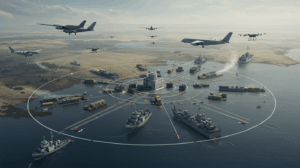
German Eurofighters in Poland
In direct response to Zapad-2025, Germany is deploying five Eurofighter combat jets to Poland for the first time. The jets, belonging to Tactical Air Wing 31, will operate from Minsk Mazowiecki Air Base east of Warsaw. Around 150 German Armed Forces personnel are supporting this nearly month-long deployment, which represents a clear signal of solidarity within NATO.
Polish and Lithuanian reactions
Poland is planning its own large-scale military exercises with 34,000 soldiers as a direct response to Zapad-2025. The exercise, "Tarassis 25," will take place concurrently with the Russian-Belarusian exercise and will include NATO soldiers from the Joint Expeditionary Force.
Lithuania is conducting its national defense exercise, "Thunder Strike." This includes a series of smaller exercises such as Thunder Bastion, Vigilant Falcon, Thunder Storm, and Cyber Shield. During the three-week exercise, 10,000 reservists and active-duty soldiers are being called up, with approximately 2,500 actively training. The exercise also involves the imposition of temporary curfews in certain areas of the capital, Vilnius, and the city of Kaunas.
Structural reforms and new commands
The Operational Command
With the establishment of the Bundeswehr's Operational Command on October 1, 2024, national and joint operations command was fundamentally reorganized. Under the command of Lieutenant General Alexander Sollfrank, the command, with its 1,400 personnel, consolidates the operational planning, execution, and evaluation of all Bundeswehr operations.
For the first time, the command will assume operational leadership of a large-scale exercise during Quadriga 2025, coordinating the implementation of Germany's operations plan. This new structure enables unified, single-source command and improves responsiveness in all scenarios – from hybrid threats to collective defense.
The new Homeland Security Division
On April 1, 2025, the German Army will establish a fourth major unit: the Home Defense Division. This division will consolidate all existing home defense regiments and companies under a single command. Initially comprising 6,000 soldiers, primarily reservists, it will be responsible for protecting critical infrastructure in Germany.
The Homeland Security Division plays a central role in securing Germany as a "hub". While the field army operates on NATO's eastern flank in the event of an attack, the Homeland Security forces secure transport routes, convoy support centers and other defense-critical facilities within the country.
Baltic Sentry – Protection of underwater infrastructure
In response to repeated attacks on critical underwater infrastructure, NATO launched Operation Baltic Sentry in January 2025. Germany is contributing naval capabilities, including corvettes, frigates, minehunters, and maritime patrol aircraft. The German Navy's Heron TP drone saw its first deployment monitoring the Baltic Sea coastal waters during this operation.
Related to this:

Technological and tactical innovations
Drone defense is firmly integrated into all phases of Quadriga 2025. The German Armed Forces are testing newly acquired equipment and further developing tactics for combating unmanned systems. Experiences from the war in Ukraine demonstrate the growing significance of this threat.
During the Role2Sea exercise, the new medical equipment kits of the "Flexible Stretcher Installation Unit" will be used for the first time under realistic conditions in the NH-90 helicopter. The system enables the simultaneous transport of six hemodynamically stable patients and significantly improves casualty care.
National dimension
Quadriga 2025 demonstrates that modern defense is a task for the entire nation and society as a whole. The transport of personnel and equipment across Germany can only succeed with the support of civilian authorities, the police, and private companies. The first-time integration of civilian service providers in the operation of Convoy Support Centers marks a paradigm shift in German defense planning.
The series of exercises illustrates Germany's transformed role from a Cold War frontline state to a logistical hub for NATO. With the capability to receive and deploy hundreds of thousands of allied troops to the eastern flank in a crisis, Germany assumes a key role in the collective defense of the alliance.
The simultaneous execution of Quadriga 2025 with the national exercises of Poland and Lithuania in response to Zapad-2025 sends a clear signal of unity and resolve. NATO partners are demonstrating their capability for coordinated defense and underscoring that any attack on a member state would result in a joint response from the entire alliance.
Your dual-use logistics experts
Dual-use logistics experts - Image: Xpert.Digital
The global economy is currently undergoing a fundamental transformation, a watershed moment that is shaking the foundations of global logistics. The era of hyper-globalization, characterized by the relentless pursuit of maximum efficiency and the "just-in-time" principle, is giving way to a new reality. This new reality is marked by profound structural breaks, geopolitical power shifts, and increasing fragmentation of economic policy. The once taken-for-granted predictability of international markets and supply chains is dissolving and being replaced by a period of growing uncertainty.
Related to this:
Consulting - Planning - Implementation

Markus Becker
I would be happy to serve as your personal advisor.
Head of Business Development
Chairman SME Connect Defense Working Group
Consulting - Planning - Implementation
Konrad Wolfenstein
I would be happy to serve as your personal advisor.
You can contact me at wolfenstein∂xpert.digital or
Just call me on +49 7348 4088 965 .