

Returns management: Managing returns fully automatically – wishful thinking & reality

Language selection 📢
Published on: March 5, 2021 / Updated on: March 6, 2021 – Author: Konrad Wolfenstein

Returns management: Manage returns fully automatically – Image: Rost9|Shutterstock.com
Returns cost money, resources, and nerves. That's why online retailers constantly strive to keep their return rate as low as possible. There are plenty of suggestions: more personalization in the shop, more detailed product descriptions with text and images, transparent shipping costs, fast delivery, and attractive packaging are just a few. But even these measures won't prevent a company from having to process no returns at all in the future.
The challenge, therefore, is to find ways to minimize the effort required for returns management. Since the volume of returns is particularly high for large online retailers, despite all preventative measures, extensive automation of the process is a viable option to reduce processing costs. However, there is still a long way to go before this can be fully implemented. Here we present some possibilities that are already moving in this direction.
Requirements for automated returns processing in the warehouse
To reduce personnel costs and processing times, automation of warehousing, order picking, and shipping processes is helpful. However, increasing automation also brings problems:
- Reduced flexibility
- High investment costs
- Lack of integration options into existing processes or systems
- Long implementation times
Due to the diversity of returned items, automated systems can only undergo minimal standardization in order to manage the broad product range without costly modifications. In contrast to conventional warehousing and returns strategies with their often very high manual labor, automated processing requires significantly higher investments in technology and software. For the systems to pay for themselves, they must meet specific requirements:
- Reduction of personnel costs
- High picking performance and precision
- Easy identification and storage of returns
- High-density storage to reduce space requirements
- Scalable processes
Requirements
While the aforementioned requirements apply to many investment decisions in intralogistics, an automated returns process requires a number of additional components:
- High-performance software control for optimized returns processing
- Good product labeling, including machine-readable return labels
- Scannability of all information
- Equipping the control systems with scanning and image recognition systems for identifying the goods
- Integration of the control system with the ERP system for processing returns in customer and inventory management (including preparation for resale)
Goods received
In addition to manual handling, automated systems for transporting returned goods for further processing are already available at the receiving stage. For example, Manuline , a French manufacturer of handling and transport systems, offers its Storpal system for the automated loading and unloading of pallets and other containers weighing up to 1,500 kg. Three to four trolleys are pulled by a tractor – for example, directly from the truck – for automatic transfer to the desired location in the warehouse. Both semi-automatic and fully automated driverless versions of the system are available.
Opening packages
Opening returned packages without damaging the goods represents a significant time and cost factor. Many manufacturers and online retailers ship goods in standardized boxes sealed with tape. Therefore, opening these boxes often only requires cutting the tape. Manufacturer ALS Automatic Logistic Solutions TOM automatic package opener for receiving and returns. When boxes of the same height arrive, they are fed through a conveyor belt and under a multi-blade. This blade ensures that the tape – even if applied at an angle – is precisely cut, opening the package for easy removal of the contents. If packages of varying sizes arrive, the opener can be optionally equipped with variable height detection to open these packages as well. TOM opens over 7,000 packages per shift.
From the same company comes another automated package opener, the Box Opening System (BOS), which opens up to 600 packages/boxes per hour, or 14,000 per day, without pre-sorting. According to the manufacturer, using these systems results in cost savings of approximately 80 percent compared to manual processing. The goods are then conveyed to the next station in the returns process using existing conveyor technology: item removal and inspection.
Automated inspection of goods
At this station, a decision is made as to whether the item is fully saleable and therefore ready for restocking (possibly after repackaging, which is now often automated). For a fully automated process, this step still represents the biggest hurdle; the often quite heterogeneous parts must be reliably removed from the packages and inspected. Besides the very complex gripping process, which is difficult to replicate technically, the main challenge lies in checking the goods for even the smallest defects that could affect their value. Due to the often subjective nature of the criteria, this is inherently quite difficult for robots. If the goods also show signs of use, they must be cleaned. Parts that are heavily soiled and/or damaged must also be rejected.
While numerous robots with sophisticated recognition software , most of these systems are still not yet capable of adequately assessing the quality of incoming returns. However, given the rapid pace of development, it can be assumed that robots will reliably perform tasks such as picking and independently inspecting returned items in the future.
Storage & Preparation for Reshipment
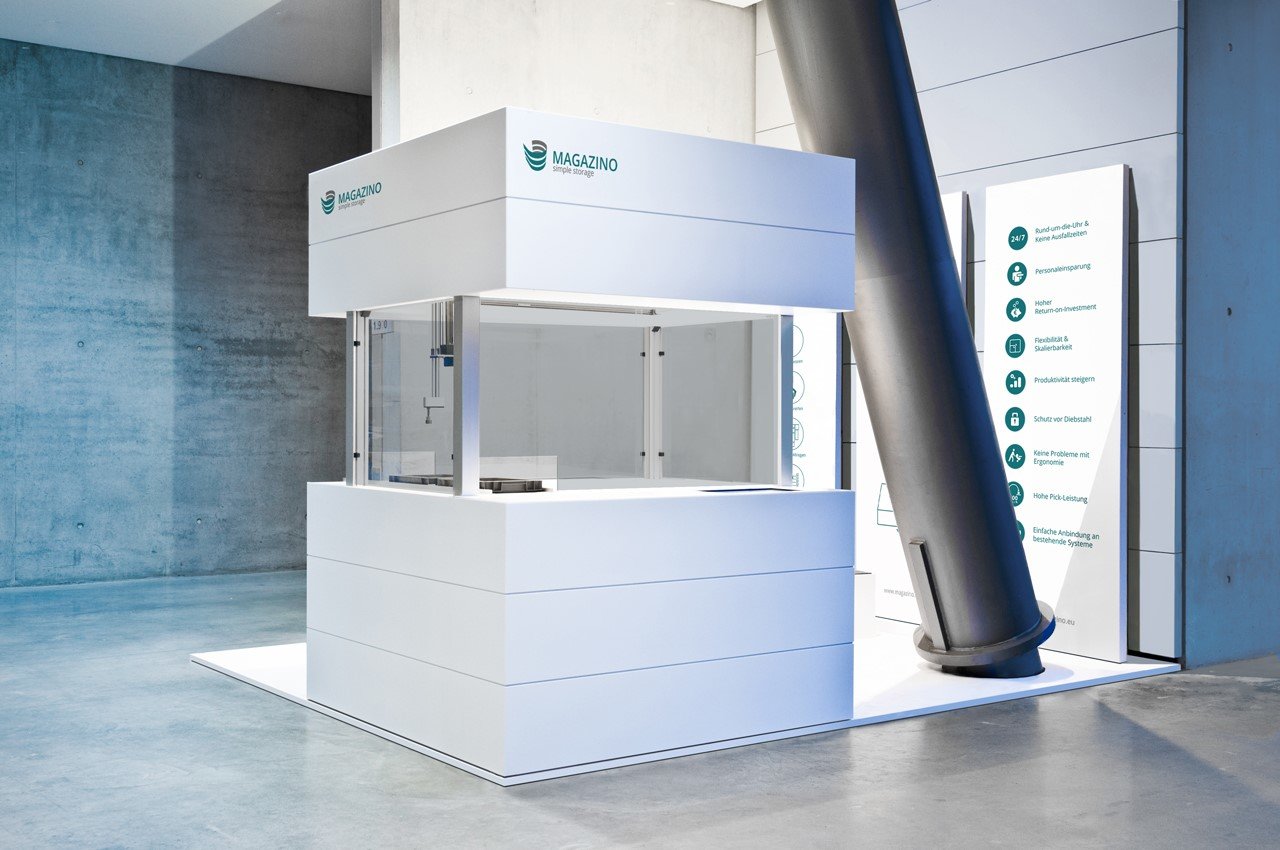
Kado (Source: Magazino GmbH)
Compared to the picking and inspection process, automation in the picking process is already more advanced. For example, returned items can be automatically removed from the conveyor belt at the picking station and transferred to an automated storage system using Kado , a development by the Munich-based startup Magazino . Depending on the type and size of the product range, dynamic lift racks, paternoster systems, or carousel storage systems are suitable options.
The challenge lies in reintegrating saleable returns into the inventory. However, with powerful warehouse management software and compatible equipment, companies can overcome this hurdle relatively easily.
Due to their nature, returned clothing is often significantly more difficult to store than, for example, compact items with uniform dimensions and a rigid structure. The Monalisa from Dematic provides a solution. It is an automated hanging system for sorting and buffering hanging and flat-packed garments, narrow items, or boxes. With its help, both returns and ordered goods from the warehouse are individually placed into the sorter's bags. These bags are then fed into the hanging system, where they rotate until the item is requested again. This type of buffering means that only a smaller portion of returned goods needs to be sorted back into the warehouse. Thanks to its modular design, Monalisa can be scaled and expanded as needed. Furthermore, the bag sorter simplifies order picking and shipping preparation. The completed orders are then sent to the packing stations, where they are packaged for shipment.
In conjunction with a dynamic retrieval system for smaller and/or more manageable items, this solution is ideal for automated warehousing and order picking processes, culminating in resale to the customer. Currently, this process still requires human intervention at various points; however, it may soon be a completely autonomous system that unpacks, inspects, and prepares returned goods for resale around the clock.
Automation is therefore progressing rapidly. Once robotics can reliably handle picking and inspection, perhaps no humans will be working in returns handling at all in the near future.
Why Xpert.Plus ?
Xpert.Plus is a project from Xpert.Digital. We have many years of experience in supporting and advising on storage solutions and in logistics optimization, which we bundle in a large network Xpert.Plus

Konrad Wolfenstein
I would be happy to serve as your personal advisor.
You can contact me by filling out the contact form below or simply call me on +49 7348 4088 965 (Munich) .
I'm looking forward to our joint project.
Write to me

Xpert.Digital – Konrad Wolfenstein
Xpert.Digital is a hub for industry with a focus on digitalization, mechanical engineering, logistics/intralogistics and photovoltaics.
With our 360° business development solution, we support well-known companies from new business to after sales.
Market intelligence, smarketing, marketing automation, content development, PR, mail campaigns, personalized social media and lead nurturing are part of our digital tools.
You can find out more at: www.xpert.digital – www.xpert.solar – www.xpert.plus
Keep in touch










