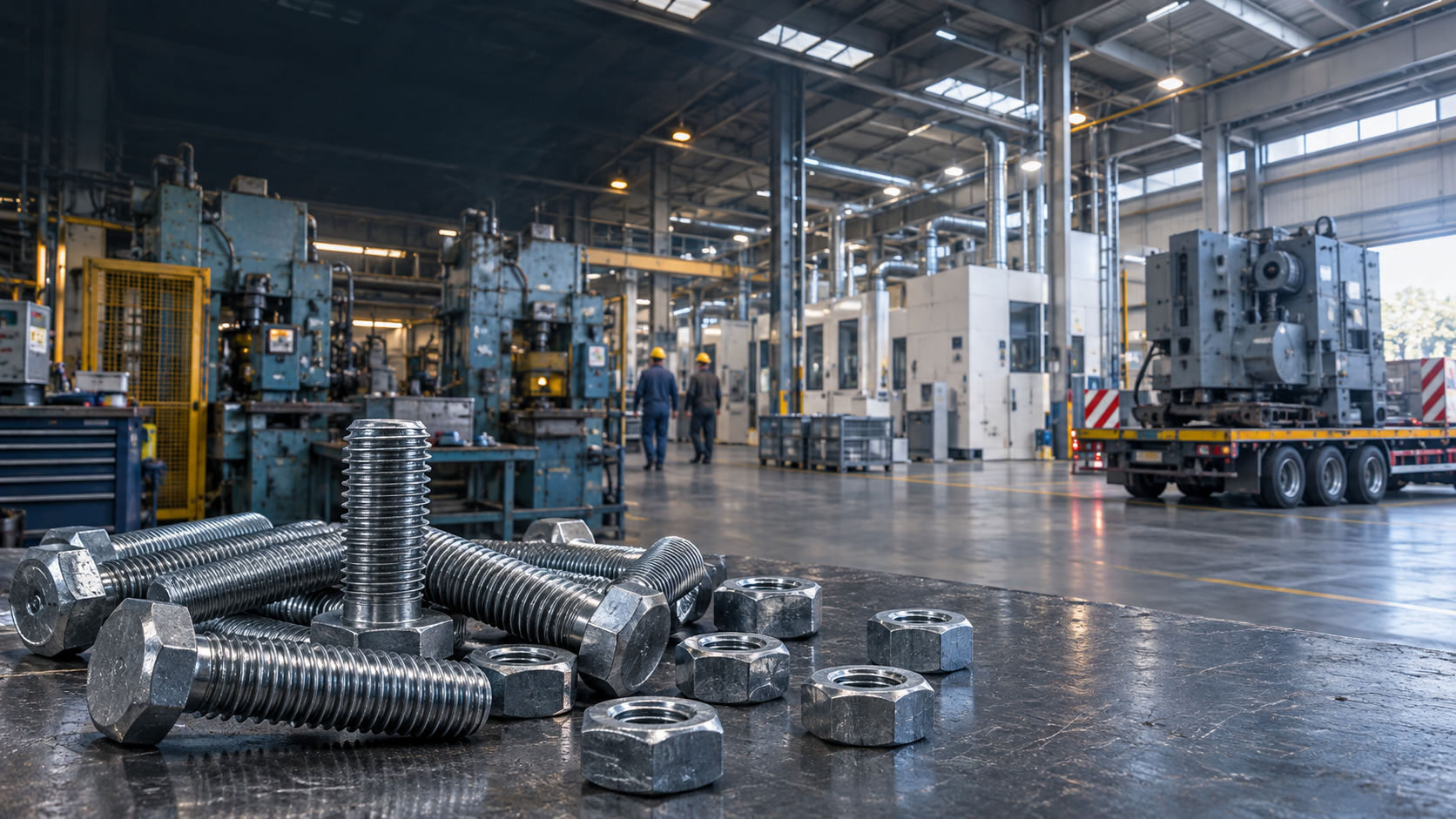
Nedschroef relocates machinery: What's at stake for Plettenberg now – Machines to Bulgaria, production in Altena – Creative image on the topic, with AI: Xpert.Digital
The restructuring at Nedschroef explained: 70 employees affected. How Nedschroef's site restructuring is changing the Sauerland region
Why Nedschroef is relocating production – and why German factories will still remain important
Less manufacturing, more logistics? The future of Nedschroef in Plettenberg
Nedschroef is reorganizing its locations: A large portion of the production machinery from Plettenberg is to be relocated to Bulgaria and Langeskov, Denmark. According to the company, Plettenberg will remain open and will focus more on service and logistics. Production will continue in Altena. Around 70 employees will need to find alternative jobs within the next three years. These plans raise a question that extends far beyond individual factory gates: Can the Sauerland region maintain its industrial significance if the tasks of its companies change? A look at cost pressures, capacity utilization, and the planned division of labor reveals what is crucial now – and why an open location does not necessarily guarantee a secure industrial future.
The factories remain open – but the crucial question is what value creation remains
The planned reorganization of Nedschroef's Plettenberg and Altena sites exemplifies a development that extends far beyond the screw industry: companies are redistributing their production across Europe, while German plants are increasingly focusing on specialized manufacturing, development, services, and logistics. This doesn't necessarily mean the disappearance of entire sites. Often, their function changes first. This is precisely where the economic and employment implications of the current restructuring lie.
Around 70 employees are to be offered alternative positions within the next three years. This is neither the immediate elimination of 70 jobs nor an unconditional job guarantee for all those affected. It primarily describes a task: jobs, qualifications, and operational functions must be aligned in such a way that the restructuring can be achieved with as few major staff disruptions as possible.
The rumor circulating that the Plettenberg site in the Mühlhoff division would be closed in about a year and a half has been refuted by management. A restructuring is planned. Plettenberg is to focus more on service and logistics, while a large portion of the production machinery will be relocated to Bulgaria and the Danish site in Langeskov. Production will continue in Altena. The key economic question, therefore, is not simply whether a plant will remain open, but rather what its future tasks, competencies, and development opportunities will be.
A location report becomes a question of industrial division of labor
The reorganization is best understood as a transformation of a European production network. A company with multiple plants not only decides whether a product can be manufactured economically, but also determines which processing steps, batch sizes, and services will yield the best results at each location.
Within the same corporate group, locations don't compete solely on wages. Equally important are machinery, capacity utilization, technical capabilities, energy consumption, customer proximity, and organizational reliability. A plant might be competitive for sophisticated products but face cost pressures for simple, standard parts. Conversely, a cost-effective location can be economically attractive without having to handle all development, quality control, and logistics functions in-house.
Nedschroef plans to reduce the number of different operational tasks in Plettenberg and focus more on service and logistics. Production capacities will be consolidated at other locations. From the company's perspective, this is an attempt to organize the overall system more efficiently.
For the region, the same decision is more ambivalent. If machines relocate, the industrial base changes. If other functions are strengthened at the same time, jobs can be preserved. However, production jobs, logistics positions, and commercial activities are not automatically interchangeable in terms of either their requirements or their regional economic impact.
The assessment should therefore not be limited to a simple comparison of maintaining a location versus closing it. A broad spectrum lies in between: from successful functional expansion to the gradual downsizing of a plant.
The journey to Stara Zagora began long before the current reorganization
The Bulgarian expansion is not a short-term reaction to a single weak quarter. The expansion in Bulgaria was confirmed as early as January 2023. In the same year, a new production plant was built in Stara Zagora. The company history explicitly describes its purpose as supporting the group's internal relocation strategy by providing additional capacity for screws and nuts. Initially, the focus was on forming and thread production; the plant was also intended to supply other Nedschroef locations.
This gives the current development a longer-term perspective. Establishing a new production site initially creates an additional option. Only when buildings, equipment, personnel, quality processes, and internal supply relationships are adequately prepared can further production volumes be transferred.
Such a development typically proceeds in several stages. First, processes are established and employees are trained. This is followed by stabilizing quality, releasing additional products, and increasing capacity utilization. Only then can a new location take on larger tasks within the production network.
The change in leadership in April 2026 should be seen in the context of this development. Achim Alles took over the position of Vice President from Jürgen Staritz, who stepped down for personal reasons. However, the Bulgarian expansion had already been publicly confirmed under his predecessor. It would therefore be an oversimplification to interpret the current reorganization solely as a consequence of a change in personnel.
Crucially, the site strategy remains consistent: the groundwork for a greater division of labor has been laid over several years. The current restructuring specifies the consequences this division of labor will have for Plettenberg and Altena.
Behind the cost pressure lies a capacity utilization problem
A shift in production is often explained solely by lower wages. In this case, that explanation falls short. Added to this is weaker demand from the automotive industry. According to management, orders have declined significantly, resulting in unused machine capacity.
This is particularly relevant from an economic perspective for an industrial supplier. Machines, buildings, and essential parts of the operational infrastructure incur costs, even when production decreases. If output falls, these costs are spread across fewer units sold. The cost per unit increases, even though the technical performance of the equipment may initially remain unchanged.
A simplified example illustrates the relationship: If one million euros in fixed costs are incurred annually for a production unit, these costs equate to ten cents per part when ten million parts are produced. With only seven million parts, the same cost block rises to approximately 14 cents. This example does not describe a Nedschroef calculation, but rather the fundamental mechanism of declining capacity utilization.
Therefore, consolidating orders at fewer locations can make economic sense. Instead of partially utilizing several machine parks, a company tries to make more intensive use of selected facilities.
However, this calculation only works if costs are actually eliminated or resources are repurposed productively at the existing locations. If machinery is relocated while buildings, administration, and essential operating costs remain unchanged, the profitability of the remaining plant may initially even worsen.
The conversion therefore requires more than just a transport plan for the machines. It requires a robust concept for the entire cost and task structure.
The wage gap is significant, but it does not explain the entire competitiveness
The magnitude of the difference in German-Bulgarian labor costs can be statistically assessed. In the manufacturing sector, average labor costs in Germany in 2025 were €49.50 per hour worked, while in Bulgaria they were €10.20. The Bulgarian figure was thus approximately one-fifth of the German figure. This figure aligns with publicly stated company estimates, but it does not prove identical cost structures at the specific Nedschroef plants. National industry averages are no substitute for company-specific cost calculations.
Furthermore, labor costs are not the same as net wages paid out. They encompass the employer's costs of employing staff. Likewise, a labor cost level of approximately one-fifth does not necessarily mean that the total production costs of a product are correspondingly low.
In addition to labor costs, the production of a screw or nut also incurs material costs, machine costs, tooling costs, maintenance expenses, energy, testing, and transportation. The extent to which a wage advantage impacts the overall costs therefore depends on the proportion of human labor involved in the respective process.
For a highly automated, material-intensive product, the direct personnel cost share can be comparatively low. It increases with frequent changeovers, additional inspections, or labor-intensive rework.
Productivity is also crucial. A lower hourly rate is of little use if significantly more time is required to produce the same saleable quantity. Conversely, a location with high hourly costs can remain competitive if it produces considerably more flawless parts per hour.
The correct comparison is therefore not: What does an hour cost? It is: What does a product delivered on time, approved, and without defects cost?
A model calculation shows the limits of simple savings promises
The true extent of a wage gap can be demonstrated using a transparent model calculation. Let's assume a product incurs total costs of €100 at the current location. Of this, €20 is attributable to directly attributable labor, while the remaining €80 covers materials, machinery, energy, and other expenses.
If the direct labor costs are reduced to one-fifth while maintaining the same productivity, they decrease from 20 to four euros. The total costs then initially fall to 84 euros. This corresponds to a reduction of 16 percent, not 80 percent.
This result, however, only holds true under the simplifying assumption that all other costs remain unchanged. In reality, additional transport, safety stock, start-up losses, and coordination expenses may arise. Likewise, further savings can be achieved through improved capacity utilization.
The model calculation thus makes two things clear. First, a large difference in labor costs can create a significant economic incentive. Second, a reliable profit contribution cannot be derived from the difference alone.
The time dimension also plays a crucial role in the investment decision. Machines must be dismantled, transported, installed, and reintegrated into stable processes. Costs can be incurred during this phase before any savings become apparent.
An economically viable relocation project must therefore be calculated over several years. Crucial factors include not only the eventual unit costs, but also the one-time conversion costs, the risks of ramping up production, and the question of when the change will ultimately pay for itself.
Bulgaria is a growing industrial location, not a frozen low-wage region
Bulgaria's cost advantage is substantial, but not fixed. Total labor costs averaged twelve euros per hour in 2025. At the same time, Bulgaria recorded an increase of 13.1 percent compared to the previous year. The EU average increase was 4.1 percent. The different figures for the overall economy and the manufacturing sector refer to different statistical definitions and should not be conflated.
This leads to an important limitation for long-term location decisions. A company should not assume that the current wage gap will remain unchanged indefinitely. Successful industrialization, rising skill levels, and the demand for experienced employees can increase personnel costs.
For Bulgaria, this development is not inherently a failure. Higher productivity and higher incomes are part of a successful economic catch-up process. From a location perspective, a development in which the country could only compete permanently on the basis of the lowest possible wages would be far more problematic.
For companies, this means that a new location must increasingly secure its profitability through stable processes, quality, technical expertise, and efficient organization. The initial cost advantage can facilitate the setup, but it does not replace a long-term productivity strategy.
This is another reason why simply installing machinery is not enough for complete industrial success. Sustainable value creation arises when local employees can operate the equipment, optimize tools, independently analyze errors, and take responsibility for more complex tasks.
The crucial development thus leads from a cost-effective production site to a high-performance industrial location. Whether and how quickly this succeeds depends on education, management, investment, and local networking.
Machines can be transported, but established knowledge only to a limited extent
A production site consists of more than just physical facilities. Its efficiency also relies on a wealth of experiential knowledge. Employees recognize unusual noises, assess wear and tear, react to material variations, and know which settings work reliably with a particular tool.
This knowledge is often only partially documented. It arises from daily interaction with machines and products. Therefore, knowledge transfer is one of the most challenging aspects of relocating production.
Even at the time the reorganization was announced, two employees from Plettenberg were already deployed to Bulgaria to prepare the local staff for additional tasks. This illustrates that the transfer is being organized not only technically, but also in terms of personnel.
This creates an economic tension. Experienced employees are needed to make the new location efficient. At the same time, sufficient expertise must remain at the existing location to manage residual production, service, quality, and any potential start-up problems.
Without this safeguard, a double loss is imminent: The new location will achieve the planned performance more slowly than expected, while the old location will have already lost important capabilities.
A sustainable implementation therefore requires clear process descriptions, verifiable quality criteria, and sufficiently long-term collaboration between the participating teams. It is equally important that knowledge does not depend solely on a few highly experienced individuals.
The quality of the transfer is a key factor in determining whether a calculated cost advantage translates into a genuinely reliable improvement in competitiveness.
🎯🎯🎯 Data-driven B2B industry hub as a quasi-in-house solution


The quasi-in-house solution: How Xpert.Digital closes operational gaps in B2B marketing and sales – Smart Content-Driven Business - Image: Xpert.Digital
Xpert.Digital is a data-driven B2B industry hub led by Konrad Wolfenstein . The company acts as an external, quasi-in-house solution for industrial partners, closing operational gaps in marketing, content, and sales – without requiring additional resources on the client side.
More information here:
Nedschroef: Strategic realignment of production sites
Why Denmark refutes the simple low-wage explanation
It is particularly revealing that production machinery is to be relocated not only to Bulgaria, but also to Langeskov in Denmark. Denmark is not among Europe's low-cost locations. Total labor costs there amounted to €51.70 per hour in 2025. While this figure does not directly compare the affected plants, it demonstrates that the choice of location cannot be explained solely by low national labor costs.
When a company consolidates manufacturing in both a low-cost and a high-cost country, this suggests a more nuanced rationale. Potential advantages include existing facilities, specific product expertise, better capacity utilization, or a more suitable industrial specialization.
Which specific factors are decisive in Langeskov cannot be definitively determined without internal economic analyses. A reliable analysis must explicitly acknowledge this limitation.
The fundamental connection is nevertheless important: A high-wage location can be successful in industrial competition if its higher productivity, quality, or specialization compensates for the cost disadvantage.
This is a relevant correction for the debate surrounding Germany's industrial base. High labor costs are a challenging factor, but not an automatic exclusion criterion for production. The decisive factor is whether a plant delivers services that are economically viable within the overall network.
The alternative is therefore not simply Germany or a low-wage country. Rather, it is: Which combination of costs, capabilities, and network function justifies the respective location?
Plettenberg's future depends on the quality of the new business model
The planned increased focus on service and logistics can make economic sense. However, it should not be prematurely judged as either a decline or automatically as an upgrade.
In industrial supply chains, logistics can extend far beyond warehousing and shipping. It can include inventory management, demand-driven provision, sorting, packaging, traceability, and customer coordination. Such services can provide significant benefits by ensuring smooth production processes at the customer's site.
However, the crucial factor is which of these functions are actually established or expanded at the site. A simple transshipment warehouse has a different strategic importance than a center that manages complex material flows and is closely linked to development, sales, and quality management.
Service and sorting operations will continue to be carried out in Plettenberg. No reduction plans have been announced for development, administration, sales, purchasing, or customer service in connection with the reorganization. Furthermore, the logistics division, which already employs around 60 people, is to be expanded.
This combination offers a plausible perspective. However, it is not yet proof that all eliminated production tasks will be replaced in an economically or personnel-wise equivalent manner.
This would require additional volumes, specific customer requirements, and permanently needed functions. A new location profile only becomes viable when it is not only described organizationally but also supported by real demand and measurable performance.
Altena could become the industrial anchor of the regional network
Since production is to continue in Altena, the site plays a central role in securing jobs. A significant proportion of the affected employees from production, toolmaking, and maintenance could be retained there.
Such a regional network offers economic advantages. Experience remains within the company, skilled professionals are not completely lost, and existing industrial capabilities can be concentrated at one location.
However, employment is not created simply because another factory continues production. Suitable tasks, sufficient capacity, and economically viable orders must be available there. Qualifications and shift patterns must also be compatible.
For employees, an internal transfer within the company is not merely an administrative change. Commuting distance, family obligations, health issues, and the specific nature of the job all influence whether an alternative offer is actually viable.
A successful restructuring therefore requires a person-centric approach. It is not enough to simply compare the number of available positions with the number of people affected. A toolmaker, a machine operator, and a maintenance technician bring different skills and may require different training paths.
If Altena can take on these functions, it would be more than just a short-term social safety net. It could stabilize a regional production hub. However, whether this will lead to a permanently stronger position depends on which products and investments will be allocated to the location in the future.
The number of 70 employees describes a task, not a result
The planned search for alternative jobs for approximately 70 employees must be carefully interpreted. It initially indicates the scale of the personnel adjustments required. It does not imply a fixed number of layoffs or the guaranteed continued employment of all affected employees.
The management has stated that no jobs will be lost initially. At the same time, they are seeking socially responsible solutions for employees nearing retirement. However, reductions are possible in temporary work and fixed-term contracts. These different forms of employment must be considered separately in the assessment.
For employees with permanent contracts, an internal transfer can offer a realistic prospect. For those with fixed-term contracts, however, adjustments can be made simply by not renewing their contracts. In the public eye, these two processes are often described using different terms, even though they can each mean job loss for those affected.
A distinction must also be made between maintaining an employment relationship and maintaining existing working conditions. Job duties, workplace, shift patterns, and career development opportunities can change.
An objective assessment should therefore not only ask how many redundancies are avoided. Equally important is how many people actually transition into stable, suitable, and sustainable long-term employment.
The success of the announced social design can only be measured by these results.
The three-year period provides economic flexibility
The planned three-year timeframe can help to organize the restructuring in stages. Staff changes, training, machine relocation, and the development of new functions then do not have to be completed simultaneously.
This allows the company to safeguard production and customer service during the transition. For employees, it generally provides more lead time to adapt to changing tasks or work locations.
However, a longer timeframe also comes at a cost. If the same production capabilities exist temporarily at multiple locations, duplicate structures can emerge. Training, parallel production, and additional coordination initially negatively impact the results.
Furthermore, there is the risk of prolonged uncertainty. If people don't know their future role for years, it can weaken motivation and commitment. Particularly mobile specialists might leave the company before a planned knowledge transfer is complete.
The timeframe is therefore only an advantage if it is linked to comprehensible milestones. Clear responsibilities, concrete qualification pathways, and timely decisions regarding individual career prospects are needed.
From an economic point of view, the transformation should be fast enough to improve competitiveness, but slow enough not to unnecessarily jeopardize quality and job transitions.
Achieving precisely this balance is one of the most demanding management tasks involved in reorganizing a site.
The underestimated cost behind transport and supply security
There are over 2,000 kilometers between Plettenberg and Stara Zagora. This gives the organization of cross-border supply chains added importance. When production steps are relocated, material movements, delivery times, and inventory levels must be realigned.
Economic efficiency is not solely determined by the price of a transport journey. Relevant factors include how many goods movements a product undergoes, how fully utilized the vehicles are, and whether additional intermediate storage is required.
Processes involving multiple transfers of materials or semi-finished products between locations can be particularly problematic. Any labor cost advantage can be partially offset by unnecessary transport. Conversely, a streamlined production chain improves predictability.
Inventory also comes at a price. Safety stocks tie up capital and require space. Conversely, insufficient inventory increases the risk of being unable to deliver in the event of delays.
Therefore, a relocation analysis should encompass the entire supply chain. A locally cost-effective manufacturing step can be expensive within the overall system if it creates additional complexity.
One potential strength of Plettenberg's future profile could lie precisely in its ability to manage this complexity. If production takes place at other locations, a high-performing, customer-focused service and logistics function can stabilize the network.
However, this requires that the division of tasks is consciously designed. Logistics must not merely be the subsequent repair of an unnecessarily complicated production structure.
Quality is the economic limit of any relocation
For industrial fasteners, the unit price is not the only deciding factor. Depending on the application, dimensional accuracy, material properties, strength, and traceability can be essential for the function of an overall system.
A defective part can cause costs that far exceed its own value. Rework, sorting, production interruptions, and customer complaints quickly impact profitability.
Therefore, a change of location must be considered from the perspective of marketable quality. A machine that is installed and producing at a new location has not automatically achieved the same stable process as before.
Potential differences include tool condition, material supply, maintenance routines, measuring instruments, and staff experience. Even small deviations can become significant with large production volumes.
This does not mean that a new location will inherently produce worse. It means that equivalence must be established and demonstrated.
From an economic perspective, the scrap rate is particularly important. If lower labor costs are achieved by producing more defective parts, material consumption and rework costs increase. At the same time, the actual usable capacity decreases.
The operational success of the reorganization should therefore not be measured solely by relocated machinery or reduced staff hours. Equally crucial are stable delivery performance, low error rates, and reliable process control across all participating plants.
For the Sauerland region, more matters than the number of employees at a single plant
The regional economic consequences of relocating production extend beyond the jobs directly affected. A manufacturing site can outsource orders to toolmakers, maintenance companies, technical service providers, and other businesses in the surrounding area.
If production volume migrates, such connections can weaken. The extent of this effect in a specific case depends on previous regional procurement practices and future task allocation. Without corresponding data, it cannot be reliably quantified.
Education and professional development are also relevant. Where sophisticated manufacturing takes place, learning opportunities arise for technical professions. If this sector shrinks, it can change the breadth of regional skills offerings in the long term.
At the same time, expanded service, development, and logistics functions can generate new demand. They require specific skills and can stabilize regional employment.
The crucial question, therefore, is not whether production is inherently more valuable than any service. It is which specific activities retain income, knowledge, and other economic ties within the region.
For municipalities and regional economic development agencies, this results in a sobering task: not only to observe the number of open factory gates, but also the development of investments, training positions, technical skills and decision-making functions.
A location can outwardly persist and lose economic importance. However, it can also change and thereby gain a new, resilient role.
Germany's answer must be higher productivity, not just wage cuts
The labor cost gap between Germany and Bulgaria is so large that it cannot be closed by minor concessions from individual workforces. A sustainable solution, therefore, cannot simply consist of worsening working conditions or reducing nominal costs.
For German factories, the challenge is to justify their higher costs through corresponding performance. This includes sophisticated products, short development times, low defect costs, efficient changeovers, and high plant availability.
A key area of focus lies in indirect losses. Lengthy downtimes, search times, unclear production planning, and unnecessary rework increase manufacturing costs without creating additional customer value. Reducing these losses can strengthen competitiveness.
Automation is not an end in itself. It only pays off if it fits the product mix and volume structure. An expensive system that is underutilized due to weak demand or frequent changes does not automatically solve the capacity utilization problem.
Equally important is the link between development and production. When technical insights are quickly translated into improved tools and stable series production processes, an advantage arises that goes beyond the hourly wage.
The strategic task is therefore to strengthen those capabilities where a German location offers demonstrable added value within an international network. Without this demonstration, location policy remains defensive. With it, a high-wage plant can maintain a sustainable role in the long term.
Three development paths show what the transformation should be measured against
Three analytical scenarios can be distinguished for further developments. These are not forecasts, but help to systematically classify opportunities and risks.
In the best-case scenario, demand stabilizes. Consolidated production achieves better capacity utilization, Bulgaria reliably takes on additional manufacturing work, and Altena strengthens its industrial role. Plettenberg expands its economically viable service and logistics operations. Most of the affected employees find suitable new jobs.
In a medium scenario, demand remains weak. While the reorganization improves the cost position, it creates only limited additional flexibility. Employment adjustments occur primarily through retirements, expiring fixed-term contracts, and reduced temporary work. The site remains, but has less industrial substance.
In the worst-case scenario, low capacity utilization, additional pricing demands, and difficulties ramping up production all coincide. Savings materialize later, while transition costs increase. This could then create further pressure to adjust. However, the fact that such a scenario is fundamentally possible does not prove that it is already being planned.
Therefore, specific key figures are suitable for assessment: actual employee transfers, development of production volume in Altena, investments in Plettenberg, quality and delivery reliability of the new network, and the development of services that are in constant demand.
Announcements are the starting point. Reliable results only emerge during operation.
An open factory door does not guarantee an industrial future
Nedschroef's reorganization is economically understandable, but not without consequences. Declining demand and unused capacity create pressure to adapt. The significant difference in labor costs compared to Bulgaria increases the incentive to redistribute suitable production volumes within the European network. However, the fact that Denmark is also slated to receive additional tasks demonstrates that specialization and location expertise remain equally important.
Plettenberg has a real opportunity to develop a stronger role in service and logistics. Altena, on the other hand, has the chance to gain importance as a production site and employment hub. However, both prospects must be supported by orders, investments, and concrete projects.
For the approximately 70 people affected, success depends not on the abstract efficiency of the corporation, but on reliable career prospects. A socially responsible transition must therefore offer more than simply avoiding immediate layoffs.
The overall perspective, therefore, is neither alarmist nor reassuring: The restructuring can help to stabilize the corporate network economically and preserve German locations. At the same time, it shifts industrial capabilities and changes the regional foundations of future value creation.
The crucial test, therefore, is not whether the factory gates will still be open in three years. It is whether they continue to generate expertise, investment, and sustainable jobs that will survive the next economic downturn.
📈🚀 From visibility to trust 👀🤝 Your scalable path with Xpert.Digital


From visibility to trust: Your scalable path with Xpert.Digital - Image: Xpert.Digital
In industrial B2B, sustainable business relationships rarely emerge overnight. They develop step by step – through visibility, professional relevance, recurring touchpoints, and growing trust. Xpert.Digital's 4-stage model addresses precisely this: It offers a structured path that begins with a manageable entry point and can evolve into deeper collaboration in business development if needed.
Instead of relying on loud marketing promises, this model puts the relationship at the forefront. Companies start with clearly defined, easily calculable measures and then decide, based on their own experience, how far they want to expand the collaboration. A key factor for this undisturbed trust-building process: The platform completely avoids annoying advertising ads, so the editorial focus remains solely on the companies' expertise.
More information here:
Your global marketing and business development partner
☑️ Our business language is English or German
☑️ NEW: Correspondence in your native language!

Konrad Wolfenstein
I and my team are happy to be available to you as your personal advisor.
You can contact me by filling out the contact form here wolfenstein@xpert.digital:or simply call me at +49 7348 4088 965. My email address is
I'm looking forward to our joint project.