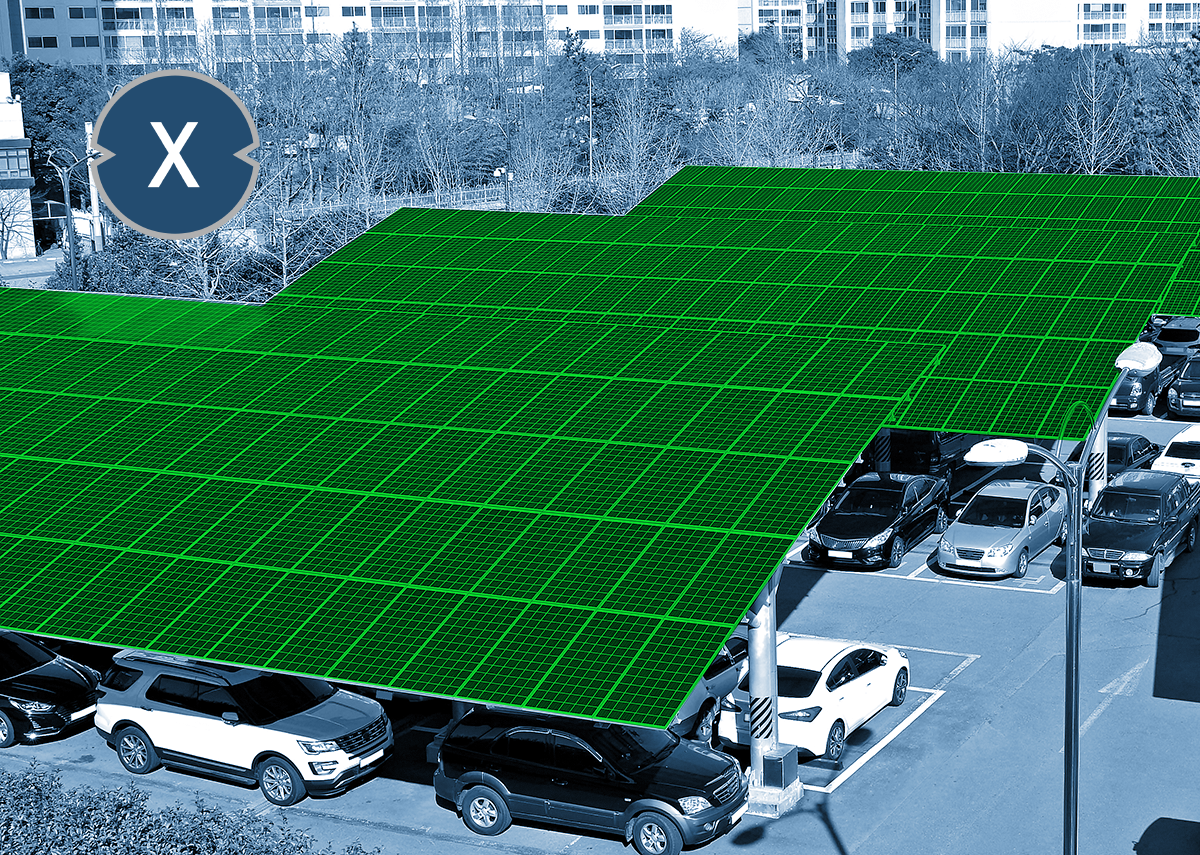
Photovoltaic solar carports and solar panels for flat and pitched roofs – Xpert.Digital / seo byeong gon|Shutterstock.com
The growing electric car industry is putting a strain on infrastructure
The motto of the moment is "demand, not promote." As of April 1, 2021, there are well over 700,000 plug-in hybrid vehicles and electric cars. This means that in April 2021 alone, a 300% increase was achieved compared to the entire previous year, 2020.
When we talk about funding, it's always linked to specific events. In the field of electromobility, however, there is an acute shortage of charging stations and charging points, making the demand for the necessary capacity to expand electromobility essential and simultaneously posing a challenge for the entire economy.
📣 Parking lot solar solutions for industry, retail and municipalities
Everything from a single source, specifically designed for solar solutions for large parking areas. Refinance or offset your future costs with your own electricity generation.
🎯 For solar installers, plumbers, electricians and roofers
Consultation and planning including a non-binding cost estimate. We connect you with strong partners in photovoltaics.
👨🏻 👩🏻 👴🏻 👵🏻 For private households
We have a regional presence throughout the German-speaking world. We have reliable partners who will advise you and implement your wishes.
The number of roadside petrol stations has decreased over the past ten years. The number fell steadily from 14,410 in 2010 to 14,089 in 2020. In contrast, the number of charging points in Germany has increased almost tenfold between 2012 and 2021. With the growing popularity of electric vehicles, the number of charging stations will continue to rise in the future.
While a charging station consists of one or more charging points, the difference between a charging point and a charging station is that only one electric vehicle can be charged at a time at a charging point. Therefore, a charging station can consist of one or more charging points.
Charging stations, along with wallboxes, are part of the charging points. There are currently over 39,500 charging points (as of February 2021).
Related to this:
- Why solar carports are becoming important now
- Are solar parks the most popular electricity generation facilities?
39,500 charging points compared to 14,000 gas stations only looks impressive at first glance. However, the reality is that gas stations can refuel or charge far more vehicles simultaneously, and much faster. Estimates suggest that electric vehicle charging stations currently only offer about 10% of the charging capacity of gas stations. The patchy charging infrastructure further exacerbates the problem. This is especially true considering that the proportion of electric vehicles in daily traffic is still significantly lower. The issue will only worsen as the number of electric vehicles grows in the coming years, which is expected.
A solar panel mandate and the expansion of solar carports at open parking areas are intended to counteract this. In general, the expansion of renewable energies, primarily through solar parks , solar fields, and ground-mounted photovoltaic systems , is to be accelerated. The emission-free future of transportation and its infrastructure is being logically and consistently initiated not with the familiar electricity from the wall socket, but with solar carports and charging stations. Whether a solar panel mandate makes sense in this regard is still debated. However, the fact remains that public interest in solar panels is not yet widespread. While many people are environmentally conscious and ecologically minded, interest in solar panels themselves has remained relatively constant at just under 50% since 2013. It is certainly true that everyone should contribute to an emission-free environment and not wait for electricity from the wall socket to become emission-free and greener.
To increase charging options and simultaneously draw charging power from solar energy, open parking lots are now coming into play.
What are open parking spaces?
This does not refer to public parking spaces. Open parking spaces are usually:
- A storage area open at the sides, not a barn or shed or similar.
- Carports, covered parking spaces
- Uncovered parking spaces
- Parking available on a property
- Outdoor parking spaces
Related to this:
In Baden-Württemberg, this applies to all open parking lots with 75 or more parking spaces. Section 8b of the Baden-Württemberg Climate Protection Act stipulates that " a photovoltaic system must be installed above the parking area suitable for solar energy use ." There is no alternative to this requirement, unlike the mandatory installation of photovoltaic systems on new non-residential buildings.
Our solar parking solution is modular and scalable:
- Quick and easy assembly
- Stable strip foundation as impact protection
- Customizable design (color, materials, surface, size, etc.)
- Installation of charging stations and inverters is possible at any time
- Scalable & modular: Available as a single, double or infinitely scalable row carport
- Even in its standard version, it can be used for very high wind and snow loads (sk= 2.2 kN/m²).
- Extra-large and wide parking spaces and very easy parking thanks to W-shaped supports
- High-quality design for demanding and long-lasting requirements: Hot-dip galvanized steel construction (DIN EN 10346, DIN EN 1461)
- [Click here for more]
Why solar carports?
Demand for electric vehicles is rising. The number of electric vehicles worldwide has increased more than fiftyfold since 2012. In 2007, there were a total of 8 new electric car registrations in Germany. By 2019, this number had risen to 194,163! From January to May 2021, it had already reached 115,296 new registrations. This trend is expected to continue. Solar carports are already attractive investment goods. This also translates into increased appeal for personnel and customer development, making the production and company location more attractive.
Related to this:
Industrial flat roof solar systems and solar parks or photovoltaic open-field systems are another alternative

Anyone considering investing in a solar carport should also consider installing a solar panel system on the company roof. Utilizing all available energy potential for an emission-free and autonomous power supply is also a competitive advantage and helps secure market share.
More information here:
Charging stations and charging infrastructure
A solar carport alone isn't enough. Fundamental questions need to be answered. Should the generated energy be fed into the grid or stored in energy storage systems? What are the load profiles, the technical connection requirements, the number of charging stations, the vehicle parking time, and ultimately, the total PV output? How will the charging sessions be recorded by the company if the employee charges their company car from home? These are questions we will have to address in the future. It's different from what we're used to today.
Related to this:
Hybrid cars in Germany by 2021
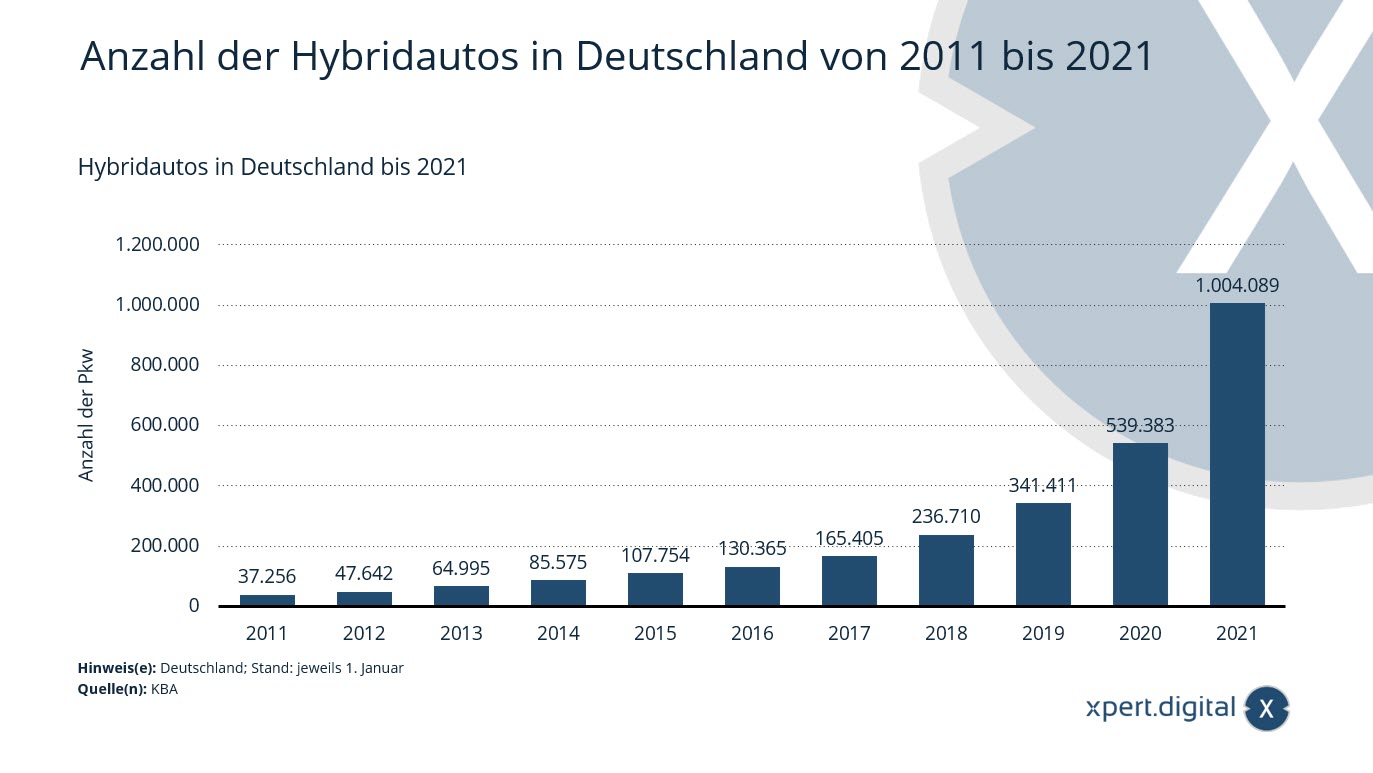
Hybrid cars in Germany – Image: Xpert.Digital
The number of hybrid cars is at a record level
In 2021, the number of hybrid passenger cars in Germany amounted to approximately one million units. In 2011, there were around 37,300 hybrid cars registered in Germany. Since then, the number has increased steadily every year. A hybrid vehicle is defined as a vehicle with at least two energy converters and two integrated energy storage systems to power the vehicle. Energy converters include electric, gasoline, and diesel engines, while energy storage systems include batteries, fuel tanks, and gas tanks. Hybrid vehicles that also have an electric motor are classified as plug-in hybrids.
Purchase bonus for electric vehicles and plug-in hybrids
The purchase or leasing of various types of electric cars is eligible for a government subsidy in Germany called the "environmental bonus." Eligible purchases (buying or leasing) are electric vehicles that are being registered for the first time and whose net list price for the base model does not exceed €65,000. Pure battery electric vehicles receive subsidies of up to €9,000, and hybrid electric vehicles receive up to €5,625. Two-thirds of the subsidy is covered by the federal government and one-third by the car manufacturer. This increased subsidy (previously €4,000 for pure battery electric vehicles and €3,000 for hybrid electric vehicles) was introduced as part of the economic stimulus package to combat the effects of the COVID-19 pandemic.
Demand for alternative drive systems is increasing
The share of conventional powertrains in new vehicle registrations has declined significantly in recent months, while the number of electric cars in Germany continues to rise. Other alternative powertrains, however, have not shown comparable growth; plug-in hybrids and battery electric vehicles (BEVs) still dominate the list of alternative powertrains among new registrations.
Number of hybrid cars in Germany from 2011 to 2021
2011 - 37,256 hybrid cars
2012 - 47,642 hybrid cars
2013 - 64,995 hybrid cars
2014 - 85,575 hybrid cars
2015 - 107,754 hybrid cars
2016 - 130,365 hybrid cars
2017 - 165,405 hybrid cars
2018 - 236,710 hybrid cars
2019 - 341,411 hybrid cars
2020 - 539,383 hybrid cars
2021 - 1,004,089 hybrid cars
Plug-in hybrids in Germany until 2021
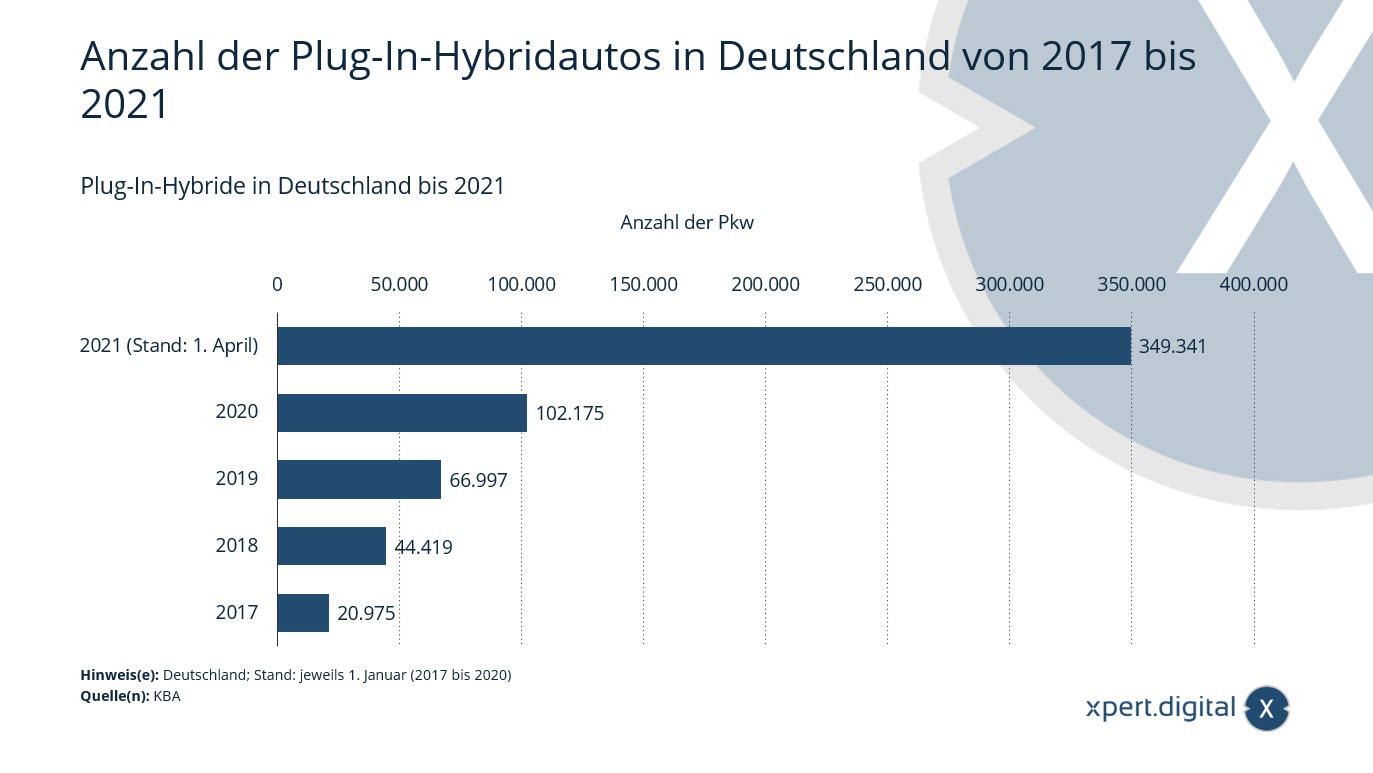
Number of plug-in hybrid cars in Germany – Image: Xpert.Digital
The number of plug-in hybrid cars is steadily increasing – as of April 1, 2021, the number of passenger cars with a plug-in hybrid drive in Germany amounted to approximately 349,300 units. Together with purely electric passenger cars (BEVs), the number of electric cars in Germany is thus approaching the one million mark.
A hybrid vehicle has at least two energy converters and two integrated energy storage systems to power the vehicle. Energy converters include, for example, electric, gasoline, and diesel engines; energy storage systems include, for example, batteries, fuel tanks, or gas tanks. At the beginning of 2021, there were approximately one million hybrid vehicles in Germany (including plug-in hybrids).
Hybrid vehicles that also have an electric motor are classified as electric cars (plug-in hybrids).
The biggest difference between an electric car and a plug-in hybrid is the drive system. An electric car is purely electric, while a plug-in hybrid always has a conventional combustion engine alongside the electric motor. Hybrid cars therefore have two drive systems. In a pure hybrid vehicle, the electric motor only assists the combustion engine when starting off, and the combustion engine takes over at higher speeds and lower RPMs. This hybrid electric motor cannot therefore be considered an independent vehicle drive system or an equivalent electric motor in a plug-in hybrid car.
Related to this:
- Solar carports as a further step towards the growing charging station infrastructure
- Interest in and demand for solar carports is growing
Number of plug-in hybrid cars in Germany from 2017 to 2021
- 2017 – 20,975 plug-in hybrid vehicles
- 2018 – 44,419 plug-in hybrid vehicles
- 2019 – 66,997 plug-in hybrid vehicles
- 2020 – 102,175 plug-in hybrid vehicles
- 2021 (as of April 1st) – 349,341 plug-in hybrid vehicles
Registered electric cars in Germany
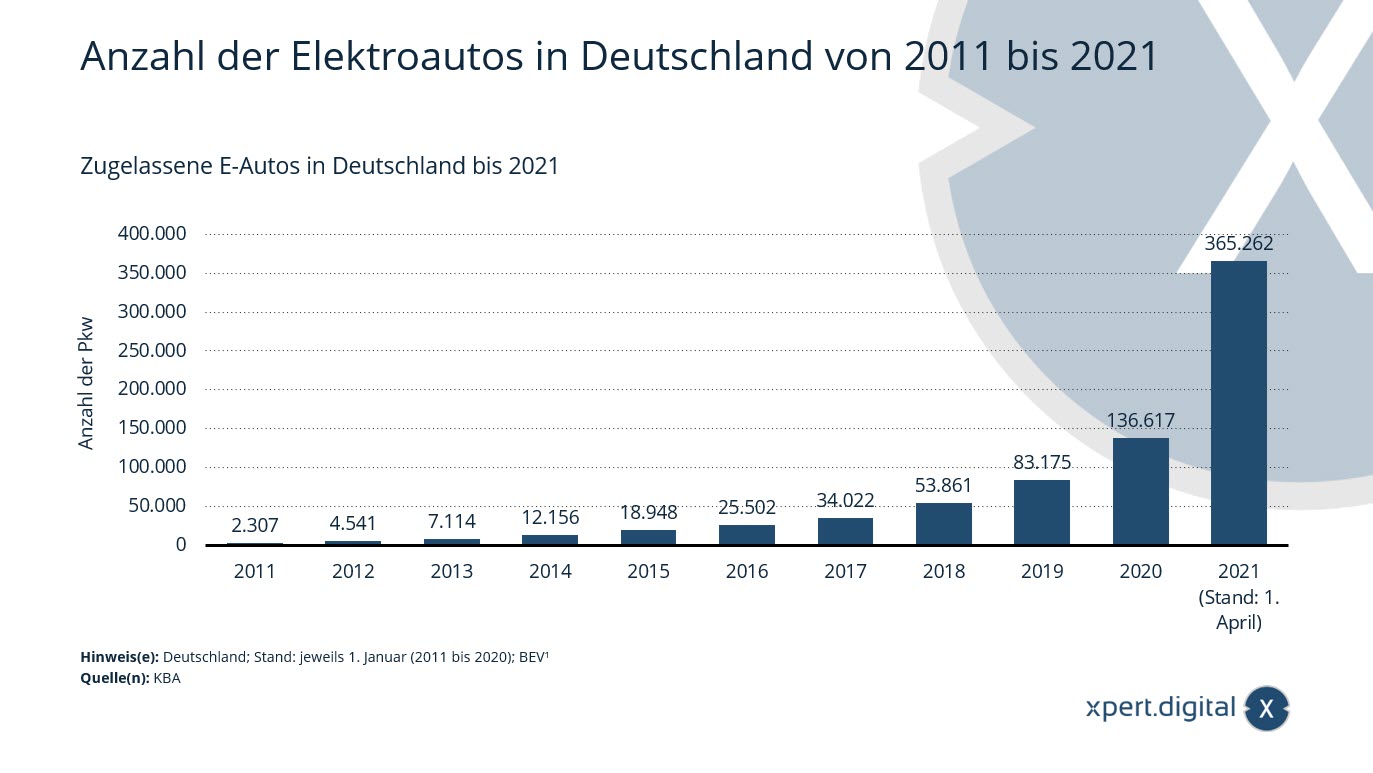
Registered electric cars in Germany up to 2021 – Image: Xpert.Digital
How many electric cars are there in Germany?
The number of registered electric cars was approximately 365,300 on April 1, 2021. This figure represents passenger cars powered exclusively by electricity (BEVs). Depending on the definition, plug-in hybrid passenger cars are also counted as electric cars; their number on April 1, 2021, was approximately 349,300. Overall, the number of electrically powered passenger cars is thus approaching the one million mark.
Which electric cars are eligible for subsidies?
Since electric cars are still relatively expensive, the government supports their purchase with a subsidy. Eligible for funding is the acquisition (purchase or lease) of an electric vehicle that is being registered for the first time and whose net list price of the base model does not exceed €65,000. Pure battery electric vehicles are subsidized with up to €9,000 and hybrid electric vehicles with up to €5,625. The subsidy is covered two-thirds by the federal government and one-third by the car manufacturer. This increased subsidy (previously: €4,000 for pure battery electric vehicles, €3,000 for hybrid electric vehicles) was decided upon as part of the economic stimulus package to combat the effects of the coronavirus pandemic.
When were electric cars invented?
As early as the 1830s, the first vehicles were powered by batteries or electric motors. However, these vehicles were not yet referred to as cars. Today, the vehicle developed by Andreas Flocken in Coburg, Upper Franconia, in 1888 is considered the world's first electric car.
Related to this:
- Best Practice Solar Carport: What trade and industry in Baden-Württemberg need to know now
- Charging stations and solar carports together make sense: The circle is complete
Number of electric cars in Germany from 2011 to 2021
2011 – 2,307 electric cars; 2012 – 4,541 electric cars; 2013 – 7,114 electric cars; 2014 – 12,156 electric cars; 2015 – 18,948 electric cars; 2016 – 25,502 electric cars; 2017 – 34,022 electric cars; 2018 – 53,861 electric cars; 2019 – 83,175 electric cars; 2020 – 136,617 electric cars; 2021 (as of April 1st) – 365,262 electric cars


- Planning photovoltaics on warehouses, commercial buildings and industrial buildings
- Industrial plant: Planning a photovoltaic open-field system or open-area system
- Planning solar power systems with photovoltaic solutions for freight forwarding companies and contract logistics
- B2B Solar Systems and Photovoltaic Solutions & Consulting
That's why Xpert.Solar offers consulting services for solar carports, solar systems and solar systems on flat roofs for Kiel, Lübeck, Flensburg and Neumünster!

Konrad Wolfenstein
I would be happy to serve as your personal advisor.
You can contact me by filling out the contact form below or simply call me on +49 7348 4088 965 .
I'm looking forward to our joint project.
Write to me


Xpert.Digital – Konrad Wolfenstein
Xpert.Digital is a hub for industry focusing on digitalization, mechanical engineering, logistics/intralogistics and photovoltaics.
With our 360° Business Development solution, we support renowned companies from new business to after-sales.
Market intelligence, smarketing, marketing automation, content development, PR, mail campaigns, personalized social media and lead nurturing are part of our digital tools.
You can find more information at: www.xpert.digital – www.xpert.solar – www.xpert.plus
Keep in touch