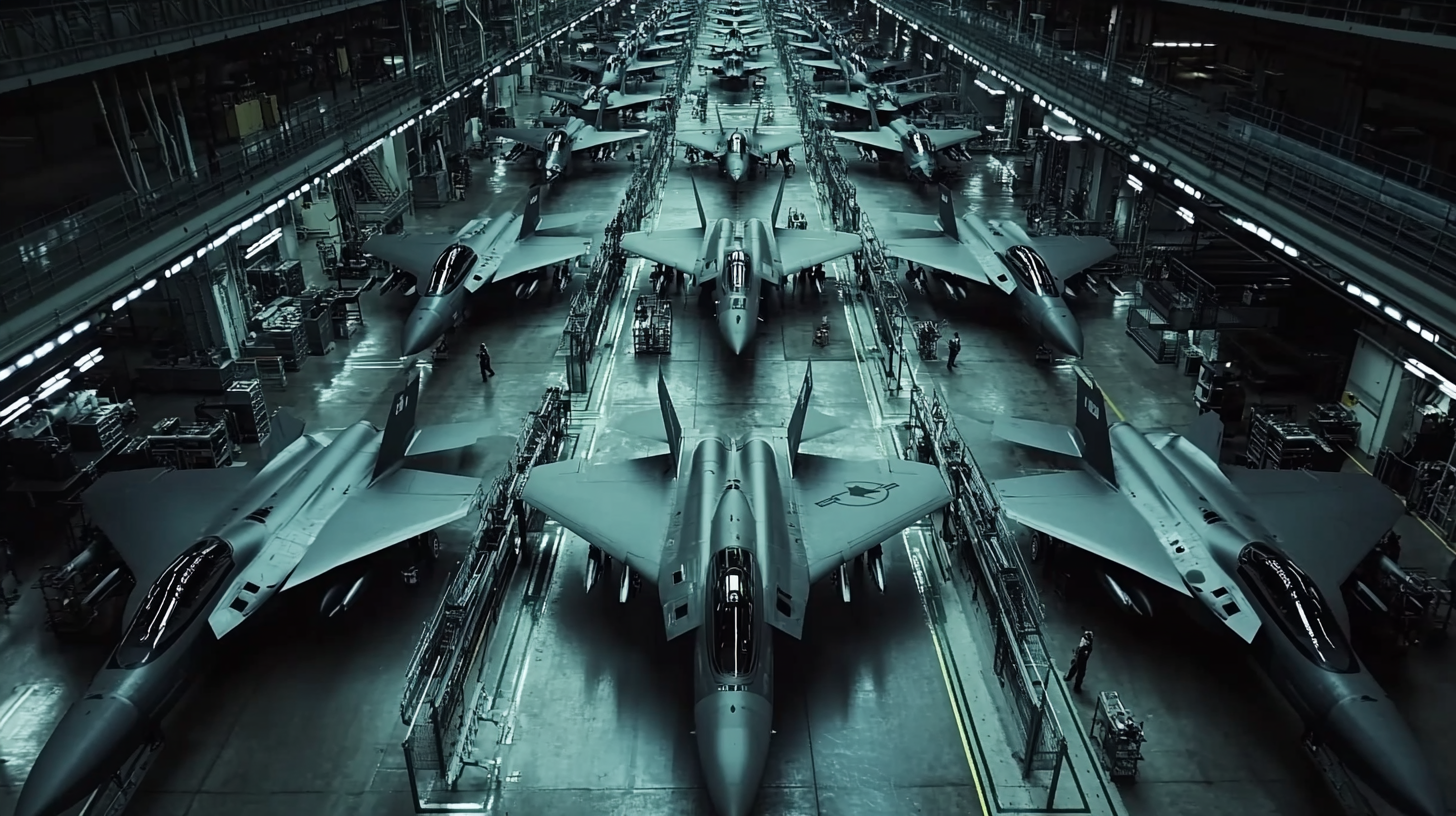
Outmaneuvered? Lock-in effects are not only dangerous for the economy – A look at the military sector – Image: Xpert.Digital
National sovereignty at risk: The risks of foreign military technology
Strategic risks as exemplified by US arms exports and the F-35 debate
Dependence on foreign military technology poses an existential risk to national security and operational sovereignty. The example of US arms deliveries to Ukraine and the controversies surrounding the F-35 fighter jet demonstrate how lock-in effects restrict a state's ability to act and cement geopolitical power structures. This phenomenon is not limited to purely technological aspects but encompasses contractual, logistical, and political dimensions, which will be analyzed in detail below.
Related to this:


Control over weapons systems as a tool of political pressure: The case of Ukraine
Restrictions on US weapons use due to political directives
In November 2024, the US government under Joe Biden eased restrictions for the first time on the use of ATACMS missiles in the Kursk region of Russia, after previously imposing strict geographical limits on attacks against Russian territory. This decision was made against the backdrop of North Korean troop build-ups on the Russian side and under the time pressure of Biden's impending end of his term. However, this temporary authorization also illustrates how the US, as a supplier, controls Ukraine's operational autonomy
- Geographical restrictions: Until November 2024, US-supplied Himars systems were only allowed to be used within a radius of 80 km around the front line near Kharkiv.
- Political conditionality: The release of the ATACMS missiles was tied to the deployment of North Korean units in Kursk, not to Ukrainian defense needs.
- Time constraint: Biden's decision was made during the last phase of his term in office, which underlines Ukraine's dependence on domestic US political cycles.
The abrupt halt of US military aid under Trump
President Donald Trump's suspension of all US arms shipments in March 2025 revealed Ukraine's vulnerability:
- Immediate consequences: The failure of Patriot and NASAMS surface-to-air missiles left critical infrastructure unprotected. Artillery ammunition for Himars and 155mm shells was unavailable, making offensive operations impossible.
- Indirect control mechanisms: It remained unclear whether satellite reconnaissance data and access to Starlink communication systems were also affected – both crucial for operational control.
- Historical parallels: Back in 2023, a six-month supply stoppage led to the improvisation of Ukrainian drone technology, which today accounts for 80% of direct hits. Nevertheless, the dependence on US systems remains structural.
Geopolitical implications
US policy demonstrated how suppliers pursue strategic goals through selective releases and supply disruptions:
- Escalation control: Biden's initial reluctance regarding long-range weapons was aimed at avoiding a direct confrontation with Russia.
- Negotiating leverage: Former NATO Supreme Allied Commander Wesley Clark viewed the late release as a means of giving Ukraine more weight in future peace talks.
- Dependence as a tool of pressure: Trump's demand for "sufficient willingness to make peace" from Ukraine illustrated how military aid can be tied to political conditions.
The F-35 controversy: Technological dependence and its consequences
Contractual lock-in mechanisms in the F-35 program
The purchase agreement for the German F-35s reveals structural dependencies:
- Unilateral termination clauses: The US reserves the right to halt deliveries in cases of "national interests".
- Technological control: Modifications to the jets are prohibited; spare parts require US approval.
- Data sovereignty: Aircraft data is stored in a US-managed Amazon cloud, which limits operational transparency.
The debate about the “kill switch”
Although the Pentagon denies rumors of a direct deactivation mechanism, indirect control options exist:
- Software dependency: The F-35 requires regular updates via the Autonomic Logistics Information System (ALIS), which is controlled by US servers. Discontinuation of this support would degrade its combat capability within a few months.
- Logistics chain: 80% of spare parts and maintenance technologies are concentrated in the USA. A supply disruption would cripple fleets within weeks.
- Mission Planning Systems: Joachim Schranzhofer of Hensoldt pointed out that US mission planning systems could block flight routes or weapons deployments.
Reactions from purchasing countries
Several countries responded with purchase recalls or reviews:
- Portugal: Cancelled its F-35 order explicitly due to "US unpredictability".
- Canada: Is reviewing its order in light of diplomatic tensions with the Trump administration.
- Germany: Parliamentary inquiries regarding contractual exit clauses and alternative European fighter jets such as the Eurofighter.
Strategic lessons and alternative approaches
Risk minimization through diversification
The German Armed Forces are relying on a multi-cloud strategy in the IT sector to avoid vendor lock-in. Applied to defense projects, this means:
- Hybrid fleets: Combining F-35s with European models such as the Eurofighter to diversify dependencies.
- Open-source development: Initiatives such as the Future Combat Air System (FCAS) promote interoperable technology standards.
Contractual safeguards
- Exit clauses: Legally binding regulations for data migration and technology transfer upon termination of the contract.
- Source code escrow: Depositing critical software components with neutral third parties to secure access in case of conflict.
European sovereignty aspirations
The F-35 dispute is accelerating initiatives for European arms autonomy:
- EPAF (European Participating Air Forces): Cooperation for the maintenance of Eurofighter-Tornado fleets independent of US logistics.
- EDIDP (European Defence Industrial Development Programme): Promoting joint armaments projects to reduce extraterritorial dependencies.
Related to this:

Lock-in effects as a threat to strategic resilience
The examples of Ukraine and the F-35 illustrate that military lock-in models extend far beyond financial risks. They jeopardize operational freedom, undermine political sovereignty, and expose states to geostrategic blackmail. While the US uses its technological leadership to bind its allies, the growing skepticism surrounding the F-35 program demonstrates that customers are increasingly recognizing the costs of this dependency. The solution lies in striking a balance between technological interoperability and preserving autonomous decision-making structures—a challenge that can only be met through European coordination and investment in research.
Related to this:
Your global marketing and business development partner
☑️ Our business language is English or German
☑️ NEW: Correspondence in your native language!

Konrad Wolfenstein
I and my team are happy to be available to you as your personal advisor.
You can contact me by filling out the contact form here wolfenstein@xpert.digital:or simply call me at +49 7348 4088 965. My email address is
I'm looking forward to our joint project.