Ukraine/Russia | Propaganda or reality? The truth about the Donbas: Is the Ukrainian front really collapsing? – Image: Xpert.Digital
Behind the scenes of the war: What frontline reports conceal and numbers prove
Between drones and "grey zones": The unvarnished reality on the Ukrainian front
Russia's economy and the Donbass: Why the image of certain victory is deceptive
Five years after the start of the Russian invasion, a deceptive contrast dominates public perception of the war in Ukraine. While leading Western media outlets frequently focus on spectacular drone strikes against Moscow or Crimea, pro-Russian channels and social networks paint a picture of an imminent collapse of the Ukrainian front in the Donbas. But what is the truth behind these narratives? A sober, data-driven analysis of the military situation in key cities like Kostiantynivka and Lyman, the rapid technological developments in drone warfare, and the true state of the Russian war economy reveals a far more complex picture. Let us take a critical look at the facts that are overlooked in the heated and often one-sided reporting – and systematically separate operational realities from targeted propaganda.
The Donbass in the fifth year of the war: What the front-line reports conceal — and what the numbers really say
Between front-line dynamics and media image: An inventory
Since the start of the Russian invasion in February 2022, the Donbas has remained the geographical heart of the war. However, public perception of the conflict follows a peculiar pattern: while mainstream media outlets are reporting extensively on Ukrainian drone strikes against Crimea and Moscow, a protracted war of attrition rages in eastern Donetsk, its strategic importance undeniable. The prevailing narrative—that Ukraine is collapsing in the Donbas—deserves critical examination based on available, independently verified data. The emerging picture is considerably more nuanced than the polarized comments on social media platforms suggest.
Kostiantynivka: Between semi-encirclement and controlled retreat
The city of Kostiantynivka, a strategically important hub in northern Donetsk, is indeed under immense pressure. Ukrainian maps themselves show the heavily damaged industrial city encircled on three sides. The commander of a Ukrainian drone battalion confirmed that the two main supply routes into the city are increasingly falling under Russian control, significantly hindering evacuations and resupply. Military analysts, including experts from the Center for Military and Political Studies, estimate that Ukraine could lose control of Kostiantynivka as early as June or July 2026.
Nevertheless, the claim that the city had simply "fallen" was inaccurate as of mid-June 2026. The Institute for the Study of War (ISW) in Washington clarified that certain areas of the city had become a contested "gray zone" where neither side held full control. According to Ukrainian military sources, only about 100 to 150 Russian soldiers were operating as infiltrators in the city, without holding any consolidated positions. ISW analyst Kateryna Stepanenko describes these movements as infiltrations by small groups of one or two soldiers, not as a systematic takeover. This is a crucial, often overlooked distinction: being militarily occupied and being infiltrated by individual groups are not operationally the same thing.
Kramatorsk lies approximately 35 kilometers north of Kostiantynivka. Should Kostiantynivka fall, Ukraine would lose a significant bastion of the so-called "fortress belt" in the Donbas, which stretches for about 50 kilometers through the northern part of the Donetsk Oblast. This belt encompasses four key cities—Sloviansk, Kramatorsk, Druzhkivka, and Kostiantynivka—which Russia has so far been unable to capture. Their loss would be a serious setback for the Ukrainian defense, but not an immediate collapse of the entire front.
Lyman: Forceps movement or stabilized position?
Lyman is indeed a tense sector of the front, but here too, the image of an “imminent fall” diverges from verified reality. In June 2026, Russian forces attempted to infiltrate the eastern outskirts of Lyman, and the situation around the settlements of Jampil and Oserne was assessed as increasingly critical by Ukrainian military analysts. However, at the same time, Ukrainian armed forces reported in early June that, following a successful counterattack, the situation had completely stabilized and the enemy had been pushed significantly further back from the city's periphery.
The overall picture of the Lyman sector remains a back-and-forth between Russian pressure and Ukrainian stabilization efforts. In June 2026, Russia launched a multidirectional pincer movement threatening Lyman from both the north and south. However, the defensive systems installed by Ukraine, consisting of explosive and non-explosive barriers, are significantly slowing the Russian advance. The 66th Mechanized Brigade, along with two other units, is operating in this sector as part of the Third Army Corps. Lyman has not fallen—but it remains a flashpoint, the defense of which continues to tie up Ukraine.
Drone warfare: Technological advantage as a key factor
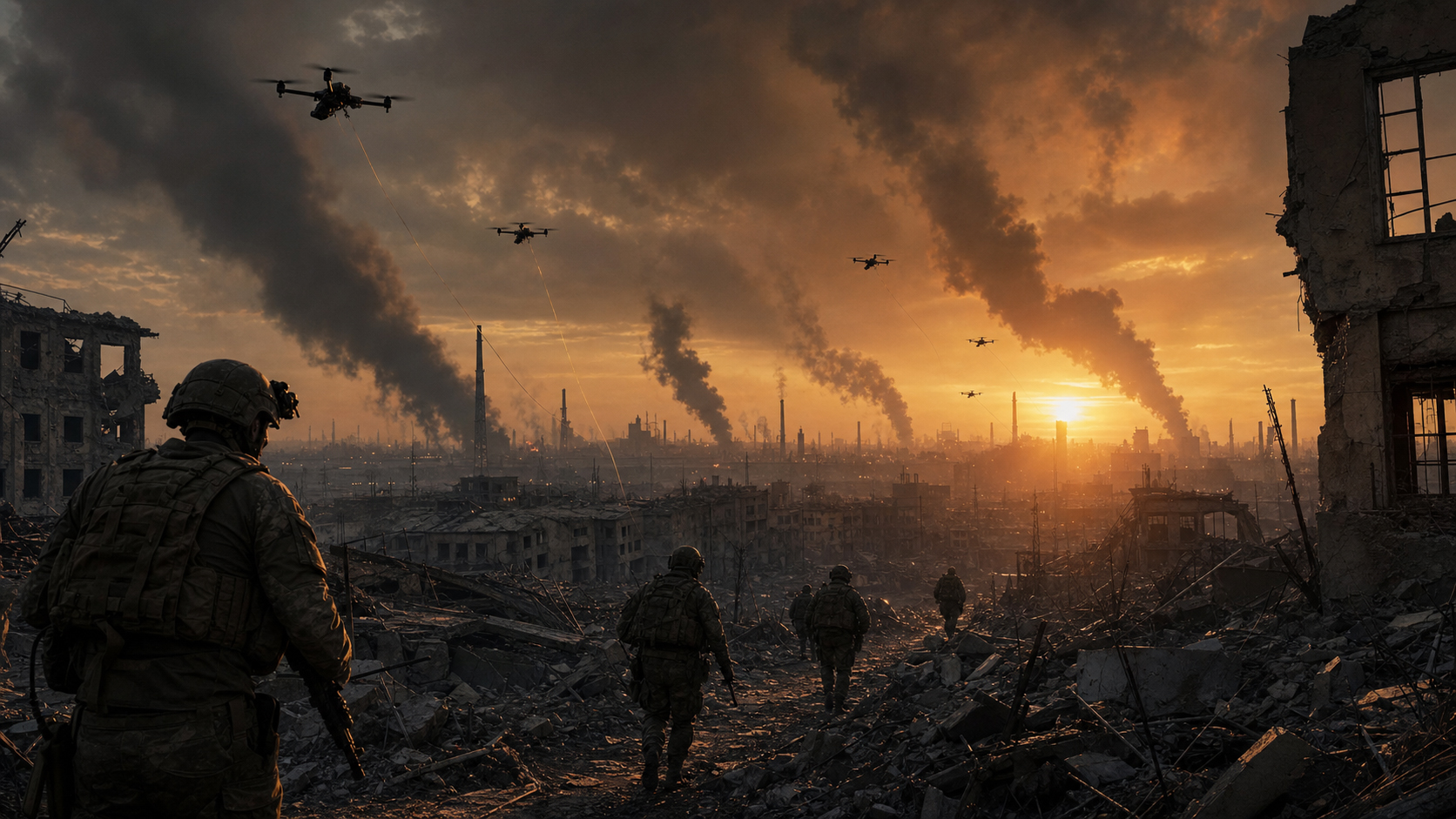
The role of FPV drones with fiber optic control is one of the few points where the assessment formulated in the initial article has a substantial basis. Fiber optic drones are controlled via an extremely thin cable of approximately 0.2 millimeters in thickness, which transmits video signals and control commands in real time without using a radio link. This makes them largely immune to electronic warfare and jamming, giving them particular tactical relevance in modern combat. First deployed on a large scale in the fall of 2024, they have quickly established themselves as a key tool in attacks on Ukrainian supply lines, command posts, and fortified positions, with reported ranges of over 20 kilometers.
In September 2025, Russia's production capacity for this class of drones was reported to be over 50,000 units per month. In contrast, Ukrainian President Volodymyr Zelenskyy stated in March 2026 that Ukraine and Russia had reached parity in FPV drone production, with an overall output of approximately 7 million units per year. This statement of parity contradicts the significantly higher Russian monthly figures circulating in the military press and suggests that while Ukraine is catching up in conventional FPV drones, it still lags behind in fiber optic drones. The Russian technological lead in this specific weapon category is therefore real, but not absolute—the gap is closing gradually.
The tactical impact of these drones on the battlefield is profound. They allow Russian forces to disrupt supply corridors behind Ukrainian lines and logistically isolate cities—an approach structurally reminiscent of medieval siege tactics, but taking place on a modern, technologically advanced battlefield. This aspect of the war is indeed underrepresented in Western media coverage, even though it is crucial for understanding the operational situation in the Donbas.
Russia's numerical superiority: facts and limits
The claim of a fourfold Russian numerical superiority on the front is difficult to verify precisely, but a significant Russian force imbalance is documented. The ISW confirmed in several situation reports that Russia's numerical superiority and the low density of Ukrainian defensive positions facilitated infiltration attempts. At the same time, ISW data for the months of December 2025 to May 2026 show that Russian forces captured or infiltrated only about 40 square kilometers during this period—a comparatively modest result, equivalent to one-fifth the area of Potsdam. In March 2026, Russia even experienced a net loss of territory for the first time in two and a half years: Ukraine recaptured nine square kilometers.
The comparison of forces must therefore be viewed in a nuanced way. Russia has significantly slowed its offensive: at the beginning of 2026, it gained 319 square kilometers of territory in January, but only 123 square kilometers in February. This slowdown is not solely attributable to Ukrainian strength, but also to Russian structural problems such as recruitment difficulties, high casualties, and logistics strained by the war economy. According to reports, the number of Russian soldiers recruited daily in the first quarter of 2026 reached only about 800 men per day—compared to 1,000 to 1,200 in the same period of the previous year. At the same time, Ukrainian sources assume total daily losses on the Russian side exceed this recruitment rate. These figures have not been independently verified, but are considered by Western institutions to be consistent with other indicators.
Hub for Security and Defense - Advice and Information


Hub for Security and Defense - Image: Xpert.Digital
The Security and Defence Hub offers expert advice and up-to-date information to effectively support companies and organizations in strengthening their role in European security and defence policy. Working closely with the SME Connect Defence Working Group, it particularly promotes small and medium-sized enterprises (SMEs) that wish to further develop their innovative capacity and competitiveness in the defence sector. As a central point of contact, the Hub thus creates a crucial bridge between SMEs and European defence strategy.
Related to this:
How attacks on Russia's refineries are really affecting its war economy
Ukrainian drone strikes: symbolism and strategic substance
The strong emphasis placed on Ukrainian drone attacks against Moscow and Crimea in Western media coverage is factually accurate. In June 2026, these attacks escalated dramatically: Ukrainian drones struck a refinery in the Moscow suburb of Kapotnya, located within the Moscow ring road—representing the largest air attack on the Russian capital to date, including attacks during World War II. All three northern land routes connecting Crimea to the Russian mainland were severely damaged and rendered impassable, effectively cutting the peninsula off from the mainland. These attacks caused real damage to the Russian energy sector and logistics and were not merely symbolic pinpricks.
Whether one can conclude from this that Russia is "almost finished," as suggested in certain media outlets, is another question entirely. The Ukrainian strategy aims to force Putin to the negotiating table and to destabilize the Russian war economy through attacks on energy infrastructure. The refinery attacks create real economic costs, but they do not solve the fundamental problem of the numerical power imbalance on the front line. The error, therefore, lies not in the reporting of these attacks, but in the logical conclusion drawn from them. Frontline and infiltration attacks are complementary dimensions of warfare—one does not replace the other.
Russia's economy in 2026: War-induced boom waning
The claim that Russia's GDP will grow faster than Germany's in 2026 requires careful scrutiny. While formally accurate for certain year-on-year comparisons, it significantly distorts the overall picture. Germany closed 2025 with modest GDP growth of 0.2 percent after two consecutive years of recession. The IMK forecasts growth of 1.4 percent for 2026. Russia, on the other hand, grew by around one percent in 2025, according to the IMF, following a boom of 4.9 percent in 2024. The IMF raised its forecast for Russian GDP growth in 2026 to 1.1 percent in April, primarily due to higher oil prices resulting from the Gulf conflict. Even taking these revisions into account, Russia's growth forecast for 2026 is not clearly higher than Germany's—rather, it is at a comparable, low level.
However, what is crucial is to look beyond the growth figures. In June 2026, the Kiel Institute for the World Economy, together with the Stockholm Institute of Transition Economics, published a study diagnosing the "endgame" of the Russian war economy. The reserves of the Russian sovereign wealth fund fell from 6.5 percent of GDP at the start of the war to just 1.8 percent in April 2026. The budget deficit already exceeded the government's target for the entire year in the first quarter of 2026. In March 2026, the German Federal Intelligence Service (BND) published an intelligence analysis indicating that the actual federal budget deficit for 2025 was approximately 41.8 percent higher than officially reported—equivalent to about 3.7 percent of GDP. Russia is thus engaging in systematic statistical concealment, which fundamentally calls into question the trustworthiness of all official economic figures.
At a government meeting in April 2026, Putin himself admitted with unusual candor that GDP had fallen by 1.8 percent in January and February compared to the previous year. The war-induced boom of 2023 and 2024, primarily based on massively increased government spending on defense, had lost its momentum. Structural problems such as a high key interest rate of up to 21 percent, chronic labor shortages due to war losses and emigration, declining oil and gas revenues, and an excessively strong ruble, which made exports more expensive, were having a lasting negative impact on the economy. In June 2026, IMF Managing Director Kristalina Georgieva concluded that Russia would emerge from this development "severely damaged" and that its medium- and long-term economic prospects had "deteriorated significantly.".
Media coverage: Bias, gaps and information warfare
Criticism of one-sided media coverage is a complex and multifaceted issue. On the one hand, there are legitimate findings: Strategic developments on the front line, such as the gradual disintegration of the Donbas fortress belt, receive less attention in some Western mass media than symbolically charged events like drone strikes on Moscow. A broader and more nuanced picture of the war, one that realistically portrays both Ukrainian and Russian tactical advantages and disadvantages, is indeed underrepresented in public discourse. Identifying this gap is legitimate.
On the other hand, a clear distinction must be made between journalistic incompleteness and targeted propaganda. Since the beginning of the war, the Russian state has been conducting a systematic, professionally organized disinformation campaign that deliberately influences Western information spaces. Narratives about the "collapsing" Ukrainian fronts, circulating on Telegram channels and social networks, are often either of Russian origin or rely uncritically on Russian military data that cannot be independently verified. The claim that the entire front in the Donbas is collapsing significantly exaggerates Russian territorial gains while simultaneously ignoring documented Russian setbacks, recruitment problems, and economic burdens.
Furthermore, there is a methodological problem: Anyone who relies solely on sources that are geopolitically aligned with Russia for war reports—be they Telegram channels, Russian state media, or their Western amplified media outlets—is subject to a structural information bias that is just as one-sided as the Western reporting being criticized. A reliable analysis relies on multiple, ideologically divergent sources and must necessarily distinguish between unverified claims and verified facts.
Consulting - Planning - Implementation

Markus Becker
I would be happy to serve as your personal advisor.
Head of Business Development
Chairman SME Connect Defense Working Group
Consulting - Planning - Implementation
Konrad Wolfenstein
I would be happy to serve as your personal advisor.
You can contact me at wolfenstein∂xpert.digital or
Just call me on +49 7348 4088 965 .