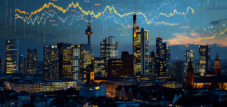
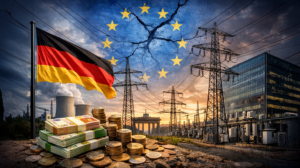
Germany's involuntary locational gift to international SME competition – Top 5 most expensive electricity prices worldwide – Image: Xpert.Digital
Germany's electricity price crisis: causes, global context and possible solutions
Germany's homegrown electricity price crisis – A location factor becomes a stress test
Germany, once the undisputed engine of the European economy, faces one of its greatest structural challenges: energy has become a luxury commodity that massively threatens the country's competitiveness. What critics often cynically refer to as an "involuntary gift" to international competitors can now be substantiated with hard figures. With an average household electricity price of 38 cents per kilowatt-hour, Germany currently ranks fifth worldwide – electricity is only more expensive in island nations like Bermuda or Denmark.
But while private households groan under the burden, industry is fighting for its very survival. In direct comparison to the USA, where industrial electricity often costs only 8 cents, or China with 6 to 9 cents, German companies are finding themselves in a precarious position. The warning signs are unmistakable: when four out of ten industrial companies are considering relocating production, according to the DIHK barometer, this is more than just a temporary economic downturn – it's the harbinger of potential deindustrialization.
The causes of this predicament are complex and rooted in history. It is a toxic mix of a tax system bloated over decades, a delayed grid expansion, and the globally unique decision to simultaneously phase out both nuclear and coal power. While the federal government is attempting to counteract this with measures such as electricity tax reductions and a temporary industrial electricity price, experts doubt whether these "emergency measures" will be sufficient to heal the structural wounds.
This article sheds light on the underlying causes of the German electricity price crisis, places the costs in a global context, and analyzes why political solutions have often failed to meet reality.
Related to this:

Germany's position in the global electricity price ranking
High German electricity prices are not a law of nature, but the result of political decisions made over decades
Germany ranks fifth out of 143 countries surveyed in a global comparison of household electricity prices, averaging 38 cents per kilowatt-hour (Q1 2025). Electricity is only more expensive in Bermuda (42 ct), Denmark (40.6 ct), Ireland (39.4 ct), and Belgium (38.2 ct). The global average is just 15 ct/kWh – meaning German households pay more than double that amount.
Within the EU, Germany leads the way in household electricity prices at 38.35 ct/kWh (first half of 2025), followed by Belgium and Denmark. The EU average electricity cost is 28.72 ct/kWh – meaning Germany is 34% above the EU average. Among the G20 countries, Germany also has the highest nominal electricity prices. Even adjusted for purchasing power parity, the country only slips to 22nd place worldwide and remains second only to Italy among industrialized nations.
For industrial electricity, German companies without subsidies pay an average of 17–20 ct/kWh, while large consumers with existing relief measures pay around 10–14 ct/kWh. By comparison, industrial electricity prices in France are 9–11 ct/kWh, in the USA an average of 8 ct/kWh, and in China 6–9 ct/kWh.
Industrial electricity prices in Germany are very high by international standards, ranging from 14 to 20 cents per kilowatt-hour (ct/kWh). This is primarily due to taxes, grid fees, and CO₂ costs. These high costs are prompting many industrial companies to consider relocating their production. Other countries offer significantly more favorable conditions: In France, prices are between 9 and 11 ct/kWh thanks to inexpensive nuclear energy, while the USA achieves an average price of around 8 ct/kWh due to cheap fracking gas. China secures prices between 6 and 9 ct/kWh for its industry through government price regulation and the use of coal. Scandinavia, too, can offer industrial electricity for under 10 ct/kWh thanks to a high proportion of hydropower and wind power.
Energy costs as a competitive disadvantage: The extent of the problem
Energy costs, alongside personnel costs, represent one of the largest cost factors for companies in Germany. According to KfW research, the average share of energy costs in revenue for medium-sized businesses was 5.8%. For one in five medium-sized companies, energy costs amount to between 5% and 10% of revenue, and for 7% of companies, they even exceed 10%. For energy-intensive industries such as chemicals, steel, glass, and paper, these figures can be a threat to their very existence.
The consequences are dramatic and measurable: According to the DIHK Energy Transition Barometer, four out of ten industrial companies are considering reducing their production in Germany or relocating it abroad. Among large companies with over 500 employees, more than half are even considering such steps. Jürgen Kerner, Vice Chairman of the IG Metall union, sums it up bluntly: "Electricity prices in Germany are a problem for industrial jobs." Companies are shifting production to France, the USA, and China. While the DIHK Energy Transition Barometer 2025 shows a slight improvement in sentiment (value: -8.3 vs. -20 in the previous year), the underlying skepticism remains.
Why politics can't solve the problem: A root cause analysis
The reasons why German governments have failed to find a sustainable solution for electricity prices over decades are structural, political, and systemic in nature:
1. The tax and levy system as a historical legacy
Around 50% of the German electricity price consists of taxes, levies, and surcharges – electricity tax, value-added tax, concession fees, formerly the EEG surcharge, now network charges and various additional fees. These government-induced costs have grown organically over decades, with each government adding new items without abolishing old ones. A genuine reduction regularly fails due to budgetary constraints: every tax cut creates billions in budget deficits.
2. Network charges: Infrastructure failures have been neglected for decades
Network usage fees make up almost a third of the electricity price and have increased by over 100% in the last ten years for transmission networks. The reason: Network expansion is lagging massively behind demand. Wind power from the north has to be transported to consumption centers in the south – but major transmission lines like SuedLink have been in the planning and implementation phase for over a decade. Because the network is regularly overloaded, wind turbines have to be curtailed and expensive reserve power plants activated – so-called redispatch costs, which are passed on to consumers through network fees. In addition, there are massive regional differences: The difference between the cheapest and most expensive regions is over €360 per year for a four-person household.
Related to this:
3. The merit order principle: Gas-fired power plants set the price
In the European electricity market, the most expensive power plant still needed determines the exchange price for everyone – the so-called marginal power plant. During hours without wind and sun, this is expensive gas-fired power plants, which drive the price up. Although renewable energies are very inexpensive to produce, consumers only partially benefit because the market design makes the gas price the price setter. A reform of this system is being discussed at the EU level, but so far has failed due to the diverging interests of the member states.
4. Double phase-out: nuclear and coal simultaneously
Germany is the only major industrialized nation to have simultaneously phased out both nuclear power (fully since April 2023) and coal (planned for 2038). While France obtains 70% of its electricity cheaply from nuclear power and Sweden relies on a combination of hydropower and nuclear power, Germany has eliminated these options independently. Studies by the Halle Institute for Economic Research (IWH) show that the nuclear phase-out has increased wholesale electricity prices by 1–8%. The effect is moderate, but it adds to all other cost drivers.
5. Political conflicts of objectives and lack of consensus
German energy policy suffers from a multitude of competing goals that block each other:
- Climate protection requires CO₂ pricing → increases electricity prices
- Security of supply requires backup capacities → incurs additional costs
- Affordability often directly contradicts the first two goals
- Industrial policy demands low prices, which can only be achieved through subsidies
- Budgetary discipline limits the possibilities for subsidies
Each governing coalition prioritizes these goals differently, leading to a constant zigzag course in energy policy. The red-green coalition initiated the nuclear phase-out, the black-yellow coalition reversed it, then came Fukushima and the final phase-out. The traffic light coalition abruptly canceled the planned federal subsidy for grid fees, only for the grand coalition to reinstate it in 2025. This inconsistency destroys planning certainty for businesses.
6. CO₂ pricing without a global level playing field
CO₂ certificates in the European Emissions Trading System (ETS) now cost over €100 per ton – compared to around €10 in 2018. As long as competitors in China and the USA do not pay a comparable CO₂ price, a systematic cost disadvantage arises. The EU Border Adjustment Mechanism (CBAM) is intended to partially compensate for this, but it is complex and does not cover all sectors.
Our EU and German expertise in business development, sales and marketing

Our EU and German expertise in business development, sales and marketing - Image: Xpert.Digital
Industry focus areas: B2B, digitalization (from AI to XR), mechanical engineering, logistics, renewable energies and industry
More information here:
A thematic hub offering insights and expertise:
- Knowledge platform covering global and regional economies, innovation and industry-specific trends
- A collection of analyses, insights, and background information from our key areas of focus
- A place for expertise and information on current developments in business and technology
- A hub for companies seeking information on markets, digitalization, and industry innovations
Blueprint for SMEs: What companies can learn from this successful restructuring
What is being done – and what could be done
Current measures of the Federal Government (2025/2026)
The government has already put together a package that will take effect from 2026:
- Federal subsidy for network charges: 6.5 billion euros from the Climate and Transformation Fund will reduce transmission network charges from an average of 6.65 to 2.86 ct/kWh
- Electricity tax reduction to the EU minimum for over 600,000 manufacturing companies, permanent from 2026
- Industrial electricity price of 5 ct/kWh for energy-intensive companies, limited to 2026–2028 (approved under EU state aid rules), whereby only 50% of the electricity volume is subsidized – the effective price is therefore 6.5–7.25 ct/kWh
- Abolition of the gas storage levy
- Total relief: approximately 10 billion euros for citizens and businesses
Related to this:
Systematic solutions for a sustainable price reduction
a) Accelerated network expansion and storage infrastructure
The most significant structural lever. Faster approval processes for power lines (SuedLink, SuedOstLink), the expansion of distribution networks, and the nationwide harmonization of grid fees (planned by 2029) could considerably reduce system costs. Without adequate grid infrastructure, even the cheapest kilowatt-hour of wind and solar power is wasted.
b) Massive expansion of renewable energies plus storage
Renewables already covered 57% of Germany's electricity consumption in the first half of 2024. The higher this share, the less frequently expensive gas-fired power plants dictate prices. Agora Energiewende calculates that the planned expansion by 2030 will structurally lower wholesale prices – provided that grids and storage facilities grow accordingly. Large-scale battery storage, pumped storage, and load flexibility are crucial.
c) Reform of the electricity market design
The merit order principle is under debate at the EU level. Possible alternatives:
- Pay-as-bid models, where each producer receives their own bid price
- Contracts for Difference (CfD) protect producers against price declines while simultaneously capturing excess profits
- Capacity markets that compensate for guaranteed capacity regardless of the amount of electricity supplied
d) Technology neutrality: SMR, hydrogen and CCS
The debate about a return to nuclear energy is taking place in Germany, but it is encountering massive political and economic hurdles. The nuclear industry (KernD) is calling for the reactivation of the reactors shut down in 2023 and envisions possible commissioning before 2030. International developments in Small Modular Reactors (SMRs) appear more realistic, as they could be commercially available no earlier than the 2030s. According to the Federal Court of Auditors, the hydrogen strategy is stalling considerably – supply and demand remain far below expectations.
e) Long-term supply contracts (PPAs) and direct marketing
Companies can enter into long-term contracts directly with wind farm or solar operators through Power Purchase Agreements (PPAs) – often at prices significantly below market levels. McKinsey also emphasizes the importance of long-term natural gas offtake agreements for reducing gas prices, which, via the merit order, influence the overall electricity price.
f) Reduction of the state's tax burden
Beyond the already decided reduction in electricity tax, a fundamental reform of the levy system would be conceivable: financing climate protection costs via the general budget instead of via the electricity price, in order to make electricity more competitive with fossil fuels for heat pumps and e-mobility.
International perspective: What others are doing better
An international perspective reveals that other countries achieve lower electricity prices through targeted strategies. In France, for example, where 70% of electricity is generated from nuclear power and state-regulated ARENH tariffs apply, the industrial electricity price is around 9 to 11 cents per kilowatt-hour. Sweden also achieves an industrial electricity price of under 10 cents through a mix of hydropower and nuclear power. The USA benefits from cheap fracking gas and low taxes, resulting in prices of around 8 cents per kilowatt-hour, and even as low as 3 cents in some regions. Norway secures very favorable prices with virtually no CO₂ costs thanks to its almost 100% hydropower output.
While these models cannot be directly applied to Germany – Germany has neither Norway's fjords nor France's nuclear power fleet – they demonstrate that low electricity prices can be shaped politically if the will and readiness for long-term investments exist.
A solvable problem – but not with bandages
High German electricity prices are not a law of nature, but the result of political decisions made over decades – from the organically increased burden of taxes and levies to the dual phase-out of nuclear and coal power and the delayed expansion of the electricity grid. The fact that politicians "cannot solve" the problem is due to the entanglement of competing conflicting objectives (climate protection, affordability, security of supply, fiscal discipline) and the lack of a long-term consensus on energy policy.
The planned industrial electricity price of 5 ct/kWh from 2026 onwards is – as Economics Minister Reiche herself admits – a "pain-relieving emergency measure," not a cure. It is limited to three years, covers only half of consumption, and does not solve the underlying problem. Sustainable relief can only be achieved through:
- Consistent network expansion and elimination of infrastructure congestion
- Further expansion of renewables plus storage technologies
- Reform of the electricity market design at EU level
- Fundamental relief of electricity prices from extraneous levies
- Technological openness instead of ideological constraints
The next three to five years will be crucial. If the structural reform succeeds, Germany could even benefit in the long term from the lowest marginal costs of renewable energies. If it fails, a new wave of deindustrialization threatens after the subsidies expire in 2029 – with consequences that extend far beyond electricity bills.
Your global marketing and business development partner
☑️ Our business language is English or German
☑️ NEW: Correspondence in your native language!

Konrad Wolfenstein
I and my team are happy to be available to you as your personal advisor.
You can contact me by filling out the contact form here wolfenstein@xpert.digital:or simply call me at +49 7348 4088 965. My email address is
I'm looking forward to our joint project.
☑️ SME support in strategy, consulting, planning and implementation
☑️ Creation or realignment of the digital strategy and digitization
☑️ Expansion and optimization of international sales processes
☑️ Global & Digital B2B trading platforms
☑️ Pioneer Business Development / Marketing / PR / Trade Fairs
📈🔵 Order acquisition and organizational development: From classic sales to a strategic business function💡


Order acquisition and organizational development - Image: Xpert.Digital
Xpert.Digital supports companies in this complex transformation, whether it's building a modern order acquisition function from the ground up or optimizing existing processes. With comprehensive expertise in marketing, sales, data analysis, digital transformation, and organizational development, we guide your company toward strategic repositioning. Our approach is holistic: We not only optimize processes but also develop the people and organizational culture necessary to achieve sustainable, measurable success.
More information here: