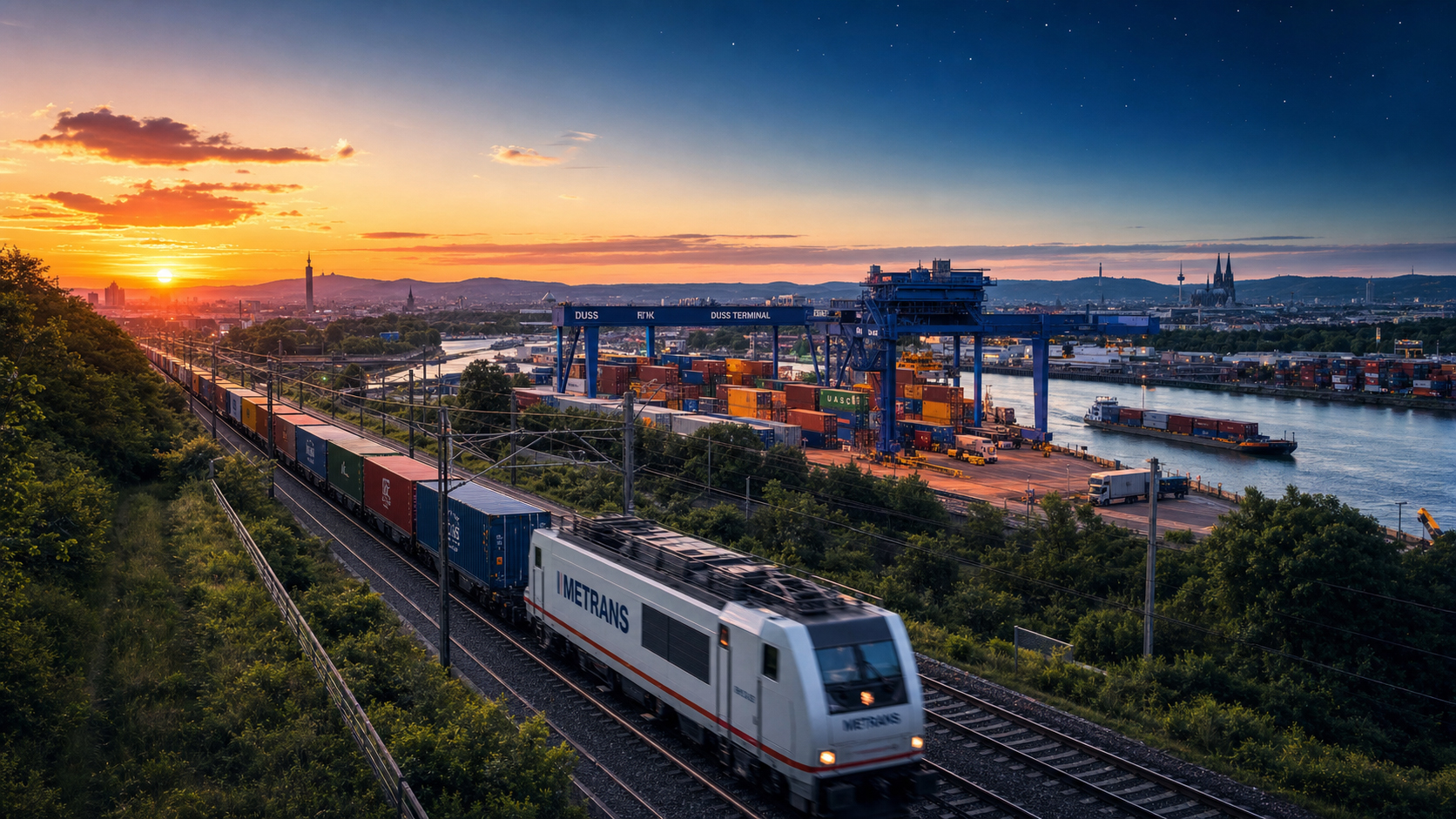
Intermodal Single Market in Europe: Europe sleeps – while the world builds the tracks – Creative image: Xpert.Digital
Billions stuck in traffic: The hidden crisis of the European single market
Dangerous truck dependency: Why Europe's supply chains are on the brink
Europe is asleep, China is building: Why our freight transport is falling behind
The European single market is considered an economic giant, yet its logistical backbone is crumbling: Freight transport is heavily dependent on roads, while the far more environmentally friendly and efficient intermodal transport by rail and waterways is hampered by outdated regulations, dilapidated infrastructure, and a lack of digitalization. Although ambitious EU climate targets and billions in investments are intended to accelerate a shift away from trucks, the share of road traffic continues to grow steadily – a fatal step backward. Given geopolitical tensions, the need for robust supply chains, and China's massive logistical buildup, this gap is increasingly becoming a significant economic and security risk. Europe does not lack technology or capital, but rather the political will for consistent implementation. A strategic course correction is imperative if Europe is not to jeopardize its economic sovereignty in global competition.
Related to this:


More than just logistics: Why Europe's freight transport is now becoming a security issue
The European single market is officially considered the largest and most deeply integrated economic area in the world. However, a closer look reveals a worrying gap between political ambition and infrastructural reality: freight transport – the silent backbone that keeps factories, supermarkets, and supply chains running – still relies predominantly on roads in Europe, while rail, inland waterway, and maritime shipping remain structurally underdeveloped despite significant political commitments. This imbalance is not a mere technical quirk, but a strategic failure with far-reaching economic consequences.
What intermodal transport actually means – and why these terms matter
Intermodal transport refers to the transport of goods in a single loading unit – usually a container, swap body, or semi-trailer – via at least two modes of transport, without the goods themselves being handled during transshipment. The advantage is obvious: the flexibility of trucks for the first and last mile is combined with the efficiency and environmental friendliness of rail, inland waterway transport, or short-sea shipping for the main leg. The term "combined transport" is more precisely defined legally and refers to operations that fall under the EU Combined Transport Directive – one of the few binding legal regulations that actively promote intermodal transport.
This clarification of terms is more than just semantics. The current directive dates back to 1992 – a year when the internet was still an academic experiment, the Berlin Wall had only just fallen, and EU enlargement to include Eastern Europe was still a distant vision. The world of freight transport has fundamentally changed since then: e-commerce, global supply chains, geopolitical upheavals, and climate change have created new demands on transport networks that a 30-year-old set of rules simply cannot meet. The European Commission presented a new proposal to revise this directive in 2023, but the project has so far failed due to a lack of agreement in the trilogue negotiations – and the Commission even threatened to withdraw the proposal entirely.
A growing market – and its structural breaks
European intermodal rail freight grew in 2025, but the growth was unevenly distributed and accompanied by deep disruptions. According to the UIRR 2025–26 report, intermodal rail transport in Europe reached a total of 3,898,621 shipments, representing a year-on-year increase of 1.48%. Gross tonnage transported rose by 3.72% to 81.03 million tons. At first glance, this sounds like a success story.
However, behind these aggregated figures lies a structural divide. Growth was driven almost exclusively by domestic traffic, particularly the French domestic market, which expanded by 7.1% thanks to new terminal openings and new services. Cross-border traffic – the very segment that is fundamental to the European single market – shrank by 1.13%. The reason is clearly identifiable: renovation work on the German rail network forced operators to use alternative routes with lower technical specifications, reduced speeds, and higher costs. For some operators, the additional costs due to diversions exceeded 30%. The result was a partial shift back to road transport – a so-called reverse modal shift – which negates all the efforts invested over the years in developing intermodal services.
The figures for individual routes speak volumes: The Germany-Poland route lost 66% of its volume, Germany-Hungary 38%, and Germany-Italy 11%, which equates to 57,879 lost shipments on this route alone. At the same time, routes that do not use the German network gained, in some cases dramatically: The Belgium-Romania connection grew by 44%, and Belgium-Spain by 38%. This is no coincidence, but a clear indication of the underlying structural problem: Europe lacks a truly redundant, network-like intermodal backbone that can compensate for disruptions on individual routes without massive collateral damage.
The market dimension – billions in play, billions at stake
The economic significance of European intermodal freight transport cannot be grasped from a single perspective. The total market for intermodal rail freight in Europe generated revenue of US$10.23 billion in 2023 – and is projected to grow to around US$22.99 billion by 2030, representing an annual growth rate of 12.3% to 12.6%. This would constitute a doubling in less than a decade. Europe represents approximately 23.8% of the global intermodal market.
However, these growth forecasts will only become reality if the infrastructural and regulatory bottlenecks are overcome. And this is precisely where the dilemma lies: The EU transport strategy envisages increasing rail freight capacity by 50% and inland waterway capacity by 25% by 2030. According to current investment plans, however, the transshipment capacity of intermodal terminals will only grow by 18% by 2030. This represents a capacity gap of structurally threatening proportions – predictable, quantifiable, and yet insufficiently addressed politically.
The financial requirements for closing this gap are calculable. The UIRR estimates the necessary investments to eliminate the major network restrictions – particularly for adapting the loading gauge to the P400 standard (the transport of semi-trailers without special wagons), for terminal modernization, and for route expansion – at around €7.7 billion in a medium scenario. For comparison, the Connecting Europe Facility (CEF) is providing a total of €25.81 billion for transport projects for the period 2021–2027. The intermodal investment needs are therefore solvable – if the political will exists to prioritize them.
The backbone of the single market – road dependency as a structural weakness
Currently, 25.7% of all freight ton-kilometers within the EU are transported by road, while rail accounts for only 5.4%. These are the figures for 2024. Compared to 2014, the road share has even increased by 3.3 percentage points – making it the only mode of transport to show growth. In contrast, the rail share has decreased by 0.3 percentage points since 2014. This development is the opposite of what the EU strategy aims for.
The modal split is particularly symptomatic in continental freight transport. If maritime transport is excluded, the dominance of road transport becomes even more pronounced. While rail transport accounts for a larger share in purely domestic traffic – in Germany, for example, well over 10% of tonne-kilometers – the target is far from the proclaimed 30% target for 2030, which European railway CEOs defined in 2023 as an absolute minimum. This target is defined not as an ambitious vision, but as a necessary minimum for system stability.
The economic significance of this imbalance is considerable. According to the European Commission, freight transport is responsible for more than 30% of transport-related CO₂ emissions. At the same time, it is the backbone of the EU single market – ensuring the supply of supermarkets, factories, and pharmacies, and enabling companies to distribute their products across the continent. This over-reliance on road transport makes the system vulnerable: to fuel price shocks, driver shortages, geopolitical supply disruptions, and climate policy regulations. A structurally more diversified freight infrastructure would simply be more resilient.
Related to this:
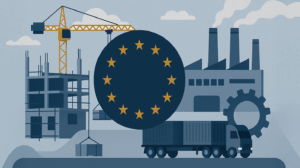
Infrastructure as a bottleneck – the TEN-T network and its limits
The Trans-European Transport Network (TEN-T) forms the conceptual basis for an integrated European transport infrastructure. It defines core network corridors designed to connect the main axes of European freight and passenger transport. The revised TEN-T Regulation, which entered into force in summer 2024, sets new standards for multimodality and requires Member States to assess their terminal capacities by June 19, 2027, and to submit action plans to address bottlenecks by June 19, 2028.
But reality regularly catches up with ambitious plans. In a special audit report in 2023, the European Court of Auditors soberly concluded that European infrastructure is simply not yet intermodally compatible. Specifically, trains with the European standard length of 740 meters, which would represent one of the most cost-effective ways to improve competitiveness compared to trucks, can only be regularly used on half of the TEN-T core network corridors. The P400 loading gauge, which allows the unrestricted transport of semi-trailers by rail, is only available on 48% of the TEN-T core routes. The greatest shortcomings are in France, Italy, and Spain – three of the EU's largest economies.
Added to this is the terminal deficit. Between 60 and 80% of EU handling capacity relies on conventional reach stacker or crane operations for containers. Only 2% of terminals have the technology to handle standard semi-trailers that are not suitable for intermodal transport. Yet, between 300,000 and 400,000 swap bodies and around 2.8 million semi-trailers are in operation in the EU – the vast majority of which are not suitable for rail transport. As long as this technological leap is not achieved, intermodal transport will remain confined to a niche segment of freight logistics that cannot realize its systemic growth potential.
Digitalization as a driver – from isolated solutions to network intelligence
Anyone who considers intermodal logistics a purely infrastructural problem underestimates the transformative impact of digitalization. The true strength of an intermodal system only unfolds when real-time data on capacities, locations, delays, and border crossings flows seamlessly between rail operators, freight forwarders, terminal operators, and end customers. In Europe, this remains the exception, not the rule.
In March 2026, new TSI telematics specifications came into force, making the sharing of data along the entire logistics chain, from goods receipt to delivery, mandatory. The UIRR coordinates several European projects in this regard: the Bridge project supports the implementation of TSI telematics, Trans4m-R is developing a computer system for quality control of multimodal transport, and ReMuNet is a digital platform for disruption management and real-time route optimization. The European research program FP5-TRANS4M-R sets measurable targets: 10–20% faster transport, 50% less waiting time at borders, 20% fewer stops, and 70% faster cross-border response times.
In parallel, digitalization is progressing at the wagon level. The Italian company Mercitalia Intermodal, for example, has converted more than a third of its fleet to intelligent wagons equipped with the WagonTracker system, enabling real-time brake analysis, rollover monitoring, and automated brake tests. Such systems are a prerequisite for the next stage of evolution: the Digital Automatic Coupling (DAC), which aims to transform freight trains into truly networked systems where wagons communicate with each other and enables automated train assembly and disassembly in marshalling yards. Without this technological foundation, a substantial increase in network capacity and reliability is hardly possible.
The eFTI system for the electronic exchange of freight information and the EDIGES format for digital data exchange between infrastructure managers and railway operators form the legal and technical framework intended to integrate these individual initiatives into a systemic network intelligence. However, implementation is fragmented, national systems are not merging quickly enough, and interoperability between the 27 member states – with their differing track gauges, loading gauges, track standards, and regulatory regimes – remains a structural obstacle.
LTW Intralogistics Solutions – Intermodal Transport

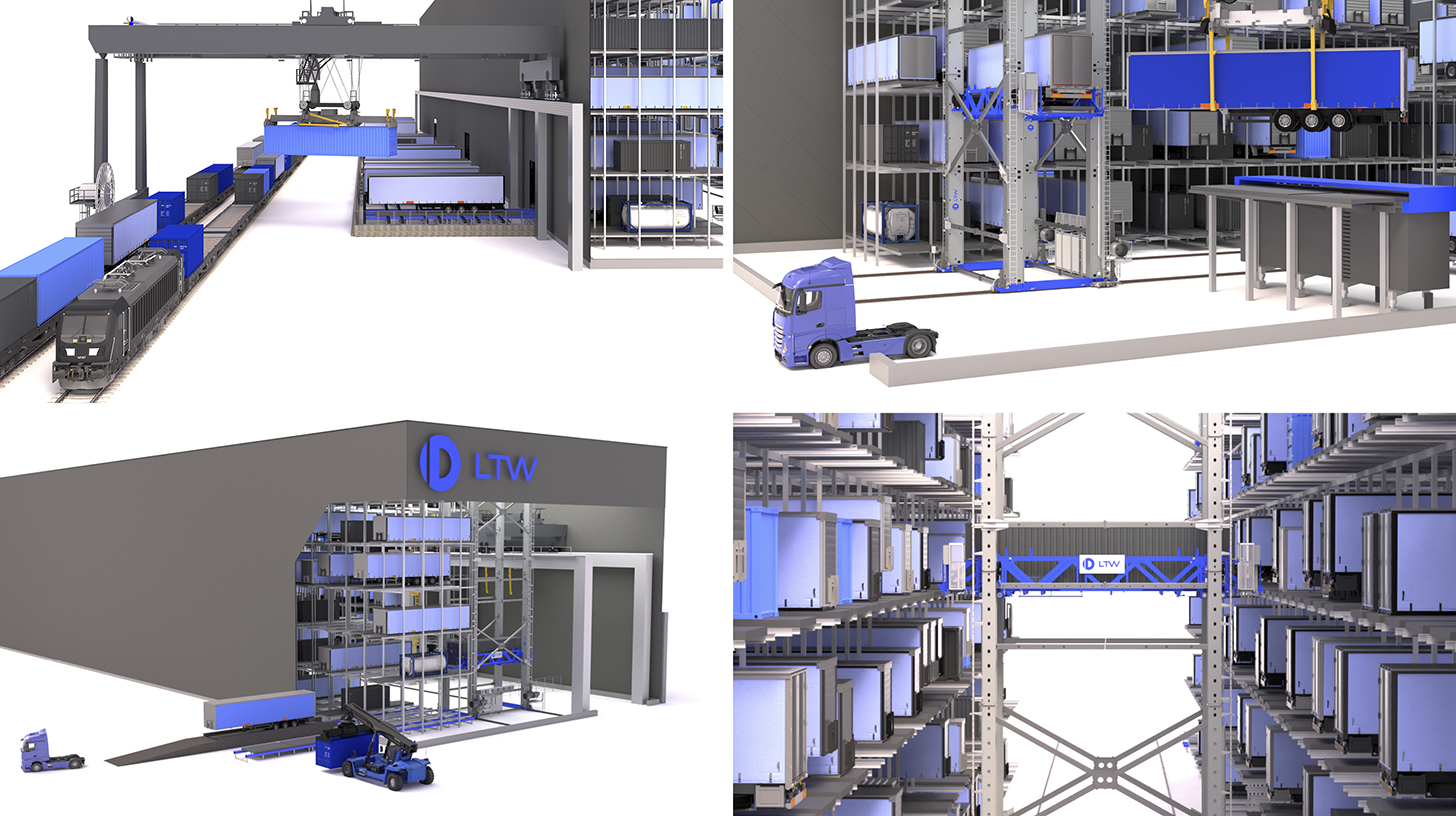
LTW Intralogistics Solutions – Intermodal Transport – Image: LTW Intralogistics GmbH
LTW offers its customers not individual components, but integrated complete solutions. Consulting, planning, mechanical and electrotechnical components, control and automation technology, as well as software and service – everything is networked and precisely coordinated.
In-house production of key components is particularly advantageous. This allows for optimal control of quality, supply chains, and interfaces.
LTW stands for reliability, transparency, and collaborative partnership. Loyalty and honesty are firmly anchored in the company's philosophy – a handshake still means something here.
Related to this:
Nearshoring, resilience, jobs: The underestimated potential of intermodal hubs
Climate policy as a driver – or as a brake?
The EU Green Deal has assigned intermodal transport a political role as a climate instrument whose importance can hardly be overstated. Freight transport accounts for around 30% of transport-related CO₂ emissions in the EU – and these are to be reduced by 90% by 2050. Without a structural shift from road to lower-emission modes of transport, this goal is simply unattainable. A single container transported by rail from Kaunas to Duisburg saves almost 4,000 kilograms of CO₂ compared to transport by truck. In 2022 alone, LTG Cargo saved almost 70 million kilograms of CO₂ through intermodal transport.
Rail transport is not just a relative, but an absolute efficiency marvel: around 90% of rail freight volume in Europe is already carried out on electrified lines, potentially CO₂-free if the electricity comes from renewable sources. The challenge lies with the remaining 35% (Editor's note: The original text shows a discrepancy of 90% vs. 35%) of rail freight volume, which is still handled by diesel traction. Fuel cells using green hydrogen offer a solution for this gap – especially on non-electrified feeder lines where full electrification is not foreseeable for economic reasons. For European long-distance rail freight on the major corridors, however, full electrification is considered realistic in the medium term, as these lines are already almost entirely electrified.
The political dynamics, however, are contradictory. On the one hand, the EU is setting climate targets that are unattainable without a modal shift and is providing billions of euros from the Connecting Europe Facility. On the other hand, the revision of the Combined Transport Directive – the regulatory framework intended to make intermodal transport more attractive through exemptions from driving bans, fiscal incentives, and simplified permitting procedures – is in danger of being withdrawn entirely if no trilogue agreement is reached. That would send a disastrous signal. Climate policy and transport policy need to be more coherently integrated than they currently are.
This goes well with:

Geopolitics of logistics – why Europe's transport network is also a security issue
The Russian invasion of Ukraine in 2022 was a brutal stress test for the resilience of European supply chains. Suddenly, trade routes, energy supply corridors, and infrastructure corridors that had been taken for granted for decades were politically compromised. Europe responded by extending TEN-T corridors to Ukraine and Moldova, with the REPowerEU plan, and with a growing interest in military mobility—the ability to rapidly move forces and supplies across the continent.
Intermodal terminals play a dual role in this context. The new EU regulation on military mobility explicitly recognizes the dual-use potential of intermodal infrastructure – both civilian and military. Terminals that handle containers on a daily basis can serve as hubs for troop resupply in times of crisis. This realization shifts the logic of financing: investments in intermodal infrastructure are not only transport and climate policy, but also security policy.
In parallel, the global trend toward nearshoring is changing the structural demand for intermodal transport. Geopolitical tensions between the West and China, combined with the lessons learned from the supply chain disruptions of the COVID-19 pandemic and the war in Ukraine, have triggered a wave of production relocations to Europe or neighboring European markets. Q1 2026 data confirms this trend as ongoing and structural. Decentralized production models require more robust regional logistics networks with multimodal hubs. If Europe makes these investments now, it secures a competitive advantage; if it hesitates, it loses it to more agile competitors.
Related to this:

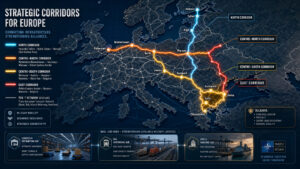
The Chinese challenge – and what Europe can learn from it
In the first five months of 2025 alone, China invested around US$168 billion in new transport infrastructure projects. By comparison, the EU's total CEF transport funding for the period 2021–2027 amounts to €25.81 billion. China is building not only for domestic transport but also for global trade corridors – and intermodal logistics is at the heart of this strategy. The Huochebang platform, which uses AI to manage route planning for around eight million trucks, illustrates how data-driven network intelligence is already operating in China on a scale that is still a distant prospect in Europe.
China itself still suffers from significant inefficiencies: at the end of 2024, Chinese logistics costs amounted to 14.1% of its economic output – almost twice as high as in the US or Germany. This illustrates that sheer investment volumes are no guarantee of efficiency. Europe's strength lies not in imitating the Chinese investment program, but in systematically dismantling the regulatory and infrastructural barriers that have so far prevented efficient intermodal competition with road freight transport.
The real competitive pressure Europe faces is more subtle than a direct infrastructure comparison. Chinese exporters are pushing into the European single market and systematically gaining market share: In the German automotive industry, imports from other EU countries fell from 33% to 29% of the market share, while China's share rose from 1% to 4%. In mechanical engineering, China increased its share of EU imports from 7% to 10%. A more efficient, cheaper, and more reliable intermodal transport system within Europe—one that reduces trade costs between member states, shortens delivery times, and increases the reliability of supply chains—is one of the most effective industrial policy responses Europe can offer to this pressure.
The regulatory patchwork – national solo efforts and European failure
One of the little-discussed but economically consequential weaknesses of the European intermodal system is regulatory fragmentation. The idea of the single market suggests uniformity – but in reality, a multitude of national special rules apply to transport, making cross-border operations complex, expensive, and prone to errors.
Concrete examples from the 2025 UIRR report illustrate the problem: In Switzerland, an accident at the Gotthard Tunnel led to new maintenance regulations that place a disproportionate burden on wagon owners. In Denmark, specific wagon pocket rules apply until at least 2027, even though European standards have already been harmonized. Several EU member states – Finland, Sweden, Denmark, Hungary, and Slovakia – are using an exemption that allows them to apply cabotage quotas to road sections used in combined transport. This creates legal uncertainty and increases transaction costs for operators working across borders.
The lack of harmonization is also evident in the differing approval procedures, fiscal incentives, and infrastructure charge regimes of the individual member states. What is tax-advantaged as intermodal transport in Germany may fall under different categories in France. Track access charges vary considerably, and regulations governing terminal access conditions are fragmented at the national level. The new EU regulation on railway infrastructure capacity management is an important step forward in this regard: it replaces the old corridor concept with a coordinated network approach and aims to improve track availability for cross-border freight trains. Whether it will bring about the promised systemic change in practice will become clear in the coming years.
The underestimated potential – resilience, employment and regional development
The discussion about intermodal transport in Europe is often reduced to the axis of climate protection versus cost efficiency. This underestimates a third dimension, at least as strategically important: the regional and socio-economic impact of intermodal networks. Intermodal terminals are not just transshipment points for containers – they are the nuclei for business developments, logistics clusters, and industrial ecosystems.
Regions with efficient multimodal hubs have a structural advantage when it comes to attracting production and distribution centers. They generate skilled jobs in logistics, attract supplier industries, and increase tax revenue. Conversely, regions without access to an intermodal network are structurally dependent on road transport – with all the associated costs of noise, road wear, accidents, and emissions.
The restructuring of European supply chains as a result of nearshoring trends creates concrete opportunities. When production facilities are relocated to Central and Eastern Europe, new freight flows emerge that can be handled more efficiently via rail and inland waterways than via endless lines of trucks on the motorway. Poland and Spain are currently considered the strongest growth markets in European transport – both have invested in intermodal capacities and are benefiting from more favorable macroeconomic conditions. This model is transferable: countries and regions that invest in intermodal infrastructure today are positioning themselves for the supply chains of tomorrow.
Experts also emphasize the changing nature of road freight transport within a mature intermodal system: trucks will increasingly be limited to short distances of 100 to 200 kilometers – the first and last mile – instead of serving all of Europe. This reduces the strain on drivers, decreases wear and tear on highways, and makes freight transport more sustainable overall.
What Europe must do now – a strategic overview
The economic analysis of the European intermodal single market leads to a clear conclusion: Europe possesses all the prerequisites for a competitive, climate-friendly, and resilient multimodal freight transport system. There is no lack of technology, capital, or political commitment. What is lacking is consistent and coordinated implementation.
First, Europe needs a reliable regulatory foundation. The revision of the Combined Transport Directive must not fail or be withdrawn. The proposal, which includes a target of at least a 10% cost reduction in combined transport within seven years, must be implemented in a binding manner. Transport and climate policies must be coherently integrated.
Secondly, infrastructure funding must be aligned with actual needs. The €7.7 billion for removing key network constraints is not an astronomical sum considering the overall economic benefits. Terminal capacity must increase by significantly more than 18% to enable the modal shift necessary for climate policy. The TEN-T core network corridors must be fully upgraded to the P400 standard.
Thirdly, digital integration is not an optional add-on, but a structural prerequisite for competitiveness. TSI telematics standards, eFTI platforms, automatic coupling, and AI-supported route optimization must be implemented comprehensively according to a clear timetable.
Fourth, Europe must stop viewing intermodal policy as the sum of individual national decisions. Freight transport knows no borders – at least not voluntarily. National special rules that burden cross-border operations must be systematically dismantled. The new capacity management regulation is a first step in the right direction, which must be followed by others.
The real strategic question for Europe is not whether it can afford a well-developed intermodal transport market – but whether it can afford to do without one. In a world where China is expanding its logistics infrastructure on a global scale, where global supply chains are being reconfigured, where climate policy is fundamentally restructuring transport costs, and where geopolitical risks are making redundancy and resilience strategic assets, a competitive intermodal single market is not a matter of technical optimization. It is a core condition for Europe's economic sovereignty.
Consulting - Planning - Implementation

Konrad Wolfenstein
I would be happy to serve as your personal advisor.
You can contact me at wolfenstein∂xpert.digital or
Just call me on +49 7348 4088 965 .
Your container high-bay warehouse and container terminal experts

Container high-bay warehouses and container terminals: The logistical interplay – expert advice and solutions - Creative image: Xpert.Digital
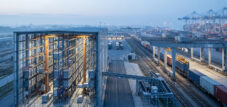
This innovative technology promises to fundamentally change container logistics. Instead of stacking containers horizontally as before, they will be stored vertically in multi-story steel racking structures. This not only allows for a drastic increase in storage capacity within the same area, but also revolutionizes all processes at the container terminal.
More information here: