The structural challenges of the super app: How WeChat is shaping China's market architecture – Image: Xpert.Digital
Hindrance to creativity or engine of innovation? A nuanced assessment
High-tech champions vs. traditional SMEs: The unrecognized two-tier society in China
The digital paradox: World-class AI, but small companies without their own website
China is considered a global technological powerhouse: platforms like WeChat, Alipay, and TikTok dominate the global discourse, while the country invests massively in artificial intelligence, 5G, and smart factories. But anyone who looks behind the glittering, high-gloss facade of the Chinese digital economy will discover a structurally divided system. On the one hand, there are highly cultivated, subsidized tech giants that set global standards. On the other hand, millions of small and medium-sized enterprises struggle, often lagging surprisingly far behind in the digital landscape.
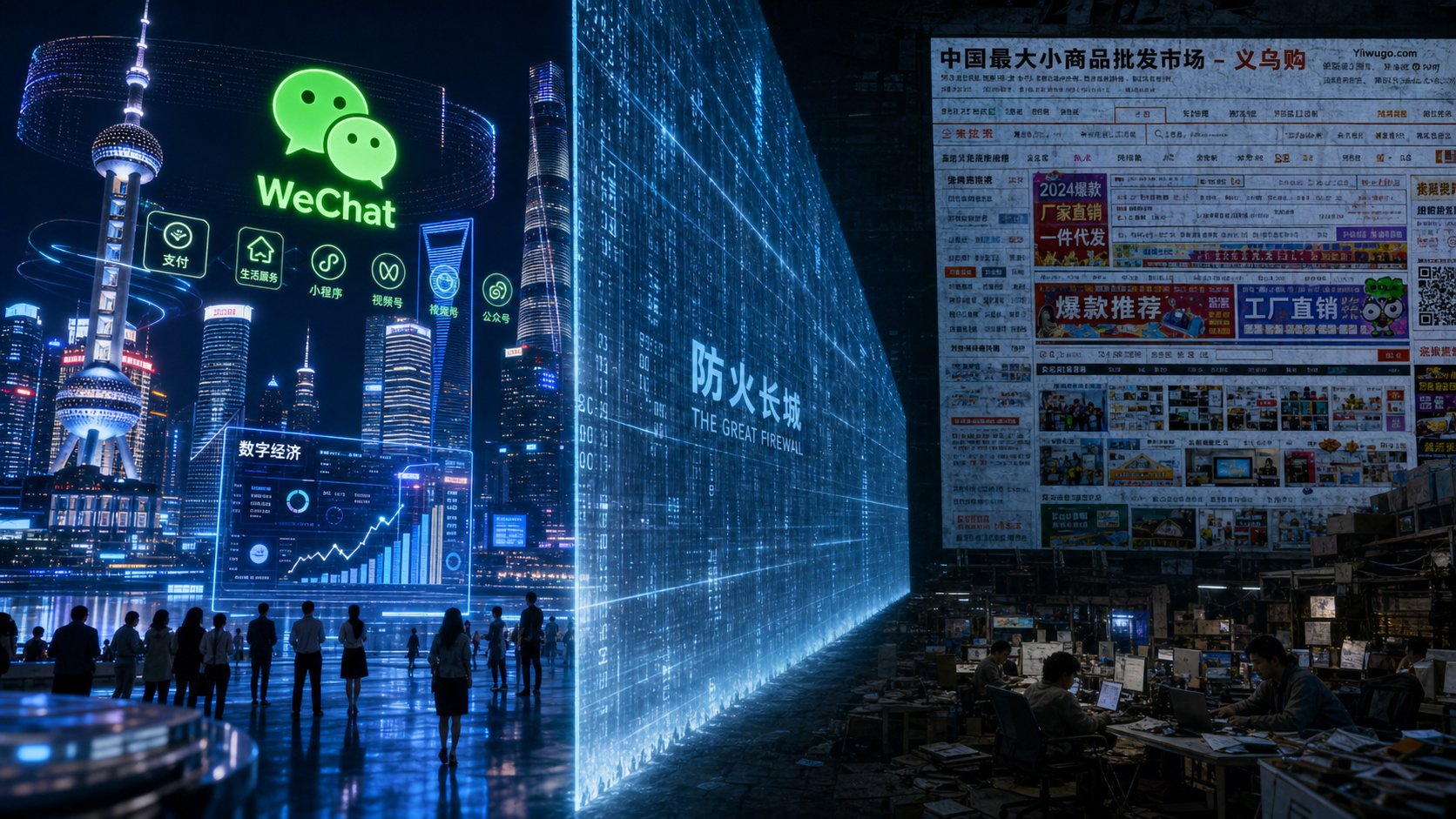
The root cause of this digital two-tier society lies, paradoxically, in the very systems that shaped China's rise. The omnipresence of "super apps" like WeChat, which function simultaneously as indispensable infrastructure, a gigantic marketplace, and a sophisticated instance of information control, ties up resources and channels independent innovation into predetermined paths. Small businesses are forced into a closed ecosystem that, while offering them digital reach in the short term, ultimately leads to structural platform dependency and delays the development of their own digital capabilities. The following analysis illuminates why the much-lauded Chinese digital model is heavily driven by platform power—and why the technological lag of many companies is the result of a system that consistently prioritizes standardization and compliance over radical openness.
Related to this:


Behind the glittering facade: How a single messenger app binds billions – and why China's digital reality is more complex than it appears
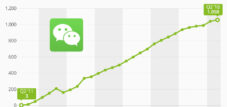
To an outsider looking at China's digital economy, the initial impression is impressive: WeChat with more than 1.4 billion monthly active users, Tencent with projected annual revenue of 751.8 billion yuan in 2025, and an ecosystem of over six million mini-programs that permeates virtually every aspect of daily life. But behind this glossy digital surface lies a structurally divided system—a digital dualism that leaves large corporations and small businesses operating in fundamentally different realities. This analysis examines the extent to which WeChat, as a platform and compliance tool, shapes digital creativity and critically examines the assumption that small Chinese companies are inherently digitally backward.
WeChat as a comprehensive control engine
WeChat is not just a communication application – it is also one of the most sophisticated and far-reaching management systems ever integrated into a consumer application. Researchers at the Citizen Lab at the University of Toronto have documented that WeChat scans messages from users with Chinese phone numbers for specific keywords and moderates them according to local content guidelines.
The extraterritorial dimension of this content control is remarkable. The moderation measures don't stop at national borders, but often also apply to users with accounts originally registered in China who are located abroad. For the approximately 50 million Chinese living abroad, this means a high degree of continuity in information curation. Furthermore, the app's built-in browser blocks certain unauthorized websites for users with Chinese accounts, while international users have different access restrictions. This selective information control effectively creates different digital realities within a single application.
The path from messenger app to total platform control
WeChat began in 2011 as a simple instant messaging service and within a few years evolved into what analysts call a "super app"—an application that covers virtually every aspect of daily life. Today, the average Chinese user can use WeChat to send messages, buy train tickets, book doctor's appointments, pay taxes, make purchases, play games, apply for loans, and maintain social networks—all without ever leaving the app. It is estimated that over one million different services are directly accessible within WeChat.
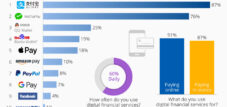
This total platform integration has a systemic consequence: WeChat not only manages what is communicated, but also how millions of businesses reach their customers and process transactions. The WeChat Pay system, together with Alipay, handles around 90 percent of all mobile payments in China. Any company operating in China can practically not avoid WeChat – it's not a sales channel chosen by choice, but rather a de facto infrastructure. This position as an indispensable digital operating system gives Tencent economic power that goes far beyond traditional market power: it is power over access itself.
Citizen Lab described WeChat's extraterritorial information control as "quite unique" and spoke of a remarkable precedent. No other platform worldwide operates such a systematically nested connection between everyday infrastructure and regulatory compliance on a global scale.
Hindrance to creativity or engine of innovation? A nuanced assessment
The question of how WeChat influences digital creativity cannot be answered in a one-dimensional way. On the one hand, the mini-program ecosystem is a genuine catalyst for certain forms of innovation: at the end of 2024, over six million mini-programs existed on the platform, covering sectors from retail and education to tourism. Usage by international users exceeded five billion visits in 2025, and the transaction value via mini-programs increased by over 70 percent in the second half of the year compared to the previous year. The WeChat Mini Shop saw a tripling of daily active sellers in 2024, and the gross merchandise value increased by 200 percent.
An analysis by a researcher at IMD Lausanne describes WeChat's data policy as an exciting engine of creativity: By granting developers generous access to user behavior, the platform fostered a vibrant ecosystem of third-party innovations. Developers could quickly test, iterate, and scale—all within the WeChat framework. On the other hand, this very framework also contains a structural peculiarity: While creativity flourishes, it is heavily focused on the parameters set by Tencent and national regulations. Those who develop applications that do not comply with regulations or directly compete with the core system face limitations or are excluded altogether.
Creativity in the WeChat universe thus follows the model of a walled garden: within the defined parameters, much is possible; outside, less so. In the Western internet, innovations often arise from disrupting existing systems. WeChat represents a different form of innovation: a regulated, platform-based adaptability that thrives within defined structures.
The national digital network architecture as an economic structure
China's policy of digital sovereignty and network regulation is not merely an informational phenomenon, but primarily an economic one. The Chinese government took care to partially exclude foreign competitors from the domestic market in favor of independent national development. The result of this strategic market shaping was a protected environment in which domestic tech companies could thrive. Baidu, Alibaba, and Tencent – collectively known as BAT – are widely considered to have directly benefited from this industrial policy decision.
The Chinese internet is technically connected to the global network via clearly defined nodes. This enables not only information management but also economic control. The result of this architecture is a digital economic model that is unique worldwide: Massive private companies operate in a strong domestic market of over one billion internet users – while simultaneously pursuing global expansion.
This architecture has had a twofold consequence for the Chinese digital economy: On the one hand, genuine global champions with world-class technical capabilities emerged under reliable framework conditions. On the other hand, these champions were hardly challenged by international providers in their domestic market. In Germany, for example, WeChat is not widespread and cannot compete with WhatsApp, which is used by 76 percent of respondents, in terms of market penetration.
The monopoly problem: BAT as a challenge within its own system
The BAT triumvirate – Baidu, Alibaba, and Tencent – controlled an estimated 70 percent of China's advertising revenue and roughly half of its venture capital investments in 2019. The payment duopoly of Alipay and WeChat Pay alone holds approximately 90 percent of the mobile payments market. BATX companies – including Xiaomi – leverage network effects extensively, acquire strategically important technologies, and define the parameters of market access.
The Chinese government reacted to this concentration of power no later than the early 2020s. The halted IPO of Ant Financial in November 2020 was the most spectacular signal of a market-regulating countermovement. Since then, the relevant authorities have adopted anti-monopoly guidelines for platform economies, redefined exclusive merchant partnerships, and reformed licensing rights. These regulatory measures have had a direct impact on the growth of these corporations.
This regulatory realignment represents an attempt to promote fair competition. It also reveals strategic priorities: Beijing's preference for high-tech industrial sectors – semiconductors, AI, robotics – over purely consumer-oriented services.
The glossy illusion: Are small Chinese companies really digitally backward?
The picture that emerges from a Western perspective is often distorted: We see the globally shining champions – TikTok, WeChat, Alibaba, Huawei – and conclude from this that the Chinese digital economy is of a uniform standard. In reality, however, a careful analysis reveals a structural divide. The Chinese State Council itself emphasized in 2024 the importance of supporting the digital transformation of small and medium-sized enterprises (SMEs). According to the "China SME Digital Transformation Report 2024," 60 percent of SMEs are still in an early stage of digital transformation.
What these figures actually mean becomes clear in the digital landscape: While large corporations operate internationally competitive platforms, the websites of many small companies appear unfamiliar to Western users. This is partly due to cultural reasons: Asian web design traditions historically favor information-dense presentations where all relevant information is displayed simultaneously.
What appears cluttered to a Western user is often a culturally informed design decision. The Chinese job portal 51job.com, for example, serves its domestic audience very effectively. Nevertheless, it must be stated that there is a significant need for technical improvements among small businesses that goes beyond mere design considerations.
Our China expertise in business development, sales and marketing


Our China expertise in business development, sales and marketing - Image: Xpert.Digital
Industry focus areas: B2B, digitalization (from AI to XR), mechanical engineering, logistics, renewable energies and industry
More information here:
A thematic hub offering insights and expertise:
- Knowledge platform covering global and regional economies, innovation and industry-specific trends
- A collection of analyses, insights, and background information from our key areas of focus
- A place for expertise and information on current developments in business and technology
- A hub for companies seeking information on markets, digitalization, and industry innovations
How WeChat is shaping small businesses — the effects of the super app
Digital divide: Concentration effects through the WeChat ecosystem
A key mechanism shapes this digital landscape: The WeChat ecosystem reduces the absolute necessity for small businesses to build their own digital infrastructure. If an SME can handle all its customer interactions via WeChat, the incentive to have its own website often disappears. The result is a system in which the WeChat ecosystem functions as a complete solution.
This dynamic has a significant downside: it makes small businesses structurally dependent on the platform's terms and conditions. If commissions are adjusted or algorithms are changed, small businesses without their own digital infrastructure have few options. Regulatory authorities in China have recognized these challenges for the market.
In contrast, large Chinese companies have built up enormous in-house capacities: By the end of 2023, China had 421 demonstration factories for smart manufacturing. Large Chinese companies exhibit an impressive integration of digital twins, supply chain transparency, and AI. Digital China is highly advanced – but noticeably concentrated in the upper echelons of the corporate hierarchy.
Related to this:


WeChat versus Western internet structures: What the comparison shows
The Western internet is structurally different and allows for a different form of technological diversity and cross-border data exchange. For a long time, China appeared to be primarily adapting – but that's an oversimplification.
In an analysis, the German Council on Foreign Relations (DGAP) highlights five structural strengths of the Chinese model: government coordination, market size, data abundance, promotion of research and development (R&D), and a pragmatic industrial policy. In the field of artificial intelligence (AI), China filed 30,000 patents in a single year. China is also a leading player in 5G development.
These figures demonstrate that China's system produces excellence in strategically prioritized sectors. It involves a focused, state-coordinated allocation of resources. Where support and strategic goals align, world-class products emerge.
The balance between promotion and regulation
The Chinese economy is currently demonstrating a striking balance between strategic governance and the need for digital innovation. On the one hand, Beijing is investing heavily in digital infrastructure and industrial digitalization. The AI program "AI Plus" explicitly calls for the integration of digital technologies. On the other hand, the government has created a regulatory framework for its most successful digital champions through antitrust law and data protection regulations.
This strategic adjustment has had economic effects and changed the investment climate for certain sectors. While Tencent recovered – profits rose by 22 percent in the first quarter of 2025 – the market environment for new, purely consumer-oriented platforms has become more challenging.
Global impact: What WeChat's model means for the world
WeChat's platform model and China's digital strategy have international relevance. WeChat Mini programs are now active in numerous countries, and WeChat Pay is expanding globally. At the same time, Beijing is actively contributing its standards to international technology partnerships.
This presents a strategic challenge for Western companies: those interacting with the Chinese market integrate into a system characterized by specific local content and compliance guidelines. For B2B corporations, this necessitates careful alignment with European standards (such as the GDPR).
The failure of many Western super-app ambitions also illustrates that WeChat's dominance is largely systemic and has been facilitated by national network regulation.
The lagging behind small businesses: A sober assessment
The assertion that small Chinese companies are less digitally independent than large corporations in some areas is essentially true, but requires a more nuanced perspective. Firstly, this lag is not specific to China: worldwide, small businesses are lagging behind large corporations in digitalization. Secondly, cultural differences in digital presentation are perfectly legitimate.
Thirdly, this development is structurally influenced by the WeChat system: because the app provides all essential functions from a single source, the economic pressure to create independent digital infrastructures decreases. Dependence on the WeChat ecosystem is economically rational in an environment that bundles all services. The fact that many companies still have a relatively low level of in-house digitalization is the result of a platform architecture that prioritizes convenience over technological autonomy.
Long-term economic perspective: The future of the system
China's digital economy is developing rapidly. An ING economist predicts that the digitalization of industry could strongly drive digital economic growth. Tencent itself is investing heavily in AI and positioning itself for the next growth cycle. DeepSeek's breakthrough in early 2025 has sparked a new wave of development.
However, the question remains how the model of strict information regulation will affect interdisciplinary and open research networks in the long term, and whether the gap between funded excellence clusters and the vast majority of SMEs can be closed.
Bruegel economists also point out that the large regional differences within China (Beijing, Guangdong, and Shanghai far ahead of the rest) must be taken into account. The glossy image of the Chinese digital economy is often a phenomenon limited to a few megacities.
A targeted market architecture
China's digital economy is the result of a deliberate strategic architecture—one optimized for scaling, standardization, and societal control. WeChat is the most striking example of this system: an app that deserves technological admiration, but from a regulatory perspective promotes platform concentration and functions as an instrument of information manipulation. The observation that small Chinese companies lag behind Western expectations in terms of autonomy requires explanation and is closely linked to this platform dominance.
What remains is the observation of a highly dynamic model that fosters technological excellence in strategically promoted areas, while simultaneously channeling other, more open forms of innovation culture into regulated paths through strict regulations and platform dependency. This balance between control and digital development will continue to be the dominant theme of the Chinese digital economy.
Your global marketing and business development partner
☑️ Our business language is English or German
☑️ NEW: Correspondence in your native language!

Konrad Wolfenstein
I and my team are happy to be available to you as your personal advisor.
You can contact me by filling out the contact form here wolfenstein@xpert.digital:or simply call me at +49 7348 4088 965. My email address is
I'm looking forward to our joint project.
☑️ SME support in strategy, consulting, planning and implementation
☑️ Creation or realignment of the digital strategy and digitization
☑️ Expansion and optimization of international sales processes
☑️ Global & Digital B2B trading platforms
☑️ Pioneer Business Development / Marketing / PR / Trade Fairs
🎯🎯🎯 Data-driven B2B industry hub as a quasi-in-house solution


The quasi-in-house solution: How Xpert.Digital closes operational gaps in B2B marketing and sales – Smart Content-Driven Business - Image: Xpert.Digital
Xpert.Digital is a data-driven B2B industry hub led by Konrad Wolfenstein . The company acts as an external, quasi-in-house solution for industrial partners, closing operational gaps in marketing, content, and sales – without requiring additional resources on the client side.
More information here: